Constrained Patterns, Part 2: Neighborhood Analysis
Sample pages
Page 1, at reduced quality. Open the document to read every page in full.
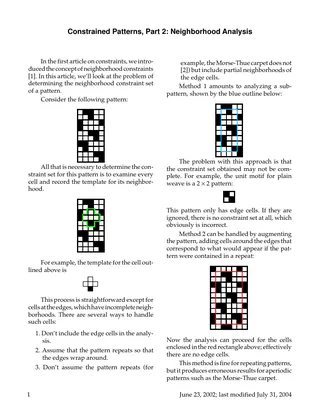
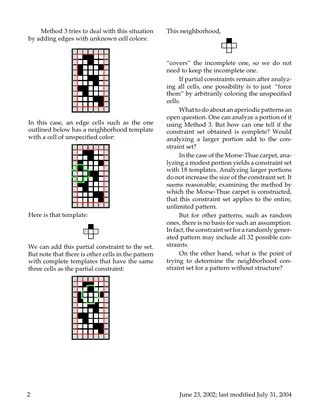
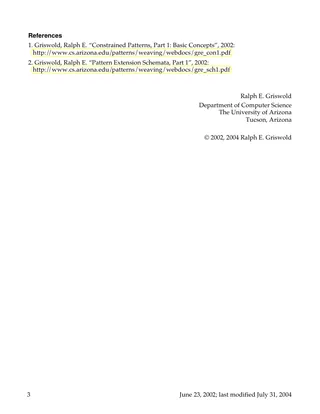
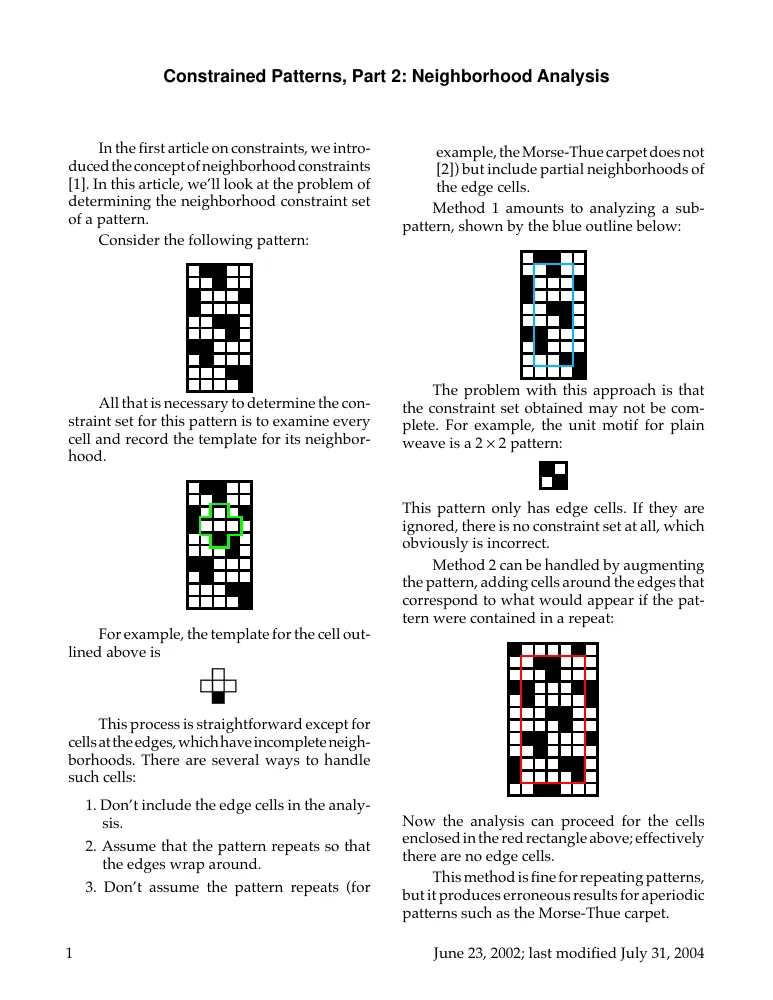
A short web article by Ralph Griswold on how to determine the neighborhood constraint set of a black-and-white cell pattern by examining each cell's neighborhood template. It compares three ways of handling edge cells with incomplete neighborhoods: ignoring them, wrapping the pattern as a repeat, and keeping partial neighborhoods. It discusses the Morse-Thue carpet, an aperiodic pattern whose constraint set has 18 templates, and random patterns, which may use all 32 possible constraints. It is illustrated with grid diagrams and neighborhood templates.
- Type
- Web Doc
- Date
- June 23, 2002
- Language
- English
- Pages
- 3
- Archive notes
- Last revised July 31, 2004
(A free account is all you need)
From Ralph Griswold's Digital Archive, delivered by the University of Arizona.
Have missing pages or a better copy of this document, or another document to share? Contributing documents »