Textile Documents › Topic: Mathematics and weaving
136 documents found
Sort: 
Recurrence Relations
Ralph E. Griswold · March 22, 2000
Web Doc · 2 pages
A short mathematical note by Ralph Griswold defining recurrence relations, especially linear recurrence relations with constant coefficients (LRRCs), and giving their canonical form. It explains how to convert a recurrence with a constant term to canonical form, and how to find an LRRC for a sequence with the difference method. It also derives explicit polynomial formulas for terms. It is background for Griswold's work on residue sequences in weave design.
The Morse-Thue Sequence
Ralph E. Griswold · 2001
Web Doc · 3 pages · weaving drafts
A short article by Ralph Griswold introducing the Morse-Thue (Thue-Morse) binary sequence and its history. It describes three ways to construct it (substitution map, append-complement, and binary digit reduction), its self-similarity and cube-free property, and generalization to other bases. It shows geometric interpretations in one, two and three dimensions and gives a two-shaft, two-treadle weaving draft derived from the sixth iteration of the Morse-Thue plane. References are included.
Nemal, Nemal
Ralph E. Griswold · August 28, 2004
Web Doc · 2 pages
A short essay by Ralph Griswold on the concept of isonemal fabrics introduced by Grünbaum and Shephard in their 1980 paper on the geometry of fabrics. He argues that isonemality is mathematically interesting but has little practical relevance for weaving, since many common weaves are not isonemal and the property says nothing about soundness, float length or appeal. The second page shows pixel-grid diagrams of isonemal and non-isonemal fabric examples drawn from the Grünbaum and Shephard paper.
On the Numbers of Patterns Which Can Be Derived from Certain Elements
Article · 6 pages
A mathematical article by J. E. A. Steggall counting the distinct repeating patterns that can be built from n×n squares with n shaded cells, one per row and column (permutation elements). It derives formulas that account for cyclic shifts and constant additions, works special cases (n prime, n = ab, n = a^a, n = 2^r), and ends with a table of counts for n from 1 to 12. The treatment is purely combinatorial, with no weaving drafts or textile terms, though the shaded-square patterns resemble twill-like and satin-like arrangements.
Pantactic Designs: Part 1, 5x5 Pantactic Squares
Ralph E. Griswold · March 27, 2006
Web Doc · 2 pages
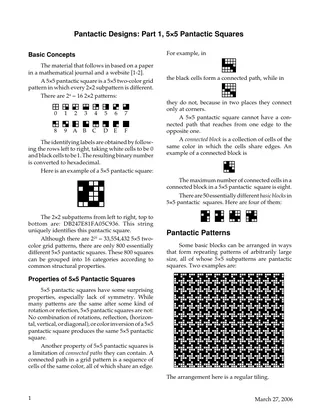
A short web document by Ralph Griswold introducing 5x5 pantactic squares, two-color grid patterns in which every 2x2 subpattern is different. It explains the hexadecimal labeling of the sixteen 2x2 subpatterns, the 800 essentially different squares, and their lack of symmetry. It also covers limits on connected paths and blocks, and how basic blocks can tile into larger repeating patterns, with two tiling examples. It closes with open questions about larger, non-square, and multi-color pantactic designs.
Befriending Sequences
Ralph E. Griswold · September 13, 2001
Web Doc · 6 pages · weaving drafts
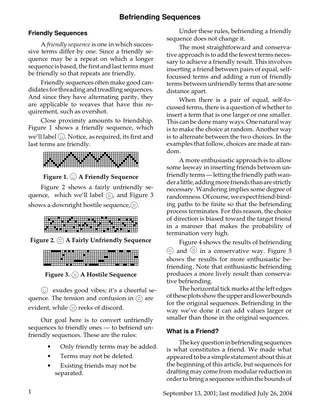
A short article by Ralph Griswold on 'befriending' sequences for weave drafting: converting sequences whose successive terms do not differ by one into 'friendly' sequences usable as threading and treadling orders. It describes conservative and enthusiastic (randomized) befriending, modular reduction and expansion on a shaft wheel, and applies the methods to the Fibonacci sequence modulo 8. An appendix presents 240-end by 240-pick drawdowns on eight shafts using direct and twill tie-ups, derived from Fibonacci and prime sequences.
Constrained Patterns, Part 2: Neighborhood Analysis
Ralph E. Griswold · June 23, 2002
Web Doc · 3 pages
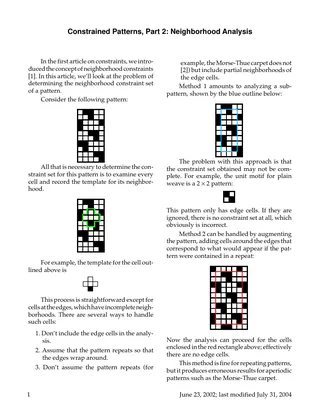
A short web article by Ralph Griswold on how to determine the neighborhood constraint set of a black-and-white cell pattern by examining each cell's neighborhood template. It compares three ways of handling edge cells with incomplete neighborhoods: ignoring them, wrapping the pattern as a repeat, and keeping partial neighborhoods. It discusses the Morse-Thue carpet, an aperiodic pattern whose constraint set has 18 templates, and random patterns, which may use all 32 possible constraints. It is illustrated with grid diagrams and neighborhood templates.
Constrained Patterns, Part 3: Representing Constraint Sets
Ralph E. Griswold · July 4, 2002
Web Doc · 2 pages
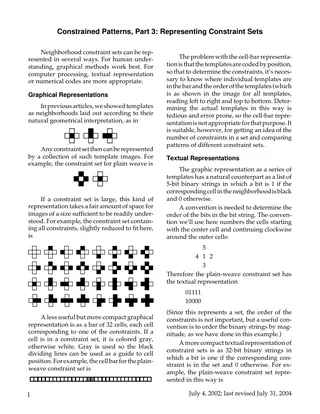
A short web article by Ralph Griswold on ways to represent sets of neighborhood constraints used to define patterns. It covers graphical forms (template images and a 32-cell bar), textual forms (5-bit binary strings and 32-bit strings), and numerical base-10 codes. Plain weave serves as the running example, with constraint codes 15 and 16 and a 32-bit code of 98305. It is the third part of a series on constrained patterns.
Continued Fractions in Weave Design - I
Ralph E. Griswold · July 12, 2000
Web Doc · 5 pages
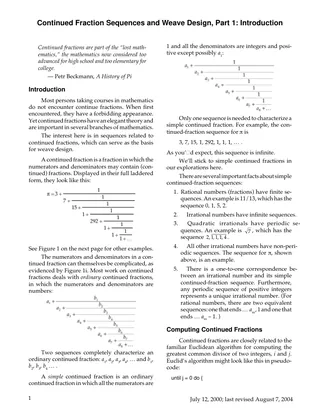
An introductory paper by Ralph Griswold on continued fractions as a source of number sequences for weave design. It explains ordinary and simple continued fractions, the sequences for rational, quadratic irrational and other irrational numbers, and how to compute them with Euclid's algorithm. It also covers periodic patterns such as those for tan(1) and e-1. A gallery of continued fraction expansions and three generated tabby and twill weave patterns (from the square roots of 10089 and 9949) hint at later applications. It ends with references and a note that quadratic irrationals will be the topic of the next article.
Designing Weave Structures Using Boolean Operations, Part 2
Ralph E. Griswold · November 29, 2001
Web Doc · 3 pages
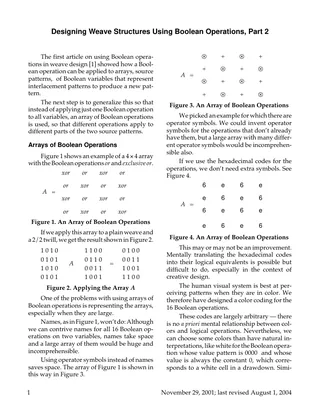
The second article in Ralph Griswold's series on Boolean operations in weave design extends the method from one operation applied to two source patterns to an array of different operations applied cell by cell. It compares ways of representing operation arrays (names, operator symbols, hexadecimal codes, and a 16-operation color code) and shows examples built from plain weave and 2/2 twill. It also covers 'deficient' operations (0, 1, x, y), which force white, black, or one source pattern's cells into the result, and closes by announcing computer programs for the next article.
Designing with L-Systems, Part 2: A Side Trip to Graphics
Ralph E. Griswold · June 20, 2002
Web Doc · 2 pages
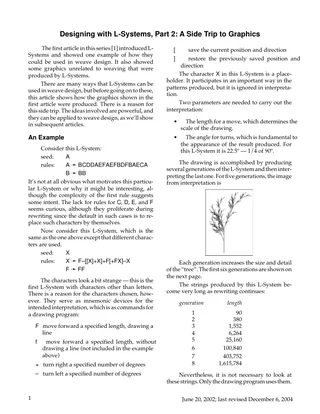
Second article in Ralph Griswold's series on L-Systems in weave design. It is a deliberate detour into graphics: it shows how string-rewriting rules, with characters read as drawing commands (forward, turn, save and restore position), produce branching tree images. It gives an example L-System with a 22.5-degree turn angle, a table of string lengths across eight generations, and a pointer to freeware such as Lparser. It says later articles will apply these ideas to weave design.
Designing with L-Systems, Part 4: Articulated L-Systems
Ralph E. Griswold · April 3, 2004
Web Doc · 2 pages
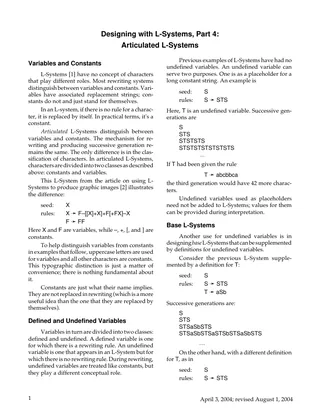
Part 4 of Ralph Griswold's series on designing with L-Systems, introducing articulated L-Systems that distinguish variables from constants. It explains defined versus undefined variables, shows undefined variables used as placeholders, and presents base L-Systems that can be supplemented with different definitions for the undefined variables. Worked examples show successive generations of string rewriting, such as S → STS with alternative rules for T.
Designing with L-Systems, Part 5: Termination
Ralph E. Griswold · April 10, 2004
Web Doc · 2 pages
Part 5 of Ralph Griswold's series on designing with L-Systems, covering termination. It distinguishes nonterminating L-Systems, which generate longer strings endlessly, from terminating ones, where generation ends in a string with no remaining variables. Short worked examples with numeric strings show how terminating L-Systems and added rules can serve as design tools, and how adding a variable rule makes a system nonterminating again.
Drafting with Sequences
Ralph E. Griswold · July 8, 1999
Web Doc · 5 pages · weaving drafts
A short tutorial by Ralph Griswold on using integer sequences to generate threading and treadling sequences for weaving drafts. It explains modular ("shaft") arithmetic, wrapping sequences such as the Fibonacci numbers, squares, cubes, and a "multi" sequence around a given number of shafts, and shows drawdowns for 4 and 8 shafts. It also covers finding integer sequences online, converting them to shaft sequences by taking remainders, and handling zero and negative numbers for downward straight draws.
Drawdown Automata, Part 2: Neighborhoods and State-Transition Rules
Ralph E. Griswold · February 13, 2002
Web Doc · 7 pages
Second article in Ralph Griswold's series on drawdown automata, using cellular automata to generate weaving drawdown patterns. It explains neighborhoods (von Neumann, Moore, and many other shapes, with radius and symmetry) and state-transition rules: general rules, totalistic and outer-totalistic rules, Life-type rules, and alternative ways to express rules such as integer codes and pseudo-code. Worked examples use the parity rule and Conway's Game of Life, and the figures are grid diagrams of neighborhoods.
Grid Overlay Patterns, Part 1: Introduction
Ralph E. Griswold · December 15, 2002
Web Doc · 2 pages
An introductory web document by Ralph Griswold on building patterns by overlaying grids of cells with increasing separation, following a scheme in Stephen Wolfram's A New Kind of Science. It shows the basic scheme (black cells separated by growing numbers of white rows and columns, combined with logical or), then generalizations: different motifs, prime-number separations, exclusive or, and repeating motif sequences. It notes that the resulting patterns have floats and are only partly usable as drawdowns, and it promises a follow-up article.
Hadamard Matrices and Weaving
Allan Wentink · 2004
Web Doc · 4 pages · weaving drafts
A short web document by Allan Wentink explaining Hadamard matrices (square matrices of +1 and -1 entries) and how they can be used as weaving tie-ups. It covers definitions, properties, equivalence operations, and a table of the number of distinct matrices by order. It shows normalized matrices of order 1 to 16 as black-and-white grids, demonstrates turning H4 into a warp-surface twill tie-up, and ends with an H16 tie-up and drawdown.
L-System Design, Part 1: Introduction
Ralph E. Griswold · July 12, 2005
Web Doc · 3 pages
The first article in a series by Ralph Griswold on designing original L-Systems for weaving and pattern generation. It explains the fractal nature of L-Systems, the role of the seed, the irrelevance of the specific alphabet beyond its size, and how generation length grows. It also covers how symbols relate to one another, what formal grammars can express, and the role of interpretation, illustrated with small rule sets and the strings they generate.
L-System Design, Part 5: "Stalks" and "Foliage"
Ralph E. Griswold · July 12, 2005
Web Doc · 2 pages
Part 5 of Ralph Griswold's series on designing L-Systems for pattern generation introduces delay chains, sets of rules that postpone the appearance of symbols and their generated strings. Using an example with a Fibonacci string L-System, it describes the chains as 'stalks' running down through the generations, with the rest of each generation as 'foliage'. It shows how modifying rules produces two stalks or several kinds of stalk, and includes diagrams of other possible stalk layouts. References list Parts 1-4 of the series.
Line Transformations, Part 1: Operations and Operation Sequences
Ralph E. Griswold · October 17, 2004
Web Doc · 3 pages
A short web article by Ralph Griswold introducing a notation for transforming the lines (rows and columns) of a pattern. It defines basic operations (no operation, complementation, reversal, shifts), operation sequences, combined operations in braces, permutations, defined operations, shift modes, state saving and restoring, and repeat controls, and ends with a summary table of the symbols. It is Part 1 of a series; examples are promised in the next article.
Line-Based Patterns, Part 1: Basic Concepts
Ralph E. Griswold · September 2004
Web Doc · 3 pages
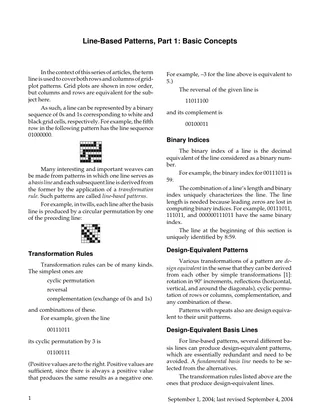
A short web document by Ralph Griswold introducing line-based patterns, in which one basis line is transformed row by row (by cyclic permutation, reversal, complementation) to generate grid-plot patterns. It explains binary sequences and binary indices for identifying a line (e.g. 8:59), design-equivalent patterns, and how to find a fundamental basis line with a worked example (8:19). It includes a table of the number of fundamental basis lines for lengths 2 to 16 and notes that soundness of the resulting interlacements must be treated separately.
Normalized T-Sequences
Ralph E. Griswold · December 24, 2003
Web Doc · 3 pages · weaving drafts
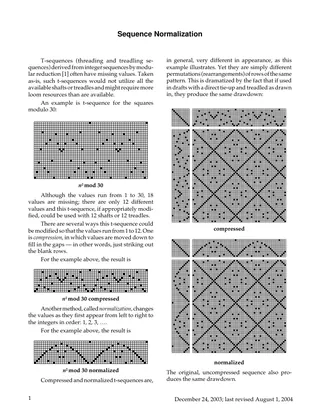
A short web document by Ralph Griswold explaining how to fix integer-sequence-derived t-sequences (threading and treadling sequences) that have missing values and would need more shafts or treadles than are used. It compares compression (closing gaps) with normalization (renumbering values in order of first appearance), using n² mod 30 as the example. Drafts and drawdowns show that both methods give the same result with a direct tie-up but differ with a 2/2 twill tie-up. It concludes that normalization generally looks more coherent and is useful for comparing sequences.
Number Drafting: Part 1 -- Introduction
Ralph E. Griswold · February 14, 2004
Web Doc · 2 pages · weaving drafts
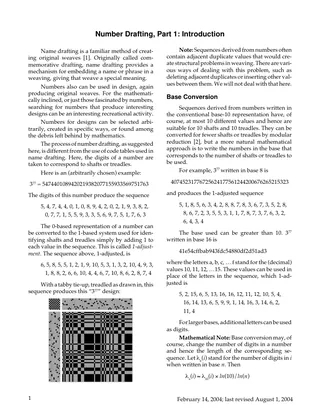
Introductory article by Ralph Griswold on number drafting, a method of generating weaving designs from the digits of numbers, in contrast to the code tables used in name drafting. It explains how digits map to shafts or treadles, how 1-adjustment works, and how base conversion (for example base 8 or 16) adapts a number to the available shafts. A worked example, the number 3^77, is shown as a draft with a tabby tie-up. It closes with resources for base conversion and previews later parts on fractions and irrational numbers.
Number Drafting: Part 2 -- Foraging for (Modestly) Large Numbers
Ralph E. Griswold · March 17, 2004
Web Doc · 3 pages
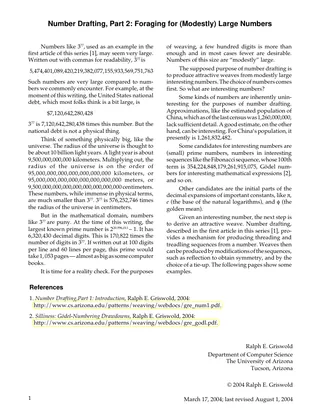
Second article in Ralph Griswold's Number Drafting series, on choosing interesting, modestly large numbers as sources for weaving designs. It compares 377 with the US national debt, the radius of the universe and the largest known prime, and says a few hundred digits are enough for weaving. Candidates include primes, Fibonacci terms, Gödel numbers, China's population and the digits of π, e and φ. The last two pages show bit-pattern drawdown images made from some of these numbers.
Number Drafting: Part 3 -- A Trip to a Strange Place
Ralph E. Griswold · March 20, 2004
Web Doc · 3 pages
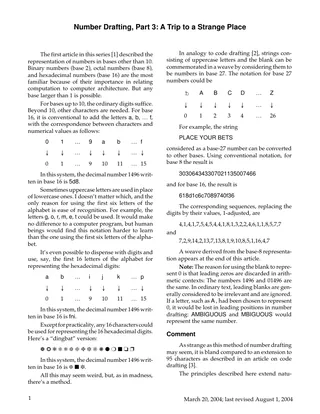
Part 3 of Ralph Griswold's series on number drafting, which generates weave patterns from numbers. It explains number bases beyond 10, with alternative symbol sets for base 16 (letters and dingbats), and proposes treating strings of capital letters and the blank as base-27 numbers. The example phrase 'PLACE YOUR BETS' is converted to base 8 and base 16, and the base-8 digits are used to derive a pattern shown on the last page. It ends with references to related articles on number drafting and code drafting.
Operations on Patterns, Part 1: Basic Notions
Ralph E. Griswold · April 23, 2002
Web Doc · 2 pages
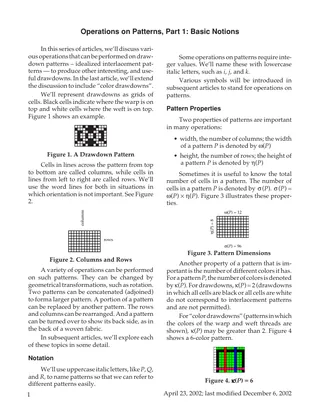
The first article in a series by Ralph Griswold on mathematical operations applied to drawdown patterns, defined as idealized interlacement grids of black and white cells. It sets out the basic terminology (rows, columns, lines) and notation (uppercase letters for patterns, lowercase for integers). It defines pattern properties: width, height, number of cells and number of colors. It previews later topics such as rotation, concatenation, replacement, rearranging rows and columns, and showing the back of a fabric, with color drawdowns discussed in the final article.
Operations on Patterns, Part 2: Geometrical Transformations
Ralph E. Griswold · May 7, 2002
Web Doc · 2 pages
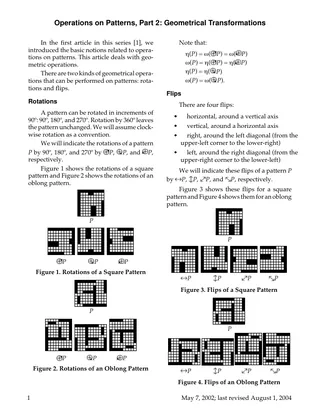
A short mathematical article by Ralph Griswold, the second in a series on operations on patterns, covering geometrical transformations of grid-based patterns. It defines rotations in 90-degree increments (clockwise convention) and four flips (horizontal, vertical, right diagonal, left diagonal), illustrated with square and oblong pixel patterns. It also gives identities relating the operations and how they affect pattern height and width, shows how compound operations derive from a few basic ones, and ends with a summary table of symbols.
Operations on Patterns, Part 3: Concatenation
Ralph E. Griswold · December 8, 2002
Web Doc · 2 pages
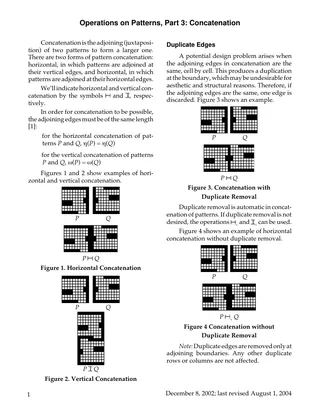
A short technical note by Ralph Griswold, part 3 of a series on operations on patterns, defining concatenation as joining two patterns edge to edge to form a larger one. It covers horizontal and vertical concatenation, the requirement that adjoining edges have equal length, and automatic removal of duplicate edges at the join. It also describes variants without duplicate removal, with grid figures of cell patterns P and Q and the results, and a summary of the operation symbols.
Operations on Patterns, Part 4: Repetition
Ralph E. Griswold · December 8, 2002
Web Doc · 2 pages · weaving drafts
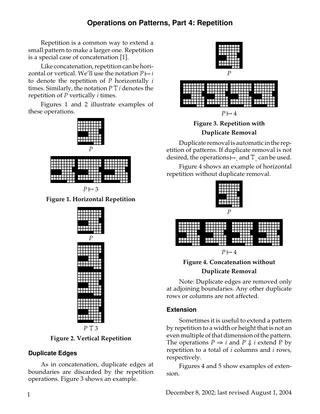
Part 4 of Griswold's series on operations on patterns, covering repetition of a small pattern horizontally or vertically to make a larger one. It defines the notation for repetition, automatic removal of duplicate edges at adjoining boundaries, and variants without duplicate removal. It also covers extension to a given number of columns or rows, including truncation, and ends with a summary table of the operations. Illustrated with black-and-white grid patterns.
Pattern Extension Schemata, Part 2
Ralph E. Griswold · November 28, 2001
Web Doc · 4 pages
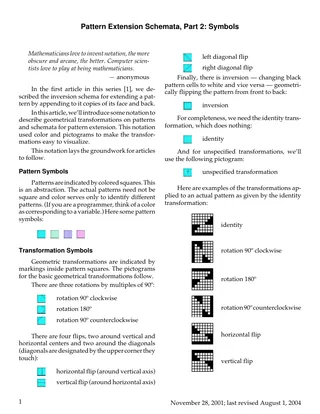
A short web article by Ralph Griswold that introduces a pictorial notation for describing geometric transformations of patterns and for pattern extension schemata. It defines symbols for rotations, flips, inversion, identity and unspecified transformations, along with horizontal and vertical concatenation. It then shows single-pattern schemata (1x2, 2x1, 2x2), schemata chains with exponents, multiple-pattern schemata, and notation for loading real patterns into abstract ones. It lays groundwork for later articles in the series.
Pattern Tours, Part 1: Basic Concepts
Ralph E. Griswold · August 7, 2002
Web Doc · 2 pages
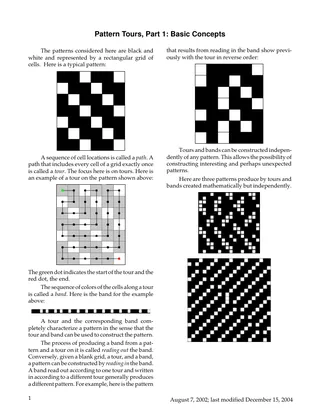
A short introductory web article by Ralph Griswold defining the basic terms for generating black-and-white grid patterns: path, tour, and band. It explains how a band is read out of a pattern along a tour and read into a blank grid, and how using a different tour produces a different pattern. It also shows a few patterns made from independently constructed mathematical tours and bands, and previews later parts of the series.
Pattern Tours, Part 2: Tour Basics
Ralph E. Griswold · December 5, 2002
Web Doc · 4 pages
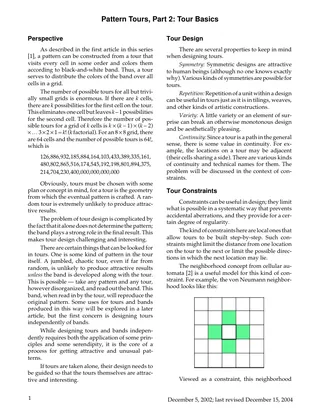
Second article in Ralph Griswold's Pattern Tours series, explaining the basics of designing tours: paths that visit every cell of a grid so that a black-and-white band can be distributed over the cells to form a pattern. It covers design properties (symmetry, repetition, variety, continuity) and neighborhood constraints (von Neumann, Moore, knight's move). It also classifies tours (algorithmic, neighborhood-constrained, numerically derived, miscellaneous) and defines re-entrant, piece-wise, incomplete tours and overtours, illustrated with grid diagrams.
T-Sequences, Part 2: Extension
Ralph E. Griswold · March 25, 2002
Web Doc · 3 pages · weaving drafts
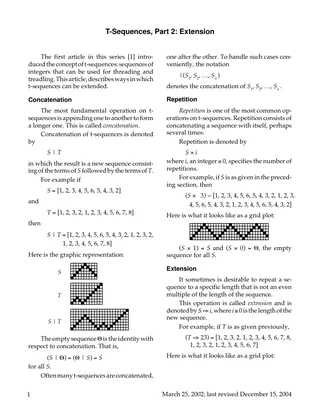
Second article in Ralph Griswold's series on t-sequences, integer sequences used to generate threading and treadling orders. It defines operations for lengthening sequences: concatenation, repetition, and extension to a specified length, with notation and worked examples shown as numeric lists and grid plots. It also discusses duplicate terms at concatenation boundaries, giving versions of each operation with and without duplicate removal, and ends with a summary table of the notation.
T-Sequences, Part 3: Runs
Ralph E. Griswold · March 25, 2002
Web Doc · 2 pages
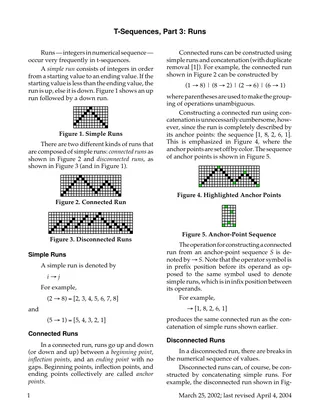
A short technical paper by Ralph Griswold on runs in t-sequences, which are integer sequences used to generate weaving and pattern designs. It defines simple runs, connected runs built from anchor points, and disconnected runs built from beginning and end point sequences, with notation for each (i → j, → S, S / T). Grid-plot figures illustrate each type, and a summary table closes the paper.
T-Sequences, Part 4: Symmetries
Ralph E. Griswold · March 29, 2002
Web Doc · 2 pages
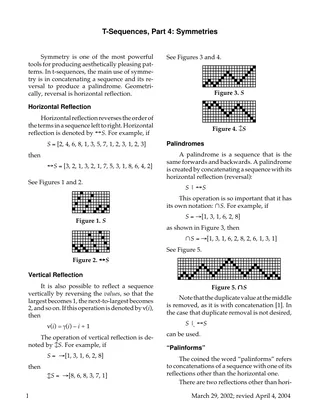
A short web document by Ralph Griswold on symmetry operations applied to t-sequences, which are numeric sequences used to generate patterns. It defines horizontal reflection (reversal), vertical reflection (value reversal), and palindrome formation by concatenating a sequence with its reversal. It also introduces "palinforms", concatenations with other reflections, and illustrates each with grid bitmaps and a summary of the notation.
T-Sequences, Part 5: Motifs Along Paths
Ralph E. Griswold · April 4, 2004
Web Doc · 2 pages
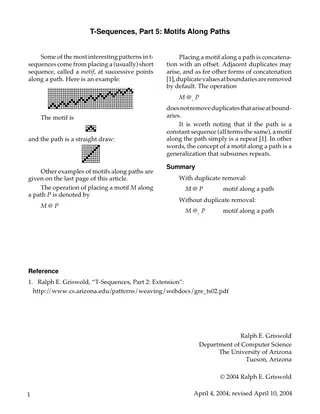
A short web document by Ralph Griswold, part 5 of his T-Sequences series, on placing a short motif sequence at successive points along a path to generate patterns. It defines the operations M @ P, which removes duplicate values at boundaries, and M @+ P, which keeps them. It notes that a constant path reduces the operation to a repeat. Grid illustrations show motifs along straight and zigzag or stepped paths.
T-Sequences, Part 6: Modular Operations
Ralph E. Griswold · April 4, 2004
Web Doc · 2 pages · weaving drafts
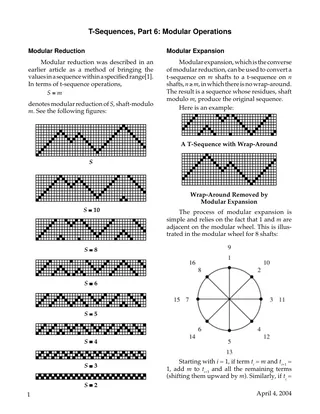
A short 2004 article by Ralph Griswold, part 6 of his T-Sequences series, on modular operations applied to t-sequences used in drafting. It explains modular reduction (shaft-modulo m) with figures showing a sequence reduced to 10, 8, 6, 5, 4, 3 and 2 shafts. It then describes modular expansion, the converse operation that removes wrap-around when converting a t-sequence on m shafts to n shafts, with a step-by-step procedure, an example and a summary of notation.
T-Sequences, Part 7: Collation
Ralph E. Griswold · April 17, 2004
Web Doc · 2 pages
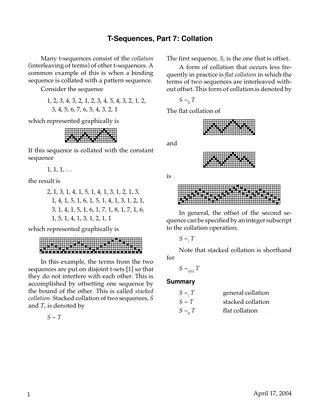
A short mathematical note by Ralph Griswold on collation (interleaving) of t-sequences, the integer sequences he used to design weaving patterns. It explains stacked collation, where the second sequence is offset by the bound of the first so their terms occupy disjoint t-sets, and flat collation, where terms are interleaved without offset. It gives an example collating a binding sequence with a constant sequence, shown as grid figures, and ends with a summary of the notation S ~i T, S ~ T and S ~0 T.
When a Fabric Hangs Together (Or Doesn't)
Ralph E. Griswold · July 14, 2004
Web Doc · 5 pages · weaving drafts
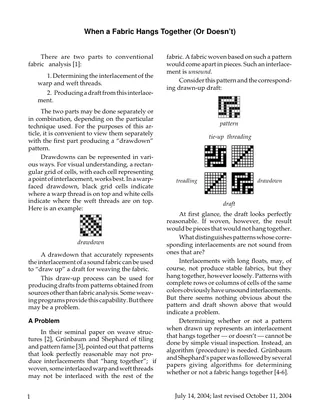
A short article by Ralph Griswold on how to tell whether a fabric produced from a drawdown pattern will hang together, or fall apart into separate pieces. It describes Clapham's mathematical method (ranking and rearranging rows and columns) and the Grünbaum and Shephard method of lifting off threads step by step, each worked on an 8x8 example. It also gives Clapham's theorem with a table of over/under thread counts, a note on constructing unsound interlacements, and a reference list.
Constrained Patterns, Part 1: Basic Concepts
Ralph E. Griswold · June 22, 2002
Web Doc · 2 pages
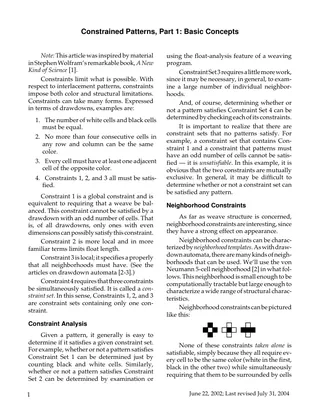
A short web article by Ralph Griswold introducing constraints on interlacement patterns (drawdowns), inspired by Stephen Wolfram's A New Kind of Science. It explains global and local constraints such as balanced cell counts and limited float length, and defines constraint sets and satisfiability. It then introduces neighborhood constraints using von Neumann 5-cell templates, noting that plain weave satisfies one template set, and outlines questions about analyzing patterns and constraint sets, to be continued in later articles.
Design Inspirations from Multivariate Polynomials, Part 2
Ralph E. Griswold · September 30, 2001
Web Doc · 10 pages · weaving drafts
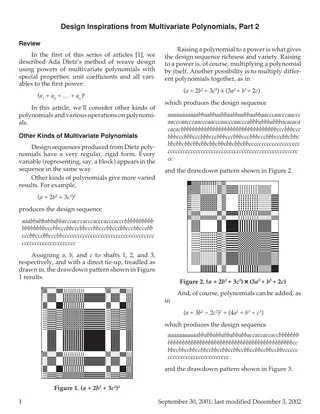
Second article in Ralph Griswold's series on generating weave design sequences from multivariate polynomials, extending Ada Dietz's method. It covers polynomials with non-unit coefficients and exponents, multiplication and addition of polynomials, negative and fractional coefficients, polynomial division, modular reduction, differentiation and integration. Each operation is illustrated with design sequences and black-and-white drawdowns. Appendices show modular reductions (mod 2 to 12), successive derivatives and successive integrals of (a+b+c)^4.
Design Sequences: Meandering Strings
Ralph E. Griswold · May 7, 2002
Web Doc · 3 pages · weaving drafts
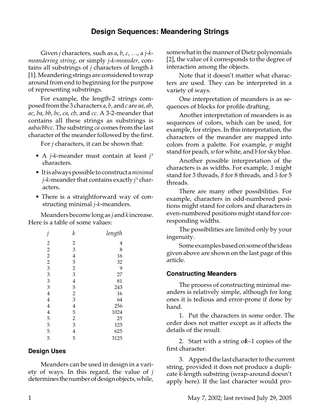
A short article by Ralph Griswold on using j-k-meandering strings, sequences containing every substring of length k over j characters, as a source of design sequences. It gives a table of minimal meander lengths, a step-by-step method for constructing them with a worked 3-2 example, and suggests interpreting the characters as profile-draft blocks, stripe colors, or thread widths. The last page shows profile drafts for mirrored 3-2 and 3-3 meanders and striped color sequences from 3-3, 3-4 and 4-3 meanders.
Designing with Farey Fractions
Ralph E. Griswold · May 11, 2001
Web Doc · 9 pages · weaving drafts
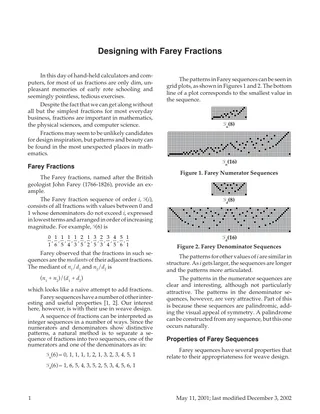
Ralph Griswold explains how Farey fraction sequences can be used to generate weaving drafts. He splits each sequence into numerator and denominator sequences, then uses them as threading and treadling with direct and twill tie-ups. He also covers fixes for repeated values, palindromes, interleaved sequences, concatenated orders, and point-twill derivations. Drawdown figures illustrate each variation, and tables give sequence lengths and point-draw lengths for orders 4 to 32.
Designing with Fractal Sequences
Ralph E. Griswold · February 11, 2004
Web Doc · 4 pages · weaving drafts
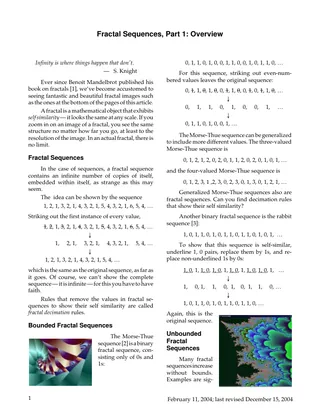
A short web article by Ralph Griswold introducing fractal sequences and how they can be used in weave design. It explains self-similarity and decimation rules, then covers bounded sequences (Morse-Thue, rabbit), unbounded ones (signature sequences, Kimberling sequences), and periodic sequences. It shows how to adapt them as threading and treadling sequences via modular reduction and as warp and weft color sequences, with sample drafts and a color swatch. It closes with advice on choosing sequences and finding them in the On-Line Encyclopedia of Integer Sequences, plus references.
Designing with L-Systems, Part 7: T-Sequence Models
Ralph E. Griswold · April 20, 2004
Web Doc · 3 pages · weaving drafts
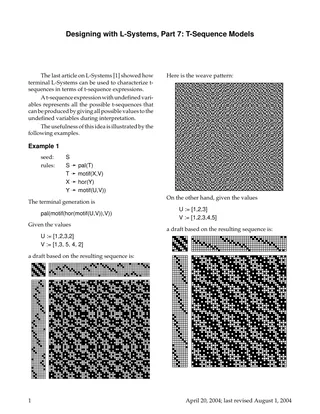
Part 7 of Ralph Griswold's series on designing weaving patterns with L-systems. It shows how terminal L-systems can produce t-sequence expressions with undefined variables, which stand for many possible t-sequences. Two examples give L-system rules and terminal generations, then show drafts and weave patterns produced by assigning different values to the variables.
Designing with L-Systems, Part 8: Non-Terminal T-Sequence Generation
Ralph E. Griswold · April 24, 2004
Web Doc · 3 pages · weaving drafts
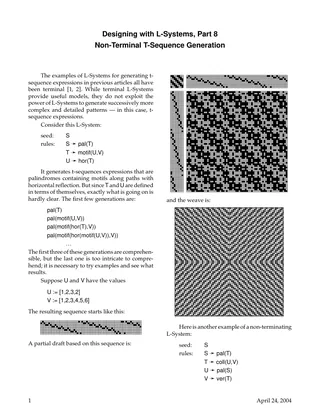
Part 8 of Ralph Griswold's series on designing with L-Systems, dealing with non-terminal L-Systems that generate t-sequence expressions. It gives two examples of recursive rule sets (using pal, motif, hor, coll and ver operations), assigns values to the undefined variables, and shows the resulting sequences, partial drafts and weave drawdowns. It closes by listing four problems with the approach (hard to design, predict, assign values, and sequences become very long) and recommends trying many alternatives with computer programs.
Designing with Power Sequences
Ralph E. Griswold · December 27, 2003
Web Doc · 29 pages · weaving drafts
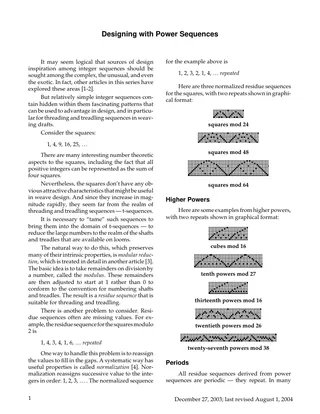
An article by Ralph Griswold on using power sequences (squares, cubes and higher powers) reduced by modular arithmetic and normalized to produce threading and treadling sequences for weaving drafts. It explains residue sequences, their periods, straight draws, and the number of distinct values (shafts or treadles needed). It counts distinct sequences for powers 2 to 32 and moduli 2 to 64. Appendix A tabulates the properties of the normalized residue sequences, and Appendix B is a long series of graphical drawdown-style bitmap patterns derived from them.
Drawdown Automata, Part 1: Basic Concepts
Ralph E. Griswold · January 8, 2002
Web Doc · 8 pages
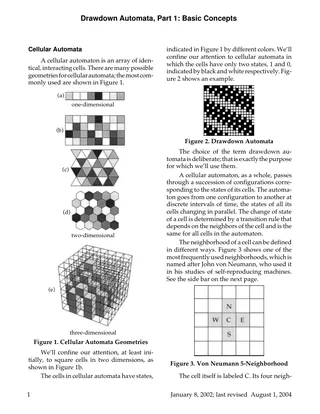
First article in a series by Ralph Griswold on using cellular automata to generate drawdown patterns for weaving. It introduces cellular automata geometries, two-state square cells, von Neumann and Moore neighborhoods, and transition rules such as the parity rule, voter rule and the 1-of-8 rule. It also covers edge wraparound (torus topology), pattern sequences started from seeds or symmetric patterns, and the structural and aesthetic problems of choosing usable patterns. It ends with resources, references and a large 65x65 1-of-8 pattern.
Drawdown Automata, Part 3: Pattern Sequences
Ralph E. Griswold · February 23, 2002
Web Doc · 3 pages
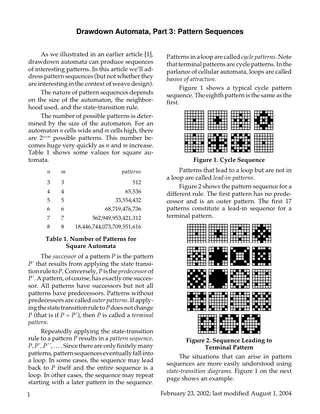
Part 3 of Ralph Griswold's series on drawdown automata, which are cellular-automaton-style programs for generating weave-draft patterns. It defines pattern sequences and related terms: successor, predecessor, outer, terminal, cycle and lead-in patterns. It shows how the number of possible patterns grows with automaton size, with illustrated cycle and lead-in sequences and a state-transition diagram of 41 patterns. It ends by noting that rules producing long sequences are the best candidates for weave design, to be explored in the next part.
Fractal Designs for Quilts, Mosaics, and Other Decorated Surfaces, Part 1
Carla X Gladstone · August 6, 2006
Web Doc · 9 pages
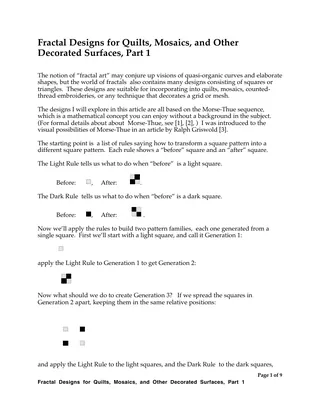
An introductory article on building fractal square-grid designs from the Morse-Thue sequence, for quilts, mosaics, counted-thread embroidery, and other grid-based decoration. It explains two substitution rules (Light and Dark) and applies them step by step to generate the L- and D-Generation patterns, showing that the two families are negatives of each other. It then gives a recursive formulation and shows Generations 5 and 6 of both families. Part 2 is announced to cover patterns with more than two colors.
136 documents found