Textile Documents › Topic: Computers and weaving
166 documents found
Sort: 
Character Sets
Web Doc · 9 pages
A short 2004 web document reproducing Appendix B (Characters) from The Icon Programming Language, 3rd edition, as a reference for string drafting. It explains ASCII, Latin-1, ECS and EBCDIC character sets and gives tables of decimal, octal and hexadecimal codes with glyph columns for several platforms. It closes with a table of the ASCII control characters and their functions.
Creating Weavable Color Patterns, Part 2
Ralph E. Griswold · November 15, 2001
Web Doc · 6 pages
Ralph Griswold describes an interactive computer application for designing color patterns that are guaranteed to be weavable, without working through threading, treadling and tie-up drafts. The article explains the interface, design and palette windows, symmetry options, layouts (including a Fibonacci-based layout), toggles for enforcing weavability and showing legal colors, and the menus. It closes with notes on user experience and five example designs created with the program.
Designing Weave Structures Using Boolean Operations, Part 3: A Design Program
Ralph E. Griswold · February 7, 2002
Web Doc · 6 pages
Part 3 of Ralph Griswold's series on designing weave structures with Boolean operations describes an interactive program that automates the process. The program has a design laboratory, a drawdown editor and a Boolean operator array editor. The design laboratory combines two drawdowns (X and Y) with an operator array (A) to produce a result drawdown (Z). The article walks through the interface with screenshots, covering menus, dialogs, editing tools and the color palette for operators. It ends with the program's limitation to 32 x 32 drawdowns and operator arrays.
Designing with L-Systems, Part 6: Generating T-Sequence Expressions
Ralph E. Griswold · April 10, 2004
Web Doc · 2 pages
A short web article by Ralph Griswold in his L-Systems series that shows how L-System strings can be interpreted as t-sequence expressions. A small terminating L-System produces pal(rpt(U,I)), which evaluates to a palindromic repeat of a sequence. The article explains why separate rules make complex nested expressions easier to understand, and gives a table that maps abstract t-sequence operations (concatenation, repetition, extension, runs, reflection, palindrome, motif, modular reduction and expansion, collation) to concrete L-System function strings. A reference list points to the related t-sequence and L-System articles.
Drawdown Automata, Part 4: A Few Good Rules
Ralph E. Griswold · March 4, 2002
Web Doc · 4 pages
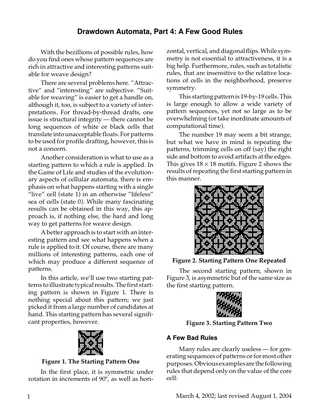
Part 4 of Ralph Griswold's Drawdown Automata series, on choosing cellular automaton rules that generate attractive pattern sequences for weave design. It explains how to pick starting patterns (a symmetric 19-by-19 pattern and an asymmetric one) and which rules to avoid, such as the standard Game of Life, the voting rule and the 1-of-8 rule. It recommends four rules: the von Neumann and Moore parity rules and two Game of Life variations (Life /123 and Life /234). Figures show the pattern sequences each rule produces from the two starting patterns.
Program Visualization of Weave Design
Ralph E. Griswold · March 31, 2004
Web Doc · 4 pages
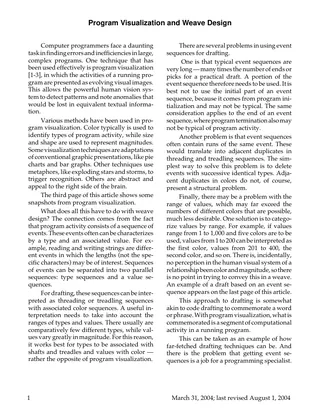
A short web article by Ralph Griswold on using program visualization, the technique of displaying a running program's activity as evolving images, as a source for weave drafts. It explains how a program's event sequences can be split into type and value sequences and mapped to threading and treadling (types) and color (values). It also covers practical problems: sequences that are too long, runs of identical events, and too many distinct values. It includes a page of program visualization snapshots and a final page showing a draft-like colored pattern derived from a chess-playing program.
From Drawdown to Draft - A Programmer's View
Ralph E. Griswold · April 11, 2000
Web Doc · 9 pages · weaving drafts
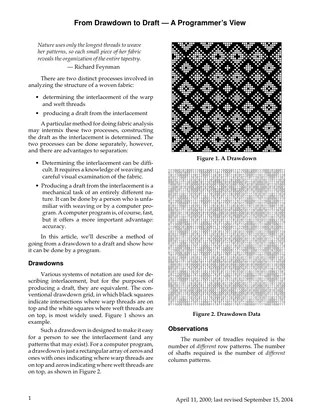
Ralph Griswold explains how to turn a fabric drawdown into a weaving draft by treating the drawdown as a rectangular array of zeros and ones. Counting the distinct rows gives the number of treadles, and counting the distinct columns gives the number of shafts. The article gives short Icon programs that compute loom requirements and produce the threading, treadling and tie-up, and a longer program that outputs a WIF file. It also covers deriving drafts from black-and-white images, with a 65 by 65 pixel Japanese pattern that needs 32 shafts and 32 treadles as an example. Appendices contain the program listing, sample WIF output and the image example.
Painter's Weaving Language
Ralph E. Griswold · November 30, 2000
Web Doc · 5 pages · weaving drafts
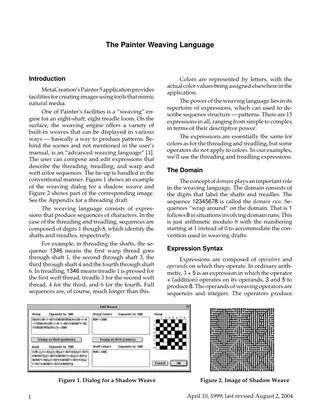
Describes the little-documented "advanced weaving language" hidden in MetaCreation's Painter 5, which lets users write expressions to generate threading, treadling, and warp and weft color sequences for an eight-shaft, eight-treadle loom. It explains the domain (shafts 1-8 wrapping modulo 8) and the expression syntax, then walks through the operators with examples: concatenation, repetition, blocks, extension, reversal, rotation, pattern palindromes, interleaving, domain runs (upto, downto, updown, downup), permutation, pattern boxes, and templates. It closes with comments on the language's limits and strengths, and an appendix giving a shadow weave threading sequence with a conventional draft made by converting a Painter specification to WIF and opening it in SwiftWeave.
Code Drafting: Part 3 -- A Larger Character Set
Ralph E. Griswold · March 3, 2004
Web Doc · 5 pages
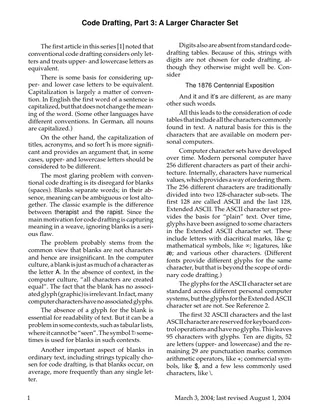
Third article in Ralph Griswold's code drafting series, which converts text into weave drafts by assigning characters to shafts. It argues that code drafting should include blanks, digits and upper- and lowercase letters, and uses the 95 printable ASCII characters as a basis. It gives character frequencies from 1,830 'farberisms' (69,675 characters) and a four-shaft balanced 95-character code table for overshot. The last page shows a sample woven wall hanging made from the string 'Screw the &*%^$#/@\ dummies!'.
Designing with L-Systems, Part 9: Devious Interpretation
Ralph E. Griswold · April 17, 2004
Web Doc · 6 pages
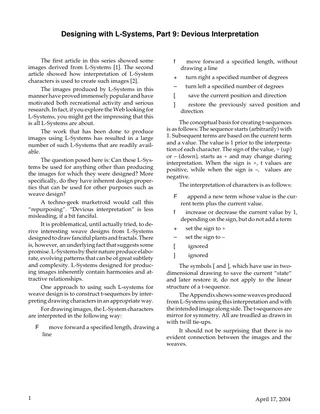
Part 9 of Ralph Griswold's series on designing with L-Systems asks whether L-Systems created to draw plants and fractals can be reused for weave design. It proposes reinterpreting the drawing characters (F, f, +, -, brackets) as rules for building t-sequences, which are mirrored for symmetry and treadled as drawn in with twill tie-ups. An appendix gallery pairs the original L-System images with the resulting weave patterns, and the author notes there is no evident connection between image and weave.
WeaveTech Archives, May 2000
WeaveTech, May 2000
Web Doc · 157 pages
A compilation of WeaveTech mailing list digests (issues 203 onward) from May 2000, preserved as email text with headers. Discussions cover copyright and crediting traditional designs such as Whig Rose, electronic fly shuttles (EFS) and shuttle handling, AVL floating heddle problems, the AVL warping wheel, solenoid firing problems on computer-driven looms, and beating technique including advice recalled from Ethel Mairet via Peter Collingwood. Other threads cover repetitive strain injury and carpal tunnel syndrome, small multi-harness looms, Bonnie Inouye's book Exploring Multishaft Design, list virus policy, Convergence plans, and equipment for sale. No weaving drafts are included.
WeaveTech Archives, June 2000
WeaveTech, June 2000
Web Doc · 123 pages
A collection of WeaveTech mailing list digests (Topica) from June 2000, preserved as raw email archives with headers. Threads cover weaving software (WeaveIt, Proweave, tabby setup, drawdown methods), sectional warping, tying on or twisting on new warps, chenille yarns, table runner dimensions, loom ergonomics and loom boxes, countermarche counterweights, and digital cameras for fiber photography. Also includes announcements for the Norwegian weaving conference and exhibition in Seattle (2001), Convergence logistics, and the launch of the WeaveScene e-magazine.
WeaveTech Archives, October 1998
WeaveTech, October 1998
Web Doc · 143 pages · weaving drafts
Archive of the WeaveTech mailing list digests for October 1998 (Volume 1, roughly issues 1 to 43), compiled from the Majordomo file weavetech.9810. The messages are e-mail discussions among handweavers about computer-assisted and dobby looms (AVL, Louet Megado, LeClerc), networked and advancing twills, sectional warping, dummy warps, yardage and revolution counters, and laptops for loom control. Other threads cover whether fiber art on the edge counts as art, music and weaving, variegated yarns, pebble weave, and many member self-introductions. Two pages contain simple text-based drafts, including a pebble weave scrap pattern.
WeaveTech Archives, January 1999
WeaveTech, January 1999
Web Doc · 243 pages
Archive of the WeaveTech mailing list messages for January 1999, compiled as a digest of email posts with headers. Threads cover chenille yarn and its worming problem, using summer and winter as a thick-and-thin structure, fly shuttles and multi-box shuttle systems, shuttle and race lubrication, AVL and Compudobby loom control software, computer-driven looms, Y2K concerns, Elizabeth Wayland Barber's lectures and books, adjustable loom benches, dukagang definitions, and a napkin exchange. No weaving drafts are present, though a GIF of a draft (Speck's Snailtrail) is mentioned.
WeaveTech Archives, August 2001
WeaveTech, August 2001
Web Doc · 190 pages
Archive of the WeaveTech email discussion list for August 2001, consisting of daily Topica digests (roughly issues 936 to 978) with message headers and threaded replies. Topics include the TC-1 computerized Jacquard loom, whether to start an online weaving magazine, warp length and yarn yardage calculations, fan-shaped reeds, painting long warps, AVL auto-advance and warping wheel questions, chenille weaving, and handwoven garment patterns. Later digests cover list administration, the move from Topica to Yahoo Groups, and copyright concerns about Yahoo's terms of service.
WeaveTech Archives, July 1999
WeaveTech, July 1999
Web Doc · 302 pages
A compiled archive of the WeaveTech mailing list e-mail digest for July 1999, with message headers and replies from list members. Topics include the AVL bobbin-winding guide, drawloom makers (Glimakra, Myrehed, Oxaback), buying a used Macomber loom, AVL auto advance and pick-per-inch calculations, compu-dobby looms, tied weaves, double weave lace, and 16-shaft tie-ups. Other threads cover guild master-weaver ratings programs and their exclusion of computers, care labeling in the US, an online weaving journal, genetic algorithms, and weaving in the movies. One draft appears on a single page.
WeaveTech Archives, November 2000
WeaveTech, November 2000
Web Doc · 159 pages · weaving drafts
A month of WeaveTech mailing list digests (Topica issues from 1 to 29 November 2000) collected as email text. Threads cover chenille dyeing, tracking, worming and fringe twisting, rag rugs and double-width weaving, sectional warping, fractals and mathematically generated drafts, AVL CompuDobby and Macomber loom problems, countermarche tie-ups, sticking shafts, and damask selvedges and shuttles. Also included are book recommendations (Becker's Pattern and Loom), Harris Tweed weavers, possum fibre from New Zealand, and a squared-square puzzle. Only a few drafts appear, as ASCII or HTML-garbled text.
WeaveTech Archives, May 1999
WeaveTech, May 1999
Web Doc · 92 pages
Archive of the WeaveTech mailing list for May 1999, reproduced as raw email messages with full headers. Threads cover spool racks and creels, yardage counters and slippage, electric cone and bobbin winders, AVL dobby looms and CompuDobby connection problems, fly shuttles and end-feed shuttles, leno selvages on shuttleless looms, and bowed filling and temples. Other discussions include Ralph Griswold's reaction to the English translation of Masson & Roussel's book on shaft weaving and graph design, a report on the Symmetry and Textiles conference at the University of Wisconsin, a long post on fiber use in the Pacific Islands, and details of a napkin exchange.
Classical Collection, Volume 1
Ralph E. Griswold · January 26, 2005
Web Doc · 55 pages · weaving drafts
A pattern book of thumbnail drawdowns of classical handweaving patterns, compiled by Ralph Griswold in 2005 from drafts that Kris Bruland posted as WIF files on Handweaving.net. The patterns are organized by size, width (shafts) first, from 2 x 3 up to 30 x 30. Each thumbnail is labeled with a five-digit number that matches a WIF file, such as 04571 for 04571.wif, so readers can browse for a pattern and download its draft. The introduction explains the organization and says the material may be used for individual projects but not republished.
German Weaving Patterns
Ralph E. Griswold · January 26, 2005
Web Doc · 27 pages · weaving drafts
A browsing index of German weaving patterns from an unknown source, digitized as WIFs by Kris Bruland and posted on Handweaving.net. Thumbnail drawdowns are grouped by size (width first, from 4 x 8 up to 16 x 48), and each is captioned with the number of its WIF file, which can be downloaded free. The introduction says the thumbnails were derived from the WIFs for easy identification of patterns of interest.
Analysis of Weave Structures, Part 2: A Canonical Form
Ralph E. Griswold · March 4, 2002
Web Doc · 4 pages
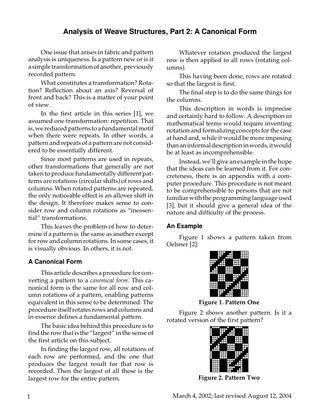
A short article by Ralph Griswold on determining whether two weave or fabric patterns are the same apart from row and column rotations (circular shifts). It describes a procedure for reducing a binary pattern to a canonical form that is identical for all rotated versions. A worked example compares two patterns, one taken from Oelsner's Handbook of Weaves, using a 24 by 20 binary array. An appendix gives the procedure in the Icon programming language.
Constrained Patterns, Part 3: Representing Constraint Sets
Ralph E. Griswold · July 4, 2002
Web Doc · 2 pages
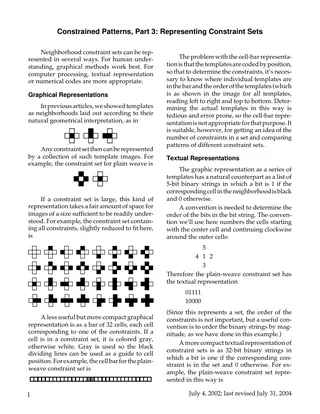
A short web article by Ralph Griswold on ways to represent sets of neighborhood constraints used to define patterns. It covers graphical forms (template images and a 32-cell bar), textual forms (5-bit binary strings and 32-bit strings), and numerical base-10 codes. Plain weave serves as the running example, with constraint codes 15 and 16 and a 32-bit code of 98305. It is the third part of a series on constrained patterns.
Designing Weave Structures Using Boolean Operations, Part 2
Ralph E. Griswold · November 29, 2001
Web Doc · 3 pages
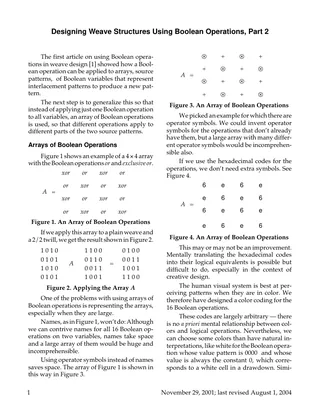
The second article in Ralph Griswold's series on Boolean operations in weave design extends the method from one operation applied to two source patterns to an array of different operations applied cell by cell. It compares ways of representing operation arrays (names, operator symbols, hexadecimal codes, and a 16-operation color code) and shows examples built from plain weave and 2/2 twill. It also covers 'deficient' operations (0, 1, x, y), which force white, black, or one source pattern's cells into the result, and closes by announcing computer programs for the next article.
Designing with L-Systems, Part 2: A Side Trip to Graphics
Ralph E. Griswold · June 20, 2002
Web Doc · 2 pages
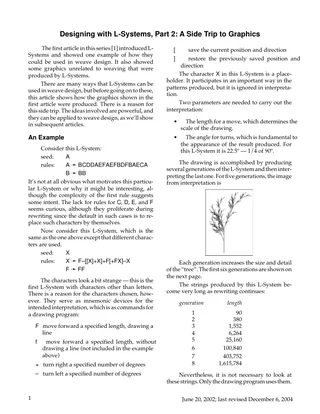
Second article in Ralph Griswold's series on L-Systems in weave design. It is a deliberate detour into graphics: it shows how string-rewriting rules, with characters read as drawing commands (forward, turn, save and restore position), produce branching tree images. It gives an example L-System with a 22.5-degree turn angle, a table of string lengths across eight generations, and a pointer to freeware such as Lparser. It says later articles will apply these ideas to weave design.
Drawdown Automata, Part 2: Neighborhoods and State-Transition Rules
Ralph E. Griswold · February 13, 2002
Web Doc · 7 pages
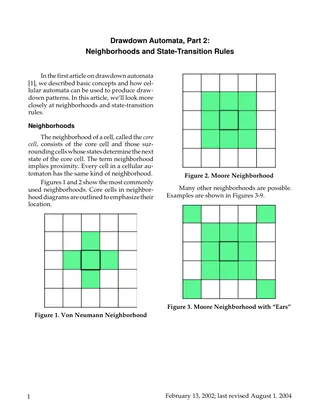
Second article in Ralph Griswold's series on drawdown automata, using cellular automata to generate weaving drawdown patterns. It explains neighborhoods (von Neumann, Moore, and many other shapes, with radius and symmetry) and state-transition rules: general rules, totalistic and outer-totalistic rules, Life-type rules, and alternative ways to express rules such as integer codes and pseudo-code. Worked examples use the parity rule and Conway's Game of Life, and the figures are grid diagrams of neighborhoods.
Grid Overlay Patterns, Part 1: Introduction
Ralph E. Griswold · December 15, 2002
Web Doc · 2 pages
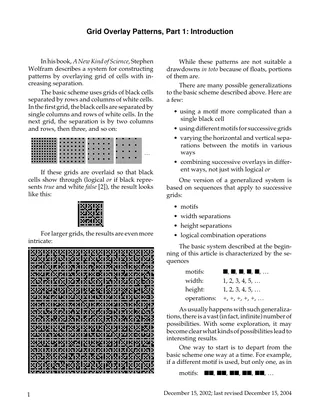
An introductory web document by Ralph Griswold on building patterns by overlaying grids of cells with increasing separation, following a scheme in Stephen Wolfram's A New Kind of Science. It shows the basic scheme (black cells separated by growing numbers of white rows and columns, combined with logical or), then generalizations: different motifs, prime-number separations, exclusive or, and repeating motif sequences. It notes that the resulting patterns have floats and are only partly usable as drawdowns, and it promises a follow-up article.
Importing Adobe Illustrator Images into JacqCAD
Garth Fletcher · July 3, 1998
Web Doc · 4 pages
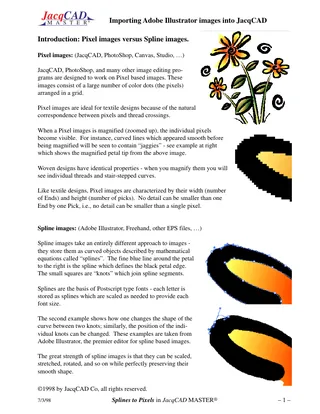
A four-page tutorial by Garth Fletcher (JacqCAD Co) on converting spline-based Adobe Illustrator artwork into pixel images usable in JacqCAD MASTER for Jacquard weaving. It contrasts pixel and spline images, then steps through saving as EPS, rasterizing in Photoshop to the desired ends and picks (with a non-square aspect ratio), converting to RGB and indexed color, saving as PICT, and opening in JacqCAD. It closes with a cautionary note on resolution limits in Jacquard design, illustrated with letterforms rasterized at 208, 104, 52 and 26 ends.
Normalized T-Sequences
Ralph E. Griswold · December 24, 2003
Web Doc · 3 pages · weaving drafts
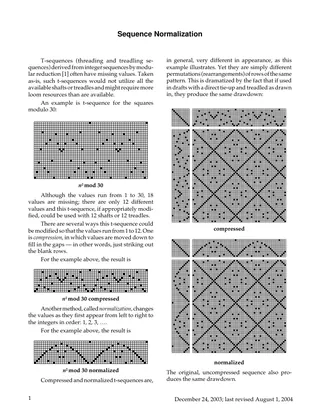
A short web document by Ralph Griswold explaining how to fix integer-sequence-derived t-sequences (threading and treadling sequences) that have missing values and would need more shafts or treadles than are used. It compares compression (closing gaps) with normalization (renumbering values in order of first appearance), using n² mod 30 as the example. Drafts and drawdowns show that both methods give the same result with a direct tie-up but differ with a 2/2 twill tie-up. It concludes that normalization generally looks more coherent and is useful for comparing sequences.
Number Drafting: Part 2 -- Foraging for (Modestly) Large Numbers
Ralph E. Griswold · March 17, 2004
Web Doc · 3 pages
Second article in Ralph Griswold's Number Drafting series, on choosing interesting, modestly large numbers as sources for weaving designs. It compares 377 with the US national debt, the radius of the universe and the largest known prime, and says a few hundred digits are enough for weaving. Candidates include primes, Fibonacci terms, Gödel numbers, China's population and the digits of π, e and φ. The last two pages show bit-pattern drawdown images made from some of these numbers.
Operations on Patterns, Part 4: Repetition
Ralph E. Griswold · December 8, 2002
Web Doc · 2 pages · weaving drafts
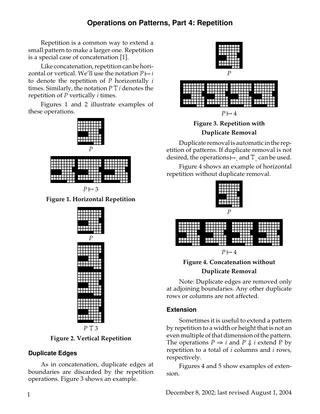
Part 4 of Griswold's series on operations on patterns, covering repetition of a small pattern horizontally or vertically to make a larger one. It defines the notation for repetition, automatic removal of duplicate edges at adjoining boundaries, and variants without duplicate removal. It also covers extension to a given number of columns or rows, including truncation, and ends with a summary table of the operations. Illustrated with black-and-white grid patterns.
Profile Drafts and WIFs
Ralph E. Griswold · June 29, 2002
Web Doc · 1 page · weaving drafts
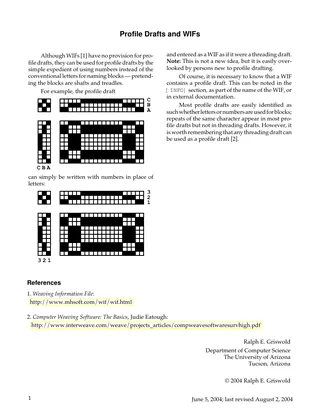
A short note by Ralph Griswold explaining how profile drafts can be stored in WIF (Weaving Information File) files even though the format has no provision for them. The trick is to name blocks with numbers instead of letters, treating blocks as shafts and treadles, and entering the profile as a threading draft. It also suggests flagging such a WIF in the [INFO] section, in the file name, or in external documentation, and notes that any threading draft can serve as a profile draft.
T-Sequences, Part 7: Collation
Ralph E. Griswold · April 17, 2004
Web Doc · 2 pages
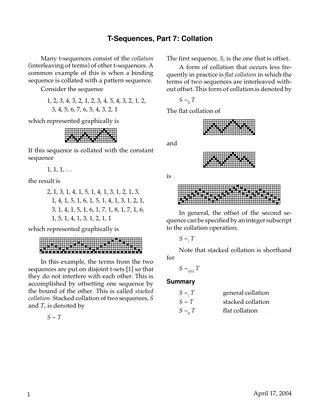
A short mathematical note by Ralph Griswold on collation (interleaving) of t-sequences, the integer sequences he used to design weaving patterns. It explains stacked collation, where the second sequence is offset by the bound of the first so their terms occupy disjoint t-sets, and flat collation, where terms are interleaved without offset. It gives an example collating a binding sequence with a constant sequence, shown as grid figures, and ends with a summary of the notation S ~i T, S ~ T and S ~0 T.
Code Drafting: Part 4 -- Adaptive Tables
Ralph E. Griswold · March 6, 2004
Web Doc · 3 pages
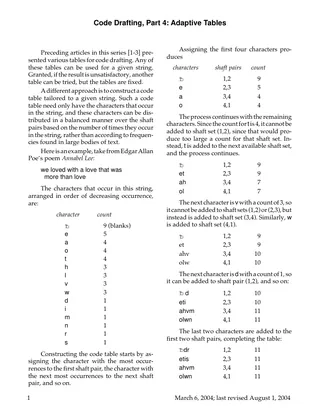
Part 4 of Ralph Griswold's code drafting series, describing how to build a code table tailored to a particular string rather than using a fixed table. Characters are assigned to shaft pairs according to how often they occur in the string, giving a balanced distribution. The worked example uses a line from Poe's poem Annabel Lee and compares the result with a table based on frequencies in large bodies of text. A pattern derived from the table appears at the end.
Design Inspirations from Multivariate Polynomials, Part 2
Ralph E. Griswold · September 30, 2001
Web Doc · 10 pages · weaving drafts
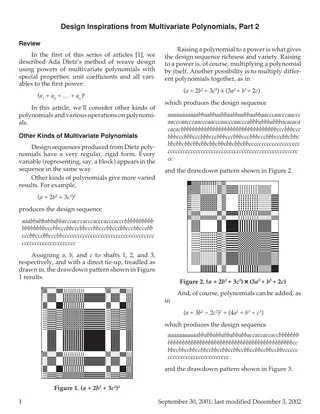
Second article in Ralph Griswold's series on generating weave design sequences from multivariate polynomials, extending Ada Dietz's method. It covers polynomials with non-unit coefficients and exponents, multiplication and addition of polynomials, negative and fractional coefficients, polynomial division, modular reduction, differentiation and integration. Each operation is illustrated with design sequences and black-and-white drawdowns. Appendices show modular reductions (mod 2 to 12), successive derivatives and successive integrals of (a+b+c)^4.
Designing with L-Systems, Part 7: T-Sequence Models
Ralph E. Griswold · April 20, 2004
Web Doc · 3 pages · weaving drafts
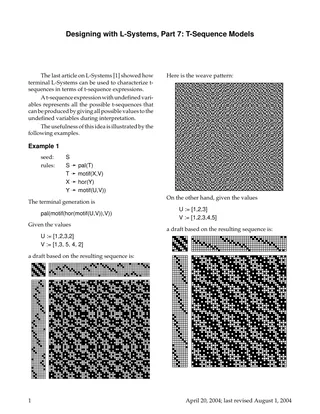
Part 7 of Ralph Griswold's series on designing weaving patterns with L-systems. It shows how terminal L-systems can produce t-sequence expressions with undefined variables, which stand for many possible t-sequences. Two examples give L-system rules and terminal generations, then show drafts and weave patterns produced by assigning different values to the variables.
Designing with L-Systems, Part 8: Non-Terminal T-Sequence Generation
Ralph E. Griswold · April 24, 2004
Web Doc · 3 pages · weaving drafts
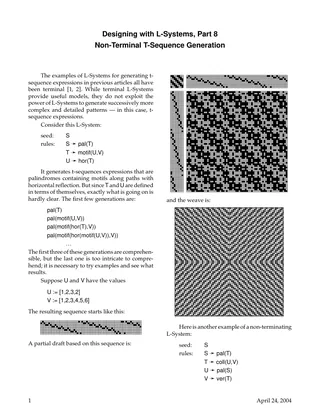
Part 8 of Ralph Griswold's series on designing with L-Systems, dealing with non-terminal L-Systems that generate t-sequence expressions. It gives two examples of recursive rule sets (using pal, motif, hor, coll and ver operations), assigns values to the undefined variables, and shows the resulting sequences, partial drafts and weave drawdowns. It closes by listing four problems with the approach (hard to design, predict, assign values, and sequences become very long) and recommends trying many alternatives with computer programs.
Drawdown Automata, Part 1: Basic Concepts
Ralph E. Griswold · January 8, 2002
Web Doc · 8 pages
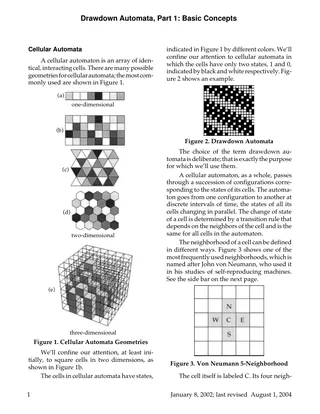
First article in a series by Ralph Griswold on using cellular automata to generate drawdown patterns for weaving. It introduces cellular automata geometries, two-state square cells, von Neumann and Moore neighborhoods, and transition rules such as the parity rule, voter rule and the 1-of-8 rule. It also covers edge wraparound (torus topology), pattern sequences started from seeds or symmetric patterns, and the structural and aesthetic problems of choosing usable patterns. It ends with resources, references and a large 65x65 1-of-8 pattern.
Drawdown Automata, Part 3: Pattern Sequences
Ralph E. Griswold · February 23, 2002
Web Doc · 3 pages
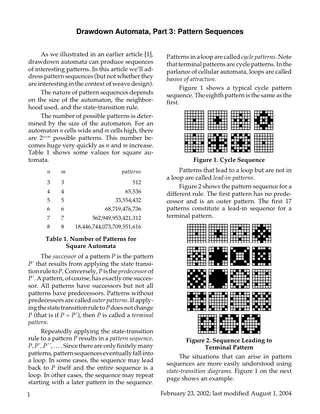
Part 3 of Ralph Griswold's series on drawdown automata, which are cellular-automaton-style programs for generating weave-draft patterns. It defines pattern sequences and related terms: successor, predecessor, outer, terminal, cycle and lead-in patterns. It shows how the number of possible patterns grows with automaton size, with illustrated cycle and lead-in sequences and a state-transition diagram of 41 patterns. It ends by noting that rules producing long sequences are the best candidates for weave design, to be explored in the next part.
Drawdown Automata, Part 5: A Catalog of Weaving Patterns
Ralph E. Griswold · April 24, 2004
Web Doc · 1 page
Part 5 of Ralph Griswold's Drawdown Automata series, a catalog of selected patterns produced by drawdown automata, ordered by size. The text pages describe the catalog and cite Parts 1-4 of the series; numbers below each pattern are database identification numbers with no other significance. The catalog itself is a long run of pattern images.
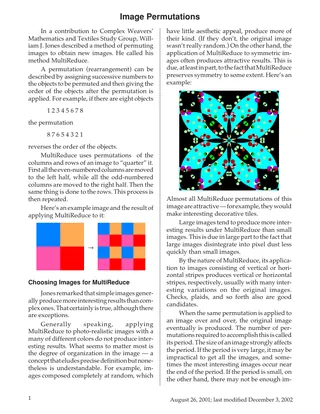
Image Permutations
Ralph E. Griswold · August 26, 2001
Web Doc · 4 pages
Ralph Griswold describes William J. Jones's MultiReduce method, which permutes the columns and rows of an image to produce new images, and explores variations on it. He discusses which images work best (symmetric, striped, checked and large images), permutation periods, block permutations and 'mutations' that delete or duplicate columns. He notes that permutations preserve loom-controlled weavability and need the same shafts and treadles as the original, so they can serve as weave-design tools. He also covers animated permutations on the web, the difficulty of getting permutations into weaving software via WIF files, and ideas for further work.
Signature Sequences in Weave Design
Ralph E. Griswold · November 25, 2000
Web Doc · 10 pages · weaving drafts
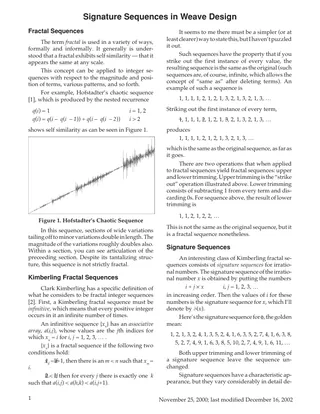
A short paper by Ralph Griswold on using Kimberling fractal integer sequences, especially signature sequences of irrational numbers, to generate threading and treadling sequences for weaving drafts. It explains fractal sequences, upper and lower trimming, and signature sequences for numbers such as the golden mean, e and pi. It then covers reducing terms by residues modulo the number of shafts and treadles, and reflecting a portion of a sequence to get symmetric repeats. Most pages are figures: grid plots of sequences, residue plots, and drawdowns for 16-shaft, 16-treadle twill tie-ups using different number and term-range combinations.
Designing with L-Systems, Part 1: String Rewriting Systems
Ralph E. Griswold · April 6, 2002
Web Doc · 6 pages · weaving drafts
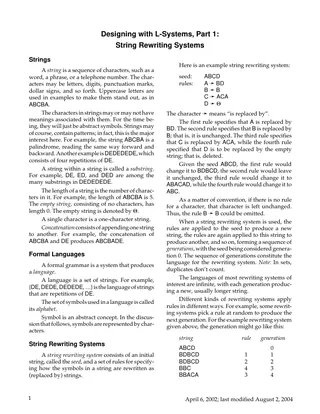
An introductory article by Ralph Griswold on string rewriting systems and Lindenmayer systems (L-Systems) as a basis for pattern design. It defines strings, formal languages, seeds, rules and generations, and shows that L-Systems apply all rules in parallel. Worked examples include the Morse-Thue and Fibonacci string sequences, and the Fibonacci string is interpreted as a profile pattern. A short sidebar covers Aristid Lindenmayer, and an appendix has plates of L-system graphics (spirals, snowflake-like curves, branching plant forms). References point to related Griswold documents and to the L-system literature.
Designing with L-Systems, Part 3: Back to Basics -- T-Sequence Design
Ralph E. Griswold · April 2004
Web Doc · 3 pages · weaving drafts
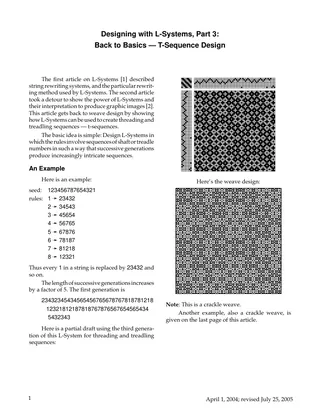
Third article in Ralph Griswold's series on using L-Systems (string rewriting systems) in weave design. It shows how rules operating on shaft and treadle numbers can generate threading and treadling sequences (t-sequences) that grow more intricate with each generation. An example L-System with eight rules and a 15-digit seed is given, with a partial draft and drawdown of a crackle weave, and a second crackle example on the last page. It also notes how to handle shaft numbers above 9 and previews later articles.
Designing with Smarandache Sequences, Part 1: Concatenation Sequences
Ralph E. Griswold · June 27, 2006
Web Doc · 3 pages · weaving drafts
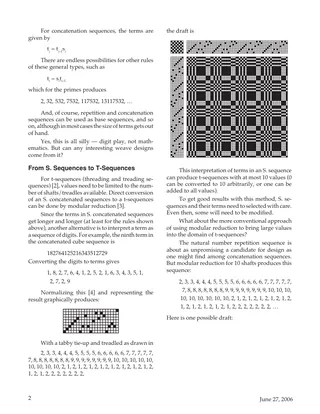
A short web article by Ralph Griswold exploring whether Smarandache integer sequences, specifically concatenation and repetition sequences, can generate weave designs. It explains how terms are formed (repetition, prime and cube concatenation), then converts them to threading and treadling sequences by interpreting digits or by modular reduction for 10 shafts. Worked examples show a normalized sequence and drafts with tabby tie-up and the resulting weave patterns. A sidebar gives a short biography of Florentin Smarandache, and the article ends by previewing a follow-up on S. palindromes.
Variations on a Shadow Weave
Ralph E. Griswold · April 10, 1999
Web Doc · 4 pages · weaving drafts
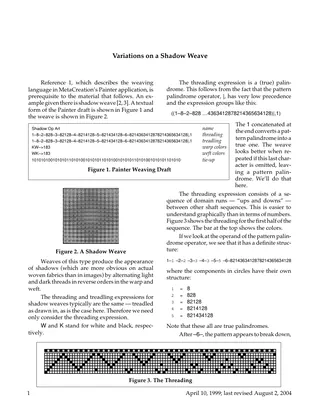
A web document by Ralph Griswold that uses the Painter weaving language to analyze a shadow weave threading. It breaks the threading into anchors for domain runs joined by palindromes, then represents this structure with pattern forms and sequence notation. It defines coupled, anchor and palindrome transformations, tries all 5,040 anchor-sequence permutations, and shows example weave images. It concludes that the design is aesthetically robust and that further variations will be explored in a later report.
Designing Weave Structures Using Boolean Operations, Part 1
Ralph E. Griswold · October 20, 2001
Web Doc · 5 pages
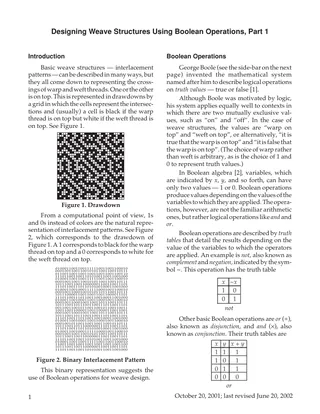
A short illustrated article by Ralph Griswold on using Boolean algebra to design weave structures. It represents drawdowns as binary arrays (1 = warp on top, 0 = weft on top) and explains the basic Boolean operations (and, or, exclusive or, equivalence, implication) with truth tables. It then applies them to arrays, combining a plain-weave or twill ground with a motif to make spot weaves, following Oelsner's diversified weaves, and combining twill with basket weave. It closes with cautions about long floats and loom resources and points to a second part on arrays of operations.
Mathematical and Computational Topics in Weaving
Ralph E. Griswold · c. 2006
Web Doc · 7 pages
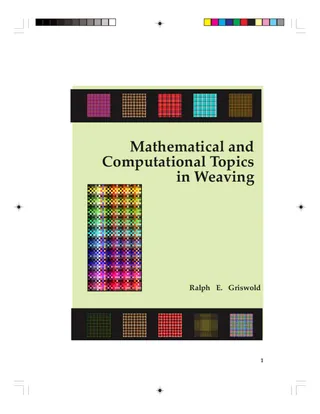
Cover, preface and table of contents for Ralph Griswold's draft web-published book on applying elementary mathematics and computation to weaving. The preface (dated September 20, 2006) explains the work-in-progress status and thanks Ruth Blau, Marg Coe and Gregg Townsend. The contents list links to separate PDFs on twill and satin counters, sequence drafting, name drafting, crackle and shadow weave, pattern operations, numeric sequences (Fibonacci, Morse-Thue, Farey, etc.), L-systems, cellular automata, Boolean design, and the Painter's Weaving Language.
WeaveTech Archives, April 1999
WeaveTech, April 1999
Web Doc · 131 pages
Monthly archive of the WeaveTech mailing list for April 1999, consisting of email messages with full headers from list members. Discussions include access to the online copy of Cyrus Uhler's 1830 weaving book (PDF and page images) and how to interpret its tie-ups and threadings, weaving software and algebraic draft entry, fly shuttles and AVL looms, beating, sectional warping and spool racks, and measuring warp yardage. Other threads cover chenille, kuvikas/taquete, incorporating crocheted lace into weaving, photographing work for juries, a napkin exchange and miscellaneous announcements.
WeaveTech Archives, August 1999
WeaveTech, August 1999
Web Doc · 234 pages · weaving drafts
A monthly archive of the WeaveTech email discussion list for August 1999, preserved as raw messages with mail headers. Threads cover AVL looms (labeling heddle bars, selvedge reels, air compressors and air-assisted lifts, 24-shaft compu-dobby purchases, measuring on an AVL), troubleshooting a Cyrefco CompuMarche, and weaving software such as ProWeave and Fiberworks. Other discussions concern deflected double weave terminology and the final issue of Weaver's magazine, handweaver versus industrial weave nomenclature, weaving linen, hemp and wet-spun flax yarn, doup heddles, crossed warp tubes, Lycra, rolled selvedges and what makes someone a weaver. A few pages contain text-based weaving drafts or diagrams.
WeaveTech Archives: Topics
WeaveTech, c. 1998-1999
Web Doc · 32 pages
An alphabetical subject index to the WeaveTech email discussion list archive, covering monthly digests from roughly September 1998 to December 1999. Each thread subject line is paired with the archive file (weavetech.YYMM) in which it appears. Topics include AVL looms and dobbies, advancing twills, chenille, lampas and beiderwand, handloom versus powerloom, sectional warping, drawlooms, temples and stretchers, care labeling, and list administration.
166 documents found