Textile Documents › Publications › Publication: Mathematical Gazette
3 documents found
Sort: 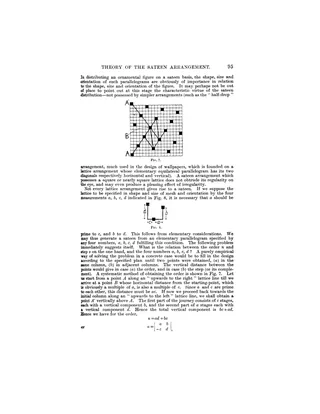
Mathematical Theory of the Sateen Arrangement
Article · 6 pages · weaving drafts
A mathematical paper by S. A. Shorter on the sateen (satin) arrangement of points on squared paper, used both for weave construction and for distributing ornamental repeats. It restates the two classical rules (order and step prime to each other; complementary steps give mirror images) and adds a third rule from rotation by a right angle to count distinct sateens of a given order. It then develops the 'sateen lattice', gives formulas for order and step from lattice measurements, and discusses 'twilliness' and 'perfect' sateens, with a table of the first seven. Diagrams of sateen grids illustrate the argument.
Mathematics of Thread and Cloth Construction: An Historical Survey
Article · 6 pages
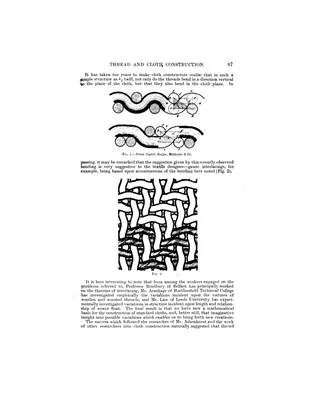
A survey by Professor A. F. Barker of Leeds University tracing how mathematics came to be applied to yarn and cloth construction from about 1880-1890 onward. It covers Ashenhurst's yarn diameter rule and cloth geometry, the idea of twist defined by angle rather than turns per inch, and graphs and nomograms that relate twist angle, yarn count and turns per inch. It closes with the confusing variety of regional textile units and the groupings needed to set up a loom for figured cloth. Illustrated with diagrams of thread interlacing, twist charts, a nomograph and two-fold yarn twist types.
Teaching of Mathematics to Textile Students
Article · 5 pages
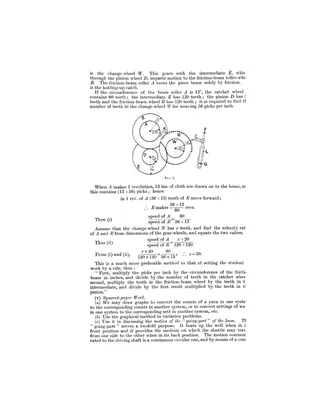
A 1920 paper by J. H. Whitwam of the Holmfirth Secondary School and Technical Institute, arguing that mathematics for textile students should use examples from the textile trade and should teach reasoning rather than memorized rules. It works through examples such as converting worsted counts to cotton counts, finding the counts of folded or twisted yarns, and calculating the change-wheel for the loom take-up motion. It also covers yarn diameter and sett as functions of count, graphs of going-part and heald motion, and the effect of thread curvature on setting.