Textile Documents › Topic: Plain weave
208 documents found
Sort: 
Leinwandbindung [Plain Weave]
Article · 2 pages · German
A 1927 German-language technical article on plain weave (Leinwandbindung) by a textile school teacher, focused on how it is woven on hand looms and power looms. It covers shed formation with a roller (Geschirrwelle), eccentric cams, shaft lift, multiple shafts with skip drafting (Sprungeinzug), and the problem of streaky cloth and how a closing shed and a movable whip roll (Walkwelle) address it. It ends with the properties, uses and names of plain-weave fabrics. The scan opens with the end of another article on stripe effects in satin weaves, and closes with the start of a second article on patterning pullover fabrics.
Taffeta
Article · 1 page
A short encyclopedia entry defining taffeta as a plain-woven silk fabric made by regular alternation of warp and filling. It gives the word's etymology (from Persian tāftah, 'woven') and notes the early association with Chinese silk weaving. It also describes how variations in warp and filling quality and in color led to taffeta becoming a general term for plain silk.
Weaving
Manufacturer and Builder, 1870
Article · 1 page
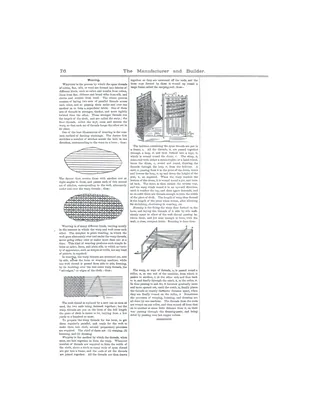
A short 1870 magazine article from The Manufacturer and Builder explaining weaving for general readers. It defines warp and weft, compares weaving to darning stockings, describes plain weave and selvedges, and outlines the preparatory processes of warping, beaming and dressing. Small diagrams illustrate darning, plain weave, a warping mill and the beaming process.
Nature of Plain Weave
Article · 8 pages
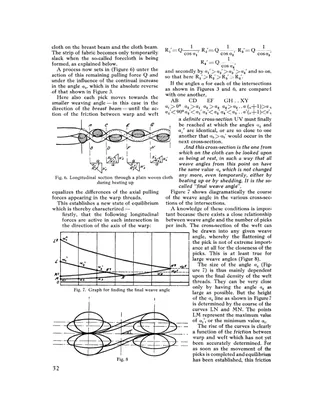
A technical article by Dr. Fr. Stein analysing the mechanics of plain weave cloth formation on the loom. It uses force diagrams and the "weave angle" to explain warp and weft tensions, warp contraction, the return of picks after beating up, the final weave angle and pick density, and the forecloth limit. It also treats reed marks, the effect of lease rod rocking on warp spacing, and post-loom shrinkage, crepe effects and curling compared with sateen.
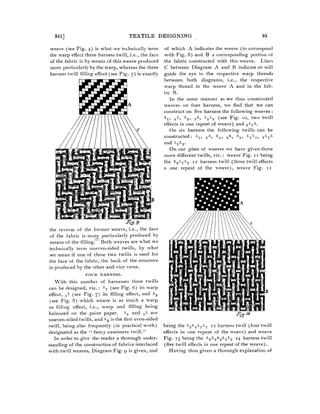
Plain Twills and Satins; The Foundation of Textile Designing
Textile World Record, November 1903
Article · 5 pages · weaving drafts
A 1903 instructional article from Textile World Record explaining the three foundation weaves of textile design: plain weave, twills and satins. It describes how each is constructed on point paper, with diagrams linking weave notation to fabric cross-sections, covers 3-, 4-, 5- and 6-harness twills plus larger twills up to 24 harness, and gives a rule for building satin weaves using counters. It closes with a set of study questions and a recommendation of E. A. Posselt's Technology of Textile Design.
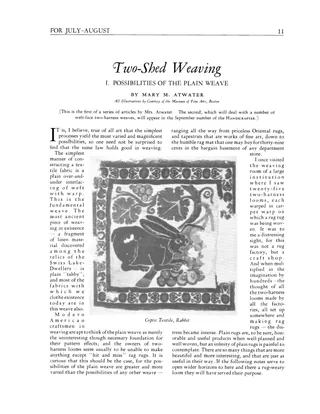
Two-Shed Weaving: I. Possibilities of Plain Weave
Article · 6 pages
The first article in Mary Meigs Atwater's series for The Handicrafter argues that plain weave offers far more variety than the rag rugs usually woven on two-harness looms. She outlines the range of two-harness fabrics in three groups: weft-face, warp-face, and balanced (half-and-half). The rest of the text covers tapestry: its antiquity, high-warp and low-warp looms, bobbins, beaters, warp setts, design, and the problem of slits. Illustrations are museum textiles from the Museum of Fine Arts, Boston, including Coptic, Peruvian, Gobelin, Flemish, Persian, Chinese and Mexican pieces.
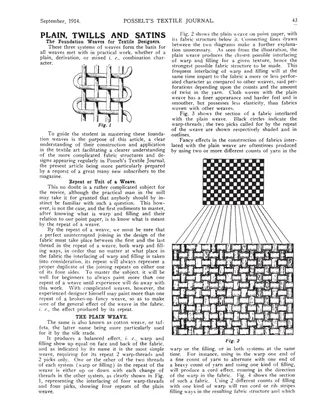
Plain, Twills and Satins
Article · 3 pages · weaving drafts
An instructional article from Posselt's Textile Journal introducing the foundation weaves for textile designers: plain weave, twills and satins. It explains the repeat of a weave, plain weave construction and cord/repp effects, and then twills on 3, 4, 5 and 6 harnesses, with interlacing diagrams and point-paper drafts. The final page also carries a worsted trousering fabric specification (reversible stripe) with warp arrangement, reed, filling and finish details. The article is marked to be continued, and the satin section is not reached in these pages.
Shuttle-Craft Bulletin, Vol. XXX, No. 9 (September 1953)
Periodical · 13 pages
This issue of the Shuttle Craft Guild Handweaver's Bulletin opens a series of beginner lessons for 2-harness weaving on a table loom. It describes the basic parts of a loom and recommended equipment (the Leclerc #14 loom, shuttles, reeds, heddles, warping board) with prices, then lists instruction books and back issues on 2-harness techniques. Five lessons follow: warping and dressing the loom with a table runner, checked tabby table mats, fine cotton napkins and an apron, linen and raffia mats, and linen towels with blended color stripes. All projects use plain weave (tabby) and the instructions include materials, sett, sleying and weft sequences.
Warp & Weft, Vol. 1, No. 8 (June 1948)
June 1948
Periodical · 8 pages · weaving drafts
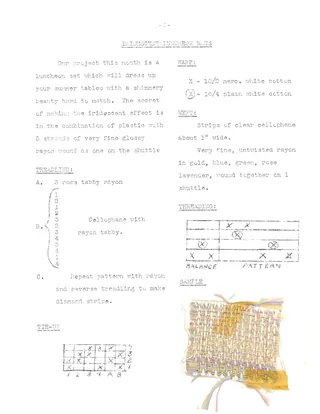
Issue 8 (June 1948) of the monthly handweaving newsletter Warp and Weft, edited by Gladys Rogers Brophil and published by Marglad Corporation in Chicago. It includes a project for iridescent luncheon mats woven with cellophane strips and fine rayon, with a threading, tie-up and treadling draft and a sample photograph. Other items cover color and texture lessons drawn from Rembrandt, alginate fiber for weaving very fine woolens, variations of plain weave (stripes, plaids, basket weave, textured yarns), and a question-and-answer column on making weft cover the warp. The last page carries advertising for threads and Norwood looms.
Warp & Weft, Vol. 13, No. 8 (October 1960)
October 1960
Periodical · 9 pages · weaving drafts
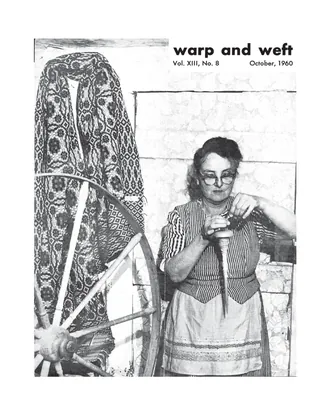
October 1960 issue of Warp and Weft, a monthly handweaving newsletter from Robin & Russ Handweavers in Santa Barbara, California. It includes the editor's column, a note on a pattern-woven twice-woven chenille rug made with clasped weft, and a profile of the Dale Hollow Craft Shop in Monroe, Tennessee. The monthly sample is "Buff and Silver," a sheer plain-weave casement or drapery fabric with a 4-shaft, 6-treadle threading, warp and weft details, sleying and a cost-per-yard breakdown. Also included are reviews of The Handweaver's Project Book and Caroline Halvorsen's Norwegian Handbok i Veving, an announcement of a 1962 Southern California Handweavers Conference, and advertisements for yarns and looms.
Warp & Weft, Vol. 2, No. 9 (July 1949)
July 1949
Periodical · 8 pages · weaving drafts
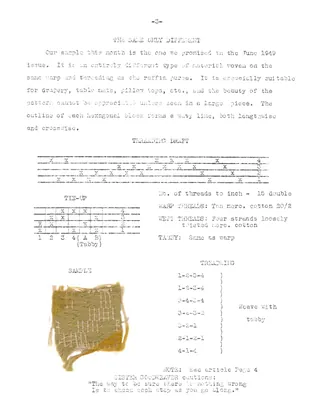
July 1949 issue of the Chicago-based handweaving newsletter Warp & Weft. It reports on the Shelburn Craft School in Vermont, summer weaving events and exhibits (Northport, Michigan; Potomac Craftsmen at the Smithsonian), and a column on machine-made 'handwoven' neckties. The monthly sample is a four-shaft hexagonal block pattern woven with tabby, with threading, tie-up and treadling given, followed by an article of hints on weaving with tabby. Also includes women-inventor trivia, a poem, short anecdotes, and advertisements for threads and summer classes.
Shuttle-Craft Bulletin, Vol. XXIX, No. 8 (August 1952)
Periodical · 16 pages · weaving drafts
August 1952 issue (Portfolio Edition) of the Handweaver's Bulletin from the Shuttle Craft Guild, Virginia City, Montana. It opens a classification of handloom weaves, explaining why power-loom classifications don't suit handweavers, and sets out Classes I-III (plain, twill, twill derivative weaves such as overshot, hybrid and crackle). It also gives instructions for a supplemental-thread weave (used in a barbecue apron) with drafts for 2-, 4- and 6-shaft looms, and a loom-dressing article on comfortable heddle threading and dismantling various looms. The portfolio included a fabric sample and photographs of students threading looms.
Shuttle-Craft Bulletin, Vol. XXX, No. 5 (May 1953)
Periodical · 13 pages
May 1953 issue of the Shuttle Craft Guild Handweaver's Bulletin, edited by Harriet Tidball. It discusses plain (tabby) weave and 2-, 3- and 4-thread basket weave, drawing on the Swiss booklet Einschaftige Leinenbindungen, and gives color-and-weft arrangements for 2-harness threadings. It also covers a drapery and bedspread set, warp settings for a new fine 4-run woolen yarn from the Coffin Sheep Company, a fund drive to buy a loom for Dr. Edith Ludowyk-Gyomroi in Ceylon, and an announcement of the September 1953 Weaver's Seminar.
A Manual of Weave Construction: a Systematic Arrangement and Explanation of the Foundation and Derivative Weaves for Harness Looms
Book · 107 pages · weaving drafts
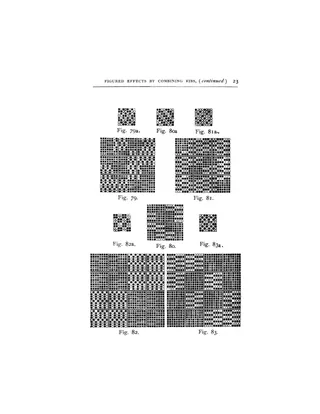
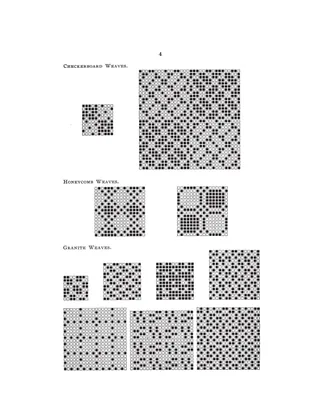
A 1903 English-language textbook on the construction of weaves for harness looms, translated and adapted by Samuel S. Dale from the work of Ivo Kastanek of the Royal Textile College, Brunn. It classifies weaves as plain, twill and satin and shows how to derive from them ribs, basket weaves, fancy and broken twills, corkscrews, crepes, pin checks, checkerboards, honeycombs, hairlines and combined weaves. Over 500 drawdown drafts and cloth-sample photographs illustrate the text. It also covers drawing-in drafts and color effects by warp and filling color order.
Jitsuyo hataorino [Practical Weaving and Designing] , Vol. 1
Torao Yokoi · 1910
Book · 255 pages · Japanese · weaving drafts
A Japanese-language textbook on practical weaving and fabric design (Jitsuyo hataori-ho, first volume) by Yokoi Torao, reviewed by Kōriki Naohiro. It covers loom weaving fundamentals, the three basic weaves (plain, twill, satin), design paper and drafting, heddle threading, and fancy and mixed weaves. It also treats double and multiple-layer cloths, pile fabrics (velvet, terry loops, carpet), leno and gauze weaves, and dobby looms. Later chapters deal with warp sizing, warping, yarn counts, calculations of warp and weft quantities, raw materials (silk, cotton, wool, flax) and identification of fibres. Many pages carry drafts, drawdowns and diagrams; the text is in vertical Japanese with some English terms on the cover.
Textile Design
Book · 263 pages · weaving drafts
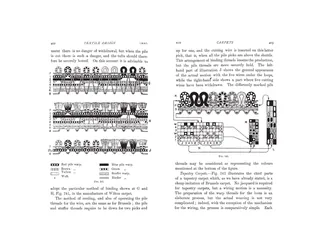
A comprehensive 1912 textbook on the technical design of woven textiles by two Scottish technical-college instructors. It works through plain, twill and sateen weaves, mock lenos, huckabacks, honeycombs, crêpes, spots, dice and diamond designs, damasks and jacquard mounting. It goes on to compound, backed and double cloths, three-ply and multi-ply fabrics, pile fabrics (velvets, plushes, carpets, terry), Bedford cords and piqués, gauze, leno, lappet and swivel fabrics, and silk picture weaving. The book is heavily illustrated with drawdowns, drafts and weaving plans, plus harness and card-cutting calculations for dobby and jacquard looms. Originally serialized in the Textile Manufacturer, it was aimed at jute and linen weaving and extended to general industrial textile design.
Shuttle-Craft Bulletin, Vol. XXX, No. 10 (October 1953)
Periodical · 3 pages
A three-page portfolio supplement to the October 1953 issue of the Shuttle-Craft Bulletin (Vol. XXX, No. 10). It consists of a decorated cover with a stylized loom drawing and two pages with mounted woven fabric swatches on green cards. The swatches appear to show open, lacy weave effects, including an eyelet-like band and a cross pattern formed by heavier bands in an open plain weave. No readable text or drafts are present in the scan.

Web
Article · 1 page
A very short dictionary-style entry from the first edition of the Encyclopedia Britannica defining a web as a tissue or texture of interwoven threads, with the lengthwise threads called the warp and the crosswise threads the woof. It refers readers to the entry CLOTH for more.
Imitation Gauze
Article · 1 page
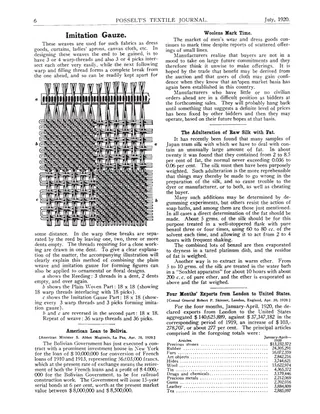
A short piece from Posselt's Textile Journal, July 1920, explaining how to combine plain weave with imitation gauze to form figures, using a cross-section diagram. It gives the reeding (3 threads per dent, 2 dents empty), the 18 x 18 plain and imitation gauze blocks, and a 36 x 36 repeat. The page also carries short trade notes on a U.S. loan to Bolivia, the woolen market, fat adulteration of raw silk, and London exports to the United States.
Handweaving News (August 1944): Handwoven Hats
Periodical · 2 pages
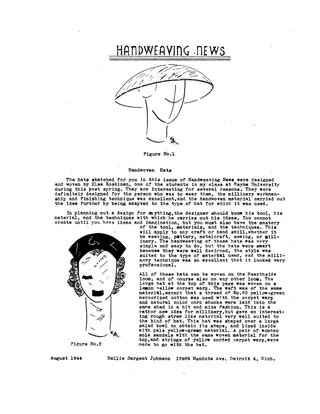
A two-page article from Handweaving News (August 1944) by Nellie Sargent Johnson describing handwoven hats designed and made by Elsa Koskinen, a student in her Wayne University class. It covers the hats' materials (carpet warp, rayon, wool, corn shucks), their construction and millinery finishing, and how to make display head forms from clay, plaster and pasted newspaper. The hats are all woven in simple tabby and can be made on a Hearthside loom.
Weaving
Chambers's Encyclopedia, 1881
Article · 1 page
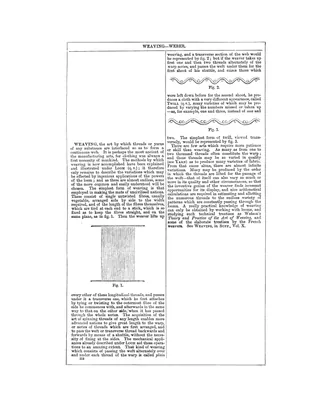
A short encyclopedia entry defining weaving as the interlacing of threads or yarns into a continuous web. It describes the simplest mat weaving of untwisted fibres tied to sticks, then plain weave and the basic twill, illustrated by three small diagrams (a warp setup and cross-sections of plain weave and simple twill). It notes the skill needed, warps of one to two thousand threads, and refers readers to Watson's treatise and related entries on Loom, Twill and Yarn.
Construction of Weaves, No. 1
Monograph · 19 pages · weaving drafts
First monthly part (May 1900) of Charles G. Petzold's textile-school text book on the construction of weaves, intended for designers, overseers, loom fixers and webdrawers. It opens with a preface, an illustrated abstract of contents, and an introduction on the three branches of the textile industry. It then covers plain weave, warp and filling rep, mixed or seedy rep, and twills and diagonals, including a method of laying out twills on a line plan and many numbered drawdowns from 3 to 16 harnesses. Portrait and pictorial plates (L. J. Knowles, Columbus Sighting America) and advertisements for loom makers and harness makers are included.
Construction of Weaves, Part 4
Article · 1 page · weaving drafts
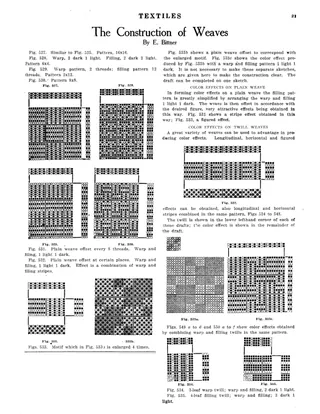
A single page from E. Bittner's series on the construction of weaves, showing figs. 527-535 with their captions. It covers color effects on plain weave, made by offsetting the weave with warp and filling arranged 1 light 1 dark, and introduces color effects on twill weaves, with 3-leaf warp twill and 4-leaf filling twill examples. The page mostly consists of drawdown-style drafts with short explanatory text.
Practical Weaving Suggestions, Vol. 1-69 (1969): Six Variations on a Plain-Weave Warp
Periodical · 4 pages
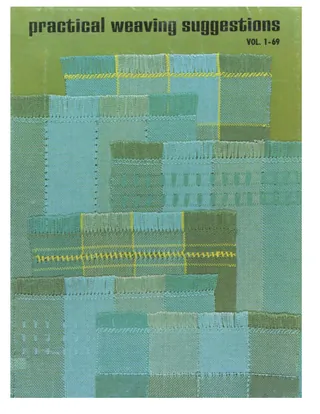
Project instructions by Mildred Dexter for weaving six table mats on one plain-weave warp on a Lily two-harness table loom. The warp is four colors of Lily size 3 mercerized pearl cotton, with warp and weft details, reed and sleying, and two on-loom end finishes (hemstitching and overcasting) illustrated with diagrams. Each mat uses a different decoration: Danish Medallion (three variations), Brooks Bouquet, supplementary warp in open areas, and wrapped warps. It ends with references to Harriet Tidball's monographs and an Irene Francisco booklet.
Summer Adventures in Weaving
Article · 2 pages
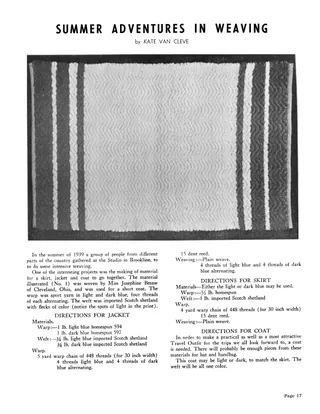
A short article from The Weaver describing projects woven at a summer 1939 weaving studio in Brookline. It gives warp and weft materials, sleying and threading details for a matching blue plain-weave jacket, skirt and coat, plus a twill skirt and jacket in white, grey and black. It ends with a note on a chenille rug in a shell pattern woven on a small-pattern threading such as honeysuckle.
Genealogy of Weaves
Master Weaver, September 1961
Article · 2 pages · weaving drafts
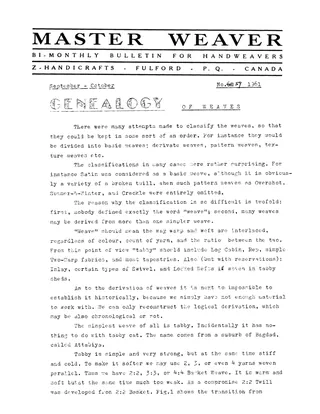
A short article from a handweavers' bulletin that discusses how weaves might be classified and traces a logical derivation of weave structures. It begins with tabby and moves through basket weave, 1:2 and 2:2 twill, herringbone, wave and diamond twills, then crackle and overshot, with summer-and-winter described as crackle on opposites. Two small figures illustrate the transitions, and the article ends with a note that it is to be continued.
Warp & Weft, Vol. 17, No. 9 (November 1964)
November 1964
Periodical · 9 pages · weaving drafts
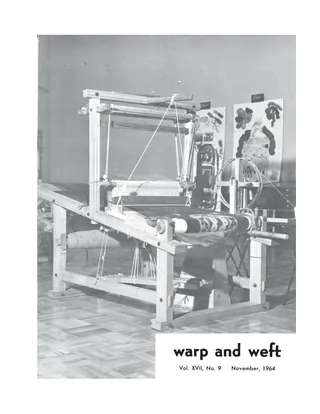
November 1964 issue of Warp and Weft, a monthly handweaving bulletin from Robin & Russ Handweavers in McMinnville, Oregon. It includes the editor's news column, a note on the Japanese Tsuzure-no-Nishiki silk brocade loom, a review of the book Crafts Design, and two projects. The first is a 4-shaft tweedy wool fabric, 'Fall Festival', with threading, tie-up, treadling, yarn costs and finishing tips. The second is a plain-weave guest towel in ten warp colors with color-block cotton lace weft. The issue ends with classified ads and a marketplace page.
Practical Weaving Suggestions, Vol. 3-71 (1971): Quesquemitls
Periodical · 6 pages · weaving drafts
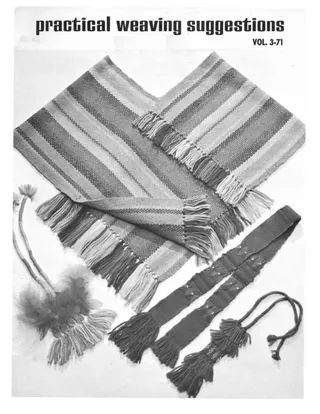
A 1971 issue of Lily Mills' Practical Weaving Suggestions bulletin by Doris Clement on weaving quesquemitls (poncho-style capes) from a single striped Wintuk Orlon warp woven in tabby. It gives warp colors, sett, color sequence and weft combinations for two quesquemitls, methods for changing the selvage stripes (repair heddles, cut reed sections), and step-by-step assembly diagrams. It also includes patterns for a reversible feathered necklace, a blue necklace with Gordian knots, and a blue belt, with drafts for 4-shaft threadings.
Warp & Weft, Vol. 12, No. 8 (October 1959)
October 1959
Periodical · 8 pages · weaving drafts
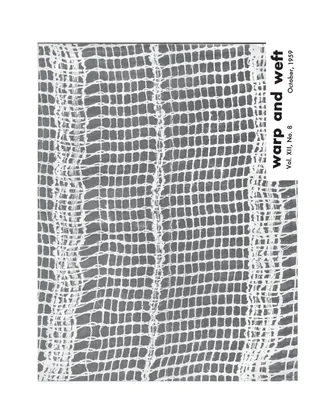
October 1959 issue of Warp and Weft, a monthly handweaving periodical from Robin & Russ Handweavers in Santa Barbara. It includes the editor's shop news (a 65-yard silk drapery order), a note on the leno/gauze cover sample, a profile of San Francisco weaver Edith Garland, and a project, "Kozy Korners", a plain-weave curtain fabric in doubled 8/2 drapery cotton and single 20/2 black Egyptian cotton with a four-shaft threading draft, tie-up, treadling and cost per yard. It also has a story on North Hollywood weaver Marie Walling, a reader's letter from a disabled weaver, a review of Zielinski's Encyclopaedia of Handweaving, and loom and yarn advertisements.
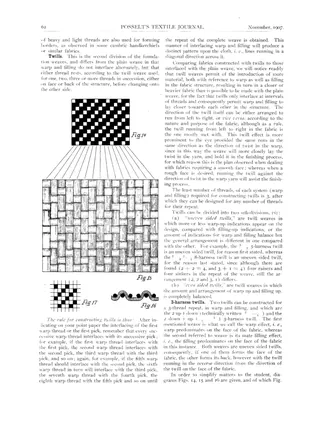
Wool, Cotton and Silk Designing and Fabric Structure for Harness Work: Lesson 2.
Article · 4 pages · weaving drafts
Lesson 2 of Posselt's textile school series on designing and fabric structure for harness work. It introduces the three foundation weaves (plain, twill, satin), the idea of the weave repeat, and the plain weave with its fabric properties and repp variations. The lesson then covers the construction of twills, with even-sided and uneven-sided twills enumerated for 3 to 8 harnesses, illustrated with point-paper diagrams (Figs. 10-49). It closes with review questions for students.
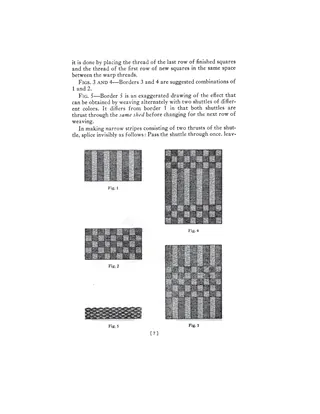
The Madmar-Bush Lap Loom
Other · 12 pages
Instruction booklet for the Madmar-Bush Lap Loom, a small frame loom with a slotted heddle-beater, issued by Madmar Quality Co. of Utica, New York. It explains weaving terms, materials, assembling and stringing the loom, weaving technique, selvages, shaping, and removing work from the loom. Further sections cover color and simple striped and checked border designs, dyeing, weaving with silk stockings, cotton rag rugs woven as squares, preparing old yarn, and a project for a pleated zipper purse.
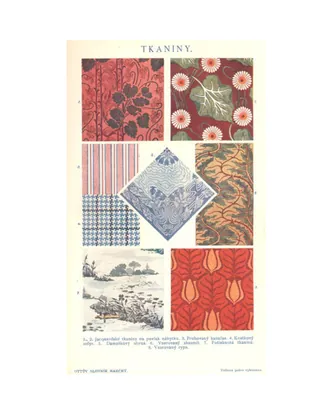
Tkaniny [Woven Fabrics]
Article · 4 pages · Czech · weaving drafts
Encyclopedia article "Tkaniny" (Woven Fabrics) from Ottův slovník naučný, with a plate of eight fabric samples. It classifies woven fabrics (simple, reinforced, double, embroidered, brocaded, pile, gauze, patterned, printed, ribbons and tapes) and explains the plain, twill and satin weaves. Small diagrams show a double-weft weave and cross-sections of double, hollow, velvet and double-plush cloth. The article ends with a section on finishing (appretura) for cotton, linen, jute, wool, worsted and silk fabrics, and a short bibliography of German works.
Warp & Weft, Vol. 5, No. 5 (May 1952)
May 1952
Periodical · 8 pages · weaving drafts
May 1952 issue of the monthly newsletter Warp & Weft, edited by Gladys Rogers Brophil. It includes weaving news (a Wisconsin handweavers' exhibition, an English guild, the Chicago Natural History Museum fabric library) and the monthly sample, 'Centuria', a textured tabby upholstery fabric combining wool, leather lacing and jute, with a threading draft, tie-up, sley and yarn details plus variations for drapery and sheer fabrics. Other items are a review of Mildred Fischer's article on three Finnish weavers, a Questions and Answers piece on winding several yarns on one shuttle (with a multi-spool rug shuttle diagram), a poem, a review of Gladys Reichard's Navajo Shepherds and Weavers, and classified ads.
Technology of Textile Design
Book · 327 pages · weaving drafts
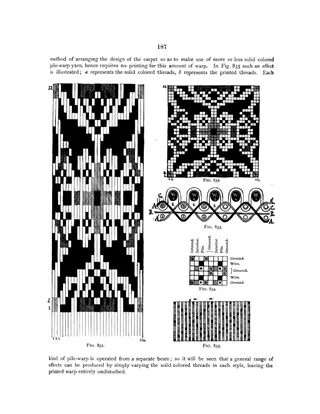
A fourth-edition textbook on the construction and design of woven fabrics for industrial textile manufacture. It covers foundation weaves (plain, twill, satin), drawing-in drafts, and a long series of derivative weaves: rib, basket, steep and curved twills, granite, honeycomb and imitation gauze. Later sections treat fabrics with extra warp or filling, lappet and tricot weaves, double and multi-ply cloth, pile fabrics (velvet, plush, chenille, carpets), Jacquard harness and card cutting, and gauze weaving. Appendices include fibre testing, yarn counting and silk-size tables, and metric conversion tables. The book is heavily illustrated with drawdown grids and machine diagrams, and has advertisements for loom and machinery makers at front and back.
Textiles or Textile Fabrics
Article · 3 pages
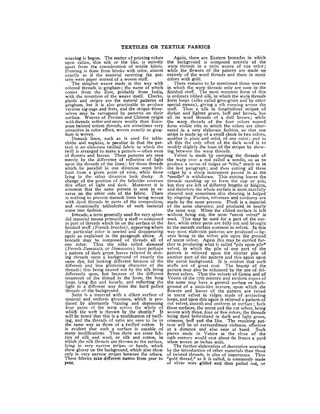
An encyclopedia article defining textiles or textile fabrics and explaining in general terms how woven cloth is made. It covers the basic action of the loom, plain weave, twill, satin, gingham, damask, brocade, ribbed silks and velvet (cut, uncut and pile upon pile), plus metallic threads and a brief history of decorative weaving in Egypt, Western Asia and Europe. It closes with a bibliography of works on textile design, Oriental carpets, medieval fabrics and church vestments.
Tissu [Fabric]
Article · 7 pages · French · weaving drafts
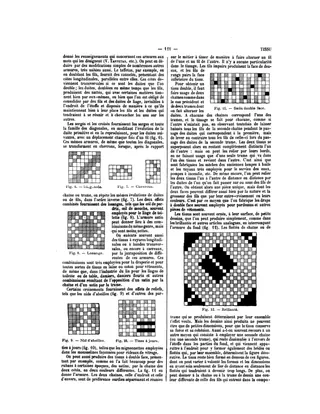
Encyclopedia article "Tissu" (fabric) from the French Grande Encyclopédie, mainly on the textile industry. It explains warp, weft, and weave structure (armure), and how weaves are notated on point paper (mise en carte). It surveys the fundamental weaves (plain, twill/croisé, satin), their derivatives (cannelé, natté, chevron, lozenge, honeycomb, openwork, brillanté), double-face and double cloth, supplementary warps and wefts for brocading, matelassé and piqué, and damask design. Illustrated with small weave diagrams. It closes with French and world textile production statistics for 1840-1896, a short section on tissue in anatomy and physiology, and a long bibliography on textiles and weaving.
Weaving
Article · 4 pages · weaving drafts
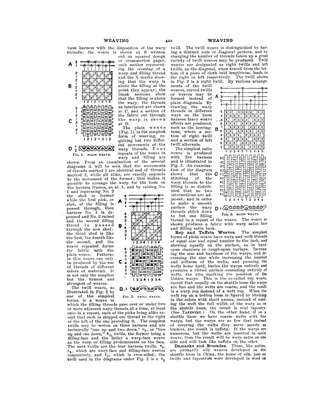
An encyclopedia article defining weaving and explaining the three fundamental weaves (plain, twill, satin) with diagrams of harness threading, squared drafts, interlacement and cross-sections. It also covers rep, taffeta, damask, brocade, velvet, gauze, leno, lappet and swivel weaving, and shows how drawing-in can reduce the number of harnesses needed for a repeat, with harness chain control and the Jacquard machine mentioned. The treatment is mostly from the viewpoint of power-loom and industrial weaving.
Études analytiques des principaux tissus [Analytic Studies of the Main Fabrics]
Book · 68 pages · French · weaving drafts
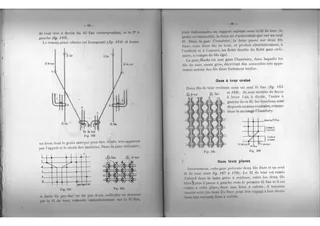
An 1898 French technical treatise by André Simon analyzing the principal woven fabrics by their interlacement of warp and weft, with 219 original figures placed in the text. It is organized in three groups: fabrics with straight threads, pile fabrics (velvets), and gauze fabrics with twisted threads. Chapters cover loom parts, drafting and threading (rentrage, empoutage), plain, twill and satin weaves, double cloth, piqué and matelassé, pleated fabrics, brocading, bead fabrics, warp and weft velvets, leno-type gauzes, and chenille. Many pages carry drawdowns, threading diagrams and mechanism drawings for hand looms, dobby and Jacquard harnesses.
Mexican and Danish Weaving
Article · 2 pages
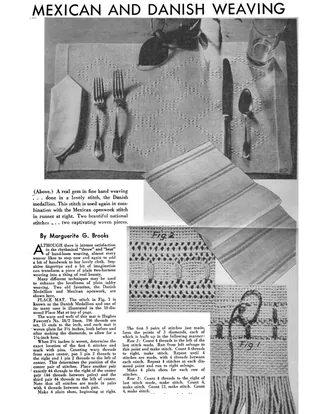
A short magazine article by Marguerite G. Brooks giving instructions for adding hand-manipulated stitches to plain tabby weaving on a two-harness loom. It explains how to make a place mat with 18 Danish Medallion (Danish Diamond) stitch diamonds, and a runner combining Danish stitch with Mexican openwork (Mexican lace). Directions cover linen yarn sizes, sett, thread counts, stitch placement with pins, and row-by-row diamond construction using a crochet hook and shed stick.
Woven Fabric and Art of Weaving the Same, US Patent No. 1775144
Patent · 6 pages · weaving drafts
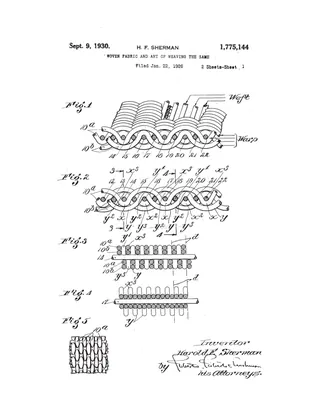
US Patent 1,775,144, granted 9 September 1930 to Harold F. Sherman of Northboro, Massachusetts, for a dense single-ply woven fabric and the method of weaving it. Warps are woven in pairs, one lying over the other, with straight wefts in a median plane. Alternate 'key' wefts are bound by warp bights and intervening wefts hold the bights tight. The fabric repeats on four ends and four picks and is intended as a broadcloth-like material for collars and cuffs. The patent has two sheets of drawings (Figs. 1-7, including a weave diagram and drawing-in draft), a description, and 15 claims.
Stripes
Master Weaver, September-October 1962
Article · 3 pages
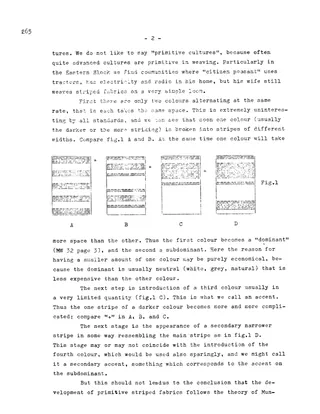
A short essay from the Master Weaver bulletin on the development and design of striped fabrics. It traces how stripes in weft and warp evolved in primitive weaving, from two alternating colours to dominant, subdominant and accent stripes, illustrated with four sample panels. It closes with six suggestions for designing stripes, including blending colour ratios, unsymmetrical stripes and changing the rhythm, and notes suitable weaves such as tabby and broken twills.
Woven Fabric with Machine-Readable Code, US Patent No. 6296022
Patent · 8 pages
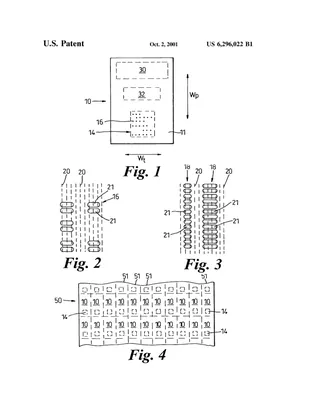
US Patent 6,296,022 (granted 2 October 2001) to John Charles Lowe, assigned to J&J Cash Limited of Coventry, describes a woven label with a machine-readable code formed by an array of dots. The dots are weft floats on a plain-weave (taffeta) ground, woven on an electronically controlled jacquard loom, and can form a two-dimensional dot code or a one-dimensional bar code. The document gives the claims, a description, a yarn example (110 dtex textured polyester, 0.5 mm dots), and four figures showing the label, the dot floats and ribbons of labels woven side by side. It appears both as a USPTO web database printout and as the patent's own pages.
Casual Table Mats
Article · 2 pages
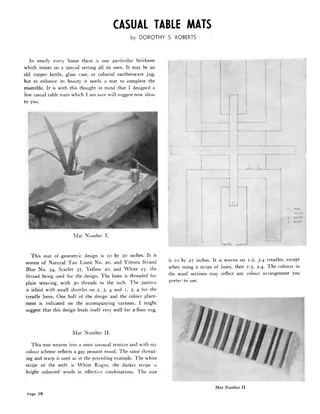
A short article from The Weaver describing four casual table mats designed by Dorothy S. Roberts, each about 10 inches wide and 12 to 27 inches long. All are woven on plain-weave threadings. Mat I has an inlaid geometric design in linen and Vittora Strand, with a cartoon for the colour placement. Mats II to IV are striped, using wool and linen wefts, with a weft-faced technique said to resemble Navaho rug texture. The article gives yarns, colours, sizes, reed and treadling details, and the stripe sequence for Mat IV.
Color Effects
Article · 1 page · weaving drafts
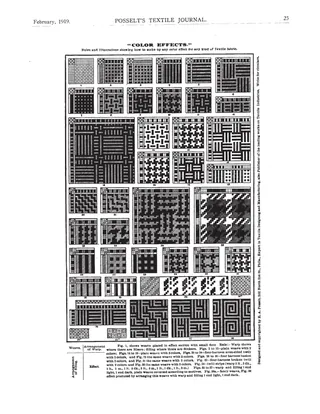
A single-page installment of Posselt's "Color Effects" series from Posselt's Textile Journal, February 1919, giving rules and 38 numbered illustrations of how color arrangements in warp and filling combine with weave to produce color effects. Examples cover plain weave in 2 and 3 colors, four-harness even-sided twill, four-harness basket, broken twill, a twill stripe, and a fancy weave. The rule given is that warp color shows where there are risers and filling color where there are sinkers.
The Construction of Weaves, Part 2
Article · 1 page · weaving drafts
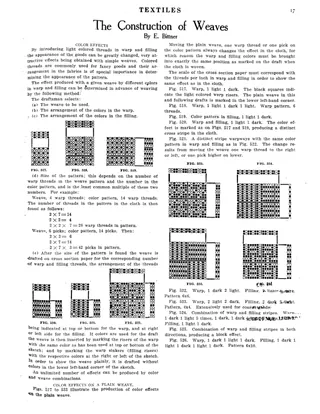
A single-page installment of E. Bittner's series on the construction of weaves, covering color effects. It explains how to work out in advance the look of a weave with colored warp and filling threads, including finding the pattern size as the least common multiple of the weave and color repeats, and drafting on cross-section paper. Figures 517 to 526 show color effects on plain weave, such as cross stripes, warp stripes and block effects, each with a caption giving the color order.
Handweaving News (June 1944): Primitive or Picture Frame Loom
Periodical · 3 pages
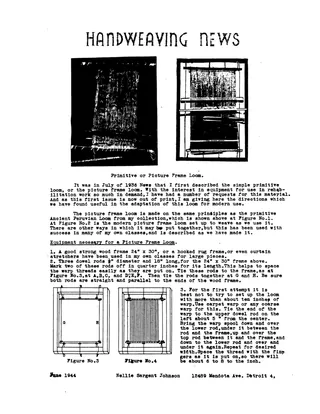
A 1944 Handweaving News article by Nellie Sargent Johnson giving step-by-step directions for building and warping a primitive (picture frame) loom, adapted for modern use and rehabilitation work. It covers the frame and dowel rods, winding and spacing the warp, setting up shed sticks and a heddle rod with looped cord heddles, and weaving plain weave (tabby). It closes with advice on keeping edges straight and a note on the loom's possibilities, including tapestry, knot techniques, brocading, gauze weave and twills. Illustrated with photographs and numbered line diagrams.
Handweaving on Loom Frames, The Kircher Loom
Article · 6 pages
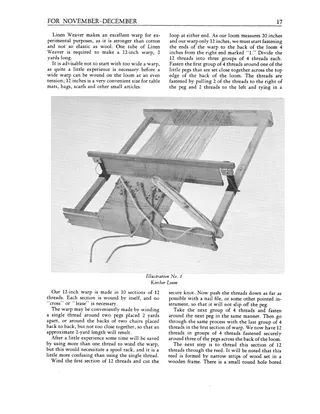
Part Two of Cecelia Cleveland Willard's four-part series on handweaving on loom frames, devoted to the Kircher loom, a small German-made hardwood frame loom with a reed that raises both sheds and serves as a beater. It gives directions for assembling the loom, making and winding a 12-inch linen warp, threading the reed, and weaving plain (tabby) weave. It also covers a striped and patterned border on a luncheon mat in two colors, advancing the warp, and fixing common errors such as threading mistakes and doubled weft. A short note at the end describes a traveling exhibit of bag weaving assembled by Mrs. Nellie S. Johnson of Detroit.
The Influence of the Twist of the Yarn upon the Fabric
Article · 2 pages
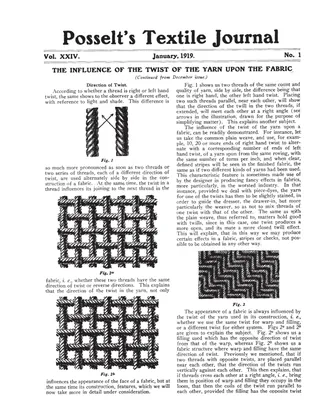
A continuation of a serialized article from Posselt's Textile Journal on how the direction of yarn twist (right-hand or left-hand) affects the look and construction of woven fabric. It explains light-and-shade effects, stripes made by alternating twists in plain weave and twills, and what happens when warp and filling have the same or opposite twist. Diagrams of enlarged fabric structures in a 3/3 six-harness twill show combinations of warp and filling twist, with practical advice for mills on keeping the twists separate.
Net Weaves, First Sampler
Master Weaver, July 1958
Article · 2 pages
A short article from Master Weaver on making a first sampler in net weaving, a technique that uses a special comb to open net sheds and a rigid weft inserted among tabby ground picks. It covers warp choice (cotton 10/2 at 24 ends per inch), suitable threadings, and materials for the rigid weft: wood strips, bamboo and bulrushes. It then gives instructions for six samples that vary the spacing of tabby picks, the number of strips, and the comb position. It ends with ideas for further experiments and for advanced work with doup leno and double weaves.
Plaids
Monograph · 14 pages
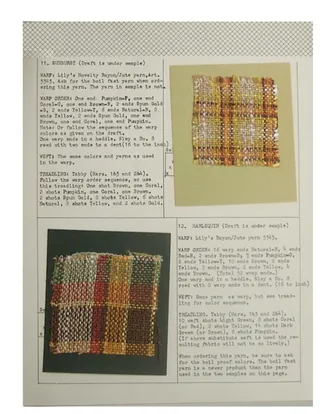
A folio of 24 plaid fabric patterns by Elmer W. Hickman, issued under the Onondaga Weavers Guild emblem, with woven swatches mounted on each page and drafts placed beneath them. Each entry gives the warp yarns, warp order, reed and sley, weft, and treadling. Most are tabby plaids; a few are twill or use other treadlings. The last page, titled Tabby Talk, explains the diffused construction in which the warp color counts are rotated to set the weft shot counts (illustrated with Thistle). It also gives helpful hints, thanks to contributing weavers, and a list of yarn suppliers.
208 documents found