Textile Documents › Topic: Ikat, batik, and resist dyeing
90 documents found
Sort: 
Jaspé
Article · 3 pages
Mary Meigs Atwater describes her experiments with jaspé, a tie-dyed warp or weft effect seen in ancient Peruvian and Guatemalan weaving. She explains stretching the weft on a frame (a spool-rack), wrapping and tying dots and dashes to resist the dye, then dyeing, unwrapping and weaving the weft. She recommends weft-dyeing for standard looms, mentions materials that worked well or poorly, and suggests using the jaspé in stripes and offsetting the weft slightly for a softer look. Illustrations show the wrapping method and a tying frame.
Specification of the Patent Granted to Mr. George Jeffreys for a Method of Dying Woollen Cloths, Stuffs, and Other Materials ...
Article · 15 pages
Text of George Jeffreys' patent (dated March 18, 1791) for a resist method of dyeing woollen cloths and stuffs in stripes, figures and patterns. A hot composition of powdered tobacco-pipe clay and tallow is applied through perforated brass grates to keep chosen areas from taking dye, and is later removed with fuller's earth. The text describes the brass grate, sliding frame and a machine for striping whole lengths of cloth, plus a frame for holding the cloth in the dye kettle. Two engraved plates (XVI and XVII) illustrate the apparatus.
The Batik
Article · 2 pages
A short how-to article by Hilda L. Frost on making a batik on silk using paraffin wax resist and successive dye baths from light to dark. She covers materials, dye suppliers, design and color harmony, and walks step by step through making a batik of a castle scene. Two photographs show finished batiks, a castle scene and a floral design.
Dyeing by Aid of Electricity
Technical World, September 1912
Article · 1 page
A short magazine item describing how the Javanese wax-resist method (batik) is used to create colored designs on silk and velvet. Liquid wax is applied to protect areas from the dye, the process is repeated for additional colors, and the wax is then washed out with benzine. The article notes that electrically heated apparatus now keeps the wax at an even temperature so it flows regularly.
Jaspé Combined with Patterns
Shuttle-Craft Bulletin, 1957
Article · 1 page · weaving drafts
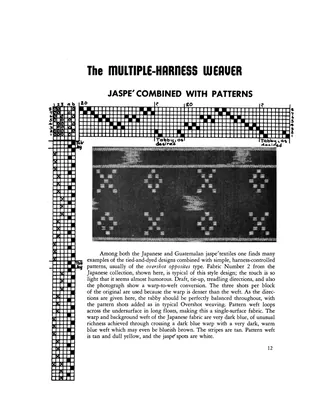
A one-page article from the Multiple-Harness Weaver column of the Shuttle-Craft Bulletin on combining jaspé (tied-and-dyed) designs with simple harness-controlled patterns, as in Japanese and Guatemalan textiles. It discusses a Japanese fabric (Fabric Number 2) with an overshot opposites-type pattern, and gives the draft, tie-up and treadling with a warp-to-weft conversion. It also describes the colors and the single-surface structure of the fabric, and includes a photograph.
Pre-Spanish Peruvian Ikat
Article · 6 pages
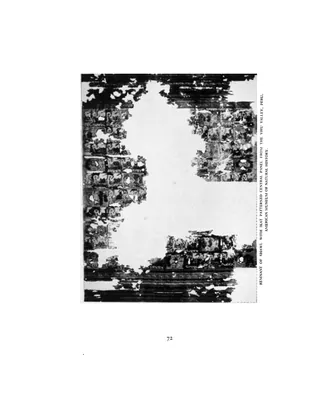
Junius Bird describes a single pre-Spanish Peruvian ikat textile from the Huaca de la Cruz in the Viru Valley, held by the American Museum of Natural History. He covers its size, construction in five sewn strips, cotton yarn and paired warps, and the warp-ikat pattern of human and bird figures. He analyzes the weaver's miscalculations in the warp counts and the later painted dye, and concludes that ikat was probably not a traditional technique in northern Peru. The article ends with a list of published references to ancient Peruvian ikats, and includes a photograph, pattern-row details and a diagram of the dyed figures.
Shibori and "Kasuri": Two Forms of Indigo Dyeing in Japan
Article · 3 pages
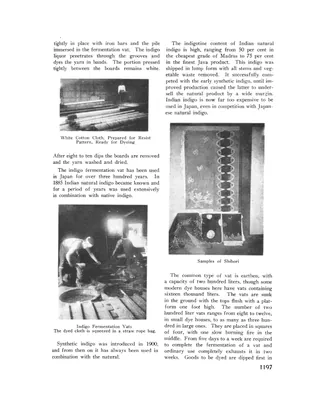
A short 1930 article by N. Takata describing two Japanese indigo resist-dyeing methods: shibori (tied or bound cloth dyed after piece weaving) and kasuri (yarn resist-dyed before weaving). It covers binding and board-clamping techniques used in Yamato and Ohmi, the dipping sequence through fermentation vats, and the history of natural, Indian and synthetic indigo in Japan. It closes with vat dimensions, a general recipe for a 200-liter vat, and temperature control. Photographs show finished kasuri cloth, prepared resist cloth, indigo vats and shibori samples.
Batik, or the Wax Resist Process
Article · 4 pages
Article by Professor Charles E. Pellew of Columbia University, number XI in a series on dyeing for craftsmen, introducing batik, the wax resist process. It covers the history of batik in Java and Madras, Javanese garments and methods, and the tools (tjentang or "teapot", brass stamping blocks, a patented wax pencil). It also covers wax mixtures (paraffin, beeswax, ceresine, rosin), modern dyes for cotton, linen, silk, wood, leather and bone, and acid etching of bone, metal and wood after waxing. A short note on indigo stencil paste follows on the last page.
The Bulletin of the Needle and Bobbin Club, Vol. 15, Nos. 1 & 2 (1931)
Periodical · 73 pages
Double issue (Vol. 15, Nos. 1-2, 1931) of the Bulletin of the Needle and Bobbin Club, devoted mainly to Charles F. Iklé's illustrated article on ikat technique and Dutch East Indian ikats. The article defines ikat (resist-dyeing of warp and/or weft threads before weaving), distinguishes it from batik and plangi, and describes the binding and dyeing process. It surveys ikats island by island (Sumatra, Java, Bali, Borneo, Celebes, the Timor group, Soemba, New Guinea), covers double ikat from Tenganan and Indian patola, the toempal motif, the spread of ikat worldwide, and native customs and beliefs around dyeing and weaving. It closes with a bibliography, followed by Club Notes for 1931-1932 with illustrated textiles and costumes, Book Notes, officers, and advertisements.
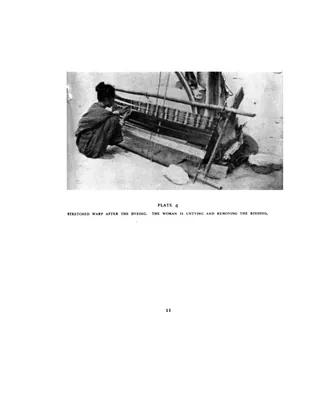
Ikat Technique and Dutch East Indian Ikats
Article · 59 pages
An illustrated article by Charles F. Iklé explaining the ikat technique, in which warp or weft threads are bound with agel fibre, resist-dyed and then woven, and distinguishing it from batik and plangi. It surveys ikat in the Dutch East Indies (Sumba, Sumatra, Bali, Borneo, Celebes, Roti, Savu, Timor, New Guinea) and the double ikats of Tenganan and of Gujarat (patola). It also covers early examples such as Egypto-Arabic pieces and the Ajanta frescoes, the toempal motif, the worldwide spread of ikat, dyes, and native beliefs about dyeing. About 30 plates, a map and a bibliography accompany the text.
Resist
Article · 1 page
A short dictionary entry defining 'resist' in dyeing: a material applied to cotton cloth to keep a mordant or dye from fixing in patterned areas. It distinguishes mechanical resists (fat, paste) from chemical resists, and describes calico-dyeing with a copper resist in an indigo vat, the china blue process, and the discharge process for black, red or chocolate with white.
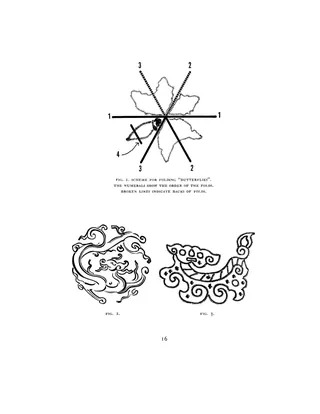
Stitch-Resist Dyed Fabrics of Western China
Article · 20 pages
Carl Schuster describes a folk tradition of stitch-resist dyeing practiced by women in Szechuan, Kweichow and Yunnan in western China. The cloths are mostly indigo-dyed cotton bedspreads, bed valances, bundle wrappers and hangings. He explains the folding, stitching and cord-resist methods, compares them with plangi and tritik, and discusses the motifs (lotus, herons, butterflies, lions, fish, Taoist symbols). Six plates, a frontispiece and an end-piece show specimens from his 1932-1938 collection. Extensive notes cite literature on resist dyeing in China, Indonesia and West Africa.
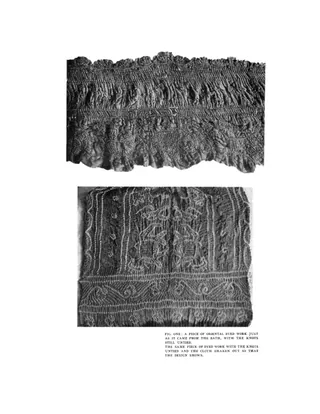
Tied and Dyed Work: An Oriental Process with American Variations
Article · 7 pages
A 1909 Craftsman article by Professor C. E. Pellew of Columbia University describing tied-and-dyed (tie-resist) work, an ancient Indian process, and how it can be adapted with modern sulphur and vat dyes. It covers the Rajputana and Kotah Chunari tradition, the general resist, discharge and direct-application methods, and practical tying techniques using marbles, loops and folds. It also describes the author's own "tied and discharged" experiments with bleaching powder and a four-color silk scarf built up by successive dye baths. Illustrated with photographs of dyed samples.
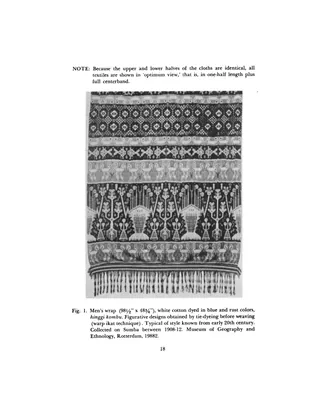
Classic and Eccentric Elements in East Sumba Textiles
Article · 39 pages
A field report by Monni Adams on the men's ceremonial wrap cloths (hinggi) of East Sumba, Indonesia, made in warp ikat from cotton dyed with indigo and rust-red mengkudu. It describes the classic banded layout and figurative motifs (skull trees, horses, deer, shrimp, roosters), royal and privileged designs, the dyeing and binding process, and warp-faced weaving on a backstrap loom. It also traces changes under Dutch administration, commercial dyes and new regional styles, and discusses the cultural context of ritual and gift exchange. Many photographs show museum textiles, related ritual objects, and step-by-step field photos of tying, dyeing, lining-up and weaving.
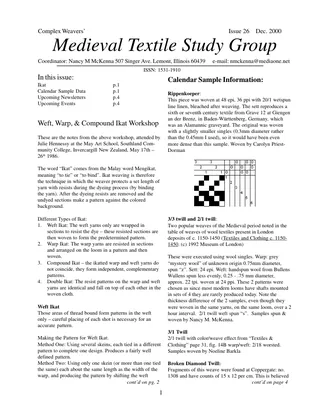
Complex Weavers Medieval Textiles Study Group Newsletter 26
Nancy M. McKenna · December 2000
Web Doc · 4 pages · weaving drafts
Issue 26 (December 2000) of the Complex Weavers Medieval Textiles Study Group newsletter. It reproduces workshop notes on weft, warp and compound ikat: definitions, the types of ikat, methods for making weft skeins, warp ikat procedure, dyeing experiments and warp shifting devices. It also gives technical details for the year's calendar samples (Rippenkoeper, 3/3 and 2/1 twill, 3/1 twill, broken diamond twill, and a Wabengewebe honeycomb with twill ground), with drafts for the Coppergate samples, and lists upcoming events and newsletter deadlines.
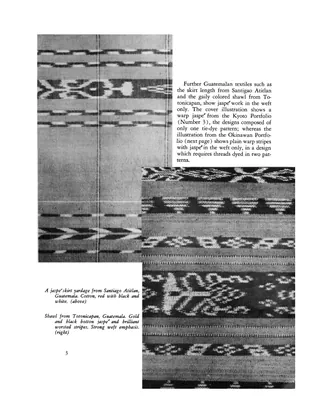
Jaspé
Article · 13 pages · weaving drafts
An article from the Shuttle-Craft Bulletin by Harriet Tidball on jaspé, the resist-dyed (tie-dyed, ikat, chiné) yarn technique, with emphasis on weft jaspé for handweavers. It surveys examples from Turkestan, Mexico, Guatemala, Okinawa and Japan, then gives instructions for winding and tying skeins, four tie arrangements, dyeing, and placing spots in tabby-woven borders. It also covers selvage handling, design and balance advice, a stripe-by-stripe weaving sequence for a Japanese-style fabric, and practical uses.
Notes on Dyeing and Weaving as Practised at Sitiawan in Perak
Article · 4 pages
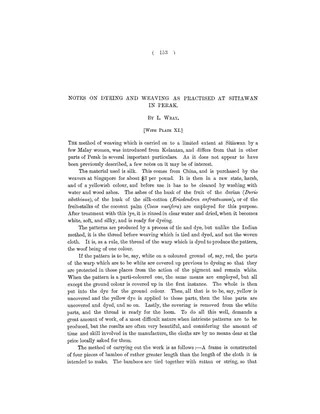
A short 1902 article by L. Wray describing silk weaving by Malay women at Sitiawan in Perak, a method introduced from Kelantan. It explains how raw Chinese silk is degummed with ash lye, how warp bundles are tied with waxed thread and banana-stem strips on a bamboo frame, and how they are dyed in stages with lac, kadrang, turmeric and purchased blue and green dyes. It also describes a diamond-patterned sarong with gold-thread weft and the supplementary gold flower patterning added during weaving. A plate shows the tied warp on the frame and a silk sarong in the Perak Museum.
Plangi Technique
Article · 22 pages
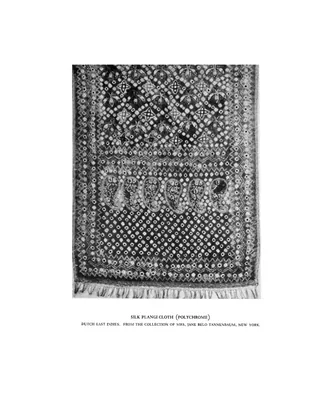
Charles Iklé's article surveys plangi, the tie-and-dye resist technique in which cloth is gathered, bound and then dyed. It compares plangi with ikat and batik, then describes the main methods: pebble-and-thread puckering in Java, Indian bandhana work, West African pleat-and-tie, and an ancient Peruvian rolled-cloth method. It also covers related resist methods such as shirring, sewn cords, leaf and bamboo resists, and the Japanese kyokechi zome. A step-by-step account of making a two-color silk plangi cloth in Samarang, Java is followed by notes on ancient examples and the present-day distribution of plangi worldwide, with maps and a bibliography. It is illustrated with photographs of cloths from the Dutch East Indies, Japan, Peru, Mindanao and Mexico, plus process diagrams.
Shuttle-Craft Bulletin, Vol. XXX, No. 8 (August 1953)
Periodical · 16 pages
August 1953 issue of the Shuttle Craft Guild Handweaver's Bulletin, edited by Harriet and Martin Tidball. It explains warp painting (chine): painting designs on a tensioned warp on the loom, with a board set-up, paint and extender advice, design suggestions drawn from Okinawan textiles, and uses. It then describes warping on the horizontal warping reel (Shuttle Craft equipment made by Gilmore), including step-by-step spiral warping and beaming from the spiral warp. It closes with a progress report on the Ceylon equipment fund and an announcement that the Guild is moving from Virginia City, Montana, to Kelseyville, California.
Telas de Los Muertos - Resist-Dyeing
Article · 3 pages
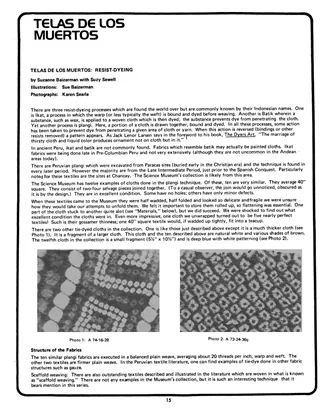
An article from the Minnesota Weaver's series on the Science Museum's collection of ancient Peruvian textiles, focused on resist-dyeing. It introduces ikat, batik and plangi, then describes twelve plangi (tie-dyed) cotton cloths, probably from Chancay, in the museum's collection, including their plain-weave structure, materials, probable tie-dye process and designs. It also explains scaffold weaving, in which the weft becomes the warp so that cloths can be tie-dyed, with line drawings and two photographs.
Art of Batik in Java
Article · 78 pages
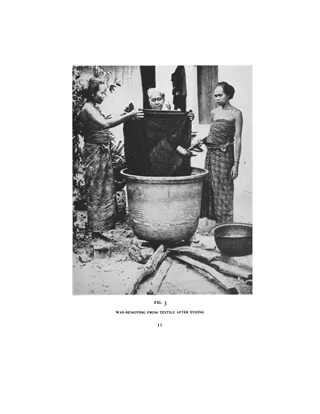
A monograph-length study by Tassilo Adam, former ethnologist of the Netherlands East Indies Government, on the wax-resist art of batik as practiced in central Java, especially Jokjakarta and Solo. It covers preparation of cotton and silk, wax application with the tjanting, indigo and soga-brown dyeing, and wax removal. A large section classifies traditional designs (swastika-derived, tjeplokkan, kawoeng, parang, floral and wing motifs, forbidden royal patterns) with their Javanese names and meanings. It closes with sections on batik dress forms (headcloth, sarong, dodot), block-printed batiks, a bibliography, an index and a list of illustrations; many plates of line drawings and photographs illustrate the designs.
The Bulletin of the Needle and Bobbin Club, Vol. 55, Nos. 1 & 2 (1972)
Periodical · 54 pages
Double issue of the Needle and Bobbin Club Bulletin (Vol. 55, Nos. 1 & 2, 1972) devoted mainly to Monni Adams's field report on East Sumba ikat textiles. The article covers the men's hinggi cloths, their warp-ikat tying, dyeing with indigo and mengkudu rust, lining-up and weaving on a frameless two-beam loom. It also treats design motifs (skull trees, horses, deer, patola ratu), royal patronage and gift exchange, and changes in style through the 20th century. Many photographs show museum cloths, craft processes and related engraved objects. The issue also has book notes on printed and dyed textiles and chintz, notes on authors, club notes, an In Memoriam and advertisements.
Clever Fingers Make Beautiful Fabrics
Article · 5 pages
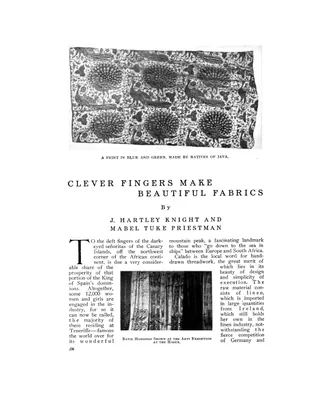
A 1911 popular magazine article on two decorative textile crafts: Calado drawn-thread work and cushion lace (rueda) made by women on Tenerife in the Canary Islands, and batik as practiced in Java and developed in Holland. It covers the history and export organization of Calado work and describes the batik process of wax resist and dye baths, with stencil and tool alternatives. Illustrated with photographs of Calado specimens, factory workers, batik hangings, a batik-decorated chair and settee, and a royal christening robe.
Primitive Stoffmusterungen [Primitive textile patterning]
Other · 39 pages · German
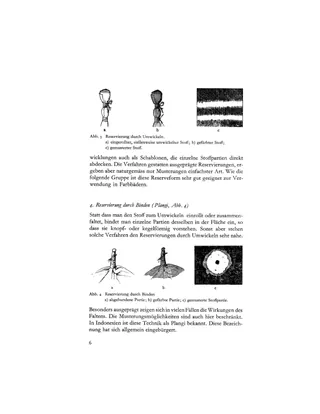
Guide to a special exhibition on resist-dyed textile patterning held at the Museum für Völkerkunde and Schweizerisches Museum für Volkskunde, Basel, in 1953. The introduction classifies resist methods for cloth (folding, sewn/tritik, wrapping, tying/plangi, stencil, paste and wax/batik, negative resist with mordants) and for yarn (warp ikat, weft ikat, double ikat), with diagrams and notes on dyeing. A room-by-room catalog lists objects by region, followed by plates of textiles from Africa, Asia, Indonesia, Egypt, Peru and Europe. No weaving drafts are included.
The Bulletin of the Needle and Bobbin Club, Vol. 25, No. 2 (1941)
Periodical · 35 pages
Issue of the Needle and Bobbin Club's Bulletin (Vol. 25, No. 2, 1941) devoted largely to Charles Iklé's article on the plangi (tie-and-dye) resist technique. The article covers the main plangi methods, a step-by-step account of making a polychrome plangi cloth in Samarang, Java, related resist methods, ancient examples from Peru, Japan, Nara, Khotan and the American Southwest, present-day centers worldwide with maps, and a bibliography. A second article by Betty Kurth describes an early 17th-century Swiss wool-embroidered genealogical panel of the Morell family. The issue ends with Club Notes for 1941-1942 and a list of directors and officers.
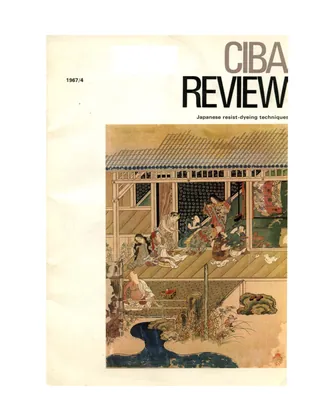
Ciba Review (c. 1967)
c. 1967
Periodical · 52 pages
Issue 1967/4 of CIBA Review devoted to Japanese resist-dyeing techniques. Articles cover the history of Japanese fabrics, fibres, spinning and weaving, yarn resist-dyeing (kasuri), fabric resist-dyeing (shibori, resist-paste, stencil), natural dyes and pigments, and the symbolism of kasuri motifs on futon coverlets. The back of the issue has CIBA company news and technical notes on printing triacetate/polyamide blends, Lanasol dyes on wool and silk, and Cibacron dyeing. It is illustrated with photographs, woodcuts and a map of Japanese textile centres.
The Bulletin of the Needle and Bobbin Club, Vol. 18, Nos. 1 & 2 (1934)
Periodical · 96 pages
Double issue (Vol. 18, Nos. 1 & 2) of the Needle and Bobbin Club Bulletin, devoted mainly to Tassilo Adam's long illustrated study of batik in Java. The article covers the history and name of batik, preparing cotton and silk, the tjanting wax pen, wax-resist and indigo and soga brown dyeing, and a classified survey of designs (parang, kawoeng, semen, and others) with many line plates. It also treats court-proscribed patterns (larangan), headcloth and sarong dress, and block-printed batik, and ends with a bibliography, index and list of illustrations. The back matter has Club notes, exhibition notices (American embroideries, Peruvian weaves, the Arthur B. Davies textile collection), current notes on lace classes, and short magazine reviews.
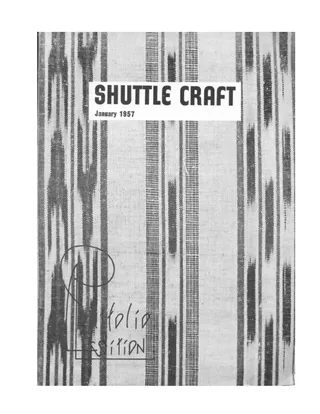
Shuttle-Craft Bulletin (January 1957)
Periodical · 42 pages · weaving drafts
January 1957 issue (Vol. XXXIV, No. 1) of the Shuttle Craft Bulletin, the Portfolio Edition, devoted to jaspé (ikat, tie-and-dye resist) weaving. Harriet Tidball's lead article covers jaspé textiles from Turkestan, Mexico, Guatemala, Japan and Okinawa, preparing tie-dye weft skeins, weaving borders, designing with weft jaspé, and combining jaspé with overshot patterns, with a Mary Meigs Atwater reprint from March 1943. Other items include Elmer Hickman's four-harness Waffle Lace with drafts, a book review column by Boris Veren, a sampling article by Grayce Perk, a fashion report on handwoven dinner skirts, and the Loom-Side Market with supplier notes and a directory of handweaving services.
Textiles Exotiques [Exotic Textiles]
Other · 47 pages · French
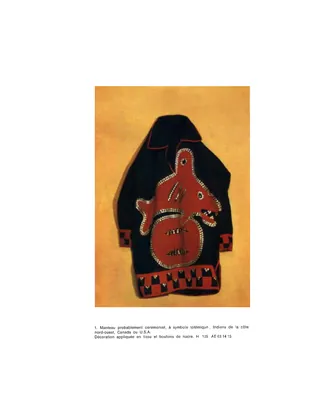
Illustrated guide, in French, to a 1964 exhibition of exotic textiles from the collections of the Antwerp archaeology museums and the Museum of Ethnography. After forewords by J. Wilms and F. Smekens, Adr. G. Claerhout surveys decoration techniques: applied work, embroidery, painting, and the resist-dyeing groups (pleat, stencil, tie-dye, tritik and plangi, wax-resist batik, discharge, and ikat on warp and weft). The guide includes schematic figures of looms, basic weaves and resist processes, a bibliography, and a catalogue of 24 plates with museum numbers, provenance (Indonesia, Japan, Mali, Peru, Northwest Coast and others) and dimensions.
Guatemala Visited Portfolio
Other · 6 pages
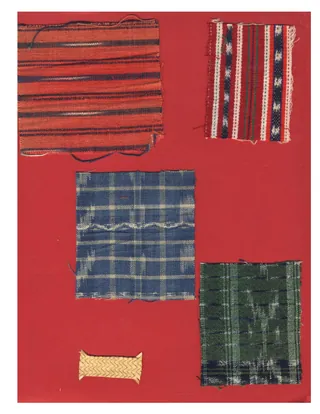
A portfolio of mounted fabric samples that accompanies Mary Meigs Atwater's Shuttle Craft Guild Monograph 15, Guatemala Visited (1965). Four pages of photographs show the swatches, and a final page lists and describes each sample. The samples include ikat skirt cloths, a man's trouser, huipiles, a stiff belt (faja), an apron, a tapestry head-band, a terminal selvage, palm braid and a draw-loom fabric. The notes give dimensions, looms (counter-balanced treadle, back-strap, draw-loom), regions and cross-references to pages in the monograph.
A Weaver Traveling in Chile
Article · 4 pages
A travel account by weaver Helen Louise Allen describing her visit to Temuco, Chile, to find the weaving of the Araucanian (Mapuche) Indians. She describes women's dress and belts, men's tied-and-dyed warp ponchos, double-weave men's belts, saddle blankets, pile-knotted choapina saddle rugs and saddle bags. She also covers the warp-faced weave structures, the upright looms and how pieces are woven complete from both ends. Illustrated with eight photographs of the textiles she collected; no drafts are given.
Het Weven in Nederlandsch-Indië [Weaving in the Netherlands Indies]
Monograph · 90 pages · Dutch · weaving drafts
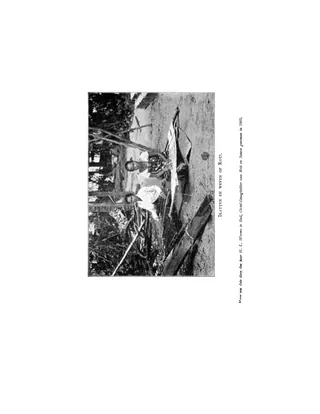
A 1903 Dutch-language monograph (Bulletin No. 28 of the Colonial Museum in Haarlem) describing hand weaving in the Dutch East Indies. It covers fibres and spinning, dyeing, warping and ikat tying (warp, weft and double ikat), the three types of loom from backstrap to pedal loom, and regional weaving centres such as Roti, Sumba, Timor, Sumatra, Borneo, Palembang, Bali and Java. A final chapter treats card (tablet) weaving of bands and borders. It includes notes, a bibliography, and about twenty plates of textiles and weaving equipment with museum provenance.
Iban or Sea Dayak Fabrics and their Patterns
Book · 205 pages
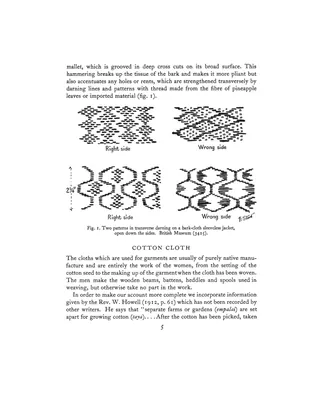
A descriptive catalogue of the Iban (Sea Dayak) textiles of Sarawak held in the Cambridge Museum of Archaeology and Ethnology. It covers Iban costume, cotton preparation, the tumpoh loom, warp-dyed (ikat-type) patterning, dyes, and weft patterning, embroidery and needle-woven tapestry badges. Specimens are described one by one by garment type (kalambi jackets, bidang petticoats, sirat loin-cloths, bedong girdles, dangdong shawls, pua blankets), with notes on thread counts, colours and named motifs. Later chapters discuss the religious meaning of the designs and possible outside influences, and give a vocabulary of Iban terms and 35 plates of line drawings of motifs (anthropomorphs, animals, birds, plants, objects).
Warp & Weft, Vol. 37, No. 2 (February 1984)
February 1984
Periodical · 8 pages · weaving drafts
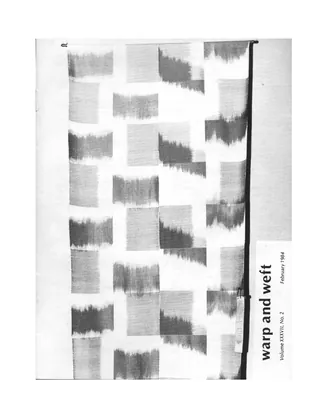
February 1984 issue of Warp & Weft, the monthly newsletter of Robin & Russ Handweavers in McMinnville, Oregon. It includes the editor's note on a large shipment of imported yarns and books, an explanation of the ikat cover piece by Lydia Van Gelder, and a three-harness draft called "Total Texture" with yarn costs and weaving tips. It also has two book reviews (Weave Structures Used in North American Coverlets and Corn Dollies From the Start), classified ads for yarns and books, and a marketplace page of lace and loom books.
Minnesota Weaver, Vol. 1, No. 1 (September 1975)
Minnesota Weaver, September 1975
Periodical · 12 pages
First issue of The Minnesota Weaver, the newsletter of the Weavers Guild of Minnesota, dated September 1975. It replaces The Threadbender and carries guild business: the September program with Jan Burhen on geometric garments, workshop registration policy, financial and membership notes, office notices, library news with new acquisitions and book reviews, and plans for the Fiber Fair and a Christmas tree at the Art Institute. It also has summer workshop reports (Bolivian weaving, rep weaves, ikat dyeing, gang weaving, cardweaving), a natural-dye light-fastness test, a frame loom tip, show listings, and ads from local suppliers.
Dyeing Easter Eggs
Article · 2 pages
A column from the 'From Woods & Fields' series in Minnesota Weaver giving instructions for coloring Easter eggs with natural dyes. It covers egg preparation, resist and wrapping methods (leaves, rubber bands, netting, onion skins, beeswax), dye baths from onion skins, red cabbage, coffee, turmeric and cochineal, and dyeing, overdyeing and finishing steps, with safety notes about eating the eggs and poisonous plants.
Natural dyes in yarn, fleece, cloth, wool, cotton etc.
Article · 1 page
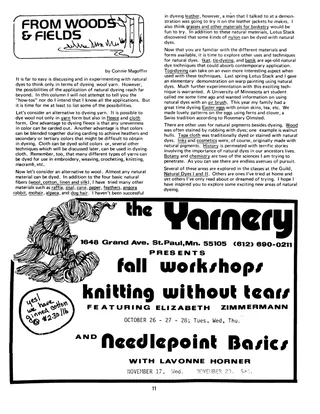
A one-page column from the Minnesota Weaver's 'From Woods & Fields' series, in which Connie Magoffin surveys the range of materials and forms that can be dyed with natural dyes. She covers dyeing fleece, yarn and cloth, other fibers and materials such as raffia, paper, feathers, animal hair and some nylon, and techniques like ikat, tie-dye, batik, warp painting and top-dyeing. She also mentions non-dye uses of natural pigments such as wood stain, tapa cloth, inks and cosmetics. The page also carries an advertisement for The Yarnery in St. Paul with fall workshops.
Modern Dyestuffs Applied to Stenciling
Article · 5 pages
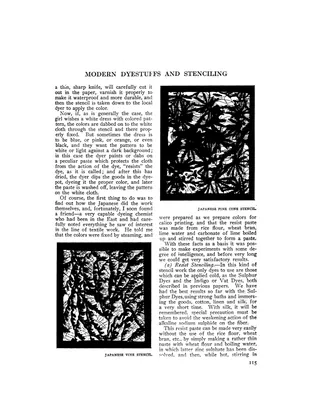
Number X in Professor Charles Pellew's series for The Craftsman, on applying modern synthetic dyestuffs to stenciling on textiles. It describes Japanese stencil practice and gives recipes for a wheat-flour and zinc oxide resist paste used with Sulphur and Vat dyes. It also gives a basic-color stencil paste fixed by ironing and a tartar emetic bath. The article is illustrated with old Japanese stencils from E. T. Shima's collection.
Handweaving News (May 1939): Guatamalan Collection of Textiles
Periodical · 3 pages · weaving drafts
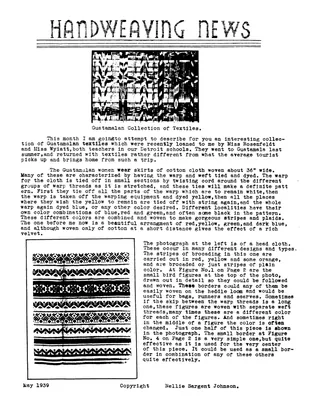
A May 1939 Handweaving News article by Nellie Sargent Johnson describing a collection of Guatemalan textiles loaned by two Detroit teachers. It covers tie-dyed warp skirt cloths, brocaded head cloths, and blouse pieces with small bird and human figures woven in weft-float technique. Pages 2 and 3 provide graph-paper drawdowns of the border and figure patterns, plus a pattern-weave technique worked over three and under one warp thread, with photographs of the textiles.
Small Wall Hangings Adapted from Guatemalan Textiles
Article · 3 pages · weaving drafts
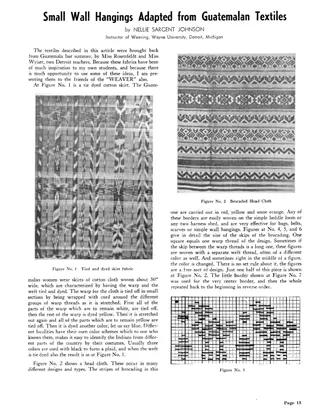
Article by Nellie Sargent Johnson describing Guatemalan textiles brought back by two Detroit teachers: a tie-dyed cotton skirt, a brocaded head cloth, and brocaded blouse cloths with stylized women, birds and animals. It explains how the brocaded figures are charted, with one square per warp thread, and how they can be woven on a simple two-harness heddle loom. It then describes small wall hangings woven by student Nell Byster Keyser, adapting the Guatemalan figures in plain weave with brocaded and laid-in motifs in Shetland and tapestry yarns.
Calico Printing
Article · 4 pages
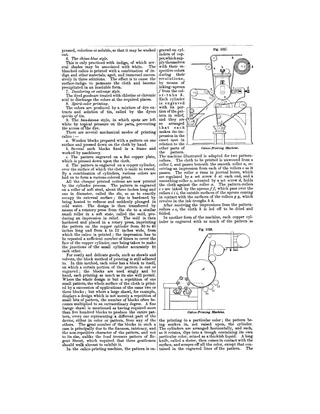
A dictionary article on calico printing from Knight's American Mechanical Dictionary. It traces the history of printing figured designs on cloth from China, India, Egypt and Europe to the introduction of calico printing in England and France. It then describes the main printing styles (madder, steam, padding, resist, discharge, china-blue, bandanna) and the mechanical methods: wood blocks, copper plates and engraved cylinders. Two figures show calico-printing machines with pattern rollers, color troughs and prism-type printers.
The Java village Midway Plaisance. World's Columbian Exposition ...
Ephemera · 3 pages
A three-page promotional guide to the Java Village on the Midway Plaisance at the 1893 World's Columbian Exposition in Chicago. It walks visitors through the numbered houses and describes the crafts and daily life shown by about 125 Javanese residents, including weaving on a simple loom, batik wax-resist dyeing, embroidery, hat making, and metalwork. It also covers the theatre, gamelan, and the Serimpi dancers, and explains that the exhibit promoted Java tea and coffee.
Natural Dyes for Easter Eggs
Article · 2 pages
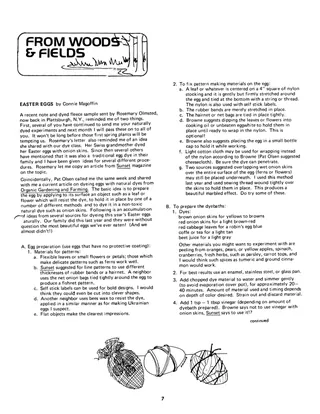
A short article from the Minnesota Weaver's "From Woods & Fields" column giving instructions for dyeing Easter eggs with natural dyes. It covers resist materials (leaves, flowers, rubber bands, nets, labels, wax, onion skins), ways to fix them on the egg, dyebath recipes (onion skins, red cabbage, coffee, tea, beet juice), the dyeing and finishing steps, and safety notes, with sources cited. Page 2 also carries the start of a separate item, "The Rigid Heddle: Large Projects - part 2", with tips on finishing large handwoven pieces and a list of fringe and non-fringe finishes.
The Bulletin of the Needle and Bobbin Club, Vol. 32, Nos. 1 & 2 (1948)
Periodical · 45 pages
Combined issue (Vol. 32, Nos. 1 & 2, 1948) of the Bulletin of the Needle and Bobbin Club. It contains Marian Hague's illustrated article on previously unpublished laces in Richard C. Greenleaf's collection (a Venetian needlepoint collar, a bobbin lace collar, and a Brussels bobbin lace flounce), Carl Schuster's study of stitch-resist dyed folk fabrics of Szechuan, Kweichow and Yunnan, and Zelina Comegys Brunschwig's survey of American printed fabrics, with notes, plates and a club report. Schuster's article covers cord-resist, binding and sewing techniques, uses, motifs and symbolism, and includes extensive footnotes and acknowledgments. The issue ends with Club Notes and a list of officers for 1948.
Weaving and Embroidery in the East
Article · 3 pages
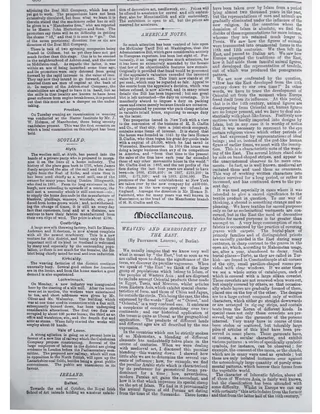
A three-page extract from The Textile Mercury of 3 May 1890 containing a lecture-style article by Professor Lessing of Berlin on weaving and embroidery in the East. He traces Oriental textile design from medieval Persian and Arabic motifs through the 16th and 17th century floral and palmette patterns, notes the link with the European pomegranate pattern via Venice, and discusses the damage done by machine production and aniline dyes. He also covers batik printing, Oriental embroidery stitches (couched work, crochet-needle stitch, gold embroidery), and objects such as grave coverlets, door curtains, handkerchiefs, and Indian long shawls. The pages also include trade news from Oldham, Preston, Scotland, Ireland and America, short notes on the silk industry in India, and cotton, yarn, and wool market reports.
Baststoffe und Gewebe [Bast Fabrics and Woven Textiles]
Other · 152 pages · German
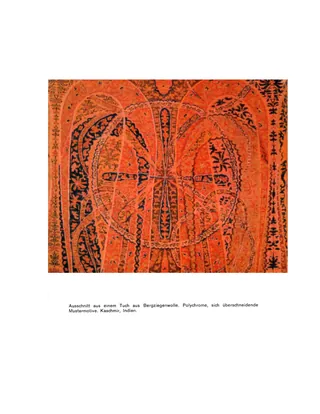
Catalog of a 1966 exhibition at the Städtisches Museum für Völkerkunde, Frankfurt am Main, on bark-cloth (bast) fabrics and woven textiles from Oceania, India, Indonesia and the Americas. It opens with an essay on bast fibre and bark cloth and technical notes on weaves (plain, rib, twill), ikat, batik, tritik, plangi and tapestry weaving with a glossary. Regional chapters on India, Indonesia, Mexico and Peru/Bolivia precede a catalog of numbered plates, with measurements, provenance and collection numbers. Most pages are colour and black-and-white plates of garments, shawls, skirts, ponchos and bark cloths.
Minnesota Weaver, Vol. 3, No. 3 (November 1977)
Minnesota Weaver, November 1977
Periodical · 23 pages · weaving drafts
November 1977 issue of the monthly newsletter of the Weavers Guild of Minnesota. It announces programs, workshops (Renie Adams, Understanding Overshot), the Fiber Fair, board minutes, officer profiles, school news, and shows including the Lausanne Tapestry Biennale. Technical content includes an article on interpreting overshot drafts in both weft and warp directions with drafts and tie-ups, and an article on resist-dyeing (ikat, batik, plangi) in ancient Peruvian textiles at the Science Museum. It also has a book review of Caring for Textiles, a Mayan backstrap weaving workshop report, classified notices, and advertisements.
Warp & Weft, Vol. 32, No. 8 (October 1979)
October 1979
Periodical · 8 pages · weaving drafts
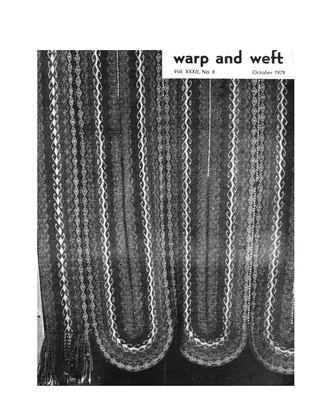
October 1979 issue of Warp & Weft, a monthly bulletin from Robin & Russ Handweavers of McMinnville, Oregon. Editor Russell Groff reports on a business trip to Thailand and Japan, describing silk reeling, ikat weaving, Jacquard-woven obis and the "fingernail weavers" of Kyoto, and announces a planned 1980 handweaving tour. The issue also has a 4-shaft, 6-treadle drapery fabric project ("Swedish Delight") in linen and ramie with threading, tie-up, treadling, yarn list and costs, a review of Penelope Drooker's Embroidering with the Loom, and classified ads for yarns and books.
Weaver's Journal, Vol. VIII, No. 1 Issue 29 (Summer 1983)
Weaver's Journal, Summer 1983
Periodical · 96 pages · weaving drafts
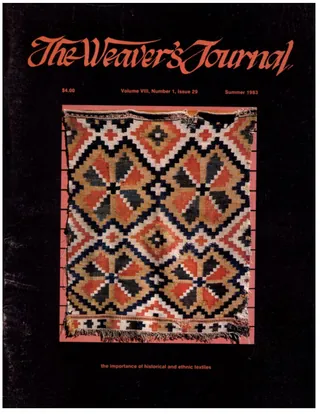
Summer 1983 issue of The Weaver's Journal, themed on the importance of historical and ethnic textiles as inspiration for contemporary weavers. Articles cover museum textile research, Chilkat and Northwest Coast weaving, Shaker textiles, Norwegian aklae tapestry, Peruvian complementary-warp weaves, Southwest Indian twill tapestry, Sumbanese warp ikat and tying ikat on the loom, Guatemalan backstrap weaving, Navajo inspiration, damask, and learning to weave in Japan. Technical pieces include part 2 of a series on computers for weavers, four-block double weave on four shafts, 8-shaft double weave with a placemat project, a proposal for standardizing weaving terminology and drafting conventions, and space dyeing with fiber-reactive dyes. Also includes the editor's letter, mail bag, index of Volume VII, errata, book and product reviews, and many advertisements.
Dyeing
Article · 4 pages
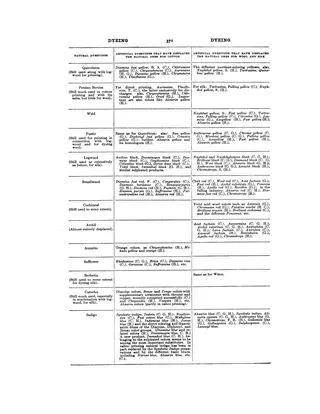
Encyclopedia article on dyeing from the New International Encyclopedia (pp. 370-373). It covers the history of dyeing from antiquity (Tyrian purple) to Perkin's mauve in 1856, a table of natural dyestuffs and the artificial dyes that replaced them for cotton, wool and silk, and an explanation of mordants and classes of dyes. It also discusses theories of dyeing, preparation and bleaching of fibres, dyeing apparatus, methods such as skein, piece, cross, resist and discharge dyeing, colorfastness, and a bibliography.
90 documents found