Textile Documents › Publications › Publication: Technical World
13 documents found
Sort: 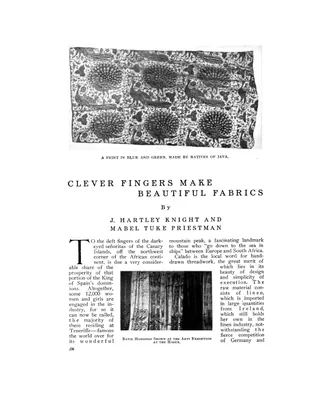
Clever Fingers Make Beautiful Fabrics
Article · 5 pages
A 1911 popular magazine article on two decorative textile crafts: Calado drawn-thread work and cushion lace (rueda) made by women on Tenerife in the Canary Islands, and batik as practiced in Java and developed in Holland. It covers the history and export organization of Calado work and describes the batik process of wax resist and dye baths, with stencil and tool alternatives. Illustrated with photographs of Calado specimens, factory workers, batik hangings, a batik-decorated chair and settee, and a royal christening robe.
Dyeing by Aid of Electricity
Technical World, September 1912
Article · 1 page
A short magazine item describing how the Javanese wax-resist method (batik) is used to create colored designs on silk and velvet. Liquid wax is applied to protect areas from the dye, the process is repeated for additional colors, and the wax is then washed out with benzine. The article notes that electrically heated apparatus now keeps the wax at an even temperature so it flows regularly.
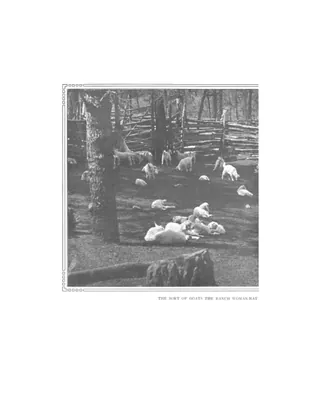
[Goats raised by ranch women in the mountains of New Mexico]
Technical World, 1911
Illustration · 2 pages
Two black-and-white photographs from a 1911 issue of Technical World Magazine showing flocks of goats in rustic fenced corrals, with pine trees in the background of one. The caption reads 'The sort of goats the ranch woman may raise in the mountains of New Mexico.' There is no weaving content, though the images relate to fiber-animal husbandry.
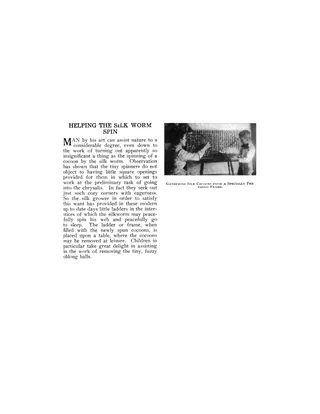
Helping the Silk Worm Spin
Technical World, September 1912
Article · 1 page
A short magazine piece from Technical World (1912) on a sericulture aid: small ladder-like frames with square openings in which silkworms spin their cocoons. The filled frame is set on a table so the cocoons can be removed at leisure, a task children enjoy. One photograph shows a person gathering cocoons from a prepared frame.
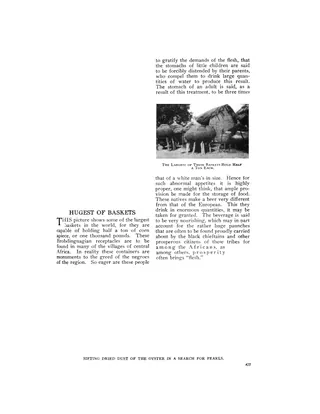
Hugest of Baskets
Technical World, September 1912
Article · 1 page
A one-page 1912 magazine item with a photograph of very large storage baskets in villages of central Africa, said to hold about half a ton (1,000 pounds) of corn each. The text is mostly racially prejudiced commentary of the period about the eating and drinking habits of the people, with little on basket construction or materials. It is of interest mainly as a historical example of how African basketry was presented in early twentieth-century popular press.
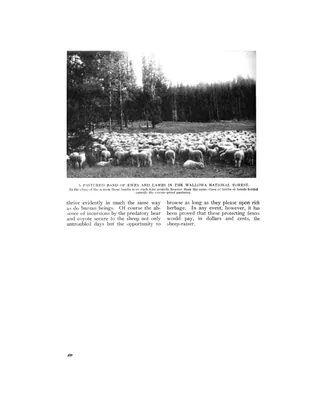
Increasing the Efficiency of Grazing Lands
Article · 4 pages
A 1912 magazine article describing a U.S. Forest Service experiment begun in 1907 on the Wallowa National Forest, Oregon, in which a 2,560-acre coyote-proof fenced pasture was compared with open-range herding of sheep. It reports heavier lamb gains, expected heavier wool clips, lower losses, reduced acreage per sheep and lower labor costs under the pasture system. Illustrated with photographs of the pasture, a ranger and a band of ewes and lambs.
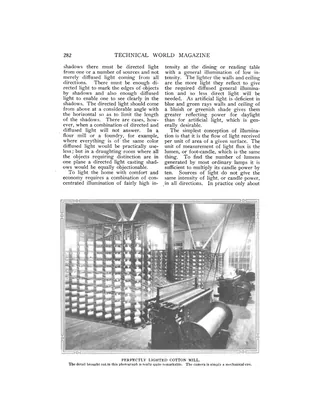
Learning to Use Light
Article · 11 pages
A popular magazine article from Technical World (1911) on the new profession of illuminating engineering and the proper use of artificial light. It uses examples such as a Chicago theater rescued from failure by indirect lighting, show windows, libraries, drafting rooms and homes. It compares incandescent, tungsten, mercury vapor, Moore tube and Cooper-Hewitt lighting, and covers glare, shadows, color of light, fatigue and the lumen. Photographs include a silk ribbon loom in a Paterson, N.J. mill shot under ordinary lights and under Cooper-Hewitt light, and a well-lit cotton mill.
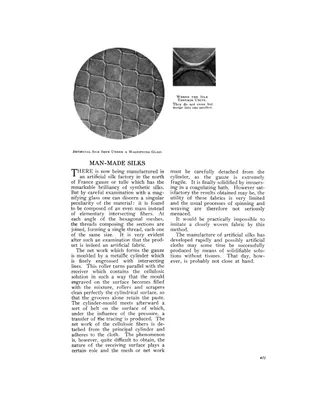
Man-Made Silks
Technical World, April 1911
Article · 1 page
A short 1911 magazine article describing an artificial silk gauze or tulle made in a factory in northern France. It explains how a cellulose solution is moulded in an engraved metal cylinder, transferred to a belt or cloth, and set in a coagulating bath to form a hexagonal net. The author notes that the product is fragile and of limited use, so conventional spinning and weaving are not threatened. Two micrographs show the mesh and the thread junctions.
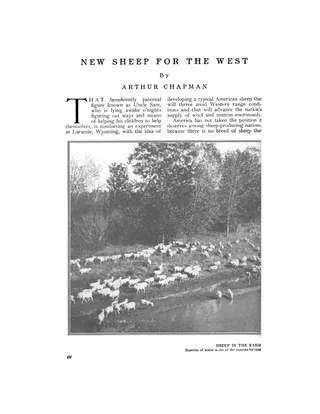
New Sheep for the West
Article · 4 pages
A 1912 magazine article describing the U.S. government's experiment station at Laramie, Wyoming, which aims to breed a typical American range sheep suited to the dry Western high plains. It explains why imported breeds such as the Rambouillet deteriorate in the West, covering forage, water scarcity, alkali, climate and effects on wool yield and fleece weight. It also mentions a private Wyoming breeder's gains and the station's prizes at the Alaska-Yukon-Pacific Exposition. Illustrated with photographs of sheep and the station.
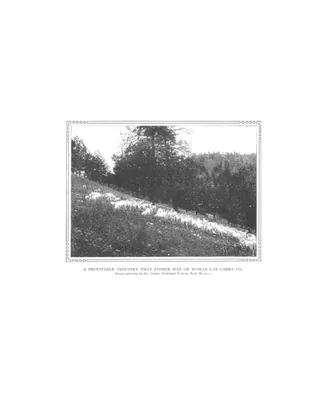
[Profitable Industry]
Technical World, 1911
Illustration · 1 page
A single-page illustration from Technical World Magazine, 1911, showing a photograph of a flock of goats grazing on a hillside beside conifer trees in the Alamo National Forest, New Mexico. The caption presents goat keeping as a profitable industry that either a man or a woman can carry on. It has no weaving content and is of interest mainly for the history of goat raising and mohair or fiber sources.
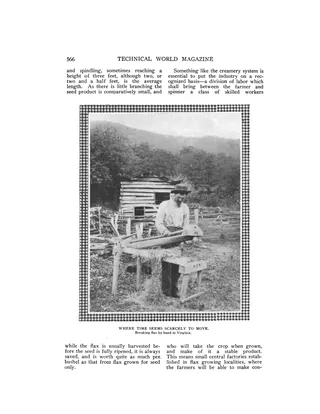
Profits in Flax
Article · 6 pages
A 1911 magazine article arguing that a commercial flax fiber industry in the United States would need a co-operative, creamery-style system of small central mills handling the farmers' straw. It contrasts growing flax for seed with growing it for fiber, and reviews imports and the flax grades of Belgium, Ireland, Russia and Canada. It also describes retting methods, then breaking, scutching, hackling, and mill spinning (dry and wet), ending with reeling, bleaching and drying the yarn. Photographs show harvesting, hand breaking in Virginia, stages of flax preparation, a modern linen factory, yarn drying sheds and hand hackling.
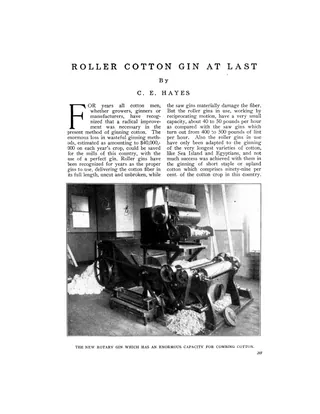
Roller Cotton Gin at Last
Article · 2 pages
A 1911 magazine article describing Charles J. McPherson's new rotary comb roller cotton gin, which was intended to match the output of saw gins (400 to 500 pounds of lint per hour) without cutting the fiber. It compares roller and saw ginning, covering fiber damage, fire risk, worker injuries, waste, and price advantages. It also describes how the gin's ginning roll, comb roll, and suction fan work. Illustrated with a photograph of the machine and micrographs comparing saw-ginned and roller-ginned fibers.
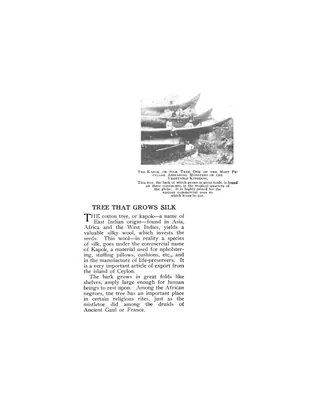
Tree That Grows Silk
Technical World, 1911
Article · 1 page
A short 1911 magazine article describing the kapok, or silk cotton tree, found in tropical Asia, Africa and the West Indies. It explains that the silky fiber surrounding the seeds is sold as kapok for upholstery, pillow and cushion stuffing, and life-preservers, and notes Ceylon as a major exporter. It also mentions the tree's shelf-like folds of bark and its role in certain African religious rites. A photograph of the tree accompanies the text.
13 documents found