Textile Documents › Publications › Publication: Craftsman
37 documents found
Sort: 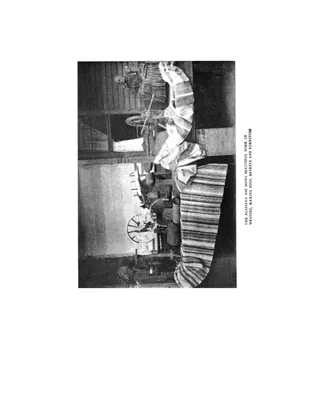
Acadians of Louisiana Still Living and Weaving as They Did Centuries Ago Before Their Exile from Canada
Article · 12 pages
A 1906 magazine article describing a visit to Acadian ("Cajun") families along Vermilion Bayou in Louisiana, where women still grow cotton, spin, dye with indigo and walnut or oak bark, and weave homespun, blankets, coverlets and "Evangeline" spreads on old looms. It recounts the efforts of Miss Patte Gorham Weeks of New Iberia to find markets for the weavers' work, and profiles weavers Madame Jules and Madame Bicou-Bodreaux. It also touches on rag rugs, baskets, chairs, knitted lace, food and daily life. Illustrated with photographs of houses, a spinning wheel and a loom with striped cloth.
Acid Colors
Article · 4 pages
Number VI in Charles E. Pellew's series on synthetic dyes for craft workers, covering the Acid class of coal-tar colors (Acid Azo dyes and sulphonated basic dyes). It explains their history and properties, then gives dyeing directions for wool (sulphuric acid and Glauber's salt bath, plus irregular 'rainbow' skein dyeing), leather, and feathers, including cleaning and bleaching white feathers. It ends with a table of selected lightfast acid dyes by manufacturer (Badische, Cassella, Elberfeld, Kalle, Metz).
Application of Modern Dyestuffs to Arts and Crafts Work: General Introduction
Article · 7 pages
Introductory article by Columbia University chemistry professor Charles E. Pellew, opening a series of eight lessons on dyeing for arts and crafts workers. He argues for modern synthetic (coal tar or aniline) dyes over the natural dyes praised by Ruskin's followers, and reviews ancient dyes such as woad, indigo, madder, cochineal, logwood and Tyrian purple. He gives simple directions for iron (rust) dye and manganese brown (bistre), then traces Perkin's 1856 discovery of mauvein and the synthesis of alizarine. He discusses poor fastness caused by dyers' and manufacturers' choices, and closes with the wider effects of coal tar chemistry on medicine, perfumes, flavorings and pigments.
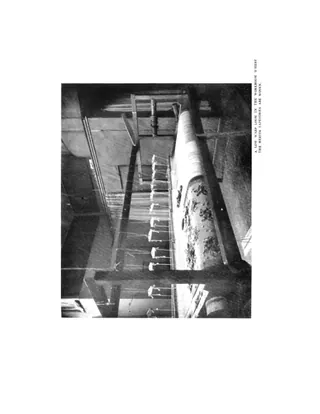
Aubusson Looms: Where American Tapestries are Designed and Woven by an American Artist, Albert Herter
Craftsman, 1909
Article · 6 pages
A 1909 magazine article about Albert Herter's Aubusson Looms, a New York workshop weaving American-designed tapestries, draperies and rugs on low warp looms. It opens with reflections on medieval tapestries and calls for an American craft tradition. It then describes Herter's designs, his dyeing and mixing of cotton, silk, wool, linen and gold threads, and his French weavers. Illustrations show a low warp loom in the workroom and two Herter curtains.
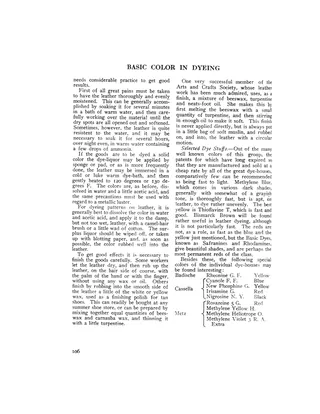
Basic Colors
Article · 3 pages
Fifth article in a series by Professor Charles E. Pellew of Columbia University on the Basic (aniline) dye-stuffs, written for readers of The Craftsman. It traces the origin of these dyes from Perkin's Mauvein of 1856 through Methyl Violet, Fuchsine/Magenta, Bismarck Brown and Methylene Blue, and explains how they bond with animal fibers and how tannin and tartar emetic mordants fix them to cotton and linen. It gives dyeing directions for straw, raffia and leather, including finishing waxes, and ends with recommended dyes and a list of dye-house products.
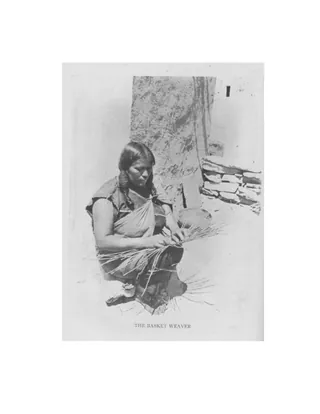
Basket Weaver
Craftsman, 1905
Illustration · 1 page
A single-page illustration titled "The Basket Weaver" from The Craftsman. It is a black-and-white photograph of a seated young woman with long hair in side braids, wearing a draped garment, who works plant fibers such as grass or rush stems on her lap with a basket beside her. The page carries only the caption and no accompanying article text.
The Basket-Maker
Other · 1 page
A single-page poem by Arthur J. Burdick addressed to a woman basket-maker. It praises her skill, her knowledge of where to find willows and grasses, and her use of natural colors, and likens her baskets to woven songs and visions. It is literary rather than technical and gives no instructions.
Batik, or the Wax Resist Process
Article · 4 pages
Article by Professor Charles E. Pellew of Columbia University, number XI in a series on dyeing for craftsmen, introducing batik, the wax resist process. It covers the history of batik in Java and Madras, Javanese garments and methods, and the tools (tjentang or "teapot", brass stamping blocks, a patented wax pencil). It also covers wax mixtures (paraffin, beeswax, ceresine, rosin), modern dyes for cotton, linen, silk, wood, leather and bone, and acid etching of bone, metal and wood after waxing. A short note on indigo stencil paste follows on the last page.
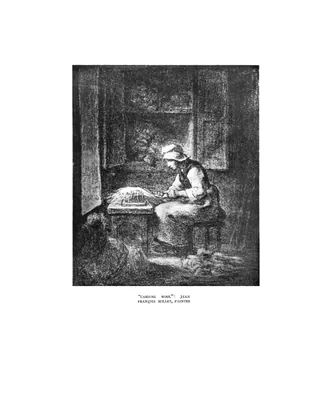
Carding Wool
Illustration · 1 page
A single-page halftone reproduction of Jean-François Millet's painting 'Carding Wool', printed in The Craftsman. It shows a seated woman in a white cap and dark bodice working wool with a hand card at a table, with a heap of wool and a basket nearby. The only text is a caption naming the painting and the painter.
Child Wage-Earners in England: Why the "Half-Time" System Has Failed to Solve the Problem
Article · 7 pages
A 1907 magazine article by Mary Rankin Cranston criticizing the English "half-time" system, under which school-age children worked outside school hours. It traces the history of British factory legislation from 1802 through the acts of 1876 and 1902-03, and describes the jobs half-timers held (milk boys, newsboys, laundry helpers, domestic servants) and their hours and pay in London, Liverpool, Belfast and elsewhere. It argues that the system harms children's health and schooling and warns against adopting it in the United States.
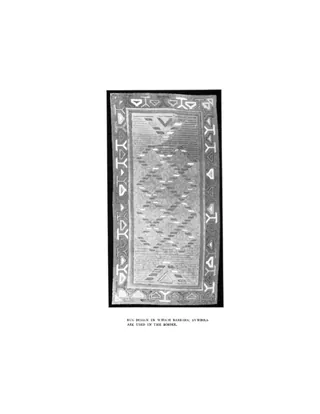
Developing a Home Industry: How the Abnákee Rug Grew Out of the Old-Fashioned Hooked Mat of Our Grandmothers
Article · 6 pages
A 1909 Craftsman article in which Helen R. Albee describes how she developed the Abnákee hooked rug from traditional New England hooked mats and built it into a home industry. She covers her choice of materials (British burlap, pure-wool twilled flannel cut in very narrow strips), her use of primitive ornament in place of floral and Oriental imitations, and how she spread the craft by supplying flannel, dyes, burlap, frames and hooks. The final pages explain border and field layouts and how she makes and stamps stencils; the frame, hook and working methods are promised for a later paper. Illustrations show two rug designs, one with barbaric symbols in the border and one adapting primitive forms.
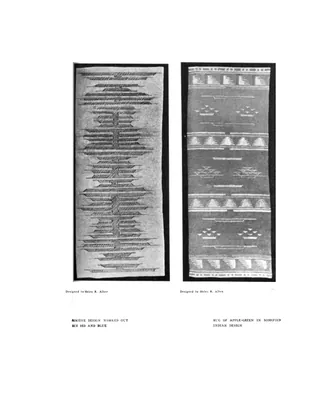
Distinctive American Rugs
Craftsman, 1907
Article · 11 pages
A 1907 Craftsman article arguing that home industries could give American farm and village women income and creative satisfaction. It describes Helen R. Albee's Abnakee hooked rugs from Pequaket, New Hampshire, including her experiments with dyes and materials and the colors of several illustrated designs. It then covers woven rag-type rugs: the Martha Washington, Priscilla, John Alden (basket-weave) and Dorothy Manners (hit-or-miss) rugs made in Philadelphia and Germantown.
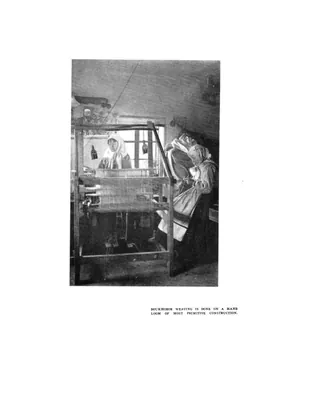
Doukhobors of Canada -- A Community of Siberian Exiles Which is Being Brought to Great Financial Prosperity by a Russian Captain of Industry
Article · 16 pages
A 1907 Craftsman magazine article by Katherine Louise Smith on the Doukhobors, Russian religious exiles who settled in Canada under their leader Peter Verigin. It covers their communal organization, finances, railroad work, agriculture, religion and customs. Photographs show women spinning yarn, weaving on a primitive hand loom, beating flax, harvesting and doing embroidery, but the text says little about textile techniques.
Dyeing of Imitation and Artificial Silk
Article · 4 pages
Article number IX in Professor Charles Pellew's series on dyeing, published in The Craftsman. It covers mercerized cotton and the main artificial silks (Chardonnet, Pauly, Elberfeld/Glanzstoff and Viscose): their history, how they are made, and how to dye and finish them. It also gives simple tests for telling natural silk, mercerized cotton and artificial silk apart, and names suitable dye classes (Sulphur, Direct/Salt and Basic colors).
Dyeing Silks
Article · 4 pages
Number VII in Charles Pellew's series on dyeing, written for The Craftsman in 1909, serves as an introduction to silk before the dyeing methods are taken up. It covers the varieties of silk (cultivated, wild/tussore, spider silk and pinna silk), a history of silk from China to Europe and Virginia, and 1900s production and import figures. It then describes the stages of silk production: raising cocoons, reeling, throwing (organzine and tram), degumming, and the contrast between piece dyeing and skein dyeing with acid dyes and boiled-off liquor. The actual skein-dyeing methods are left to the next article.
Equipment Needed for Dyeing and the Colors Formed by Oxidation
Article · 4 pages
Third article in a series on dyeing for arts and crafts workers by Professor Charles E. Pellew of Columbia University. It first describes the practical equipment for a home or studio dye shop: agate pots, gas stoves, glass and wooden stirring rods, rubber gloves, wringers and drying arrangements. It then covers Class II dyes, colors formed by oxidation on the fiber, concentrating on sulphur dyes, with dyeing directions for cotton and silk, typical colors, a list of selected dyes by manufacturer, and after-treatment for fastness.
French New Art Lace
Craftsman, 1906
Article · 5 pages
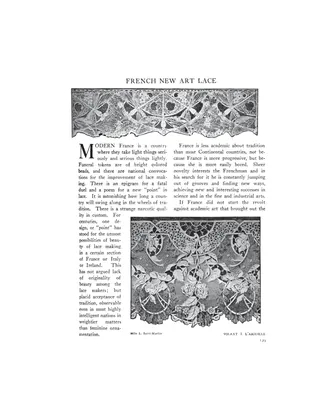
A 1906 magazine article on the first national Concours of the Comité de la Dentelle de France, a French association formed to develop new Art Nouveau-style lace designs. It describes the exhibition of 350 designs by 110 exhibitors, the jury, the prizewinners (including Berthe Hennecart's first-prize tea cloth corner) and the nature-inspired motifs, and it is illustrated with photographs of prize-winning lace pieces such as flounces, a collar, a tea cloth border and a handkerchief.
General Description and Classification of Artificial Dyestuffs
Article · 4 pages
Part II of a series by Charles E. Pellew on artificial (coal tar) dyestuffs, written for dyers and amateur craftworkers. It explains how to identify a dye by trade name, shade letter and manufacturer, and advises buying from the large German makers' agents instead of retail repackagers. It then lays out a six-class classification of coal tar dyes and begins with Class I, Direct Cotton (salt) dyes, covering their uses, dyeing directions for cotton, mercerized cotton, linen, wool and silk, fastness, a table of selected lightfast colors by manufacturer, and after-treatments.
Handicrafts Back in English Peasant Homes
Article · 10 pages
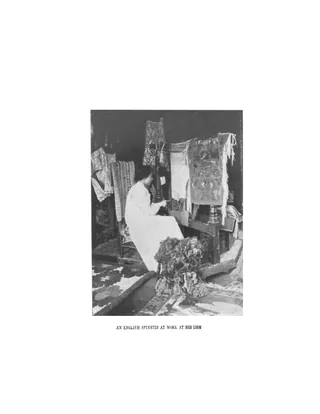
A 1906 Craftsman article by Alice Dinsmore on the revival of hand spinning, weaving and other handicrafts in English cottage communities under the influence of John Ruskin. It describes Marion Twelves's Ruskin Linen Industry in the Lake District (begun 1883), the Keswick School of Industrial Art run by Canon and Mrs. Rawnsley, Miss Clive Bayley's weaving school at Shottery, and the Canterbury weavers. Illustrated with photographs of a woman at a handloom, cottages, and the Keswick school; it contains no weaving drafts.
How Abnákee Rugs Are Made: Full description of the Exact Method of Working
Article · 5 pages
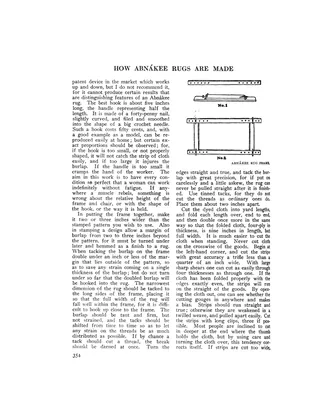
A 1909 Craftsman article by Helen R. Albee explaining how Abnákee hooked rugs are made on a small adjustable wooden frame rather than a loom. It describes building the pine frame and filing a hook from a forty-penny nail, tacking stamped burlap, cutting cloth strips, and the hooking technique, including the three-deep undulating rows, shearing, filling the pattern, and finishing the edges. A closing section covers dyeing the cloth with German aniline dyes, with measured stock solutions for repeatable shades, along with the author's views on craftwork.
How to Make Irish Laces at Home
Article · 5 pages
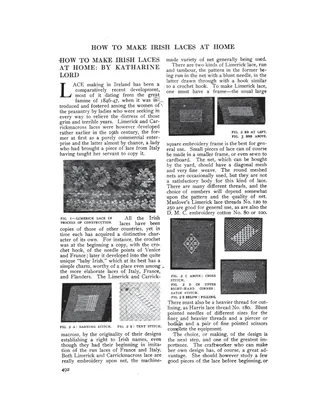
An instructional article from The Craftsman on making Limerick and Carrickmacross lace at home, both embroidered on machine-made net. It covers the history of Irish lace, materials and threads, mounting net in a frame, outlining, filling stitches (darning, tent, cross, satin and others), tambour work, and the appliqu\u00e9 and guipure methods of Carrickmacross. Illustrated with photographs of work in progress, stitch samples, a Limerick collar, and a fan mount designed by the author.
Indigo and the Vat Colors: Fourth Paper on Dyeing
Article · 6 pages
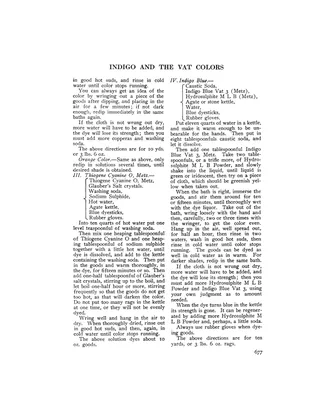
A 1908 article from The Craftsman, the fourth in Professor Charles E. Pellew's series on dyeing for arts and crafts workers, covering indigo and the other vat colors. It traces indigo's history and synthesis, compares fermentation, copperas-lime, zinc dust and sodium hydrosulphite vats, and gives step-by-step directions for dyeing cotton with indigo and the Indanthrene, Algol and Thion vat dyes. It closes with a review of cotton dyeing, including recipes used at Greenwich House for home-dyed rag rugs (manganese brown, copperas yellow and orange, Thiogene Cyanine blue, indigo blue).
Lacemakers
Article · 11 pages
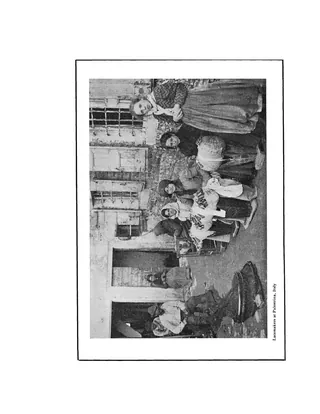
A 1903 travel account by Florence G. Weber describing her visit to European lace-making centers, including Santa Margherita, Cantù, Venice, Burano, Palestrina, Chioggia and Ghent. She compares Italian and Belgian lace, describes working conditions in factories, schools and a Béguinage, and explains how the Arts and Crafts Lace School in Boston reproduced pricking patterns by blueprint. Illustrated with photographs of lacemakers and of Burano lace pieces.
Modern Dyestuffs Applied to Stenciling
Article · 5 pages
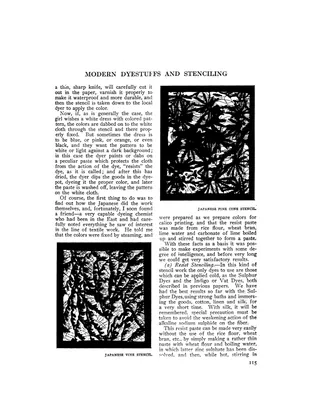
Number X in Professor Charles Pellew's series for The Craftsman, on applying modern synthetic dyestuffs to stenciling on textiles. It describes Japanese stencil practice and gives recipes for a wheat-flour and zinc oxide resist paste used with Sulphur and Vat dyes. It also gives a basic-color stencil paste fixed by ironing and a tartar emetic bath. The article is illustrated with old Japanese stencils from E. T. Shima's collection.
Notes Gathered from the History of Textiles
Craftsman, 1902
Article · 22 pages
A 1902 magazine essay surveying the history of textiles from antiquity to the nineteenth century. It treats spinning and weaving as women's crafts and civilizing forces, then reviews the raw materials wool, silk, cotton and flax and their spread through the Mediterranean, Asia and Europe. The later pages cover the English factory system, child labor, and the reforms of Sir Robert Peel and Robert Owen, ending with a balanced assessment of the modern labor system.
Revival of English Handicrafts
Craftsman, 1902
Article · 10 pages
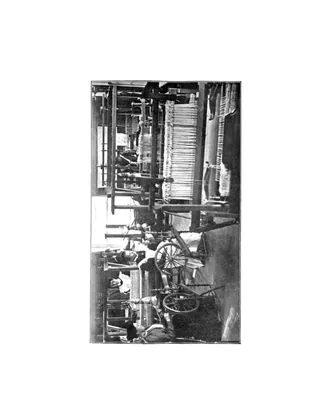
An early twentieth-century magazine article describing the revival of English handicrafts, focusing on the Weaving House and Tapestry House at Haslemere, Surrey. It covers the Home Arts and Industries Association, the founder Joseph King, the designer Godfrey Blount, the workshops, the handwoven linen and cotton fabrics, rugs and peasant tapestry applique, and where the goods were sold. It also mentions other craft workers settling nearby, including a Jacquard silk brocade weaver. Illustrations show a spinning and weaving scene and a workshop with hand looms.
Secret of the Wonderful Color Combinations Used by the Orientals and Primitive Peoples
Craftsman, 1909
Article · 2 pages
A two-page article from The Craftsman arguing that modern Western civilization has dulled the perception of color, in contrast with Oriental craftsmen and primitive peoples. It describes an experiment matching the colors of an old Japanese print with a card mask and painters' pigments. The writer concludes that each Oriental color contained all three primaries, which made the colors harmonize however they were combined. The article is about color theory and dyes; it has no weaving instructions.
Sheep Shearing
Illustration · 1 page
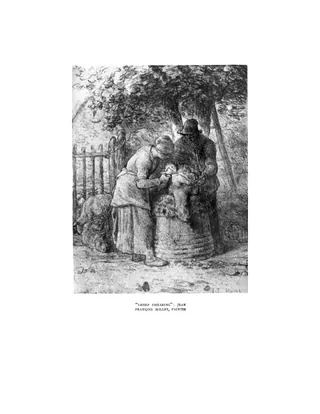
A single-page reproduction of a sketch by the French painter Jean-François Millet showing sheep shearing. A woman in a headscarf bends over a sheep being sheared while a figure in a wide-brimmed hat stands behind her. The only text is the caption naming the work and the artist; it was printed in The Craftsman.
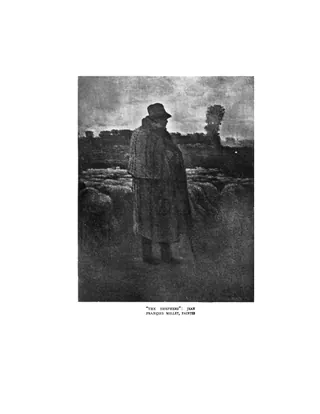
Shepherd
Illustration · 1 page
A single-page halftone reproduction of Jean-François Millet's painting 'The Shepherd', printed in The Craftsman. It shows a dark, hooded figure in a long cloak standing in a dusky field with rocks and a tree under a grey sky. The page carries only a caption and no textile or weaving content.
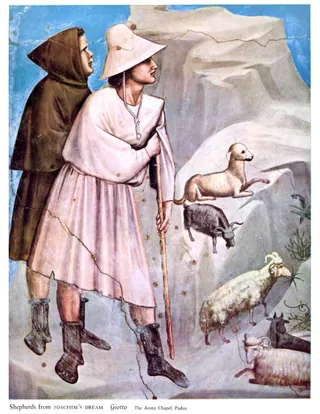
Shepherds from Joachim's Dream
Illustration · 1 page
A single-page reproduction of Giotto's fresco of the shepherds from the Joachim's Dream scene in the Arena Chapel, Padua. It shows two shepherds in hooded pink and brown garments, one holding a staff, with sheep and a goat. It appeared as an illustration in The Craftsman and has no weaving content.
Silk Dyeing (Continued)
Article · 4 pages
Part VIII of Charles Pellew's series on silk dyeing in The Craftsman covers skein dyeing with acid dyes, finishing and lustering, and dyeing silk black with logwood. It explains how silk is weighted with tin salts, iron, tannin and other chemicals, how to test for weighting by burning, and the effect on durability. It closes with advice for amateurs and craftsmen on using acid, salt (direct) and sulphur dyes on silk, including how to neutralize sulphur dye baths and obtain blacks without logwood.
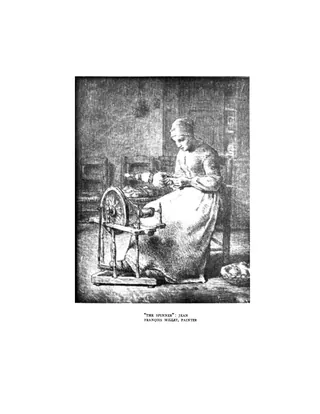
Spinner
Illustration · 1 page
A single-page halftone reproduction of Jean-François Millet's painting "The Spinner," showing a woman seated at a spinning wheel in a dim interior. A distaff holding fiber stands at the left, with a basket at lower right and a wooden chair behind her. The page carries only a short printed caption naming the work and the painter.
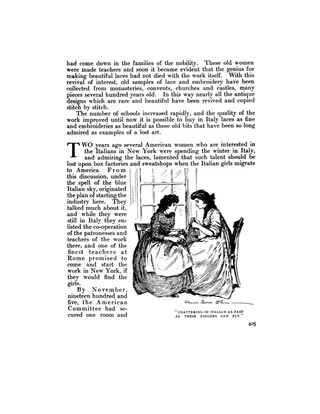
Story of a Transplanted Industry: Lace Workers of the Italian Quarter of New York
Article · 6 pages
A 1907 Craftsman article describing the Scuola d'Industrie Italiane, a school in New York's Italian quarter (MacDougal Street) that taught Italian immigrant girls to make Italian embroidery and lace from fifteenth- and sixteenth-century patterns. It covers the revival of lace-making in Italy, the founding of the school in 1905 under Miss Carolina Amari, working conditions and wages compared with box factories, materials, products, markets, and the committee of sponsors. Illustrated with line drawings of women at work.
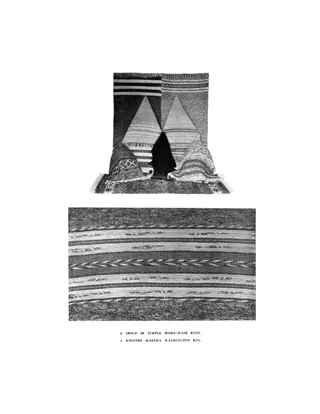
Technique of Simple Rug Weaving
Article · 8 pages
A 1907 Craftsman article by Mabel Tuke Priestman explaining how to weave simple rag-strip and fabric rugs on an old hand loom. It covers finding and setting up a loom, warping, choosing and cutting materials such as denim, muslin and cretonne, weaving technique, borders, and knotted fringes. It describes named rug designs (Martha Washington, John Alden, Waverly, Priscilla) and is illustrated with photographs of finished rugs.
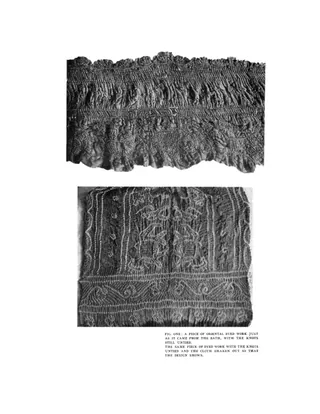
Tied and Dyed Work: An Oriental Process with American Variations
Article · 7 pages
A 1909 Craftsman article by Professor C. E. Pellew of Columbia University describing tied-and-dyed (tie-resist) work, an ancient Indian process, and how it can be adapted with modern sulphur and vat dyes. It covers the Rajputana and Kotah Chunari tradition, the general resist, discharge and direct-application methods, and practical tying techniques using marbles, loops and folds. It also describes the author's own "tied and discharged" experiments with bleaching powder and a four-color silk scarf built up by successive dye baths. Illustrated with photographs of dyed samples.
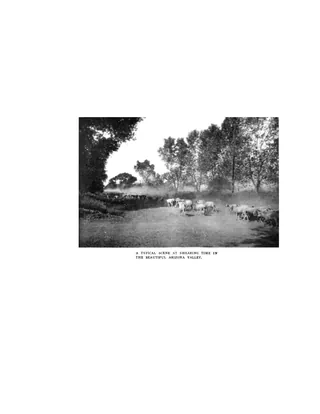
A Typical Scene at Shearing Time in the Beautiful Arizona Valley
Craftsman, 1909
Illustration · 1 page
A single-page black-and-white photograph from The Craftsman showing a flock of sheep moving across a dusty clearing beside tall trees at shearing time in an Arizona valley. The caption is the only text. It is useful as an illustration of sheep raising and wool production in the American Southwest in the early twentieth century.
Willow Baskets that Show the True Spirit of Handicraft
Craftsman, 1910
Article · 3 pages
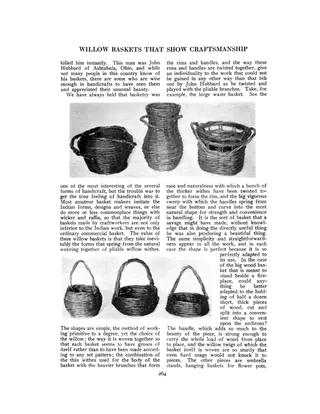
An article from The Craftsman describing the willow baskets of John Hubbard of Ashtabula, Ohio, a deaf self-taught basket maker who developed his own method of weaving willow withes and was killed by a train while working for a manufacturer. It discusses the forms, twisted rims and handles, stains, and household uses of his baskets, and argues that willow basketry suits furniture and village industry. Illustrated with photographs of waste baskets, vase-shaped baskets, and handled baskets.
37 documents found