Textile Documents › Authors › Author: Charles E. Pellew
13 documents found
Sort: 
Acid Colors
Article · 4 pages
Number VI in Charles E. Pellew's series on synthetic dyes for craft workers, covering the Acid class of coal-tar colors (Acid Azo dyes and sulphonated basic dyes). It explains their history and properties, then gives dyeing directions for wool (sulphuric acid and Glauber's salt bath, plus irregular 'rainbow' skein dyeing), leather, and feathers, including cleaning and bleaching white feathers. It ends with a table of selected lightfast acid dyes by manufacturer (Badische, Cassella, Elberfeld, Kalle, Metz).
Application of Modern Dyestuffs to Arts and Crafts Work: General Introduction
Article · 7 pages
Introductory article by Columbia University chemistry professor Charles E. Pellew, opening a series of eight lessons on dyeing for arts and crafts workers. He argues for modern synthetic (coal tar or aniline) dyes over the natural dyes praised by Ruskin's followers, and reviews ancient dyes such as woad, indigo, madder, cochineal, logwood and Tyrian purple. He gives simple directions for iron (rust) dye and manganese brown (bistre), then traces Perkin's 1856 discovery of mauvein and the synthesis of alizarine. He discusses poor fastness caused by dyers' and manufacturers' choices, and closes with the wider effects of coal tar chemistry on medicine, perfumes, flavorings and pigments.
Basic Colors
Article · 3 pages
Fifth article in a series by Professor Charles E. Pellew of Columbia University on the Basic (aniline) dye-stuffs, written for readers of The Craftsman. It traces the origin of these dyes from Perkin's Mauvein of 1856 through Methyl Violet, Fuchsine/Magenta, Bismarck Brown and Methylene Blue, and explains how they bond with animal fibers and how tannin and tartar emetic mordants fix them to cotton and linen. It gives dyeing directions for straw, raffia and leather, including finishing waxes, and ends with recommended dyes and a list of dye-house products.
Batik, or the Wax Resist Process
Article · 4 pages
Article by Professor Charles E. Pellew of Columbia University, number XI in a series on dyeing for craftsmen, introducing batik, the wax resist process. It covers the history of batik in Java and Madras, Javanese garments and methods, and the tools (tjentang or "teapot", brass stamping blocks, a patented wax pencil). It also covers wax mixtures (paraffin, beeswax, ceresine, rosin), modern dyes for cotton, linen, silk, wood, leather and bone, and acid etching of bone, metal and wood after waxing. A short note on indigo stencil paste follows on the last page.
Dyeing of Imitation and Artificial Silk
Article · 4 pages
Article number IX in Professor Charles Pellew's series on dyeing, published in The Craftsman. It covers mercerized cotton and the main artificial silks (Chardonnet, Pauly, Elberfeld/Glanzstoff and Viscose): their history, how they are made, and how to dye and finish them. It also gives simple tests for telling natural silk, mercerized cotton and artificial silk apart, and names suitable dye classes (Sulphur, Direct/Salt and Basic colors).
Dyeing Silks
Article · 4 pages
Number VII in Charles Pellew's series on dyeing, written for The Craftsman in 1909, serves as an introduction to silk before the dyeing methods are taken up. It covers the varieties of silk (cultivated, wild/tussore, spider silk and pinna silk), a history of silk from China to Europe and Virginia, and 1900s production and import figures. It then describes the stages of silk production: raising cocoons, reeling, throwing (organzine and tram), degumming, and the contrast between piece dyeing and skein dyeing with acid dyes and boiled-off liquor. The actual skein-dyeing methods are left to the next article.
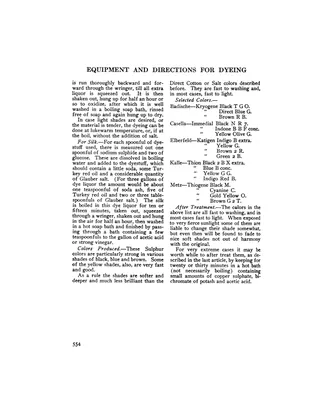
Equipment Needed for Dyeing and the Colors Formed by Oxidation
Article · 4 pages
Third article in a series on dyeing for arts and crafts workers by Professor Charles E. Pellew of Columbia University. It first describes the practical equipment for a home or studio dye shop: agate pots, gas stoves, glass and wooden stirring rods, rubber gloves, wringers and drying arrangements. It then covers Class II dyes, colors formed by oxidation on the fiber, concentrating on sulphur dyes, with dyeing directions for cotton and silk, typical colors, a list of selected dyes by manufacturer, and after-treatment for fastness.
General Description and Classification of Artificial Dyestuffs
Article · 4 pages
Part II of a series by Charles E. Pellew on artificial (coal tar) dyestuffs, written for dyers and amateur craftworkers. It explains how to identify a dye by trade name, shade letter and manufacturer, and advises buying from the large German makers' agents instead of retail repackagers. It then lays out a six-class classification of coal tar dyes and begins with Class I, Direct Cotton (salt) dyes, covering their uses, dyeing directions for cotton, mercerized cotton, linen, wool and silk, fastness, a table of selected lightfast colors by manufacturer, and after-treatments.
Indigo and the Vat Colors: Fourth Paper on Dyeing
Article · 6 pages
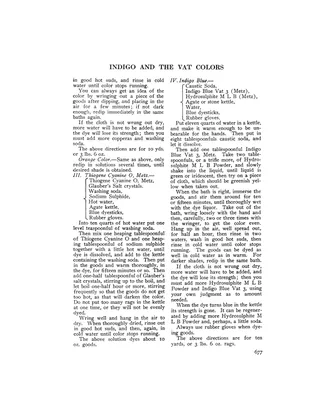
A 1908 article from The Craftsman, the fourth in Professor Charles E. Pellew's series on dyeing for arts and crafts workers, covering indigo and the other vat colors. It traces indigo's history and synthesis, compares fermentation, copperas-lime, zinc dust and sodium hydrosulphite vats, and gives step-by-step directions for dyeing cotton with indigo and the Indanthrene, Algol and Thion vat dyes. It closes with a review of cotton dyeing, including recipes used at Greenwich House for home-dyed rag rugs (manganese brown, copperas yellow and orange, Thiogene Cyanine blue, indigo blue).
Mediaeval Dyestuffs
Article · 9 pages
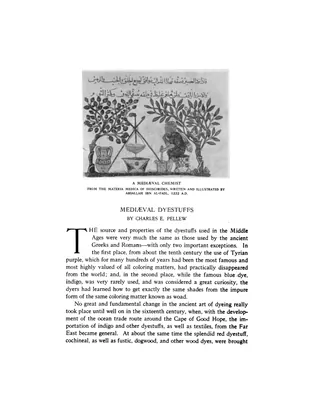
Article by chemist Charles E. Pellew surveying the dyestuffs used in the Middle Ages and how they compare with those of antiquity and later periods. It covers yellows (saffron, Persian berry, iron rust), blacks (iron and tannin, galls, logwood), reds (kermes, lac, cochineal, madder), and blues (indigo and woad). Along the way it discusses mordants, fastness of colors, the fading of yellows and greens in old tapestries, the woad-versus-indigo controversy, and the arrival of synthetic indigo.
Modern Dyestuffs Applied to Stenciling
Article · 5 pages
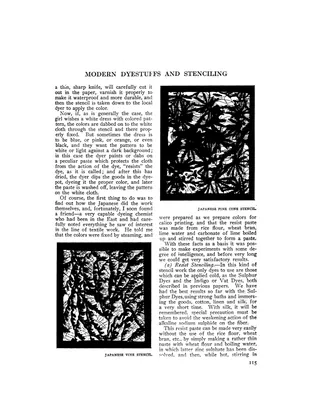
Number X in Professor Charles Pellew's series for The Craftsman, on applying modern synthetic dyestuffs to stenciling on textiles. It describes Japanese stencil practice and gives recipes for a wheat-flour and zinc oxide resist paste used with Sulphur and Vat dyes. It also gives a basic-color stencil paste fixed by ironing and a tartar emetic bath. The article is illustrated with old Japanese stencils from E. T. Shima's collection.
Silk Dyeing (Continued)
Article · 4 pages
Part VIII of Charles Pellew's series on silk dyeing in The Craftsman covers skein dyeing with acid dyes, finishing and lustering, and dyeing silk black with logwood. It explains how silk is weighted with tin salts, iron, tannin and other chemicals, how to test for weighting by burning, and the effect on durability. It closes with advice for amateurs and craftsmen on using acid, salt (direct) and sulphur dyes on silk, including how to neutralize sulphur dye baths and obtain blacks without logwood.
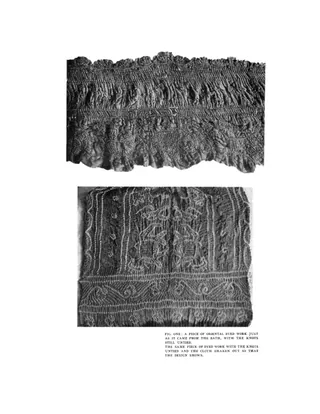
Tied and Dyed Work: An Oriental Process with American Variations
Article · 7 pages
A 1909 Craftsman article by Professor C. E. Pellew of Columbia University describing tied-and-dyed (tie-resist) work, an ancient Indian process, and how it can be adapted with modern sulphur and vat dyes. It covers the Rajputana and Kotah Chunari tradition, the general resist, discharge and direct-application methods, and practical tying techniques using marbles, loops and folds. It also describes the author's own "tied and discharged" experiments with bleaching powder and a four-color silk scarf built up by successive dye baths. Illustrated with photographs of dyed samples.
13 documents found