Textile Documents › Topic: Dyeing
739 documents found
Sort: 
Aniline Gray
Manufacturer and Builder, 1869
Article · 1 page
A short 1869 article giving M. Bloch's recipe for producing an aniline gray dye. It describes heating aniline with arsenic acid, purifying the black product with muriatic acid and carbonate of soda, and dissolving it in alcohol with sulphuric acid. The resulting liquor is used to dye silk or wool in shades of gray and for dyeing and printing. Reprinted from Moniteur Scientifique.
Chrome Orange
Manufacturer and Builder, 1869
Article · 1 page
A short 1869 article from The Manufacturer and Builder on making chrome-orange pigment, a basic lead chromate. It describes preparing it from chrome-yellow with caustic potash, soda or lime, or directly from lead solutions, and how alkalinity controls the shade. It also discusses adulteration of chrome yellows and oranges with plaster of Paris and heavy spar, and the need to test the pigment's covering power.
Coloring Matter in Coal Tar
Article · 1 page
A short magazine item from Harper's New Monthly Magazine on the coloring matter obtainable from coal tar, a by-product of gas manufacture. It traces the yield chain from tar to benzole, nitro-benzole, rosaniline, aniline red and pure fuchsine, and estimates how much coal is needed per pound of fuchsine and the potential annual output from European gas-works.
New Chrome Yellow
Manufacturer and Builder, 1869
Article · 2 pages
A short 1869 article from The Manufacturer and Builder on two chromium yellow pigments little known at the time: chrome baryta (barium yellow) and zinc yellow (chrome zinc). It gives preparation methods using barium chloride, zinc sulphate, chromate of potash and caustic soda or lye. It also describes a test-tube procedure for finding the right alkali proportion. The text concerns paint pigments, not textile dyeing as such.
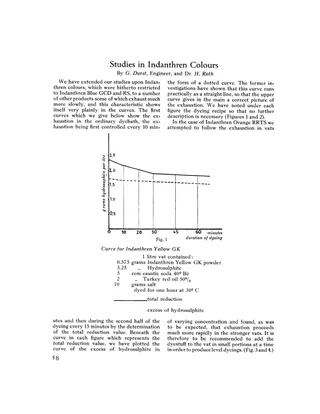
Studies in Indanthren Colours
Article · 4 pages
A short technical article reporting experiments on the vat dyeing behavior of Indanthren colors, extending earlier work on Indanthren Blue to Yellow GK, Brown R and Orange RRTS. Graphs show how dyebath exhaustion and hydrosulphite content change over time and with temperature, caustic soda quantity and vat concentration. The authors also give figures for hydrosulphite loss by oxidation and the caustic soda it consumes, with advice for jigger dyeing.
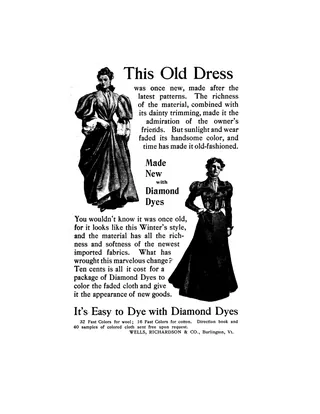
Advertisement
Diamond Dyes, c. 1890-1899
Ephemera · 1 page
A single-page advertisement for Diamond Dyes showing how a faded, old-fashioned dress can be redyed and made to look new. It claims a ten-cent package of dye will color faded cloth, and says the line offers 32 fast colors for wool and 16 for cotton. It also offers a free direction book and 40 colored cloth samples on request, and gives the maker as Wells, Richardson & Co. of Burlington, Vermont.
Book mark
Ephemera · 1 page
A single-page advertising bookmark for Easy Dye, a household fabric dye made by the American Color Co. of Chicago. The Art Nouveau design shows a young girl in a white bonnet and lace collar framed by violets and vines. The text says the dye works on silk, wool, cotton, feathers, and ribbons, mixes cold or hot, and is sold in collapsible tubes in 10 colors for 15 cents.
Chrome Colors
Article · 1 page
A one-page dictionary entry on chrome colors, the pigments containing chromium. It gives preparation methods for chrome blue, green, red, yellow and orange (chromate of lead), with notes on their use in dyeing, painting and enamel work. The text is a chemical recipe description with no weaving content.
Colour
Article · 1 page
A short encyclopedia entry on colour in the art of dyeing, from the first edition of the Encyclopedia Britannica. It lists five simple or primary colours (blue, yellow, brown, red, black) from which dyers form other colours, and names compound shades such as amaranth, violet, pansy, columbine or dove-colour, and purple-crimson. It notes that all colours made with cochineal are called crimson.
Dyeing Alpaca with Iodine Green
Article · 1 page
A short note from the Editor's Scientific Record in Harper's New Monthly Magazine describing a procedure for dyeing alpaca cloth with iodine green. It gives approximate quantities for the dye bath (iodine green, spirit of sal ammoniac, sulphuric acid, soda water-glass) and the sequence of baths, including a hot tannin solution and a final acid bath.
Dyer's Fuming Liquor
Article · 1 page
A short dictionary entry describing dyer's fuming liquor, a solution of proto-chloride of tin made by boiling tin with hydrochloric acid. It notes that dyers use it to change the color of metallic dyes and to precipitate vegetable extracts, and that older authors called it sal jovis.
Experiments on the Comparative Effects of Solutions of Magnesia, of Calcerous Earth, and of Alum, in Dying Cloths of Various Kinds with Madder
Article · 4 pages
A short 1798 report of experiments comparing magnesia, calcareous earth (lime) and alum, each dissolved in sulphuric, nitric and muriatic acids, as mordants for dyeing wool, silk, linen and cotton with madder. Wool and silk took a brown color and linen and cotton a pale red. The author found alum gave brighter, finer colors than the other earths, so it should be preferred. He also suggests testing barytes and manganese, which he could not try.
Lake Colors -- Their Nature and Manufacture
Manufacturer and Builder, 1869
Article · 1 page
A short 1869 magazine article describing what lake pigments are and how they are made from vegetable and animal dyestuffs. It covers blue lakes (litmus and soluble indigo or indigo-carmine), yellow lakes (quercitron, weld, yellow berries, annotto) and red and violet lakes (cochineal, madder, Brazil-wood, logwood). Procedures given include alum and alkali precipitation, use of tin salts, and filtering and drying into cakes.
Mordants
Domestic Encyclopedia, 1821
Article · 1 page
A short encyclopedia entry defining mordants in dyeing as substances that prepare fabrics to take up coloring matter. It lists common mordants of the period, including alum (sulphat of alumine), cream of tartar, tin solutions, gallic acid, copper sulphate, verdigris, arsenic and zinc sulphate. It also gives an early 19th-century chemical explanation of how mordants act on the stuffs and on the pigment.
Mordants
Article · 1 page
A short encyclopedia entry defining mordants as substances used in dyeing to fix colors on textile fabrics. It lists the principal basic mordants (alum, iron, tin and chromium salts) and acid mordants (tannic and fatty acids), and describes how fatty acid soaps are fixed with aluminium sulphate to form insoluble salts on the fibre. It cross-references the entries on dyeing and lakes.
New Dyes
Article · 1 page
A short trade note from Posselt's Textile Journal (December 1907) announcing a Cassella Color Company sample folder for two new Diamine direct cotton dyes, Diamine Fast Brown G and R. It describes the folder's samples on loose cotton, yarn and piece goods, the properties claimed for the dyes, and dyeing directions for cotton, half-wool and half-silk.
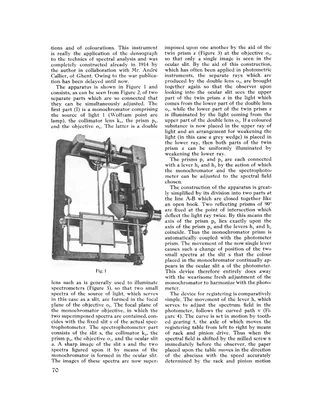
The Spectrodensograph, A Registering Apparatus for Determining the Absorption Curves of Dyestuffs
Article · 5 pages
A 1929 technical article by Professor E. Goldberg describing the spectrodensograph, an instrument that automatically records the absorption curves of dyestuffs. It explains the optical layout (monochromator coupled to a spectrophotometer, grey wedge, twin prism), the registering table and pin that prick the curve onto graph paper, and the method of measurement. It also covers measuring dyed paper and fabric by reflected light and lists the instrument's advantages over conventional spectrophotometers. Illustrated with eight figures of the apparatus and ray paths.
Acid Colors
Article · 4 pages
Number VI in Charles E. Pellew's series on synthetic dyes for craft workers, covering the Acid class of coal-tar colors (Acid Azo dyes and sulphonated basic dyes). It explains their history and properties, then gives dyeing directions for wool (sulphuric acid and Glauber's salt bath, plus irregular 'rainbow' skein dyeing), leather, and feathers, including cleaning and bleaching white feathers. It ends with a table of selected lightfast acid dyes by manufacturer (Badische, Cassella, Elberfeld, Kalle, Metz).
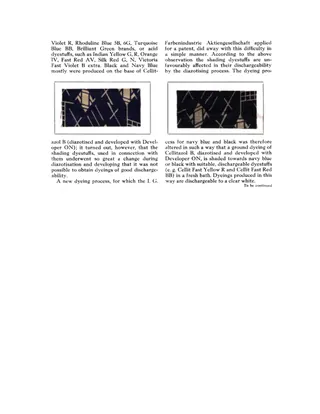
Black and Navy Blue Shades, Dischargeable to White, on Pure Acetate Silk
Article · 2 pages
A short 1929 article from The Melliand by Dr. Fischer on printing pure acetate silk fabrics, especially voiles. It lists dyestuffs that discharge well and explains a new I. G. Farbenindustrie dyeing process in which a Cellitazol B ground is diazotised and developed, then shaded with dischargeable dyes in a fresh bath. This gives black and navy blue that discharge to a clear white. The article is marked "To be continued".
Blue
Article · 1 page
A very short encyclopedia entry on blue as a dyers' color, treated as one of the simple or mother-colours used to compose other colors. It names woad, indigo, and a pastel from Normandy as the sources of blue, and notes that some dyers deepen the shade by adding Brasil and other woods.
Blue
Zell's Encyclopedia, 1876
Article · 1 page
A short encyclopedia entry defining the color blue, with etymology and a brief dyeing section. It notes that blues are generally dyed with indigo or Prussian blue (using iron salt and potassium ferrocyanide baths), and that aniline blue dissolved in sulphuric acid is used for silk and wool. Cross-references point to related entries such as Indigo Blue and Prussian Blue.
Coal Tar
Article · 5 pages
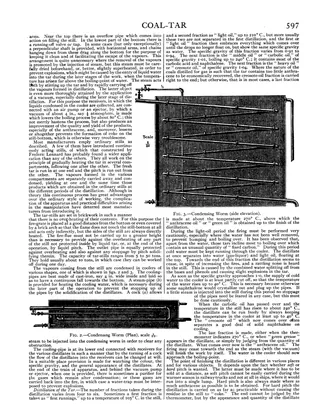
Encyclopaedia Britannica (11th ed.) article on coal-tar, covering its origin as a by-product of coal-gas and coke-oven manufacture, its composition, and its uses in the crude state (fuel, paint, roofing-felt, lamp-black). Most of the article describes fractional distillation in tar-stills and condensers, and the working up of the light, middle, creosote and anthracene oil fractions into benzene, naphthalene, carbolic acid, pyridine bases, creosote and anthracene (for alizarine). It also gives a short history of the industry (Mansfield, Hofmann, Perkin) and a bibliography. Three figures show a tar-still, a condensing worm and a benzol still.
Coal Tar
Article · 1 page
A one-page encyclopedia article describing coal tar, the black oily by-product of making illuminating gas from soft coal. It explains the fractional distillation of the tar into first runnings, light oil, carbolic oil, creosote oil, anthracene oil and pitch, and the products from each (benzene, naphtha, phenols, naphthalene, anthracene). It notes that anthracene is used to make alizarin dyes, which replaced madder root.
Coal Tar Colors
Article · 4 pages
Encyclopedia article on coal-tar (aniline) dyes from the New International Encyclopedia. It covers the history of the synthetic dye industry from Runge and Perkin's mauve to artificial alizarin and indigo, how the dyes are classified by chemical constitution (azo, triphenylcarbinol, quinone, diphenylamine, indigo), and how they are made and applied to fibres. It ends with an alphabetical list of commercial coal-tar colors with formulas and manufacturing methods, plus a bibliography.
Color and Dyeing Portfolio
Other · 3 pages
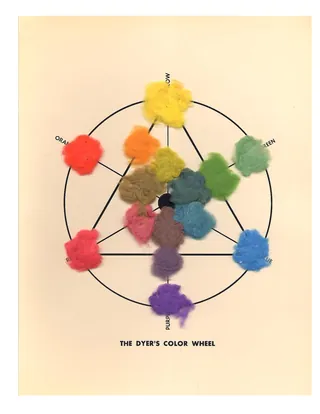
A three-page portfolio accompanying Shuttle Craft Guild Monograph Sixteen, Color and Dyeing by Harriet Tidball (1965). It consists of a cover, a diagram titled 'The Dyer's Color Wheel' showing yellow, red and blue primaries with dyed wool tufts, and a photograph of hand-dyed and handspun yarn samples. It has no weaving drafts.
Coralline Dye-Injurious Effect Therefrom
Manufacturer and Builder, 1869
Article · 1 page
A short 1869 magazine item reporting a case in which a French chemistry professor, Mr. Bidard of Rouen, wore stockings with red silk lines dyed with coralline. The wearer suffered painful burn-like inflammation and mild poisoning, certified by two physicians in Havre. Analysis found the red dye was coralline, derived from carbolic acid, while the lilac ground was harmless aniline violet.
Dye Vat
Article · 1 page
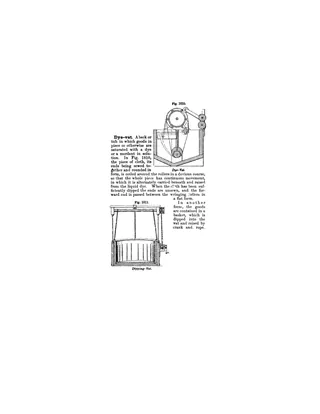
A short dictionary entry on the dye-vat from Knight's American Mechanical Dictionary. It describes a vat in which cloth is saturated with dye or mordant, and explains a machine where a stitched endless piece of cloth is coiled around rollers so it is alternately dipped and raised, then passed through wringing rollers. A second form is also shown, in which goods in a basket are dipped into the vat with a crank and rope. Two line drawings (Figs. 1810 and 1811) illustrate the equipment.
Dye Vat
Article · 1 page
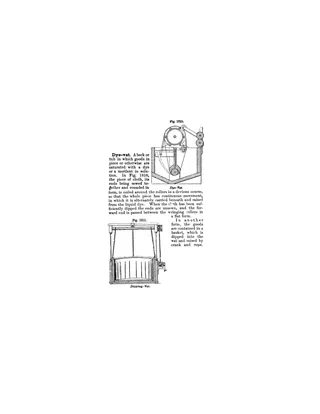
A short dictionary entry on the dye-vat, a beck or tub in which cloth or other goods are saturated with dye or mordant solution. It describes a roller-type vat in which a sewn-together piece of cloth circulates continuously through the liquid and is then wrung out. It also describes a dipping-vat in which goods in a basket are lowered and raised by crank and rope. Two engraved figures (1810 and 1811) illustrate the machines.
The Dyeing of Acetate Silk
Article · 5 pages
A technical article on dyeing acetate silk, explaining how its acetylated cellulose chemistry differs from regenerated cellulose rayons and why it needs special dyes and low-temperature, non-alkaline baths. It covers cleaning, preliminary washing, bleaching (permanganate and hypochlorite processes), and the main acetate dye classes (Celloxane/mordant with basic dyes, Cellit Fast, Celliton and Celliton Fast, Cellitazols), with recipes and temperatures. It also describes dyeing mixed fabrics of acetate with cotton, viscose, wool and real silk, including multi-colour effects, and notes on finishing and care.
Dyeing, Bleaching, Finishing, Etc.
Article · 2 pages
A 1907 article from Posselt's Textile Journal describing how artificial dyes are made from coal tar. It covers distillation of coal tar into light oil, heavy oil and naphthalene fractions, and the purification and nitration of benzene and toluene to give nitrobenzene and nitrotoluols. It also covers conversion to aniline and toluidine and the extraction of phenol (carbolic acid). The second page is the end of an installment of a knitting article on the plain stitch and needle loop formation.
Dyestuffs
Article · 2 pages
An encyclopedia article from The Americana (1903) surveying dyestuffs used to color textile fibers and fabrics. It classifies them as animal dyes (cochineal, kermes, lac, galls), vegetable dyes by plant part (madder, logwood, fustic, quercitron, safflower, saffron, indigo, woad, lichens, weld), and artificial colors (pigments and coal-tar series such as aniline, phenol, azo and anthracene colors). It notes the colors each produces, the fibers it suits, and its permanence or mordant use.
An Important Advance in the Dyeing of Artificial Silk
Article · 2 pages
A short 1929 trade article describing a new spray dyeing machine for artificial silk (rayon) skeins, built by Tillmann Gerber Söhne & Gebr. Wansleben of Krefeld. The author explains the causes of uneven dyeing and how the machine sprays dye liquor over skeins on rollers while they are immersed. He reports on a demonstration in a German dyehouse where about 100 kilos of yarn were dyed in three quarters of an hour with one operator, and he lists further advantages such as porcelain-lined cisterns and dye reuse.
Lake
Article · 1 page
A very short dictionary entry defining 'lake' as a general term for yellow and red pigments made by combining aluminous earth with the coloring matter of a plant or insect. It lists examples such as carmine, scarlet, madder, yellow, cochineal and lac lakes. The rest of the entry is illegible in the scan.
Lake
Rees's Cyclopedia, 1819
Article · 3 pages
Encyclopedia article on lakes (laques), pigments made by precipitating vegetable or animal dye colors onto alumina or metallic oxides, for painters and dyers. It gives recipes for red lakes from cochineal (carmine), scarlet cloth shreds, madder and Brazil wood, and for yellow lakes from quercitron, turmeric and broom flowers, plus an orange lake from annatto. It also notes how acids and alkalies change lake colors.
Mordant
Article · 1 page
A short dictionary entry defining a mordant as a substance applied to fabric to fix the dye. It cites Pliny's account of ancient India and Egypt, where cloth was treated with dye-absorbing drugs and then immersed in a single dye bath, coming out in several colors.
Observations of the Effect of Mordants in Dying Cotton Red
Article · 8 pages
An 1799 article by J. A. Chaptal, translated from the Annales de Chimie, that applies chemical principles to the traditional process of dyeing cotton Adrianople (Turkey) red with madder. It examines the three main mordants (oil, galls and alum): how the oil is emulsified with barilla or potash lye, what galling does, and how alum fixes the color. It gives practical rules, such as the choice of oil and barilla, hot gall decoction, quick drying in dry weather, and the proportion of galls to soap.
On the Employment of Aloes as a Dye-Stuff
Manufacturer and Builder, 1869
Article · 1 page
A short 1869 article from The Manufacturer and Builder on using aloes as a source of dyes. It explains that treating aloes with nitric acid produces chrysammic acid, gives a preparation procedure, and lists proportions for dyeing wool (brown, black, grayish blue), silk, cotton and linen. It also covers calico printing and use of the acid to fix archil and cudbear dyes as "liquid archil".
On the Use of Oxides or Calces of Iron in Dying Cotton
Article · 11 pages
An 1799 article by J. A. Chaptal, translated from the Annales de Chimie, on using iron oxides to dye cotton. It describes how cotton takes up iron from solutions in various acids to give buff, ochre and rust colours, and Chaptal's method of soaking in green vitriol, then potash and alum, for a softer, durable yellow. It also covers combining iron with madder for violet and purple on cotton prepared for Turkey red, using astringents and galls to obtain browns, greys and blacks, and why galls cannot be replaced by sumach or bark on cotton.
Red
Article · 1 page
A very short encyclopedia entry on the color red in dyeing, describing it as one of the five simple or mother colors. It lists the six kinds or casts of red some dyers distinguish and reduces them to three, according to the principal dyestuffs: kermes, cochineal, and madder.
Red
Rees's Cyclopedia, 1771
Article · 1 page
A one-page encyclopedia entry on the color red in dyeing, from Rees's Cyclopedia. It lists the seven recognized casts of red (scarlet, crimson, madder, half-grain, half-crimson, orange-red, cochineal scarlet) and reduces them to three principal dyestuffs: kermes, cochineal and madder. It gives the mordants and additives used for each, mentions the discouraged Brasil red, and lists the shades available within each cast.
Application of Modern Dyestuffs to Arts and Crafts Work: General Introduction
Article · 7 pages
Introductory article by Columbia University chemistry professor Charles E. Pellew, opening a series of eight lessons on dyeing for arts and crafts workers. He argues for modern synthetic (coal tar or aniline) dyes over the natural dyes praised by Ruskin's followers, and reviews ancient dyes such as woad, indigo, madder, cochineal, logwood and Tyrian purple. He gives simple directions for iron (rust) dye and manganese brown (bistre), then traces Perkin's 1856 discovery of mauvein and the synthesis of alizarine. He discusses poor fastness caused by dyers' and manufacturers' choices, and closes with the wider effects of coal tar chemistry on medicine, perfumes, flavorings and pigments.
Basic Colors
Article · 3 pages
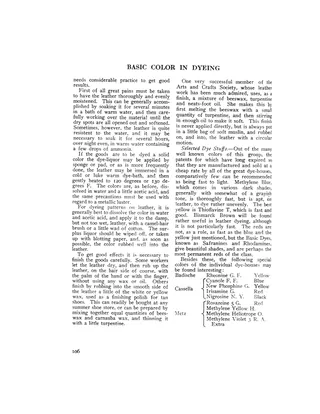
Fifth article in a series by Professor Charles E. Pellew of Columbia University on the Basic (aniline) dye-stuffs, written for readers of The Craftsman. It traces the origin of these dyes from Perkin's Mauvein of 1856 through Methyl Violet, Fuchsine/Magenta, Bismarck Brown and Methylene Blue, and explains how they bond with animal fibers and how tannin and tartar emetic mordants fix them to cotton and linen. It gives dyeing directions for straw, raffia and leather, including finishing waxes, and ends with recommended dyes and a list of dye-house products.
Black
Article · 1 page
A short encyclopedia entry on the color black as used by dyers, painters and other trades. It gives the dyer's recipe for black on high-priced woollen cloth (woad and indigo base, boiled with alum, tartar or wine-lees ashes, maddered, then blacked with galls, copperas and sumach), and a simpler method for cheaper stuffs. It also describes other blacks: German or Frankfort black, ivory, bone, hart's-horn, Spanish (burnt cork), lamp and earth blacks, ink, and currier's black for leather.
Black
Rees's Cyclopedia, 1771
Article · 2 pages
An encyclopedia article on the color black from Rees's Cyclopedia. It covers black dyeing of cloth and hats with galls and iron vitriol (copperas), the woad and indigo ground used on broadcloth, and Jesuit's or coal black. It also gives an Elizabethan statute on maddering black and notes on logwood, silver and lead blacks, and pigment blacks (earth, German or Frankfort, hartshorn and ivory black).
Colour-Matching on Textiles
Book · 175 pages
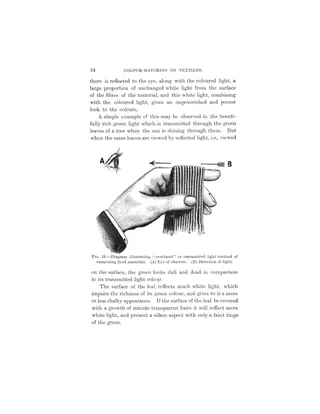
A 1901 manual by David Paterson for dyers, calico printers and textile colour chemists on matching dyed colours on textiles. It covers colour perception and the structure of the eye, the qualities of daylight, simultaneous contrast, reflected versus transmitted-light examination, and the effects of fibre lustre, transparency and dyestuff optics such as fluorescence. Later chapters treat colour-blindness, tinted films as matching aids, silk trimmings, artificial illuminants (electric arc, magnesium, acetylene, Welsbach, gas), and absorption spectra explaining why shades that match in daylight differ in gaslight. It has a coloured frontispiece, diagrams, photographs, an index, and publisher's advertisements at the back.
The Detection of Dyes
Manufacturer and Builder, 1869
Article · 1 page
A one-page article from The Manufacturer and Builder (page 275) reporting M. Tardieu's chemical tests for identifying red dyes on fabric, prompted by accidents from stockings dyed with coralline. It describes how garancine, cochineal, murexide, carthamus, aniline and coralline reds react to acids, ammonia, soap solution, water and alcohol, and how to test fibers for coralline.
Dictionary of Technical Terms Relating to the Textile Industry
Article · 2 pages
Two pages from Posselt's Textile Journal (January 1914) containing the end of a short note on dissolving basic and acid dyes, followed by the first installment of Julius Hubner's historical article "History of Dyeing." The article surveys dyeing from ancient Egypt, the Bible, and classical authors such as Pliny through medieval dyers' guilds and regulations in Germany, Italy, and Persia, up to 16th and 17th century prohibitions on indigo. It is a serial article that ends with "To be continued."
Dyeing
Article · 1 page
A one-page encyclopedia entry on dyeing from Knight's American Mechanical Dictionary. It defines organic and inorganic dyes, ranks fibers by how readily they take color, and distinguishes substantive from adjective dyes and mordants, with examples such as copperas and logwood. It also gives a historical sketch covering biblical references, Tyrian purple from murex, the discovery of Prussian blue, aniline, mauve and magenta, and ends with a note on dyeing black hats.
Dyeing
Rees's Cyclopedia, 1819
Article · 9 pages
Excerpt from Rees's Cyclopedia (1819) giving a historical account of the art of dyeing, from its obscure origins through antiquity, the Middle Ages, and early modern Europe. It covers the legends and uses of Tyrian purple, dye materials known to the Greeks and Romans (alum, alkanet, madder, woad, indigo), the discovery of archil and kermes scarlet, the Gobelin family, and the development of dyeing theory in France, including Berthollet's work. A short closing section lists the various trades that use dyeing or coloring, such as bleaching, staining wood and leather, and marbling paper.
Dyeing
Zell's Encyclopedia, 1876
Article · 1 page
A one-page encyclopedia entry on dyeing as understood in the 1870s. It distinguishes substantive and adjective dyes, describes the stages of mordanting, ageing, dunging, dyeing and clearing, and lists common mordants and dung substitutes. It also summarizes how blacks, blues, reds and yellows were produced on wool, silk, cotton and linen, and mentions the new aniline dyes and the chemists who studied dyeing.
739 documents found