Textile Documents › Topic: Bleaching, finishing, and laundering
812 documents found
Sort: 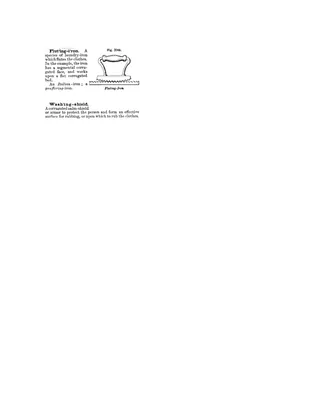
[Fluting-iron and washing-shield entries from Knight's American Mechanical Dictionary]
Article · 1 page
A single page of short dictionary entries from Knight's American Mechanical Dictionary on laundry implements. It defines the fluting-iron, a laundry iron with a segmental corrugated face working on a corrugated bed, illustrated by Fig. 2044, and notes the Italian-iron or gauffering-iron. It also defines the washing-shield, a corrugated palm-shield used to protect the hand and rub clothes.
How Should Artificial Silk Be washed?
Article · 3 pages
A 1929 article from The Melliand giving guidance on washing artificial silk (rayon) garments. It explains how the fibre loses strength when wet and is sensitive to caustic alkalis and soda. It compares soap flakes and powders such as Lux, Perflor and Persil, recommends washing at 30-35 °C, corrects common advice such as cold-water washing and vinegar rinses, and ends with short general washing and ironing directions.
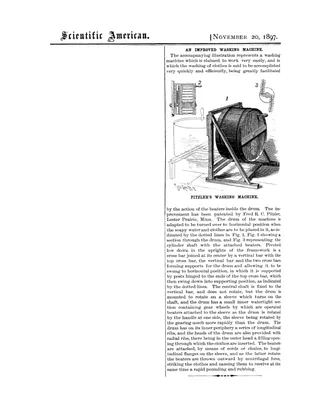
Improved Washing Machine
Scientific American, November 20, 1897
Article · 1 page
A short 1897 Scientific American item describing a patented washing machine by Fred R. C. Pitzler of Lester Prairie, Minnesota. It explains the tilting drum on a wooden frame, the geared inner shaft and sleeve that drive cord-attached beaters, and the ribs that pound and rub clothes as the drum is hand-cranked. One illustration shows the machine beside a tub, with a washboard and hand wringer.
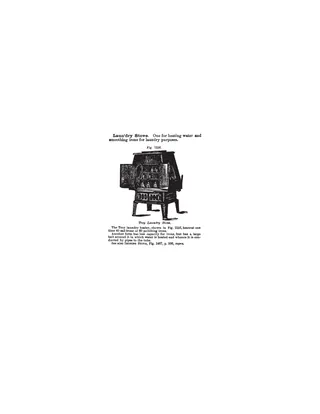
Laundry Stove
Article · 1 page
A short dictionary entry on the laundry stove, a stove for heating water and smoothing irons in laundry work. It describes the Troy laundry heater, illustrated in Fig. 1556, which heats 40 sad-irons or 80 polishing irons at once, and another form with a water-heating belt that feeds tubs through pipes. It cross-references the Ironing Stove entry.
Mangle
Article · 1 page
A short encyclopedia entry on the word 'mangle' from the 11th edition of the Encyclopedia Britannica. It covers two senses: the laundry machine for pressing and smoothing linen after washing, and the verb meaning to mutilate. The entry mainly traces etymology, linking the machine to Dutch, Italian, medieval Latin and Greek words, and giving the Anglo-French origin of the verb.
Mildew in Cotton Cloth
People's Friend, 1872
Article · 1 page
A one-sentence household tip from an 1872 periodical explaining that mildew in cotton cloth can be removed with a solution of chloride of lime. It warns that the fabric must be rinsed thoroughly in clean water as soon as the spots disappear, or the cloth will be destroyed.
Teasel
Article · 1 page
A short encyclopedia entry on the teasel plant. It describes wild teasel (Dipsacus sylvestris) and fuller's teasel (D. Fullonum), whose dried, hook-bracted heads are used to raise the nap on cloth. It also notes the plant family Dipsaceae and the related scabious.
Beetling
Article · 1 page
A short encyclopedia entry defining beetling, a mechanical finishing process for linen and for cotton cloth imitating linen. It describes how rows of upright wooden stamps strike cloth passing over a roller to flatten the yarn and give a hard, wiry look, and notes its use on fine linen damask. It also mentions beetling or hammering linen weft yarn for sailcloth to soften it for weaving.
[Bleaching]
Article · 1 page
A single page of short dictionary entries on bleaching terms and equipment from Knight's American Mechanical Dictionary. It defines chemicking (steeping goods in dilute chloride of lime), the dash-wheel for washing calico, and the hanging-machine for drying cloth with tenter hooks.

Bucking
Article · 1 page
A one-sentence encyclopedia entry from the first edition of the Encyclopedia Britannica defining bucking as the first operation in whitening linen yarn or cloth. It gives no procedural detail beyond this definition.
Calandre [Calender]
Article · 1 page · French
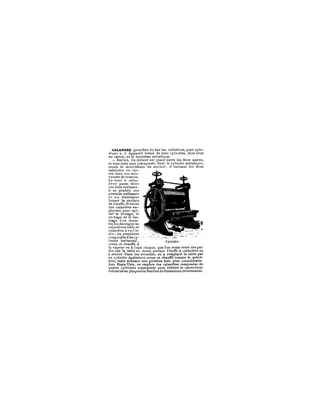
A one-page French encyclopedia entry on the calender (calandre), a machine of three cylinders, two of pasteboard and one of metal, used to press, smooth and lustre fabrics. It explains how the cloth passes between the rollers, and distinguishes table calenders from cylinder calenders, which are heated with steam or hot water. It also notes American four-roller calenders used to roll vulcanized rubber into sheets. An engraving shows a hand-operated calender with three rollers.
Calender
Article · 1 page
A short encyclopedia entry defining the calender, a machine of two or more close-set, often heated rollers through which cotton, calico and other fabrics are passed to give a smooth, glazed finish. It gives the word's etymology from the Greek for cylinder and notes that the same machine is used in paper manufacture.
Calender
Article · 1 page
A short encyclopedia entry defining the calender, a machine used in textile manufacture to press woollen and silk fabrics and linens so they become smooth, even and glossy, or to give them a watered or waved finish as seen in mohairs and tabbies. It describes the machine as two hard wooden rollers set between two heavy boards, the upper one pressed down by a screw and loaded with stones.
Calender
Rees's Cyclopedia, 1819
Article · 1 page
A short encyclopedia entry on the calender, a machine used in textile manufacture to press stuffs, silks, calicoes and linens so they become smooth, even and glossy, and to water or wave tabbies and mohairs. It covers the word's derivation, the construction of the machine with its wooden rollers and heavily weighted movable upper plank, the royal calender at Paris made for Colbert, and horse-driven versions. It also mentions calendering worsteds and linen cloths.
Calendering
Article · 1 page
A one-page dictionary entry from Knight's American Mechanical Dictionary describing calendering, the finishing operations applied to woven goods between bleaching or dyeing and packing. It covers wetting, rolling, mangling, starching, drying over heated cylinders or on frames, and the patent finish for muslins. It refers readers to the entry on the calendering machine for the glossy surface finish.
Calendering
Article · 1 page
A one-page encyclopedia entry defining calendering, the finishing process that gives paper and textile fabrics such as linen and cotton a glazed or polished surface by passing them between pressure rolls. It describes calender construction (3 to 12 rolls of wood, paper, cotton, or heated metal), starching and paraffin or soap additions, friction glazing, and watering patterns. It closes with references to Beaumont and Edge and cross-references to Beetling and Paper.
Calendering Machine
Article · 1 page
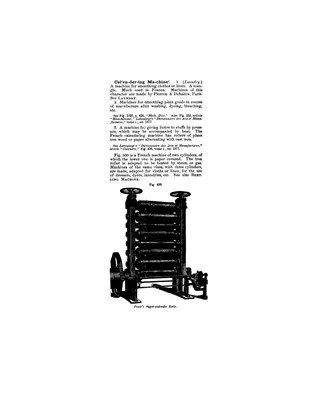
A one-page dictionary entry on calendering machines from Knight's New Mechanical Dictionary. It describes three senses: a laundry mangle for smoothing clothes and linen, machines for smoothing piece goods after washing, dyeing and bleaching, and machines that give lustre to fabrics by pressure and heat. It mentions French machines with alternating wood or paper and cast iron rollers, and includes an engraving of Poole's super-calender rolls.
Cleaning Scarlet Cloth
People's Friend, 1872
Article · 1 page
A brief 1872 household-hints item giving a recipe for "eau écarlate," a solution made from sal ammoniac, nitric acid, pure tin and water, used to revive faded scarlet cloth. It gives quantities and mixing order and notes that further dilution may be needed.
Cleaning Silk
People's Friend, 1872
Article · 1 page
A short 1872 household-hints item from People's Friend giving a method for cleaning silk dresses with potato water. It describes grating potatoes into cold spring water, letting it settle for 48 hours, pouring off the clear liquid, dipping the silk, wiping it flat with a towel, and ironing on the soiled side. The writer says the method also works on woollens and mourning cottons.
[Cloth finishing terms from Knight's American Mechanical Dictionary]
Article · 1 page
A single page of short dictionary entries from Knight's American Mechanical Dictionary (1876) on cloth finishing terms. It defines cloth-paper (used between folds in the finishing press), picking cloth (removing blemishes with tweezers and touching up undyed spots), snugging (rubbing down fuzzy rope fibers), and tabbying (passing fabric between engraved rollers to give a watered or moiré effect).
Clothes Washer
Article · 1 page
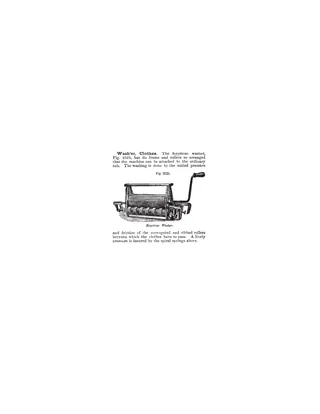
A short entry from Knight's New Mechanical Dictionary describing the Keystone clothes washer, a hand-cranked machine that attaches to an ordinary tub. Clothes are washed by pressure and friction between corrugated and ribbed rollers, held together by spiral springs. Includes one line drawing (Fig. 2525).
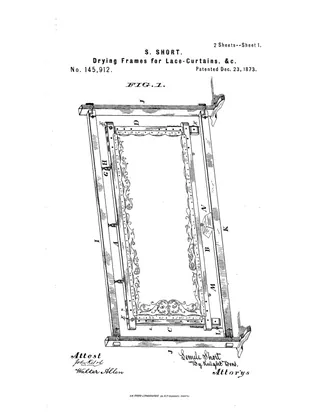
Drying Frame for Lace Curtains, &c., US Patent No. 145912
Patent · 3 pages
US Patent No. 145,912, granted December 23, 1873 to Semele Short of Cincinnati, Ohio, for an adjustable drying frame for washed lace curtains, bed blankets and similar goods. The frame is four bars joined at right angles and hung vertically, with canvas or muslin valances to which the wet fabric is pinned. A weighted sinking bottom bar keeps even tension so the article dries to its original rectangular shape. Two sheets of drawings show a version hung in a portable trestle and a version hung from a beam or ceiling, followed by the specification and claim.
Embossing
Zell's Encyclopedia, 1876
Article · 1 page
A one-page encyclopedia entry defining embossing as the art of producing patterns or inscriptions in relief on cloth, leather, felt, metal, pasteboard or paper. It describes die stamping for paper and envelopes and the use of engraved cylinders and bed-rollers for woollen goods, velvets and bookbinding cloth. It also covers heated rollers and the embossing of leather.
Erzielung von Wollcharakter auf Baumwollgeweben [Achieving a Wool Character on Cotton Fabrics]
Article · 1 page · German
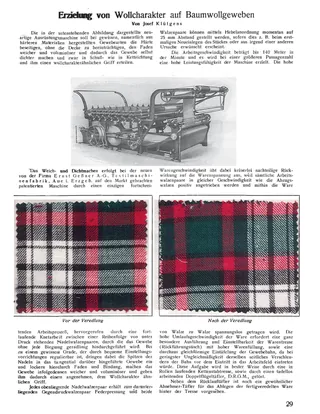
A short 1927 German trade article describing a new patented finishing machine from Ernst Geßner A.-G. (Aue, Saxony) that gives cotton fabrics a wool-like hand. The machine kneads the cloth between pairs of spring-loaded needle rollers and counter-pressure rollers, loosening threads and weave so the fabric becomes softer, fuller and denser in warp and weft. The article covers roller adjustment, running speed up to 140 m/min, tension-free fabric transport and the folding devices. A photo of the machine and before/after swatch photos accompany the text.
Fuller
Article · 1 page
A very brief encyclopedia entry defining a fuller as a workman in woollen manufactories who mills or scours cloths, serges, and other stuffs to make them thicker, more compact, and more durable. It refers readers to the article CLOTH for further information.
Fuller
Rees's Cyclopedia, 1819
Article · 1 page
A short encyclopedia entry on the fuller, the workman who fulls, mills or scours woollen cloths, rateens, serges and other stuffs to make them thicker, more compact and durable. It gives the Latin origin of the word (fullo) and notes that Roman fullers washed, scoured and finished cloth under formal laws, with references to Pliny and Ulpian. It cross-refers to the entry on Fulling.
Improvement in Frames for Drying Laces, &c., US Patent No. 119318
Patent · 3 pages
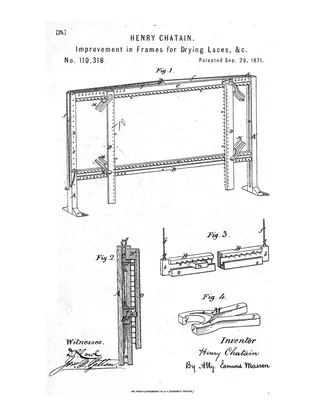
US Patent No. 119,318, granted to Henry Chatain of Washington, D.C., on September 26, 1871, for an improved frame for drying lace curtains, shawls and similar articles. The frame has grooved upright posts and a bottom bar raised and lowered by ropes and pulleys. Removable side bars are held by one-piece wooden spring-clamps, and metal pins on the bars hold the lace. The document has a drawing sheet with Figs. 1-4 and a two-page specification with two claims.
Interior of a French Laundry
Article · 1 page
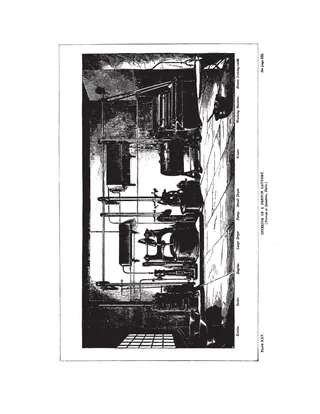
A single plate from Knight's New Mechanical Dictionary showing an engraved view of the interior of a French laundry, with the equipment labeled: kettles, boiler, engine, large and small dryers, pump, rinser, washing machine and steam ironing-table. The plate credits Pierron et Dehaitre of Paris and refers readers to page 652 of the dictionary.
Laundry
Article · 1 page
A one-page encyclopedia entry on the laundry as a place and an industry. It explains the origin of the words laundry, launder and laundress, then describes mechanized washing, hydro-extractor drying, and mangles and calender-type finishing machines that replaced hand methods.
Laundry
Rees's Cyclopedia, 1819
Article · 3 pages
An encyclopedia article on the laundry and wash-house from Rees's Cyclopedia. It argues that washing by pressure rather than friction is better for linen, then describes in detail John Bentley's wash-house and laundry at Highbury House near London, including its coppers, filtering machine, mangle, and heated drying closet. It ends with an addendum (December 1811) on a steam-washing apparatus and its advantages over hand washing.
Laundry Machinery
Article · 8 pages
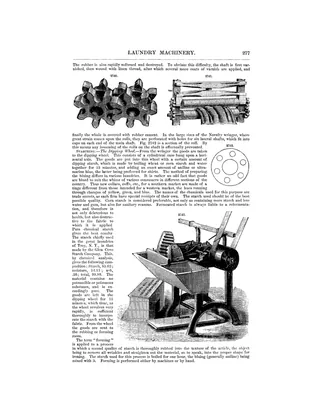
An 1889 encyclopedia article describing 19th-century American commercial laundry machinery, organized by stage: bleaching, washing, wringing, starching, and ironing. It covers dash-wheel, Brown, and Nonpareil power washers, hand washers, hydro-extractors, rubber-roll wringers, starching machines, hot mangles, gas-heated ironing machines, and collar and cuff finishing equipment. Engraved figures (Figs. 2733-2754) illustrate the machines.
Mangle
Article · 1 page
A very short encyclopedia entry defining the mangle as a machine that smooths linen and cotton goods such as tablecloths and sheets after washing by passing them between rollers. It gives the word's etymology (Dutch, German, Icelandic, Medieval Latin, Greek) and refers readers to the article on laundry machinery.
Mangle
Zell's Encyclopedia, 1876
Article · 1 page
A single encyclopedia entry defining the mangle, a machine for smoothing linen and cotton articles. It describes the common form, a weighted wooden chest of stones rolling back and forth on two cylinders over linen laid on a smooth bed, driven by a toothed wheel and pinion. It also mentions patent varieties, such as one in which linen is rolled on a cylinder pressed by hanging weights against a sliding curved bed, and gives the verb sense 'to calender'.
Of Fiber - Fabric Finishes
Article · 1 page
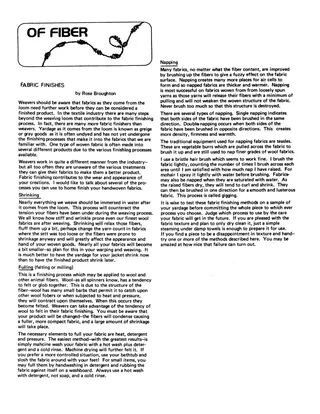
A one-page article for handweavers on finishing fabric after it comes off the loom. It explains why greige goods need further work and describes three home finishing processes: shrinking (wet-finishing), fulling of wool by heat, detergent and pressure, and napping or gigging to raise the surface fibers. It ends with advice to test each method on a sample and to choose a finish according to how the fabric will be cared for.
Producing a Woolly Finish on Cotton Fabric
Article · 2 pages
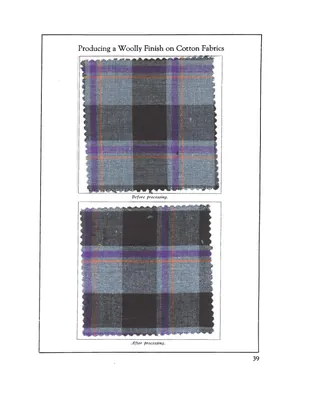
A short 1929 article describing a German-built finishing machine that gives hard-twisted cotton fabrics a soft, bulky, wool-like handle in a single continuous process. The machine passes cloth between pairs of stud-covered rolls that beetle the fabric and open up the yarns, and the text covers its operation, speed, feed and folding arrangements. Two magnified images show the fabric surface before and after processing.
Scouring Fancy Shawls
People's Friend, 1872
Article · 1 page
A short 1872 household-advice item giving a recipe for scouring tartan shawls, suggested as safe for Paisley plaids. It describes making a soap jelly with turpentine and hartshorn, washing, rinsing in cold water and then salt water to prevent colours running, and mangling and ironing with a cool iron.
Starch
Article · 2 pages
Encyclopedia article on starch from the 11th edition of the Encyclopedia Britannica. It covers starch's origin in plants, granule structure, chemical properties and its industrial uses, including textile dressing and finishing, calico printing and laundry work. It also describes manufacturing processes for potato, wheat, maize and rice starch.
Starch
Article · 3 pages
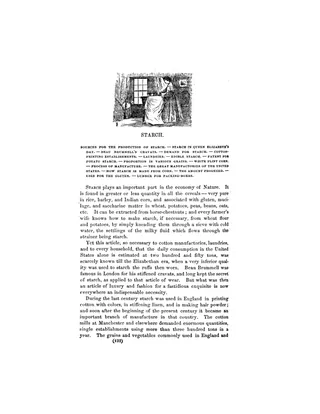
An 1872 article on starch manufacture from the book Great Industries of the United States. It covers sources of starch (wheat, potatoes, rice, corn, horse-chestnuts), its early use for ruffs and cravats and in cotton printing and laundering, and the starch content of various grains. It describes the processes for making starch from wheat, rice and white flint corn, and the large corn-starch factories at Oswego, N.Y., and Glen Cove, L.I.
Tabby and Tabbying
Article · 1 page
Two short entries from the first edition of the Encyclopedia Britannica. 'Tabby' is defined as a rich silk that has undergone tabbying. 'Tabbying' is the finishing process of passing silk or stuff under a calender with engraved iron or copper rolls, which presses the surface unevenly so it reflects light differently and shows a wavy pattern.
Tabby and Tabbying
Article · 1 page
A very short encyclopedia entry defining 'tabby' as a rich silk that has been tabbied, and 'tabbying' as the process of passing silk or other stuff under a calender with engraved iron or copper rolls. The uneven pressure gives the surface a watered or wavy light-reflecting effect. It concerns a finishing process, not the tabby weave structure.
Teasel
Domestic Encyclopedia, 1821
Article · 1 page
A short encyclopedia entry on teasel (Dipsacus), especially fuller's teasel, covering its cultivation from seed, soil, spacing, timing of sowing, flowering and harvest of the heads. It also notes the use of the hooked heads by clothiers, mounted on a wheel, to raise the nap on woollen cloth.
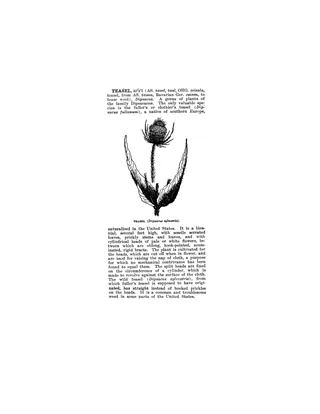
Teasel
Article · 1 page
A one-page encyclopedia entry on the teasel (genus Dipsacus), covering its etymology, botanical description and distribution in Europe and the United States. It explains that the heads of fuller's teasel (Dipsacus fullonum) are used to raise the nap on cloth, fixed on a revolving cylinder, and contrasts them with the wild teasel (Dipsacus sylvestris). Includes a line drawing of the wild teasel plant.
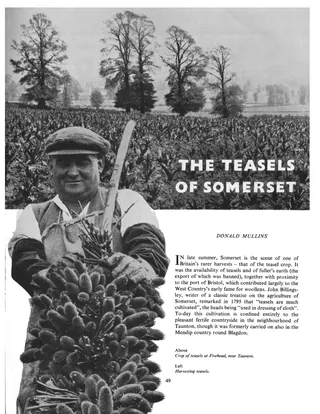
The Teasels of Somerset
Article · 2 pages
A short illustrated article on the cultivation of fuller's teasels in Somerset, England, around Taunton. It describes the plant, sowing, transplanting, harvesting and drying of the burrs, and how they are set in rods on gig-mill drums to raise a nap on woollen cloth such as blankets and overcoatings. Photographs show a teasel crop, harvesting and a gig-mill raising machine.
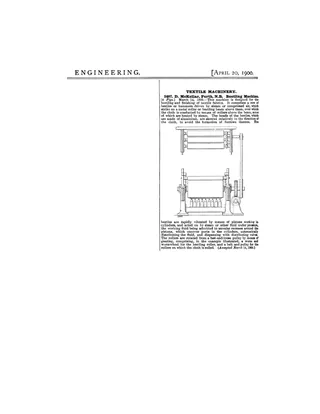
Textile Machinery
Engineering Weekly, April 20, 1900
Article · 1 page
A one-page patent abstract from a 1900 engineering periodical describing D. McKellar's beetling machine for finishing textile fabrics. Rows of aluminium-headed beetles driven by steam or compressed air strike a metal beetling beam, with the cloth passing over heated rollers. Two elevation views illustrate the machine.
To Paint Cloth, Cambric, &c., so as to Render Them Transparent
People's Friend, 1872
Article · 1 page
A short recipe from the periodical People's Friend for making cloth or cambric transparent. It gives a varnish of powdered white resin dissolved in drying nut-oil, with Venice turpentine added. The varnish is applied to both sides of stretched cloth, and the result is suited to window-blinds and to transparencies painted in oil colours.
To Remove Stains from Linen
Manufacturer and Builder, 1884
Article · 1 page
A short household-hints item from an 1884 issue of The Manufacturer and Builder on removing wine, fruit, or rust stains from linen. It recommends soaking the spots in a hyposulphite of soda solution, then covering them with strong vinegar or powdered tartaric acid, and finally washing in soft water.
Water Softening and Filtration Processes, Part 1
Article · 4 pages
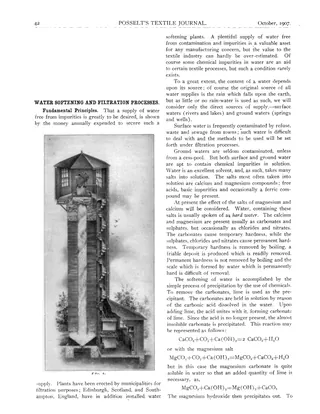
Part 1 of an article from Posselt's Textile Journal (October 1907) on water softening for textile and manufacturing use. It explains hard water (temporary and permanent hardness), the chemistry of removing carbonates, sulphates, chlorides, nitrates and iron with lime and soda-ash, and the Clark and Porter-Clark processes. Most of the text describes the American Water Softener Co. plant, with its motor, chemical tank, oscillating "tipper" and stand-pipe, and gives operating costs and the savings for dyeing, scouring, bleaching and boilers. The article ends with a note on bacterial purification and is to be continued.
Water Softening and Filtration Processes, Part 2
Article · 4 pages
Second installment of an article on water purification for textile mills, from Posselt's Textile Journal, November 1907. It covers removal of suspended impurities by plain sedimentation and by coagulation with alum or sulphate of alumina, including the chemical reactions and a table of suspended matter removed over time. It then explains sand filtration, from a simple home-made tank filter to patent self-washing filters with valve control and automatic alum feed.
Whitening Linen
Article · 1 page
A short magazine item on whitening linen laundry, reporting a French writer's claim that crystallized carbonate of soda weakens linen fibre. It describes an alternative wash solution of soap, warm water, turpentine and ammonia, with instructions for soaking, rinsing and reusing the solution, and claims it saves time, labor and fuel without harming the cloth.
Beetling
Zell's Encyclopedia, 1876
Article · 1 page
A brief encyclopedia entry defining beetling as a finishing process in which wooden stampers pound cloth to give cotton shirting a hard, linen-like appearance. It notes that the process was first used on linen shirting.
812 documents found