Textile Documents › Publications › Publication: Encyclopedia Britannica, 6th Ed.
9 documents found
Sort: 
Tabby and Tabbying
Article · 1 page
A very short encyclopedia entry defining 'tabby' as a rich silk that has been tabbied, and 'tabbying' as the process of passing silk or other stuff under a calender with engraved iron or copper rolls. The uneven pressure gives the surface a watered or wavy light-reflecting effect. It concerns a finishing process, not the tabby weave structure.
Taffety
Article · 1 page
A very short encyclopedia entry defining taffety (taffeta) as a fine, smooth, glossy silk fabric. It notes that taffeties were made in all colours, plain or striped with gold or silver, chequered, or flowered, according to the weaver's fancy.
Tapestry
Article · 2 pages
A two-page encyclopedia article on tapestry from the sixth edition of the Encyclopaedia Britannica. It gives a brief history of the craft, covering its supposed Saracen origin, the Netherlands, and the manufactures at Mortlake, Paris, the Gobelins, Aubusson, Felletin, Beauvais and Flanders. It then describes in detail the looms, tools and working methods for high-warp (vertical) and low-warp (horizontal, treadle-operated) tapestry weaving, and the differences between the two.
Thread
Article · 1 page
A one-sentence encyclopedia entry defining thread as a small line made from many fine fibres of vegetable or animal origin, such as flax, cotton, or silk, and named accordingly as linen, cotton, or silk thread. It gives only a basic definition, with no discussion of manufacture or use.
Velvet
Article · 1 page
A short encyclopedia entry defining velvet as an all-silk fabric with a short, soft pile on one face and a strong close tissue on the other. It explains that the pile is formed from part of the warp threads, raised over a channelled needle and cut with a sharp steel tool. It lists the main centers of manufacture (France, Italy, Holland) and compares quality and price, noting that Chinese velvets are the poorest.
Warp
Article · 1 page
A very short encyclopedia entry defining 'warp' as the threads of silk, wool, linen, hemp and other fibers stretched lengthwise on the weaver's loom. The weft threads are passed across them with a shuttle to form cloth, ribbon, fustian and similar fabrics. It is a single-sentence definition with no technical detail or illustrations.
Weaving
Article · 5 pages
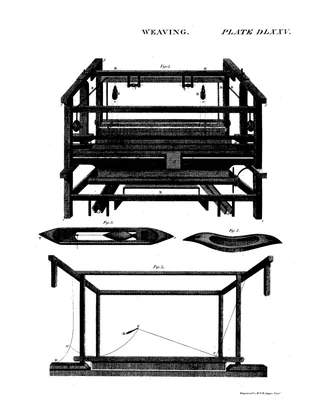
Encyclopedia article on the weaving loom from the 6th edition of the Encyclopaedia Britannica. It describes the parts of the common weaver's loom (lams or headles, treadles, batten, reed, beams), then the flying shuttle and its driver mechanism. It also gives Robert Millar's 1796 patent power loom, driven by water, steam or horses, and a numbered description of a ribbon loom. It closes with a note on a French machine for weaving ribbed stockings. Two engraved plates (DLXXV and DLXXVI) show the looms and shuttles.
Wool
Article · 3 pages
An encyclopedia article on wool from the sixth edition of the Encyclopaedia Britannica. It covers how wool differs from hair, how fleeces are sorted and graded, the regions most prized for wool, and the history of the Society for the Improvement of British Wool founded in Edinburgh in 1791 under Sir John Sinclair. It closes with a short note on early woollen manufacture in Britain and a section on Edmund Cartwright's machine for combing wool, described by figure letters.
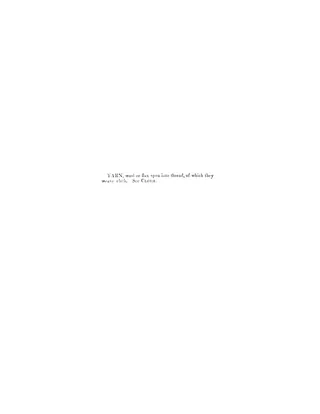
Yarn
Article · 1 page
A one-sentence encyclopedia entry defining yarn as wool or flax spun into thread for weaving cloth, with a cross-reference to the article on Cloth. It gives only a brief definition and no technical detail on spinning or materials.
9 documents found