Textile Documents › Topic: Pile weaves: velvet, plush, terry, corduroy
334 documents found
Sort: 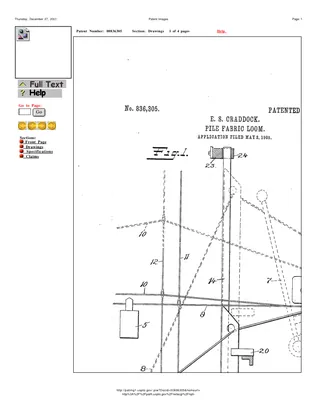
Pile Fabric Loom, US Patent No. 836305
Patent · 1 page
A single-page printout of the first drawing sheet (Fig. 1) from US Patent No. 836,305 for a pile fabric loom by E. S. Craddock. The drawing shows warp threads and loom parts marked with reference numerals. Only the drawing sheet is included, with no specification or claims text.
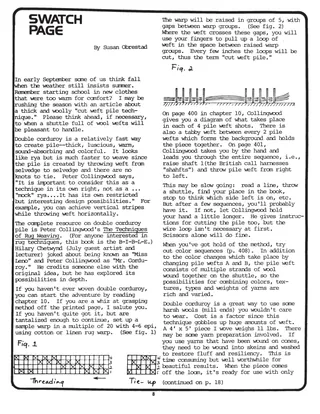
Double Corduroy
Article · 1 page · weaving drafts
A one-page article from the Swatch Page column introducing double corduroy, a cut weft pile technique for rugs that resembles rya but is woven faster because the pile is thrown selvedge to selvedge with no knots. It directs readers to Peter Collingwood's The Techniques of Rug Weaving (chapter 10) and suggests a sample warp in multiples of 20 at 4-6 epi in cotton or linen rug warp. It also covers yarn choice, color sequences, and the heavy weft consumption. Figures show a 4-shaft threading and tie-up and a diagram of raised warp groups of 5.
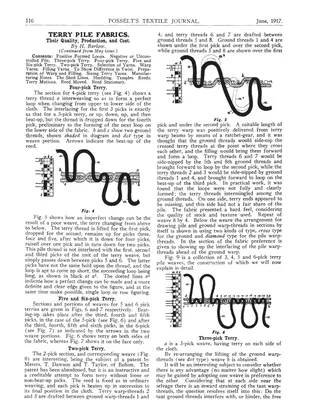
Terry Pile Fabrics
Article · 2 pages · weaving drafts
A two-page installment (continued from the May issue) of H. Barlow's serial on terry pile fabrics, covering 4-pick, 5- and 6-pick, 2-pick and 3-pick terry weaves. It explains how loops form, when the reed beats up, how ground and pile threads are drafted and bound, and compares weave arrangements for fast and loose pile. Drawn weave diagrams, sections and drafts show the structures, with notes on end uses such as towels, bath sheets, counterpanes and quilting and drapery fabrics.
Velvet
American Cyclopedia, 1883
Article · 1 page
A one-page encyclopedia article on velvet from the American Cyclopedia (1883). It defines velvet as a silk or silk-and-cotton pile fabric, outlines its origin in 13th-century Italy and spread to France and England, and describes how the pile is produced on the loom using an extra set of pile warp threads, wires, and a cutting knife. It also mentions striped and uncut velvets, the use of two shuttles, Gratrix's weft-pile method, and the main production centers (Lyons, St. Étienne, Rhenish Prussia).
Velvet
Domestic Encyclopedia, 1821
Article · 1 page
A short encyclopedia entry defining velvet as a silk fabric with a close, short, soft shag. It explains the etymology of the word and how the pile is made from warp threads raised over a channelled ruler or needle and cut with a steel tool. It names France and Italy as the best centers of velvet manufacture.
Weaving Terminology - Lifting Plan
Master Weaver, May 1954
Article · 1 page · weaving drafts
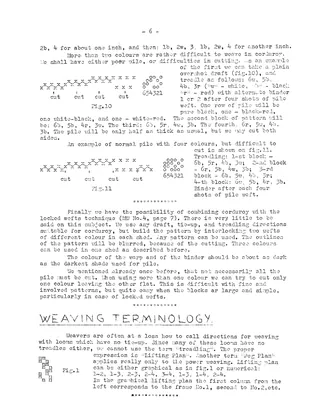
A single page from Master Weaver, No. 15 (May 1954), combining the end of a piece on corduroy (cut pile) weaving with a short note on weaving terminology. The corduroy portion gives treadling sequences for multicolor pile in white, black and red, with diagrams (Figs. 10 and 11) showing cutting problems, and mentions combining corduroy with locked wefts. The terminology note explains that "lifting plan" is the proper term for directions on looms without a tie-up or treadles, and distinguishes it from "peg plan".
Colours in Corduroy
Master Weaver, May 1954
Article · 3 pages · weaving drafts
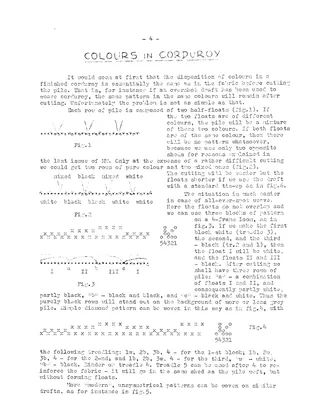
A 1954 article from Master Weaver explaining how colour patterns behave in handwoven corduroy (cut-pile weft) after the pile is cut. It covers pile floats made of two half-floats, all-over-spot drafts for blocks of black and white pile on four shafts, treadling sequences with dimensions, stripes and checks, and the difficulty of using three or four colours on overshot-style drafts. It also mentions combining corduroy with locked wefts, and ends with a short note on the terms "lifting plan" and "peg plan" for looms without tie-ups.
Corduroy
Article · 1 page
A short encyclopedia entry defining corduroy as a cotton fabric with a cut, ribbed pile like velvet. It explains that the pile weft is bound to the cloth and cut by a special knife during weaving on a plush loom, and cross-references fustian.
Corduroy
Article · 1 page
A short encyclopedia entry defining corduroy as a cotton fustian cloth made like a ribbed velvet, coarse and heavy for workmen's clothes, with finer kinds used for ladies' dresses. It discusses the word's supposed origin (the English coinage imitating a French corde du roi), notes the unrelated Somerset woollen duroy, and mentions the American use of the name for log roads.
Design for Textile Fabric
Article · 1 page
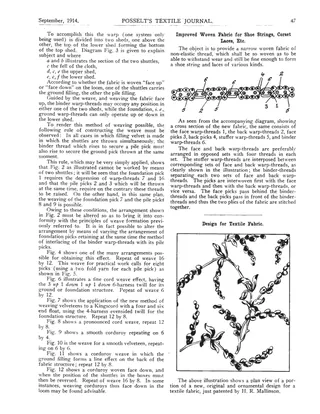
A single page from Posselt's Textile Journal continuing a technical article on weaving filling velvet, velveteen, and corduroy with two shuttles in a double-shed arrangement. It states the rule for constructing the weave and gives repeat sizes for Figs. 4-12, covering cord, Kingscord, smooth corduroy, and velveteen weaves on twill foundations. It also includes a short patent note on a narrow woven fabric for shoe strings and corset laces with face, back, stuffer, and binder warps, and a note on a floral textile design patented by H. R. Mallinson.
Free Patterns in Chenille
Master Weaver, March 1958
Article · 4 pages
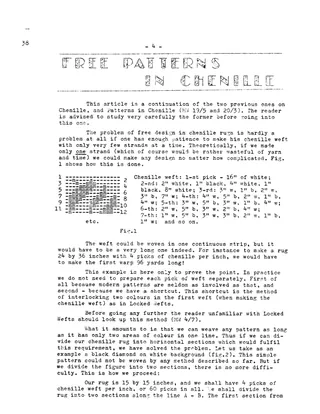
An article from Master Weaver on weaving free-design patterns in chenille rugs, continuing two earlier articles on chenille. It explains how interlocking two colours in the chenille weft (the locked-weft method) allows any design to be woven if it is divided into sections with no more than two colours in any vertical line. It works through a black diamond on white and a three-colour rug, with notes on warp width, pile length, shuttle and bobbin setup, weaving tables, the second weaving, and time per square yard.
Fustian
Article · 1 page
A short encyclopedia entry defining fustian as a cotton corded pile fabric, shorter-piled than velvet, made by leaving and cutting weft loops and then shearing, singeing and brushing. It gives the word's origin from Fustat near Cairo and explains related cloths such as moleskin, beaverteen and corduroy. It refers readers to Posselt's Technology of Textile Design for technical detail.
Fustian
Zell's Encyclopedia, 1876
Article · 1 page
A short encyclopedia entry defining fustian as a cotton cloth similar to velvet, with a pile of doubled threads thrown up in ridges over the warp and weft ground. It explains that the loops are cut and sheared to leave an evenly ribbed surface, and names related fabrics such as cotton-velvet, velveteen, moleskin and corduroy.
Loom for the Manufacture of Terry Fabrics, US Patent No. 1776759
Patent · 3 pages
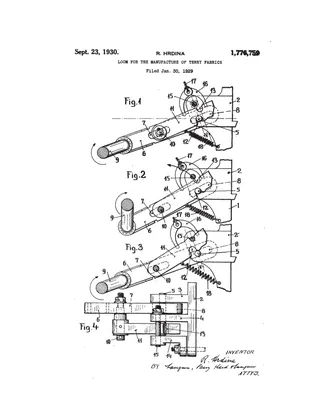
US Patent No. 1,776,759, granted 23 September 1930 to Rudolf Hrdina of Cerveny Kostelec, Czechoslovakia, for a loom for weaving terry fabrics. It describes a beat-up rod fitted with an adjustable pivoted latch that changes the rod's effective length, so the batten makes either an incomplete or a complete stroke to form terry loops. The latch is controlled by a card or jacquard machine. The text covers the background, the mechanism, how it operates, and two claims, with one drawing sheet of four figures.
The Manufacture of Turkish Toweling Fabrics
Article · 2 pages
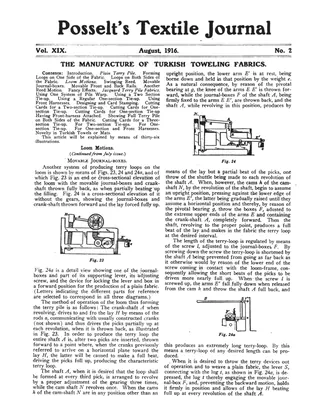
Two pages from a serialized article in Posselt's Textile Journal (August 1916) on the manufacture of Turkish toweling (terry pile) fabrics, continuing a section on loom motions. It explains three mechanical methods of forming terry loops: movable journal-boxes and crank-shaft, the Crompton & Knowles terry motion using eccentrics and a hook lever, and movable front and back rails that move the cloth. Illustrated with loom diagrams (Figs. 23-26); no weaving drafts.
Pile Fabric
Article · 2 pages · weaving drafts
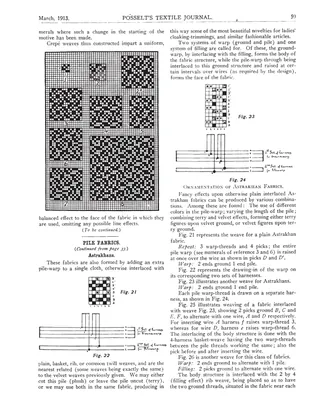
Installment of a serial article on pile fabrics from Posselt's Textile Journal, covering Astrakhan fabrics and double plush. It explains the two warp systems (ground and pile) and the use of wires to form cut or uncut pile. Weave drafts and drawing-in diagrams (Figs. 21-28) show plain Astrakhan weaves, loom attachments with cutting knives, and cross-sections of double-plush fabrics. A short note on a patent for preparing fabrics for dyeing follows.
Pile Fabric Loom, US Patent No. 840257
Patent · 12 pages
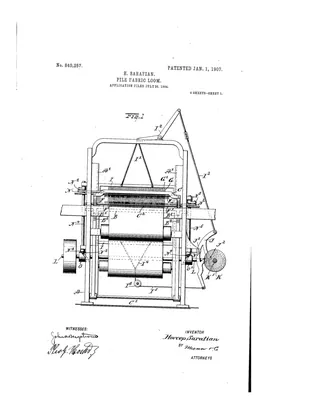
US Patent No. 840,257, granted Jan. 1, 1907 to Hovcep Sarafian of Yonkers, New York, for a pile-fabric loom. The loom weaves a fabric with a pile warp looped around a lower ground warp and raised between two ground warps to form face loops over pile wires. Shogging combs shift the ground warps sideways, heddles move them up and down, and a vertically moving needle carries the pile warp. The document has five sheets of drawings (Figs. 1-17), a specification describing the operating cycle step by step, and 27 claims.
Pile Weaves 1 - Corduroy
Master Weaver, March 1954
Article · 5 pages · weaving drafts
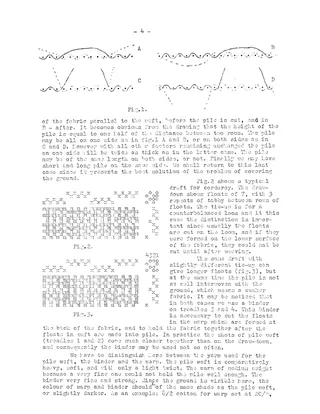
An instructional article, the first in a series on pile weaves, explaining how to weave weft-pile corduroy on a handloom. It covers the properties and uses of corduroy, how floats are formed and cut into pile, and the yarns for pile, binder and warp. Drafts and tie-ups show pile on one or both sides, long and short pile, and variations on overshot-type threadings. It also gives advice on tie-ups for counterbalanced and rising-shed looms and on cutting the floats with scissors. It ends with a bedspread project.
Plush
Article · 1 page
A short encyclopedia entry defining plush as a textile with a cut nap or pile, like fustian or velvet. It notes that the pile was originally mohair or worsted yarn and later silk, alone or on a cotton backing, and that plush differs from velvet in its longer, less dense pile. It also lists uses in upholstery, furniture, dress and millinery.
Plush
Article · 1 page
A very short encyclopedia entry defining plush as a fabric with a velvet-like nap or shag on one side. It describes the usual construction: a single woolen weft thread with a double warp, one of twisted wool and the other of goat or camel hair. It also notes that some plushes are made wholly of worsted or wholly of hair.
Plush
Article · 1 page
A short encyclopedia entry defining plush as a woven cloth with a long, shaggy pile that, unlike velvet, is not clipped to a uniform length. It describes the older construction with a double warp of worsted and goat's hair and a worsted filling, and the later use of silk and cotton, including tussah silk. It refers readers to the article on weaving.
Plush
Rees's Cyclopedia, 1819
Article · 1 page
A short encyclopedia entry on plush from Rees's Cyclopaedia. It describes plush as a fabric with a velvet-like nap, made with a wool weft and a double warp of wool and goats' or camels' hair. It explains weaving on a three-treadle loom and cutting the pile over a brass broach with a knife. It also notes disputed origins in England or Holland and the French centers of manufacture at Amiens, Abbeville and Compiègne, plus all-silk varieties.
Practical Weaving Suggestions, Vol. 3 (1965)
Periodical · 6 pages · weaving drafts
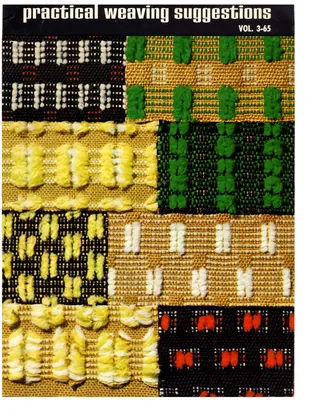
A six-page leaflet from Lily Mills Company's Practical Weaving Suggestions series (Vol. 3, 1965) on corduroy, a weft pile weave made by cutting overshot pattern floats separated by tabby areas. Frances A. Morgan explains how to cut floats on or off the loom, how sett and float length affect pile, and lists possible uses. It gives a 4-shaft, 26-thread threading and tie-up with counterbalance and jack loom treadlings, followed by eight sample recipes with Lily yarns, colors, sett (18 ends per inch, 9-dent reed double sleyed) and treadling sequences. The cover shows a collage of the samples.
Swatch Page - Weaving Velvets
Article · 2 pages
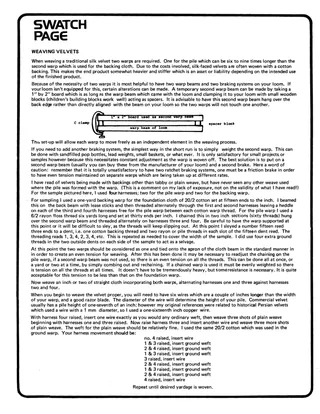
A two-page Swatch Page column by Lotus Stack on weaving warp-pile velvet on a four-harness loom. It explains the two-warp setup, including improvising a second warp beam and brake, and gives the sampling details: 20/2 cotton ground, 6/2 rayon floss pile, a 15-dent reed, the threading, wire insertion and treadling sequence, and cutting the pile. It also describes 'W' and 'U' velvet constructions, with notes on grooved wires and on historical velvets Stack examined.
Terry Pile Fabrics
Article · 2 pages · weaving drafts
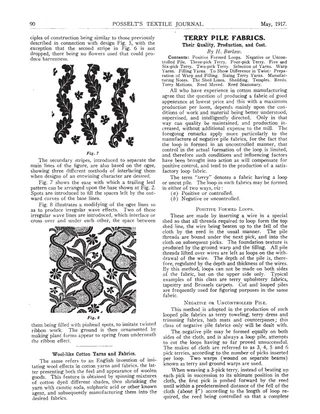
Two pages from Posselt's Textile Journal, May 1917, opening H. Barlow's serial article on terry pile fabrics. It distinguishes positive (wire-formed) loops from negative (uncontrolled) pile and explains how 3-pick terry is woven, with weave plans and interlacing diagrams for the terry and ground warps. The page also carries the end of a piece on ogee-based textile design (Figs. 7 and 8) and a short note on wool-like cotton yarns. The article is continued in a later issue.
Velvet
Article · 1 page
A very short encyclopedia entry defining velvet as an all-silk fabric with a close, short, soft shag on the face and a strong close tissue on the back. It names the main centers of manufacture: France, Italy (Venice, Milan, Florence, Genoa, Lucca) and Holland, where French refugees established the industry at Haarlem. It judges French velvets superior to the others.
Velvet
Article · 1 page
A short encyclopedia entry defining velvet as an all-silk fabric with a short, soft pile on one face and a strong close tissue on the other. It explains that the pile is formed from part of the warp threads, raised over a channelled needle and cut with a sharp steel tool. It lists the main centers of manufacture (France, Italy, Holland) and compares quality and price, noting that Chinese velvets are the poorest.
Velvet
Zell's Encyclopedia, 1876
Article · 1 page
A short encyclopedia entry defining velvet as a cloth with a supplementary weft of short thread pieces brought to the surface in loops, which are then cut to form a short pile. It distinguishes the two kinds, plain-backed and twilled (Genoa) back, and notes that silk gives velvet while cotton gives velveteen, a type of fustian used for men's clothing.
Velveteen
Article · 1 page
A short encyclopedia entry defining velveteen as a cotton cloth made in imitation of velvet, sometimes applied to silk and cotton mixtures. It notes that some velveteens are a type of fustian with ribs of velvet pile alternating with plain depressions. It also mentions that the trade follows fashion in velvet and that velveteens are woven in sheeting looms.
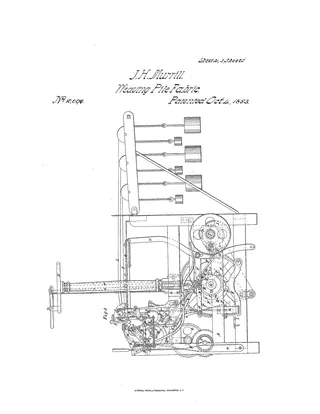
Weaving Pile Fabric, US Patent No. 10096
Patent · 6 pages
US Patent No. 10,096 granted to James H. Murrill of Richmond, Virginia, for a loom for weaving coach-lace and other pile fabrics. The specification describes a mechanism of revolving pliers that withdraw the needles carrying the figured pile from the finished fabric and reinsert them under the jacquard-selected warp. It also covers a stationary shuttle box with a stop motion for shuttle misthrows, a needle guard, and springs relieving strain on the harness eyes. Three sheets of drawings (Figs. 1-6) and five claims are included.
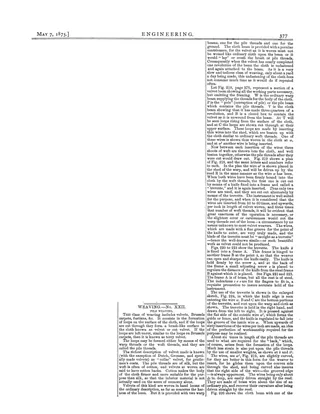
Weaving. -- No. XXII: Pile Weaving
Article · 2 pages
Two-page installment (No. XXII) of Alfred Barlow's series on weaving in Engineering, covering pile weaving: velvets, terry velvet, Brussels and tapestry carpets. It explains the velvet loom with separate ground and pile beams, the insertion of grooved wires, and the cutting of loops with the trevette knife. It then describes the cloth beam with needle-point laths, the headle motions, and the construction of tapestry carpet (printed pile threads) and Brussels carpet (Jacquard-selected pile colours), with brief mention of Axminster and Wilton. Illustrated with numbered engineering figures (Figs. 218-231).
Weaving. -- No. XXIII: Pile Weaving (continued)
Article · 2 pages
A two-page installment (No. XXIII) of Alfred Barlow's 'Weaving' series in Engineering, continuing the discussion of pile weaving in power looms. It describes early velvet-weaving methods using wires, including Thompson's 1842 velvet ribbon loom, Collier's multiple-wire plan and Weild's 1855 grooved-cylinder wire inserter. It also covers knife-edged wires for cut pile, double (face-to-face) velvet and plush weaving with cutting knives, and the start of a discussion of chenille weft. Illustrated with small engineering diagrams of wires, cloth sections and mechanisms.
Boutonné Rugs: A Tufted Technique
Monograph · 4 pages · weaving drafts
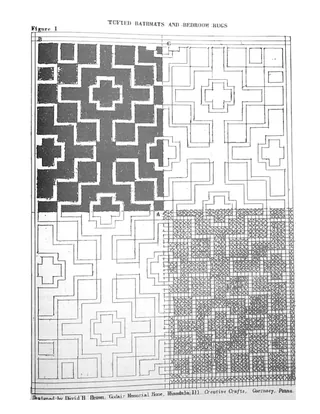
A short instruction leaflet by Osma Gallinger Tod on making tufted (boutonné) rugs and bath mats with a plain-weave tabby ground and raised loop tufts. It covers designing on check paper, materials and warp settings (8/4 carpet warp, wool or cotton rug yarn), and weaving the loop rows with a pick-up stick on a 2- or 4-harness loom or a simple frame. Step-by-step directions explain the two sheds, the tabby sequence between loop rows, and finishing with fringe or hem. Diagrams show rug designs, check-paper grids and a warp/shed diagram.
Chenille or Twice Woven Fabric
Master Weaver, January 1955
Article · 6 pages
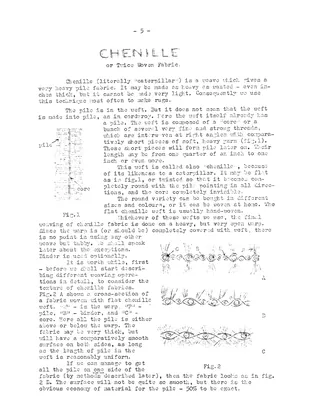
An instructional article from the Master Weaver series on weaving chenille rugs by the two-stage method. It explains the structure of flat and round chenille weft, how to plan, thread, sley and weave the first warp that produces the weft, and how to cut and store the strands. It then covers weaving the rug itself with the chenille weft, including combing the pile, the use of binder, and colour effects (mottled, striped, vertical stripes). A short excerpt on chenille from C.G. Gilroy (1844) closes the piece.
Eine neue Jacquardmaschine zum Weben von Jacquard-Doppelmoquette auf Doppelschlägerstühlen [A New Jacquard Machine for Weaving Jacquard Double Moquette on Double-Shuttle Looms]
Article · 2 pages · German · weaving drafts
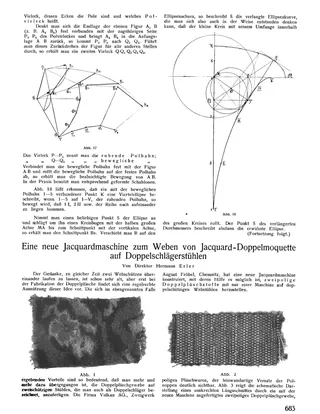
Part of a 1927 article by Hermann Erler describing a new Jacquard machine from Vulkan AG (August Fröbel branch, Chemnitz) for weaving two-pole double-faced moquette (double plush) on double-shuttle looms. The text explains how the machine allows two-colour-pole double plush to be made with a single Jacquard, and describes the warp and weft arrangement: ground threads, pole threads, their colour sequence and reversal between warp courses, and upper and lower wefts. The pages also include the end of an unrelated mechanical discussion of pole paths (Polbahn) and a weave diagram of warp and weft paths. The article continues in a later issue.
Improvements in Fabric Structures: Chenille Fabrics
Article · 1 page
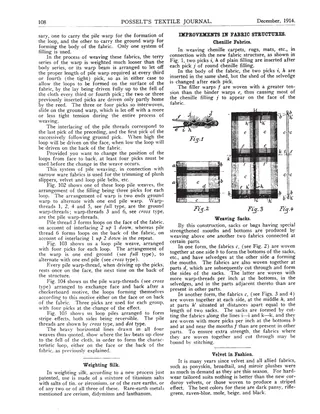
A single page from Posselt's Textile Journal covering loop pile weaves for narrow ware, with explanations of Figs. 102-105 (ground and pile warp ratios, three- and four-pick loop formation, checkerboard and stripe effects). It also has short items on chenille fabric structure (plain picks inserted after round chenille filling), weaving sacks as two connected fabrics, weighting silk with titanium salts, and velvet fashion colors.
Information Service - Patterns in Chenille
Master Weaver, March 1953
Article · 1 page
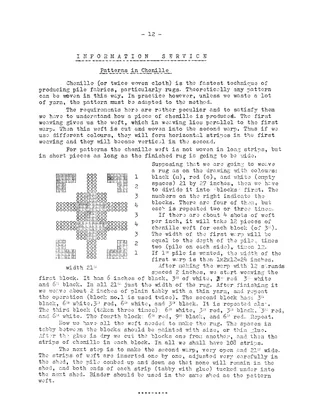
A short instructional article from the Master Weaver Information Service explaining how to plan and weave patterned chenille (twice-woven) rugs. It works through an example of a 21 by 27 inch rug in black, red and white, divided into four numbered blocks, and gives the calculations for first warp width, chenille weft pieces, and gluing, cutting and inserting the strips into a second, open warp. A block-pattern drawing of the cross-like motif accompanies the text.
Man-Made Fur
The Melliand, October 1931
Article · 1 page
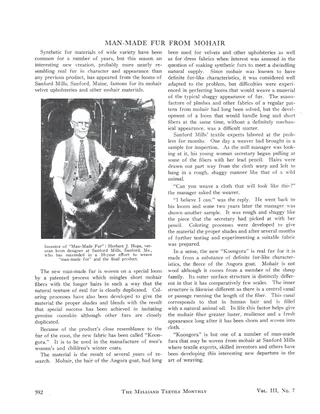
A short trade-journal article describing "Koongora," a man-made fur woven from mohair at Sanford Mills in Sanford, Maine. It credits loom designer Herbert J. Hope with a roughly 10-year effort to develop a special loom and patented process that mingles short and long mohair fibers to imitate coonskin and other furs. It recounts the anecdote of the mill secretary pulling out fibers, and explains how mohair (Angora goat fleece) differs from wool.
The Manufacture of Narrow Wares
Article · 3 pages · weaving drafts
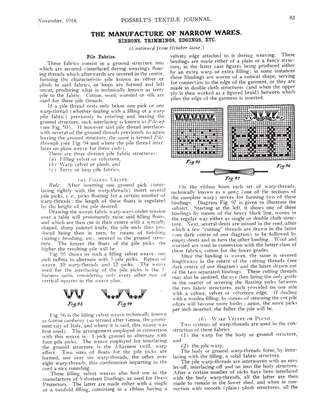
An installment of Posselt's series on narrow wares (ribbons, trimmings, edgings) covering pile fabrics: filling velvet and velveteen, Genoa corduroy, velveteen bindings for dress protectors, warp velvet and plush, double plush, and terry/loop pile. It explains pile-up and pile-through interlacing, pile wires and cutting methods, and walks through weave plans Figs. 93-100 with warp and filling arrangements. The scan also includes a short article on dyeing Solidonia bast fibre and a worsted trousering fabric specification with a weave draft.
The Manufacture of Turkish Textile Toweling Fabrics
Article · 3 pages · weaving drafts
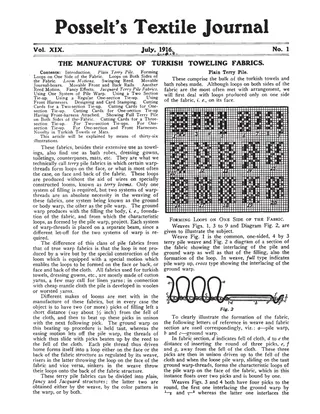
First installment of a serial article by E. A. Posselt on making Turkish (terry pile) toweling, from Posselt's Textile Journal, July 1916. It explains the two-warp construction (ground and pile), how loops form on one or both faces of the cloth, and gives numbered weave diagrams (Figs. 1-20) with loop formations, warp arrangements, reeding, and standard fabric textures and take-up figures. It begins the section on loom motions, describing the swinging reed mechanism (Figs. 21-22). The scan also includes the start of a separate article on calendering in the finishing of cotton goods.
Patterns in Chenille
Master Weaver, March 1955
Article · 4 pages · weaving drafts
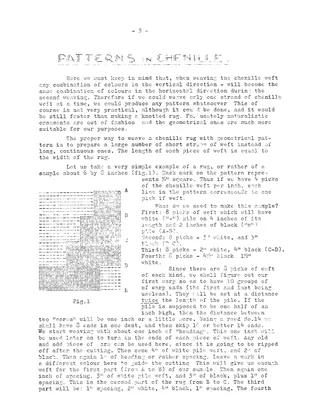
Article from Master Weaver (a continuation of a series on chenille) explaining how to plan and weave pattern rugs with chenille weft made in a first weaving and cut into short pieces. It covers calculating pick lengths and warp groups for block patterns, inserting the pile weft with a notched stick, binder shots, tucking in the core ends, and weaving diagonals by shifting picks. It also mentions the Locked Wefts technique for chenille rugs. A short quotation on the antiquity of weaving from Alexander Peddie's The Linen Manufacturer (1822) closes the piece.
Patterns in Velvet Rugs
Master Weaver, September 1957
Article · 3 pages · weaving drafts
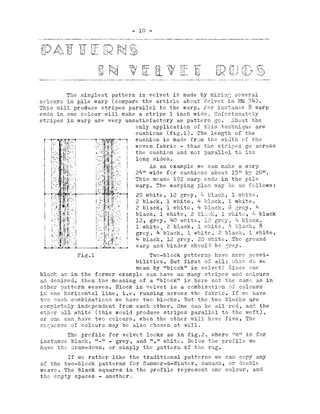
A short article on creating patterns in woven velvet (cut-pile) rugs on a four-shaft loom. It explains warp-stripe patterning for cushions and two-block patterning using separate pile warps, with profile drafts, calculations of warp lengths, and threading and tie-up. It ends with a practical project for a 40 by 64 inch wool pile rug, including warp colour sequences and weaving order.
Personal Thoughts on Natural Dyeing
Article · 2 pages
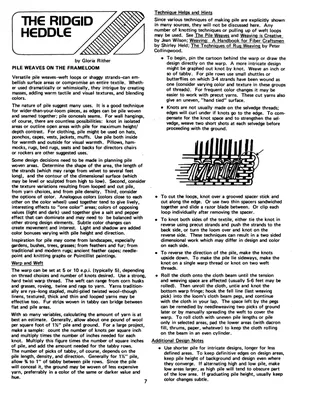
Two pages from the Minnesota Weaver (November 1976), containing Gloria Rither's "The Ridgid Heddle" column on pile weaves on the frame loom, followed by Weavers' Guild "School News". The column covers design planning, warp and weft choices, yarn estimates, and techniques for cutting loops, knotting both sides, reversing pile direction, and rolling cloth with pile. The school news lists November classes, an open house exhibit, and the January interim program. Nothing in the text matches the catalogued title, Connie Magoffin's article on natural dyeing.
Pile Fabrics Produced by an Extra Warp
Article · 4 pages · weaving drafts
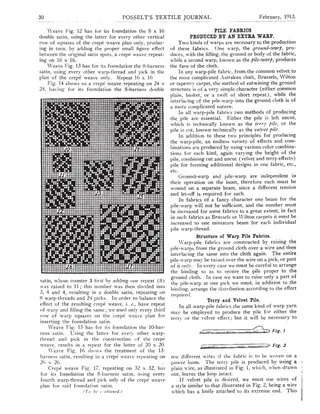
Instalment of a Posselt's Textile Journal series on warp-pile fabrics made with an extra (pile) warp. It explains ground warp versus pile warp, terry (uncut) versus velvet (cut) pile, the wires and trevette knife used on hand looms, and how loops are formed. It then gives weave plans and fabric sections for common velvet weaves, including two-pick and three-pick velvets and a 6-harness twill ground, with repeats, warp and filling ratios, and pick-by-pick lifting instructions. The first page also carries the end of a preceding article on crepe weaves built on satin foundations (Figs. 12-17).
Piled-fabric Loom
Article · 1 page
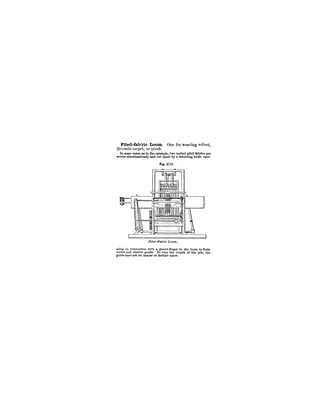
A short dictionary entry from Knight's American Mechanical Dictionary describing a piled-fabric loom used for weaving velvet, Brussels carpet, or plush. It explains that two joined piled fabrics are woven at once and cut apart by a revolving knife working with a guard-finger, and that pile length is changed by adjusting the spacing of the guide-bars. A side-elevation line drawing (Fig. 3716) shows the knife and guide-bar mechanism, heddles, cam and gear drive, and cloth take-up.
Ribbons, trimmings, edgings, etc.
Article · 2 pages · weaving drafts
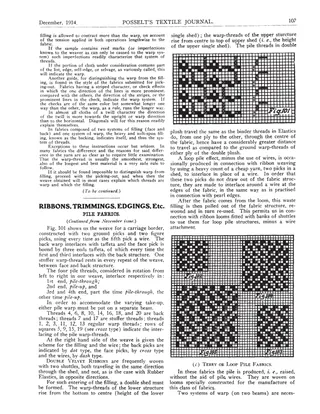
Two pages from Posselt's Textile Journal continuing a series on ribbons, trimmings and edgings, covering pile fabrics. It describes a carriage-border pile weave with wires (Fig. 101) and terry or loop pile weaves woven without wires (Figs. 102-105), with warp and filling arrangements. Short items follow on weighting silk with titanium salts, chenille and sack weaving structures, and velvet in fashion. The first page also ends an article on telling warp from filling when picking out a fabric.
Silk Velvet Textile and Method of Manufacturing the Same, US Patent No. 5598615
Patent · 12 pages
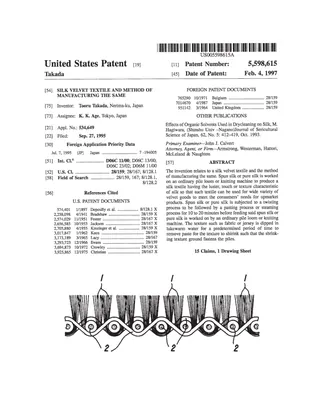
US Patent 5,598,615 (granted Feb. 4, 1997) to Tooru Takada, assigned to K. K. Age of Tokyo, for a silk velvet fabric or jersey and its manufacture. Spun or pure silk is twisted, pasted or steamed, then worked on a pile loom or pile knitting machine. The piece is dipped in lukewarm water to remove the paste, which makes the ground shrink and lock the cut piles in place. The document gives claims, yarn counts, twist levels, shrinkage figures and one cross-section drawing. It contains a USPTO database printout followed by the patent's printed pages.
Suggestions for the Bathroom Accessories
Article · 2 pages
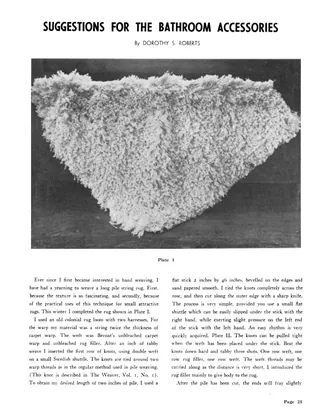
Short article by Dorothy S. Roberts describing how she wove a long pile string rug for the bathroom on a two-harness colonial loom, tying knots around two warp threads and cutting the pile over a flat stick. It also shows guest towels woven in Spanish lace weave on a fine linen warp, each with a different border design. Material, sizes and sett details are given for the rug and towels, illustrated with photographic plates.
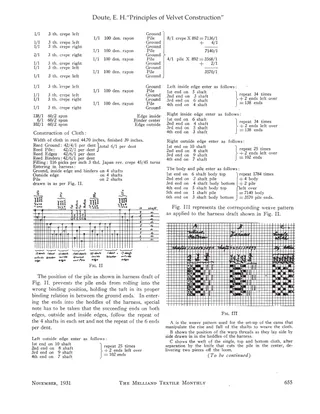
Technology of Velvet Construction
Article · 2 pages · weaving drafts
Part one of an article on the construction of transparent chiffon velvet woven as double cloth, in which a knife cuts the pile threads between the top and bottom cloths. It gives the full warping disposition (Japan crepe ground, viscose rayon pile, spun silk edges and binders), reed and filling specifications, and shaft-by-shaft entering instructions for edges, body and pile. Fig. I shows the cutting principle, Fig. II the harness draft and Fig. III the weave pattern for cam set-up. The article ends with "To be continued".
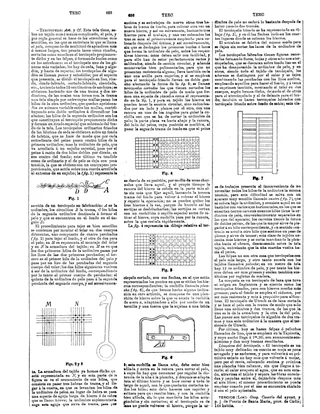
Terciopelo [Velvet]
Article · 1 page · Spanish · weaving drafts
A Spanish encyclopedia entry on velvet (terciopelo) describing the cloth as a ground weave with a pile warp, and how it is made on the loom. It covers the two-warp setup with separate heddle sets for ground and pile, the use of pile wires (hierros) to form loops, and the cutting of the pile with a grooved wire and knife. It also treats variants such as frisé, cut and figured velvet, astrakhan, plush, moquette, Utrecht velvet and cotton panne, the tensioning frame (cantre), and how to restore crushed velvet. Figures show a velvet cross-section, loom threading, wire and knife details.
334 documents found