Textile Documents › Publications › Publication: Diccionario Enciclopédico Hispano-Americano
7 documents found
Sort: 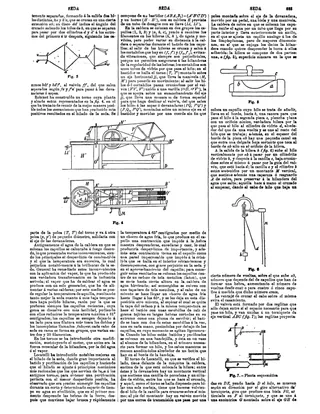
Seda [Silk]
Article · 8 pages · Spanish
Eight-page encyclopedia entry on silk ("Seda") in Spanish. It covers the structure of the silkworm cocoon and its thread, the killing and classification of cocoons, and silk reeling machinery (including Robinet's reeling machine), with figures. It then treats throwing and twisting of raw silk (pelo, trama, organzin; circular and oval throwing mills), stain removal and cleaning of silk fabrics and ribbons, and chemical tests distinguishing silk from wool and cotton.
Tapicería [Tapestry]
Article · 10 pages · Spanish
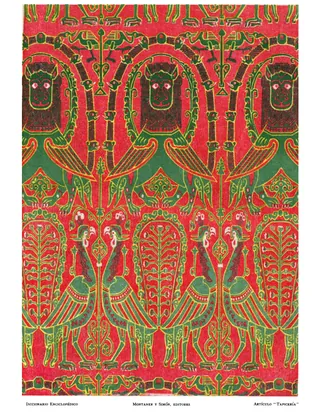
Encyclopedia article "Tapicería" from a Spanish-language illustrated dictionary (Montaner y Simón). It traces the history of tapestry weaving from ancient Egypt, Babylon, Rome, Persia and the Islamic world through the medieval and Renaissance workshops of Arras, Brussels and the Gobelins, and the Spanish royal factories of Santa Bárbara and Santa Isabel. It discusses guild regulations, cartoons, marks and the tapestry collections of the Spanish royal house, including Raphael's Acts of the Apostles. The final section turns to the upholsterer (tapicero adornista), covering tools and upholstery techniques, with line drawings of tacking and pleating. Illustrations include the Bayeux Tapestry and a panel from The Conquest of Tunis.
Tejido [Weaving]
Article · 5 pages · Spanish · weaving drafts
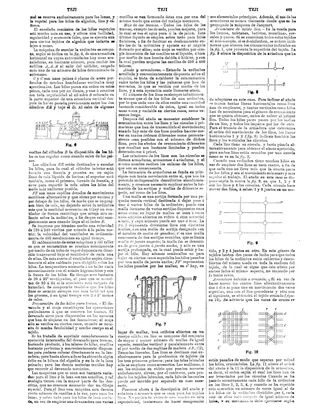
A five-page Spanish encyclopedia article on weaving (tejido) covering the principles and mechanical processes of cloth production. It explains warp and weft interlacement, the loom with two heddles and treadles, bobbin winding, warping by hand and machine, warp sizing, weft preparation, and drafting and tie-up of heddles. It then describes the basic weave structures (plain, twill, satin), pile fabrics such as velvet and corduroy, gauze, and figured weaving with the Jacquard system. Numbered engraved figures and diagrams illustrate machines and weave drafts.
Telar [Loom]
Diccionario Enciclopédico Hispano-Americano, c. 1887-1910
Article · 3 pages · Spanish
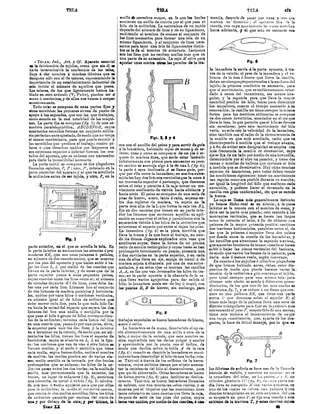
A three-page Spanish encyclopedia article on the loom (telar), describing the fixed frame and moving parts of the hand loom: beams, treadles, heddles, reed, batten and shuttles. It explains how to dress the loom (drawing in the warp, sleying the reed, tying up the heddles) and how the weaver works the shed. It then covers multiple-cylinder hand looms, power looms and their protective devices, carpet, ribbon and velvet weaving, Jacquard looms, and some 19th-century inventions. Figures show a loom frame, heddle loops, shuttle-box section, shuttles, and tension brake mechanisms.
Terciopelo [Velvet]
Article · 1 page · Spanish · weaving drafts
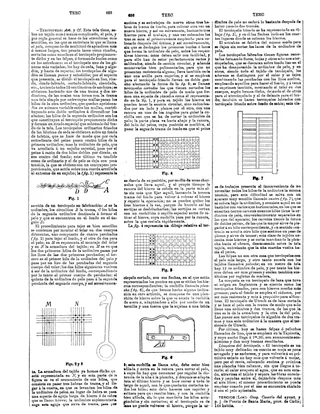
A Spanish encyclopedia entry on velvet (terciopelo) describing the cloth as a ground weave with a pile warp, and how it is made on the loom. It covers the two-warp setup with separate heddle sets for ground and pile, the use of pile wires (hierros) to form loops, and the cutting of the pile with a grooved wire and knife. It also treats variants such as frisé, cut and figured velvet, astrakhan, plush, moquette, Utrecht velvet and cotton panne, the tensioning frame (cantre), and how to restore crushed velvet. Figures show a velvet cross-section, loom threading, wire and knife details.
Tinte [Dyeing]
Article · 10 pages · Spanish
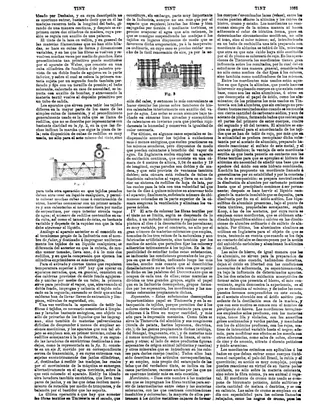
Encyclopedia article on dyeing (tinte) from a Spanish-language encyclopedic dictionary. It opens with the history of dyeing from antiquity (Tyrian purple, indigo, wax-resist methods of India), then covers the chemistry of fixing dyes on vegetable and animal fibres, mordants (alum, tin and chromium salts), and the dyeing apparatus (padding machines, roller vats, Weber apparatus, washing machines). The later pages give practical recipes by colour, including madder reds on wool and silk, indigo blues, blacks, browns and garment dyeing.
Trenza [Braid]
Article · 1 page · Spanish
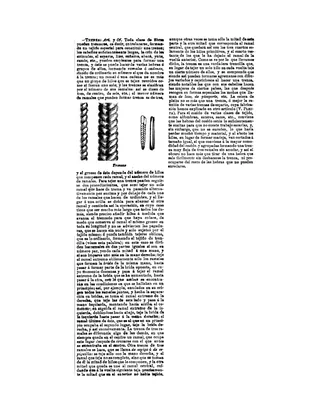
A Spanish encyclopedia entry on the braid (trenza), explaining how fibers such as hair, horsehair, esparto, flax, hemp, abaca, jute and ramie are interlaced in groups of strands (ramales). It classifies braids by number of strands, with three as the minimum, and describes two methods of braiding: a single weft strand woven through warp strands, or the usual oblique plaiting. It also covers the three-strand 'espiga' braid, braided hairstyles, esparto mats made of braids, and loose braids used to hold sewing threads. One page of illustrations shows braided cords.
7 documents found