Textile Documents › Topic: Natural dyes
347 documents found
Sort: 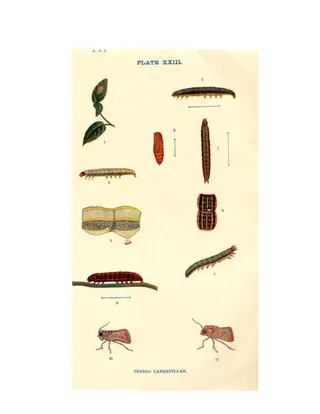
Caterpillar Pest of Indigo in Behar
Article · 14 pages
A 1906 entomological article by H. M. Lefroy, Imperial Entomologist at Pusa, on the caterpillar (Caradrina exigua) that destroys newly sown indigo in Behar. It covers the life history, damage at Surat and Pusa, the effect of east and west winds, identification, distribution and natural enemies. Remedies discussed are sowing Java-Natal indigo, using irrigated lucerne as a trap crop surrounded by a trench, and spraying. A colored plate of the insect's stages and a trench cross-section diagram are included.
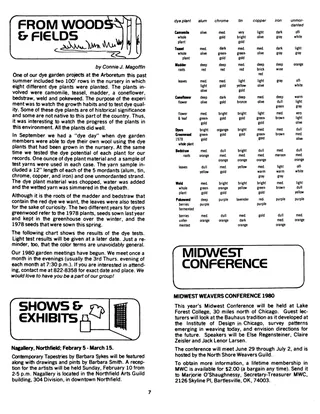
Dye chart
Article · 1 page
A single page from Minnesota Weaver (February 1980) in which Connie J. Magoffin reports on a dye garden project at the Arboretum. Eight dye plants were grown in the nursery and tested with five mordants and an unmordanted sample. A chart lists the resulting colors for camomile, teasel, madder, coneflower, dyers greenwood, bedstraw, weld and pokeweed. The page also carries a notice for the 1980 Midwest Weavers Conference at Lake Forest College and a short gallery exhibit listing.
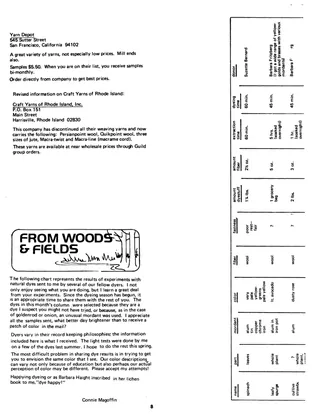
Dye Experiments
Article · 2 pages
A column from the Minnesota Weaver in which Connie Magoffin shares natural dye experiment results sent in by fellow dyers. A chart records dye plant, part used, mordant, resulting color, fiber, fastness, amounts, extraction and dyeing times, and donor for dyes such as spinach, leafy spurge, strawberry, tea, coffee, cranberries, goldenrod, purple iris, onion skin, pine and rhubarb. The first page also carries short notes on yarn suppliers, including the Yarn Depot in San Francisco and revised product information for Craft Yarns of Rhode Island.
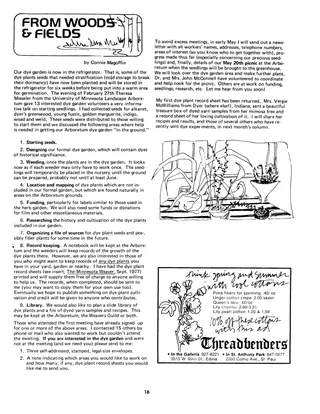
Dye Garden
Article · 1 page
A column from The Minnesota Weaver reporting on a volunteer dye garden being established at the University of Minnesota Landscape Arboretum. It describes starting dye plant seeds that need cold stratification, a talk on seedlings, and nine areas where volunteers are needed, including seed starting, garden design, weeding, mapping wild dye plants, funding, research, record keeping and a slide and yarn sample library. It also announces a May picnic and mentions a reader's dye results from a mimosa tree. The page includes an advertisement for Threadbenders.
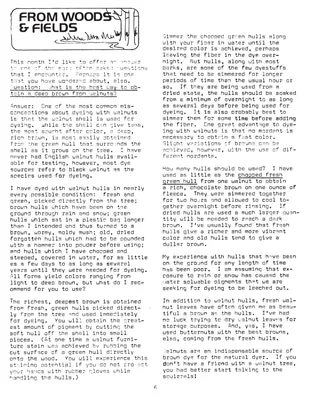
Dyeing with walnuts
Article · 1 page
A one-page column from the Minnesota Weaver's "From Woods & Fields" series answering how to get a deep brown from walnuts. The author explains that the green hull, not the shell, is the best dye source, and compares fresh, dried, and ground-weathered hulls. She gives advice on chopping, soaking, and simmering times, notes that no mordant is needed, and mentions walnut leaves and butternuts as alternative sources.
Extract of a Memoir on the Cultivation of the Indigo-Plant, and the Preparation of Indigo
Article · 5 pages
An 1802 extract of a memoir by Citizen Brulley, read at the Lyceum of Arts, on growing the indigo plant and making indigo. It describes the species of indigo plant and the French colonial practice of mixing indigo-franc and wild indigo seed. It then gives the vat process for extracting the dye: maceration, the test for when it is complete, beating in a second vat, and draining and drying the paste. It credits a St. Domingo planter, Nazon, with a method meant to prevent failed vats.
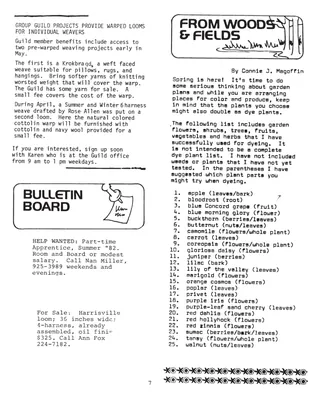
Garden Dye Plants
Article · 1 page
A one-page column from the Minnesota Weaver, "From Woods & Fields" by Connie J. Magoffin, listing 25 garden and woodland plants she has successfully used for natural dyeing, with suggested plant parts to use for each (such as leaves, bark, flowers or berries). The list is not exhaustive and omits weeds and untested plants. The page also carries guild news about pre-warped group projects (a krokbragd and a Summer and Winter project) and bulletin board notices.
Improvement in the Mode of Extracting Color from Dye-Woods, US Patent No. 951
Patent · 1 page
US patent specification by Laurens Kent of Dorset, Vermont, for extracting color from dye-woods by steam or distillation instead of ordinary boiling. It describes an upright tub holding 400 to 500 pounds of ground wood with a strainer near the bottom and a steam pipe entering through the head. The liquor is drawn off and returned to the boiler, leaving the coloring matter as a gum or powder, and alcohol with a condensing worm is used for woods whose color water cannot extract fully. The single claim covers the steam and distillation process for producing dye extracts for dyeing and staining.
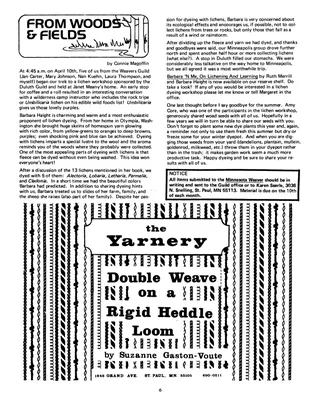
Lichen Workshop
Article · 1 page
A short column from the Minnesota Weavers Guild newsletter reporting on a lichen dyeing workshop held in Duluth, led by Barbara Haight of Olympia, Washington. It describes the lichens used (Alectoria, Lobaria, Letharia, Parmelia, Cladonia), the colors obtained, dyeing fleece without washing, and concerns about ecologically responsible collecting. It closes with notes on a library book, woad seeds, and encouragement to use garden plants and weeds in the dyepot.
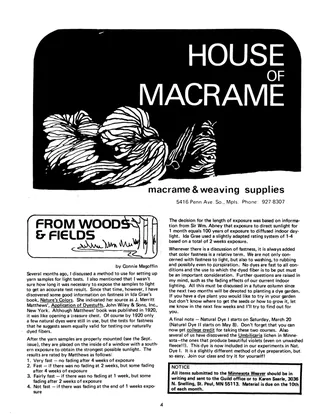
Light Testing
Article · 1 page
A one-page column from the 'From Woods & Fields' series in the Minnesota Weaver on testing natural-dyed yarn for lightfastness. Connie Magoffin reports on a rating system from J. Merritt Matthews' 'Application of Dyestuffs' (1920), as cited in Ida Grae's 'Nature's Colors'. Samples are exposed in a south-facing window and rated from very fast to not fast over one to four weeks. She also notes that fastness covers washing, rubbing and perspiration as well as light, and announces natural dye classes and the use of Umbilicaria lichen for violet dyes.
Notice le Pastel (Isatis tinctorum) [Notes on Pastel (Isatis tinctorum)]
Web Doc · 9 pages · French
A French-language notice on woad (Isatis tinctoria) by Jean-Pierre-Casimir Marcassus, Baron de Puymaurin, extracted from his 1811 "Instructions pratiques" and republished online by Philippe Demoule of the CVMT. It covers choice of soil, sowing, weeding, harvesting and the making of woad paste (coques) with its long fermentation before it reaches the dyer's vat. It also describes the Corfu peasant method of dyeing wool with fermented woad, and experiments and processes for extracting indigo from woad (Astruc, Dambourney, Gréene) and from anil in Java and Malta.
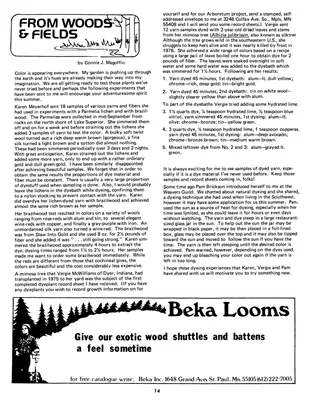
Parmelia (lichen), Brazilwood, Mimosa, solar dyeing
Article · 1 page
A one-page natural dyeing column from the Minnesota Weaver in which Connie Magoffin reports on readers' dye experiments. It covers Karen Meyerhof's tests with Parmelia lichen and brazilwood on wool, silk and cotton, and Vergie McWilliams's mimosa (Albizia julibrissin) dyebaths with alum, chrome, tin and other additions, listing the colors obtained. It also describes Pam Brickson's solar dyeing method using a large glass jar left in the sun.
Sampling new plants
Article · 2 pages
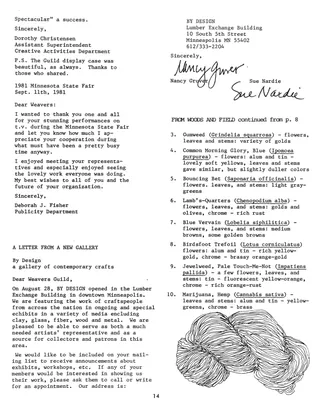
A column from the Minnesota Weaver in which Connie J. Magoffin describes her method for sampling unfamiliar dye plants: chopped plant material simmered with six wool strands mordanted with alum, tin, copper, chrome, iron, or left unmordanted, then recorded on index cards for light testing. She then lists ten plants she tried for the first time, such as Queen Anne's Lace, Gumweed, Jewelweed and Birdsfoot Trefoil, with general color results for each. The second page continues the list and carries unrelated guild letters, including thanks for the Minnesota State Fair demonstrations and a note from a new Minneapolis crafts gallery.
Botany: List of Dying Plants
Article · 2 pages
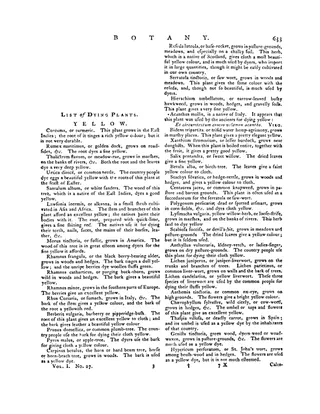
Two pages from the article on Botany in the first edition of the Encyclopedia Britannica, listing plants used in dyeing, arranged by color (yellow, red, purple, blue, violet, green, black). Each entry gives the Latin name, common English name, habitat, the plant part used, and the color obtained. The section closes with a short remark on the usefulness of botany to food, medicine, agriculture and the arts.
Carmine
Article · 1 page
A short encyclopedia entry defining carmine as a bright red pigment made from cochineal. It describes how it is prepared by boiling cochineal and precipitating the color with alum, cream of tartar, stannous chloride or potassium oxalate, and how light and alumina content affect its quality. It also covers adulterants, a test for purity, its chemical makeup, and its uses in artificial flowers, water-colors, cosmetics, ink and miniature painting. The text begins with the tail of the preceding entry, which mentions carmine lake.
Carmine
Article · 1 page
A short encyclopedia entry defining carmine as a beautiful purplish-red powder used by miniature painters, though rarely because of its price. It describes the main method of extracting it from cochineal with water infused with chouan and antour, and notes variants using rocou or brazil-wood, fernambouc and leaf-gold steeped in white-wine vinegar.
Carmine
Article · 1 page
A short encyclopedia entry on carmine, a red pigment made from cochineal. It covers the word's etymology, its uses in inks, silk dyeing, artificial flowers and painting, and its reported accidental discovery by a Franciscan monk at Pisa. It gives two preparation methods, describes carminic acid, and notes carmine lake and its replacement by coal-tar colors.
Coccidae
Article · 1 page
A one-page encyclopedia entry on the Coccidae, the family of scale insects, mealy bugs and bark lice. It covers their biology and the coverings they secrete, and notes the products derived from them: lac or shellac, the red dye lake, cochineal, other dyes, and waxes. It cites Newstead's monograph and a U.S. Department of Agriculture bulletin, and cross-references Lac Insect and Scale Insect.
Cochineal
Article · 1 page
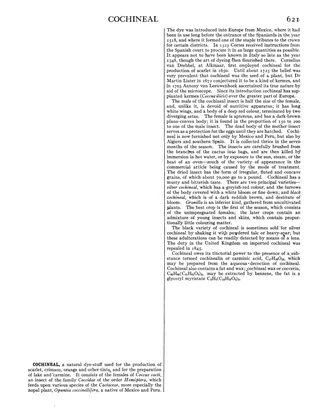
A one-page encyclopedia article on cochineal, the red dye obtained from the female Coccus cacti insect that feeds on nopal cactus. It covers the dye's introduction to Europe from Mexico, its early use in scarlet dyeing, the insect's natural history, harvesting and processing, commercial varieties, adulteration, and the chemistry of its colouring matter, carminic acid.
Cochineal
Article · 1 page
A one-page review from the 'From Woods & Fields' column in Minnesota Weaver of Fred Gerber's 70-page book on cochineal and other insect dyes. The reviewer describes its coverage of dye and mordant history, kermes, St. John's Blood, lac and cochineal, its 34 mounted cochineal-dyed yarn samples, Bancroft's study, carmine preparation, and use of the ISCC-NBS color name charts. Ordering information and prices are given; the page also carries a Glimåkra loom advertisement.
Dyeing Easter Eggs
Article · 2 pages
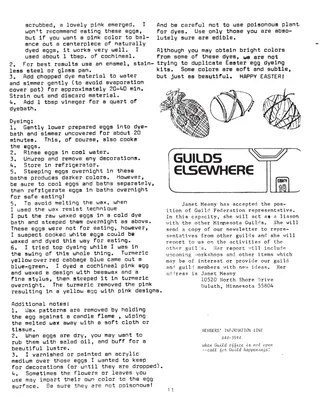
A column from the 'From Woods & Fields' series in Minnesota Weaver giving instructions for coloring Easter eggs with natural dyes. It covers egg preparation, resist and wrapping methods (leaves, rubber bands, netting, onion skins, beeswax), dye baths from onion skins, red cabbage, coffee, turmeric and cochineal, and dyeing, overdyeing and finishing steps, with safety notes about eating the eggs and poisonous plants.
Dyeing with grapeskins
Article · 1 page
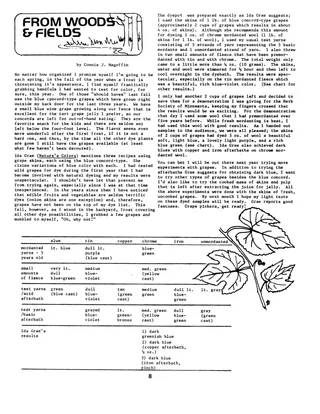
A short column from the Minnesota Weaver series "From Woods & Fields" in which Connie Magoffin reports her experiments dyeing wool with the skins of blue concord-type grapes, following recipes from Ida Grae's Nature's Colors. She describes the dyepot, the mordants tested (alum, tin, copper, chrome, iron, and unmordanted), and the resulting blues, violets and greens. A results chart compares her samples with Grae's, and she outlines further experiments she plans.
Dyeing with pomegranates, testing
Article · 1 page
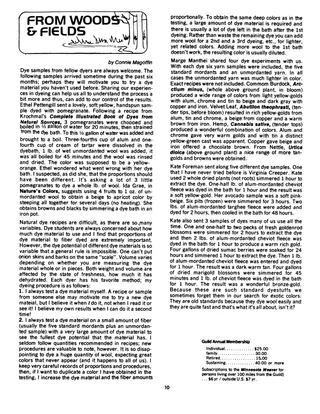
A column from the Minnesota Weaver's "From Woods & Fields" series in which Connie Magoffin reports on dye samples sent by fellow dyers. It describes an unsuccessful pomegranate dyebath on wool and compares recipes from Krochmal and Ida Grae. It also covers Magoffin's method of testing a dyestuff on small fiber samples with the five standard mordants and an unmordanted sample, using a large amount of dye material. Results are given for burdock, velvet leaf, hemp, nettle, Virginia creeper, avocado pits, goldenrod, sumac and marigold.
Dyers' Green Weed
Domestic Encyclopedia, 1821
Article · 1 page
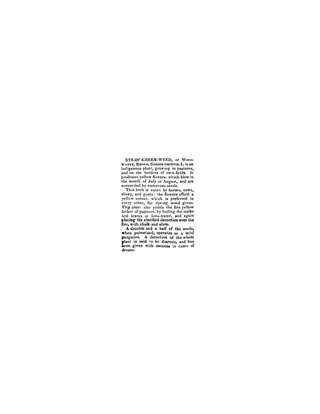
A short encyclopedia entry on dyers' greenweed (Genista tinctoria), also called woodwaxen or dyer's broom. It describes the plant's habitat and flowering season and its use as a yellow dye, preferred for dyeing wood green. It also mentions the yellow lake pigment made for painters and the plant's medicinal uses as a purgative and diuretic.
Dyers' Weed
Domestic Encyclopedia, 1821
Article · 2 pages
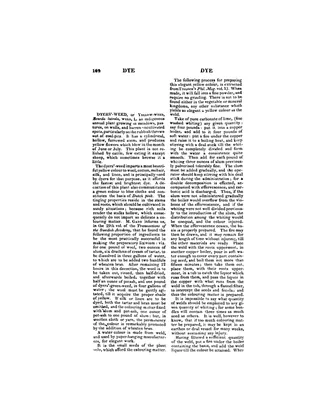
An encyclopedia entry on dyers'-weed (weld, Reseda luteola), describing the plant, its habitat, and its use as the fastest and brightest yellow dye for wool, cotton, mohair, silk and linen. It gives M. Gadd's mordanting and dyeing proportions using alum, cream of tartar, bran and potash, and a second process, from Tilloch's Philosophical Magazine, for making a yellow water-colour pigment from weld seeds with whiting and alum.
From Woods & Fields
Article · 1 page
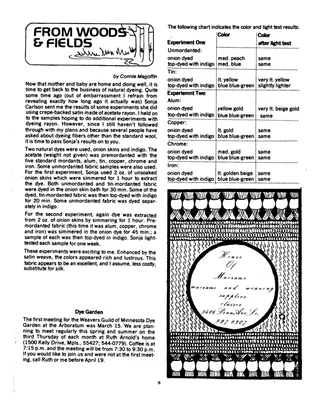
A one-page column from the Minnesota Weaver on natural dyeing of acetate rayon crepe-backed satin. It reports Sonja Carlson's experiments with onion skins and indigo on unmordanted fabric and fabric premordanted with alum, tin, copper, chrome and iron, including a chart of colors before and after a one-week light test. It also announces meetings of the Weavers Guild of Minnesota Dye Garden.
From Woods & Fields-Dye Garden
Article · 1 page
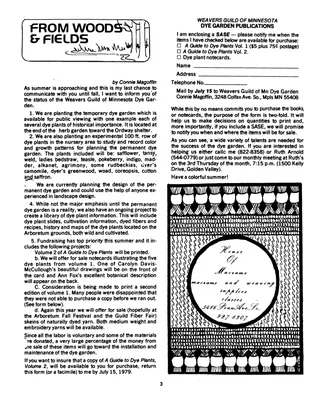
A one-page column from the Minnesota Weaver reporting on the Weavers Guild of Minnesota Dye Garden at the Minnesota Landscape Arboretum. It describes a temporary public dye garden, an experimental row of dye plants, plans for a permanent garden, and a dye plant information library. It also covers fundraising: Volume 2 of A Guide to Dye Plants, notecards, a possible second edition of Volume 1, and sales of naturally dyed yarn. A pre-order form is included.
Fustic
Article · 1 page
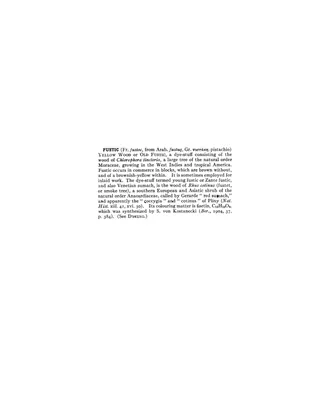
A short encyclopedia entry on fustic, a yellow natural dye from the wood of Chlorophora tinctoria (old fustic) of the West Indies and tropical America. It also covers young or Zante fustic from Rhus cotinus, a southern European and Asiatic shrub, whose colouring matter is fisetin. The entry gives the commercial form of the wood, its alternate uses, and cross-references to the article on dyeing.
Fustic
Article · 1 page
A short encyclopedia entry on fustic, a yellow dye-stuff. It distinguishes old fustic (Chlorophora tinctoria, from the West Indies and tropical America) from young or Zante fustic (Rhus cotinus, the smoke tree of southern Europe and Asia). It gives the commercial form of the wood, its other uses, and the colouring matter fisetin, and refers readers to the Dyeing article.
Fustic
Rees's Cyclopedia, 1819
Article · 1 page
A single page from Rees's Cyclopedia on fustic, a yellow dyestuff. It describes old fustic (Morus tinctoria) and young fustic (Rhus cotinus, Venice sumach), covering colour, durability, mordants, and uses in compound colours such as greens, drabs and olives. The entry begins on this page and breaks off partway through the description of the tree.
Fustick
Article · 1 page
A very short encyclopedia entry on fustick (also spelled fustock), a yellow dyewood from the Caribbean islands used for dyeing yellow. It also notes that the wood paid no import duty.
Indigo
Article · 1 page
A brief dictionary entry on indigo, describing it as a dark blue drug prepared from the leaves and small branches of a low shrub native to warmer parts of Asia and Africa. It notes the dye's wide use in dyeing and its value to oil and water-color painters for its brilliance, mixing qualities and permanence.
Indigo
Domestic Encyclopedia, 1821
Article · 1 page
A single page from the Domestic Encyclopedia (1821) with the entry on indigo. It describes how indigo is made from the leaves and branches of the indigo shrub: steeping and fermenting the slips in vats, beating the liquor with perforated wooden buckets to precipitate the coloring matter, draining, filtering, and drying. It also gives signs of good indigo and a short recipe for a blue color made by dissolving powdered indigo in oil of vitriol.
Indigo
Article · 2 pages
A short encyclopedia entry on indigo from the first edition of the Encyclopedia Britannica. It cross-references the botanical genus Indigofera, then describes how indigo blue is made from the leaves of the anil plant by steeping, churning with olive oil, settling and drying. It also gives advice on judging quality, compares East Indian (Serquisse) with West Indian (Guatimala, St Domingo, Jamaica) types, and lists uses for dyers, laundresses, painters and confectioners.
Indigo
Oxford Encyclopedia, 1828
Article · 1 page
A short encyclopedia entry on indigo dye made from Indigofera tinctoria. It covers the plant's history from Pliny onward, where it is grown, how it is cultivated, and the vat fermentation, beating, settling, draining and drying steps used to make cake indigo. It closes with uses in laundry bluing, watercolors and dyeing, and the main producing regions in the Americas.
Indigo
Zell's Encyclopedia, 1876
Article · 1 page
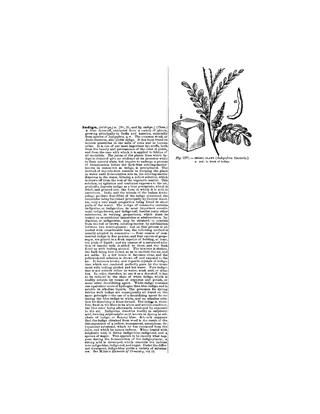
A one-page encyclopedia entry on indigo as a blue dye-stuff, from Zell's Encyclopedia. It covers the source plants (Indigofera species and woad), the fermentation and precipitation process used to make commercial indigo, and its chemical constituents such as indigotine, indigo-red and indigo-brown. It also explains why indigo must be reduced to soluble white indigo for dyeing, with a deoxidizing agent and an alkali, and then developed blue by exposure to air. An engraving shows the Indigofera tinctoria plant, a pod, and a block of indigo.
Indigo Dyeing
Article · 1 page
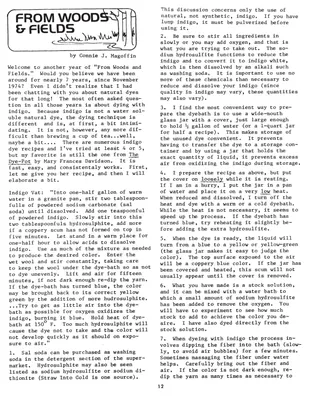
A column from the "From Woods & Fields" series on natural dyes in Minnesota Weaver, in which Connie Magoffin explains how to dye wool with natural indigo. She gives Mary Frances Davidson's indigo vat recipe from The Dye-Pot (sodium carbonate, powdered indigo, hydrosulphite). Numbered notes follow on sourcing chemicals, preparing and storing the vat in a glass jar, judging when the vat is ready, making a stock solution, and dipping and airing the fiber.
Industrial Development of Indigo
Article · 7 pages
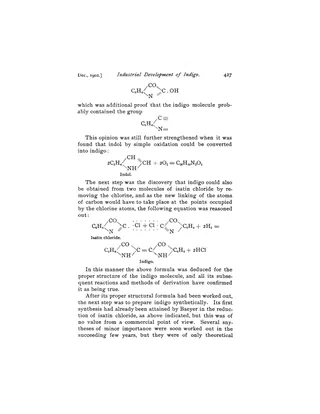
A 1902 paper read before the Chemical Section of the Franklin Institute on how indigo went from a plant-derived dye to a synthetic coal-tar product. It describes the natural extraction of indigo from Indigofera tinctoria via indican, then Adolph von Baeyer's twenty-year work on indigo's chemical structure. It then covers the commercial syntheses (Heumann's phenyl-glycocoll route from naphthalene) developed by Badische Anilin und Soda Fabrik and others, and predicts the decline of the natural indigo industry as happened with madder and alizarin.
Madder
Rees's Cyclopedia, 1819
Article · 6 pages
Encyclopedia article on madder (Rubia tinctorum) from Rees's Cyclopaedia. It covers the agricultural cultivation of the plant (soils, sets, planting, weeding, harvesting, kiln drying, milling, seed saving, and an acre cost-and-profit estimate), with comments on the English market versus Dutch imports. It also treats madder's medicinal uses and its colouring of animal bones, the Dutch and Turkish preparation of the root, chemical experiments on its dye with alum, alkalis and metallic salts, and methods for making madder lakes (Englefield, Margraaf).
Madder
Article · 1 page
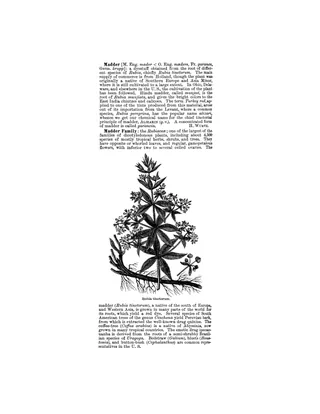
Encyclopedia entry on madder, the red dyestuff obtained from the roots of Rubia species, chiefly Rubia tinctorum. It covers sources of supply (Holland, Southern Europe, Asia Minor, the U.S.), Hindu madder (munjeet) used for East Indian chintzes, the origin of the term Turkey red, alizarin, and garancin. A second entry describes the madder family (Rubiaceae) and its other useful plants, and a botanical engraving of Rubia tinctorum is included.
Madder and Barilla
Article · 1 page
A short notice announcing that the Pennsylvania Horticultural Society has appointed a committee to investigate the cultivation of dyer's madder and of barilla in the United States. The committee asks readers for information on acreage, imports, preparation for market, price fluctuations, soil and climate suitability, and quality differences. Communications are to be sent to David Landreth, Jr., Corresponding Secretary, in Philadelphia.
Mediaeval Dyestuffs
Article · 9 pages
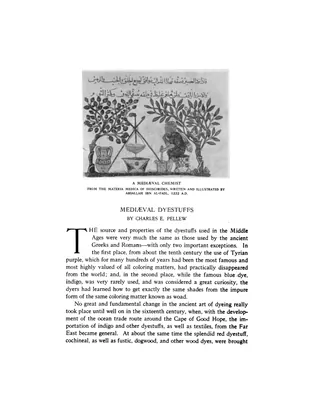
Article by chemist Charles E. Pellew surveying the dyestuffs used in the Middle Ages and how they compare with those of antiquity and later periods. It covers yellows (saffron, Persian berry, iron rust), blacks (iron and tannin, galls, logwood), reds (kermes, lac, cochineal, madder), and blues (indigo and woad). Along the way it discusses mordants, fastness of colors, the fading of yellows and greens in old tapestries, the woad-versus-indigo controversy, and the arrival of synthetic indigo.
Natural dyes in yarn, fleece, cloth, wool, cotton etc.
Article · 1 page
A one-page column from the Minnesota Weaver's 'From Woods & Fields' series, in which Connie Magoffin surveys the range of materials and forms that can be dyed with natural dyes. She covers dyeing fleece, yarn and cloth, other fibers and materials such as raffia, paper, feathers, animal hair and some nylon, and techniques like ikat, tie-dye, batik, warp painting and top-dyeing. She also mentions non-dye uses of natural pigments such as wood stain, tapa cloth, inks and cosmetics. The page also carries an advertisement for The Yarnery in St. Paul with fall workshops.
Nekal BX Dry in the Indigo Vat
Article · 2 pages
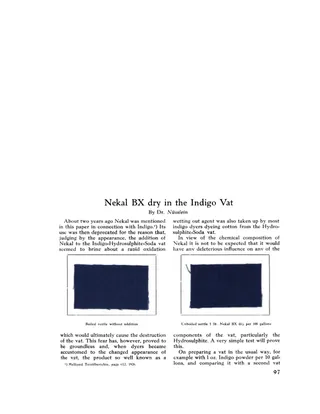
A two-page article from The Melliand by Dr. Nüsslein on using Nekal BX dry, a wetting agent, in the indigo-hydrosulphite-soda vat for dyeing cotton. It reports on how Nekal changes the vat's appearance, the particle size and filtration of precipitated indigo, and the effects on vat stability and shade depth at different concentrations per 10 gallons. The text ends with "To be continued"; two photographs show dyed nettle samples.
"Of Dyeing as an Art" in Arts and Craft Essays
Monograph · 16 pages
William Morris's essay on dyeing as an art, contrasting traditional natural dyeing with the commercial aniline dyes that he argues have nearly destroyed it. He describes the four base colours (blue, red, yellow, brown) and the dyestuffs for each: indigo and woad, kermes, cochineal, madder, weld, walnut and catechu. He also covers mixing for green, purple and black, the difference between substantive and mordant (adjective) dyes, indigo vat practice, alum mordanting, and the fading of dyes as seen in Gothic tapestries.
Specification of the Patent Granted to Mr. Joseph Barton for an Improved Method of Preparing Indigo for the Purpose of Dying Wool, Silk, Cotton, and Other Articles
Article · 2 pages
Two-page specification of an English patent dated March 25, 1797, granted to Joseph Barton, a London chemist, for an improved method of preparing indigo for dyeing wool, silk, linen, cotton and other goods, and for giving blue shades to linens, woollens and papers. The text explains that quantities cannot be fixed because indigo varies in quality. It describes grinding the indigo finely, dissolving it in acid or alkaline solvents, adding tin, iron, zinc or alum as a fixing base, and neutralizing excess solvent so the colour stays durable and bright.
Summer Dyeing
Article · 1 page
A one-page column by Connie Magoffin from the Minnesota Weaver (June 1977) offering natural dyers ideas for summer. It covers the advantages of lichen dyeing, tips for experimenting with unidentified dye plants, and references to earlier columns with dye recipes and light-test instructions. It also proposes group dyeplant collecting trips and one-day dyeing get-togethers for Guild members.
Weld
Article · 1 page
A very short dictionary entry defining weld as the dried stalks, leaves, and flowers of the annual plant Reseda luteola. It notes that dyers use weld to produce a brilliant and durable yellow color.
Weld
Article · 1 page
A short encyclopedia entry on weld (Reseda luteola), also called dyer's rocket, dyer's weed or yellow weed. It describes the plant, its habitat and cultivation, and its use as a yellow dye for linen, wool and silk. It also notes that weld is often confused with woad, which yields blue.
Woad
Article · 1 page
A short encyclopedia entry on woad (Isatis tinctoria), a plant of the mustard family whose leaves yield a blue dye. It covers the plant's description, the preparation of the leaves by fermenting and forming dye balls, and its replacement by indigo. It also notes that woad is often used with indigo and should not be confused with weld, a yellow dye plant.
347 documents found