Textile Documents › Publications › Publication: Philippe Demoule
8 documents found
Sort: 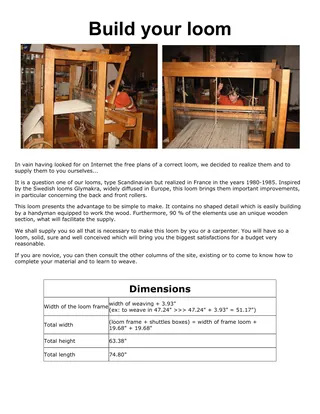
Build Your Loom
Web Doc · 11 pages
Free construction plans for a Scandinavian-style wooden floor loom, based on Swedish Glimåkra looms and built in France in the 1980s. The document gives overall dimensions, side-frame plans, cut lists with section sizes, crossbars, pedals, the batten, shuttle boxes, and the front and back rollers. Photographs show joinery, brakes, the shuttle launch system, the raised-shaft system and roller blocking. The plans are supplied by CVMT.
Le Dictionnaire de la Soierie I: Glossaire [The Dictionary of Silk Weaving I: Glossary]
Web Doc · 71 pages · French
A French-language alphabetical glossary of silk-weaving and silk-manufacturing terms compiled by Philippe Demoule (edition of 5 January 2002). Entries cover looms and loom parts (including the Lyon hand loom and Jacquard mechanism), tools, shuttles and bobbins, warp preparation, silk fabrics, and the trades involved. Many entries are drawn from 18th-century encyclopedic sources, with other entries giving modern Lyon workshop usage. A few longer entries discuss treadle and heddle arrangements and manufacturing economics.
Le Dictionnaire de la Soierie II [The Silk Dictionary II]
Web Doc · 72 pages · French
Second part of a French-language dictionary of silk manufacture compiled by Philippe Demoule from the Diderot and d'Alembert Encyclopédie. It reproduces the articles on velvet, taffeta, damask, brocade, brocaded fabrics, gauze (including gauze de Cos) and moire. The longest article, on figured velvet, describes the loom frame, cantre, roquetins, heddles, harness cords and treadling, and the others cover warp and heddle arrangements, treadle sequences, gold and silver bindings and fabric defects. No weaving drafts are shown, though some pages carry figures.
The Great Story of Silk Trade of Lyons
Web Doc · 12 pages
A three-part history of the Lyons silk industry, translated from French into English, written by Philippe Demoule in 1979. It covers the origins of silk and its introduction to Lyon from the 15th and 16th centuries under royal patronage, the regulation of the guild and the working conditions of master weavers (chefs d'atelier), and the development of the Jacquard loom. It then treats the Revolt of the Silk Workers (canuts) in 1831, the dispersal of looms into the countryside, artificial fibers, and the modern hand-weaving of reproduction fabrics for French palaces. It contains no weaving drafts.
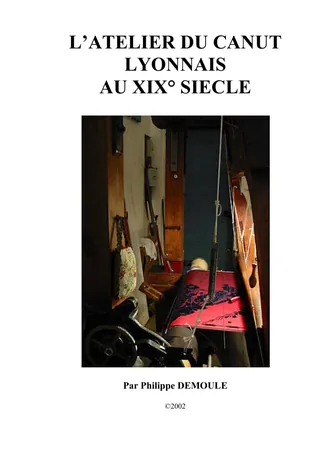
L'Atelier du Canut Lyonnais au XIX° Siècle [The Workshop of the Lyonnais Canut in the 19th Century]
Web Doc · 130 pages · French
An illustrated French-language study of the Lyon silk weaver's (canut's) workshop in the 19th century, written for the Conservatoire des Vieux Métiers du Textile. It describes the Lyonnais hand loom part by part (frame, warp-tension 'bascules', beater, regulator), the weaver's tools such as shears, shuttles, and the brocheur, and Jacquard mechanisms, followed by a section on silk velvet weaving (plain, cut and ciselé velvet). It also contains a history of the Lyon silk industry from its origins through the Jacquard era, and a long dictionary of silk-weaving terms that mixes modern definitions with Encyclopédie-style entries. Many photographs of looms and tools from the Atelier du Chelu and technical line drawings illustrate it.
A Museum Treasure
Web Doc · 4 pages
A short web document describing a set of four hand-woven Jacquard silk panels of La Marseillaise, the French national anthem, designed by Eugene Grasset and woven in Lyon by Tassinari & Chatel in an edition of 300. It gives a brief history of the firm, founded in 1680, and describes each panel's imagery and the woven musical score. It notes the set came in its original cardboard portfolio and that the CVMT association acquired a copy.
Notice le Pastel (Isatis tinctorum) [Notes on Pastel (Isatis tinctorum)]
Web Doc · 9 pages · French
A French-language notice on woad (Isatis tinctoria) by Jean-Pierre-Casimir Marcassus, Baron de Puymaurin, extracted from his 1811 "Instructions pratiques" and republished online by Philippe Demoule of the CVMT. It covers choice of soil, sowing, weeding, harvesting and the making of woad paste (coques) with its long fermentation before it reaches the dyer's vat. It also describes the Corfu peasant method of dyeing wool with fermented woad, and experiments and processes for extracting indigo from woad (Astruc, Dambourney, Gréene) and from anil in Java and Malta.
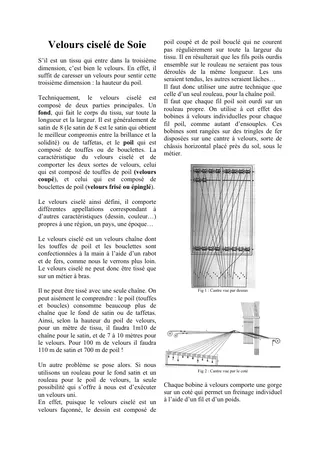
Velours ciselé de Soie [Silk Cut-and-Looped Velvet]
Web Doc · 3 pages · French
A short French article by velvet weaver Philippe Demoule explaining how cut-and-looped silk velvet (velours ciselé) is woven by hand. It covers the satin or taffeta ground, the separate pile and binding warps, the creel (cantre) with individual velvet bobbins, and the Verdol and 104-hook jacquard mechanisms. It also describes the rabot and the weft-inserted irons (fers) used to form looped (frisé) and cut (coupé) pile. Illustrated with creel diagrams, photographs of tools and an engraved plate from Diderot and d'Alembert's Encyclopédie.
8 documents found