Textile Documents › Publications › Publication: Journal of the Franklin Institute
9 documents found
Sort: 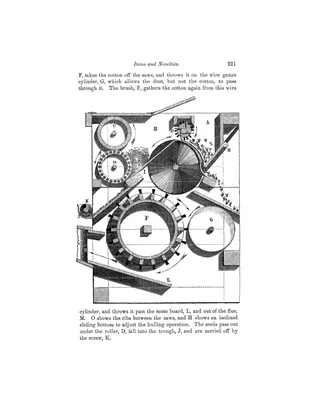
Cotton Gin, by Richard R. Gwathmey
Journal of the Franklin Institute, April 1869
Article · 3 pages
A short 1869 notice from the Journal of the Franklin Institute describing the Champion Gin and Huller, a cotton gin exhibited by Richard R. Gwathmey. It explains the machine's parts with a labeled cross-section diagram (saws, hulling roller, carrying rollers, brush, wire gauze cylinder, mote board, seed screw). It claims the reverse-running saws let the machine gin cotton in the boll with hulls included, and gives a calculation of the planter's financial gain over hand-picking.
Industrial Development of Indigo
Article · 7 pages
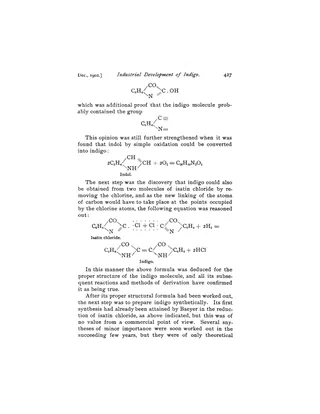
A 1902 paper read before the Chemical Section of the Franklin Institute on how indigo went from a plant-derived dye to a synthetic coal-tar product. It describes the natural extraction of indigo from Indigofera tinctoria via indican, then Adolph von Baeyer's twenty-year work on indigo's chemical structure. It then covers the commercial syntheses (Heumann's phenyl-glycocoll route from naphthalene) developed by Badische Anilin und Soda Fabrik and others, and predicts the decline of the natural indigo industry as happened with madder and alizarin.
List of Books Relating to Cotton and the Cotton Industry, in the Library of the Franklin Institute, 1909
Article · 5 pages
A classified bibliography of books on cotton and the cotton industry held in the Franklin Institute Library in 1909. Entries give author, title, place, publisher, date and call number, and are grouped under headings: bleaching, cotton manufacture, cotton fibre, machinery, dyeing, calico printing, mill construction, spinning, textile fabrics, weaving, and periodicals. Sources are English, French, German, Spanish and Finnish, dating from the 18th century to 1908.
On the Chemistry of Wool
Article · 5 pages
A 1905 lecture by J. Merritt Matthews on the chemical constitution of wool, delivered at a Franklin Institute stated meeting. It distinguishes raw fleece components (dirt, wool-fat, suint) from the purified fibre, and discusses wool as a proteoid, amido-acid substance with both basic and acidic properties, including its coefficient of acidity and its reactions with acid and basic dyes. It closes with an argument that the fibre is not chemically homogeneous, based on its three-part cell structure and variable sulphur content.
Power Looms
Journal of the Franklin Institute, July 1868
Article · 3 pages
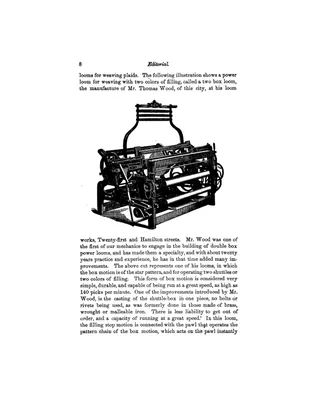
A short 1868 notice on the development of double box power looms for weaving checks, ginghams and plaids in Philadelphia. It recounts J. C. Kempton's first double box power loom at Manayunk around 1833 and the hand loom weavers' opposition to it. It then describes a two box loom built by Thomas Wood, with a star-pattern box motion, a one-piece cast shuttle box, a filling stop motion and a spring-cushioned shuttle stop. One engraving of the loom is included.
Preservation of Timber, Hemp, Linen, etc. by Sir William Burnett's Method
Article · 2 pages
A short 1847 notice from the Journal of the Franklin Institute on Sir William Burnett's patented process, which uses chloride of zinc to preserve timber, cordage, sail-cloth and goods made of hemp, flax, cotton, wool or silk. It describes protection against mildew, rot and decay, and fireproofing with a strong enough solution. It also reports other uses, including preserving dissecting-room specimens, treating green hides and treating bilge water, and mentions government treatment tanks and railway sleepers. The writer suggests applying the solution to paper pulp or printed paper.
Scouring of Cotton
Article · 6 pages
A paper by J. Merritt Matthews read before the Section of Physics and Chemistry of the Franklin Institute in May 1906, on how raw cotton is scoured before dyeing, mordanting or bleaching. It describes the waxes, pectin and other impurities in the fibre, then distinguishes light "wetting-out" from full "boiling-out". It covers scouring with alkalies (soda ash, caustic soda) and with sulphated oils such as Turkey-red oil, with practical notes on yarns, hard water and basic dyes.
Some Account of the Late James Cross, a Journeyman Weaver, of Paisley, in Scotland
Journal of the Franklin Institute, January 1827
Article · 5 pages
A short biographical article on James Cross (died March 1824, aged 45), a journeyman weaver of Paisley, Scotland, who invented improvements to harness looms for figured fabrics that made draw-boys unnecessary. It reprints an account from the London Journal of Arts and Sciences (May 1825) describing his machines, the repeated and inadequate subscriptions raised by Paisley manufacturers, his debts and death, and the plight of his orphaned children. Footnotes list his inventions and quote weavers' testimonials praising the machine.
Some Recent Developments in Textile Processes
Article · 14 pages
A paper read before the Chemical Section of the Franklin Institute in March 1898 on new chemical treatments of textile fibers. It covers Mercer's mercerizing patent and the silk-luster finish given to cotton yarns under tension, with bath strengths, times and scroop treatments. It also describes the Thomas & Prevost and Hoechst resist-printing effects, silky luster on wool by hypochlorite or bromine, artificial silk from nitrocellulose (Lehner, Chardonnet), and uses of formaldehyde and gelatine in fibers, sizing, printing, waterproofing and souple silk.
9 documents found