Textile Documents › Topic: Leno and gauze
254 documents found
Sort: 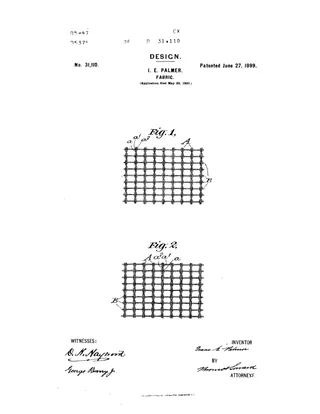
Fabric, US Patent No. D0031110
Patent · 2 pages
US design patent No. 31,110 granted to Isaac E. Palmer of Middletown, Connecticut, for a fabric design. The fabric has warp threads in groups of three, where the two outer threads cross each other at intervals (as in leno or gauze) and a straight central thread runs between them. Single weft threads pass between the central and outer threads. The patent has a drawing sheet with two views (Fig. 1 and Fig. 2) showing the two sides of the fabric, and a one-page specification with a single claim.
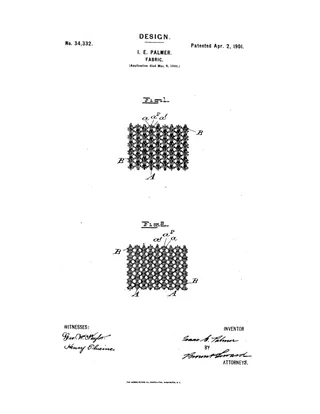
Fabric, US Patent No. D0034332
Patent · 2 pages
US Design Patent No. 34,332, granted April 2, 1901 to Isaac E. Palmer of Middletown, Connecticut, for a fabric design. The specification describes warp threads arranged in groups of three, with the two outer threads crossing to form loops and the middle thread running between them. Zigzag weft threads pass between the loops and the middle thread, giving a lace-like open mesh. Two drawings show the two sides of the fabric.
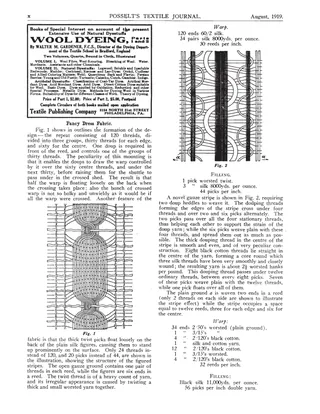
Fancy Dress Fabric
Article · 1 page
A one-page article from Posselt's Textile Journal (August 1919) describing a fancy dress fabric combining an open gauze ground with doup-controlled figured stripes. It explains the 120-thread repeat, the doup mounting, and a second novel gauze stripe needing two doup heddles, with warp and filling specifications (silk, worsted, black cotton, reed counts, picks per inch). Two diagrams illustrate the structures. The page also carries an advertisement for Walter Gardener's two-volume Wool Dyeing.

Gauze
Zell's Encyclopedia, 1876
Article · 1 page
A short encyclopedia entry defining gauze as a light, transparent silken fabric, said to be named after Gaza in Palestine. It explains that the open texture comes from crossing the warp threads between each weft pass, which holds the threads apart. It notes that France and Switzerland were major producers and that inferior grades mix silk and cotton.
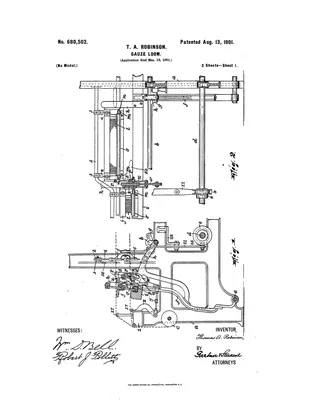
Gauze Loom, US Patent No. 680502
Patent · 5 pages
US Patent No. 680,502, granted August 13, 1901 to Thomas A. Robinson of Paterson, New Jersey, for a gauze loom that produces cross-weaving (leno-type crossed warp threads). It improves his earlier Patent No. 671,148 by using a laterally moving reed placed behind the needles instead of a roller in front. The document has two sheets of drawings, a specification describing the lay, needles, rock-shafts, cam-driven reeds and selvage harness, and four claims.
Handweaving News (April 1950): Gauze or Leno Weave
Periodical · 2 pages
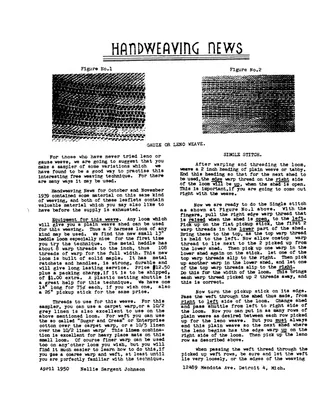
A two-page instructional leaflet by Nellie Sargent Johnson on weaving gauze or leno, a free pick-up technique done on a plain weave shed. It lists equipment (a small 13-inch heddle loom, netting shuttle, pickup stick) and suitable carpet warp, cotton or linen threads. Step-by-step directions cover the single stitch, single stitch on the top shed only, staggered single leno, and leno combined with Spanish weave, with photographs and a pickup diagram. It also mentions earlier Handweaving News issues on the subject and includes product prices.
Imitation Gauze
Article · 1 page
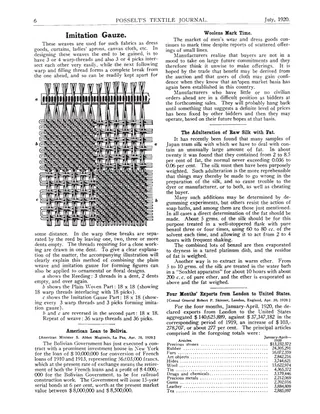
A short piece from Posselt's Textile Journal, July 1920, explaining how to combine plain weave with imitation gauze to form figures, using a cross-section diagram. It gives the reeding (3 threads per dent, 2 dents empty), the 18 x 18 plain and imitation gauze blocks, and a 36 x 36 repeat. The page also carries short trade notes on a U.S. loan to Bolivia, the woolen market, fat adulteration of raw silk, and London exports to the United States.
Leno Cloths, Part 1
Article · 3 pages · weaving drafts
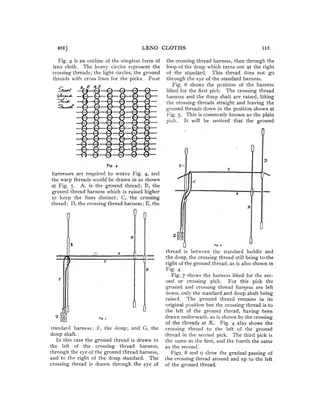
The first part of a 1903 trade-journal article on the construction of leno cloths, written for textile designers. It explains the doup heddle, the doup shaft, and the ground and crossing threads, and defines the related terms. It then walks through the harness lifts for the plain pick and the crossing pick in the simplest leno, and describes the hemstitch leno, with two picks per shed. Figures 1-10 include doup diagrams and interlacement grids, and the article ends "to be continued."
Leno in Double Weave on Four Shafts
Master Weaver, September 1965
Article · 3 pages · weaving drafts
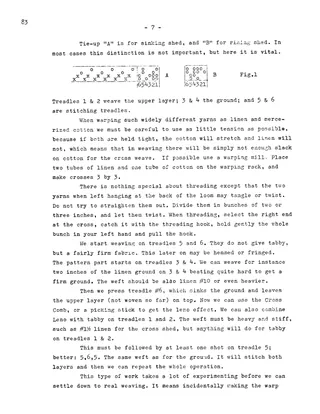
A short technical article on weaving leno (gauze) as a top layer over a stiff tabby backing in double weave on a four-shaft loom, so the leno fabric does not pull in at the edges. It specifies yarns (8/2 mercerized cotton face, 25/2 linen ground), setts, warping, threading and a six-treadle sequence for ground, leno and stitching. It gives tie-ups for sinking and rising sheds and four alternative threadings with different face-to-back sett ratios. It ends with a note on doup leno on a six-shaft loom.
Loom for Cross Weaving, US Patent No. 788328
Patent · 2 pages
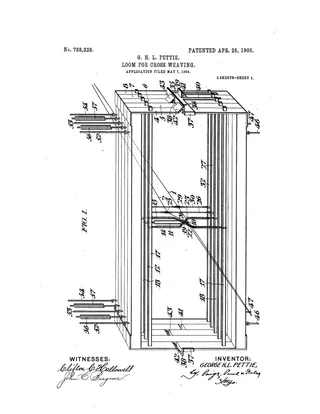
Two drawing sheets (sheets 1 and 2 of 3) from US Patent No. 788,328, granted April 25, 1905 to George H. L. Pettie for a loom for cross weaving. Fig. I is a perspective view of the loom frame with heddle-bearing rods, a top beam with pivoted levers and bars, and numbered parts. Fig. II is a sectional view of the mechanism showing cords, eyes, heddles, springs and levers. The scan has only drawings, with no specification text or claims.
Method and Weaving Loom for Producing a Leno Ground Fabric, US Patent No. 6311737
Patent · 9 pages
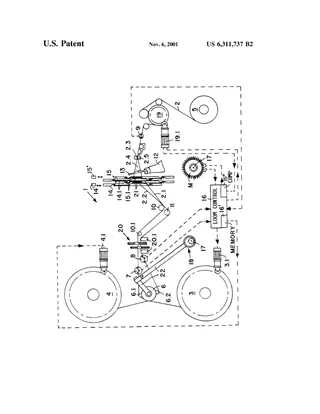
US Patent 6,311,737 (granted Nov. 6, 2001) to Wahhoud, Czura and Hehle of Lindauer Dornier, describing a method and loom for weaving leno ground fabric across the full weaving width. Two full-width heald frames carry lifting healds and half healds that move the leno and ground warp threads. Separate warp beams allow independent tension control, with the leno warp held at 40-60% of the ground warp tension. The scan contains a USPTO database printout with claims, the patent front page, a drawing sheet of the loom, and the printed specification covering background art, objects, and the detailed description.
Net Weaves 2
Master Weaver, March 1958
Article · 3 pages
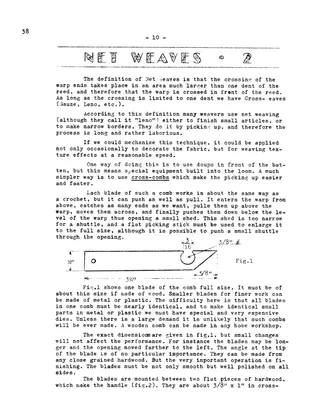
An article from Master Weaver on net weaves, in which the warp ends cross over an area wider than one dent of the reed. It describes a hand-made wooden cross-comb with blades that pick up, move and push down groups of warp ends to open a small shed, and a flat picking stick that enlarges the shed. It gives blade dimensions, comb construction, finishing, how to use the comb, and suggestions for weft such as rigid reeds or bamboo alternated with plain tabby. It promises a follow-up article with practical projects.
The Rigid Heddle - Leno Weaves
Article · 2 pages · weaving drafts
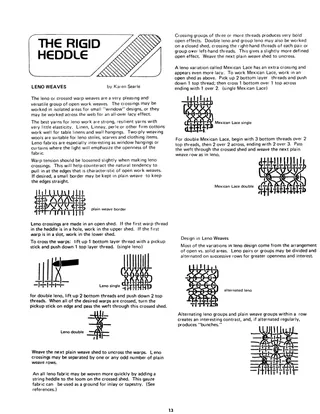
A two-page article by Karen Searle in the Rigid Heddle column of Minnesota Weaver explaining how to make leno (crossed-warp) lace on a rigid heddle loom with a pickup stick. It covers suitable yarns, tension, single and double leno, Mexican Lace variations, and design ideas such as alternating leno and plain weave groups, with small diagrams and a reference list. The second page also carries notices of regional fiber exhibits and yarn shop advertisements.
Shedding Loom, US Patent No. 2528
Patent · 2 pages
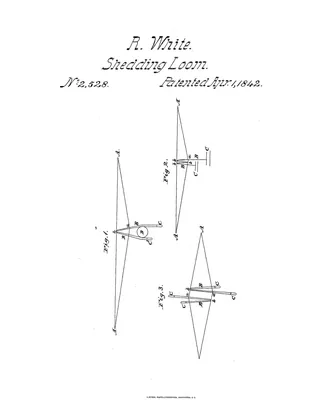
US Patent No. 2,528, granted April 1, 1842 to Rollin White of Williamstown, Vermont, for a way of mounting and operating the harness in looms that weave bolting-cloth. The heddles pass around neighboring warp threads so that the warp is twisted one or more times between successive weft picks, which keeps the mesh openings even. The drawing sheet has three diagrams (Figs. 1-3) showing single twists, multiple twists, and a two-harness arrangement, and the specification and claim follow.
Weaving Loom for Producing a Leno Fabric, US Patent No. 6315008
Patent · 12 pages
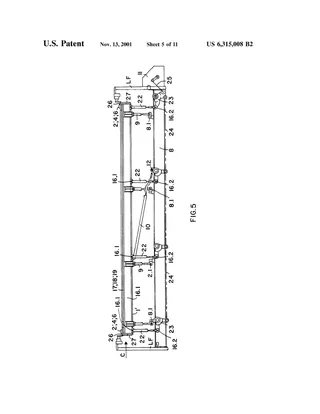
US Patent 6,315,008 (granted 13 Nov 2001) to Dornier et al. of Lindauer Dornier GmbH, describing a weaving loom for leno fabric. It uses two warp control sections on the reed side facing the warp: one guides the leno threads and ground threads and oscillates horizontally, the other carries a detour element and needle bar and oscillates vertically, both driven by a common (eccentric) drive or by separate drives. The scan includes a US PTO web printout with abstract, claims and description, plus the patent's front page and drawing sheets showing side-view loom mechanisms, heddle/needle details and lamellae needle bars.
Elastic Woven Fabric, US Patent No. 1950559
Patent · 6 pages
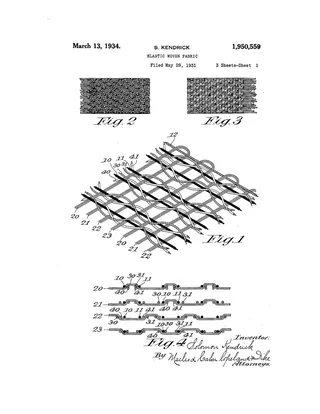
US Patent 1,950,559, granted to Solomon Kendrick of Easthampton, Mass., and assigned to United Elastic Corporation, for an elastic woven fabric. The fabric uses only covered elastic strands in the warp, with leno warps and thick fibrous weft picks, to give maximum resiliency in one direction for belts, suspenders and garters. The patent has three drawing sheets (Figs. 1-6) showing the preferred weave and two modifications, a specification describing the interlacement, and eight claims.
Gauze
Article · 1 page
A short encyclopedia entry defining gauze as a light, transparent, openly woven fabric, originally silk and later linen or cotton. It gives the supposed origin of the name at Gaza, describes how the warp threads are twisted in pairs between wefts, and notes the related leno fabric. It also mentions the 18th-century silk gauze industry in western Scotland and uses such as flour bolting and wire gauze.
Gauze
Article · 1 page
A short encyclopedia entry defining gauze as a light, transparent fabric originally made of silk. It explains the open texture as produced by crossing warp threads between the weft threads (leno-type construction) and gives the etymology. It also mentions surgical cotton gauze, silk bolting cloth for flour mills, wire gauze, and light fabrics used for summer underwear.
Gauze or Leno Weaving
Article · 3 pages · weaving drafts
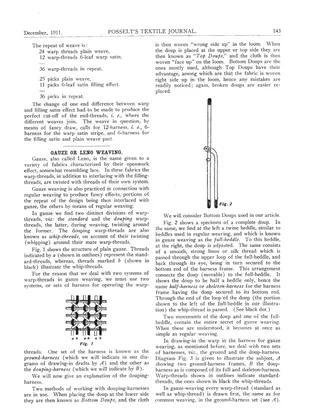
Part of a serial article from Posselt's Textile Journal (December 1911) explaining gauze or leno weaving. It describes standard and whip (doup) threads, bottom and top doups, the full-heddle and skeleton harness, drawing-in of ground and doup harnesses, the slackener or easer, and plain gauze with harness chains. Diagrams show the doup, drawing-in drafts, fabric sketches and harness chains. The pages also include a short fragment on a 6-leaf satin weave repeat, news notes on cotton, and the start of a piece on figured madras shirting with warp arrangement and reed details.
Gauze or Leno Weaving
Article · 2 pages · weaving drafts
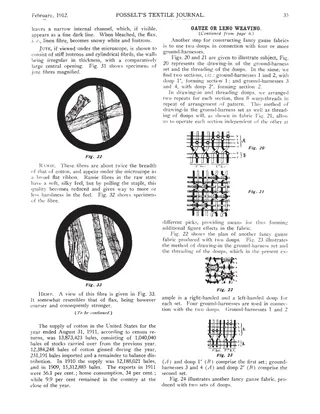
Two pages from the February 1912 issue of Posselt's Textile Journal (pp. 35-36), continuing a serial on gauze or leno weaving. The text explains fancy gauze fabrics made with two doups and four ground harnesses, with threading diagrams, fabric plans (Figs. 20-26), and a harness chain for fabric 24. The pages also include the end of a fibre-microscopy section (jute, ramie, hemp) and the start of a piece on cotton carding.
Gauze or Leno Weaving
Article · 2 pages · weaving drafts
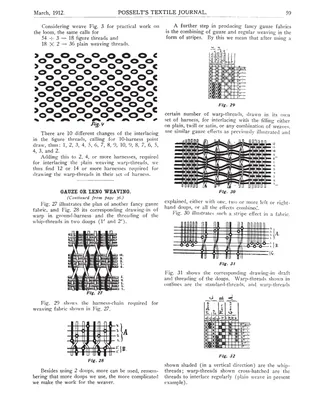
Two pages from the March 1912 issue of Posselt's Textile Journal continuing a series on gauze or leno weaving. They describe fancy gauze fabrics with one or more doups, combining gauze and regular weaving in stripes, and drawing-in drafts with ground-harness, regular harness and doup sets, along with harness chains. The second page begins a section on fabric analysis, on identifying artificial wools such as shoddy, mungo, extract and flocks.
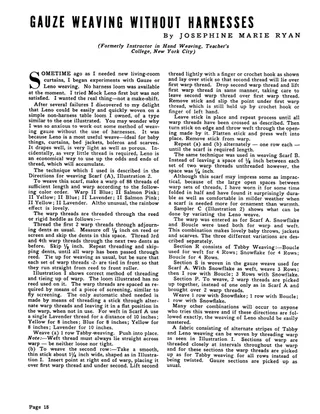
Gauze Weaving without Harnesses
Article · 2 pages
A short article by Josephine Marie Ryan explaining how to weave gauze (leno) on a simple non-harness table loom, using a rigid heddle or screen for spacing and a shed stick with fingers or a crochet hook to twist warp pairs. It gives directions for a rainbow-striped scarf (A), a wider-spaced scarf (B) and a sampler (C) combining tabby and leno sections with Snowflake and Boucle yarns. It also mentions alternating stripes of tabby and leno. Two pages of photographs show the loom setup and the finished pieces.
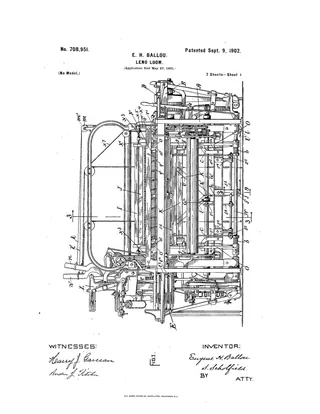
Leno Loom, US Patent No. 708951
Patent · 11 pages
US Patent No. 708,951, granted September 9, 1902 to Eugene H. Ballou of Pawtucket, Rhode Island, for a leno loom. The invention places the doup and standard harnesses in front of a reed that can be detached from the lay, so the warp threads to be crossed pass through several dents of the reed. It also adds a device that keeps the weft-fork from stopping the loom during blank picks. Seven sheets of drawings (Figs. 1-17) are followed by the specification and 13 claims.
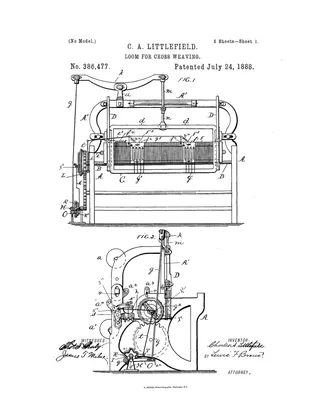
Loom for Cross Weaving, US Patent No. 386477
Patent · 8 pages
US Patent No. 386,477, granted July 24, 1888 to Charles A. Littlefield of Fall River, Massachusetts, for a loom attachment that produces cross weaving (leno). It uses needles carrying crossing warp threads and a laterally sliding reed with auxiliary sliding reed sections, driven by a cam, ratchet and pattern chain. The loom can weave longitudinal cross-woven stripes or borders and transverse cross-woven bars or headings, for curtains and dress goods. Five sheets of mechanical drawings precede the specification and claims.
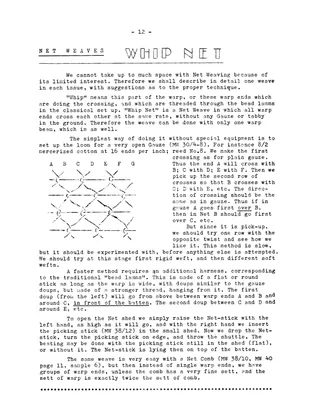
Net Weaves - Whip Net
Master Weaver, January 1959
Article · 1 page
A one-page article from the Master Weaver series on net weaves, describing whip net, in which all warp ends cross each other at the same rate with no gauze or tabby ground. It explains a slow pick-up method on a loom set up for open gauze (8/2 mercerized cotton, 16 ends per inch, No. 8 reed) and a faster method using a net-stick with doups, similar to traditional bead lamms. It also mentions making the weave with a net comb. A diagram labeled A through G shows the warp crossings.
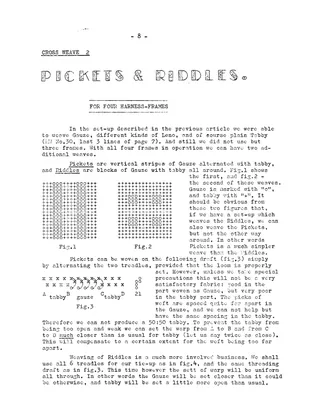
Cross Weave 2 - Pickets & Riddles for Four Harness-Frames
Master Weaver, January 1957
Article · 3 pages · weaving drafts
Second article in a Master Weaver series on cross weave (leno/gauze) for four-harness frames. It explains how to weave Pickets (vertical gauze stripes alternating with tabby) and Riddles (gauze blocks surrounded by tabby), with six-treadle tie-ups, treadling orders, and two methods for compensating for the differing pick spacing of gauze and tabby. It ends with a practical project for a rayon scarf, giving the threading draft, warp, sett, reed and treadling.
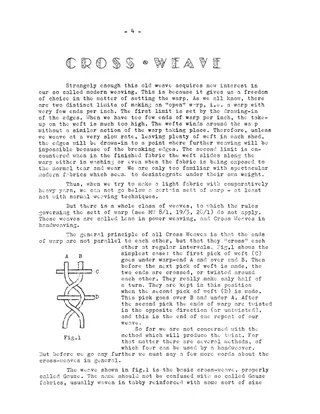
Cross-Weave
Master Weaver, November 1956
Article · 5 pages · weaving drafts
An instructional article from Master Weaver on cross-weaves (gauze, leno, pickets and riddles) for handweavers on four-shaft looms. It explains why cross-weaves allow very open warp setts, defines the terms, and surveys four methods of crossing warp ends. It then details the doup-without-standards method: making the doups, threading, tie-up, treadling sequences, and adjusting the sheds, including adding a spring-loaded roller to lengthen the warp ends. Diagrams show the crossings, the threading and the tie-ups.
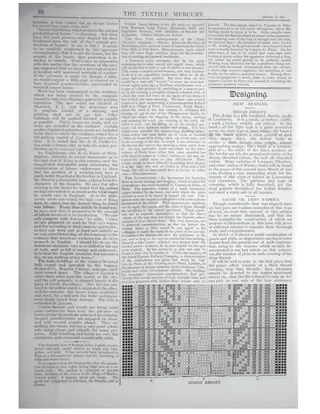
Designing
Textile Mercury, January 24, 1891
Article · 2 pages · weaving drafts
Two pages from The Textile Mercury (24 January 1891) with the "Designing" feature. It presents an Indian silk-bordered dhooty from Loodianah, with a colour description and drawdown, followed by a tutorial on gauze (leno) fabrics. Three examples, Sketches A, B and C, are explained with point-paper designs, pegging plans and doup/heald drafts (Designs 8, 9, 10). Suggested fibre uses (cotton, silk, worsted, mohair) are given. The first page also carries unrelated trade news columns.
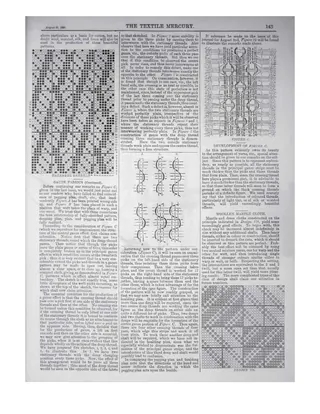
Designing
Textile Mercury, 1890
Article · 2 pages · weaving drafts
Two pages from The Textile Mercury, 30 August 1890, covering the 'Designing' column. It gives a clan tartan design (McDonnell of Glengarry) with threading, color sequence, reed and pick counts for cotton. It continues a technical series on gauze fabrics, explaining doup and stationary threads, pick grouping, healding and pegging plans, and the development of Figure C. It closes with notes on a woollen mantle cloth design (Design 176) related to 2 and 2 twill.
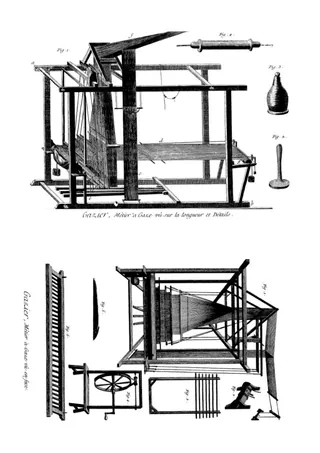
Encyclopedia: Weaving Plates, Part IV - Gauze/Gaze
Illustration · 3 pages · French
A short set of engraved plates on gauze weaving from the Diderot and d'Alembert Encyclopédie, compiled as Part IV of a weaving plates series by Philippe Demoule. It shows the gauze loom (métier à gaze) in lengthwise and front views with detail figures, plus plates illustrating the functions of the heddles (lisses) and the development of the loom. Captions are in French and there is no explanatory text.
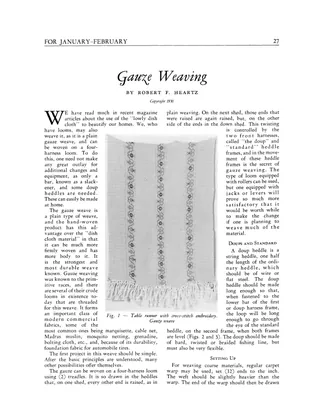
Gauze Weaving
Article · 5 pages
A 1930 magazine article explaining how to weave plain gauze (leno-type) cloth on a four-harness loom using doup heddles and a slackener. It covers the doup and standard heddle frames, threading order, tie-up for jack and roller looms, and the weaving procedure, with line diagrams of the shed arrangements. It also suggests stripe and check variations and uses of the cloth as a foundation for embroidery and rugs, illustrated with items made at Kings Park State Hospital.
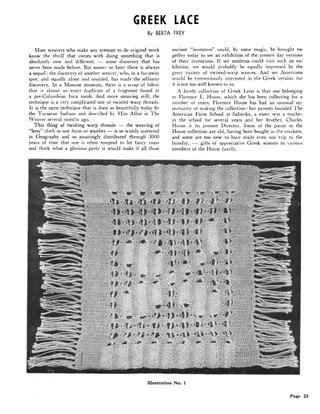
Greek Lace
Article · 6 pages · weaving drafts
Article by Berta Frey on Greek Lace, a twisted-warp (leno) technique found in Greek handwoven towels and bedspreads from the collection of Florence E. House. It describes the Greek weavers' freedom of design, then gives simplified directions for weaving it on a tabby shed, covering twisting with a pick-up stick, heavy pattern shots, odd numbers of fine tabby shots, and designs charted on cross-section paper. Illustrations show specimens (birds, ducks, grapes, a large bedspread-like cloth) with a draft and design figures. The scan ends with a Questions and Answers column by Mary M. Atwater on rusted and bent heddles and reeds.
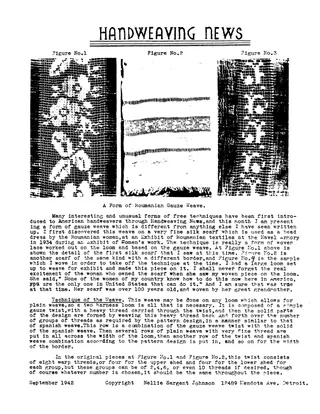
Handweaving News (September 1942): A Form of Roumanian Gauze Weave
Periodical · 2 pages · weaving drafts
Nellie Sargent Johnson describes a form of gauze weave, a loom-woven lace, that she found on an old Roumanian silk head scarf at a 1934 exhibit in Detroit. She explains how a gauze twist is combined with a heavy weft worked in Spanish-stitch fashion, separated by rows of fine plain weave, and she gives the pick-up stick procedure. She also gives her sample's warp and weft materials and sett, and design planning advice using cross-section paper. Photographs show the original scarves and her modern sample, with an enlarged detail and a design drawing.
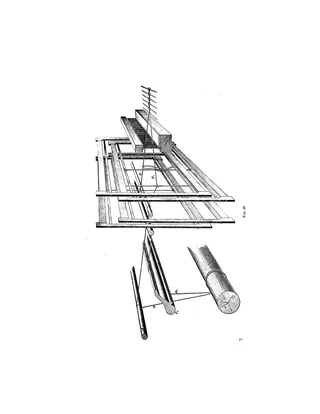
Leno Attachments
Monograph · 38 pages · weaving drafts
An International Correspondence Schools instruction paper (Serial 496) on the mechanical leno (gauze) attachments used on dobby looms. It explains the doup and standard harnesses, bottom and top doups, drawing in, reeding, and the slackener or easer for single-lift (close-shed) dobbies. It then covers double-lift (open-shed) dobbies with the jumper and yoke, harness-chain pegging plans, and the fixing and setting of these motions. It ends by comparing American and European drawing-in methods. Illustrated with numbered figures of harness and mechanism drawings and four chain drafts.
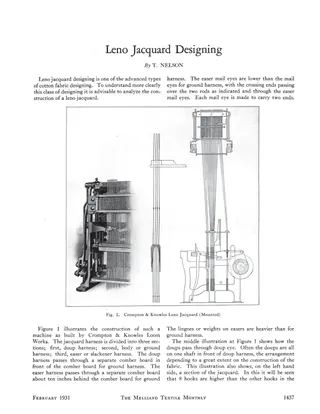
Leno Jacquard Designing
Article · 4 pages · weaving drafts
A 1931 Melliand Textile Monthly article by T. Nelson explaining how to design for leno jacquard looms. It describes the Crompton & Knowles leno jacquard with its doup, ground and easer harness sections, how ends are drawn through the harness, and how the design must be split into three sections for doups, body and easers. It works through hook and needle allocation on a 600 jacquard and an English 400 machine, with an example leno fabric and its design grids.
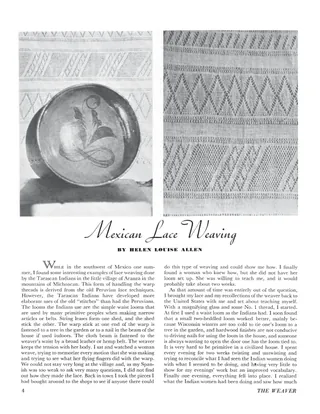
Mexican Lace Weaving
Article · 3 pages
Helen Louise Allen describes Tarascan Indian lace weaving she saw in Aranza, Michoacan, Mexico, and how she taught herself the technique at home in Wisconsin. She gives instructions for the single stitch and double stitch, which are picked up with a stick on a two-heddled loom, and for combining them into patterns. She also covers the scalloped edge that results when lace bands are used with plain weave bands, and three ways to avoid it. Illustrations show the gauze weave and the lace stitch sequences.
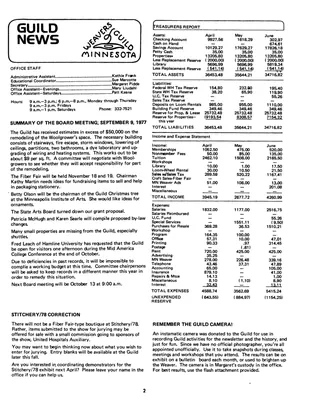
Minnesota Weaver, Vol. 3, No. 2 (October 1977)
Minnesota Weaver, October 1977
Periodical · 18 pages
October 1977 issue of the Weavers Guild of Minnesota's monthly newsletter. It carries guild business: the October program of member reports on textile conferences, a board meeting summary and treasurer's report, committee chairmen, library news, the search for a larger guild space, the Fiber Fair sale of November 18-19, and the Minneapolis Institute of Arts Christmas tree project. It also includes the Ken Weaver workshop reports, class and seminar announcements, the MIA textile study room, classified ads and advertisements. The main feature is Sue Baizerman's article on Peruvian crossed warp (gauze) weaves, with diagrams and museum textile descriptions.
Net Weaves - Whip Net
Master Weaver, March 1959
Article · 3 pages · weaving drafts
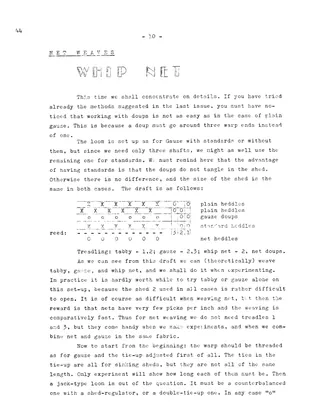
An instalment of the Master Weaver series on net weaves, focused on whip net woven with doups on a three-shaft setup plus a shaft for standards. It gives the draft and treadling, explains the counterbalanced tie-up with sinking sheds, and describes making net doups and opening the difficult second shed. It also covers weft take-up and the need for templets. A short closing piece, Terminology, laments the confused weaving terms used by non-weaver historians.
Textile Fabric, US Patent No. 1661142
Patent · 4 pages
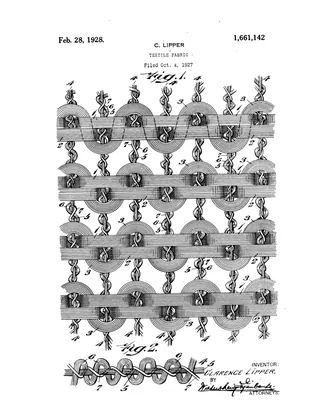
US Patent No. 1,661,142, granted 28 February 1928 to Clarence Lipper of Philadelphia, assignor to Lipper Manufacturing Co. It describes a loom-woven fabric made to look and feel like hand-crocheted hat fabric. The fabric uses a composite weft of a cotton core, a loosely spiralled stiff cellulose (artificial straw) body thread and a binder thread of artificial silk. The warp is two sets of plain warp threads plus a doup warp. The patent has two figures (fabric plan view and composite weft) and 16 claims.
The Weaving of Filling Leno
Article · 4 pages
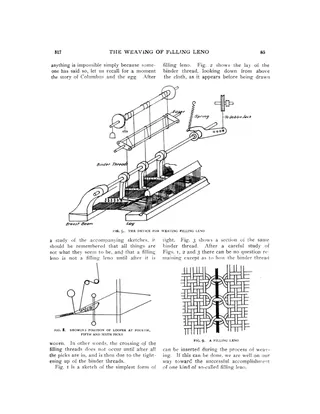
A 1913 article from Textile World Record explaining how filling leno effects, in which weft threads cross one another, can be woven on a power loom. It describes a binder thread inserted by spring-steel loopers mounted over the breast beam and operated from an open shed dobby. The loopers take three positions (out, half in, all in), and the crossing of the filling picks occurs only when the binder threads are tightened after the picks are in. Seventeen figures show the loom attachment, looper positions at successive picks, and filling leno stripe, block and net effects.
Weaving. -- No. XXI: Cross Weaving
Article · 3 pages
A 19th-century engineering journal article, number XXI in a series on weaving, explaining gauze (cross) weaving, in which whip threads are twisted around adjoining warp threads by doups and extra leashes. It covers half and full twists, doup and leash arrangements for ordinary and Jacquard looms, gauze selvages for cutting wide cloth into narrow strips, net weaving, and bobbin tension devices for the separate warp supplies. Illustrated with line diagrams (figs. 197-217) of looms and harness mechanisms, with no weaving drafts.
Woven Lace
Article · 2 pages
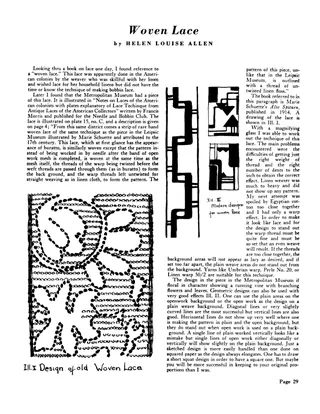
A short 1938 article by Helen Louise Allen on "woven lace," a loom-woven imitation of bobbin lace reportedly made in colonial America. She cites a Metropolitan Museum piece and descriptions by Francis Morris and Marie Schuette, then explains how she reproduced it: gauze-weave areas picked up on a flat stick, separated by three rows of plain weave. She gives advice on yarns, sett, design and outlining with running stitch, with illustrations of old and modern designs and the technique.
Designing
Textile Mercury, 1890
Article · 2 pages · weaving drafts
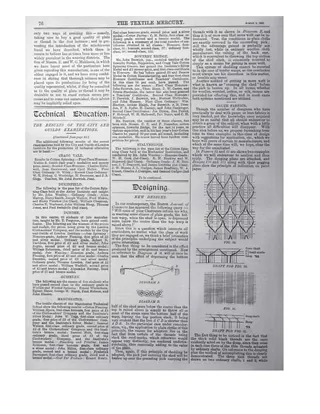
An article from The Textile Mercury of 2 August 1890 in its Designing column. It explains why the bottom warp is depressed further than the top warp when the shed opens, and how this affects reed marks and weft insertion. It then introduces gauze (leno) fabrics, analysing two doup-and-heald examples (Figs. 24 and 25, Designs 170 and 171) with douping plans and pegging plans. It closes with dress fabric suggestions and colouring and drafting details for a Galatea stripe, a fancy scroll stripe and two tartan checks.
Gauze or Leno Weaving
Article · 3 pages · weaving drafts
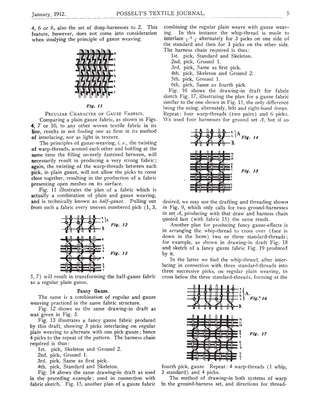
Three pages from the January 1912 issue of Posselt's Textile Journal. They continue E. A. Posselt's series on gauze (leno) weaving, with drawing-in drafts, doup threading, harness chains and fabric sketches for plain gauze, half-gauze and fancy gauze. The pages also open with the end of a section on reversible blanket cloths (double cloth twill weaves, Figs. 17-24) and include a ribbon installment on color effects and a short note on Glauber's salt versus common salt in dyeing.
Gauze or Leno Weaving
Article · 2 pages · weaving drafts
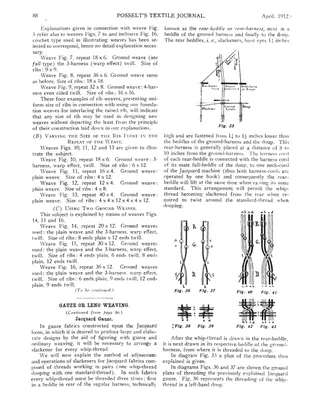
Two pages from the April 1912 issue of Posselt's Textile Journal. The main item continues the series on gauze or leno weaving, covering Jacquard gauze: rear-harness slackeners for whip-threads, threading plans for left- and right-hand doups, and the resulting crossings in the fabric (Figs. 35-43). The pages also carry the end of an article on rib weaves (Figs. 7-16) and a section of the series on fabric analysis, which describes burning and reagent tests for telling wool, silk and cotton apart.
Leno Weaves
Monograph · 66 pages · weaving drafts
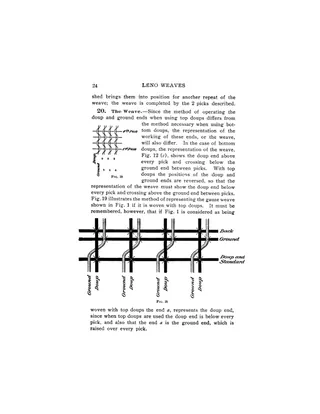
An International Correspondence Schools instruction paper (Serial 512) on leno, or gauze, weaves as woven on dobby looms. It covers plain gauze with bottom and top doups on close-shed and open-shed looms, including the standard, doup, ground and back harnesses, the slackener, jumper and yoke, and how to write harness and chain drafts. The second half treats fancy gauze: combinations of right- and left-hand doups, multiple picks before douping, multiple doup or ground ends, several sets of doups, combinations with plain weaves, effects without extra mechanisms, and dissecting leno cloth. It is illustrated with many mechanism drawings, weave diagrams and chain and drawing-in drafts.
Leno Weaving and Design, Part 1
Article · 6 pages · weaving drafts
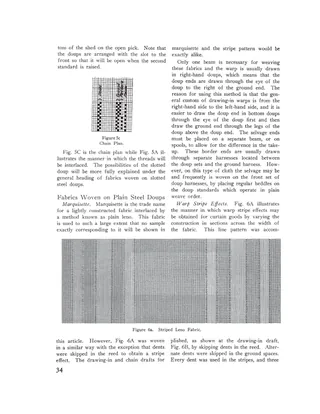
First part of a serial article on leno (gauze) weaving from The Melliand, explaining how warp threads cross one another and how steel doups are used to produce the crossing. It describes the plain steel doup and the slotted (super) doup, with a marquisette loom attachment, a dobby head with jumper motion, and drawing-in and chain drafts. Examples include marquisette, warp stripe, checked and filling-border leno, and a leno and figured rib curtain fabric. The article ends 'To be continued'.
Leno Weaving and Design, Part 2
Article · 7 pages · weaving drafts
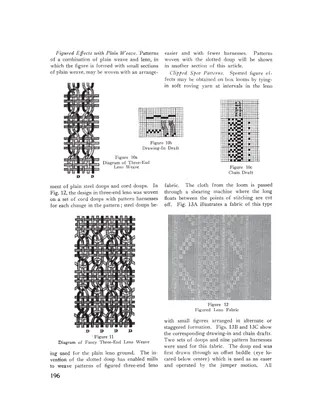
Second installment of a series on leno weaving and design from The Melliand, covering fancy allover leno effects with multiple doup sets and ground harnesses, figured effects combining plain weave and leno, and clipped spot patterns woven on box looms. It explains doup, slotted heddle, jumper and slackener mechanisms, double yokes, and ways of catching roving filling at the selvedges, with drawing-in and chain drafts for each sample. It closes with tubular leno fabrics woven with double doup mountings, used for hosiery dyeing, laundry and vegetable bags.
Leno Weaving and Design, Part 3
Article · 6 pages · weaving drafts
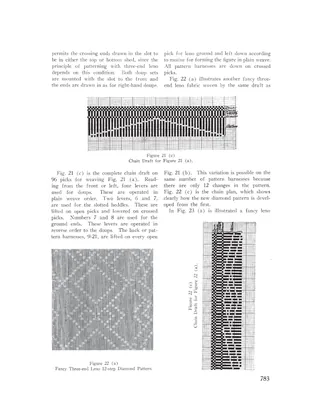
Third installment of a series on leno weaving, covering design of figured three-end leno fabrics woven with slotted steel doups on dobby looms. It explains the open and crossed shed positions of the slotted doup and describes several sample fabrics (diamond, all-over, scroll and quadri-symmetrical patterns) with drawing-in drafts and chain drafts. The final pages give practical loom settings for leno, including harness and doup standard heights, leasing, slackener setting, selvages, and reeds.
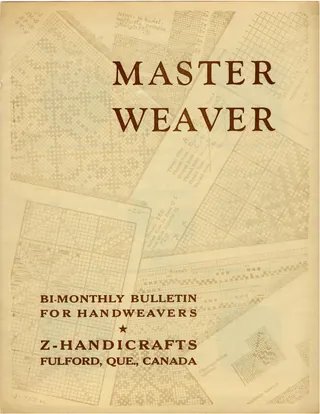
Master Weaver, No. 30 (November 1956)
Periodical · 14 pages · weaving drafts
Issue No. 30 (November 1956) of Master Weaver, a bi-monthly bulletin for handweavers published by Z-Handicrafts in Fulford, Quebec. It opens with a memorial note for Mary Meigs Atwater, followed by an article on the history and purposes of weavers' guilds and how to choose one. Technical articles cover cross-weaves (gauze, leno, pickets, riddles) woven with doups on four frames, a shortcut for designing new fabrics on multiharness looms using the tie-up as the draw-down, and lesson 3 of a series on analyzing drafts, including rearranging threading and treadling.
254 documents found