Textile Documents › Topic: Tapestry
353 documents found
Sort: 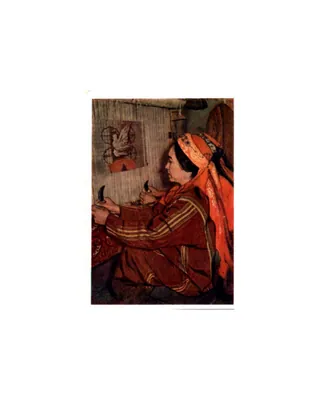
Picture postcard
Ephemera · 1 page
A single picture postcard reproducing a color painting of a woman seated at a loom. She wears a red robe with gold stripes and an orange headscarf, and is weaving a textile with a white bird (dove-like) motif in a roundel. The card carries no legible text, so the artist, date and place of publication cannot be determined from the scan.

Tapestry
Article · 1 page
A very short encyclopedia entry defining tapestry as a manufacture of woven wall hangings in wool and silk, sometimes enriched with gold and silver, depicting figures, animals, landscapes and histories. The scan contains only this brief definition.
Tapestry Through the Ages: Khelim, Aklae and Rolakan
Article · 2 pages
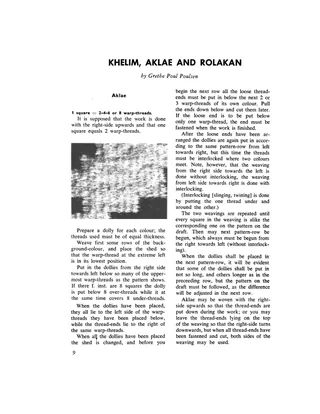
A two-page instructional article by Grethe Poul Poulsen on three related tapestry techniques: aklae, rollakan and khelim. It explains how to place and interlock dollies (butterfly bobbins) of coloured weft over a chosen number of warp threads following a squared pattern. It describes how the three techniques differ in interlocking and in how thread ends are fastened, and how to wind a dolly. The pages include a pattern block for aklae and photographs of the right and wrong sides of rollakan.

Billedvaer
Minnesota Weaver, March 1977
Article · 1 page
A single page from The Minnesota Weaver (March 1977) showing a photograph caption for a fragment of Norwegian "Billedvaer" (picture weaving) dated 1646, from the Vesterheim Collection. The image itself is not legible in the scan. The page also carries the newsletter masthead listing editors, a March calendar, and the Weavers Guild of Minnesota mailing panel.
Handweaving News (October 1943): Ancient Peruvian Slit Tapestry
Periodical · 3 pages · weaving drafts
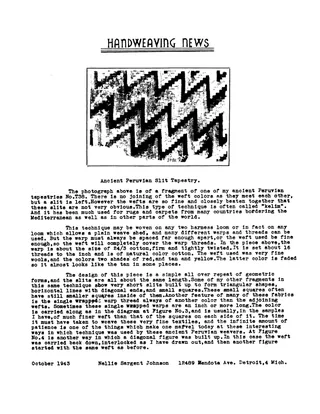
A short 1943 article by Nellie Sargent Johnson describing a fragment of an ancient Peruvian slit tapestry (kelim-type) from her collection. She gives the warp and weft materials, colors and sett, a charted design on cross-section paper, and diagrams showing how to work the slits and turn colors around warp threads. Two variations seen on other fragments are also drawn, and she offers one fragment for sale.
Moon and Her Children; A Tapestry from a Set of the Planets
Article · 7 pages
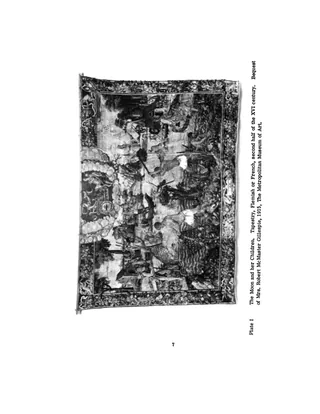
Article by Edith Appleton Standen on a sixteenth-century Flemish or French tapestry in the Metropolitan Museum, 'The Moon and Her Children' (also published as 'Month of June'), from a set of the planets. It traces the design to a 1531 woodcut series attributed to Bartel Beham and explains the planetary iconography, including the moon's chariot, water themes and shell-game scene. It compares the tapestry with a Brussels version in Munich and other sets, and discusses its style, coarse weave and likely provincial origin. Includes notes and three plates.
Note on the Tapestries at the Pompe Funèbre of Charles III of Lorraine
Article · 10 pages
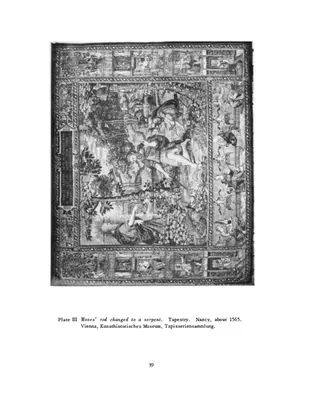
An article on the tapestries hung in the salle d'honneur at the 1608 funeral ceremonies (Pompe Funèbre) of Charles III, Duke of Lorraine, as shown in Friedrich Brentel's engravings of about 1610. The author compares the Moses tapestries in the engravings with nine Moses tapestries from the Dukes of Lorraine now in Vienna, and cites Pierre Marot's explanation of the differences. She identifies Bernard Salomon's woodcuts in the Quadrins Historiques de la Bible (Lyons, 1553/1558) as the pattern source for Brentel's tapestry scenes. Illustrated with plates of the engravings, a Vienna tapestry, the Discours title page, and a Salomon woodcut.
On Tapestry
Article · 2 pages
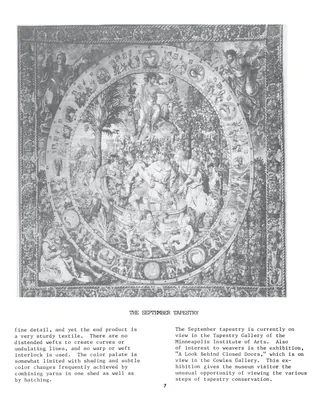
A column from the Minnesota Weaver in which Lotus Stack, associate curator of textiles at the Minneapolis Institute of Arts, begins a series on the museum's tapestry collection. It discusses the Brussels tapestry 'The Month of September' (c. 1525-1528), from a twelve-month series attributed to Van Orley, covering its iconography, its Gothic and Renaissance influences, and related editions in other museums. It also gives technical details of the weave: wool with silk highlights, 19 warp ends per inch, about 80 wefts per inch, and shading by hatching and combining yarns in one shed.
On Tapestry
Article · 2 pages
A short article from the Minnesota Weaver on the historical role of tapestries in late medieval and early Renaissance Europe, where they served as decoration, insulation, and displays of wealth. It focuses on the early seventeenth century French Artemisia series, ten pieces of which are held by the Minneapolis Institute of Arts, and explains how the story was tied to Catherine de Medici and later regent queens. A captioned photograph shows one tapestry from the series, woven in 1610 for Marie de Medici.
Picture postcards
Ephemera · 4 pages · French, English
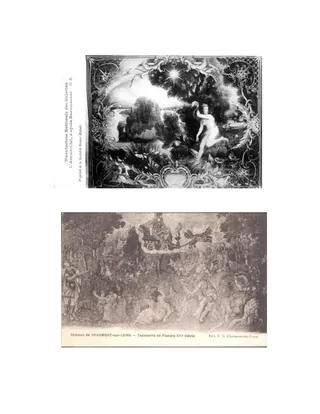
A small set of picture postcards reproducing historic tapestries, scanned as four pages of paired images. Subjects include Gobelins Manufactory pieces (L'Air-en-Ciel after Beauneveu, a Louis XV hunt scene after Oudry), a 16th-century Flemish tapestry at Chaumont-sur-Loire, the Unicorn Tapestries at the Château de Verteuil, a Musée de Cluny medieval piece, and a Victoria and Albert Museum Flemish Trojan War tapestry. Captions are mostly French, with some English.
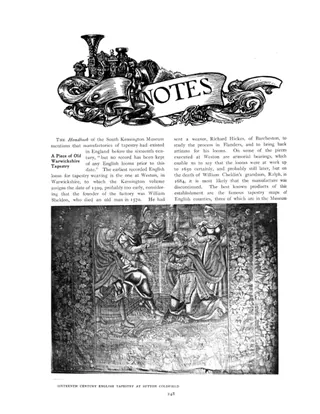
A Piece of Old Warwickshire Tapestry
The Connoisseur, 1903
Article · 2 pages
A short note from The Connoisseur on a sixteenth-century English tapestry at Sutton Coldfield, attributed to the Sheldon looms at Weston/Barcheston in Warwickshire. It reviews the history of the Sheldon manufactory founded by William Sheldon and Richard Hickes, then describes the piece, about 8 feet square, showing Queen Esther before King Ahasuerus. It traces the tapestry's provenance from Castle Bromwich to Sutton Coldfield and notes its cut borders and damp damage.
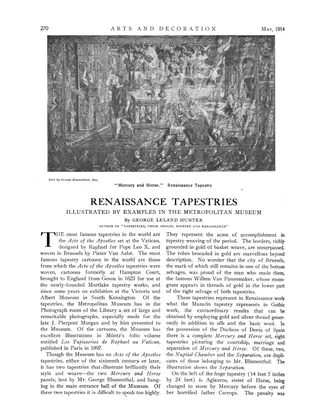
Renaissance Tapestries
Article · 4 pages
A 1914 magazine article by George Leland Hunter surveying Renaissance tapestries in the Metropolitan Museum of New York. It discusses the Mercury and Herse panels woven in Brussels by Willem Van Pannemaker, the Roman Triumph and Roman Colosseum tapestries, Grotesque-ornament panels, verdure tapestries, and a set of German Story of Christ panels. It also mentions the Raphael Acts of the Apostles and Scipio series for context. Illustrated with halftone photographs of several tapestries.
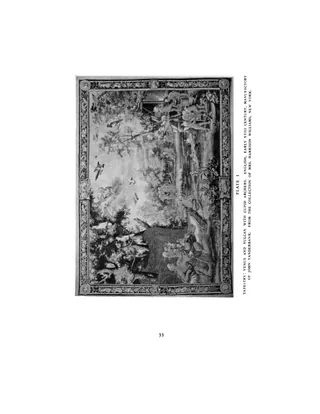
Set of English Eighteenth Century Tapestries
Article · 10 pages
Article describing a set of three early eighteenth-century English tapestries signed by John Vanderbank of the Great Queen Street (Soho) workshop, owned by Mrs. Harrison Williams of New York. The set shows Venus and Cupids scenes: Venus and Vulcan with Cupid Archers, Adonis and the Sleeping Venus, and Nymphs Clipping the Wings of Cupids. The author traces the designs to Francesco Albani's paintings and to earlier Brussels sets, compares the pieces with the Ackermann oil sketches, and describes each tapestry's composition, size and border. Plates show the tapestries, the Albani tondos in the Borghese Gallery, and the weaver's signature band.
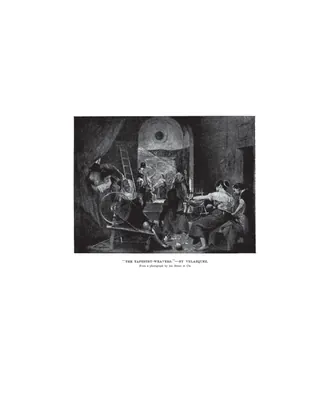
The Tapestry Weavers
Illustration · 1 page
A single-page reproduction of Velázquez's painting 'The Tapestry Weavers' (Las Hilanderas), printed in Harper's New Monthly and taken from a photograph by Ad. Braun et Cie. It shows a dim workshop with a large arched opening in the background, where a tapestry with figures is visible, and a ladder against the left wall. The page has only the caption and credit, with no article text or weaving drafts.
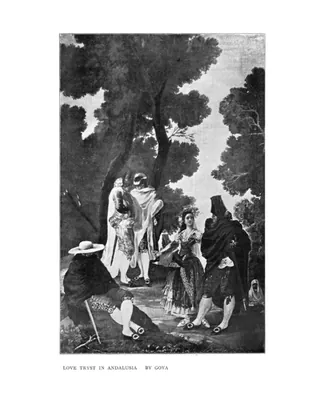
Tapestry: Its Origin and Uses, Part IV: The Goya Tapestries
Article · 5 pages
Part IV of Delia Angela Hart's series in The Connoisseur (December 1903) discusses the tapestries woven at the Madrid works from Francisco Goya's cartoons, made for the Prince of Asturias at El Pardo. It covers Goya's relationship with director Raphael Mengs, the Spanish genre subjects (The Blind Musician, kite flying, love trysts), and the Flemish weavers descended from Van der Gotten's atelier. A closing section on tapestry borders mentions fruit, flowers and birds, the Acts of the Apostles borders and Giulio Romano's designs. Illustrated with reproductions of Goya's Love Tryst in Andalusia, The Crockery Vendor and Kite Flying.
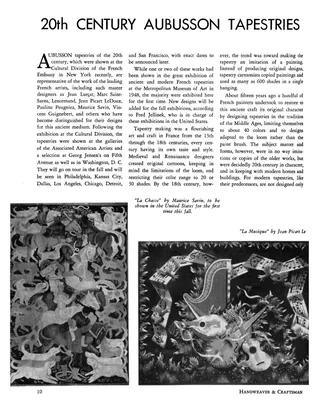
20th Century Aubusson Tapestries
Handweaver and Craftsman, May 1950
Article · 3 pages
Article on an exhibition of 20th-century Aubusson tapestries shown in New York and other US cities in 1950, featuring designs by Jean Lurçat, Marc Saint-Saens, Maurice Savin, Jean Picart Le Doux and others. It traces French tapestry from the medieval period to the return to loom-appropriate designs in the 1930s. It also describes how Aubusson tapestries are woven today on low-warp looms with a cartoon and mirror, compares Aubusson with Gobelin, and covers prices and government purchasing. Illustrated with photographs of tapestries and of the stages of production.
The Bulletin of the Needle and Bobbin Club, Vol. 54, Nos. 1 & 2 (1971)
Periodical · 47 pages
Double issue (Vol. 54, Nos. 1 & 2, 1971) of the Bulletin of the Needle and Bobbin Club. Madeleine Jarry surveys recent French tapestry at the Gobelins, Beauvais and Aubusson, covering designs after Lurçat, Le Corbusier, Adam, Vasarely, Chagall, Mathieu and others, with plates and weaving techniques. Elizabeth Birbari describes the Dovecot Studios in Edinburgh, with photographs of the loom, inking-on, bobbin weaving and tapestries made there. The issue also has book notes (including Weigert's French Tapestry), notes on authors, club notes, a memorial, a list of officers and advertisements.
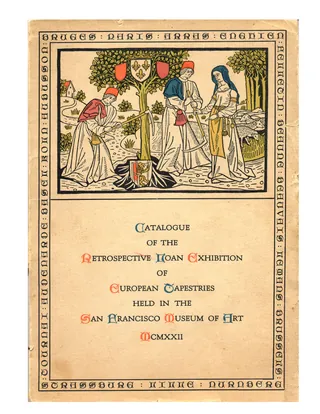
Catalog of the Retrospective Loan Exhibition of European Tapestries Held in the San Francisco Museum
Phyllis Ackerman · 1922
Other · 90 pages
Catalogue of the 1922 retrospective loan exhibition of European tapestries at the San Francisco Museum of Art, written by Phyllis Ackerman with a preface by director J. Nilsen Laurvik. It opens with an historical and critical introduction to tapestry weaving, then lists about 79 tapestries in order of date and place of origin (Franco-Flemish, Flemish, Brussels, Tournai, Fontainebleau, Gobelins, Beauvais, Aubusson, Mortlake, Russian, Spanish and others, 14th to early 19th century). Each entry gives materials, dimensions, subject, commentary and lender. Many plates reproduce the tapestries, and the book ends with a list of weavers and a subject and title index.
Cleveland Tapestry Exhibition
Article · 9 pages
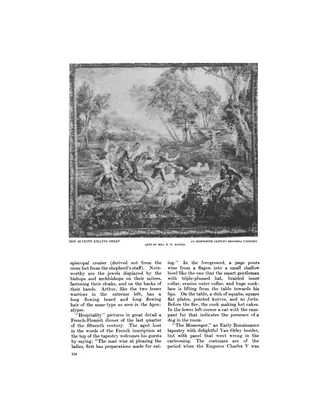
Article by George Leland Hunter on the loan exhibition of tapestries he organized for the Cleveland Museum of Art. He argues for the practical and inspirational value of tapestries for fashion, design and American textile industries, and for the importance of texture in tapestry weaving. He comments on illustrated pieces including King Arthur (14th c. Gothic), Hospitality, The Messenger, Flora, May from the Months of Lucas, Don Quixote Killing Sheep, and Vertumnus and Pomona, and lists the lenders.
The Creed - Flemish Tapestry
Handicrafter, February 1928
Article · 1 page
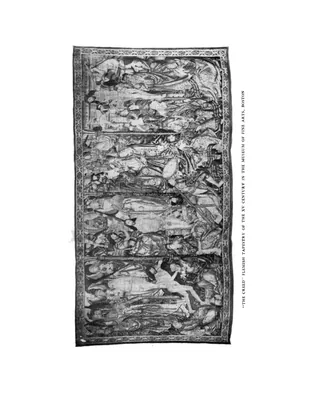
A single-page illustration from the first issue of Handicrafter (February 1928) showing a photograph of "The Creed," a 15th-century Flemish tapestry held by the Museum of Fine Arts, Boston. The tapestry is arranged in several horizontal registers of figures, foliage and animals within a decorative border. The page carries only a caption and no accompanying article text.
Documents Relating to the Trivulzio Tapestries
Article · 38 pages
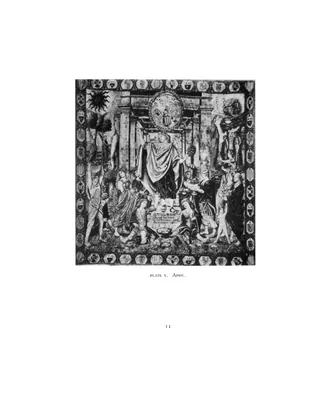
An article by William E. Suida on the Twelve Months tapestry series woven at Vigevano for Marshal Gian Giacomo Trivulzio, now in the Castello Sforzesco, Milan. It covers the Marshal's career, the family crests in the borders, a month-by-month description of the scenes and their Latin verses, and the attribution of the cartoons to Bramantino. It also prints, in Italian with an English translation, entries from the Trivulzio account book for 1509-1510 that record payments to the weaver Benedetto da Milano for yarn, gold and silver thread, dyes, and designs. The article is illustrated with plates of each month.
Enjoy Your Museum. IVc: Tapestries
Monograph · 17 pages
A short popular booklet in the Enjoy Your Museum series that surveys the history of tapestry from the 14th to the 19th century. It follows changes in subject and style from Gothic hunting and religious scenes through Renaissance, Rubens, Teniers and 18th-century French work (Gobelins, Beauvais, Aubusson), then Morris's Merton Abbey looms. It also notes tapestry weaving in Egypt, Persia, China and Peru, and explains true tapestry technique: weft-faced weave, slits, high-warp and low-warp looms, cartoons and shading.
French Tapestry Today
Article · 14 pages
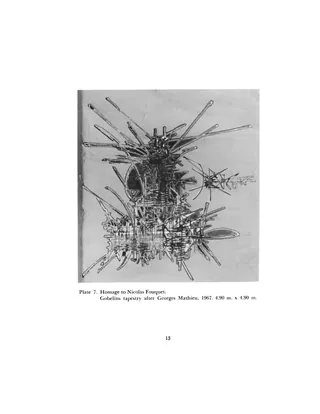
Madeleine Jarry surveys French tapestry of the late 1960s, tracing the revival begun by Mme Cuttoli in 1923 and Jean Lurçat. She discusses the continuing influence of Lurçat, Le Corbusier and Henri Georges Adam, technical experiments at the Gobelins, Beauvais and Aubusson, and specialist tapestry painters such as Prassinos, Matégot and Tourlière. She also covers tapestries woven after paintings by Chagall, Mathieu, Ubac, Vieira da Silva and others, and textile hangings that compete with tapestry. Nine black-and-white plates show Gobelins and Beauvais tapestries with dimensions and dates.
The History and Technique of Tapestry Weaving, Article II: Making a Warp
Handicrafter, December/January 1932-1933
Article · 5 pages
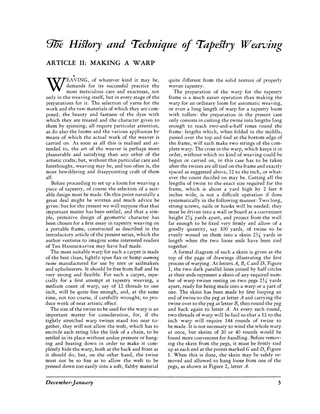
Second article in a series on tapestry weaving from The Handicrafter, explaining how to make and mount a warp on a portable tapestry frame loom. It covers choice of flax or hemp seaming twine at 12 ends per inch, winding skeins on pegs, cutting and mounting the twines in the reed-wire stretcher bar, taking the cross with colored cords, and making and attaching healds to a heddle-rod. Numbered figures and illustrations show the skein, loop knots (snitches), loom frame and heald construction.
Lice [Warp]
Article · 1 page · French
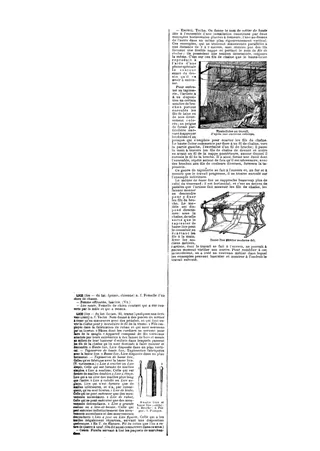
A one-page encyclopedia entry on the French word "lice" from the Nouveau Larousse Illustré. It describes the haute-lice (vertical) tapestry loom and the basse-lice (horizontal, pedal-operated) loom, the tools used (broche, peigne, poinçon), and how the weaver works from the back of the tapestry. It also lists the technical meanings of lice as a heddle, with its types, and as thread or cord in other trades. Illustrations show a haute-lice weaver, a modern basse-lice loom, and the tools.
Modern Treatments of Tapestry and Embroidery Weaves
Article · 6 pages
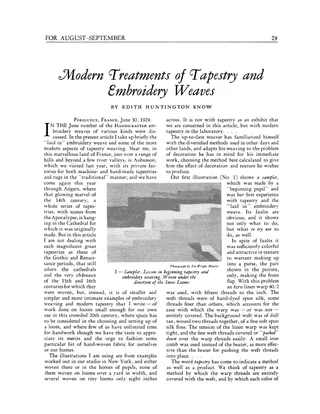
Article by Edith Huntington Snow on small-loom tapestry weaving and the "laid in" embroidery weave, written as a follow-up to her June article on embroidery weaves. It explains how to weave a beginner's sampler, covering warp tension, handling the sheds, interlocking weft at vertical color joins versus leaving slits, building up shapes in pyramids, and pulling down pairs of warp threads for a Coptic-style rib. It compares tapestry with laid-in weaving, where pattern threads lie over a continuous background weft, and describes a swan design, a tapestry bag, and a modern abstract silk wall hanging woven on small four-harness looms with linen or silk warps. The last page carries advertisements and the start of an unrelated excerpt from Walter Crane on the bases of design.
A New Development in Locked Wefts
Master Weaver, November 1961
Article · 3 pages
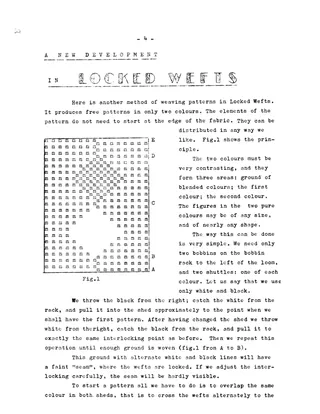
A short article from Master Weaver describing a method of weaving free-form two-colour patterns in locked wefts, where pattern elements need not begin at the fabric edge. It explains the two-bobbin, two-shuttle technique, how the interlocking point and seam work, and how warp and weft colour choices affect the ground. It includes a practical project for cocktail napkins in 20/2 mercerized cotton and pages of pattern diagrams, with advice on keeping seams between figures unobtrusive.
Portuguese Tapestry?
Article · 12 pages
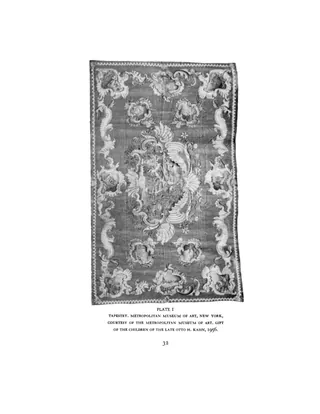
Edith A. Standen discusses a large mid-18th-century tapestry given to the Metropolitan Museum of Art in 1956 by the children of Otto H. Kahn. The tapestry has a blue ground, a central hunting scene, and a border of emblematic devices, most of them found in 18th-century emblem books, set in rococo (rocaille) scrollwork. She considers a Portuguese origin, comparing the rocaille to azulejo frames and weighing known Portuguese tapestry manufactories, and concludes it remains labelled "Portuguese (?), mid-eighteenth century." Nine plates show the whole tapestry and details of the border emblems, and footnotes cite sources.
A School of Tapestry Weaving in New York
Handicrafter, January-February 1932
Article · 2 pages
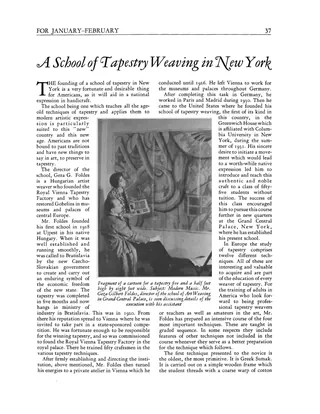
Article describing the school of tapestry weaving founded in New York by Hungarian artist weaver Geza G. Foldes, first at Greenwich House in 1931 and then at the Grand Central Palace. It outlines Foldes's career in Hungary, Czechoslovakia, Vienna, Germany, Paris and Madrid, and his four-technique course taught in graded sequence: Greek Sumak, Swedish, a modified Khilim, and French. Two photographs show a tapestry cartoon and a class at work.
Tapestries of Diane de Poitiers
Article · 48 pages
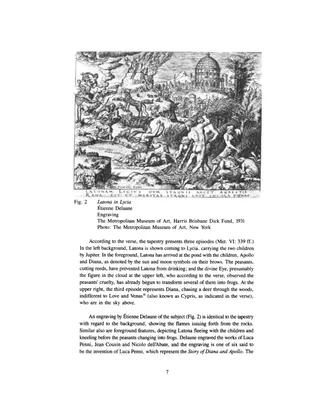
A scholarly article on the set of eight sixteenth-century French tapestries of the Story of Diana that belonged to Diane de Poitiers and were associated with the Château d'Anet. It covers their provenance, border emblems and cartouche verses, scenes drawn from Ovid, related drawings and engravings by Luca Penni, Étienne Delaune and the Cousins, and the arguments for attributing the designs to Jean Cousin the Elder through comparison with the St. Mamas tapestries at Langres. A short section on weaving covers wool and silk high-warp technique and possible weavers and workshops at Fontainebleau. Illustrated with many black-and-white plates and footnotes.
Tapestry
Article · 1 page
A one-page dictionary entry on tapestry from Knight's American Mechanical Dictionary. It surveys the history of tapestry hangings from antiquity through Flanders, France (Gobelins, Fontainebleau) and England, mentions the Bayeux tapestry, and briefly distinguishes hand (needle) tapestry from basse lisse (horizontal) and haut lisse (vertical) loom weaving.
Tapestry Through the Ages: Tapestry Methods
Article · 9 pages · weaving drafts
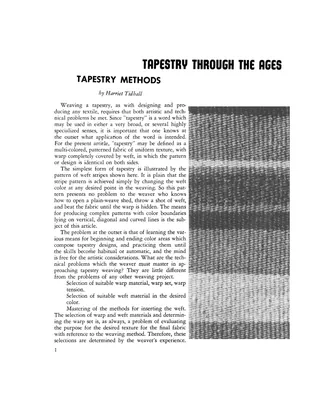
An installment of the 1957 Shuttle-Craft Bulletin series "Tapestry Through the Ages" in which Harriet Tidball defines true tapestry and outlines the technical problems of learning it. She suggests a learning warp and weft (linen carpet warp, fine worsted), describes finger-wrapped weft butterflies and beating tools, and explains seven methods for handling color-area edges (low curves, slit, diagonal, dovetailed, multiple-dovetailed, interlocked, double interlocked). Diagrams and photographs of Guatemalan, Norwegian and Precolumbian examples illustrate the methods, and the final pages give charted border and motif designs on cross-section paper for beginners.
Tapestry Weaving in America
Arts and Decoration, 1919-1920
Article · 2 pages
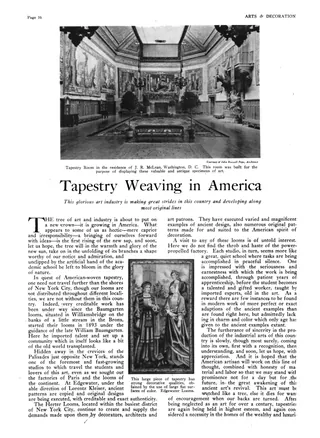
A two-page magazine article from Arts and Decoration surveying the state of tapestry weaving in the United States around 1919. It profiles the Baumgarten looms (founded 1893 in Williamsbridge, Bronx), the Edgewater Looms under Lorentz Kleiser, and the Herter Looms in New York City. It also briefly describes the tapestry process (cartoons, high and low warp, cotton warp, wool and silk wefts, dyeing) and encourages patrons to buy American-made tapestries. Photographs show the J. R. McLean tapestry room in Washington and tapestries from the Edgewater, Herter and Baumgarten looms.
Tapestry, Simple Laid-In Tapestry for Beginners
Article · 3 pages
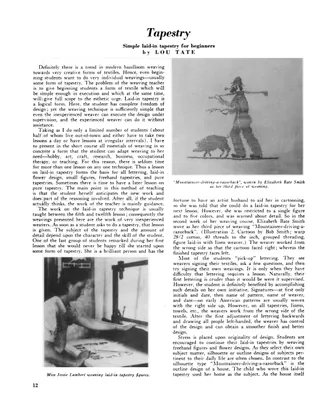
A 1938 article by Lou Tate on teaching beginning weavers laid-in tapestry, drawn from her loomroom lessons. She describes student projects, including a mountaineer figure, a child's house tapestry, a place mat and the 'Guapo the fiddler' freehand figures, with warp and weft details for each. It ends with an outline of practical guidance on cartoons, warps, binder and pattern yarns, shrinkage allowance and beating.
Tapestry-Weaving at the Dovecot Studios
Article · 19 pages
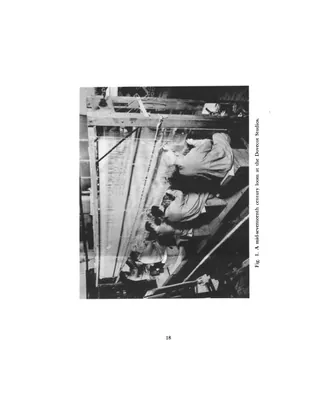
Describes the Dovecot Studios tapestry-weaving workshop in Corstorphine, Edinburgh, founded in 1912 by the Marquis of Bute, and its high-warp looms. Explains the process step by step: tracing and enlarging the artist's cartoon, inking the design onto the warp, shed and leash mechanics, passing the bobbin, beating down the weft, and closing slits. Discusses specific tapestries such as Flight into Egypt, Raising the Standard at Glenfinnan, a view of Edinburgh in 1575, and a council chamber hanging by Archie Brennan, with photographs of the weavers at work. Ends with a short bibliography.
The Bulletin of the Needle and Bobbin Club, Vol. 27, Nos. 1 & 2 (1943)
Periodical · 54 pages
Double issue (Vol. 27, Nos. 1 & 2, 1943) of the Needle and Bobbin Club Bulletin. The main article, by William E. Suida, discusses the Trivulzio tapestries of the Twelve Months, woven at Vigevano in the early 1500s and now in the Castello Sforzesco, Milan. It describes each monthly tapestry, attributes the cartoons to Bramantino, and prints and translates Trivulzio's 1509 account book entries for the tapestry maker Benedetto, covering wool, dyes, yarn and candles. A shorter piece covers an early silk weave in the Dumbarton Oaks Collection, showing a youth wrestling a lion and dated 6th-8th century, and the issue closes with Club notes for 1943-1944 and notices.
The Bulletin of the Needle and Bobbin Club, Vol. 71, Nos. 1 & 2 (1988)
Periodical · 71 pages
Double issue (Vol. 71, Nos. 1 & 2, 1988) of the Bulletin of the Needle and Bobbin Club. The main article, by Gail Patricia Lloyd, studies the surviving Story of Diana tapestries made for Diane de Poitiers and the Château d'Anet. It covers their provenance, iconography, related drawings and engravings, and the debate over the designer (Luca Penni, Jean Cousin). A second article by Veronica Rowe describes "Clare Embroidery," an Irish cottage industry begun by Florence Vere O'Brien in Co. Clare. The issue also has notes on authors, book reviews (including Edith Standen's catalogue of post-medieval tapestries at the Metropolitan Museum), club notes, and an In Memoriam.
Exhibits of Tapestries and Carpets Loaned by His Majesty the King of Spain
Article · 15 pages
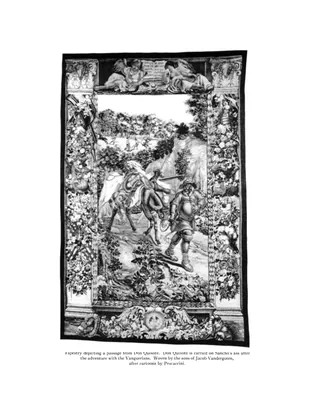
Article by the Marquis de Valverde, translated by Emilio M. Amores, introducing an exhibition of tapestries and carpets from the Royal Tapestry Factory of Madrid, lent by King Alfonso XIII of Spain and shown by the Hispanic Society of America. It traces the factory's history from its founding under Philip V in 1720 by the Flemish master Jacob Vandergoten, through the Vandergoten and Stuyk directorships, the Goya cartoons, decline during the French invasion, and revival under Alfonso XII and XIII. It also notes that the factory kept traditional weaving, yarns and dyes. Illustrated with tapestries from the Don Quixote series, Goya designs, a Flemish-style tapestry and a tapestry-point carpet.
Flat Tapestry
Article · 4 pages
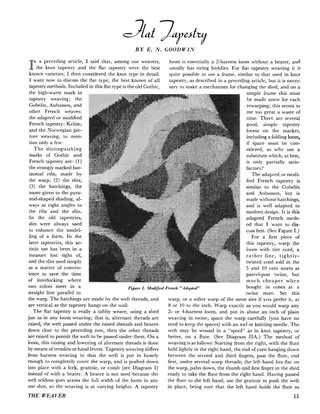
An instructional article on flat (slit) tapestry weaving, the second of two on tapestry in The Weaver, following one on knot tapestry. It explains the distinguishing features of Gothic, Gobelin, Aubusson, adapted French, Kelim and Norwegian picture weaving. It covers loom and warp setup with tire cord, weaving with flutes, grattoir and comb, building a design, sewing the slits, and shading with hatching exercises (pyramid samplers). Illustrated with photographs of tapestry details and tool diagrams.
Gobelin
Article · 1 page
A single-page encyclopedia entry on the Gobelin family of dyers and the Gobelins manufactory in Paris. It traces the family from the 15th century, when Jehan Gobelin set up a scarlet dye-works on the Bièvre, through the addition of tapestry weaving in the 16th century. It then covers the purchase of the works by Colbert for Louis XIV in 1662, the closure and reopening in the 1690s, the addition of carpet manufacture in 1826, and the fire of 1871. It ends with a short list of French references.
Gobelins
Article · 2 pages · French
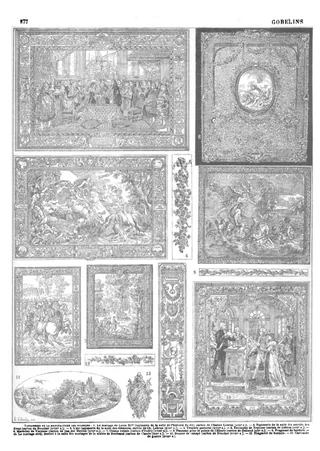
A short French encyclopedia entry on the Manufacture des Gobelins, the famous Paris tapestry and dyeing establishment. The text begins with the origins of the Gobelin family, dyers from Reims who settled in the faubourg Saint-Marceau along the Bièvre in the 15th century. A full-page plate shows numbered examples of Gobelins tapestries from the 17th to 19th centuries, with a caption naming the cartoon designers (Lebrun, Boucher, Oudry, van der Meulen, Galland, Claude).
Gobelins
Rees's Cyclopedia, 1819
Article · 1 page
A one-page encyclopedia entry on the Gobelins, the Paris manufactory for tapestry and furnishings for the French crown. It recounts the founding by the dyers Giles and John Gobelins, the 1667 establishment as the Hotel Royal des Gobelins under Louis XIV and Colbert, and the regulations governing it. It also mentions notable tapestry series designed by Le Brun.
Greek Weaving
Article · 2 pages
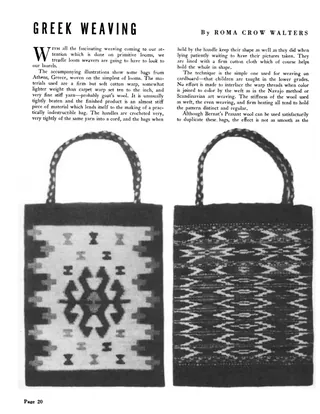
A short 1939 article describing woven handbags from Athens, Greece, made on simple primitive looms with a fine cotton warp and stiff weft yarn, probably goat's wool. It explains the tabby-based, discontinuous-weft technique (like cardboard weaving), crocheted handles and cotton linings. The author suggests duplicating the bags with Bernat's Peasant wool, with colors for five illustrated bags, and notes they can be woven on treadle or portable heddle looms.
Handweaving News (March 1940): Peruvian Tapestry Weaving Similar to Norwegian "Aklae"
Periodical · 3 pages · weaving drafts
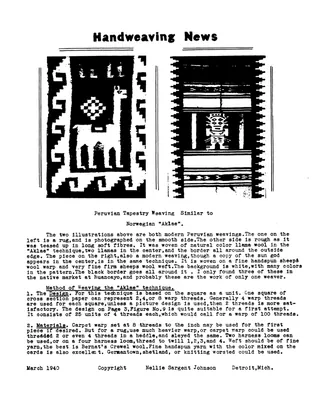
A three-page article from Handweaving News (March 1940) by Nellie Sargent Johnson giving instructions for the tapestry technique she calls "Aklae," which she links to modern Peruvian weavings she saw at Huancayo. It covers designing on squares, warp and weft materials, winding yarn bobbins, the pattern shed and interlocking shed, finishing off and adding weft colors, and changing design. Line diagrams illustrate each step, and a five-color sample design is included.
Late-Antique Tapestry Medallion
Article · 15 pages
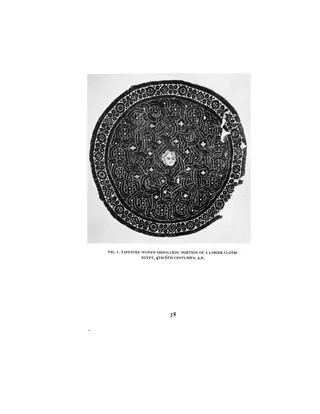
Vivi Sylwan describes a tapestry-woven medallion with a human head, found in Egypt and dated to the 4th-6th centuries, that has real gold thread woven into a linen and wool ground. She covers its construction (S- and Z-spun yarns, warp-strands, the method of weaving the medallion in stages with the main cloth, and the 'flying needle' technique), its design, and its probable Hellenistic-Egyptian origin. The second half is a history of gold thread. It draws on classical and biblical sources, compares gilt membrane thread (aurum filatum) with real gold strip thread (aurum tractitium), and discusses Byzantine, Cyprian, Syrian and Chinese practice. It ends with a bibliography and notes. The article was translated by R. J. Charleston from a 1932 Swedish museum yearbook.
Manufacture des Gobelins [The Gobelins Manufactory]
Ephemera · 5 pages · French
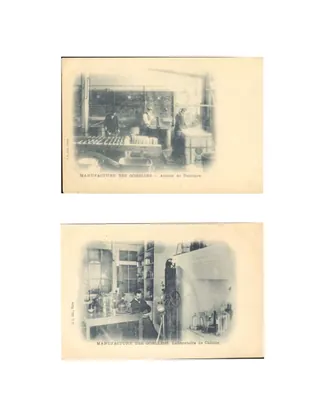
A set of early 20th-century sepia picture postcards of the Manufacture des Gobelins in Paris, the French national tapestry works. Views include the dye workshop, the chemistry laboratory, weavers at high-warp (haute-lisse) looms, a museum gallery hung with tapestries, the stone staircase, and the Bièvre river. The cards show workshop equipment and working conditions in tapestry production.
On Tapestry
Article · 2 pages
A short article by Lotus Stack, curator in the Textile Department of the Minneapolis Institute of Arts, on how medieval to pre-industrial European tapestries were produced. It covers the supply of wool, silk and metallic yarns, spinning, dyeing regulations, guild training and apprenticeship, task-based pay, and commissioned versus ready-made tapestries. It ends with a note on how mille-fleurs tapestries were assembled from small design elements, illustrated by a French tapestry of about 1520 in the museum's collection.
Scandinavian Art Weaving, Norwegian Lynildbordvevning or Lightning Weave
Article · 8 pages · weaving drafts
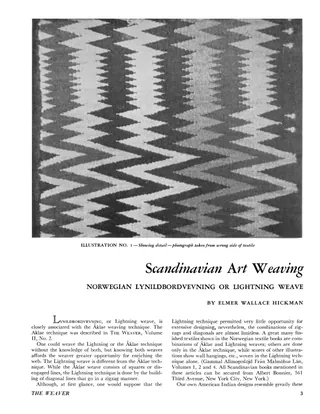
An instructional article by Elmer Wallace Hickman on Norwegian Lynildbordvevning (Lightning weave), a bobbin-woven tapestry technique that builds zigzag diagonals and is related to Åklae. It covers loom setup, yarns and warp, the sequence of interlocking and pattern sheds, and how to reverse the diagonal, add bobbins and drop bobbins. Three patterns are given (an experimental design, a nine-unit hanging and a more difficult colored design), with step diagrams and photographs taken from the wrong side of the textiles. Hickman also compares the technique to American Indian weaving and cites Scandinavian sources.
Scandinavian Art Weaving: Norwegian Åklae Technique
Article · 11 pages · weaving drafts
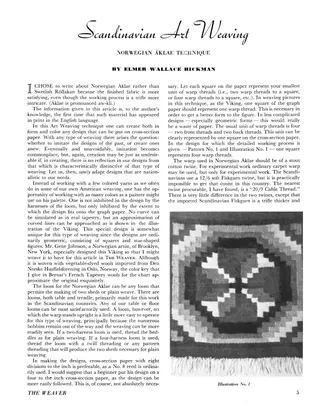
An instructional article by Elmer Wallace Hickman on Norwegian Åklae, a Scandinavian tapestry-like art weaving technique worked with many small hand-wound bobbins on a plain-weave (two-shed) warp. It covers loom, warp and weft choices, bobbin winding and tying, the Pattern and Interlocking sheds, how to advance or retreat design units, and tips for beginners. It gives step-by-step directions for weaving Pattern No. 1, plus charted patterns (including a Viking figure) with Bernat Peasant and French Tapestry wool color keys, and illustrations of finished pieces.
Society of Arts Lectures. Egyptian Tapestry
Article · 3 pages
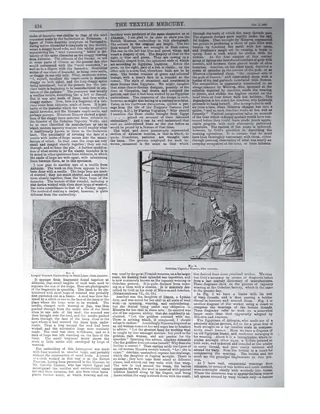
Part of a lecture by Alan S. Cole on Egyptian tapestry, printed in The Textile Mercury on 5 Oct 1889 as a continuation of an earlier instalment. It discusses textiles from the Akhmim graves in Upper Egypt: shaggy looped linens (the Greek kaunakes), looped worsted embroidery worked over small reeds, and tapestry weaving with bobbin and comb on linen warps. It follows the technique through Ovid's account of Minerva and Arachne, the Gobelins weavers and the Peruvian textiles of Ancon. The scan also includes surrounding trade news and textile market reports.
353 documents found