Textile Documents › Publications › Publication: Handweaver and Craftsman
29 documents found
Sort: 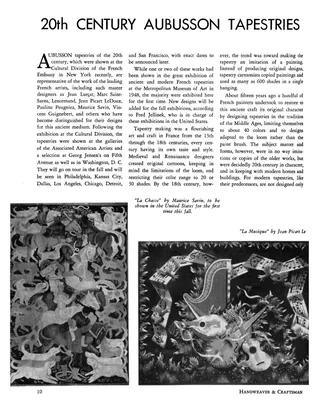
20th Century Aubusson Tapestries
Handweaver and Craftsman, May 1950
Article · 3 pages
Article on an exhibition of 20th-century Aubusson tapestries shown in New York and other US cities in 1950, featuring designs by Jean Lurçat, Marc Saint-Saens, Maurice Savin, Jean Picart Le Doux and others. It traces French tapestry from the medieval period to the return to loom-appropriate designs in the 1930s. It also describes how Aubusson tapestries are woven today on low-warp looms with a cartoon and mirror, compares Aubusson with Gobelin, and covers prices and government purchasing. Illustrated with photographs of tapestries and of the stages of production.
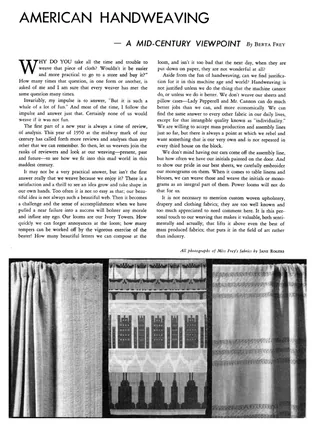
American Handweaving --- A Mid-Century Viewpoint
Article · 3 pages
Berta Frey's essay in the first issue of Handweaver and Craftsman reviews American handweaving at the midpoint of the twentieth century. She argues that handweaving is justified as art and individual expression rather than as production competing with machines, and she criticizes the pattern-collecting habits of the 1920s and 30s and the later swing to color and texture. She urges weavers to adapt traditional weaves such as overshot (Honeysuckle) and summer and winter to modern uses. An editorial note describes the accompanying photographs of her fabrics, including threadings, yarns, and commissions.
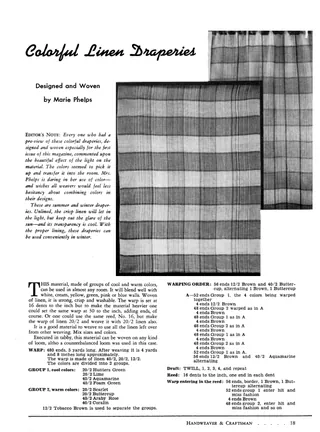
Colorful Linen Draperies
Article · 2 pages
A project article by Marie Phelps on linen draperies designed and woven for the first issue of Handweaver and Craftsman. It gives full instructions: warp colors and linen sizes, warping order, reed setting (16 dents per inch), a twill threading woven as tabby, weft color sequence, finishing, and approximate yarn quantities. The editor's note describes the cool and warm color groups and the way the draperies transmit light.
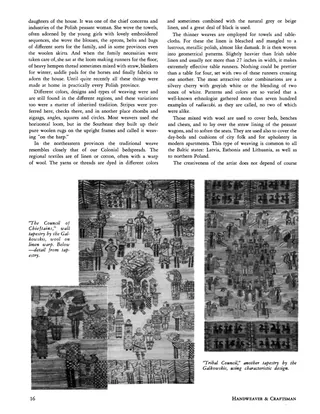
Contemporary Polish Weaving
Article · 5 pages
An article on twentieth-century revival of Polish traditional weaving, centered on the reversible double-warp wool rugs of the Bialystok peasant looms directed by Eleanora Plutynska and the kilim-style tapestries of Helena and Stefan Galkowski at the State Textile Institute Wanda. It covers the regional peasant textiles of Poland, the symbolism and technique of the rugs, the effects of World War II, and the philosophy of designing directly on the loom. Photographs show rugs, tapestries and a weaver at an upright loom.
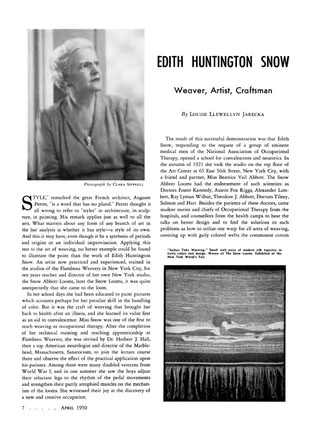
Edith Huntington Snow: Weaver, Artist, Craftsman
Article · 5 pages
A profile of New York weaver and teacher Edith Huntington Snow, written for the first issue of Handweaver & Craftsman. It traces her path from weaving as convalescent therapy to founding the Snow Abbott Looms, later the Snow Looms, and describes her teaching, her materials and her design philosophy. Most of the text describes her fine linen table sets, runners, lunch cloths and silk and wool fabrics, with notes on yarns, thread counts, colors and looms. The illustrations are photographs of her work and a line drawing of an Alaskan Eskimo boot design; there are no weaving drafts.
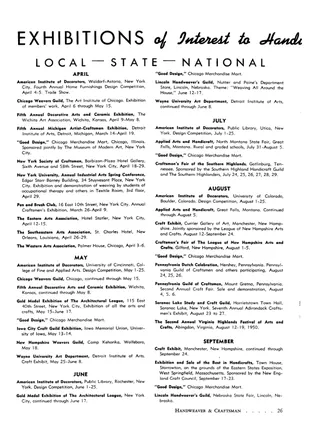
Exhibitions of Interest to Handweavers
Handweaver and Craftsman, April 1950
Article · 5 pages
A news section from the first issue of Handweaver and Craftsman (April 1950) listing craft and design exhibitions for April through September 1950, followed by short reports on current shows and events. Items include the "Good Design" exhibition in Chicago, a profile of the Anni Albers textile exhibition from the Museum of Modern Art, news from Dorothy Liebes' studio, handweaving demonstrations at the J. L. Hudson Company in Detroit, Texas craft exhibition awards, and the Southern Highland Handicraft Guild's Craftsmen's Fair at Gatlinburg. Photographs show fabrics by Liebes, Albers and Antoinette Webster, and weavers from Greenfield Village.
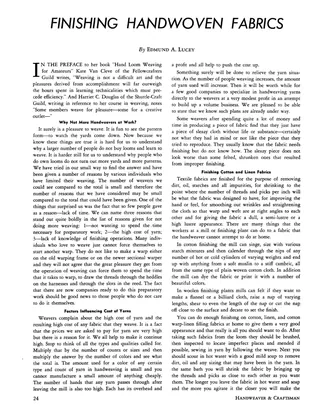
Finishing Handwoven Fabrics
Article · 3 pages
Article by Edmund A. Lucey on finishing handwoven cloth at home. It opens with reasons weavers give for weaving less (preparation time, yarn cost, lack of finishing knowledge), then explains the purposes of finishing and how it differs from mill finishing. It gives home procedures for cotton, linen, wool and worsted: brushing, mending, scouring, shrinking, bleaching, drying and pressing, and the start of a discussion of fulling. The scan includes the continuation pages with a closing portion of an unrelated essay on quality versus charity in handweaving and an advertisement for a braided rug book.
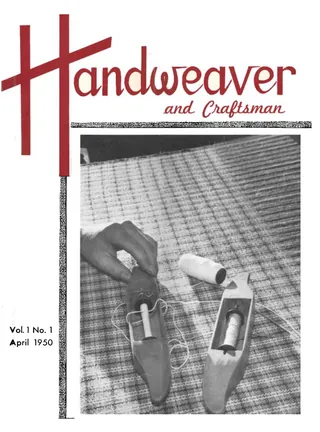
Handweaver and Craftsman, Vol. 1, No. 1 (April 1950)
Handweaver and Craftsman, April 1950
Periodical · 54 pages · weaving drafts
First issue of the quarterly Handweaver and Craftsman (April 1950), a magazine for home and professional weavers, designers, teachers and therapists. It carries feature articles on American handweaving at mid-century (Berta Frey), the weaver Edith Huntington Snow, handweaving in the South, Old Sturbridge Village, Virginia City and the Shuttle-Craft Guild, a weaving school in Finland, and the Seattle Weavers' Guild. Regular sections cover summer workshops and classes, exhibitions, the A.I.D. design competition, guild notes, people, and book reviews. Marie Phelps's summer and winter linen draperies are given with weaving specifications, and a lace tablecloth pattern for Lily yarn is also included.
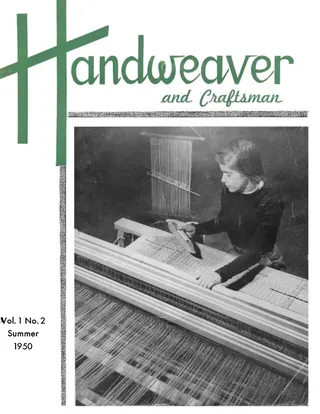
Handweaver and Craftsman, Vol. 1, No. 2 (Summer 1950)
Handweaver and Craftsman, Summer 1950
Periodical · 64 pages · weaving drafts
Second issue of the quarterly Handweaver and Craftsman (Summer 1950), a general magazine for handweavers and craftsmen. It includes articles on the Society of Arts and Crafts of Boston, texture in woven cloth, 20th-century Aubusson tapestries, Polish weaving (Bialystok rugs and Galkowski tapestries), kitchen textiles, choosing yarns, finishing handwoven fabrics, selling handweaving, and a New Hampshire woolen mill. It also covers Greek spinners and weavers, exhibitions and fairs, workshops and classes, guild news, a bookshelf of book listings, and many period advertisements. Two pages carry weaving drafts, for tweed fabrics and a towel and baby bib border.
A Handweaver's Hobby
Handweaver and Craftsman, April 1950
Article · 1 page
A short profile of Robert F. Heartz of Epping, New Hampshire, a weaver who began in New England textile mills and later became a professional handweaver and collector of textiles and weaving books. It recounts his mill and occupational therapy background and anecdotes of bargain finds, including an Oltinean carpet, a possible Bayeta saddle blanket, and rare books on dyeing, weaving, and Swedish textiles. It ends with his decision to start a lending library.
Handweaving in the South Today
Article · 2 pages
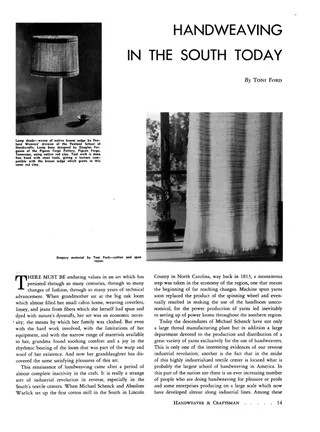
A short overview essay on the revival of handweaving in the American South around 1950. It traces the move from household weaving to mill production, beginning with the first southern cotton mill in 1813, and then to a modern craft movement. It mentions schools and producers such as Penland, Black Mountain College, the Southern Highland Handicraft Guild, Biltmore Industries and Churchill's of Kentucky. Photographs show a broom sedge lamp shade, drapery fabric and place mats woven from broom sedge and wood strips.
International Textile Exhibition 1950
Handweaver and Craftsman, April 1950
Article · 1 page
A short announcement of the 1950 International Textile Exhibition, held November 1-30, 1950 at The Woman's College of the University of North Carolina in Greensboro. It gives entry and exhibit deadlines, the classifications, eligibility rules, prize amounts and the jury members. It also lists the winners and jury of the 1949 show.
Old Sturbridge Village
Handweaver and Craftsman, April 1950
Article · 3 pages
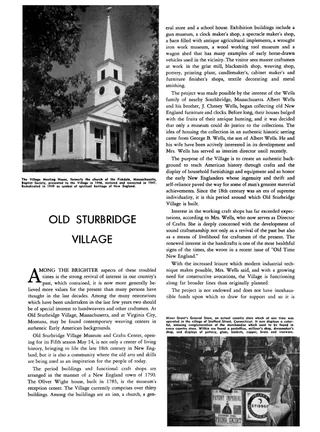
A 1950 article describing Old Sturbridge Village, a living-history museum and crafts center in Massachusetts arranged as a New England town of about 1790. It covers the Village's history and the Wells family who founded it, its craft shops (including the weaving shop), and the effort to make each shop self-supporting. The weaving section describes the two full-time weavers, the products made (luncheon sets, mats, drapery, upholstery, rugs, blankets, apparel fabrics), and a twill drapery fabric, with photographs of the weave shop, place mats and upholstery fabric.
On Textures - Notes of a Contemporary Weaver
Article · 4 pages
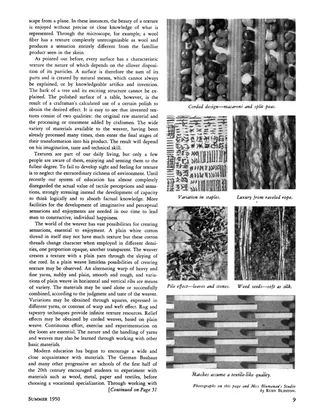
Essay by Lili Blumenau on the role of texture in handweaving and cloth design. She cites Peruvian leno, Coptic tapestry and medieval weavers, and argues that weavers should train their perception of texture through plain weave variations, yarn density and sleying, corded weaves and experiments with materials such as peas, matches and macaroni. She also stresses Bauhaus-style material education. The scan includes photographs of her studio and texture studies, plus pages of loom-buying advice and advertisements, and the end of an article on Greek spinners and weavers.
The Peripatetic Weaver
Article · 4 pages
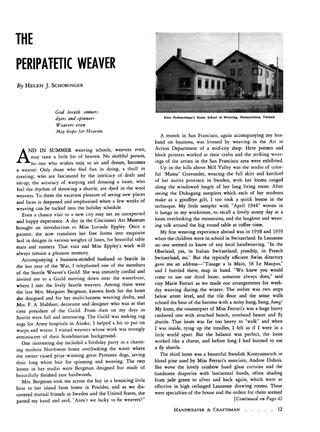
A first-person travel essay by Helen J. Schobinger recounting weaving schools, studios and guilds she visited in the United States and Europe between about 1938 and 1950. Stops include Seattle, San Francisco, Lausanne, Säterglantan in Sweden, Hämeenlinna and Helsinki in Finland, and the Cranbrook summer school in Michigan. It describes teachers, looms, techniques taught and the daily routine of the schools, and closes by encouraging weavers to take summer weaving courses.
Plymouth Colony Farms
Handweaver and Craftsman, April 1950
Article · 2 pages
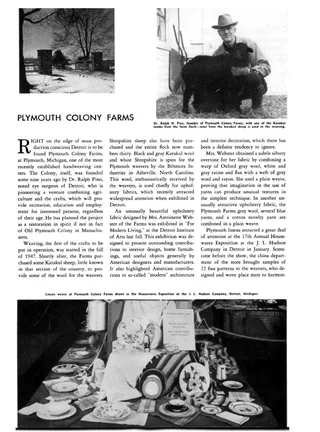
A short article from the first issue of Handweaver and Craftsman describing Plymouth Colony Farms in Plymouth, Michigan, a handweaving center founded by Detroit eye surgeon Dr. Ralph Pino. It covers the farm's Karakul and Shropshire sheep, wool spun by Biltmore Industries, upholstery fabrics (including a plain weave design by Antoinette Webster shown at the Detroit Institute of Arts), and place mats and linens woven for a J. L. Hudson Company exhibition. It also notes the shop's custom orders and the individual-instruction weaving school.
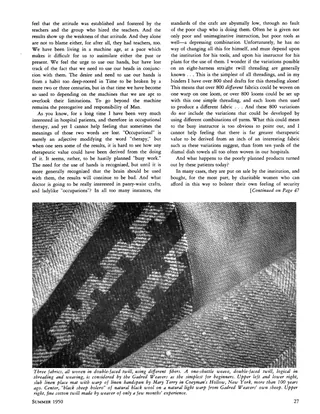
Quality of Charity - On What Basis Should Weaving be Offered for Sale
Handweaver and Craftsman, May 1950
Article · 3 pages
An essay by the Gadred Weavers of New Scotland, New York, framed as an exchange of letters between "McGad" and "Chase". It criticizes handwoven goods sold at charity and craft sales for poor quality, such as unwashed fabrics and routine overshot patterns, and blames weak teaching and low standards, including in hospital occupational therapy. It argues for better planning, knowledge of tools, materials and history, and for selling on quality rather than charity. A photograph shows three double-faced twill fabrics, and the pages end with the start of a section on finishing, fulling and scouring handwoven fabrics, plus an advertisement for a braided rug book.
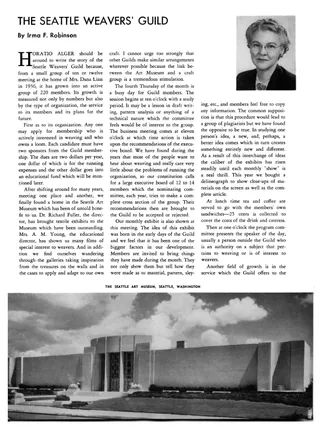
The Seattle Weavers Guild
Article · 2 pages
A 1950 article by Irma F. Robinson describing the Seattle Weavers' Guild, which grew from ten or twelve members in 1936 to 220. It covers membership rules and dues, the guild's home at the Seattle Art Museum, monthly meetings with study periods, member exhibits and speakers, a lending library, study groups with rented folding looms, a summer school taught by Victoria Strand, the educational fund and annual sale, and a juried museum exhibit. The scan also includes the start of a news item on the Hand Weavers' Guild of Connecticut.
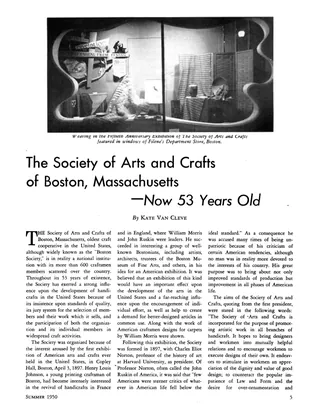
The Society of Arts and Crafts of Boston, Massachusetts -- Now 53 Years Old
Article · 5 pages
Article tracing the history of the Society of Arts and Crafts of Boston, the oldest American craft cooperative, from its founding after the 1897 Copley Hall exhibition through 1950. It covers the jury system, craftsman/master/medalist ranks (including weaving requirements for master craftsman), major exhibitions, the Newbury Street salesroom, and director Humphrey Emery's comments on trends in handweaving and the craftsman's role. Photographs show handwoven linens, scarfs and ties, silver, and showrooms; page 1 carries captions for two drapery fabrics, and the last page has a short note on the Contemporary Hand Weavers of Texas.
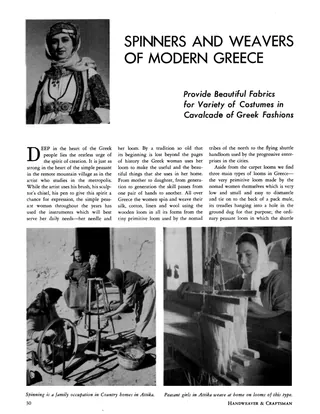
Spinners and Weavers of Modern Greece
Handweaver and Craftsman, May 1950
Article · 5 pages
An article on hand spinning and weaving in Greece around 1950, describing the three main loom types (nomad, peasant, and flying-shuttle handlooms), the fibers used (silk, cotton, linen, wool, goat hair), regional specialties, and the economic role of the home loom. The second half covers the Cavalcade of Greek Fashions shown in New York, in which handwoven Greek fabrics were made into modern and historic-style costumes, and profiles weaving firms such as Karastamati, Caloutsi and Richardson/Topoglides. Illustrated with photographs of spinners, looms and costumes.
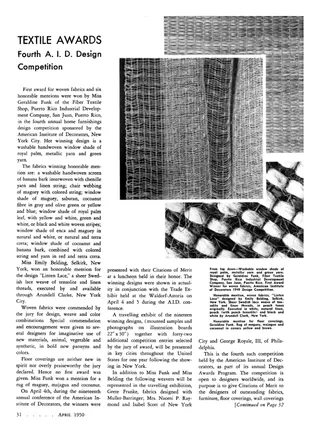
Textile Awards: Fourth A. I. D. Design Competition
Handweaver and Craftsman, April 1950
Article · 3 pages
Report from the first issue of Handweaver and Craftsman on the fourth American Institute of Decorators design competition, in which Geraldine Funk of Puerto Rico won first award for woven fabrics with a palm window shade. It lists honorable mentions, the jury, and the traveling exhibit. Shorter news items follow on weaver Floyd La Vigne's one-man show, Sigvard Bernadotte's rugs, a Philadelphia Art Alliance exhibition, and the Virginia Highlands Festival. Photographs show winning fabrics, a Polish tapestry, a twill plaid, and a crackle afghan.
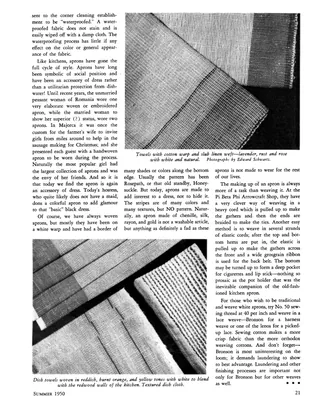
Weave for your Kitchen
Article · 3 pages
Berta Frey's article encourages beginning weavers to learn technique by weaving useful kitchen items, starting with a dozen dish towels. It gives a practice warp recipe (bedspread cotton alternating with 20/3 colored crochet cotton, sleyed at 20 ends per inch, 8/1 slub linen weft, set in Rosepath) and advice on fibers for absorbency. It also covers place mats made from unusual materials and fashionable aprons, including lace-weave aprons in Bronson or leno and ways to finish the gathers and ties. Photographs show a kitchen, aprons, and towels.
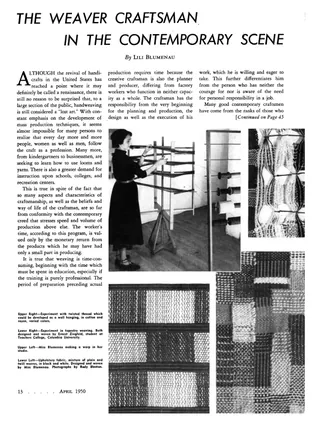
The Weaver Craftsman in the Contemporary Scene
Article · 3 pages
An essay on the place of the handweaver as a craftsman in mid-twentieth-century America. Blumenau discusses the revival of handicrafts, the craftsman's responsibility for both design and execution, and the contrast with mass production. She sets out the weaver's basic principles: studying yarns and fibers, mastering plain, twill and satin weaves, and working with color. She argues for combined artistic and technical training and against copying historical patterns. Photographs show student and instructor work, including a tapestry experiment, a twisted-thread wall hanging and an upholstery fabric.
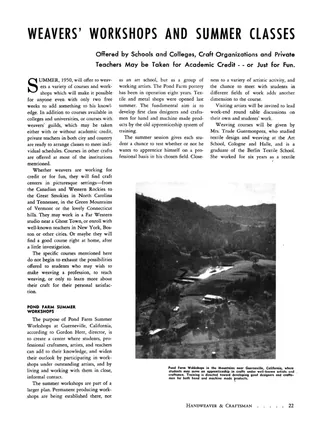
Weavers' Workshops and Summer Classes
Handweaver and Craftsman, April 1950
Article · 5 pages
An article from the first issue of Handweaver and Craftsman surveying weaving workshops and summer courses available in 1950 at schools, colleges, craft centers and with private teachers. It describes programs at Pond Farm, Penland, New York University, Fletcher Farm, Teachers College, Utah State and the University of British Columbia (Mary Atwater), Taxco, Gatlinburg, Berea, Banff, Black Mountain and others. Entries give dates, instructors, course content and addresses for enrollment. Two photographs show Pond Farm Workshops and the Lily Loom House and Lucy Morgan at Penland.
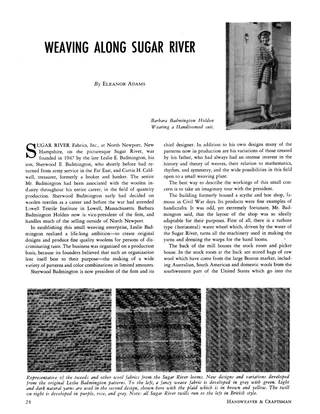
Weaving Along Sugar River
Article · 2 pages
An illustrated article profiling Sugar River Fabrics, Inc., a small woolen weaving business in North Newport, New Hampshire, founded in 1947 in a former scythe and hoe shop. It follows the production process from raw wool blending, carding and spinning on the mule through warping, drawing-in and weaving on wide hand-operated throw-shuttle looms with up to twelve harnesses. It also covers the finished tweeds and twills, their weights and markets, and the sale of natural undyed yarns to handweavers.
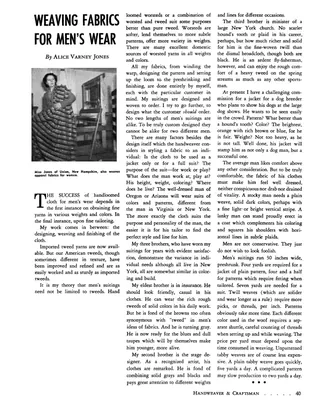
Weaving Fabrics for Men's Wear
Article · 1 page
A first-person article by a New Hampshire handweaver on designing and weaving custom suiting fabrics for men. She discusses yarn sources (American and imported tweeds, worsteds), tailoring each length to the customer's build, coloring, occupation and location, and gives examples from her brothers and a dog breeder's jacket. It closes with practical notes on cloth width, yardage for jackets and suits, twill versus tabby, and production rates and pricing.
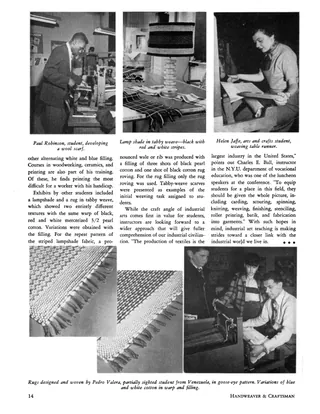
Weaving has Part in New York University's Annual Spring Conference on Industrial Arts
Article · 2 pages
Report on the Annual Industrial-Arts Spring Conference held April 28-29, 1950 at New York University School of Education, with emphasis on handweaving in occupational therapy. It describes the exhibits: silk-screened textiles, a hospital-style wall hanging, and student work including goose-eye rugs by a partially sighted Venezuelan student, a tabby-weave lampshade and rug in pearl cotton and rug roving, and tabby scarves as beginner projects. It closes with remarks on broadening industrial arts teaching to cover the whole textile industry.
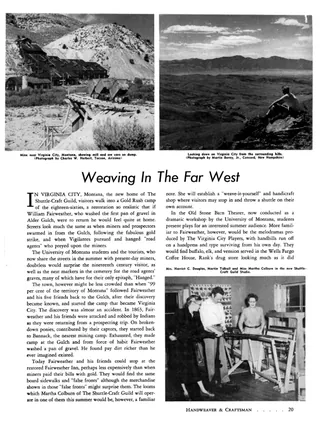
Weaving in the Far West
Handweaver and Craftsman, April 1950
Article · 3 pages
An article from the first issue of Handweaver & Craftsman describing the move of The Shuttle-Craft Guild to restored Gold Rush-era Virginia City, Montana. It covers the town's history and restoration by Charles Bovey, the Guild's history from Mary Atwater to Harriet Douglas, and the new log studio with twenty looms. It also gives details of summer courses, beginner classes, university credit and veterans' training, and includes photographs of the town and Guild fabrics.
What Kinds of Yarns for Handweaving? More than One Might Think
Article · 4 pages
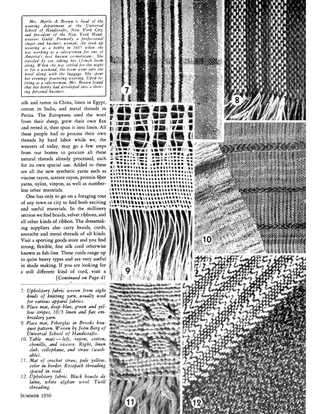
Article by Myrtle A. Brown, head of weaving at the Universal School of Handicrafts, on the wide range of materials handweavers can use as yarns, including unconventional ones sourced from millinery, sporting goods, twine and lumber suppliers. It surveys fibers by origin (vegetable, animal, mineral, synthetic) and gives practical remarks on knitting wools, crochet cottons, embroidery flax, straw, nylon cord, silk, ribbons, plastics and Fiberglas, with finishing advice. Twelve photographs of sample textiles are captioned with materials and threadings, and the scan also includes a page of tweed fabric captions, advertisements and 'Personal Mention' profiles.
29 documents found