Textile Documents › Authors › Author: Lili Blumenau
3 documents found
Sort: 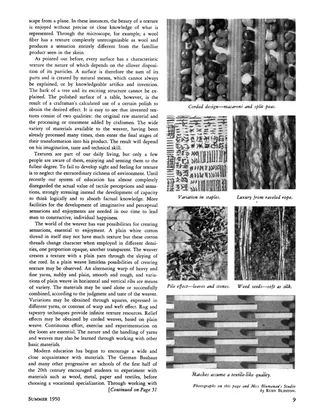
On Textures - Notes of a Contemporary Weaver
Article · 4 pages
Essay by Lili Blumenau on the role of texture in handweaving and cloth design. She cites Peruvian leno, Coptic tapestry and medieval weavers, and argues that weavers should train their perception of texture through plain weave variations, yarn density and sleying, corded weaves and experiments with materials such as peas, matches and macaroni. She also stresses Bauhaus-style material education. The scan includes photographs of her studio and texture studies, plus pages of loom-buying advice and advertisements, and the end of an article on Greek spinners and weavers.
Practical Weaving Suggestions, Vol. 1-59 (1959): Samples of Yarn Weave and Color
Periodical · 8 pages
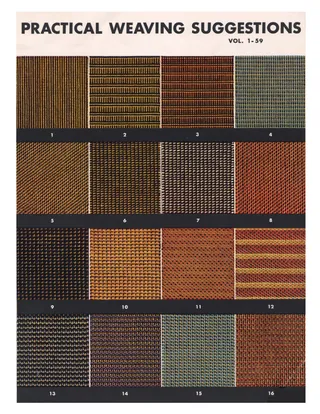
A Lily Mills leaflet in the Practical Weaving Suggestions series, with sixteen sample swatches designed by Lili Blumenau. The opening sections discuss yarn qualities, weave structure and color interaction. Sixteen samples follow, all woven on one gold and black alternating warp (15 ends per inch, 120 ends, four-shaft straight threading, direct tie-up), grouped as tabby, even-sided twill, weft twill and mixed basket/plain weaves. Each sample lists its weft yarn sequence, Lily Mills article numbers and colors, and shaft order, with brief design comments. No weaving drafts are shown; swatch photographs illustrate the samples.
The Weaver Craftsman in the Contemporary Scene
Article · 3 pages
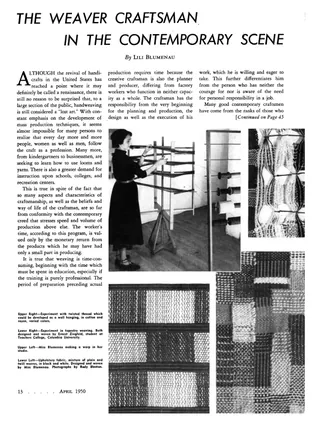
An essay on the place of the handweaver as a craftsman in mid-twentieth-century America. Blumenau discusses the revival of handicrafts, the craftsman's responsibility for both design and execution, and the contrast with mass production. She sets out the weaver's basic principles: studying yarns and fibers, mastering plain, twill and satin weaves, and working with color. She argues for combined artistic and technical training and against copying historical patterns. Photographs show student and instructor work, including a tapestry experiment, a twisted-thread wall hanging and an upholstery fabric.