Textile Documents › Topic: Hand spinning
274 documents found
Sort: 
Draw Mechanisms, Part 1
Article · 1 page
A one-page article on how spinning wheels draw yarn onto the bobbin, the first of a series. It names three basic draw mechanisms (double band, Scotch tension, and "Indian head" tension) and explains the double-banded system in detail: the figure-8 drive band, bobbin and flyer pulleys, pulley size ratio, drive cord tension and the screw tension control on antique wheels. Diagrams show the drive band, pulleys, flyer assembly and the direction of flyer movement on castle and saxony wheels. Scotch tension and Indian head systems are left for the next installment.
Draw Mechanisms, Part 2
Article · 1 page
Second part of a series on spinning wheel draw mechanisms from the column 'As the Wheel Turns.' It explains scotch tension (driven flyer, as on the Ashford wheel) and indian head tension (driven bobbin, used on bulk spinners), and contrasts both with the double-banded draw. A short question-and-answer section by Glaski lists the advantages of driven bobbin wheels, including strong draw, very low twist yarns, fewer critical parts and easier tension adjustment.
Lace Valentine
c. 1906
Illustration · 1 page
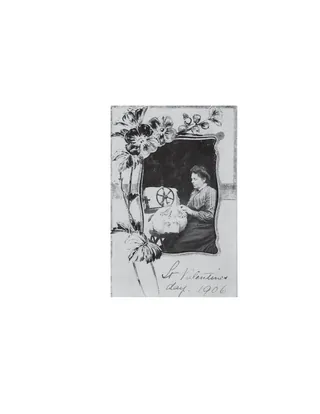
A single-page Valentine's Day postcard-style illustration dated 1906. A floral border of flowers and leaves frames a black-and-white photograph of a woman in a striped blouse and dark skirt seated at a spinning wheel. The only text is a handwritten greeting, 'To Valentine's day. 1906'.
Missionary's Wife
Illustration · 1 page
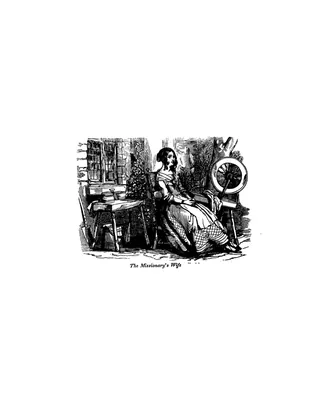
A single engraved illustration titled "The Missionary's Wife," showing a woman seated at a spinning wheel beside a window. A table with a jug and a basket stands nearby, with plants and foliage in the background. The only text is the caption.
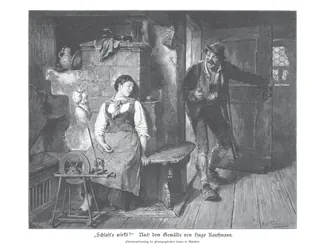
"Schlaft's wirkli?" ["Is She Really Sleeping?"]
Illustration · 1 page · German
A single printed engraving of a dim farmhouse interior showing a young woman in a dirndl-style bodice and apron asleep beside a spinning wheel, with a tiled stove and a jug behind her and a man also in the scene. The caption credits it as a reproduction of a painting by Hugo Kauffmann, issued by the Photographische Union in Munich. It is useful as a genre-scene depiction of a spinning wheel in a rural German household.
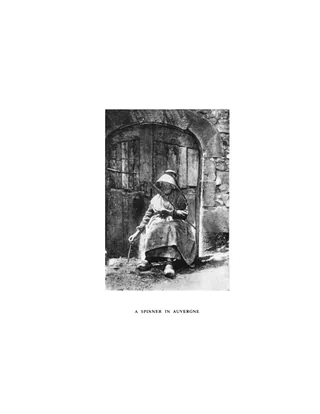
A Spinner in Auvergne
Illustration · 1 page
A single-page halftone photograph of a woman spinning outdoors in Auvergne, France. She wears a headscarf and apron and works with a distaff and spindle beside a stone building with a doorway. The only text is the caption "A Spinner in Auvergne."
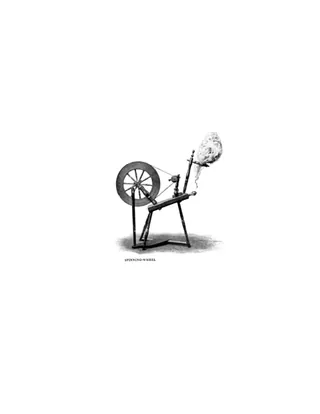
Spinning Wheel
The Connoisseur, 1905
Illustration · 1 page
A single-page illustration of a treadle spinning wheel, reproduced from The Connoisseur, vol. 11 (1905). The line drawing shows a large spoked wheel on an upright support, a drive cord running to the spindle assembly, a bobbin and flyer arm, and a distaff holding fiber. The only text is the caption 'Spinning Wheel'.
Spinning wheel drive types
Article · 1 page
A one-page article by Anthony Glaski comparing the three spinning wheel drive types: Driven-Flyer, Driven-Bobbin, and Driven-Bobbin-Flyer (double drive). Using an imagined adjustable Ashford wheel, it explains how each drive affects tension adjustment, pull on the yarn, and the range of yarns that can be spun, from fine and uniform to thick and textured. The page also carries a short news item on the Yarnery Warehouse, a yarn outlet in St. Paul, Minnesota.
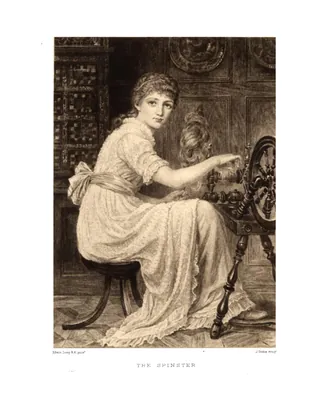
The Spinster
Magazine of Art, 1893
Illustration · 1 page
A single-page black-and-white engraving titled "The Spinster," reproduced from the Magazine of Art. It shows a seated woman in a flowing robe turning her head to one side, with fabric draped across her lap and the floor. The plate is credited to Edwin Long, R.A., as painter and J. Dobie as engraver. There is no accompanying article text.
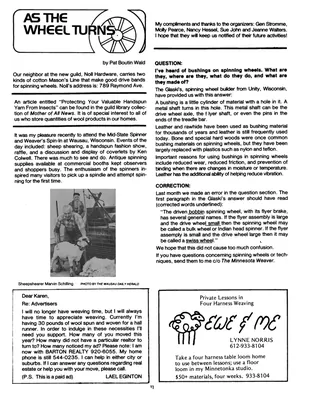
Bushings
Article · 1 page
A single-page "As the Wheel Turns" spinning column from the Minnesota Weaver. It answers a reader's question about spinning wheel bushings: what they are, where they sit on the wheel (drive wheel axle, flyer shaft, treadle bar pins), and what they are made of (leather, rawhide, bone, hard woods, nylon, teflon). It also includes a correction to the previous month's answer on bulk and Swiss wheels, a tip on cotton Mason's Line for drive bands, and a report on a Wausau, Wisconsin spin-in.
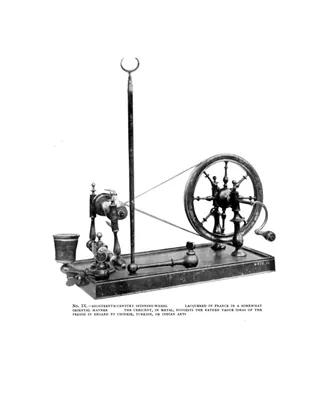
Eighteenth Century Spinning Wheel
The Connoisseur, 1916
Illustration · 1 page
A single page with a black-and-white photograph of an eighteenth-century spinning wheel, lacquered in France in a somewhat oriental style. The caption notes that the metal crescent finial reflects the period's vague ideas about Chinese, Turkish, or Indian arts. It appears to be one plate from a numbered series in The Connoisseur.
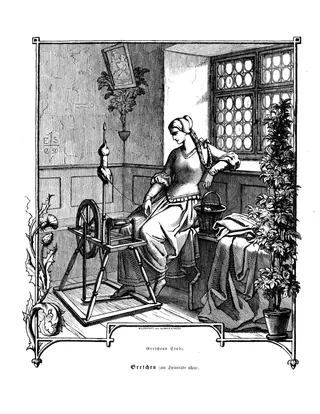
Gretchen's Stube [Gretchen's Chamber]
1850
Illustration · 1 page · German
A single wood-engraved illustration showing Gretchen, the character from Goethe's Faust, seated alone at her spinning wheel in her room. The scene includes a leaded-glass window, a basket of wool or yarn, a potted plant, and a rose-vine border. It is a visual source for the spinning wheel and domestic spinning in mid-19th-century German imagery.
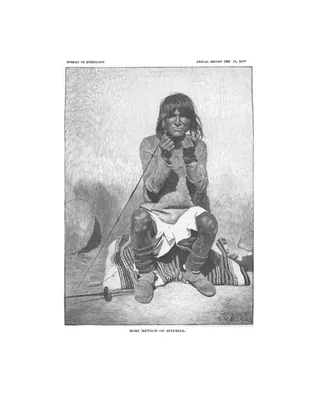
Moki Method of Spinning
Illustration · 1 page
A single plate showing a seated woman spinning fiber with a drop spindle, captioned as the Moki (Hopi) method of spinning. A basket and bundles of fiber or yarn sit beside her. It is Plate XLIV from a Bureau of Ethnology annual report and has no accompanying text.
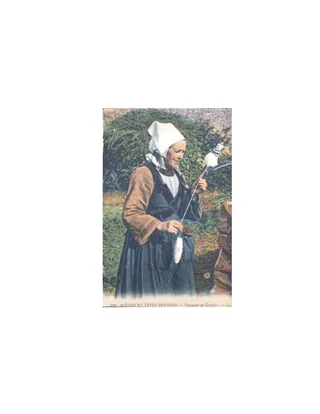
Paysanne de Concarneau [Peasant Woman of Concarneau]
Ephemera · 1 page · French
A hand-colored photographic picture postcard from the series Moeurs et Types Bretons, showing a peasant woman of Concarneau, Brittany, spinning with a distaff. She wears a white coiffe, dark blue dress and brown shawl and is posed in a garden. The caption reads "Paysanne de Concarneau".
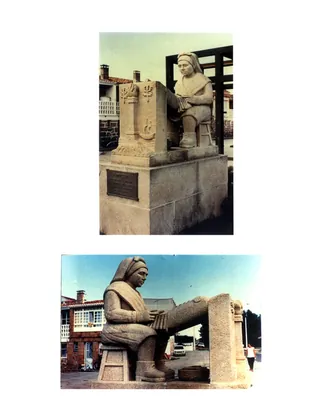
Photographs
Ephemera · 1 page
A single page of two photographs showing a stone sculpture of a seated woman wearing a headscarf and shawl. She appears to be spinning or handling a distaff or bundle of yarn, and sits on a stool beside a tall stone block carved with ornamental designs. No legible text accompanies the images.
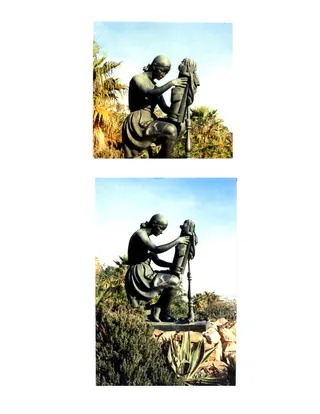
Photographs
Ephemera · 2 pages
Two pages of color photographs showing a bronze sculpture of a seated woman spinning or working at a distaff, spindle frame, or loom. The first page shows the statue in a garden with palm trees and agave plants, and the second shows it in front of a yellow multi-story building with a snack bar sign. There is no readable text.
Picture postcard
Ephemera · 1 page
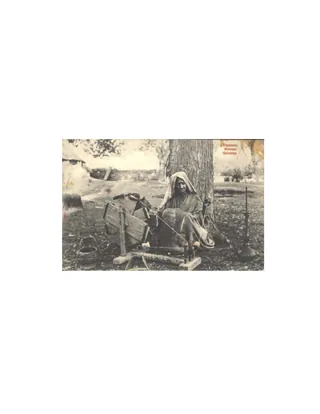
A single picture postcard titled "Kashmiri Woman Spinning." It shows a sepia photograph of a seated woman in a head covering spinning yarn at a wooden spinning wheel beside a large tree trunk. A basket, a tall wooden post, and thatched or mud dwellings appear nearby. The only text is the printed caption.
Spinner
Illustration · 1 page
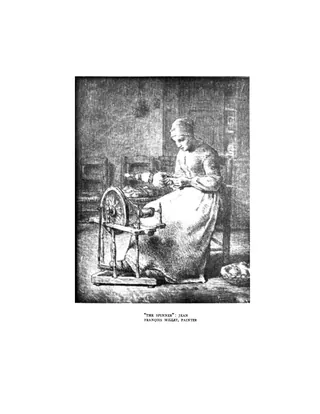
A single-page halftone reproduction of Jean-François Millet's painting "The Spinner," showing a woman seated at a spinning wheel in a dim interior. A distaff holding fiber stands at the left, with a basket at lower right and a wooden chair behind her. The page carries only a short printed caption naming the work and the painter.
Spinning Wheel
Zell's Encyclopedia, 1876
Article · 1 page
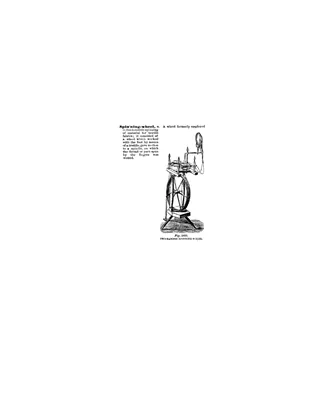
A short encyclopedia entry defining the spinning wheel as a domestic tool for spinning textile fibers, driven by a foot treadle that turns a spindle on which the hand-spun thread is wound. It includes an engraving of a two-handed spinning wheel on a stand, showing the large wheel, spindles, and drive band.
Ancient History of the Spinning Wheel
Article · 3 pages
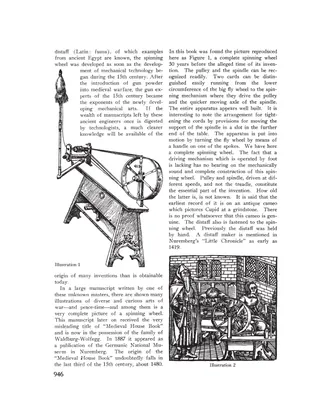
A short historical article by F. M. Feldhaus examining the claim that a Brunswick wood carver named Juergen invented the spinning wheel in 1530. Feldhaus traces the claim to a 1722 chronicle and argues against it, citing a complete spinning wheel drawn in the c. 1480 "Medieval House Book" and drawings by Leonardo da Vinci. The article is illustrated with five woodcuts and line drawings of early spinning wheels and spinning scenes.
As the Wheel Turns
Article · 1 page
A one-page spinning column from Minnesota Weaver. It lists sources for people interested in raising sheep, including the Black Sheep Newsletter and the Pipestone Home Sheep Study Course. It then gives two answers from wheel builder Tony Glaski: why an antique flax wheel should not be modified to spin thick wool yarn, and how to sand and finish a spinning wheel kit with Hope's pure tung oil.
As the Wheel Turns
Article · 1 page
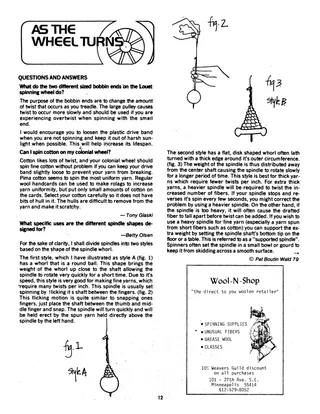
A one-page question-and-answer column on spinning from Minnesota Weaver. It covers the two bobbin pulley sizes on a Louet wheel and care of the drive band, spinning cotton on a colonial wheel, and how spindle whorl shape (round ball versus flat disk) suits fine or thick yarns. Three small figures illustrate the spindle styles and the flicking motion used to start a spindle.
Method of Causing the Bobbin of the Common Spinning-Wheel to Move Backward and Forward
Article · 5 pages
An 18th-century article describing John Antis's improvement to the common spinning wheel, which moves the bobbin backward and forward so the thread need not be shifted between staples on the flyer. It reproduces his introductory letters and a mechanical description of the gearing: a pinion on the great wheel axle, a 97-tooth wheel, an oblique wire ring, a lever, a sliding bar and a weight. An engraved plate with lettered parts accompanies it. The invention won a premium of twenty guineas from the Society for the Encouragement of Arts, Manufactures, and Commerce.
Picture postcards
Ephemera · 10 pages
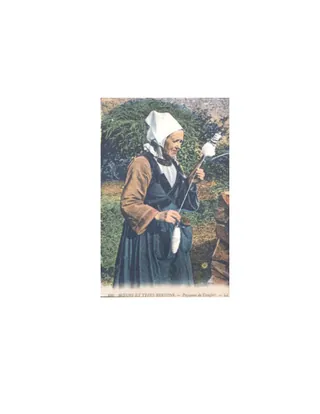
A set of scanned picture postcards showing women spinning with distaffs, drop spindles and spinning wheels. Examples come from Brittany, Flanders, Romania, Ireland (including Donegal), Quebec, Madeira, Greece, the Azores and Mozambique. Captions are in French, English, Portuguese and Greek, and the images include hand-colored and sepia photographs and a woodcut-style engraving.
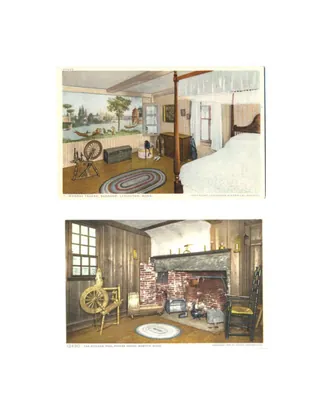
Picture postcards
Ephemera · 6 pages
A set of picture postcards, shown two per page over six scanned pages, depicting historic interiors that include spinning wheels. Locations include Munroe Tavern, Paul Revere House, the House of Seven Gables attic, Martha Washington's spinning room at Mount Vernon, Plas Newydd, Kelmscott Manor, Aberconwy, the Adelina Patti House, Dalarna in Sweden, and the Fairbanks House in Dedham. One card shows a sepia photograph of a Donegal spinner at her wheel, with a handwritten message on the card.
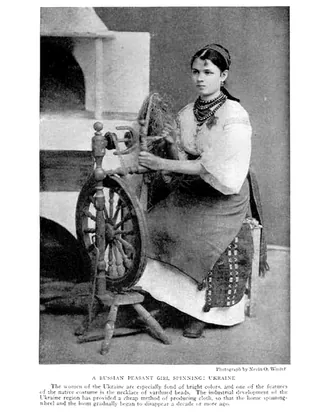
Russian Peasant Girl Spinning
National Geographic, August 1918
Illustration · 1 page
A single-page National Geographic illustration with a photograph by Nevin O. Winter of a young Ukrainian woman in traditional dress and a multi-strand bead necklace, seated at a wooden spinning wheel beside a stove. The caption notes the women's fondness for bright colors and says that industrial cloth production had led to the decline of home spinning wheels and looms in the Ukraine region.
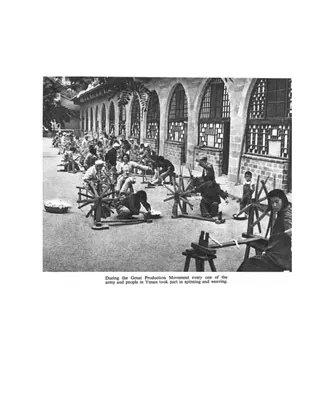
[Spinning and Weaving]
China Pictorial, 1976
Illustration · 1 page
A single page from China Pictorial (1976, No. 1) with a black-and-white photograph of people spinning thread on wooden spinning wheels in a courtyard with arched, lattice-paned windows. The caption says that during the Great Production Movement, soldiers and civilians in Yenan all took part in spinning and weaving. It is a historical illustration of hand spinning, not a technical document.
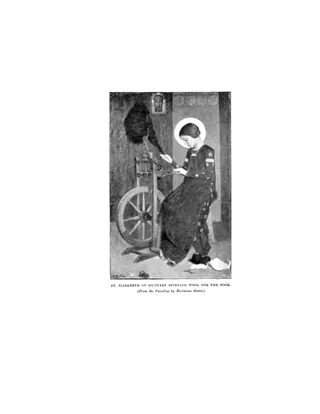
St. Elizabeth of Hungary Spinning Wool for the Poor
Illustration · 1 page
A single-page halftone reproduction of a painting by Marianne Stokes showing St. Elizabeth of Hungary, haloed, seated at a spinning wheel and spinning wool for the poor. A bundle or basket of wool rests on the floor beside her. The page carries only the caption and the painter's credit.
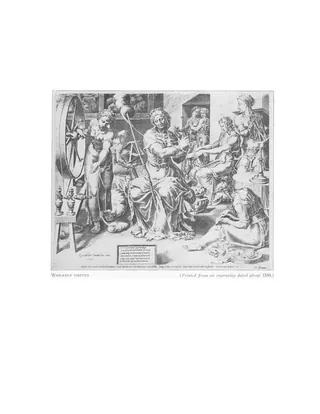
Womanly Virtues
c. 1550
Illustration · 1 page
A single-page reproduction of a mid-16th-century engraving titled "Womanly Virtues." It shows a domestic interior in which several women are spinning and doing needlework, including a large spinning wheel with a distaff on the left and a seated woman holding spun thread in the center. The only text is the title and a note that it was printed from an engraving dated about 1550.
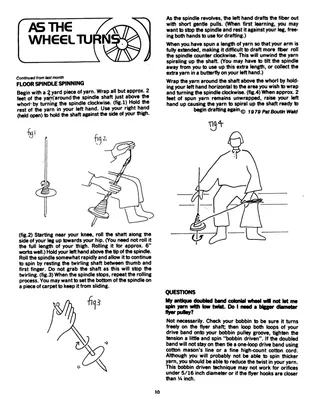
As the Wheel Turns
Article · 2 pages
Two pages from the Minnesota Weaver (May 1979) with Pat Boutin Wald's spinning column, continuing instructions for floor spindle spinning: winding on, rolling the shaft along the thigh, drafting, and unwinding. Reader Q&A on spinning wheels follows, covering low-twist spinning with a doubled drive band and freeing a binding bobbin by reaming it with a threaded rod. Page 2 also carries Connie Magoffin's 'From Woods & Fields' dyeing column, reporting wool dyed with avocado pits and peels, artichokes, tangelo and tangerine peels, and brass, plus an offer of Fred Gerber's book on cochineal.
As the Wheel Turns
Article · 1 page
A short column from Minnesota Weaver in which Pat Boutin Wald presents a guest piece by Wausau, Wisconsin spinner Sue John about her fear of new equipment ("neomechanophobia"), including her spinning wheel and a contramarche loom that takes months to warp. The page also announces a study manual on color and spinning for the Range fiber guild, and closes with a question-and-answer section by Tony Glaski on the best woods for spinning wheels and looms (black cherry, red oak, walnut).
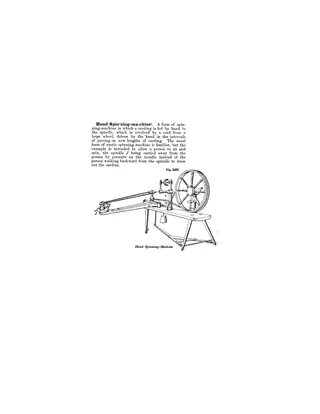
Hand Spinning-Machine
Article · 1 page
A short dictionary entry from Knight's American Mechanical Dictionary describing a hand spinning machine in which a carding (rolag) is fed by hand to a spindle turned by a cord from a large wheel. The entry explains that a treadle moves the spindle away from the seated spinner, replacing the usual practice of walking backward to draw out the carding. It includes one line drawing (Fig. 288) of the wheel, treadle base, weight and carding arm.
How to Be Owned by an Antique Spinning Wheel: Book review
Ralph E. Griswold · April 14, 2004
Web Doc · 2 pages
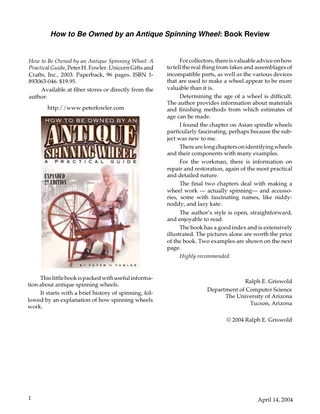
A short book review by Ralph E. Griswold of Peter H. Fowler's 'How to Be Owned by an Antique Spinning Wheel: A Practical Guide' (Unicorn Gifts and Crafts, 2003). It summarizes the book's contents: history of spinning, how wheels work, advice for collectors on spotting fakes and dating wheels, a chapter on Asian spindle wheels, identification, repair and restoration, spinning, and accessories. The second page reproduces two illustrations from the book, including a postcard-style image of a woman spinning from a distaff.
New Type of Spinning in North America
Article · 8 pages
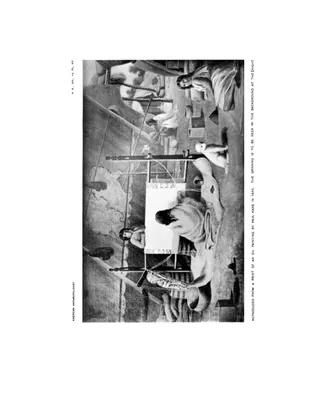
Article describing a previously unrecorded method of spindle spinning among the Cowichan and Thompson Salish peoples of British Columbia, using a very large spindle held in the hands and a tension ring or chair back to draft the roving. Kissell compares it with free-spindle and sustained-spindle spinning, Tlingit hand spinning, ancient Egyptian and Greek practices, and neighboring tribes, and argues it is the most elementary use of the spindle. Illustrated with a Paul Kane painting (1846) and a 1915 photograph taken at Musqueam.
Spinning
English Encyclopedia, 1867
Article · 1 page
A short encyclopedia entry defining spinning as two distinct manufacturing operations: spinning of animal and vegetable fibres into thread, and spinning of soft metals. It describes fibre spinning as forming a continuous uniform thread from aligned fibres by twisting. It contrasts the spindle, distaff and spinning-wheel, which produce a single thread, with cotton spinning machinery that can produce nearly two thousand threads at once. It refers readers to other entries on cotton, linen, silk, and woollen and worsted manufacture.
Spinning
Article · 1 page
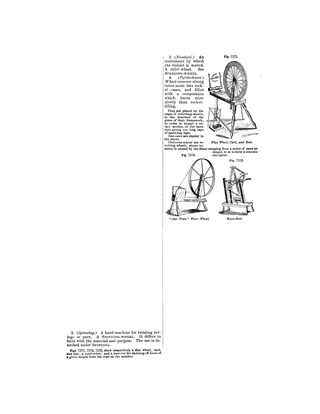
A single page from Knight's American Mechanical Dictionary showing three illustrations of hand-spinning equipment: a flax wheel with card and reel, an 'Old-Time' wool-wheel, and a knot-reel. The text defines the spinning sense of 'wheel' as a hand-machine for twisting rovings or yarn and refers readers to the entry SPINNING. The page also carries the end of the entry on wheels in other senses (nautical tiller-wheel, pyrotechnic wheel-cases and Catherine-wheels).
Spinning Wheel
Article · 1 page
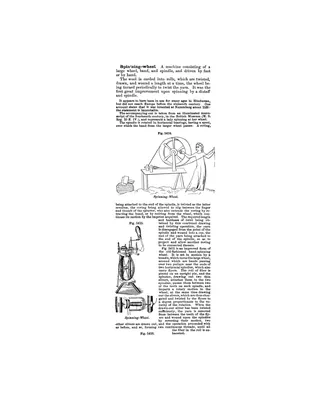
A one-page dictionary entry on the spinning wheel from Knight's American Mechanical Dictionary. It describes how the wheel works for spinning wool rolls, notes its likely origin in Hindustan and its arrival in Europe by the sixteenth century, and explains the drawing and twisting action. It also describes an improved treadle-driven double-spindle wheel with flyers. Illustrated with engravings, including one taken from a fourteenth-century manuscript.
Spinning Wheels of 1776
Illustration · 1 page
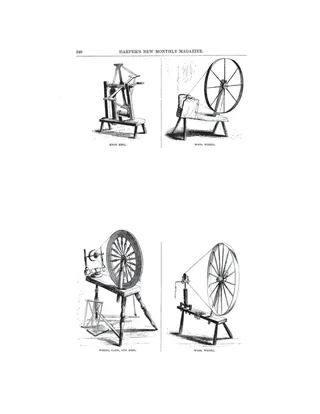
A single magazine page of four wood engravings showing colonial-era spinning equipment: a knot reel, two wool wheels, and a group of a wheel, card, and reel. Captions are brief and there is no running text on the page. It is useful as a visual reference for American hand-spinning tools of the 18th century.
As the Wheel Turns
Article · 1 page
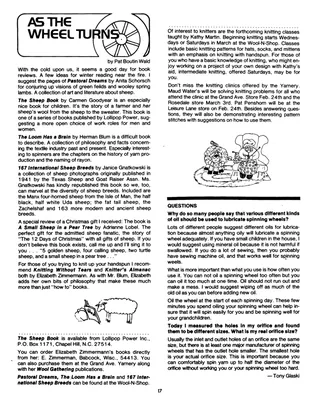
A one-page spinning column from Minnesota Weaver that opens with short reviews of sheep-themed and knitting books, including titles on sheep breeds, the textile industry and Elizabeth Zimmermann's knitting books. It lists where to buy them and announces knitting classes and clinics at local Minnesota yarn shops. It closes with a Q&A section on lubricating spinning wheels and on measuring orifice size, signed Tony Glaski.
As the Wheel Turns
Article · 2 pages
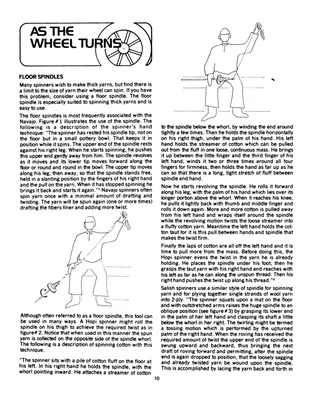
A column from the Minnesota Weaver on floor spindles for spinning thick yarns. It describes how Navajo, Hopi and Salish spinners use the spindle, quoting accounts of hand technique for spinning wool and cotton and for plying. A short Q&A follows, covering spinning wheel choice for beginners (band drive, orifice size, pulley ratios) and how to judge overtwist. The piece ends with a Glimakra loom lessons advertisement.
Fine Adjustments on the Ashford Wheel; Steps and Tools for Hand-spinning
Article · 1 page
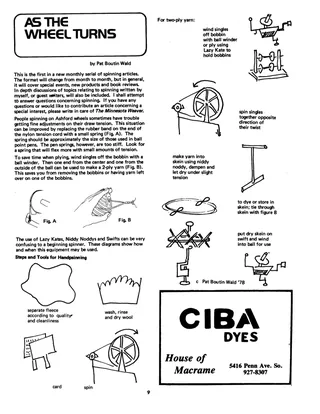
First installment of a monthly spinning column in The Minnesota Weaver. It gives a tip for getting finer draw-tension adjustments on an Ashford wheel by replacing the rubber band on the nylon tension cord with a small spring, and a time-saving method for plying singles from a ball wound on a ball winder. It also includes diagrams and a step list of hand-spinning, from sorting and washing fleece through carding, spinning, plying, skeining, and winding into a ball, showing the use of lazy kates, niddy noddys, and swifts.
Spinning
Article · 2 pages
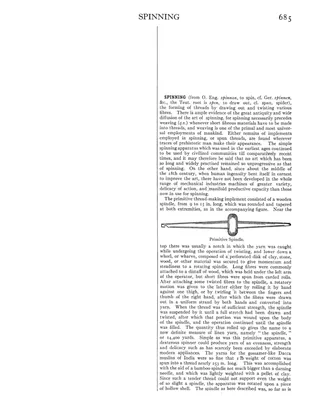
Encyclopedia article tracing the history of spinning from the primitive hand spindle with whorl and distaff through the bobbing wheel, treadle wheel and Saxony flyer wheel. It then covers the mechanical inventions of the 18th and 19th centuries: Paul's roller drafting, Arkwright's water frame, Hargreaves's jenny, Crompton's mule, and the American dead-spindle and ring frames. A line drawing shows a primitive spindle.
Spinning lessons
Article · 1 page
A one-page column from the Minnesota Weaver, April 1980, in which spinner Sue John of Wausau, Wisconsin, describes six "learning experiences" from her early spinning. The lessons cover buying a dirty fleece, dye bleeding in handspun yarn, choosing a fleece by staple, grade and crimp, machine carding that blended colored fleece, the cost of buying greasy Lincoln fleece from abroad, and underestimating the yardage in a pound of alpaca. The page also carries short notices of Minnesota and South Dakota shows, exhibits and craft festival deadlines for 1980.
Spinning Wool
Monograph · 12 pages
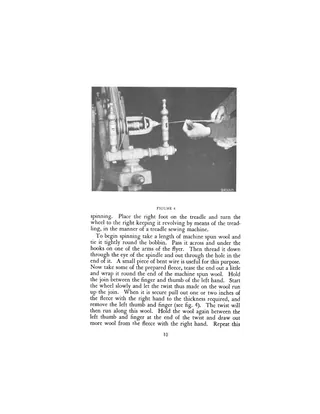
A Dryad Handicrafts leaflet giving beginner instructions for hand-spinning wool. It covers choosing and preparing fleece (teasing by hand and carding to make rolags), spinning with a drop spindle, and the parts, assembly, driving band and use of a treadle spinning wheel. It also explains making 2-ply yarn, winding skeins, and washing the spun wool, and illustrates the steps with photographs and a numbered line drawing of the wheel.
As the Wheel Turns
Article · 1 page
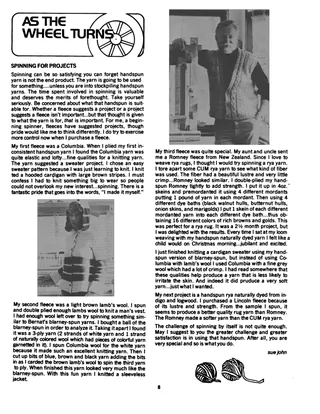
A first-person column from the Minnesota Weaver spinning series in which a beginning spinner describes choosing fleeces and spinning yarn to suit specific projects. She covers a Columbia fleece spun for a knitted cardigan, lamb's wool spun to imitate a commercial blarney-spun yarn, and a Romney fleece spun, mordanted and dyed for a rya rug. She also mentions a planned rya from Lincoln wool dyed with indigo and logwood, and urges spinners to plan what the handspun will be used for.
Household Spinning-Wheels and the First Spinning Machines
Article · 3 pages
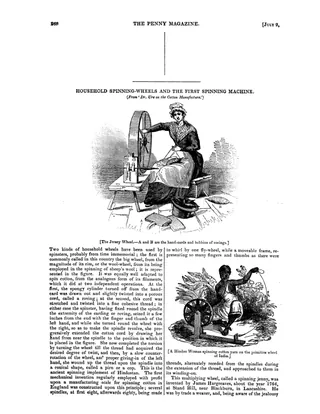
An 1836 Penny Magazine article, excerpted from Andrew Ure's work on the cotton manufacture, describing the household big wool-wheel (Jersey wheel) and how it was used to spin cotton and wool. It then traces the invention of James Hargreaves' spinning jenny around 1764, including his patent of 1770, the riots against him and his dealings with manufacturers. It closes with a detailed mechanical description of the improved jenny: its spindles, drum, clasp carriage, and winding wire. Three engravings illustrate the Jersey wheel, an Indian cotton-spinning wheel and the jenny.
Spinning
Chambers's Encyclopedia, 1881
Article · 3 pages
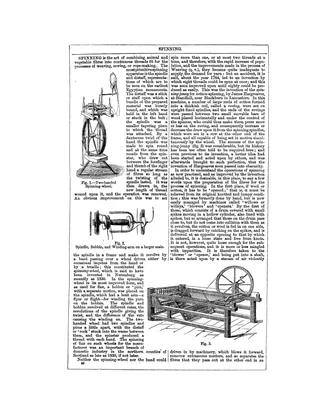
An encyclopedia article on spinning, tracing the craft from the hand spindle and distaff through the spinning-wheel to the mechanized spinning of the Industrial Revolution. It describes the Hargreaves jenny, Arkwright's throstle, and Crompton's mule. It also covers the preparation of fibre by opening, lapping and carding, and the yarn counts reached in the 1880s. Illustrated with line figures of a two-handed wheel, spindle and bobbin, the jenny, and carding machinery.
Spinning
Article · 1 page
A very short encyclopedia entry defining spinning as the reduction of silk, flax, hemp, wool, hair and other materials into thread. It mentions spinning on the wheel with distaff and spindle or with other machines, and notes that vegetable fibers such as hemp, flax and nettle are wetted while spinning, whereas silk and wool are spun dry, except for silk spun from cocoons using hot water.
Swatch Page - Spinning Helps and Hints
Minnesota Weaver, November 1976
Article · 2 pages
A two-page "Swatch Page" column from Minnesota Weaver offering practical advice for handspinners. It covers fiber choices, spinning cotton with a long draw, setting the twist and sizing for cotton and wool, and scouring wool using a four-bath formula (given in a table). It also covers dyeing, spinning oils, and tips for weaving with handspun yarn. Much of the advice draws on a workshop by the Linders and cites Irene Emery and Marilyn Kluger.
The Tale of the Spinning-Wheel
Monograph · 68 pages
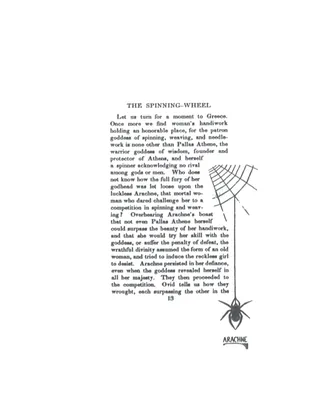
A 1903 illustrated essay, revised from a paper read to historical and patriotic societies, on the history and symbolism of the spinning wheel and women's spinning. It moves from ancient Egypt, Greece, Rome and Norse lands to colonial New England, covering the flax-to-linen process (breaking, swingling, hetcheling, spinning, reeling), wool carding, dyeing, spinning matches and women's work during the Revolution. Line drawings show distaffs, wool and flax wheels, hetchels, a clock reel, cards, shuttles and a tape loom, many from Litchfield, Connecticut collections.
274 documents found