Textile Documents › Publications › Publication: The Penny Magazine of the Society for the Diffusion of Useful Knowledge
22 documents found
Sort: 
Attempts to Rear Silk-Worms in England
Article · 3 pages
A short Penny Magazine article surveying the history of attempts to produce silk in the British Isles. It traces sericulture from medieval Italy and France to James I's mulberry-planting campaign, the 1718 Appleton patent and company, the 1825 British, Irish and Colonial Silk Company, and experiments with lettuce leaves as feed. It concludes that high land and labour costs make commercial success in England unlikely.
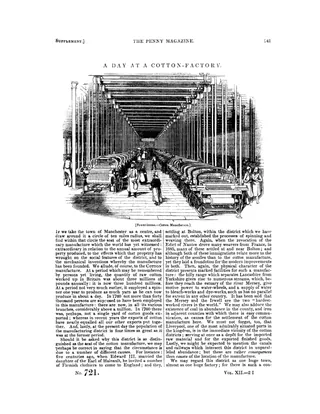
Day at a Cotton-Factory
Article · 8 pages
A Penny Magazine supplement describing the British cotton manufacture around Manchester, Bolton, Bury, Hyde and Stockport, with its history, geography and trade organization. It then walks through a large steam-powered cotton factory, floor by floor, covering the preparation, carding, roving and spinning processes (Hargreaves, Arkwright) and the power-loom weaving room. Illustrated with engravings of power looms, a can-roving frame and a carding engine.
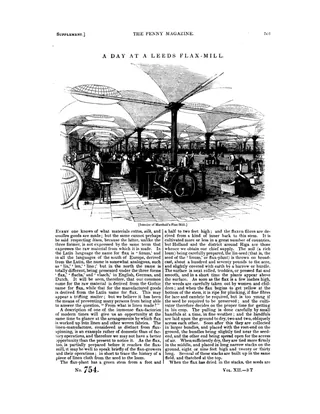
Day at a Leeds Flax-Mill
Article · 8 pages
An illustrated 1843 Penny Magazine supplement describing flax from seed to linen cloth, centered on a visit to Marshall's flax-mill at Holbeck, Leeds. It covers flax growing, pulling, retting (notably at Courtrai), and the Irish flax improvement society, then follows mill processes: heckling, drawing, doubling, tow-carding, roving, spinning and twisting. It closes with notes on the linen trade in Dundee and Ireland, including hand-loom weavers and the fabrics woven. Engravings show the mill interior and the machine rooms.
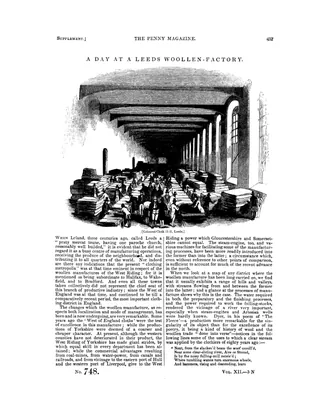
Day at a Leeds Woollen-Factory
Article · 8 pages
An illustrated article from the Penny Magazine supplement of November 1843 describing a visit to a large woollen cloth factory in Leeds (Messrs. Gott's Bean Ing works). It sets the history of Leeds and the West Riding against the older West of England cloth districts, distinguishes woollen from worsted goods and factory from domestic systems, then follows the processes: wool sorting, scouring, carding, slubbing, spinning, weaving, burling, fulling, drying, raising with teasels, cropping and finishing. It closes with the history of the Leeds cloth-market halls. Engravings show the Coloured-Cloth Hall, fulling stocks, hand-raising and teasel fixing.
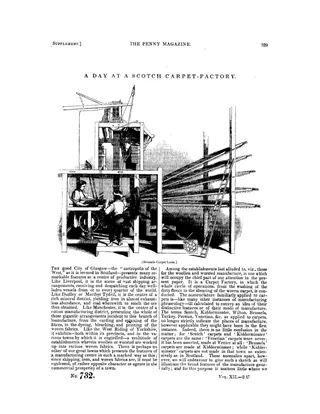
Day at a Scotch Carpet-Factory
Article · 8 pages
An 1843 Penny Magazine supplement describing a visit to a carpet factory at Port Eglinton, Glasgow. It follows the process from wool sorting, combing, drawing, roving and spinning through weaving of Scotch (double-cloth), Brussels (looped-pile, wire-woven) and Persian/Turkey-style knotted rugs, to shearing. It clarifies carpet naming (Scotch, Kidderminster, Wilton, Brussels, Turkey, Venetian), mentions Kilmarnock's carpet industry, and ends with sections on Paisley shawls and Highland tartans, including Jacquard and draw-boy looms. Illustrated with engravings of looms and machines.
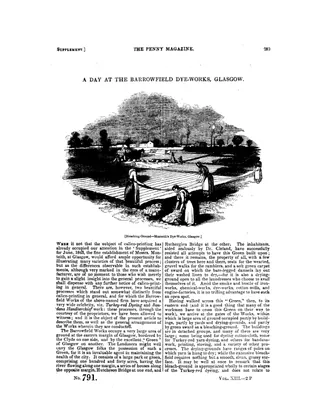
Day at the Barrowfield Dye-Works, Glasgow
Article · 8 pages
An 1844 Penny Magazine supplement describing a visit to Monteith's Barrowfield Dye-Works in Glasgow. It explains the lengthy Turkey-red dyeing process for cotton cloth and yarn (oiling, alkali, sumach, alum, madder and blood dye, clearing) and the hydraulic bandana press that discharges white spots from dyed handkerchief cloth using perforated lead plates. The later pages give a historical survey of dyeing and printing of cottons in India, the East and the Americas, and of muslin tambouring and embroidery in Scotland and Ireland.
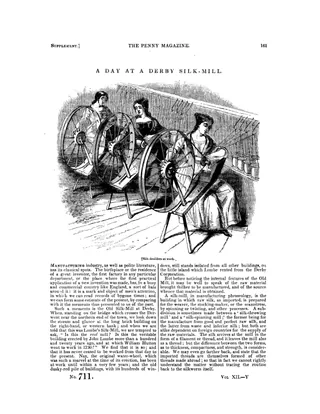
Day at the Derby Silk-Mill
Article · 8 pages
An illustrated 1843 Penny Magazine supplement describing a visit to the Old Silk-Mill at Derby, built by John Lombe around 1717. It outlines the origin of silk from the silkworm and cocoon, then the history of silk-throwing in Italy and England, including Lombe's industrial espionage and William Hutton's boyhood work there. It goes on to describe the mill's processes: winding, cleaning, doubling, spinning and throwing (singles, tram, organzine), and scouring before dyeing. Engravings show the machines and workers, including a brass-tag machine for silk boot-laces.
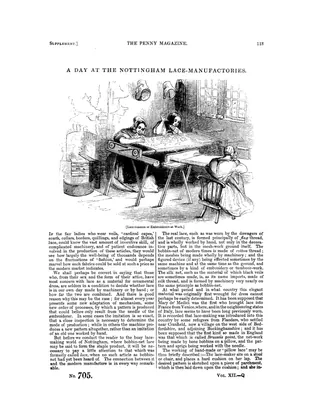
A Day at the Nottingham Lace-Manufactories
Article · 8 pages
A Penny Magazine supplement article from March 1843 describing how machine-made bobbin-net lace was produced in Nottingham. It first contrasts hand-made pillow lace with machine net, then traces the trade from cotton thread supply and manufacturers through the bobbin-net machine, the Jacquard attachment, and finishing work such as embroidery (lace-running), dressing and bleaching. Engravings show the winding engine, the machine's parts, the Jacquard apparatus, a lace-dressing room and specimens of machine and run lace; it also comments on prices and the poor earnings of women workers.
Day at the Yorkshire Worsted-Factories
Article · 8 pages
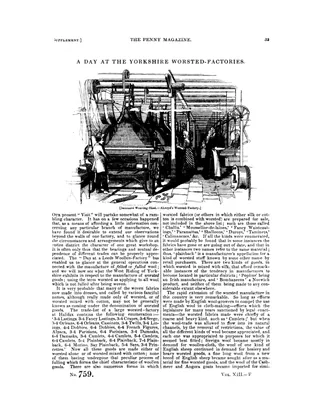
An 1844 Penny Magazine supplement describing the worsted manufacture of the West Riding of Yorkshire. It surveys the district's clothing towns (Bradford, Halifax, Keighley, Huddersfield, Wakefield, Leeds, Rochdale, Dewsbury) and the history of the trade, then follows the processes in a large factory such as Akroyd's: wool combing, drawing into slivers, warp-scouring, drawing-in the warp, power-loom and Jacquard weaving, and Jacquard-card making. It is illustrated with engravings of the machinery and the weaving shed.
History of a Coat -- No. I
Article · 3 pages
The first installment of a series from The Penny Magazine tracing how a sheep's fleece becomes a man's coat. It opens with the anecdote of Sir John Throgmorton's coat made in a single day, then gives a historical sketch of the woollen manufacture from early skin garments, the origins of sheep, and the Roman, Spanish, Flemish and French industries to the growth of the English trade. It closes with statistics on output, exports and employment in 1800 and 1833, and says later installments will describe the making of short-wooled fabrics such as broadcloth.
History of a Coat -- No. II
The Penny Magazine of the Society for the Diffusion of Useful Knowledge, September 26, 1840
Article · 2 pages
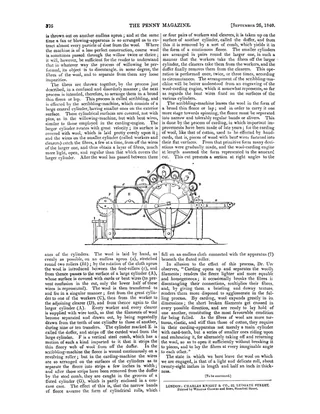
Second installment of a serial in The Penny Magazine tracing the manufacture of a broadcloth coat. It explains the felting property of sheep's wool, including the serrated fibre structure Youatt observed under the microscope in 1835. It then describes the early woollen-manufacturing stages: sorting long versus short wool, washing, willowing, scribbling and carding, with an engraved section of a wool-carding engine. The article ends with the wool as carded rolls, ready for spinning, and is to be continued.
History of a Coat -- No. III
Article · 3 pages
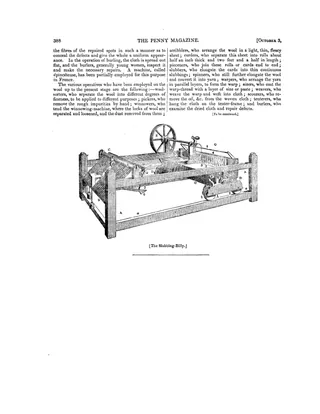
Third installment of a Penny Magazine series tracing the manufacture of a woollen coat. It describes the slubbing-billy (with an engraving), the child 'piecener' labour tied to it, and the spinning of woollen yarn with jenny and mule. It then covers warping, weaving of broadcloth, and finishing: scouring, fulling, tentering and burling. It ends with a list of the workers involved up to that stage.
History of a Coat -- No. IV
The Penny Magazine of the Society for the Diffusion of Useful Knowledge, October 17, 1840
Article · 3 pages
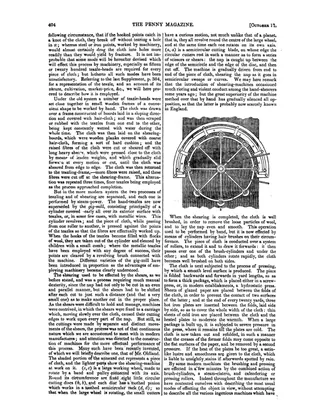
The concluding article in a Penny Magazine series on how wool becomes a coat, covering the finishing of woollen broadcloth. It describes dyeing (especially black over blue or walnut grounds, with mordants), milling or felting with mallets and soap, teazling with teazle heads and gig-mills, shearing by hand shears and by Mr. Oldland's machine, brushing, hot pressing, and baling. One engraved diagram shows the shearing machine. It closes with remarks on machinery and the cheapening of clothing in England.
History of a Cotton Gown -- No. 1
Article · 3 pages
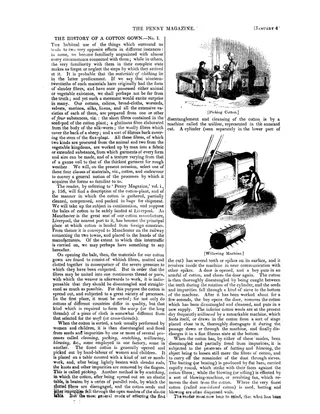
First part of a series in The Penny Magazine tracing how raw cotton becomes a cotton gown. It covers the cotton's arrival at Liverpool and Manchester, then sorting, picking, scutching, willowing, batting and blowing, carding, the drawing-frame and roving. Wood engravings show cotton picking, a willowing machine, cards and a drawing-frame. The spinning stage is left to the next installment.
History of a Cotton Gown -- No. 2
The Penny Magazine of the Society for the Diffusion of Useful Knowledge, January 18, 1840
Article · 3 pages
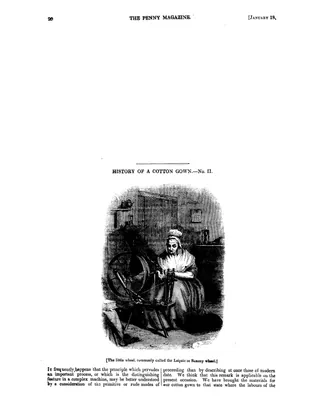
Second installment of a Penny Magazine series tracing the making of a cotton gown, covering the spinning of cotton into yarn. It describes domestic spinning on the big wheel and the little (Leipzic or Saxony) wheel, then the machine inventions of Hargreaves (spinning-jenny), Arkwright (water-twist frame), Crompton (mule) and the throstle. It also explains yarn qualities, hank numbering, warping, sizing, and the move toward power weaving, with a note on Cartwright's loom. Illustrated with an engraving of the little wheel and a drawing of throstle-spinning apparatus.
History of a Cotton Gown -- No. 3
The Penny Magazine of the Society for the Diffusion of Useful Knowledge, February 1, 1840
Article · 3 pages
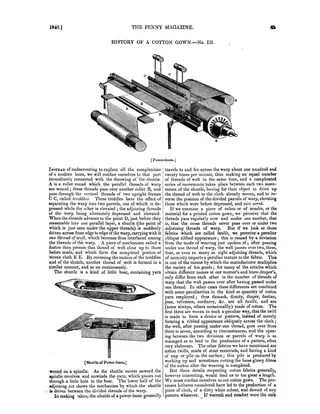
Third part of a Penny Magazine series on the making of a cotton gown, covering weaving and finishing. It explains the power-loom (warp roller, treddles, shuttle, batten), plain weave versus twills, and how damask, dimity, diaper, fustian, jean, velveteen and corduroy are made. It then describes patterning with coloured warp and weft, and the singeing, bleaching and calico printing of the cloth (block and copper-plate/cylinder printing, mordants, resist pastes, Bandanna handkerchiefs). It closes with remarks on the economic importance of the British cotton industry.
Household Spinning-Wheels and the First Spinning Machines
Article · 3 pages
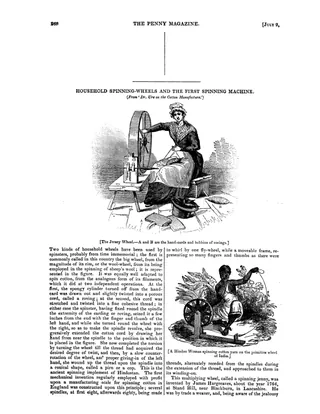
An 1836 Penny Magazine article, excerpted from Andrew Ure's work on the cotton manufacture, describing the household big wool-wheel (Jersey wheel) and how it was used to spin cotton and wool. It then traces the invention of James Hargreaves' spinning jenny around 1764, including his patent of 1770, the riots against him and his dealings with manufacturers. It closes with a detailed mechanical description of the improved jenny: its spindles, drum, clasp carriage, and winding wire. Three engravings illustrate the Jersey wheel, an Indian cotton-spinning wheel and the jenny.
Lace, and its Manufacture
Article · 3 pages
A short article from The Penny Magazine (16 May 1840) on the history and manufacture of lace. It traces pillow-lace and needle lace from Italy, Saxony, Flanders and France to the English centres of Honiton, Buckinghamshire and Bedfordshire. It explains how handmade pillow lace is worked with bobbins and pins on a parchment pattern, and lists the mesh structures of Brussels, Mechlin, Valenciennes, Lisle and Alençon laces. It closes with a brief account of machine-made bobbin-net, with two diagrams of the mesh structure.
Llama and its Silk Wool
Article · 2 pages
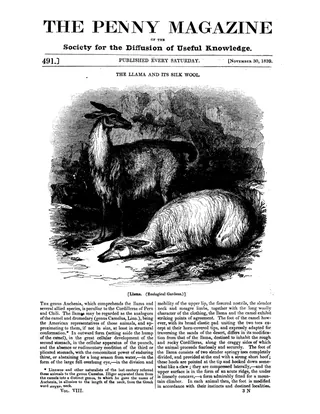
A short natural-history article from The Penny Magazine on the llama (genus Auchenia) of the Peruvian and Chilean Cordilleras. It compares the llama with the camel in anatomy and foot structure, then argues for naturalizing the animals, especially the alpaca-vicugna cross, in Wales or Scotland for their wool. It stresses the commercial value that llama fleece could have, comparing it to sheep wool and silk. An engraving of llamas at the Zoological Gardens accompanies it.
Manufacture of Kashmir Shawls
Article · 2 pages
A short extract from G. T. Vigne's Travels in Kashmir, reprinted in the Penny Magazine, describing how Kashmir shawls are made and finished. It covers thread preparation and rice-water stiffening, the terms for shawl cloth and other Kashmiri products, the taxation of shawls, and the washing, bleaching and sulphur-fume colouring of finished shawls. It also describes the shawl brokers (mokym) and their dealings with merchants, and the origin of the cypress-shaped shawl motif.
Silk-Producing Fish
The Penny Magazine of the Society for the Diffusion of Useful Knowledge, February 1, 1840
Article · 2 pages
A two-page article from The Penny Magazine (1840) on the pinna, a large Mediterranean bivalve that produces a silky fibre called byssus. It describes how the animal forms and uses the fibres, how Sicilians gather the byssus, spin it, and weave or knit it into light, warm gloves, stockings and caps, and compares it to the threads of the common mussel. It also recounts ancient and later naturalists' accounts of the pinna's crab companion and quotes proposals to farm pinnae in ponds to increase byssus production.
Weaving in Ceylon
Article · 2 pages
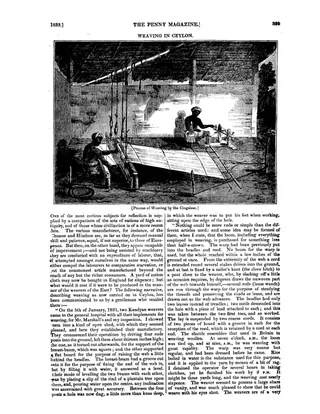
A short article from The Penny Magazine reproducing an eyewitness account of two Kandyan weavers who set up a simple pit loom at a hospital in Ceylon in January 1821. It describes the loom's construction, the sizing of the warp with rice water, the two-leaf heddles worked by toe cords, and the assistant who winds pirns on a split-bamboo swift. Engravings show the weavers at work and the shuttle. The introduction contrasts hand production in the East with machine production in England.
22 documents found