Textile Documents › Topic: African textiles
49 documents found
Sort: 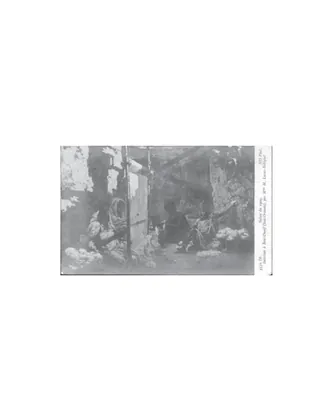
Tisserand à Beni-Ouniff (Sud-Oranais) [Weaver at Beni-Ouniff (Sud-Oranais)]
Ephemera · 1 page · French
A single picture postcard reproducing a painting of a weaver working at a hand loom in a rough, whitewashed interior at Beni-Ounif in the Sud-Oranais region of Algeria. The card is captioned as a work by M. Lucas-Robiquet exhibited at the Salon. It is a pictorial record of a North African loom and weaving setting, with no technical weaving information.
Hykes
Rees's Cyclopedia, 1819
Article · 1 page
A short encyclopedia entry defining the hyke, a blanket-like garment used in Barbary (North Africa). It says the women weave hykes without a shuttle, passing each weft thread by hand. It describes the size, use as daytime dress and night bedding, and cites Dr. Shaw's comparison to the ancient peplus or toga.
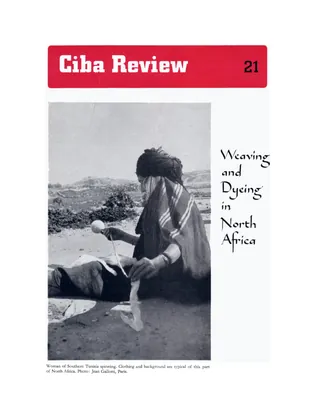
Ciba Review, No. 21 (May 1939): Weaving and Dyeing in North Africa
Ciba Review, May 1939
Periodical · 36 pages
Issue No. 21 of the Ciba Review (Basle, May 1939) is devoted to weaving and dyeing in North Africa, with articles by Jean Gallotti. It opens with a survey of Egyptian textile crafts from the Pharaohs and Coptic tapestry through the Islamic period. It then covers Morocco, Algeria and Tunisia: vertical and horizontal looms, flidjs, mats of esparto and palm fibre, knotted and tapestry-like rugs (Rabat, Saian, Uled-Ben-Seba, Kairuan), silk weaving and braid, and traditional plant, insect and mineral dyes. The issue is illustrated with photographs and a map of textile centres, and also contains Ciba dye advertisements, short technical notes on dyeing, and Historical Gleanings on textile patterns and the evil eye and on silk-growing in Prussia.
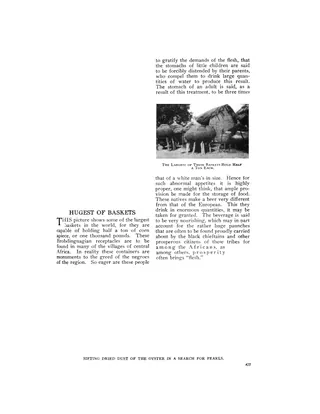
Hugest of Baskets
Technical World, September 1912
Article · 1 page
A one-page 1912 magazine item with a photograph of very large storage baskets in villages of central Africa, said to hold about half a ton (1,000 pounds) of corn each. The text is mostly racially prejudiced commentary of the period about the eating and drinking habits of the people, with little on basket construction or materials. It is of interest mainly as a historical example of how African basketry was presented in early twentieth-century popular press.
African Basketry Weaves
Article · 1 page
A short note from Science describing a collection of Barotse and Bechuana baskets recently received by the American Museum of Natural History. The author lists the woven and coiled basketry techniques present, including wicker, checker, twill, wrapped, twine variants, the California 'ti' weave, and several coil types, and compares them with Californian and Aleutian basketry. She notes the emphasis on sturdy storage chests and the black-only coil decoration.
Cultivation of Cotton in Western Africa
Article · 17 pages
A 1903 article by Emile Baillaud, a French colonial agronomist, assessing the prospects for commercial cotton growing in West Africa. It reviews the German Togo Cotton Expedition of 1901, staffed by Tuskegee Institute personnel under James Calloway, and its results with planting, rains, pests and draught animals. It then compares climate, soil, labour and transport costs on the coast and in the Sudan interior, gives cost calculations for delivering a bale to Bremen, and recommends model farms and experimental stations for Germany, England and France. It concerns agriculture and the cotton trade, not weaving.
Silk-Producing Insects of West Africa
Article · 1 page
A short note in Nature on wild silk-producing insects of West Africa. It describes how cocoons of Anaphe infracta and A. venata are boiled, spun and mixed with native cotton yarn to weave "Sanyan" cloth in Nigerian towns such as Ibadan and Ilorin. It also covers the white "Gambari" (Haussa) silk from northern Nigeria, the author's experiment producing white cocoons by confining larvae in the dark, and notes on larval food plants and the classification of other Anaphe species.
Ancient Egyptian Textiles - Abu Seiffein
Article · 1 page
A one-page article by Cherilyn Nelson on textiles recovered in the winter of 1981 from the churchyard of Abu Seiffein, a Coptic cemetery in Akhmim, Egypt. It describes the site, burial customs, coffin types, and how bodies were clothed, along with the plain, striped and checked fabrics and a sheer garment called a shala. It also outlines how the textiles were handled, catalogued and divided between Egyptian museums and the University of Minnesota, whose Akhmim project made the excavation.
The Cotton Plant in Egypt
Book · 215 pages
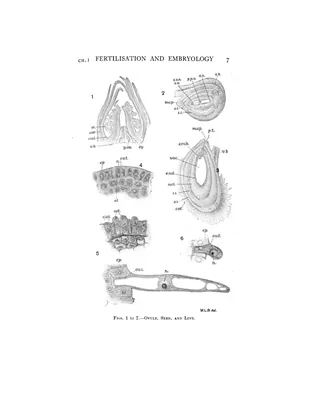
A scientific monograph on the physiology and genetics of the Egyptian cotton plant, first published in 1912 and reprinted in 1919. It covers the history of cotton in Egypt, fertilisation and embryology, how temperature, water, roots and light affect growth, flowering and shedding, and the structure and growth of the cotton fibre. Later chapters treat fluctuation, commercial varieties, natural crossing, Mendelian heredity of qualitative and quantitative characters in crosses, and the economics of the Egyptian crop. It includes many graphs, microscope drawings, photographs, statistical tables, a bibliography and an index.
Shuttle-Craft Bulletin (December 1960)
Periodical · 4 pages · weaving drafts
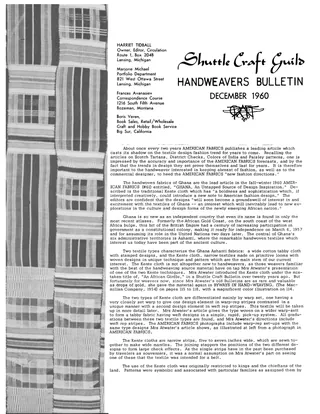
December 1960 issue of the Shuttle Craft Guild Handweavers Bulletin, edited by Harriet Tidball. The lead article discusses Ghanaian Kente cloth as a design trend reported in American Fabrics, and proposes adapting it in double weave. It gives instructions for two Christmas party strips (festremsa): a silk four-harness double weave with warping hints, and a quick pearl cotton version. The issue also has book and periodical news, a list of Shuttle Craft Guild publications, correspondence course news, and guild business such as binders, renewals and a Peru trip.
[Ancient Egyptian Weaving]
Article · 2 pages
Two pages from George Rawlinson's History of Ancient Egypt (pp. 228-229) on Egyptian weaving. They cover Herodotus's claim that only men wove, evidence from monuments that both sexes spun and wove, the simple Egyptian loom, and the fine linen produced, including dyed edges, inwrought patterns, printed designs and gold threads. The passage ends with an Egyptian poem on the weaver's hard working conditions.
Studies in Primitive Looms
Article · 39 pages · weaving drafts
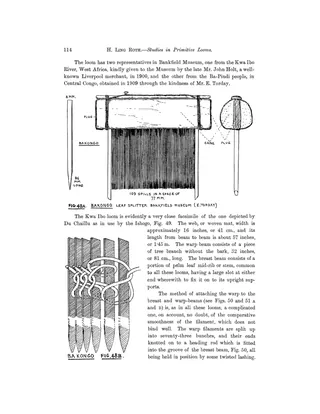
Part II of H. Ling Roth's series on primitive looms, covering African looms. He identifies seven forms: vertical mat loom, horizontal fixed heddle loom, vertical cotton loom, horizontal narrow band treadle loom, pit treadle loom, Mediterranean or Asiatic treadle loom, and the "carton" loom. The text describes museum specimens (Bankfield, Liverpool, Glasgow, Edinburgh, Brighton, British Museum) from Kwa Ibo, Ba-Pindi, Old Calabar, Madagascar, Nyasaland, Abeokuta and Opobo, with dimensions, warp attachments, heddles, selvedges, needles, spools, reeds and shuttles. It has many line drawings and diagrams, including pattern-heddle and herring-bone rod threading diagrams for the vertical cotton loom. It ends with a tentative distribution map of loom types in Africa and discussion of their origins.
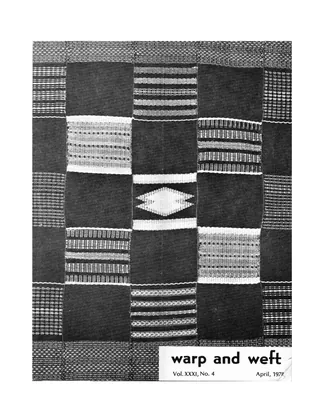
Warp & Weft, Vol. 31, No. 4 (April 1978)
April 1978
Periodical · 8 pages · weaving drafts
April 1978 issue of Warp & Weft, the monthly newsletter of Robin & Russ Handweavers in McMinnville, Oregon. The issue includes the editor's column on rising yarn costs and shop news, a sample project called 'Combo' that blends two miniature overshot patterns in 20/2 Egyptian cotton with a silk/polyester pattern weft (with threading, tie-up, and a 52-pick treadling sequence), a note on the cover photograph (a strip-woven piece in the West African manner), and a review of Venice Lamb's book West African Weaving. The last pages carry shop advertisements for yarns, tools, and books, a Jack Womersley summer workshop, and a weaving tour.
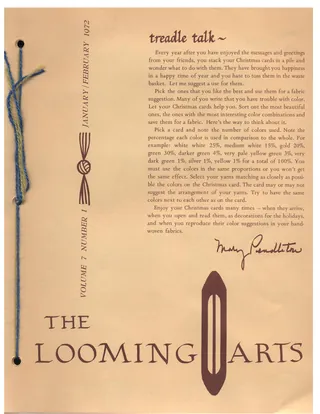
Looming Arts, Vol. 7, No. 1 (January-February 1972)
Looming Arts, January-February 1972
Periodical · 9 pages · weaving drafts
Issue of The Looming Arts, a bimonthly handweaving newsletter published by Mary Pendleton of Sedona, Arizona. It opens with a suggestion to use Christmas card colors as a guide to choosing yarn colors, followed by reader letters, studio news, and short reviews of craft booklets (Indian crafts, drop spindle spinning, natural dyeing, ojos de Dios). The projects are a fine-yarn check fabric in 2/20 wool (36 ends per inch, doubled threads, 16-shaft threading draft with tie-up and treadling), a knitted hat-scarf pattern, and a nine-shaft fabric inspired by Ghanaian Kente cloth that combines a twill-type stripe with a plain-weave stripe. A Sticky Problem column explains how to use a double warp beam to handle uneven take-up. The issue also carries a yarn sample offer (plied spun rayon) and advertisements for Pendleton looms and local businesses.
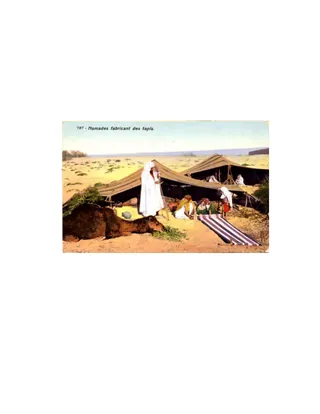
Nomades fabricant des tapis [Nomads Making Rugs]
Ephemera · 1 page · French
A single hand-colored picture postcard showing nomadic people in white robes and headwraps working at a striped woven textile stretched on the ground beneath a dark striped tent with wooden supports. The only text is the printed caption, "Nomades fabricant des tapis" (nomads making rugs), with the number 787. It is useful as a visual record of tent-side rug or carpet weaving among nomadic groups.
Cultivation of Cotton in West Africa
Article · 10 pages
A 1902 article arguing that West Africa could become a major source of raw cotton if it were grown systematically as an annual crop rather than gathered from indigenous perennial trees. It reviews the cotton shortages affecting Lancashire spinners, compares Africa with India and the United States, and draws on the records of the Cotton Supply Association (1857-71) and its journal, the Cotton Supply Reporter. It covers attempts at cultivation in Lagos, Yoruba country, Liberia and the Gold Coast, with import statistics for 1859-70, and notes the decline of native handloom weaving as imported cloth spread. It closes with recommendations on gins, buying agencies, native versus exotic seed, and transport.
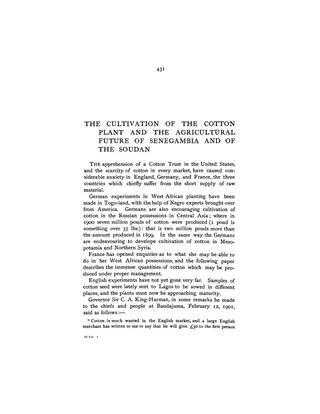
Cultivation of the Cotton Plant and the Agricultural Future of Senegambia and the Soudan
Article · 13 pages
An English translation of a 1901 French article by the botanist A. Chevalier on the prospects for growing cotton in Senegambia and the French Soudan, introduced by a note on the founding of the British Cotton Growing Association. It describes the four Gossypium species cultivated there, the strengths and weaknesses of the native Soudan cotton (fibre length, adherence of the wool to the seed), hybridisation and selection, and estimated yields, costs and revenues. An appendix surveys European attempts to grow cotton in West Africa from the 18th century through the 1890s.
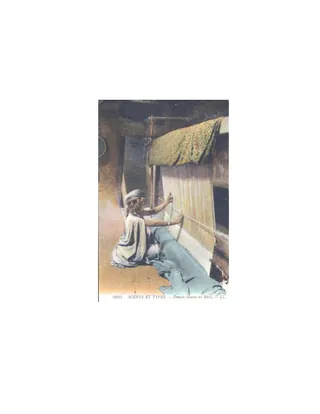
Scenes et Types. – Femme tissant au Bali [Scenes and Types. – Woman Weaving in Bali]
Ephemera · 1 page · French
A hand-colored photographic postcard showing a woman seated at a vertical loom, weaving a patterned textile. Warp threads hang from the beam and finished cloth is draped over the top bar. The printed caption is in French, in the series "Scenes et Types", and the card is numbered 8083.
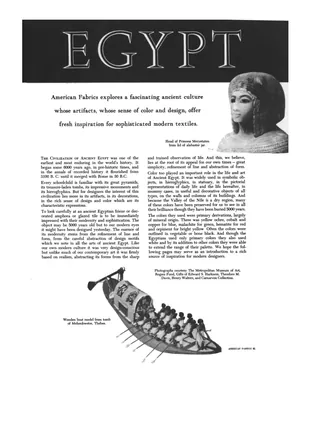
Egypt: A Rich and Ancient Source of Fashion and Design
American Fabrics, Fall 1962
Article · 5 pages
A photo-essay from American Fabrics (Fall 1962) presenting ancient Egyptian art as inspiration for modern fashion and textile design. A short introduction covers Egyptian civilization, the abstraction of its design motifs, and its mineral-based color palette. Most pages are museum photographs of rosettes, glazed faience tiles, amphorae, stelae, friezes and other objects, with captions. It has no weaving instructions or drafts.
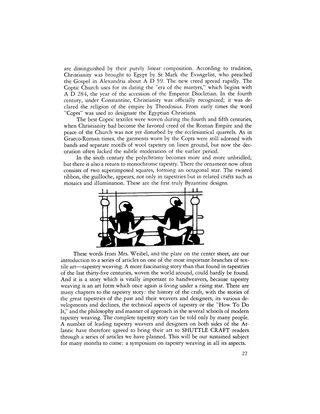
Tapestry through the Ages: Tapestry in Egypt
Article · 9 pages
Reprinted excerpt from Adele Coulin Weibel's Two Thousand Years of Textiles (Detroit Institute of Arts, 1952) that opens the Shuttle-Craft Bulletin series on tapestry. It defines tapestry weaving and traces it in ancient Egypt, from the linen cloths in the tomb of Thutmose IV through the Hellenistic introduction of wool wefts, Syrian influence, and Coptic textiles of the first millennium AD. An editorial note at the end announces a planned symposium series on tapestry weaving. Most pages are photographs and drawings of tapestry fragments, a loom, and an Egyptian-style weaving silhouette.
Work of the British Cotton-Growing Association
Article · 9 pages
A 1904 article by J. Arthur Hutton, vice-chairman of the Association's executive council, describing the aims and early work of the British Cotton-Growing Association. It covers the world cotton shortage, speculation in the American market, and the Association's founding in Lancashire in 1901-1902. It surveys efforts to expand cotton cultivation in India, the West Indies, Egypt and the Sudan, East Africa and West Africa. The focus is on raw cotton supply and the economics of the industry, not on weaving or textile techniques.
African Wild Silk and Its Uses
Article · 4 pages
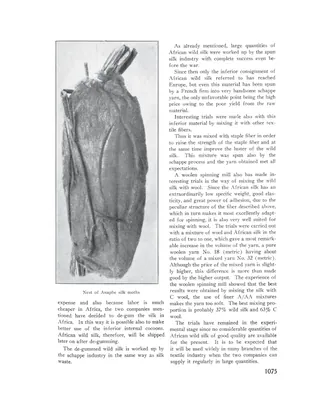
A 1929 article by Consul Max Saurenhaus on African wild silk (Anaphe species) as a textile raw material. It traces the failed early European trials, the pre-war Anglo-German exploitation company in East Africa, and new French and Belgian Congo ventures planned for 1930. It describes the fiber's properties (fineness, strength, dyeing, poor luster) with a strength and elongation table comparing its schappe to Bombyx mori schappe, and reports trials of spinning it alone and blended with staple fiber and wool. One photograph shows a nest of Anaphe silk moths.
Balls of Thread on Pieces of Pottery
Article · 2 pages
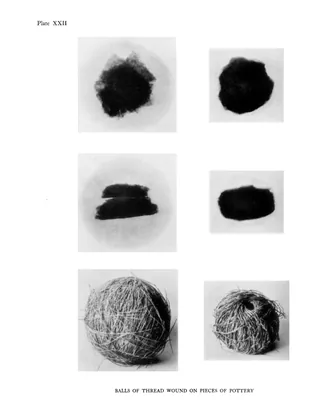
A short note describing X-ray photographs of two balls of linen thread in the Metropolitan Museum of Art, dated to about 1200-1000 B.C. (Twentieth to Twenty-second Dynasties). The X-rays show that the Egyptians wound thread around small pottery fragments used as cores. The author notes similar worked potsherds found without thread at Lisht, and a thumb-hole in the smaller ball. A plate of six photographs shows the balls and their X-rays.
"The Delta and the Cotton Industry" from The Redemption of Egypt
Monograph · 19 pages
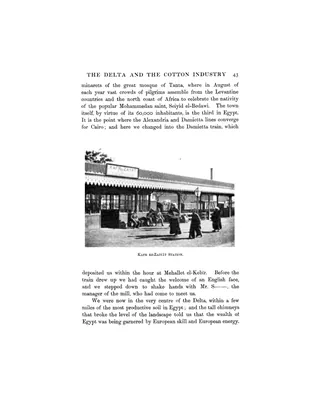
Chapter III of W. Basil Worsfold's 1899 travel and political account The Redemption of Egypt. The author travels from Alexandria through the Nile Delta to Mehallet el-Kebir and visits a cotton ginning mill. He covers Egyptian cotton cultivation, prices against American cotton, export figures and destinations, and the ginning, garbling and baling of cotton and cotton seed. The chapter ends with a visit to the town, noting hand and foot-powered weaving of cotton towels and counterpanes, silk shawls and handkerchiefs, straw plaiting, and linseed cake manufacture.
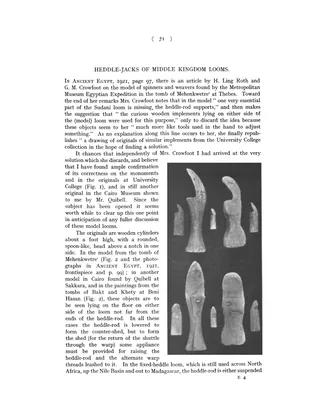
Heddle-Jacks of Middle Kingdom Looms
Article · 4 pages
Article arguing that the small wooden cylinders with spoon-shaped heads found beside Middle Kingdom Egyptian model looms and shown in tomb paintings are heddle-rod jacks. The author reasons from the models, tomb scenes at Beni Hasan and Thebes, and originals at University College and Cairo, and tests the idea with a working model loom. He concludes that the heddle was movable, with jacks set up and knocked out for every two shuttle shots, and that the fixed-heddle looms of Libya and the Sudan descend from it. Fig. 2 compares ancient tomb drawings with diagrams of the working model.
The Bulletin of the Needle and Bobbin Club, Vol. 12, No. 1 (1928)
Periodical · 46 pages
Issue of the Bulletin of the Needle and Bobbin Club (New York) devoted largely to Germaine Merlange's study and catalogue of the Elsberg Collection of Egypto-Arabic embroideries of the medieval period. The catalogue describes numbered fragments (tapestry borders on wool gauze, embroidered linen borders with Kufic inscriptions, a fringed scarf) with notes on stitches, colors, dating and find-spots such as the Fayoum and Fostat. It also includes a short article on a Medici brocade at the Metropolitan Museum, Club Notes (including a talk on opus Anglicanum), Book Notes, club officer lists and period advertisements.
Minnesota Weaver, Vol. 3, No. 7 (April 1978)
Minnesota Weaver, April 1978
Periodical · 24 pages
April 1978 issue of the monthly newsletter of the Weavers Guild of Minnesota. It announces the April meeting (Merle Sykora on weaving and nature), a workshop on loom tricks of the trade, a silent auction fundraiser, and a guild exhibit of study-group work, and it carries board, treasurer, yarn committee and workshop notes. Features include interviews with interim course teachers, a book review of Baskets & Beyond, an article on garment sleeves, a report on a West African arts and textiles symposium, a rigid heddle article on fibers for the frameloom, a dye garden column, and Suzy Sewell's article on Peruvian tapestry weaving. It also lists Guild School classes, summer study programs and many advertisements for yarn shops and looms.
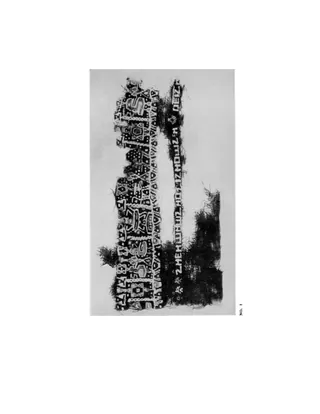
Group of Egypto-Arabic Embroideries of the Elsberg Collection
Article · 6 pages
An article by Germaine Merlange on a group of Egypto-Arabic embroideries excavated in Egypt, from the collection of H. A. Elsberg. It outlines the periods of Arab rule in Egypt and discusses dating, silk and wool materials, and Sassanian influence on five Fayoum pieces worked on wool gauze. It also notes the stitches, including a Kufic inscription piece worked with drawn weft threads, and their later survival in the Greek Islands and Near East. The scan includes photographs of two textile fragments.
Inside the Sisal Cord Plant in the Tanga Region
China Pictorial, 1976
Illustration · 1 page
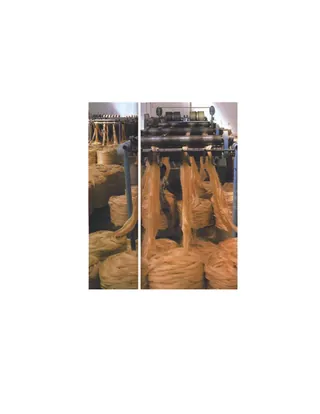
A single page of two photographs from China Pictorial, 1976 no. 3, showing the interior of a sisal cord plant in the Tanga Region of Tanzania. The images show rows of machinery for spinning or twisting rope, with coils of golden sisal fibre stacked below and fibre strands running through the equipment. There is no readable text on the page.
Loom Weights in Egypt
Article · 3 pages
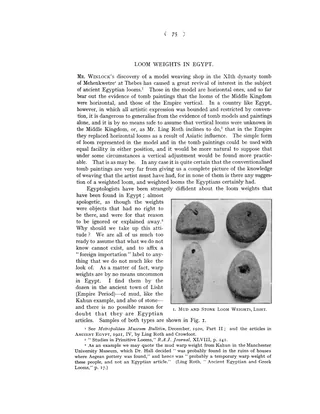
Short 1922 article by A. C. Mace arguing that warp-weighted looms were used in ancient Egypt, based on mud and stone loom weights found in large numbers at the Empire-period town of Lisht. Mace argues that tomb paintings and models give an incomplete picture of Egyptian looms and criticizes the tendency to dismiss the weights as foreign. He suggests the weights were used on a two-beam loom, comparing it to a modern pit treadle loom at Maharraqa near Lisht in which bunched warp threads are held taut by stone weights. Illustrated with a photograph of the modern loom and a photograph of the Lisht weights.
Society of Arts Lectures. Egyptian Tapestry
Article · 1 page
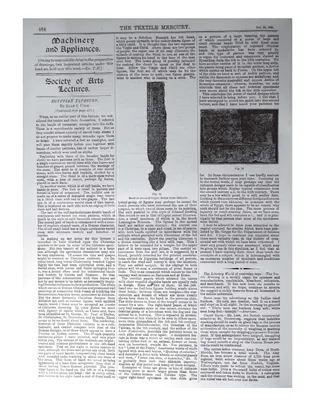
The concluding part of Alan S. Cole's second Society of Arts lecture on Egyptian (Coptic) tapestry, printed in The Textile Mercury of 26 October 1889. It discusses tapestry-woven cuff and tunic bands from Akhmim, from vine-scroll and ivy patterns to barbaric Christian figure subjects, circular panels and medallion patterns. Cole relates the designs to Greco-Roman, Persian, Syrian and Byzantine sources and dates them from the 2nd to the 10th century A.D. Two figures of Akhmim bands are included.
Catalog of the Elsberg Collection of Egypto-Arabic Embroideries of the Mediaeval Period
Article · 22 pages
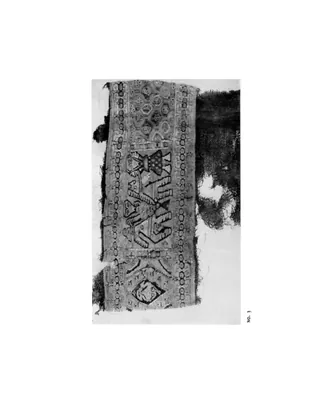
A catalogue of sixteen medieval Egypto-Arabic textile fragments in the Elsberg Collection, published in the Bulletin of the Needle and Bobbin Club. Each entry describes a fragment's technique (tapestry borders on wool gauze, silk or wool embroidery on linen), design, inscriptions, stitches, dating (9th to 13th century), find place (Fayoum or Fostat) and size. Entries compare pieces with the Kühnel and Kendrick catalogues and note Sassanian and Eastern influences. Many pages are photographic plates and stitch details.
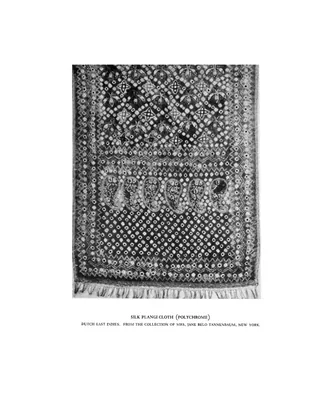
Plangi Technique
Article · 22 pages
Charles Iklé's article surveys plangi, the tie-and-dye resist technique in which cloth is gathered, bound and then dyed. It compares plangi with ikat and batik, then describes the main methods: pebble-and-thread puckering in Java, Indian bandhana work, West African pleat-and-tie, and an ancient Peruvian rolled-cloth method. It also covers related resist methods such as shirring, sewn cords, leaf and bamboo resists, and the Japanese kyokechi zome. A step-by-step account of making a two-color silk plangi cloth in Samarang, Java is followed by notes on ancient examples and the present-day distribution of plangi worldwide, with maps and a bibliography. It is illustrated with photographs of cloths from the Dutch East Indies, Japan, Peru, Mindanao and Mexico, plus process diagrams.
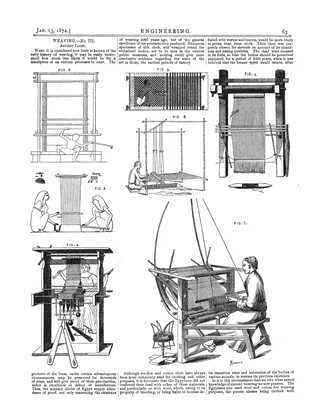
Weaving. -- No. III: Ancient Looms
Article · 2 pages
Third installment of a series on weaving in the periodical Engineering, surveying ancient and primitive looms. It covers Egyptian mummy linen, Egyptian vertical and horizontal looms from Theban paintings (after Wilkinson), the Greek warp-weighted loom compared to the Icelandic loom, a loom from the Vatican Virgil manuscript, the Indian loom used for Dacca muslins, and a Chinese loom. It gives a detailed account of Dacca loom construction, working conditions and figured muslin technique, and includes seven figures of looms.
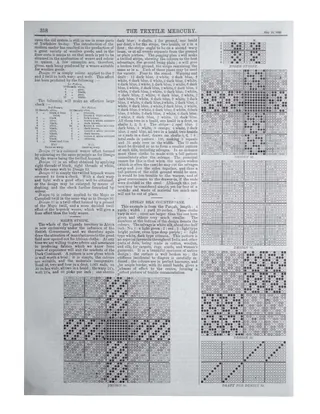
Designing
Textile Mercury, May 10, 1890
Article · 3 pages · weaving drafts
A three-page "Designing" feature from The Textile Mercury, 10 May 1890, giving colour-and-weave designs for worsted and woollen suitings (Designs 90-95) with warp colour orders and weave notes. It also gives a Niger Stripe cloth for the African market, with reed, sett, shaft and colour details and pegging plans, and describes an Indian silk counterpane from the Punjab. Pages 2-3 carry the drawdowns, pegging plans and design diagrams. Page 1 also holds unrelated items on a German factory bill and a letter on West Indian cotton growing.
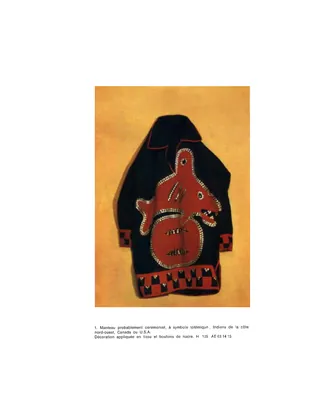
Textiles Exotiques [Exotic Textiles]
Other · 47 pages · French
Illustrated guide, in French, to a 1964 exhibition of exotic textiles from the collections of the Antwerp archaeology museums and the Museum of Ethnography. After forewords by J. Wilms and F. Smekens, Adr. G. Claerhout surveys decoration techniques: applied work, embroidery, painting, and the resist-dyeing groups (pleat, stencil, tie-dye, tritik and plangi, wax-resist batik, discharge, and ikat on warp and weft). The guide includes schematic figures of looms, basic weaves and resist processes, a bibliography, and a catalogue of 24 plates with museum numbers, provenance (Indonesia, Japan, Mali, Peru, Northwest Coast and others) and dimensions.
Warp & Weft, Vol. 5, No. 10 (October 1952)
October 1952
Periodical · 8 pages · weaving drafts
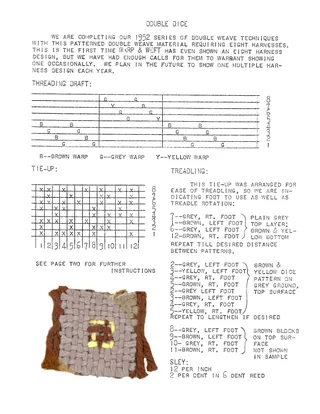
October 1952 issue of Warp & Weft, a monthly handweaving newsletter edited by Gladys Rogers Brophil. The main project is "Double Dice," an eight-harness patterned double weave in grey, brown and yellow rug yarn, with threading draft, tie-up, treadling and foot order, sley, color rotation and suggested uses such as outdoor chair upholstery, reversible rugs, jackets and blankets. Other items include Marianne Huebner's report on a traveling State Department exhibition of US handcrafts, a letter from a weaver in Zululand, a review of Elmer W. Hickman's folio New Weaves from Old, a Q&A comparing cord, chain and wire tie-ups, a short word-history note on "shoddy," and weaving-related advertisements.
Primitive Stoffmusterungen [Primitive textile patterning]
Other · 39 pages · German
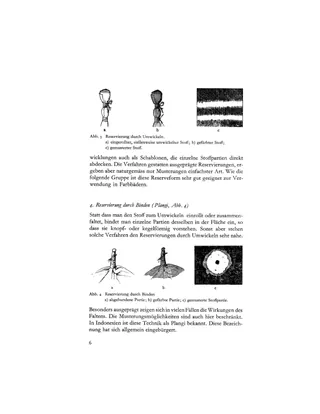
Guide to a special exhibition on resist-dyed textile patterning held at the Museum für Völkerkunde and Schweizerisches Museum für Volkskunde, Basel, in 1953. The introduction classifies resist methods for cloth (folding, sewn/tritik, wrapping, tying/plangi, stencil, paste and wax/batik, negative resist with mordants) and for yarn (warp ikat, weft ikat, double ikat), with diagrams and notes on dyeing. A room-by-room catalog lists objects by region, followed by plates of textiles from Africa, Asia, Indonesia, Egypt, Peru and Europe. No weaving drafts are included.
Shuttle-Craft Bulletin (1934)
Periodical · 40 pages · weaving drafts
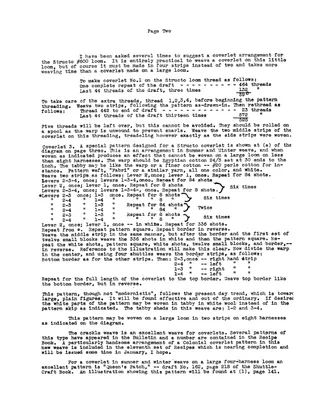
Ten issues of Mary Meigs Atwater's Shuttle-Craft Guild Bulletin for 1934 (January through December, with some months absent). Topics include coverlet arrangements in overshot and Summer and Winter, African pick-up and inlay weaving from Sierra Leone, braiding and plaiting, linen weaving with Spanish open-work, Mexican warp-face weave, the Finnish double weave, rag and stair-carpet rugs, crackle-weave upholstery fabrics, Christmas gift weaving, and loom adjustment. Many pages carry hand-drawn drafts, tie-ups and treadling instructions.
Models of Ancient Looms
Article · 7 pages
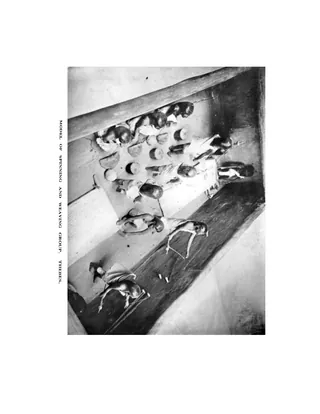
Two-part note on the model of Egyptian textile work found in an XIth dynasty tomb at Thebes by Winlock and Burton. H. Ling Roth describes the model from photographs, comparing its flax preparation, spinning, warping and two horizontal looms with the XIIth dynasty wall drawing in the tomb of Tehuti-hetep. G. M. Crowfoot then compares the model with spinning, warp laying on pegs and horizontal two-beam looms she saw in the Sudan, and discusses the puzzling wooden implements beside the looms. Illustrated with the model, the wall drawing and diagrams of a Sudani warp and wooden implements.
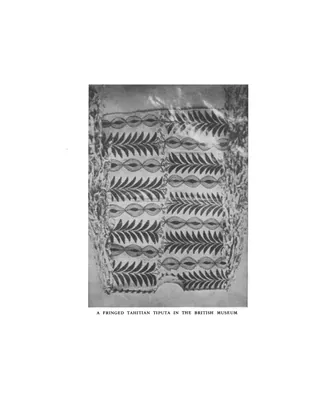
Pacific Bark-Cloth
Article · 19 pages
An article by Gertrude Whiting on the making, decoration and use of Pacific bark-cloth (kapa, tapa, siapo), drawing on accounts by Joseph Banks, Reinhold Forster, William Ellis, James Cook, William T. Brigham and others. It covers the trees used, stripping, soaking and beating, patching and pasting, dyeing and stamping with bamboo blocks, lace kapa, perfuming and waterproofing, sewing, and a glossary of Hawaiian, Samoan, Tahitian and Fijian terms. Comparisons are made to bark-cloth in Africa, Borneo and Malaya. Illustrations show kapa specimens from the Bishop Museum and British Museum, bamboo stamping sticks, and Hawaiian warriors with kapa beards.
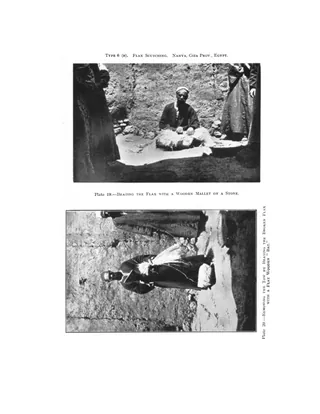
Methods of Hand Spinning in Egypt and the Sudan
Monograph · 79 pages
A 1931 Bankfield Museum Notes monograph by Grace M. Crowfoot surveying hand-spinning methods in Egypt and the Sudan. It classifies methods into types (hand spinning, hooked stick, spindle rotated in the hand, grasped, supported, and suspended spindle) and describes each from her field observations of wool, flax and cotton spinning among named peoples and villages. It compares modern practice with Ancient Egyptian tomb scenes and weaving models (Daga, Baqt, Khety, Mehenkwetre, Beni Hasan), and covers spindles, whorls, doubling and warping. Illustrated with many photographic plates, line drawings, summary tables, appendices and an index.
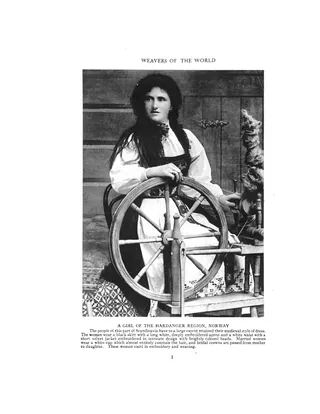
Weavers of the World
National Geographic, August 1919
Article · 8 pages
A photographic feature from National Geographic showing weavers and spinners in eight parts of the world, each plate with a short caption. Subjects include a Hardanger girl at a spinning wheel in Norway, a woman spinning with distaff and spindle in northern Portugal, a Navajo woman at an upright loom, outdoor weaving in Mexico, homespun linen weaving in Serbia, mat weaving on Santa Cruz in the South Pacific, reed floor-covering manufacture in Egypt, and Korean women spinning and weaving. The captions give brief notes on dress, materials, and loom types, but there are no technical weaving details or drafts.
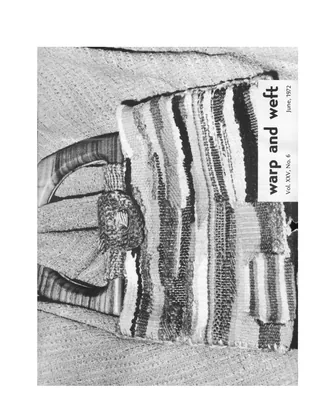
Warp & Weft, Vol. 25, No. 6 (June 1972)
Warp & Weft, June 1972
Periodical · 8 pages · weaving drafts
June 1972 issue of Warp & Weft, the monthly newsletter of Robin & Russ Handweavers in McMinnville, Oregon. It features a full draft and weaving instructions for "Buttermilk Sky," a silk and tussah-rayon drapery or coat fabric combining one-spot huck and rosepath, including threading, tie-up, 36-shot treadling, sleying, and cost per yard. Editor Russell Groff also gives a critical report on the Convergence 1972 conference in Detroit, reviews Rene Gardi's "African Crafts and Craftsmen," and describes a tapestry bag by Lucy Delgado on the cover. The issue ends with classified ads for yarns and supplies and a marketplace page.
WeaveTech Archives, February 1999
WeaveTech, February 1999
Web Doc · 127 pages
Archive of the WeaveTech email discussion list for February 1999, reproduced as raw messages with full mail headers. Topics include co-op galleries and selling work, shrinkage of rayon yarn, computer-driven dobby and J-Comp looms, fly shuttles and beaters, the Macomber sliding shuttle, huck lace, lace weave color effects, whiter silk, African strip weaving, dimity, and mommy measurement of fine yarns. It also includes list administration notices, a notice of a death in the dyeing community, the Vav conference, and rules for the Third Annual Non-Holiday Serviette (Napkin) Exchange. Only one page has a weaving draft, in text form.
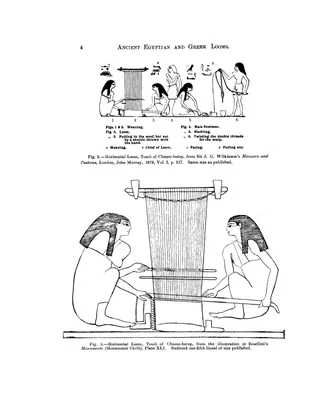
Ancient Egyptian and Greek Looms
Monograph · 45 pages
Bankfield Museum Notes, Second Series No. 2 (Halifax, April 1913), in which the museum's keeper H. Ling Roth examines how looms were built and used in ancient Egypt and Greece. He compares published copies of Egyptian tomb paintings (Beni Hasan, Thebes, El Bersheh) with new drawings by N. de G. Davies, and discusses horizontal and vertical Egyptian looms, loom parts such as beaters-in, laze rods, heddles, reeds and warp weights, and the Rameses III linen girdle. A section by W. W. Midgley gives a microscopic examination of fifteen Egyptian mummy wrappings, with a table of thread counts and fibre measurements. The Greek section covers vase paintings, warp-weighted looms, and Scandinavian, Icelandic and English chalk-weight parallels.
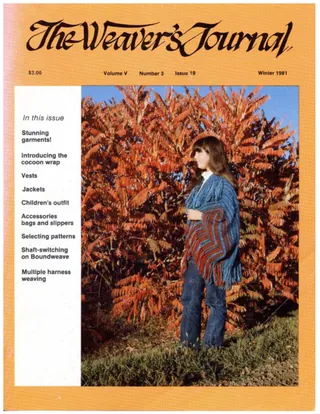
Weaver's Journal, Vol. V, No. 3, Issue 19 (Winter 1981)
Weaver's Journal, Winter 1981
Periodical · 56 pages · weaving drafts
Winter 1981 issue of The Weaver's Journal, devoted largely to handwoven clothing and accessories. It includes the new cocoon wrap jacket with several woven variations, vests, cardigan and other jackets, a ruana, an oval cape, a child's tulip outfit with loom-controlled inlay, a jacket inspired by West African strip weaving, bags, slippers and a sheepskin-and-weaving article. Technical pieces cover choosing commercial patterns for handwoven fabric, the multiple harness course (crepe weaves, fancy twills), color-and-weave effects on twill, and shaft-switching on boundweave rugs. The issue also has product reviews (Glimåkra looms), book reviews, and advertisements, with many threading, tie-up and treadling drafts and garment layout diagrams.
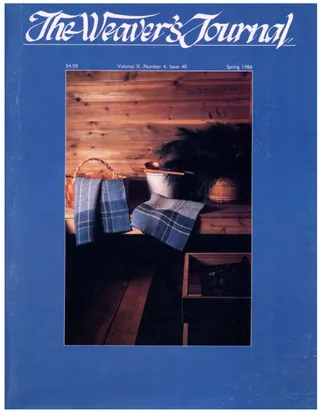
Weaver's Journal, Vol. X, No. 4 Issue 40 (Spring 1986)
Weaver's Journal, Spring 1986
Periodical · 92 pages · weaving drafts
Tenth-anniversary issue (Spring 1986) of The Weaver's Journal, with a tribute to founder Clotilde Barrett and her article on designing multi-harness huck. Other features cover Shaker towels, hemstitched edgings for linen, Danish twined rag rugs, loom-woven baskets, color theory and visual illusions, boundweave, sock-top bathmats and sauna towels in tow linen, and custom upholstery and windlace woven for a 1930 Cadillac. Further articles deal with West African strip weaving, point block progression, ways to hang a weaving, warp-faced double cloth adapted from Andean technique, and shed rods. The issue also has editorials, letters, product news, book reviews, a calendar, classifieds and advertisements, with drafts on about 20 pages.
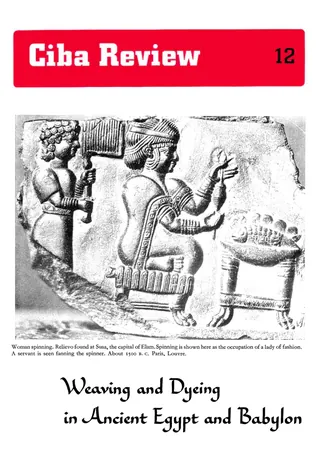
Ciba Review, No. 12 (May 1938): Weaving and Dyeing in Ancient Egypt and Babylon
Ciba Review, May 1938
Periodical · 40 pages
Issue No. 12 of the Ciba Review, devoted to textiles and dyeing in the ancient Near East. Articles cover the history and geography of Babylon and Egypt, Egyptian linen and dress (spinning, looms, woven and embroidered royal garments, sandals), Babylonian and Assyrian wool and dress, and the colours and pigments of the ancient Orient. Shorter items on board (card) weaving, Egyptian palettes, hieroglyph decipherment, Babylon excavators, parchment and the Babylonian chronology follow. Illustrated with reliefs, tomb paintings, statues, and models of Egyptian looms; it contains no weaving drafts, and the issue carries Ciba dye advertisements.
49 documents found