Textile Documents › Topic: Yarns and threads
651 documents found
Sort: 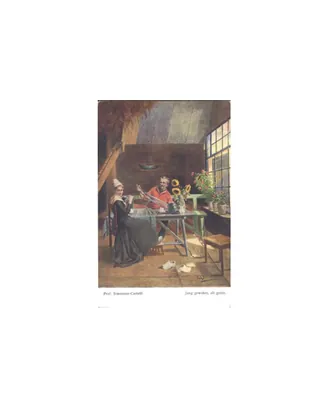
Jung gewohnt, alt getan. [Accustomed Young, Done Old.]
Ephemera · 1 page · German
A single picture postcard with a colour illustration of an interior scene: a woman in a dark dress and white cap sits at a table holding a blue cup while a man in a red shirt holds up strands of colourful yarn or ribbon, with a model ship nearby. The printed text gives an artist or series name, Prof. Simonsen-Castelli, and the German proverb "Jung gewohnt, alt getan." The card relates to the catalog topic of winding yarn.
Making Gold Lace
Article · 1 page
A short magazine piece describing how gold wire for gold lace is made. A silver rod is coated with gold leaf, burnished, and drawn through steel plates into very fine wire, with the gold keeping the same ratio to the silver throughout. The article estimates the gold layer on the finest wire at about one-third of one-millionth of an inch thick.
Manufacture of Fancy Yarn, Part 1
Article · 5 pages
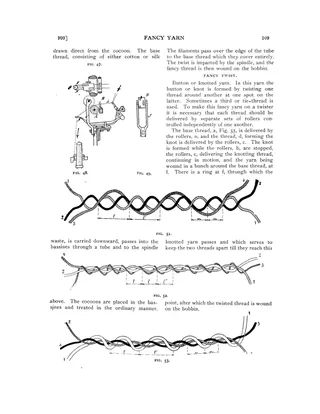
A continuing 1906 trade-journal article on making fancy (novelty) yarns on twisting machines. This installment covers twisted gut yarn, barred twist, mouline twist, silk-covered threads, and button or knotted yarn. It explains the roller, gear, ratchet and cam arrangements that start and stop delivery rolls to form knots. It is illustrated with numbered line figures of yarn structures and machine parts.
Manufacture of Fancy Yarn, Part 2
Article · 7 pages
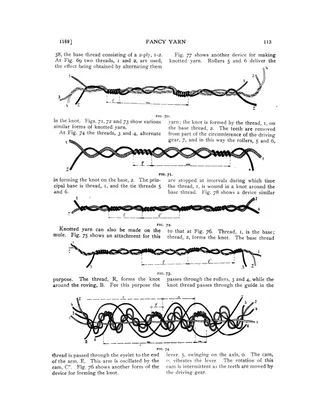
Second installment of a serial article on fancy yarn manufacture, published in Textile World Record in February 1906. It describes the machinery and mechanisms for making knotted (boutonné) yarns: cams and clutch-driven roller sets that stop and start to form knots, mule attachments, and a frame with hollow spindles, bobbins and a ratchet-driven reel. It also covers how knot size, spacing and elongation are controlled by changing cams, gears and vibrating guide eyes or spindle rails. Figures 60-84 show the apparatus and the resulting yarn structures.
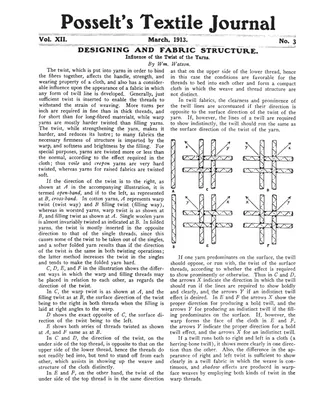
Designing and Fabric Structure
Article · 1 page
A one-page technical article by Wm. Watson on how the direction and amount of yarn twist affect a fabric's handle, strength, and appearance. It explains open-band and cross-band twist, the usual twist directions for cotton, worsted, and woolen yarns, and folded yarns. It also covers how warp and filling twist combine, and how twill line direction should relate to surface twist to make twill lines bold or indistinct. A diagram (A-F) illustrates the twist directions and thread crossings.
Fil D'Or et D'Argent [Gold and Silver Thread]
Article · 2 pages · French
French encyclopedia article on gold and silver thread, covering drawn precious-metal wire and silk threads wrapped with thin flattened gilt or silver strip. It describes the use of these threads in passementerie for military epaulettes, belts and braids, and the shift from pure silver or gilt copper cores to mixed silver-over-copper wire. It then reports M. Hélouis's improvement of 'mi-fin' by using nickel silver (maillechort) wire, and his coloring of metal strips with galvanic lead-peroxide deposits following Nobili and Becquerel. It also mentions the effect of foreign competition on Lyon manufacture.
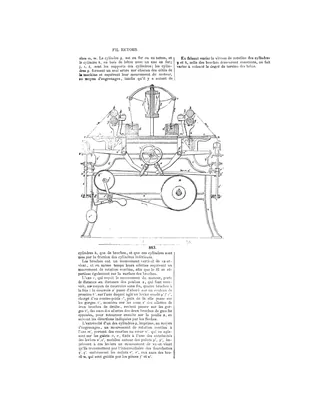
Fil Retors [Plied Thread]
Article · 2 pages · French
A short 19th-century French encyclopedia entry describing a machine for twisting several strands of cotton, wool or linen into a single plied thread for sewing, netting and similar uses. It explains the parts shown in a transverse section (figure 883): bobbins, glass guide rods, water troughs for wetting the thread, drawing cylinders, spindles with flyers, belt drives and heart-shaped cams. It also notes how varying the cylinder speed against constant spindle speed changes the degree of twist.
Handweaving News (August 1945): Importance of Texture in Handweaving
Periodical · 2 pages
A 1945 Handweaving News article in which Nellie Sargent Johnson argues that texture, built from the choice and size of threads and yarns, matters more to modern handweaving than traditional patterns. She gives advice on mixing odds and ends in warps and on unusual weft materials such as raffia, hat straw, cellophane, nylon and leather lacing. She then lists nine texture experiments woven by her Wayne University students, with warp and weft sequences for hats, bags and upholstery, and asks readers whether they would like a texture exhibit.
Of Fiber - Combining Fibers in Weaving
Article · 1 page
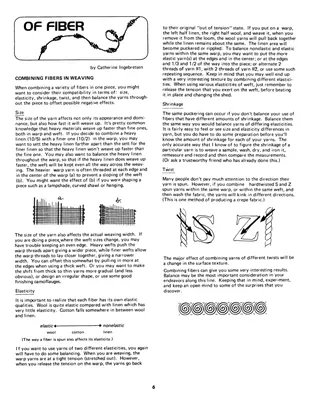
A one-page column from the Minnesota Weaver's 'Of Fiber' series on what to consider when combining different fibers in one woven piece. It covers yarn size, elasticity, shrinkage and twist (S and Z), and suggests balancing yarns across the warp to avoid sloping wefts, puckering and uneven edges. It also advises sampling, washing and measuring to determine shrinkage.
Patterns in Twist
Master Weaver, March-April 1963
Article · 4 pages · weaving drafts
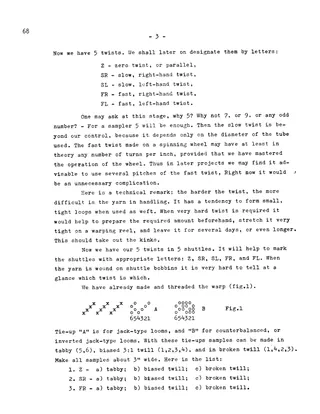
A short instructional article on creating patterns by plying two or more colored yarns together with different twist directions and pitches, used as weft (and in principle warp). It defines five twist types (zero, slow right/left, fast right/left), explains how to prepare them with a spinning wheel, doubling stand and warping frame, and gives a tie-up for a sampler in tabby, 3:1 biased twill and broken twill. It lists nine sample weft sequences and notes on extending the technique to more colors and to warp twist.
Unusual Yarns - 2
Master Weaver, January-February 1963
Article · 4 pages
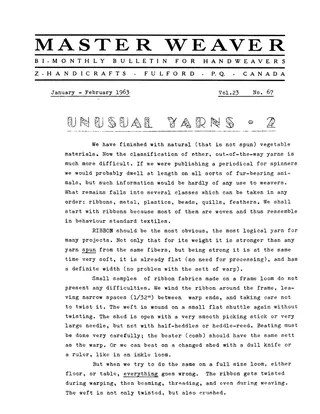
An article from the Master Weaver bulletin on weaving with ribbon as warp and weft. It explains how to handle flat ribbon at each stage: sectional warping with a makeshift nail raddle, cord heddles, a No. 5 reed, tying in, heading, and weaving with a flat shuttle. It also covers ways to beat without crushing the ribbon, such as sectional beating with a pin comb or stiffening the ribbon with starch or wax. It ends with brief notes on wider ribbons, plain threading on four shafts, and tabby and 2:2 twill.
Wood-Pulp Yarn
Article · 1 page
A short encyclopedia entry defining wood-pulp yarn, a coarse yarn made by twisting narrow strips of wood-pulp paper. It describes its uses in twine and coarse fabrics such as floor and wall coverings, bagging and upholstery drapery, and notes that it is replacing jute because it wears better and costs less, though it is weaker. It lists the trade names xylolin, textilose, silvalin and licella.
Yarn
Zell's Encyclopedia, 1876
Article · 1 page
A short encyclopedia entry defining yarn as thread spun for weaving and explaining how fineness is standardized by counting hanks or cuts per pound. It gives hank lengths for linen (300 yards) and for wool or cotton (840 yards). It also discusses Grège yarn, a wool and silk blend used as warp in long shawls, first made in France and later developed in Germany.
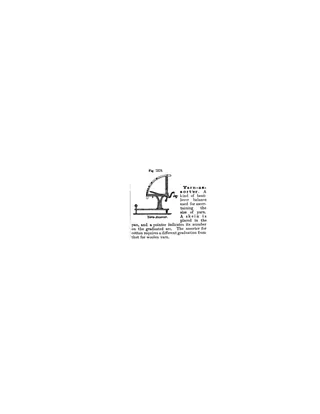
Yarn Assorter
Article · 1 page
A short dictionary entry from Knight's American Mechanical Dictionary describing the yarn-assorter, a bent-lever balance for finding the size (count) of yarn. A skein is placed in the pan and a pointer shows its number on a graduated arc. The entry notes that cotton and woolen yarn need different graduations, and includes an illustration (Fig. 7378).
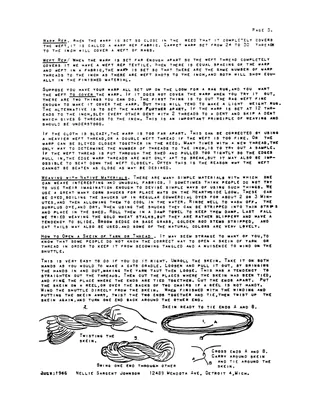
Handweaving News (July 1946): Threads -- The Weaver's Materials
Periodical · 3 pages
An article from Handweaving News (July 1946) by Nellie Sargent Johnson on choosing yarns and threads for handweaving. It covers fiber classes, matching thread to end use and technique, making and labeling samples, checking color fastness, and sleying with 12, 15 and 20 dent reeds. It also explains warp rep and weft rep, weaving with native materials such as corn shucks and grasses, and how to open and tie a skein, with four line drawings.
The Influence of the Twist of the Yarn upon the Fabric
Article · 3 pages · weaving drafts
Three pages from Posselt's Textile Journal, April 1911 (pp. 86-88). The main article explains how direction and amount of twist affect yarn strength and fabric character, covering fiber length, count, raw material, lubricants, warp versus filling yarns, napped and smooth-faced fabrics, and mule versus ring spinning. The pages also open with the end of a piece on combining entwining and regular twills (Figs. 3 and 4), and close with the start of a ribbon-design article on preparing sketches and choosing point paper.
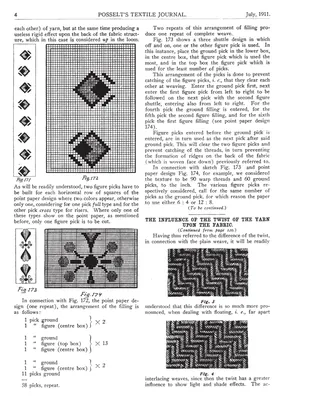
The Influence of the Twist of the Yarn upon the Fabric
Article · 3 pages · weaving drafts
A continuation of E. A. Posselt's article on how the direction of yarn twist (right hand or left hand) in warp and filling changes the look of woven fabric. It explains light and shade effects in floating weaves using enlarged diagrams of 6-harness twill and broken twill structures (Figs. 3-18), comparing like, opposite and alternating twist combinations. It also gives practical advice on keeping different twist yarns distinct in the mill and at the loom. The first page opens with the end of an article on Jacquard figure picks and point paper designs (Figs. 172-174) for multi-shuttle weaving.
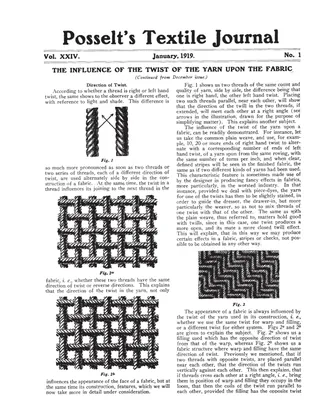
The Influence of the Twist of the Yarn upon the Fabric
Article · 2 pages
A continuation of a serialized article from Posselt's Textile Journal on how the direction of yarn twist (right-hand or left-hand) affects the look and construction of woven fabric. It explains light-and-shade effects, stripes made by alternating twists in plain weave and twills, and what happens when warp and filling have the same or opposite twist. Diagrams of enlarged fabric structures in a 3/3 six-harness twill show combinations of warp and filling twist, with practical advice for mills on keeping the twists separate.
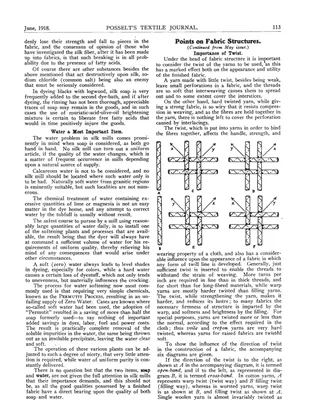
Points on Fabric Structures
Article · 2 pages
Continuation of E. A. Posselt's article on fabric structure from Posselt's Textile Journal, June 1918. It discusses how yarn twist (amount and direction) affects the strength, handle, and appearance of woven cloth, using six diagrams to explain open-band and cross-band twist and how twist direction interacts with twill line direction. It also summarizes a theory of cloth structure and the reasons manufacturers depart from it (utility, appearance, cost). The scan begins with the end of an unrelated piece on soap and water in silk mills and ends with the start of an article on the dyestuff situation.
Practical Weaving Suggestions, Vol. VI, No. 1: Planning Hand Woven Fabric
Periodical · 12 pages
An issue of Lily Mills' trade newsletter Practical Weaving Suggestions. Howard C. Ford's article on planning handwoven fabric lists household and clothing items with suitable weave techniques, advises on choosing yarns for curtains, draperies and table linens, and explains yarn counts for cotton, wool, linen and silk or rayon, with a worked example of calculating warp yardage. The issue also has Osma Gallinger's "Lily's Weaving Chart", a table of Lily yarns with yards per pound, colors, tabby setting per inch and suggested uses as warp or pattern weft, and an advertisement for Lily yarns and the Weaver's Notebook.
Shuttle-Craft Bulletin, Vol. XXX, No. 1 (January 1953)
Periodical · 3 pages
Portfolio insert for the January 1953 Shuttle-Craft Bulletin (Vol. XXX, No. 1) holding two mounted woven samples with notes. The notes give draft and tie-up numbers that refer to the Bulletin, and describe the yarns and sett used. The first sample is woven with 18/2 worsted at 28 ends per inch, and the text discusses its poor elasticity and warp breakage. The second uses a 10/3 cotton warp at 20 per inch with a rayon-mohair weft for draperies.
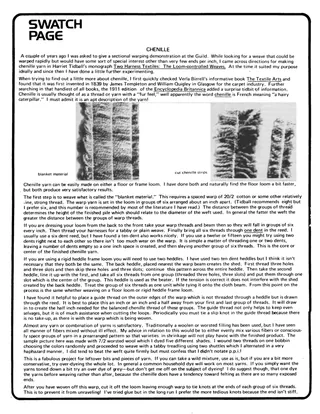
Swatch Page - Chenille
Article · 2 pages
A short Swatch Page column explaining how to make chenille yarn by weaving a spaced "blanket material" warp in groups of six threads, then cutting it into strips between the groups. It covers setup on floor looms and rigid heddle frame looms, weft choices, and cutting the strips. It also describes weaving the chenille as weft in a reversible rug with tabby spacing shots, and gives some history of chenille and a short reference list.
T-Shirt Yarns: How to Recycle T-Shirts, Etc.
Karen Madigan · 1988
Monograph · 24 pages
A 1988 self-published booklet from New South Wales, Australia, on turning stretch knit fabrics such as T-shirts into yarn for knitting, crochet, weaving and other yarn crafts. It covers fabric types and the yarns they produce, testing for greatest stretch, cutting a continuous strip (including tubular knits), stabilizing by stretching, and heavier yarns for mats and rugs. It also covers decorative additions (tags, beads, bows, thick and thin yarn), plying, stretching the yarn supply for a garment, brief notes on weaving and inkle weaving with the yarn, a lace knitting pattern, a glossary and a bibliography.
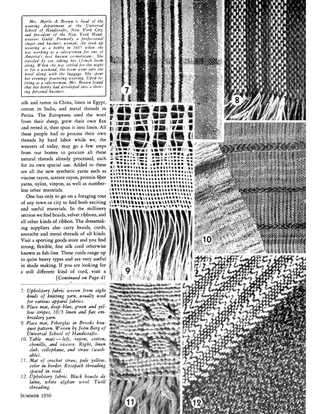
What Kinds of Yarns for Handweaving? More than One Might Think
Article · 4 pages
Article by Myrtle A. Brown, head of weaving at the Universal School of Handicrafts, on the wide range of materials handweavers can use as yarns, including unconventional ones sourced from millinery, sporting goods, twine and lumber suppliers. It surveys fibers by origin (vegetable, animal, mineral, synthetic) and gives practical remarks on knitting wools, crochet cottons, embroidery flax, straw, nylon cord, silk, ribbons, plastics and Fiberglas, with finishing advice. Twelve photographs of sample textiles are captioned with materials and threadings, and the scan also includes a page of tweed fabric captions, advertisements and 'Personal Mention' profiles.
Yarn
Article · 1 page
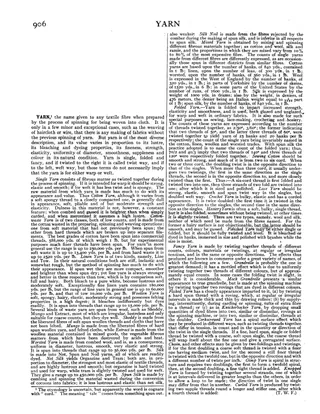
Encyclopedia article defining yarn as any textile fibre spun for weaving, and describing single, folded and fancy yarns. It compares cotton, linen, woollen, worsted and silk yarns (including waste yarns such as shoddy and mungo) and gives the count systems used for each fibre. It also covers folded yarns for sewing, lace, crochet and hosiery, and fancy yarns such as grandrelle, flaked, corkscrewed, gimp, knopped and curled.
The Influence of the Twist of the Yarn upon the Fabric
Article · 2 pages
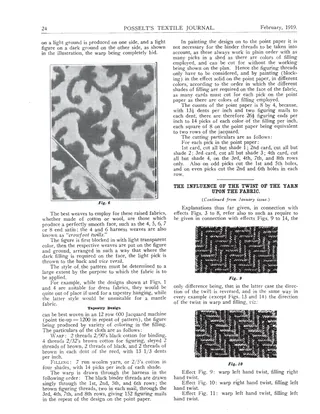
Two journal pages from Posselt's Textile Journal, February 1919, containing the end of a piece on raised Jacquard fabrics and tapestry design (warp and filling particulars, point paper counts, card cutting) and the continuation of 'The Influence of the Twist of the Yarn upon the Fabric'. The twist article describes effects in twill and broken twill fabrics (Figs. 9-18) produced by right- and left-hand twist in warp and filling, alone or alternated. The pages end with a short market note on aniline dyes and coal tar intermediates.
Looming Arts, Vol. 6, No. 5 (September-October 1971)
Looming Arts, September-October 1971
Periodical · 8 pages · weaving drafts
Issue of Mary Pendleton's handweaving newsletter from Sedona, Arizona, September/October 1971. It opens with the editor's note on the sudden death of her mother and sister, followed by reader letters on natural dyeing, a Navajo weaver poem, and studio news. Projects include a 6-treadle wool sample "A Bouquet for Mother" with threading and treadling, a "Sticky Problem" column on slipping chenille wefts, two-harness wrapping and "Happy Daze" circular weft techniques, and an 8-shaft chenille and black cotton fabric inspired by the hymn The Lost Chord, with full draft and weaving directions. The issue also carries yarn offerings and advertisements for Pendleton looms and local businesses.
Shuttle-Craft Bulletin, Vol. XXX, No. 5 (May 1953)
Periodical · 4 pages
Portfolio of woven and yarn samples issued with the May 1953 Shuttle-Craft Bulletin. The text page describes the yarn samples: a 4-run woolen yarn from the Coffin Sheep Co. Weaver's Center in Yakima, Washington, woven as tabby at 18 ends per inch for a sheer fabric and at 30 ends per inch for a firm one. It also describes a sample from the German pattern collection Einschaftige Leinenbindungen (#43), woven in brown and yellow 20/6 Lily and natural pearl cotton at 18 ends per inch. The other pages show attached fabric swatches and yarn on cards.
Tensile Strength, Elasticity and Elongation in Yarns
Article · 4 pages
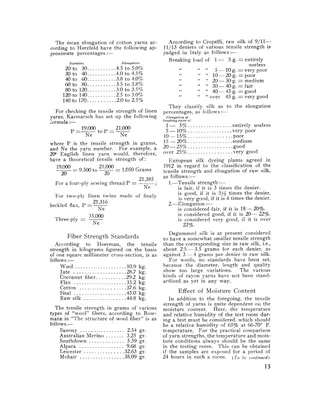
A technical article on the factors that determine the tensile strength, elasticity and elongation of textile yarns. It covers the effects of twist, fiber elastic limit, the number of fibers in a yarn cross-section, uneven (thick and thin) places, and fiber quality. It gives formulas and tables for the expected strength of cotton yarns by count and twist, and for linen yarns. It also gives elongation percentages for cotton, strength figures for wool, silk and other fibers, and silk grading standards. It closes with the effect of moisture and test-room conditions and is marked to be continued.
Terrace Textures: Basic Design Series
Monograph · 9 pages · weaving drafts
A set of nine sample-and-instruction sheets from Terrace Yarn Shop of Portland, Oregon, showing how different yarns weave up on twill threadings. Each sheet covers one yarn type (cotton boucle, wool and rayon floss, 7/2 and 9/2 linen, novelty rayon, 2-32 wool, singles weft linen, wool suiting) with warp set, reed, amounts, and finishing advice. Projects include table mats, towels, dirndl skirts, and women's and men's suiting. Pages 3, 7, 8 and 9 give threadings and treadlings, including Thousand Flowers, Whig Rose and an irregular twill, with photographs of woven swatches.
Thread
Rees's Cyclopedia, 1819
Article · 1 page
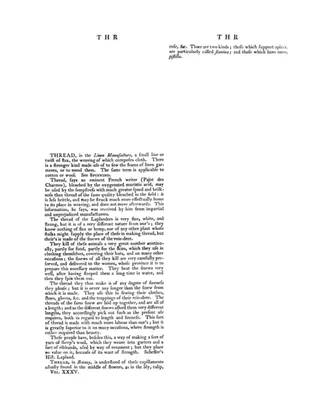
A single-page encyclopedia entry on thread from Rees's Cyclopedia. It defines thread in the linen manufacture as a twist of flax used for weaving and sewing, and notes a French report that thread bleached with oxygenated muriatic acid is less brittle and works better in weaving and sewing. It also describes how Laplanders make very fine, strong thread from reindeer sinews, and mentions their wool yarn used for garters and ribbons. The entry ends with the start of a botanical definition of thread.
Thread
Article · 1 page
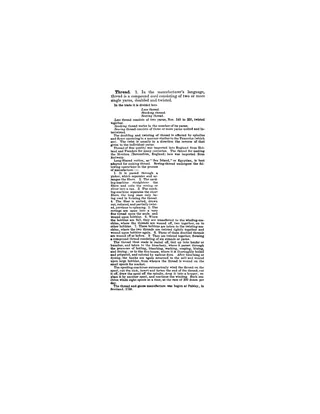
A one-page dictionary entry defining thread as a compound cord of two or more yarns doubled and twisted. It lists the trade categories (lace, stocking and sewing thread) and describes the steps of making cotton sewing thread, from picking and carding through spinning, doubling, twisting, bleaching or dyeing, and spooling. It also notes the historical import of fine thread from Holland and Flanders and the start of thread manufacture at Paisley in 1759.
WeaveTech Archives, September 1998
WeaveTech, September 1998
Web Doc · 11 pages
Archive of WeaveTech mailing list digests from late September 1998 (volume 1, numbers 1-3), the first days of the list. Discussion covers sources for very fine threads (cotton, silk, linen, wool, rayon), dyeing fine warps, a yards-per-pound calculation for the McMorran balance, whether a stripe can be called a block, non-unit weaves, choosing a wide loom with warp separators and sectional warping, and a copyright proposal.
Effect of Yarn Twist and Weave on the General Appearance of a Fabric
Article · 7 pages · weaving drafts
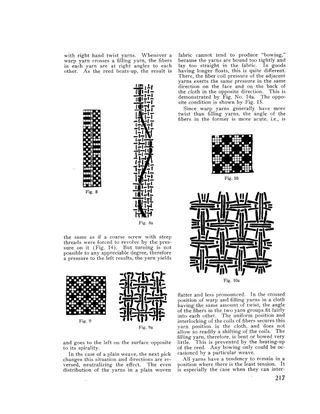
A 1929 article from The Melliand by Josef Funke on how the direction and amount of yarn twist interact with weave structure to affect the look of a woven fabric. It explains how light reflects differently from right- and left-twist yarns, why yarns bow or deviate from straight lines in floats, honeycomb, mock leno and huck weaves, and how warp and filling twist relationships affect beating-up. It ends with how twill and gabardine constructions can control tilting of floats. Illustrated with numbered figures, including twill and other weave drawdowns.
Yarns, Part 1
Monograph · 46 pages
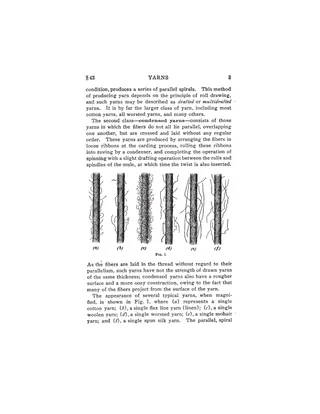
An International Textbook Company instruction paper (Section 43) on yarns made from vegetable fibers. It covers yarn terminology and classification (drawn vs. condensed, by material), then cotton yarns by raw material, preparation, counts, and put-up forms such as cops, bobbins, spools, skeins, beams, chains, and cones. Shorter sections treat linen, hemp, jute, ramie, leaf and fruit fibers, and end with examination questions.
Yarns, Part 2
Monograph · 53 pages
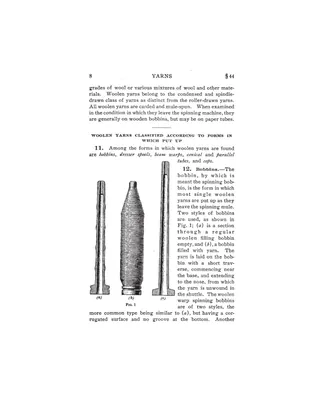
Part 2 of an International Textbook Company instruction paper on yarns, covering yarns from animal fibers (woolen, worsted, hair and silk yarns) and yarns with special characteristics. It classifies woolen and worsted yarns by raw material, manufacturing system (Bradford, French, uncombed), size and the forms in which they are put up (bobbins, cops, spools, skeins). It goes on to silk (thrown and spun), converted yarns (bleached, mercerized, printed, glazed), conditioning, mixes and twists, and a long section on novelty yarns such as knickerbocker, bead, bunch and knotted yarns. It includes line drawings of yarn packages and novelty yarns, and ends with review questions.
Of Fiber - Yarn Sizes
Article · 1 page
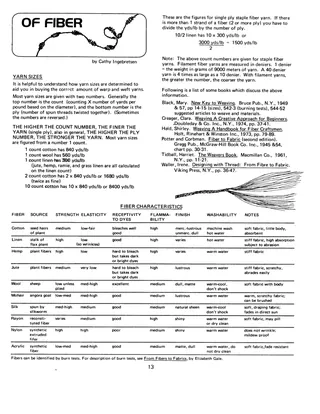
A short article from the Minnesota Weaver explaining how yarn sizes are determined, so weavers can buy the right amount of warp and weft yarn. It covers count and ply, yards per pound for a number 1 count of cotton, wool and linen, worked examples, and deniers for filament yarns. It also lists reference books on the subject and gives a chart comparing fiber characteristics (source, strength, elasticity, dye receptivity, flammability, finish, washability) for cotton, linen, hemp, jute, wool, mohair, silk, rayon, nylon and acrylic.
I. C. S. Reference Library; Vol. 89: Yarns
Book · 465 pages
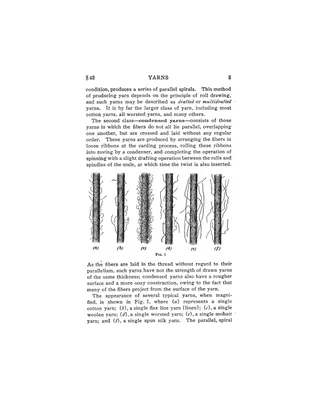
A 1906 International Correspondence Schools textbook (Reference Library vol. 89) that bundles five instruction papers for textile mill students: Yarns, Cloth Rooms, Mill Engineering, Reeling and Baling, and Winding. The Yarns part, which opens the volume, classifies cotton, linen, hemp, jute, ramie, woolen, worsted, hair, silk, mineral and novelty yarns by material, preparation, count, put-up form, and use. The remaining parts cover cloth-room machinery and inspection, mill construction and power plants, cotton-mill planning with production tables, yarn reeling and baling, and winding machines. Each section ends with examination questions and illustrated line drawings of machinery and yarn forms.
Minnesota Weaver Quarterly, Vol. I, No. 1 (Fall 1982)
Minnesota Weaver Quarterly, Fall 1982
Periodical · 22 pages
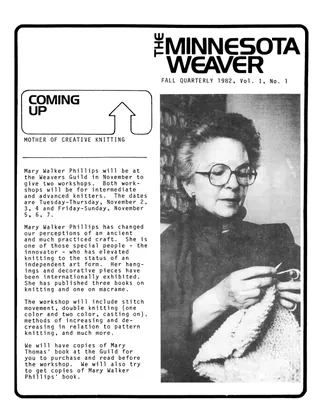
First issue of the Weavers Guild of Minnesota's quarterly, themed on fibers and yarns. It includes articles on natural yarns (wool, mohair, silk, cotton), warp fibers for frame (rigid heddle) looms, historical blended fabrics illustrated with Minneapolis Institute of Arts textiles, handweaving and knitting with synthetics, natural and synthetic dyeing, and heathering fleece before spinning. It also carries guild news: a Mary Walker Phillips knitting workshop, study group listings, fiber source group-buy offerings, and member workshops for 1982-83.
Bushings
Article · 1 page
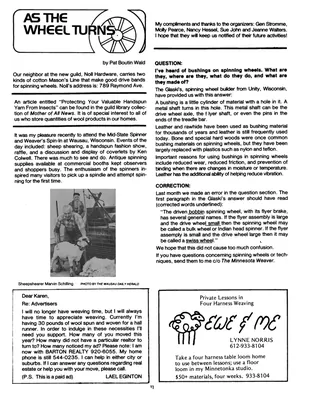
A single-page "As the Wheel Turns" spinning column from the Minnesota Weaver. It answers a reader's question about spinning wheel bushings: what they are, where they sit on the wheel (drive wheel axle, flyer shaft, treadle bar pins), and what they are made of (leather, rawhide, bone, hard woods, nylon, teflon). It also includes a correction to the previous month's answer on bulk and Swiss wheels, a tip on cotton Mason's Line for drive bands, and a report on a Wausau, Wisconsin spin-in.
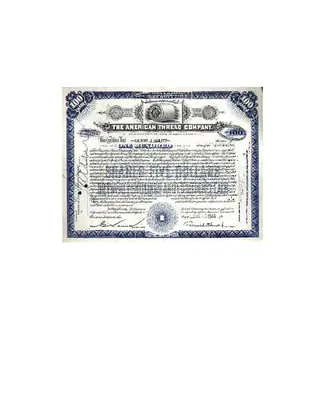
Certificate for common stock
American Thread Company, 1946
Ephemera · 1 page
A single-page stock certificate issued by The American Thread Company certifying that Gilbert J. Goulett owns shares of its common stock. The certificate has an ornate decorative border, '100' medallions in the corners, a thread spool vignette at the top, a circular seal and handwritten signatures. It is business ephemera relating to a thread manufacturer, with no weaving content.
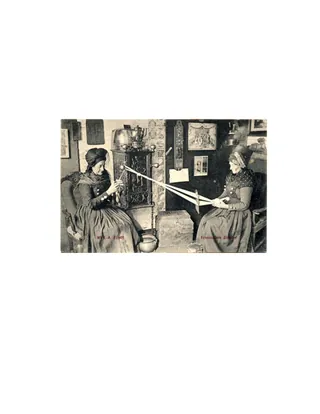
Friesisches Zimmer [Frisian Room]
Ephemera · 1 page · German
A single black-and-white picture postcard showing two women in traditional dress seated in an interior room, facing each other and holding or winding a long skein of pale yarn between them. The printed caption identifies the scene as a Frisian room (Friesisches Zimmer) and gives a publisher or photographer credit. It contains no weaving drafts.
Modern Count of Yarn
Master Weaver, May 1955
Article · 3 pages
A 1955 article from the Master Weaver newsletter that criticizes the confusing yarn-count systems used for cotton, linen, wool, silk and rayon in English-speaking countries. It lists old English yarn measures from the early 19th century and argues for the metric yarn number (meters per gram), with conversion factors and formulas between English counts and metric numbers. It also explains how to find an unknown yarn's metric number by weighing a one-meter sample and how to write plied yarns.
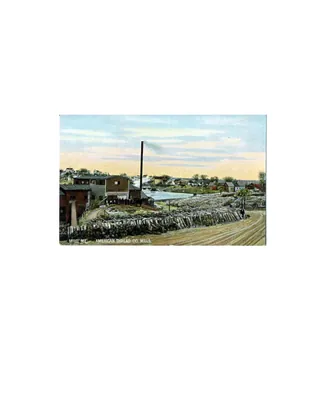
Picture postcard
Ephemera · 1 page
A single hand-colored picture postcard showing the American Thread Co. mills in Milo, Maine. The image depicts a multi-story brick and wood mill building with a tall smokestack emitting smoke and workers gathered at the entrance. The only text is the printed caption identifying the mills and location.
Synthetic Yarns
Master Weaver, July 1957
Article · 3 pages
An article from Master Weaver (No. 34, July 1957) that sorts weaving yarns into natural, processed, synthetic and mixed fibers. It explains why synthetic yarns exist and then reviews the properties of rayon types, nylon, Vinyon, Saran, Orlon, Terylene, Perlon, polythene and glass fiber from a handweaver's viewpoint. The scan opens with the end of a piece on texture effects in pattern weaving and closes with the start of an article on velvet rugs.
The TEX System of yarn sizing
Article · 1 page
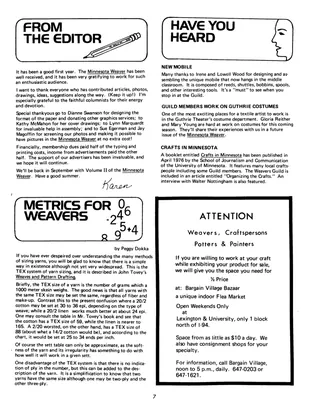
A short article, "Metrics for Weavers" by Peggy Dokka, explaining the TEX system of yarn sizing, in which a yarn's size is the weight in grams of a 1000 meter skein. It argues that yarns of equal TEX can be set at the same sett regardless of fiber, citing the table in John Tovey's Weaves and Pattern Drafting with examples for cotton, linen and worsted. The page also carries the editor's end-of-year note, a "Have You Heard" column of guild news, and an advertisement for a flea market.

Thread
Article · 1 page
A one-sentence encyclopedia entry defining thread as a small line made from many fine fibres of vegetable or animal origin, such as flax, cotton, or silk, and named accordingly as linen, cotton, or silk thread. It gives only a basic definition, with no discussion of manufacture or use.
Triaxial Fabric Pattern, US Patent No. 4191219
Patent · 8 pages
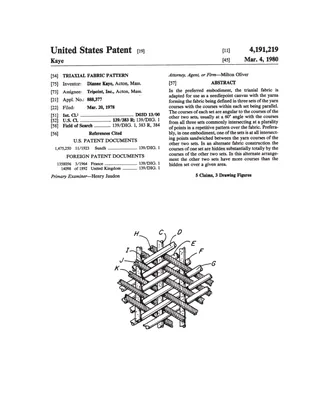
US Patent 4,191,219, granted March 4, 1980 to Dianne Kaye of Acton, Massachusetts and assigned to Tripoint, Inc., for a triaxial woven fabric intended mainly as needlepoint canvas. Three sets of yarn courses cross at about 60 degrees, with the warp sandwiched between two weft sets at each intersection to leave large triangular pores. A second embodiment hides the warp behind more closely spaced wefts. The scan includes a web-database printout and the original patent pages with claims, drawings and description, and contrasts the design with earlier triaxial patents such as the Dow (Doweave) patents.
Yarn
Article · 1 page
A one-sentence encyclopedia entry defining yarn as wool or flax spun into thread for weaving cloth, with a cross-reference to the article on Cloth. It gives only a brief definition and no technical detail on spinning or materials.
Adhesively Applied Schiffli Embroidery, US Patent No. 4788922
Patent · 8 pages
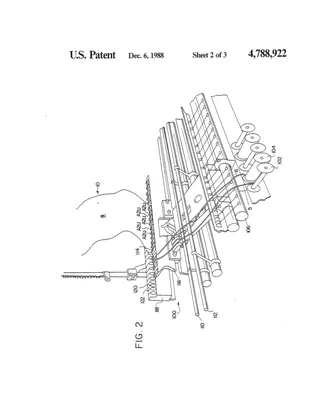
US Patent 4,788,922, granted to H. William Clarius and assigned to Lion Brothers Co., describes a heat-sealable Schiffli embroidery appliqué. The design is stitched in mirror image on a heat-degradable cellulosic backing, with bobbin yarn forming the top surface. The needle yarn combines a fusible thermoplastic monofilament with a non-fusible one, so the design bonds to a garment under heat and pressure and keeps its structure while the backing is brushed away. The document includes background on prior art, a description of the Schiffli loom setup, three drawing sheets and 20 claims.
651 documents found