Textile Documents › Publications › Publication: International Correspondence Schools
14 documents found
Sort: 
Card Clothing
Monograph · 69 pages
An International Correspondence Schools instruction text on card clothing, the wire-set foundations that cover carding machine cylinders, doffers and flats in textile mills. It covers flexible wire clothing (foundations, rib-set and twill-set construction, counts, wire gauge, points-per-square-foot calculations), the procedure for clothing cylinders, doffers and flats, card grinding and burnishing, and metallic and semiflexible clothing. Illustrated with photographs and diagrams of clothing types and machines, and it ends with examination questions for students.
Carding Practices, Cotton and Synthetic
Monograph · 122 pages
A 1955 International Correspondence Schools textbook on carding cotton and synthetic staple on revolving-flat and roller-top cards. It covers card gearing and calculations (actual and mechanical draft, draft constant, doffer and lickerin speeds, production), then the gauges and procedures for setting each part of the card. Later sections cover stripping methods (roll, vacuum, continuous and central waste systems), grinding and maintenance, and quality control: waste tests, sliver testers and charts, evenness testing and nep counts. It includes gearing diagrams for Saco-Lowell and Whitin cards, worked examples and practice problems.
Carding Practices: Wool and Synthetics
Monograph · 88 pages
An International Correspondence Schools instruction text on carding wool, worsted and synthetic fibers, written by John K. Stearns with Alfred S. Govin. It covers the automatic feed, the breaker card and metallic breast, the Peralta machine, Apperly and Scotch intermediate feeds, card drive and setting, finisher cards, ring and tape condensers, and production calculations for woolen cards. A final section deals with worsted and synthetic cards, balling heads, sliver calculations, cardroom management and static electricity. The text includes many photographs and line drawings of card components, worked formula examples, practice problems with answers, and examination questions.
Dobbies and Other Head Motions
Monograph · 57 pages · weaving drafts
An International Correspondence Schools textile technology text on dobbies and other head motions, the mechanisms that raise and lower loom harnesses for weaves too complex for cam looms. It explains dobby parts (knives, jacks, hooks, fingers, chain cylinders), how chain drafts are turned into wooden, paper or punched pattern chains, and how dobbies are connected to harnesses by sheaves, straps and connectors. Later sections cover cleaning and maintenance, timing, variations such as punched-chain, Staubli and multiplier dobbies, the butterfly motion, and a heavy-duty head motion with its drive gearing. It is illustrated with many line drawings and ends with review questions.
I. C. S. Reference Library; Vol. 65: Wool
Book · 586 pages
Volume 65 of the I.C.S. Reference Library, a 1905 textbook compiled from International Correspondence Schools instruction papers on the woollen trade. It covers wool and other fibres, their properties, and wool sources and sorting. It then follows processing through washing, drying, burring and carbonizing, opening and mixing, oils and oiling, woollen carding and card clothing, and woollen mule spinning. The text is illustrated with many machine diagrams and includes an appendix of chemical terms, but it has no weaving drafts.
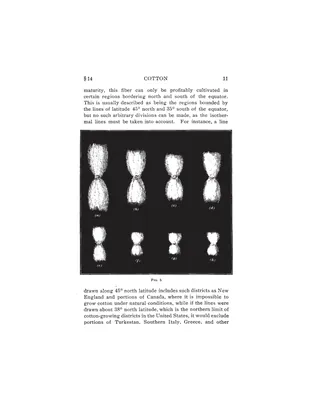
I. C. S. Reference Library; Vol. 87: Cotton
Book · 517 pages
Volume 87 of the I. C. S. Reference Library, a 1906 textbook for correspondence students on cotton and cotton-yarn preparation. It begins with cotton cultivation, fiber structure, the cottons of the world, ginning, baling and marketing. It then covers the machines that turn raw cotton into roving: pickers, cards (construction, clothing, grinding, setting), drawing rolls, railway heads and drawing frames, combers, and fly frames. Each section has numbered paragraphs, many line drawings of machine mechanisms, tables, examination questions with answers, and an index.
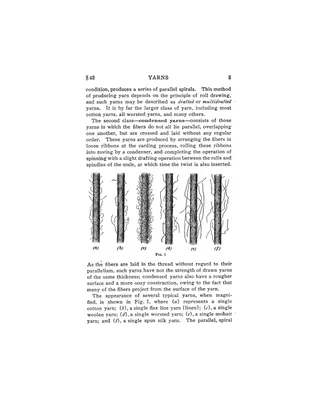
I. C. S. Reference Library; Vol. 89: Yarns
Book · 465 pages
A 1906 International Correspondence Schools textbook (Reference Library vol. 89) that bundles five instruction papers for textile mill students: Yarns, Cloth Rooms, Mill Engineering, Reeling and Baling, and Winding. The Yarns part, which opens the volume, classifies cotton, linen, hemp, jute, ramie, woolen, worsted, hair, silk, mineral and novelty yarns by material, preparation, count, put-up form, and use. The remaining parts cover cloth-room machinery and inspection, mill construction and power plants, cotton-mill planning with production tables, yarn reeling and baling, and winding machines. Each section ends with examination questions and illustrated line drawings of machinery and yarn forms.
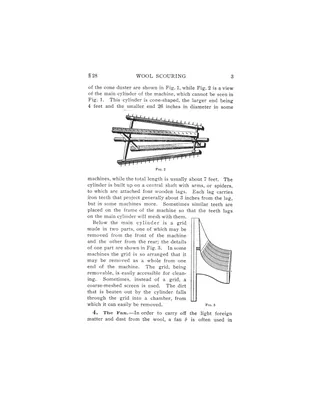
I. C. S. Reference Library; Vol. 90: Wool
Book · 529 pages · weaving drafts
Volume 90 of the I. C. S. Reference Library, a correspondence-school textbook on the preparation of wool for woolen and worsted manufacture. It covers the wool fiber, sheep breeds and wool qualities, sorting, scouring, drying, burr picking, carbonizing, mixing, oiling, woolen carding, card clothing and grinding, mule spinning, and warp preparation (spooling, dressing, beaming). Each section ends with examination questions, and the book has many line drawings of machines and a general index.

Register of International Correspondence Schools
Monograph · 57 pages
Third edition of a register published by the International Correspondence Schools (Scranton, Pa.), listing names and addresses of 107,239 students who completed or made considerable progress in their mail-instruction courses. It opens with a preface, an explanation of the I. C. S. system, instructions for reading the entries, a course index, and lists of subjects in each course, including abolished courses. The sampled directory pages cover Arizona Territory, with entries giving name, year, address, class letters and number, and record. The textile content is limited to course subject lists (textile designing, woolen, worsted and cotton manufacture, carpet design, silk designing, loom fixing, weaves).
Standard Textile Fabrics, Part 1
Monograph · 82 pages
An International Correspondence Schools instruction text by George E. Linton on standard cotton and linen fabrics, arranged as an alphabetical reference from airplane cloth to wigan. Each entry describes construction (thread counts, yarn sizes, widths), weave, finish, uses and working properties. Later sections cover cotton finishes and trade names, dyeing and printing methods, and a Department of Commerce-style listing of cotton fabric uses, ending with study questions.
Textile Dyeing, Part 1
Monograph · 64 pages
An International Correspondence Schools instruction text on the dyeing of cotton and other cellulosic fibers. It covers the history and theory of dyeing, dyeing machinery (dye box, rotating-arm machine, padder, jig, beck, package and continuous machines), and the application of direct, sulfur, naphthol, vat, indigosol, basic, oxidation, mordant and fiber-reactive dyes. It includes tables of dyes with Colour Index names, procedures with recipes, and a set of student examination questions at the end.
Textile Dyeing, Part 2
Monograph · 57 pages
Part 2 of an International Correspondence Schools textbook on textile dyeing, focused on wool. It covers wool fiber structure and chemistry, acid, neutral, chrome, metalized and vat/indigo dyes, and the methods for applying them. It also treats union (blend) dyeing of wool with cotton, rayon and nylon, dyeing machinery for stock, tops, yarn, felt and piece goods, and special problems such as shade variations and water quality. It ends with examination questions for students.
Textile Dyeing, Part 3
Monograph · 60 pages
Part 3 of an International Correspondence Schools instruction text on textile dyeing, covering the dyeing of synthetic and man-made fibers. It treats rayon, cuprammonium rayon, acetate, Arnel, nylon, polyester, acrylics (Orlon, Acrilan, Creslan), Dynel, Zefran, Saran and other fibers, with dye classes, recipes, and tables of dyestuffs with Colour Index names. It also describes pressure-dyeing equipment (kiers, Hy-Press and Lo-Press machines), continuous Thermosol and disperse-vat processes, and dyeing of fiber blends. It ends with examination questions for students.
Textiles: Care and Testing
Monograph · 80 pages
An International Correspondence Schools instruction text by George E. Linton on the care and testing of textiles. It covers dry-cleaning plant procedure, special cleaning problems (finishes, dyes, moire, solvent hazards, mildew), stain removal with an alphabetical treatment guide and quick-reference chart, art mending (reweaving, stoting, patching), and consumer testing of fabrics. The testing chapter describes abrasion, water and air permeability, microscope, colorfastness (light, wash, crocking, perspiration, ironing) and shrinkage tests. Review questions and answers close the text.
14 documents found