Textile Documents › Topic: Rugs and carpets
522 documents found
Sort: 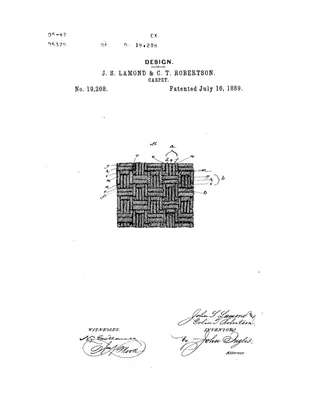
Carpet, US Patent No. D0019208
Patent · 2 pages
US design patent D19,208, granted July 16, 1889 to John S. Lamond and Colin T. Robertson of Paterson, New Jersey, for a carpet design. The drawing shows a square pattern of woven-looking blocks with lettered parts. The specification describes two alternating groups of bars: group a has three long bars with shorter outer bars, and group b has two transverse long bars with a short outer bar. It claims the design as shown and gives no weaving structure or draft.
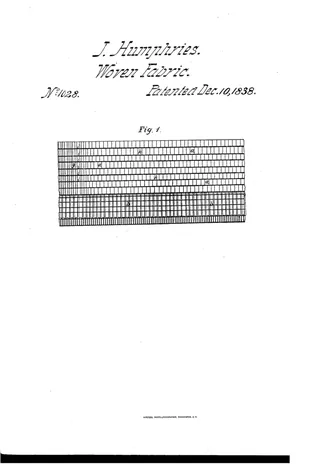
Woven Fabric
John Humphries · December 10, 1838
Patent · 2 pages · weaving drafts
US Patent No. 1,028, granted December 10, 1838 to John Humphries of New York, for an improvement in the manufacture of carpeting and rugs. The invention attaches an additional ply, rib or knit layer of weft material to the back of carpets such as Brussels, Wilton, Saxony and Imperial, secured by threads passing over and under the ply and through the carpet. A single figure shows the back of the carpet with the added ply and stitching threads.
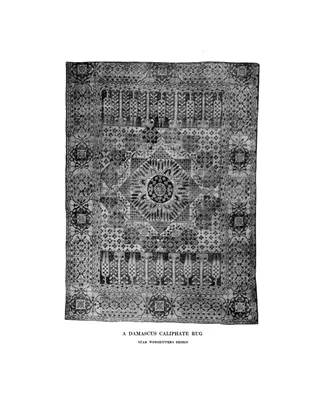
Caliphate Rugs
Article · 3 pages
A short magazine article by Churchill Ripley on so-called Caliphate rugs, which he identifies as Syrian (Damascus) rugs and distinguishes from Ispahan, Persian-Portuguese and Indo-Persian types. He discusses the confusing and shifting names used for Saracenic, Moorish and Arab rugs, the wiry yet soft wool warp, and the three-color scheme of red, blue and green. He also covers the star-medallion "Star worshippers' design" attributed to Chaldean origin, quoting dealer Mr. Benguiat. One halftone illustrates a Damascus Caliphate rug.
Carpet Makers
Article · 1 page
A short newspaper item from the 1840s on carpet manufacturing in the United States. It reports a proposal to build a steam carpet mill near Boston, with Winnissimet named as a possible site, and says American carpets match imported ones in machinery, colors, designs and materials. The text cuts off mid-sentence at the end of the page.
Carpet Stretcher
Article · 1 page
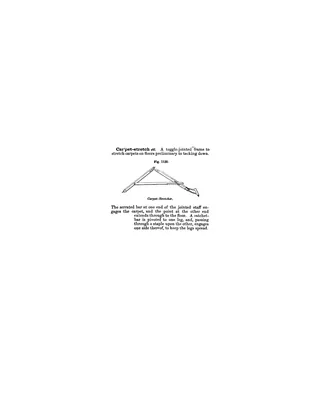
A short dictionary entry defining the carpet stretcher, a toggle-jointed frame used to stretch carpets on floors before tacking them down. The text describes how the serrated bar grips the carpet, the point braces against the floor, and a ratchet bar holds the legs spread. A line drawing (Fig. 1130) illustrates the tool.
How Abnákee Rugs Are Made: Full description of the Exact Method of Working
Article · 5 pages
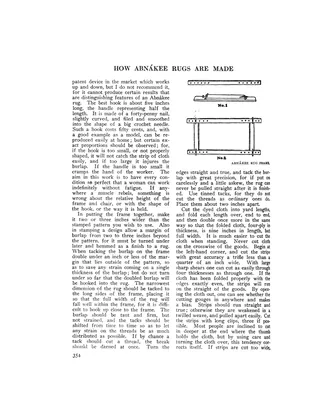
A 1909 Craftsman article by Helen R. Albee explaining how Abnákee hooked rugs are made on a small adjustable wooden frame rather than a loom. It describes building the pine frame and filing a hook from a forty-penny nail, tacking stamped burlap, cutting cloth strips, and the hooking technique, including the three-deep undulating rows, shearing, filling the pattern, and finishing the edges. A closing section covers dyeing the cloth with German aniline dyes, with measured stock solutions for repeatable shades, along with the author's views on craftwork.
The Modern Rug
Article · 1 page
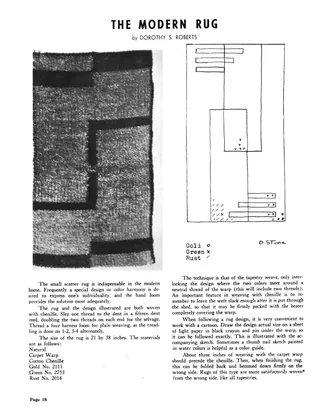
A short article from Weaver giving instructions for a 21 by 38 inch scatter rug woven in chenille on a four-harness loom threaded for plain weave. It covers the sett (one thread per dent in a 15-dent reed), materials and colors, tapestry-weave technique with interlocking at color joins, and use of a full-size cartoon under the warp. It also gives advice on packing the weft and finishing the hem. A photograph of the rug and a drawing of the cartoon with a color key accompany the text.
Nomades fabricant des tapis [Nomads Making Rugs]
Ephemera · 1 page · French
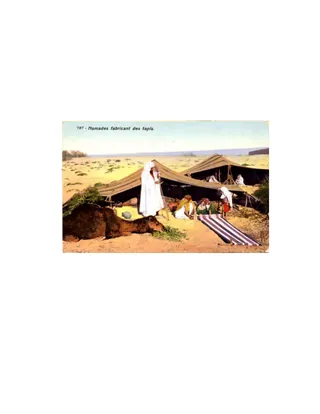
A single hand-colored picture postcard showing nomadic people in white robes and headwraps working at a striped woven textile stretched on the ground beneath a dark striped tent with wooden supports. The only text is the printed caption, "Nomades fabricant des tapis" (nomads making rugs), with the number 787. It is useful as a visual record of tent-side rug or carpet weaving among nomadic groups.
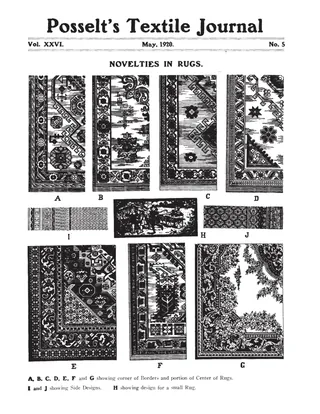
Novelties in Rugs
Article · 1 page
A single printed plate from Posselt's Textile Journal, May 1920, showing rug design illustrations labeled A through J. A to G show corners of borders and portions of rug centers, H a design for a small rug, and I and J side designs. Motifs include floral, geometric and scrolled patterns. There is no text beyond the caption.
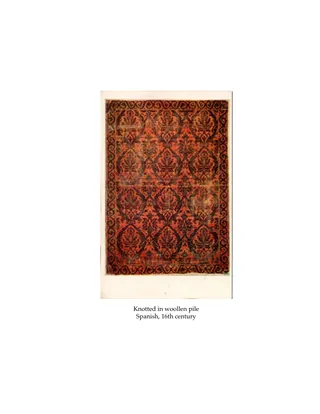
Picture postcard
Carpet, c. 1500-1599
Ephemera · 1 page
A single picture postcard showing a photograph of a carpet with a red ground and dark brown or black scrolling damask-style motifs. The motifs are arranged in rows of stylized lobed medallions with floral sprays, within a scrolling foliate border. The caption reads 'Knotted in woollen pile, Spanish, 16th century.'
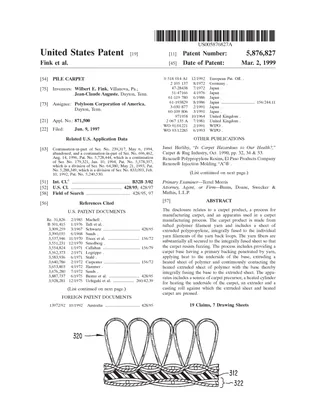
Pile Carpet, US Patent No. 5876827
Patent · 39 pages
US Patent 5,876,827 (granted March 2, 1999) to Wilbert E. Fink and Jean-Claude Auguste, assigned to Polyloom Corporation of America. It describes a recyclable tufted polypropylene loop pile carpet in which an extruded polypropylene sheet is fused to the yarn back loops and primary backing, so the carpet resists fuzzing and passes the fiberlock (Velcro) test. The patent covers the carpet product, the manufacturing process, and the apparatus (heated roller, extruder, casting roll). It includes claims, cited references, patent drawings, simulation and tuft-bind examples for grass and BCF loop pile carpets, and temperature graphs. The scan contains both a USPTO web printout and the printed patent.
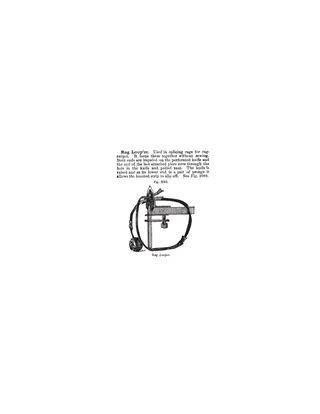
Rag Looper
Article · 1 page
A short dictionary entry from Knight's New Mechanical Dictionary describing the rag looper, a hand device used to join strips of rag for rag carpet without sewing. The rags are impaled on a perforated knife, an end is pulled through the hole to form a knot, and the knife's prongs let the knotted strip slip off. A line drawing (Fig. 2083) shows the tool on its frame.
Wilton Carpet
Article · 1 page
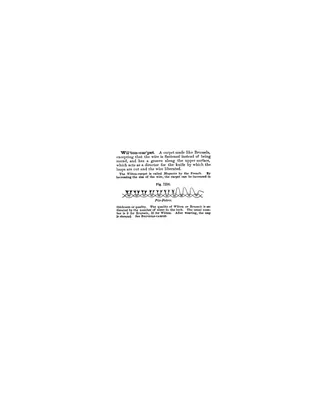
A short dictionary entry defining Wilton carpet as a Brussels-type pile carpet in which the wires are flat with a groove that guides the knife cutting the loops. It notes the French name Moquette, how wire size affects thickness and quality, the usual wires per inch (9 for Brussels, 10 for Wilton), and that the nap is sheared after weaving. Includes a cross-section figure of pile fabric showing cut and uncut loops.
Apparatus for Making a Handcrafted Pile Rug, US Patent No. 4275515
Patent · 16 pages
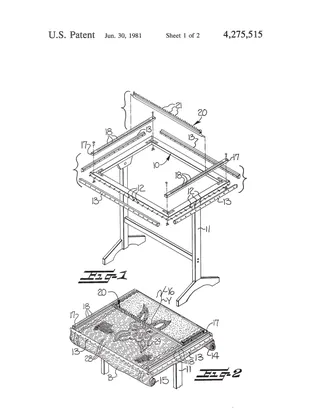
US Patent 4,275,515 (Betty R. Hinson, granted 30 June 1981) for a frame-and-guide apparatus for making handcrafted pile rugs. A backing fabric is stretched on a pinned rectangular frame, and a comb-like pile forming guide set at adjustable heights holds yarn loops while each tuft is sewn and knotted into the backing with a needle, giving uniform pile spacing and height. The document includes the USPTO web printout (abstract, claims, description) and the original patent print with two sheets of drawings (Figs. 1-9).
Carpet
Oxford Encyclopedia, 1828
Article · 1 page
A short encyclopedia entry defining the carpet as a woollen floor covering and sketching its history and manufacture. It notes the probable Asian origin, Turkey carpets as the finest ornamental kind, and production in France, Italy and Britain. It names Wilton, Kidderminster, Stirling and Kilmarnock as British centers.
Carpet
Zell's Encyclopedia, 1876
Article · 1 page
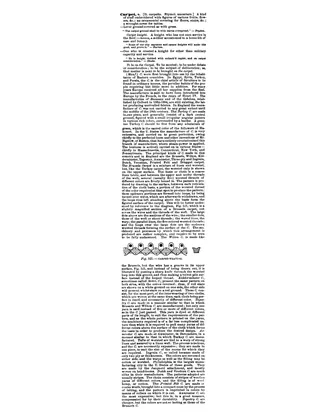
A one-page encyclopedia entry on carpets from Zell's Encyclopedia. It gives the word's definitions and idioms (carpet knight, on the carpet), then a history of carpet manufacture from the East to Europe and the United States. It describes the main types: Brussels, Wilton, Kidderminster, Tapestry, Axminster, Ingrain, Dutch and Venetian, and Printed Felt. Fig. 521 is a magnified cross-section diagram of a Brussels carpet showing wires, weft and warp.
Carpet Beater
Article · 1 page
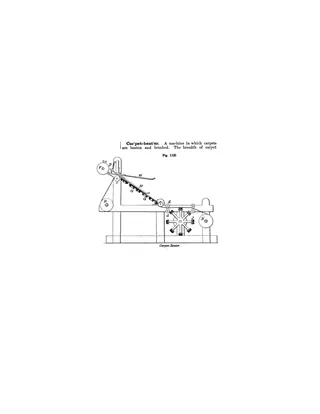
A short dictionary entry on the carpet-beater, a machine for beating and brushing carpets to clean them. It includes a side-elevation line drawing (Fig. 1125) of a frame-mounted machine with rollers and a beater mechanism with brushes, with the carpet passing over the rollers. The sampled text gives only the definition's opening, so the mechanical description is not fully visible.
Carpet Cleaning Machine
Article · 1 page
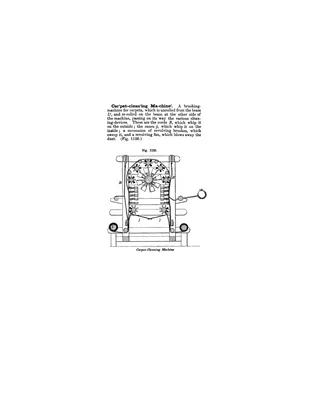
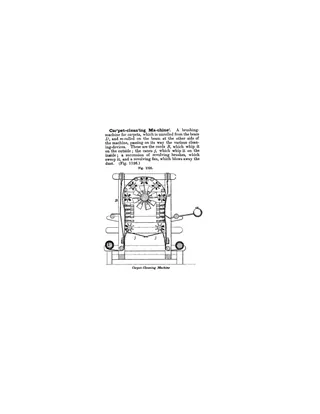
A short dictionary entry describing a mechanical carpet-cleaning machine. The carpet is unrolled from one beam, passes cords that whip its outside, canes that whip its inside, revolving brushes, and a fan that blows away dust, then is re-rolled on another beam. A cross-sectional diagram (Fig. 1126) shows the arrangement of rollers, cords, canes, and brushes.
Catalogne or Plain Rag Rugs
Master Weaver, September 1965
Article · 2 pages
A short critical article from Master Weaver arguing that plain rag rugs (catalogne) are economically and aesthetically poor and wear badly. It explains that the usual fine, closely set 16/2 cotton warp is exposed and breaks down under foot traffic. It recommends a strong, open warp (heavy carpet warp or 8/3 linen at no more than 8 ends per inch) with a twisted weft, hard beating, and locked wefts for patterns. It concludes that heavy cotton rug filler is a better choice than cut rags.
Chenille
Article · 1 page
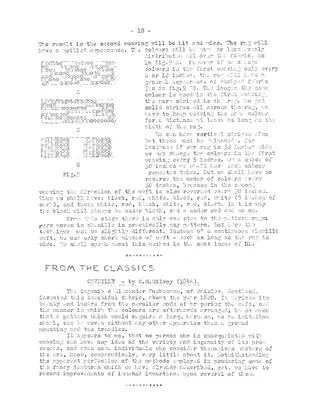
A single page from Master Weaver No. 19 (January 1955). It concludes a discussion of weaving chenille rugs, explaining how colour changes in the first weaving of the chenille weft produce mottled, striped or vertical-stripe effects in the finished rug. It then begins a 'From the Classics' excerpt from C.G. Gilroy (1844) crediting Alexander Buchanan of Paisley with inventing chenille fabric around 1820.
The Design of Hooked Rugs, I -- Primitives
Article · 4 pages
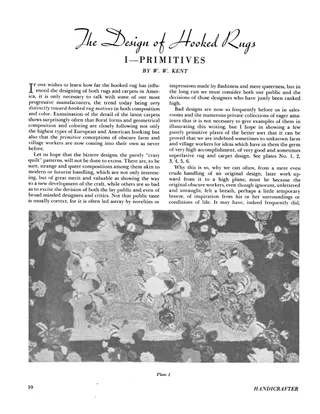
An essay by W. W. Kent on the design qualities of early American hooked rugs, arguing that the primitive work of anonymous farm and village makers, especially in Maine and Nova Scotia, offers ideas for modern rug and carpet design. It is illustrated with ten plates of hooked rugs with captions giving size, motifs, colors and collections. Kent also discusses the origin of hooking, citing his book The Hooked Rug, Scandinavian practice and the possibility that Coptic shaggy fabrics were hooked.
Genuine Persian Rug, Part 3
Article · 5 pages
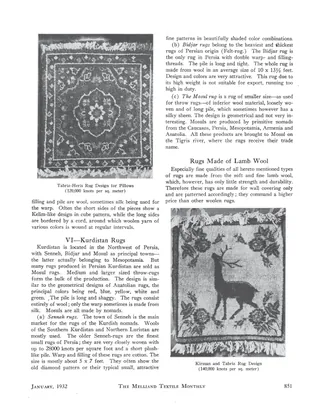
The concluding part of a three-part article from The Melliand Textile Monthly on Persian rugs. It distinguishes nomad, Persian and Turkish/Smyrna rugs, then surveys Persian rug types by region: Azerbaijan (Tabriz, Heris, Karadagh), Turkmenian, Northeast (Chorasan-Meshed), Central (Feraghan, Kashan, Isfahan, Hamadan, Sarabent, Saruk), South (Kirman, Shiras-Kashkai) and Kurdistan (Senneh, Bidjar, Mosul). For each it describes the wool, knot density per square foot, sizes, colors and designs. Illustrations include a map of Persian wool districts and two rug design photographs with knot counts.
Hand Woven Rugs
Article · 1 page
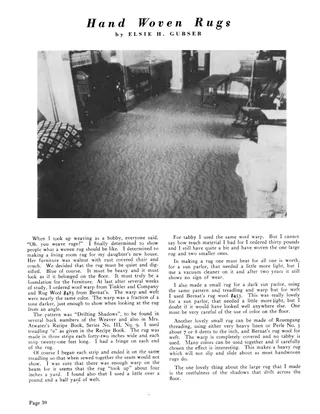
A short first-person article by Elsie H. Gubser describing how she wove a heavy blue wool living room rug for her daughter's house. She used the "Drifting Shadows" pattern from Mrs. Atwater's Recipe Book, wool warp from Tinkler and Company and Bernat's rug wool for weft. The rug was woven in three strips sewn together, and she reports yardage, take-up, and wear. She also describes a smaller rug in a different color and suggests a Rosengang rug threaded with heavy linen or Perle cotton and woven with rug wool weft and no tabby.
Handweaving News (February 1947): How to Do Tufting
Periodical · 2 pages · weaving drafts
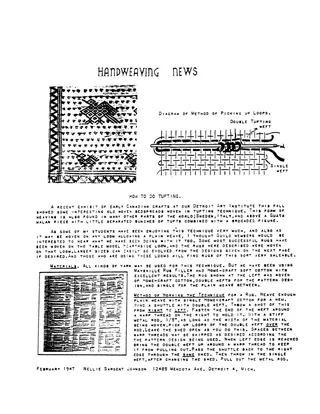
A two-page instruction sheet by Nellie Sargent Johnson on weaving tufted rugs, a plain-weave technique in which loops of double weft are picked up over a metal rod. It covers materials (rug filler and soft cotton), the picking-up method, edge treatment, and tips for threading. Three grid-style rug pattern designs are given for the table model Hearthside loom (214 warp threads), with yarn quantities and measurements.
Handweaving News (March 1948): Warp Pattern Rugs
Periodical · 2 pages · weaving drafts
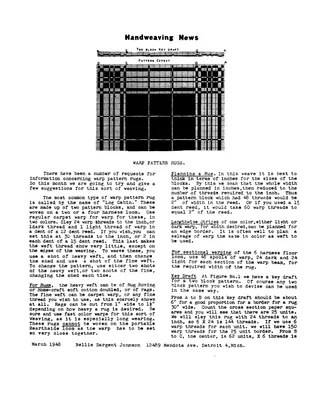
A March 1948 Handweaving News article by Nellie Sargent Johnson on weaving warp pattern rugs, chiefly the two-block "Log Cabin" type, woven on two, four or six harness looms. It covers sett, warp colors, heavy and fine weft alternation, planning block sizes in inches, a key draft, threading and tie-up, and a complete two-figure rug adapted from a Swedish draft with a treadling sequence. Two pages of drafts and figures are included.
Handweaving News (September 1946): Questions About Selling Handweaving
Periodical · 2 pages
A September 1946 issue of Handweaving News in which Nellie Sargent Johnson answers subscribers' questions about selling handweaving. Page 1 discusses buying a loom, learning to weave well, and the family benefits of weaving. Page 2 covers selling rag rugs: how to answer customers who compare prices with store rugs, and how to work out warp and weft costs per yard, with worked figures for a 10-yard carpet warp and a first rag rug woven from dyed cotton strips.
Industrial Experiment
Article · 14 pages
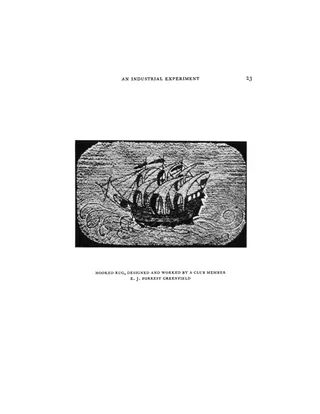
A reprinted extract from Helen R. Albee's book Abnakee Rugs, describing how she founded a hooked-rug cottage industry among farm women in Pequaket, New Hampshire. She covers her motives, the search for suitable wool flannel, her dyeing experiments, the village-hall exhibition that won local support, and how she paid workers and priced rugs. She also explains the Abnakee name and label, and offers advice to others wanting to start rural handicraft industries. The last page shows a hooked rug with a ship design made by a club member.
Ingrain-Carpet Loom
Article · 1 page
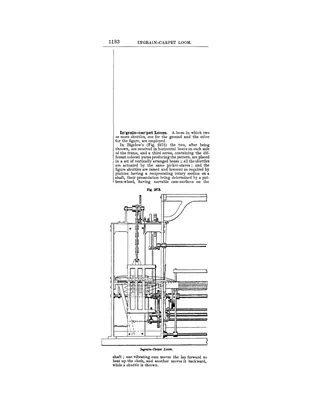
A short dictionary entry defining the ingrain-carpet loom, a loom using two or more shuttles, one for ground and others for figure. It describes Bigelow's version, with horizontal and vertical shuttle boxes, picker-staves, pinions and a pattern-wheel with movable cams that controls shuttle presentation and lay movement. Includes a side-elevation line drawing (Fig. 2675).
Spanish Designs for Hooking
Handicrafter, February 1928
Article · 4 pages
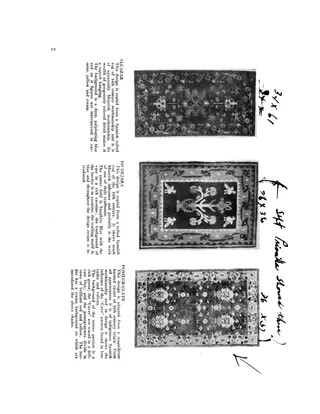
A 1928 Handicrafter article on Spanish-inspired designs for rug hooking and hangings, discussing Moorish influence on Spanish art and the tufted and cross-stitch rugs from which the patterns were adapted. It describes six stamped burlap patterns (Alcazar, Mudejara, Pomegranate, Deer, Spanish Scrolls, Giralda) with their sources and color schemes, and gives yarn recommendations, loop heights, sizes and prices. A short Yarn News section announces new and changed yarns such as Linen Floss, Mudejara homespun, Afghan worsted, Raytone, Florelle and chenille mixes.
Tapestry Carpet
Article · 1 page
A short dictionary entry on tapestry carpet from Knight's American Mechanical Dictionary. It defines several types, including printed-warp two-ply carpet, patent tapestry rugs with velvet pile, tapestry Brussels (moquette) and mosaic tapestry. It also gives a brief history of carpet use, from Persian and Turkish rugs and Roman examples to medieval European floor and bedside coverings.
Twice Woven Rugs
Article · 2 pages
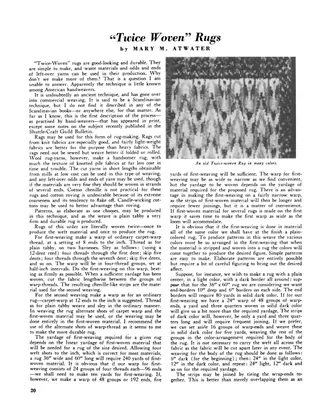
Mary Atwater describes the twice-woven rug technique, in which a first weaving of carpet warp and rags or yarn is cut lengthwise into chenille-like strips and used as weft for a plain tabby rug. She gives sleying, warp setting and yardage calculations for a 36 x 60 inch rug. She also gives color-arrangement plans for borders, checkerboard, stripes, diagonal and zigzag centers. Two photographs show an old rug and an experimental sample.
Two-Ply Carpet
Article · 1 page
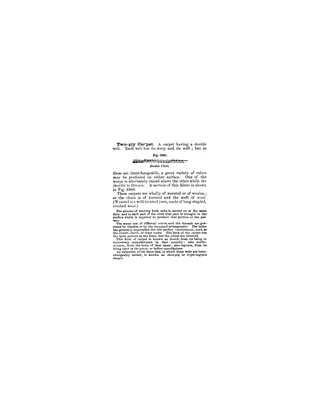
A short dictionary entry defining the two-ply carpet, a double-web fabric in which two sets of warp and weft interchange to produce reversible patterns in different colors. It covers the materials (worsted and wool), the use of treadles or Jacquard control, and the alternate names Scotch, Kidderminster and ingrain. It also mentions three-ply or triple-ingrain carpet. Includes one small illustration (Fig. 6840) of a double cloth section.
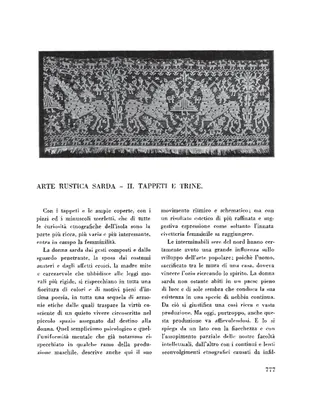
Arte Rustica Sarda -- II. Tappeti e Trine [Sardinian Rustic Art -- II. Rugs and Lace]
Article · 25 pages · Italian
Second part of a series on Sardinian folk art from the Italian art magazine Dedalo, covering rugs, chest covers, bed coverlets, lace and drawn-thread or cross-stitch embroidery. The author describes regional styles (Santa Giusta, Isili, Morgongiori, Ittiri, Bosa), typical layouts, colors and motifs such as birds, horsemen and heraldic figures. He also discusses the decline of the traditions and the Pischedda and Manconi collections. About half the pages are plates of rugs, copricassa, bisaccia, burato and ingirialettu pieces.
Brussels Carpet
Article · 1 page
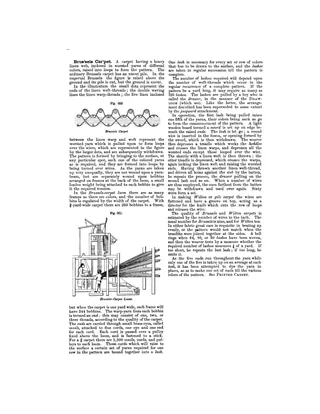
An encyclopedia entry from Knight's American Mechanical Dictionary describing how Brussels carpet is made. It explains the linen warp and weft with worsted pile yarns raised in loops over wires, and the multi-frame bobbin loom with mails, cords and lashes pulled by a drawer. It also covers Wilton (cut pile) carpet, the wire count used to grade quality, and the jacquard attachment that replaced the lash system. Two figures show the carpet structure and the loom.
Carpet
Article · 2 pages
A dictionary entry on carpets from Knight's American Mechanical Dictionary (1876). It gives a historical survey of carpets from ancient Egypt, Babylon, Persia, Turkey and India to their introduction in France and England (Axminster, 1755). It then lists nine manufacturing processes, including tufted, Brussels, Wilton, tapestry, ingrain, felted and printed carpets, and ends with cross-references to carpet varieties.
Carpet-Cleaning Machine
Article · 1 page
A short dictionary entry describing a carpet-cleaning machine, with one cross-sectional diagram (Fig. 1126). The carpet is unrolled from one beam and re-rolled on another while passing cords that whip it on the outside, canes that whip it on the inside, revolving brushes, and a fan that blows away the dust.
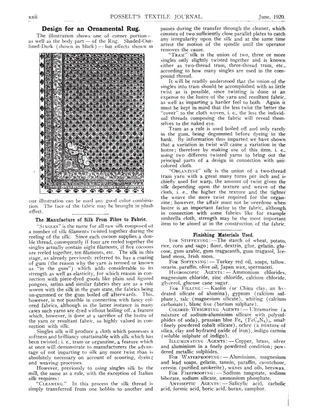
Design for an Ornamental Rug
Article · 1 page
A single page from Posselt's Textile Journal, June 1920, showing a black-and-white corner design for an ornamental rug with a lattice field, stylized border and scrolled corner ornament. A brief caption notes the design can be used in any good color combination and the fabric face can be made in plush effect. The page also carries part of a serial article on silk manufacture (singles, tram, organzine, cleaning) and a list of finishing materials for stiffening, softening, filling, weighting, waterproofing and fireproofing.
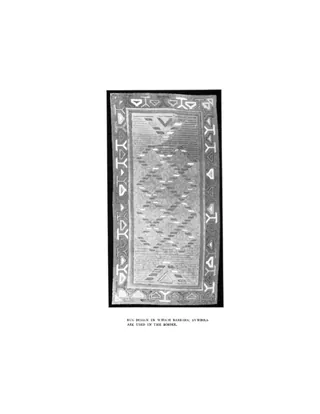
Developing a Home Industry: How the Abnákee Rug Grew Out of the Old-Fashioned Hooked Mat of Our Grandmothers
Article · 6 pages
A 1909 Craftsman article in which Helen R. Albee describes how she developed the Abnákee hooked rug from traditional New England hooked mats and built it into a home industry. She covers her choice of materials (British burlap, pure-wool twilled flannel cut in very narrow strips), her use of primitive ornament in place of floral and Oriental imitations, and how she spread the craft by supplying flannel, dyes, burlap, frames and hooks. The final pages explain border and field layouts and how she makes and stamps stencils; the frame, hook and working methods are promised for a later paper. Illustrations show two rug designs, one with barbaric symbols in the border and one adapting primitive forms.
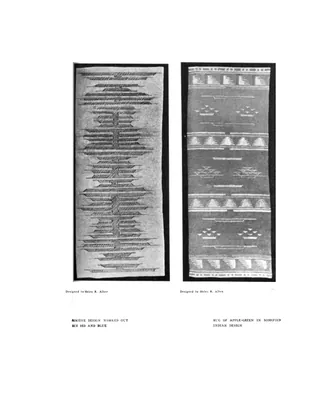
Distinctive American Rugs
Craftsman, 1907
Article · 11 pages
A 1907 Craftsman article arguing that home industries could give American farm and village women income and creative satisfaction. It describes Helen R. Albee's Abnakee hooked rugs from Pequaket, New Hampshire, including her experiments with dyes and materials and the colors of several illustrated designs. It then covers woven rag-type rugs: the Martha Washington, Priscilla, John Alden (basket-weave) and Dorothy Manners (hit-or-miss) rugs made in Philadelphia and Germantown.
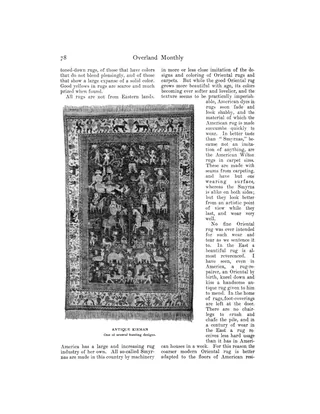
Fine Rugs
Article · 9 pages
A 1900 magazine article from Overland Monthly offering an amateur's guide to Oriental rugs at the height of the American rug-collecting craze. It surveys the main Persian, Turkish, Central Asian and Indian rug types, explains how rugs are knotted on a frame, and discusses knot counts, materials, prices, antique versus modern rugs, bleached imitations, and the meanings of designs such as the palm-leaf, prayer-rug and hunting-carpet patterns. It closes with advice on buying and a comparison with American-made Smyrna and Wilton rugs. Illustrated with halftone photographs of Kirman Shah, Serabend, Bokhara, Kasak, Shirvan, Cashmere, Kirman, Khorasan and Sinneh rugs.
Handweaving News (August 1942): A Variety of Rugs
Periodical · 3 pages · weaving drafts
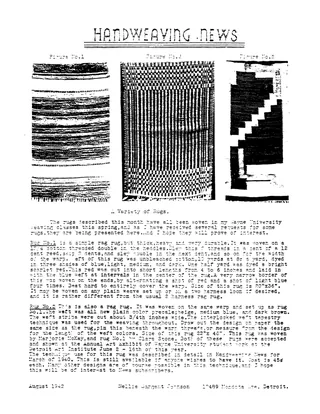
An August 1942 issue of Handweaving News in which Nellie Sargent Johnson describes four rugs woven by her Wayne University students. They include a thick cotton rag rug, an interlocked-weft tapestry rag rug, a two-harness heddle-loom rug made on a Sears "Hearthside" loom, and a twill-threaded rug with a stripe design by Mrs. Helen Hill. The text gives materials, sett, warp counts, weft sequences and finishing, with a two-harness threading draft for Rug No. 3 and a design grid for Rug No. 4.
Handweaving News (August 1946): Rag Rugs
Periodical · 3 pages · weaving drafts
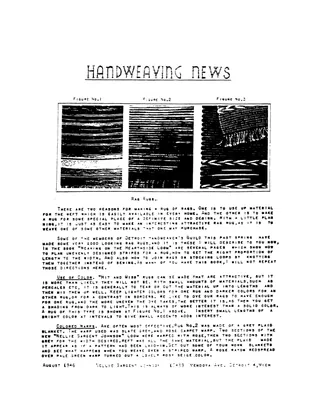
An article by Nellie Sargent Johnson in Handweaving News on weaving rag rugs, covering use of color, colored warps, rag preparation, material estimates, sleying and hem or fringe finishes. It also gives two four-harness rug patterns with threading and treadling directions: a modern four-block overshot rug with rag weft and a crackle weave rug in carpet warp and rug filler. Photographs show three sample rugs, and threading drafts and a drawdown are included.
Mattor
Article · 7 pages · weaving drafts
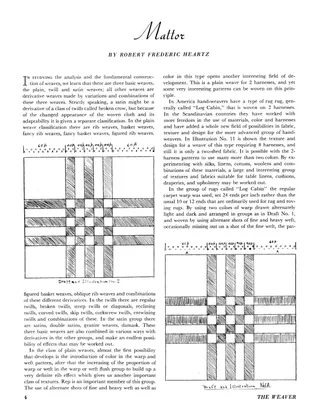
An article from The Weaver (October 1936) by Robert Frederic Heartz on "Mattor," a Scandinavian-style weave built on plain-weave sheds using alternate shots of fine and heavy weft, with pattern created by dropping a fine shot. It begins with a survey of basic weaves, then explains the technique with a warp-colored check example (Drafts 1, 1A, 1B) and treadling instructions. It presents a series of drafts (Nos. 2-17) taken from Danish, Finnish, Norwegian and Swedish sources for 4, 6, 8 and 10 harnesses, with notes on uses such as runners, rugs, upholstery, pillows and dress fabric.
Novelties in Border Designs for Rugs
Article · 1 page
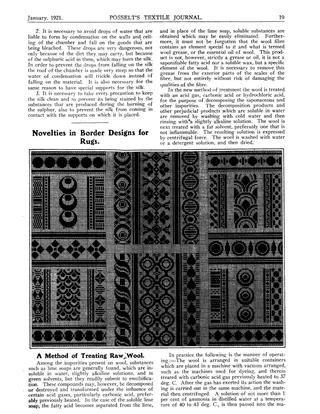
A single page from Posselt's Textile Journal, January 1921, featuring a large black-and-white rug border design shown as a pattern grid, with panels of circles, diamonds, stripes and scroll motifs. The page also carries the end of a piece on sulphur bleaching of silk and the start of an article on a method of treating raw wool with acid gases to remove lime soaps and other impurities.
Peter Collingwood's Shaft Switching Technique, Part 2
Article · 2 pages · weaving drafts
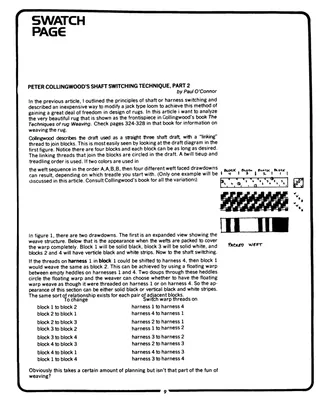
Second of two articles by Paul O'Connor explaining Peter Collingwood's shaft switching technique for weaving rugs. It analyzes the rug shown as the frontispiece of Collingwood's The Techniques of Rug Weaving, using a three-shaft threading with linking threads to join four blocks and a twill tieup. It explains how floating warp threads running through doups between empty heddles can be switched between shafts to change blocks, with a table of the switches needed. Figures include a block draft with drawdowns, a drawing of the rug and a threading draft for the switching section.
Practical Weaving Suggestions, Vol. 1-61 (1961): No-Tabby Weave and Tufted Rugs
Periodical · 8 pages · weaving drafts
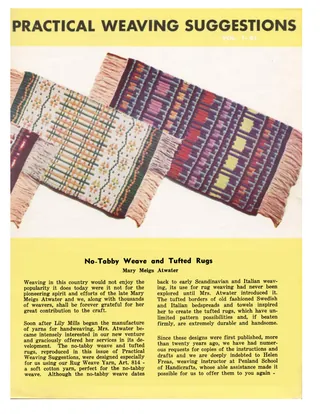
An issue of Lily Mills' Practical Weaving Suggestions reprinting Mary Meigs Atwater's designs for no-tabby weave rugs and tufted rugs, woven with Lily Rug Weave Yarn on a beige carpet warp. It gives materials, sett, threading and tie-up drafts, and pass-by-pass color directions for three 19 x 36 inch rugs (Boy and Girl Figures, Vine and Trellis, Tulip Bed). A final section explains the pick-up tufted rug method on two or four harnesses, with a tuft-making diagram and a bath mat example. The last page is a Lily Mills yarn advertisement.
Shuttle (Fall 1947)
Shuttle, Fall 1947
Periodical · 8 pages
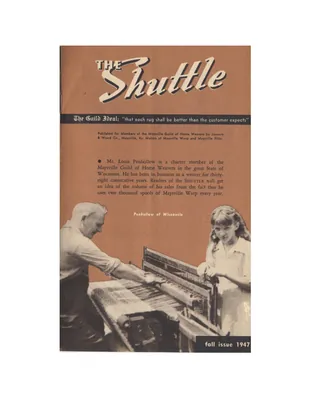
Fall 1947 issue of The Shuttle, a house newsletter for members of the Maysville Guild of Home Weavers, published by January & Wood Co. of Maysville, Ky., makers of Maysville Warp and Filler. It consists mainly of short letters from home rag-rug weavers in several states, describing their rug sales, looms and use of Maysville Warp, with photographs. It also includes a tip on using yardsticks to make rug fringe, written instructions for a striped 'Golden Stairs' rug with a checkered border, and a short poem. No weaving drafts are given.
Shuttle (Fall 1951)
Shuttle, Fall 1951
Periodical · 8 pages · weaving drafts
Fall 1951 issue of The Shuttle, a promotional newsletter from January & Wood Co. of Maysville, Kentucky, for Maysville Guild weavers using Maysville carpet warp and rug filler. It presents short profiles of weavers from several states who sell hand-woven rag and filler rugs, with advice on pricing rugs, displaying them for sale, and labeling them. It also promotes Alice K. Cripps's book Adventures in Weaving on a Two-Harness Loom. The main instructional feature is Cripps's article on four-harness Rose Path with four warp colors, including treadling, border, and bag directions on the last page.
Shuttle (Spring 1947)
Shuttle, Spring 1947
Periodical · 10 pages
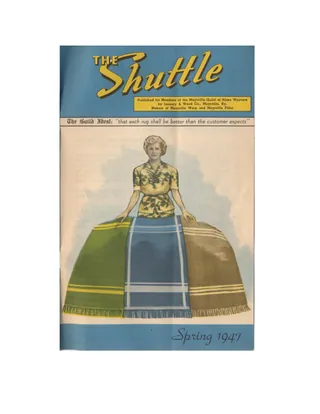
Spring 1947 issue of The Shuttle, a house newsletter that January & Wood Co. of Maysville, Kentucky issued to members of the Maysville Guild of Home Weavers. It encourages weavers to advertise and display their hand-woven rag-type rugs, and it prints testimonials from guild weavers in several states along with photos of members. It gives written instructions for weaving three two-harness rugs (Arrow, Log Cabin, Madison seersucker) with Maysville warp and rug filler. It closes with a notice about guild labels and washing and colorfastness of the yarns.
Shuttle, Vol. XII, No. 12 (Autumn 1946)
Shuttle, Autumn 1946
Periodical · 16 pages
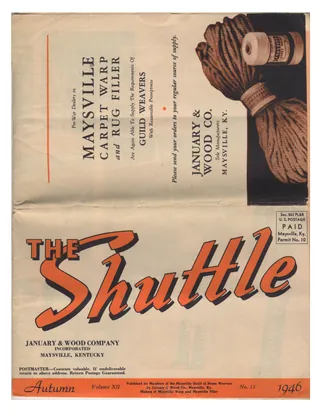
Autumn 1946 issue of The Shuttle, a house magazine that January & Wood Co. of Maysville, Kentucky published for the Maysville Guild of Home Weavers. It opens with an editorial on rising cotton and living costs, with advice on pricing handwoven rugs (15-20% materials mark-up plus a fair hourly wage). Most of the issue is state-by-state photographs and short testimonials from Guild rug weavers across the US, praising Maysville carpet warp and rug filler after postwar production resumed. It also profiles a California couple who draft original patterns. It contains no weaving drafts.
522 documents found