Textile Documents › Publications › Publication: Overland
10 documents found
Sort: 
The American Silk-Worm Moth: Telea Polyphemus
Article · 2 pages
A short natural-history article on the Polyphemus moth (Telea polyphemus), sometimes called the American silk-worm moth. The author describes rearing it in captivity: egg laying, caterpillar feeding and growth, cocoon spinning, emergence of the moth, and natural enemies. It ends by noting that the cocoon thread is strong and brilliant but coarser than Chinese silk, and that labor costs prevent commercial silk production in America.
Cotton Experiments in California
Overland, 1871
Article · 10 pages
An 1871 magazine article in which a Mississippi cotton planter explains why he is growing cotton in California's Merced and Los Angeles County lands. He compares per-acre costs, yields and profits against the Cotton States and against California wheat, using his own plantation account books, agricultural reports and the proceedings of a Southern commercial convention. He reports sample classifications of California cotton and argues that cotton would diversify the state's grain-dependent agriculture and support local manufacturing.
Fine Rugs
Article · 9 pages
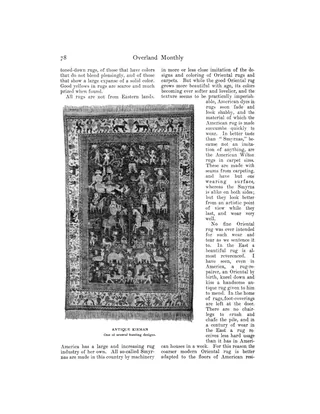
A 1900 magazine article from Overland Monthly offering an amateur's guide to Oriental rugs at the height of the American rug-collecting craze. It surveys the main Persian, Turkish, Central Asian and Indian rug types, explains how rugs are knotted on a frame, and discusses knot counts, materials, prices, antique versus modern rugs, bleached imitations, and the meanings of designs such as the palm-leaf, prayer-rug and hunting-carpet patterns. It closes with advice on buying and a comparison with American-made Smyrna and Wilton rugs. Illustrated with halftone photographs of Kirman Shah, Serabend, Bokhara, Kasak, Shirvan, Cashmere, Kirman, Khorasan and Sinneh rugs.
Flock of Wool
Overland, 1870
Article · 6 pages
A magazine essay from Overland (Feb. 1870) on sheep herding and wool-growing in California. The author discusses the low social standing of shepherds, the kinds of men who take up the work, and anecdotes of a Digger Indian shepherd and his dog. He also covers pasture problems (droughts, annual grasses, bunch-grass), a sample budget of expenses and income for a 15,000-sheep ranch, and the suitability of Merino, South Down, Cotswold and native sheep breeds. It has no weaving content.
History and Hygiene of Linen
Article · 9 pages
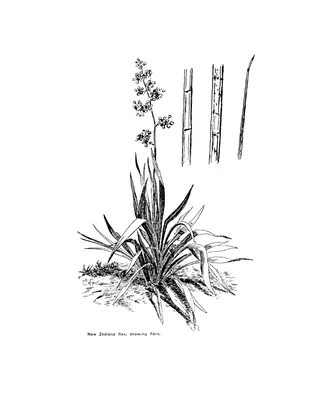
A 1902 Overland Monthly article in two parts. The first covers the history of linen from ancient Egyptian mummy cloths and biblical references through medieval Europe, flax cultivation, retting and scutching, hand spinning, and the competition from cotton and wool. The second argues for linen underwear on hygienic grounds (heat loss, moisture absorption, porosity) and ends with the story of Dr. Deimel and the Deimel Linen-Mesh Company. Illustrations show flax plants and fibre and a portrait of Dr. Deimel.
The Old Basket-Weaver of San Fernando
Article · 5 pages
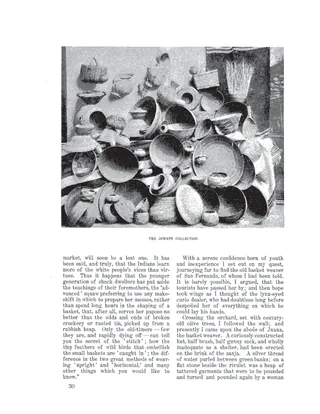
A first-person magazine article from Overland Monthly in which the author visits the mission village of San Fernando, California, in search of an authentic old Indian basket. Along the way a collector friend explains how to tell genuine old baskets from those made for sale, including dyes, uses and ornament. The author meets Juana, an aged Indian basket-weaver, who demonstrates coiled basket construction and talks about the baskets of her youth. Illustrated with photographs of baskets from the Jewett collection and the mission cloister.
A Revolution in Weaving
Article · 3 pages
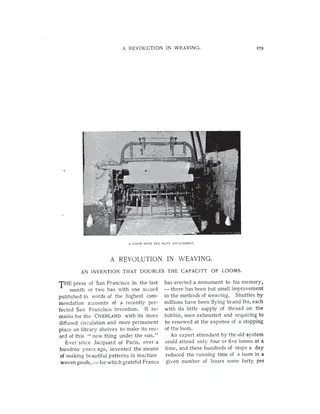
A 1896 magazine article describing Robert H. H. Hunt's San Francisco invention, an attachment for power looms that replaces the shuttle and bobbin with a thread carrier fed from large spools. It explains the problems of the shuttle (frequent stops, yarn waste), claims labor savings of 20 to 50 percent and one operator tending 20 to 30 looms, and names the Hunt Loom and Fabric Company's officers. Illustrated with two photographs of a loom fitted with the attachment.
Silk Culture in California
Article · 6 pages
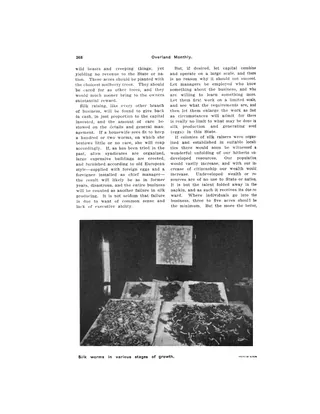
A 1902 Overland Monthly article by Carrie Williams arguing that California's climate and soil suit commercial silk production. She recounts early silk-raising efforts from the 1850s and 1860s, including the 1860 exhibit at the Mechanics' Fair in San Jose. She also describes her own experience in San Diego raising silkworms year-round and storing eggs in cold storage, and she discusses economics, acreage, education, and a federal silk-culture project in South Carolina. Six pages with halftone photographs of a rearing canopy and tray, silkworms, moths and cocoons, and reeling apparatus with native silk skeins.
Silk-Culture in California
Overland, 1870
Article · 6 pages
A magazine article from 1870 on the rise of sericulture in California. It argues that the dry, mild climate suits silkworms, and it contrasts this with the silkworm disease in Europe and the spread of a parasitic fly in Japan. It covers the egg trade with France and Italy, the pioneer Louis Prevost near San Jose, growers' profits per acre, mulberry cultivation, feeding methods, and plans for a San Francisco silk manufactory.
Young-Man-Leading-a-Cow and Weaving-Girl
Article · 2 pages
A short magazine article retelling the Chinese legend of the Weaving-girl (Yelr N'geu) and the Young-man-leading-a-cow (N'gow Long), as told by a Chinese informant in San Francisco's Chinatown. The two industrious lovers neglect their work, are separated in heaven by the Silver River, and meet once a year on a magpie bridge on the seventh day of the seventh month. The article explains the girls' feast day, when Chinese girls do needlework and pray to avoid the Weaving-girl's fate. It has no technical weaving content.
10 documents found