Textile Documents › Topic: Loom parts and tools
736 documents found
Sort: 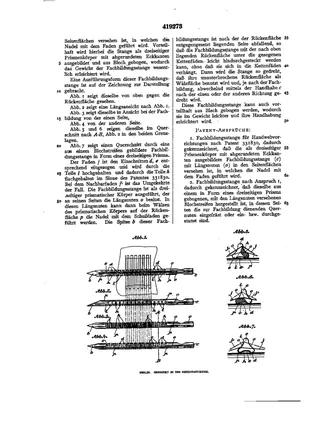
Fachbildungsstange für Handwebvorrichtungen [Shed-Forming Bar for Hand Weaving Devices]
Fransiska Daugart · August 21, 1924
Patent · 2 pages · German
German Reich patent no. 419273 (Reichspatentamt), an addition to patent 331830, for a shedding bar for hand weaving devices. The bar is a triangular prism with rounded edges and lengthwise grooves in its sides that guide the needle carrying the weft thread. It may be bent from sheet metal to make it lighter. The bar is rolled on its unbroken back surface to open the shed. The text describes seven figures and gives two patent claims.
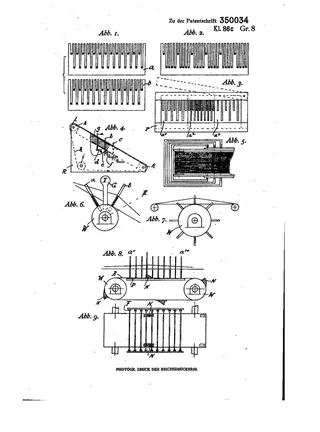
Fachbildungsvorrichtung für Handwebapparate [Shedding Device for Handweaving Apparatus]
Gertrud Witte · September 18, 1919
Patent · 3 pages · German
German imperial patent no. 350034 for a shedding device for hand-weaving apparatus, filed by Gertrud Witte of Bern, Switzerland. It describes open-topped combs with alternating short and long slots that guide the warp threads, with many combs mounted on a rotating drum or above an endless cam band so that different weave bindings (plain weave, 4- and 5-end twill) can be brought into working position quickly. The text covers comb variants, a three-part adjustable comb for varying warp spacing, lever and bracket operation, and suitable comb materials. The patent claims and one sheet of drawings (Abb. 1-9) are included.
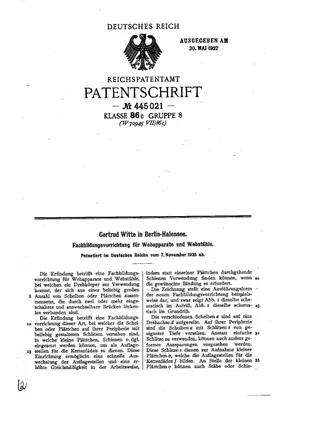
Fachbildungsvorrichtung für Webapparate und Webstühle [Shedding Device for Weaving Apparatus and Looms]
Gertrud Witte · November 7, 1925
Patent · 2 pages · German
German Reich patent no. 445 021 by Gertrud Witte of Berlin-Halensee for a shedding device for weaving apparatus and looms. The device uses a rotating body made of slotted disks or plates on an axle, with small plates or rails inserted in the slots to serve as interchangeable supports for the warp threads. The text describes the frame, table and plate arrangement, and the claim; figures show the device in elevation and plan.
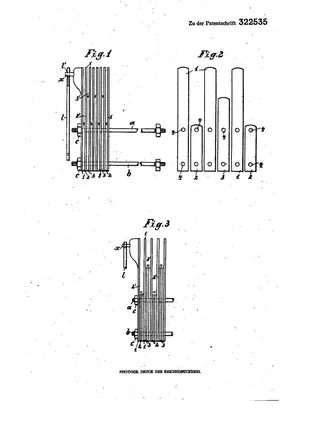
Handwebvorrichtung [Handweaving Device]
Ellen Struve · July 2, 1920
Patent · 3 pages · German
German imperial patent no. 322535, an addition to patent 312851, granted to Ellen Struve (née Gleiche) of Berlin-Friedenau for a hand-weaving device. It describes an interchangeable comb (reed-like shed-forming comb) made of slats of different lengths threaded on two bolts and held by nuts, so the slot depths can be arranged for fine warps such as linen or for coarse goods such as rugs. The text covers the description, one patent claim and one sheet of drawings showing the comb in front and side views.

Heddle
Zell's Encyclopedia, 1876
Article · 1 page
A one-paragraph dictionary entry defining the heddle (heald) as one of the sets of parallel double threads that, with their mounting, make up the harness guiding the warp threads to the lathe or batten. It also defines the heddle-eye, the loop in each heddle that receives a warp thread, and credits Webster as the source.
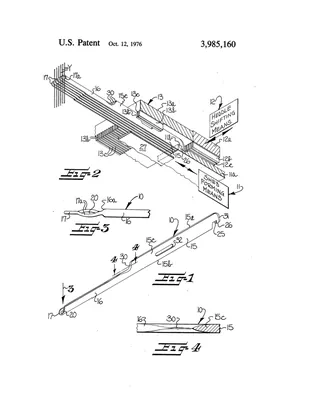
Heddle for a Weaving Machine for Making Triaxial Fabrics, US Patent No. 3985160
Patent · 16 pages
US Patent 3,985,160 (12 October 1976), assigned to Barber-Colman Company, describes a flat, thin strip heddle for a machine that weaves triaxial fabrics. The heddle has a nose with a warp guide opening, a cutout and hook-shaped tail for longitudinal shedding movement, and a shoulder along one edge for shifting it weftwise. The scan includes the USPTO database printout (abstract, references cited, claims, description) and the original patent pages with drawings of the heddle and a schematic of the shed forming and heddle shifting mechanism.
Heddle, or Heald
Article · 1 page
A short encyclopedia entry defining the heddle (or heald) in weaving. It explains that heddles are vertical threads, cords, or wires with a central loop that carry individual warp threads so groups can be raised and lowered for the shuttle to pass. It gives a brief etymology and refers readers to the article on the loom.
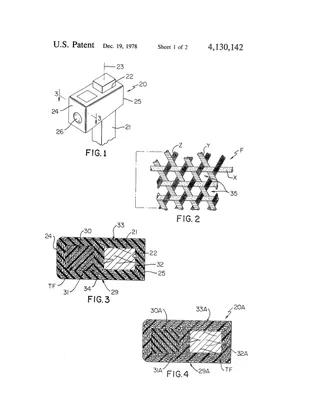
Loop Picker, US Patent No. 4130142
Patent · 10 pages
US Patent 4,130,142, granted December 19, 1978 to Mayo B. Tell and assigned to Dayco Corporation, covers an improved loop picker for shuttle looms. The picker is built from a face block and laminated fabric layers around a picker stick passage, with the face block and/or laminated layers made of triaxial fabric (nylon, polyester or aramid) for a longer service life. The scan includes a USPTO web printout of the full text and the original patent pages with claims, background, description and two sheets of drawings.
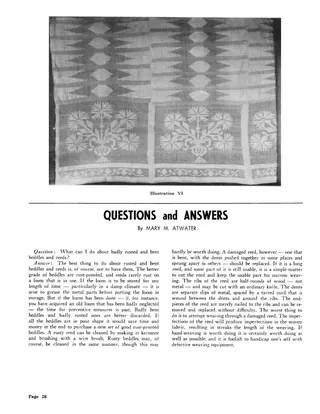
Questions and Answers
Article · 1 page
A one-page Questions and Answers column by Mary M. Atwater from Weaver, 1942, addressing what to do about badly rusted and bent heddles and reeds. She advises on prevention through rust-proofed heddles and greasing stored looms, cleaning a rusty reed with kerosene and a wire brush, replacing damaged heddles and reeds, and cutting a long reed down for narrow weaving. She also describes how a reed is constructed and warns that a damaged reed leaves streaks in the cloth.
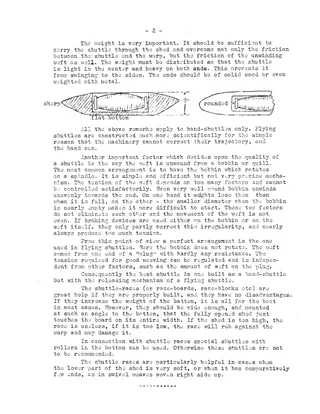
Shuttles and Shuttle-Races
Master Weaver, May 1953
Article · 2 pages
A two-page article from Master Weaver (Z-Handicrafts, Fulford, Quebec) discussing what makes a good hand shuttle for weaving. It covers shuttle shape, weight distribution, depth for the bobbin, and tip form, and compares bobbin-on-spindle weft release with the flying shuttle's non-rotating plug. It closes with advice on building and mounting shuttle races on the batten and when they help.
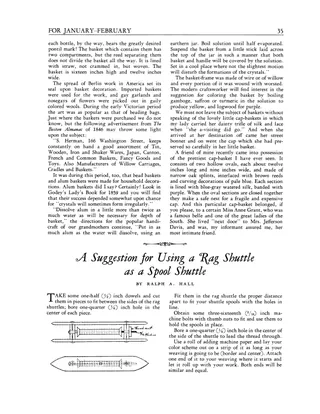
A Suggestion for Using a Rag Shuttle as a Spool Shuttle
Article · 1 page
A short 1930 how-to note by Ralph A. Hall on converting a rag shuttle to carry spool shuttles. Cut half-inch dowel spacers, bore quarter-inch holes, and fit them between the shuttle sides to hold the spools in line. Three-sixteenth-inch machine bolts with thumb nuts secure the spools, and a hole bored in the shuttle side leads the thread out. It ends with a tip for laying out a color scheme on a strip of adding machine paper that rolls up with the weaving. Two diagrams show the arrangement.
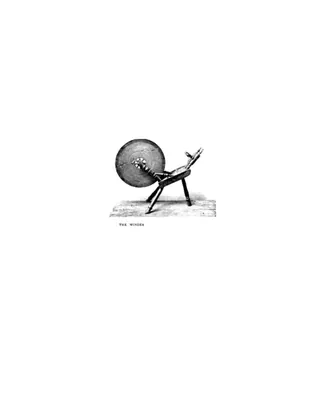
Winder
The Connoisseur, 1905
Illustration · 1 page
A single page from The Connoisseur (vol. 11, 1905) with a low-resolution line drawing of a winder, a device associated with spinning wheels. The only text is the caption "The Winder". It is a small illustration with no accompanying discussion.
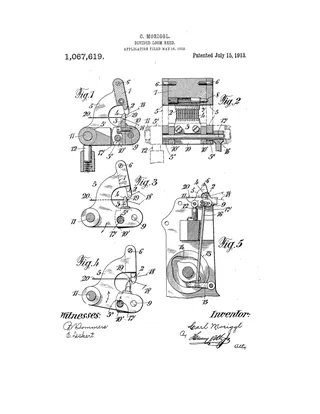
Divided Loom reed, US Patent No. 1067619
Patent · 3 pages
US Patent No. 1,067,619 by Carl Moriggl of Arbon, Switzerland, assigned to Adolph Saurer, for a divided loom reed used on ribbon looms. One set of teeth is mounted on a pivoting member so it moves away from the other set each time the reed opens, fully releasing the warp threads (including knotted ones) as the shed forms while the weft is inserted in front of the teeth. The document has patent drawings (Figs. 1-5), a specification describing the cam-driven mechanism, and three claims.
Doubling Stand
Master Weaver, January 1957
Article · 2 pages
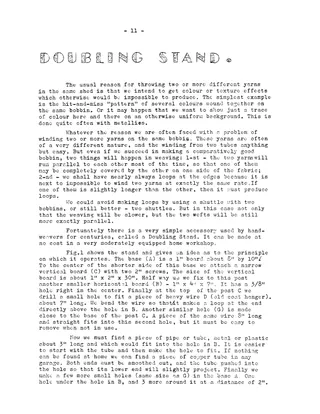
A short how-to article from Master Weaver (No. 31, January 1957) on making and using a doubling stand, a simple accessory for winding two or more different yarns together for use as a single weft. It explains why combining yarns in one shed causes problems such as parallel running and loops at the selvedges. It gives dimensions for building the stand from boards, wire and a tube, and describes threading and set-up for tubes, bobbins and cones. It also covers twist and rewinding onto shuttle bobbins for neat edges.
Flying Shuttle
Master Weaver, November-December 1961
Article · 3 pages
An editorial-style article from the Master Weaver bulletin discussing the flying shuttle in handweaving. It briefly describes the mechanism (shuttle race, boxes, pickers, cop) and argues that speed is no longer a real advantage, citing weight, fatigue, noise, cost and unsuitability for multiple shuttles. It concludes the device is justified mainly for very wide fabrics (72 inches or more) and criticizes mass production passed off as handweaving. A short editor's note corrects an issue-number misprint.
Heddle with Guide Means Thereon for Use in a Weaving Machine for Making Triaxial Fabrics, US Patent No. 3965939
Patent · 12 pages
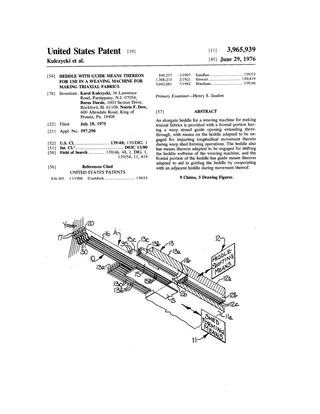
US Patent 3,965,939 (29 June 1976) to Karol Kulczycki, Burns Darsie and Norris F. Dow describes an elongate strip heddle for machines that weave triaxial fabrics. The heddle has a warp guide opening in a reduced-width frontal portion and a small lateral guide tab that cooperates with adjacent heddles. It moves longitudinally to form sheds and is shifted weftwise to make the warps run diagonally. The document includes the claims, a description of the machine arrangement with two staggered rows of heddles, shifting and guide bars, dimensions, and patent drawings (Figs. 1-5). It is a printout from the USPTO database plus the original patent pages.
Die Herstellung der Webeblattzähne [The Production of Weaving Reed Dents]
Article · 2 pages · German
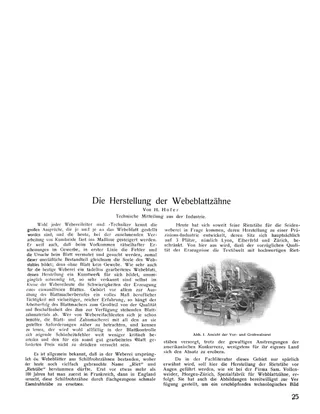
A 1927 technical article in German on how reed dents (the wires of a weaving reed) are manufactured, drawing on the Swiss firm Sam. Vollenweider of Horgen-Zürich. It covers the history of reeds, from cane (Schilfrohr) to flat iron wire, and the centers of fine reed-wire production (Lyon, Elberfeld, Zürich). It then covers the choice of round wire and the precision rolling process, with photographs of the rough-rolling and fine-rolling shops. The article ends with "Fortsetzung folgt" (to be continued).
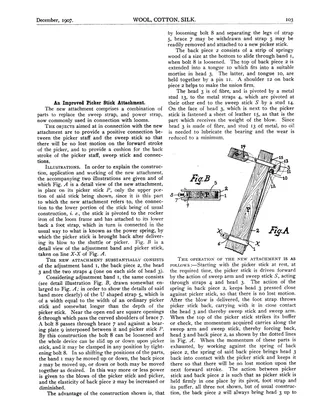
An Improved Picker Stick Attachment
Article · 2 pages
A 1907 article from Posselt's Textile Journal describing a new picker stick attachment for looms, invented by H. E. Taplin, which replaces the sweep strap and power strap. It explains the adjustment band, spring wood back piece, fibre head and metal straps, and how they remove lost motion on the forward stroke while cushioning the back stroke. Two figures illustrate the parts, and the article closes with the inventor's claims about smoother action and less wear.
Lathe
Article · 1 page
A short dictionary entry on the weaving sense of the word 'lathe' (a variant of lay or batten), the beam that beats up the weft. It lists the parts of the lay: swords, lay-cap, reed (sley or slay), race, shuttle-boxes, picker and picker-cord. The text is a definition only and has no drafts or illustrations.
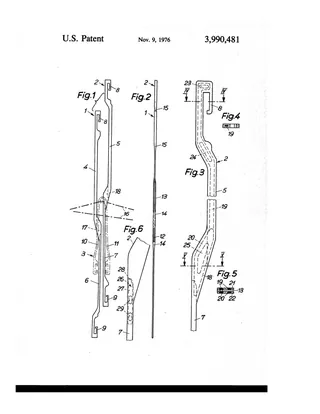
Leno Heddles, US Patent No. 3990481
Patent · 7 pages
US Patent 3,990,481 (Martin Graf, assigned to Grob & Co., Horgen, Switzerland; granted 9 November 1976) describes a wear-resistant leno heddle with a doup and two lifting heddles. The lifting heddles are moulded in one piece from plastic with varying cross-sections, and may contain embedded metal reinforcing inserts. The scan includes a 2002 web printout of the patent text and the original printed patent with drawings (Figs. 1-6), background on steel welded heddles, and 12 claims.
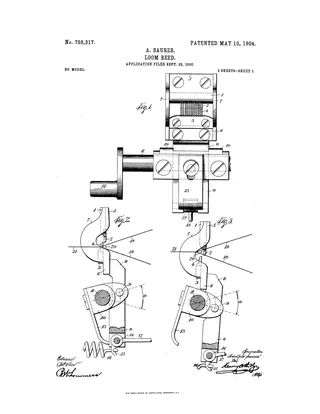
Loom Reed, US Patent No. 759317
Patent · 4 pages
US Patent No. 759,317, granted May 10, 1904 to Adolph Saurer of Arbon, Switzerland, for a divided loom reed for weaving narrow goods such as ribbons and tape. The reed has upper and lower sets of overlapping teeth so the weft can be laid behind the reed and then passed through the gap to the front to be beaten up. The patent has two drawing sheets (Figs. 1-4) showing the reed, the rocking crank, spring and cam drive, followed by the specification and seven claims.
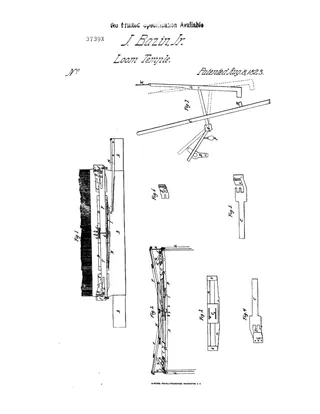
Loom Temple, US Patent No. X0003739
Patent · 2 pages
Patent drawing sheet and handwritten reference list for a loom temple patented by J. Bazin Jr. in 1823. The drawings show the temple assembly on cloth, its centre frame, left and right sliders, and a view of how the temples are worked in the loom. The reference page explains Figs. 1-7. No printed specification is available.
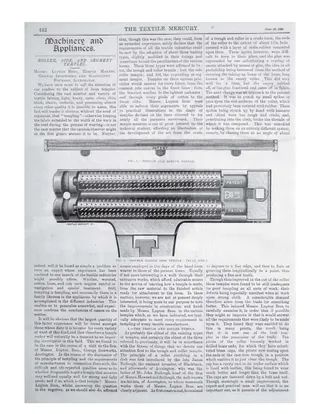
Machinery and Appliances
Textile Mercury, 1890
Article · 2 pages
A two-page article from The Textile Mercury describing loom temples (devices that hold cloth at full width during weaving) made by Lupton Bros. of Accrington. It covers the trough and roller temple, the one-roller and double-roller side temples, and the ring or Swiss (segment) temple, with the makers' patented improvements to rollers, troughs, caps and pivots. It also gives a short history of how roller temples developed, from rubber and emery coverings to cut and fluted teeth. Four engraved figures show the temples.
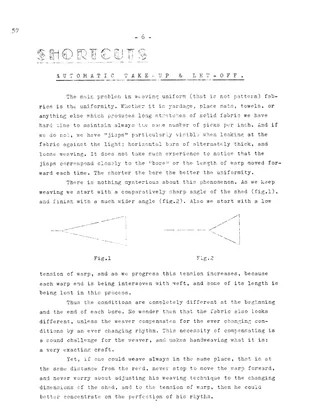
Shortcuts - Automatic Take-Up & Let-Off
Master Weaver, May 1961
Article · 5 pages
A 1961 Master Weaver 'Shortcuts' article describing a simple do-it-yourself automatic let-off and take-up for a handloom, intended to keep picks per inch uniform in plain yardage, towels and place mats. It explains why uneven beat appears as the shed angle and warp tension change, then gives construction details for a cord-and-bolt friction let-off on the warp beam, a cord-and-weight take-up on the cloth beam, and rubber-bumpered beater stops. It also covers variations (basement or pulley weight), use, resetting, correcting mistakes, and maintenance such as waxing the cord.
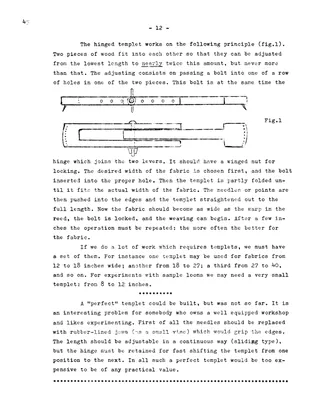
Shortcuts - Templets or Stretchers
Master Weaver, May 1959
Article · 3 pages
A short article from Master Weaver's Shortcuts series on templets (temples, stretchers) used in handweaving to keep fabric at width. It explains the origin of the names, how hinged and sliding templets are built and used, and their drawbacks such as wavy edges, needle holes and slower weaving. It lists five cases where a templet is justified (very low sett, elastic weft on stiff warp, wide weak warp, bound weaves, and cross or net weaves) and suggests an improved design with rubber-lined jaws. One figure shows a hinged templet.
Shuttle
Rees's Cyclopedia, 1819
Article · 1 page
A short encyclopedia entry defining the weaver's shuttle as the instrument that carries the weft thread back and forth through the warp on a loom. It describes the eye or chamber that holds the pirn (quill) wound on a tube of paper or rush. It also describes the ribbon-weaver's shuttle, made of box wood, iron-shod and pointed at both ends.
Simplifying the Tie-up
Article · 1 page
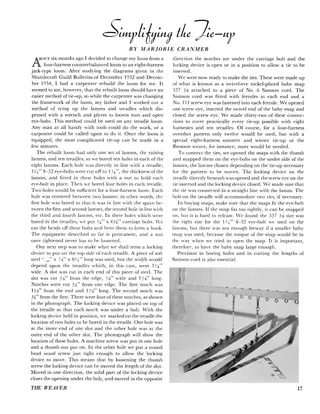
A 1936 article in which Marjorie Cranmer describes a mechanical system for simplifying treadle-to-lamm tie-ups on a rebuilt eight-harness, ten-treadle jack-type loom. She and her father fitted eye-bolts in the lamms, hooked carriage bolts in the treadles, and a notched steel locking device on each treadle. Ties made of Samson cord with baby snaps connect lamms and treadles without wrench or pliers. The article gives dimensions and hardware sizes, and notes the system suits any treadle loom.
Swap Shop
Article · 1 page
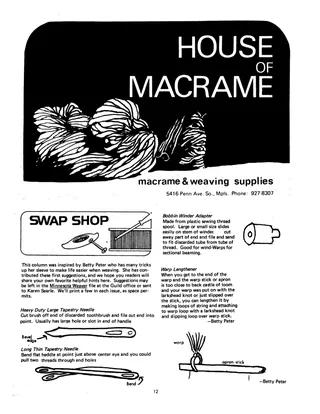
A one-page column from Minnesota Weaver collecting practical weaving tips contributed by Betty Peter. It describes homemade tools and fixes: a large tapestry needle made from a discarded toothbrush, a long thin needle made by bending a flat heddle, a bobbin winder adapter made from a plastic thread spool, and a way to lengthen a warp with string loops attached by larkshead knots. The column invites readers to submit their own hints.
Temple for Weaving Cloth
Peter Newell · December 2, 1836
Patent · 2 pages
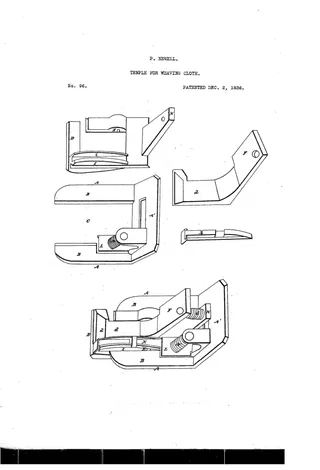
Reissued U.S. Patent No. 96 (reissued December 2, 1836) for an improved temple for weaving cloth, invented by Peter Newell of Waterford, New York. The specification describes an iron frame with guides, sliding upper and lower jaws that hold the selvage, a spring-closed mechanism opened by the lathe striking a projection, and a slide that lets the jaws recede to protect the reed when the shuttle stops. It lists three claims and is accompanied by a patent drawing showing several views of the parts.
Terminology - Once More About the Harness
Master Weaver, July 1954
Article · 1 page
A short terminology note from Master Weaver proposing "harness-frame" (or simply "frame") as a compromise between the widely used but etymologically wrong "harness" and the artificial "heddle-frame". It explains the reasoning and the English objection to "heddle-frame". The page also carries the end of a preceding piece of business advice for craft weavers on dealing with dealers, individual customers, collecting payment, salesmen and expected income.
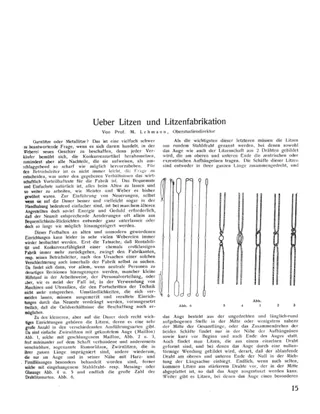
Ueber Litzen und Litzenfabrikation [On Heddles and Heddle Manufacture]
Article · 2 pages · German
A German-language technical article from 1927 on heddles (Litzen) for power looms, comparing thread (twine) heddles with wire and metal types. It describes knotted, looped, glass-, steel- and brass-eyed heddles, round and flat steel wire heddles, and movable "Rumor" heddles. It weighs durability, cost, warp density and suitability for fine yarns, silk and damask weaving. The text ends with "to be continued", so it is the first part of a series.
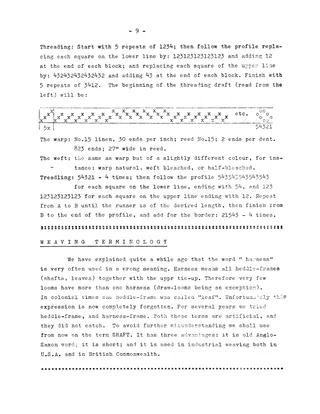
Weaving Terminology - Harness, Shaft
Master Weaver, July 1958
Article · 1 page · weaving drafts
A single page from Master Weaver, No. 40, July 1958. It opens with the end of a threading and treadling description for a linen runner, giving warp and weft specifications, sett, and a partial threading draft. It then has a short note on terminology, explaining that 'harness' properly means all the heddle-frames together with the upper tie-up, and that the publication will use 'shaft' for a single heddle-frame.
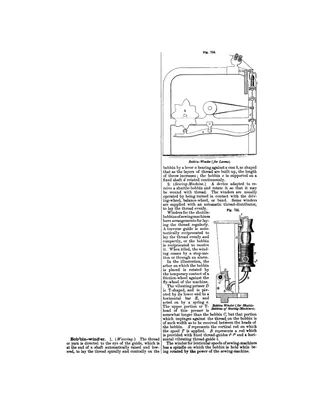
Bobbin-Winder
Article · 2 pages
A short dictionary entry on bobbin-winders from Knight's American Mechanical Dictionary. It describes a loom bobbin-winder that uses a lever and cam to lay thread in conical layers, and winders for sewing-machine shuttle bobbins with traverse guides, presser, tension device and automatic cutoff. Three line drawings (Figs. 754-756) illustrate the mechanisms.
Gadgets
Master Weaver, January 1957
Article · 3 pages
A critical, humorous essay from Master Weaver (January 1957) on handweaving gadgets and loom "improvements". The author argues that most do not work or conflict with craft principles, covering peg-drum shed openers, prefabricated warps, fixed loom ties, race boards, flying shuttles, specialized hand shuttles, ready-wound weft tubes, and electric bobbin winders. He also discusses well-conceived but poorly made or misunderstood equipment such as doubling stands, warping mills, shed regulators and pattern harnesses.
Harness
Article · 1 page
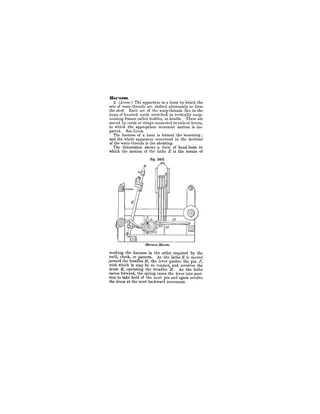
A one-page dictionary entry from Knight's American Mechanical Dictionary defining the loom harness as the apparatus that shifts sets of warp threads alternately to form the shed. It explains heddles (healds), the terms 'mounting' and 'shedding', and describes a hand-loom shedding mechanism in which the motion of the lathe turns a pin drum to work the treadles. It includes Fig. 2402, a side-elevation diagram of this 'Harness-Motion'.
Heddle
Article · 1 page
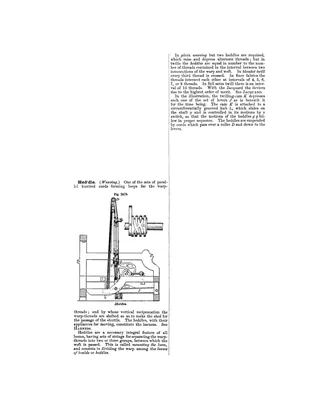
A short dictionary entry defining the heddle as the set of knotted cords forming loops that guide the warp threads and, by moving up and down, open the shed for the shuttle. It explains how many heddles are needed for plain weave and twills (including blanket twill and satin twill) and mentions the Jacquard. It also describes an illustrated mechanism (Fig. 2478) in which a twilling cam acts on levers to move the heddles in sequence.
Machinery and Appliances
Textile Mercury, April 5, 1890
Article · 2 pages
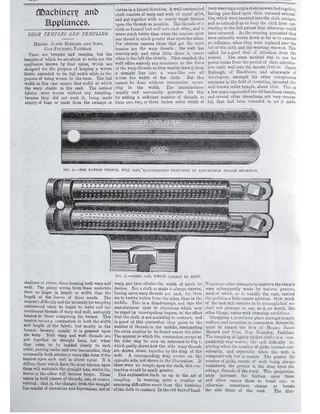
An 1890 trade article from The Textile Mercury on loom temples, the devices that hold woven cloth at full width during weaving. It explains why cloth contracts, briefly traces templing from hand-loom stick temples to James Bullough's roller temple of about 1842, and describes the patent steel-cap roller temple made by James Blezard and Sons of Padiham. Illustrated with drawings of ordinary and patent temples; the second page also carries short trade notes and news items.
Machinery and Appliances
Textile Mercury, 1890
Article · 1 page
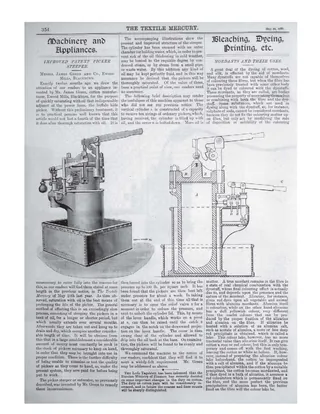
A single page from The Textile Mercury of 24 May 1890. It describes James Green and Co.'s improved patent picker steeper, a pressurized oil cylinder with a heated water jacket that saturates buffalo-hide pickers for power looms in about a week, in place of months of steeping in a tank. The page also carries a short note on Russian cotton duties and the start of an article on mordants and their use in dyeing cotton, wool and silk, using alizarine and alumina as the example.
Navette [Shuttle]
Article · 1 page · French
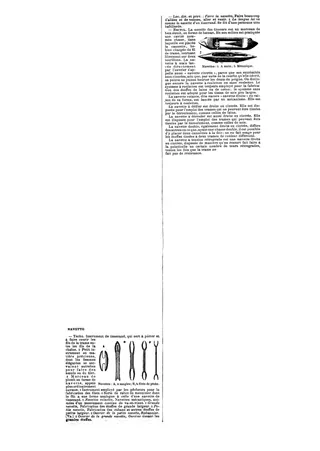
A French encyclopedia entry on the word 'navette' (shuttle) from the Nouveau Larousse Illustré. It defines the weaver's shuttle for carrying weft through the warp, along with other senses: a lacemaking or netting tool, a lead piece called saumon, a fisherman's netting shuttle, and a carpenter's plane. The encyclopedic section describes shuttle construction and types: hand or curved, flying or mechanical, rolling and non-rolling, unwinding, double, and reverse-tension shuttles. Engraved figures show hand and mechanical shuttles and sangle and fishing-net shuttles.
The Pros and Cons of Fly-Shuttle Weaving
Article · 2 pages
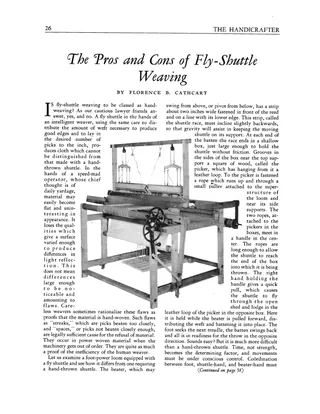
An article by Florence B. Cathcart weighing fly-shuttle weaving against hand-thrown shuttle weaving, asking whether it counts as hand-weaving. It describes how a foot-power loom is fitted with a fly shuttle (shuttle race, pickers, ropes and handle) and the coordination of foot, shuttle hand and beater hand. It discusses weft and warp tension, selvage problems, rhythm, and an automatic cloth take-up, and concludes that a skilled weaver can produce equally good cloth with less fatigue and far greater output. The second page also carries a short continuation of 'Further Notes on the Speck Drafts' and two advertisements.
Reed
Article · 1 page
A dictionary entry on the weaving reed (also called sley or slay), the loom part with metal or cane dents through which warp threads pass. It explains how reed lengths and dent counts are measured in Scotland and elsewhere in Britain, the reed's role in beating the weft to the web, and the batten or lathe that holds it. It also describes the linen-prover and its four perforations for counting threads in Holland, Scotch and French reed standards.
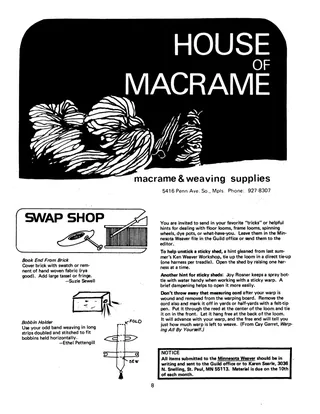
Swap Shop
Minnesota Weaver, May 1976
Article · 1 page
A one-page "Swap Shop" column of practical hints from the Minnesota Weaver newsletter. Tips include covering a brick with handwoven fabric as a bookend, making bobbin holders from band-woven strips, freeing a sticky shed with a direct tie-up or a dampening spray, and using a marked measuring cord to track remaining warp. It also invites readers to submit their own tips.
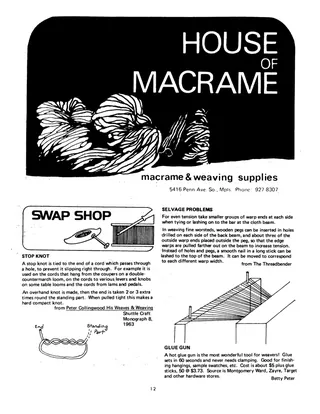
Swap Shop
Article · 1 page
A one-page 'Swap Shop' column of weaving tips from Minnesota Weaver. It explains how to tie a stop knot for loom cords, gives two methods for improving selvage tension (smaller lashing groups, and pegs or a nail on the back beam for fine worsteds), and recommends a hot glue gun for finishing hangings and sample swatches. The page carries a House of Macrame advertisement header and credits to Peter Collingwood's Shuttle Craft Monograph and The Threadbender.
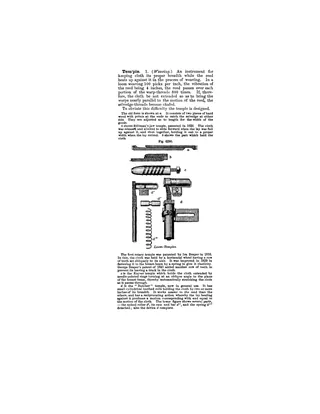
Temple
Article · 1 page
Dictionary entry from Knight's American Mechanical Dictionary defining the loom temple, the device that holds woven cloth at its proper width while the reed beats up. It describes the old wooden pointed temple, Stillman's jaw temple (patented 1826), the rotary temples of Ira and George Draper, the Kayser needle-pointed ring temple, and the Dutcher toothed-roll temple. A figure illustrates the different forms.
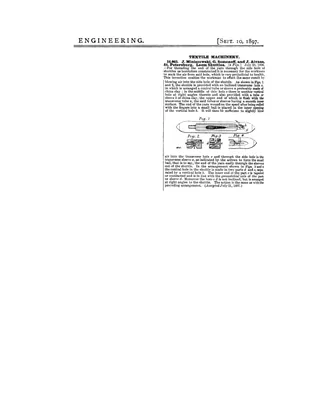
Textile Machinery
Engineering Weekly, September 10, 1897
Article · 1 page
A one-page patent abstract from the 'Textile Machinery' column describing British patent no. 16,063 (1896) for a loom shuttle. The invention lets weavers thread the yarn end through the shuttle's side hole by blowing air instead of sucking, which was considered harmful to health. Two arrangements are described with china clay sleeves in transverse and vertical holes, illustrated by four figures.
Weaving. -- No. VII: Hand-Loom Weaving (continued)
Article · 2 pages
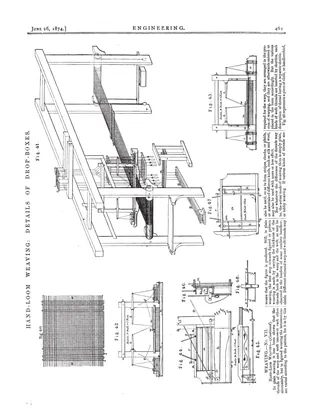
A two-page installment from a Victorian engineering series on weaving, covering the hand loom's drop-box. It first notes how plain weaving can be varied with threads of different thickness or colour, and how several shuttles are used for different wefts. It then gives a detailed mechanical description of Robert Kay's drop-box (c. 1760), a three-shuttle version with shelves, pickers, hooks, pins, cords and levers, illustrated by Figs. 40-48. It closes with remarks on the difficulty of fitting multiple shuttles to power looms.
Balance
Article · 1 page
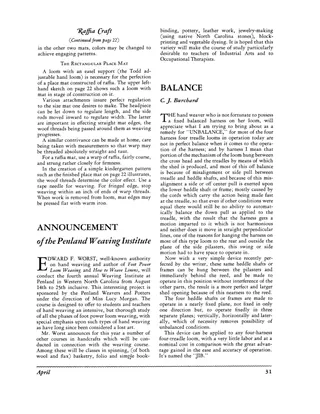
A one-page article by C. J. Burchard on the problem of unbalanced harnesses in four-harness, four-treadle hand looms, caused by side pull between treadles and heddle shafts. He describes a device, the "JIB", that lets the heddle shafts hang between the pilasters just behind the reed and move in fixed planes, giving a larger shed. The page also carries the end of a raffia craft article on weaving a rectangular place mat on an easel-type loom, and an announcement of the fourth annual Penland Weaving Institute, led by Edward F. Worst.
Patent Picker Steeper
Textile Mercury, 1889
Article · 2 pages
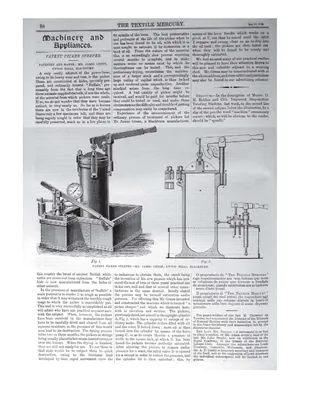
Two pages from The Textile Mercury (May 1889) on mill machinery and trade news. The lead article describes James Green's Patent Picker Steeper of Blackburn, which saturates loom pickers (buffalo hide) with oil under 350 lb/sq in pressure instead of slow immersion over months; it is shown in perspective and sectional figures. The second page describes Perkin and Co.'s improved friction gear for reversing winches, and reports the Flax Supply Association's annual meeting in Belfast, covering Irish flax acreage, yarn imports and exports, and seed supply. Short news items include John Bright's will and a cotton spinners' short-time decision.
Shuttle
Article · 1 page
Encyclopedia article defining the shuttle as the boat-shaped implement that carries weft through the warp. It discusses the shuttle's ancient origins, including Egyptian wall paintings, hooked rods and netting needles, and John Kay's fly shuttle of 1733. It also describes materials, sizes and weights of silk and power-loom calico shuttles, the tongues that hold the weft, and the small shuttles for ribbons and narrow goods. It ends with cross-references to the articles Weaving and Weaving Machinery.
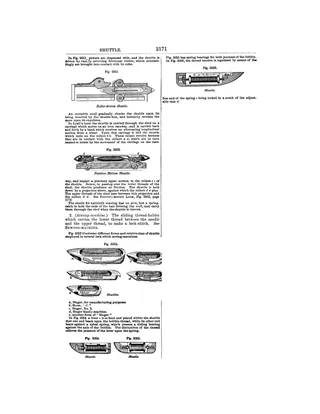
Shuttle
Article · 2 pages
Two-page dictionary entry on the shuttle from Knight's American Mechanical Dictionary. It defines the loom shuttle, notes John Kay's 1735 invention of the fly-shuttle, and describes several patented loom-shuttle varieties: hinged spindle, guide-wire, tension device, compressed-air thrown, roller-driven and Lyall's positive-motion loom. It also covers sewing-machine shuttles (Singer, Howe) with illustrated tension and bobbin-bearing designs.
736 documents found