Textile Documents › Authors › Author: Karol Kulczycki
5 documents found
Sort: 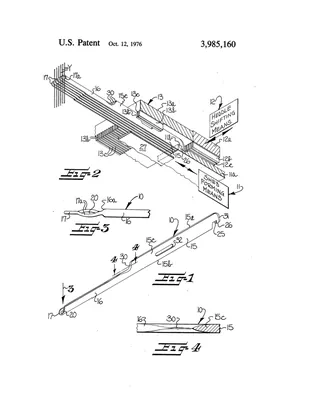
Heddle for a Weaving Machine for Making Triaxial Fabrics, US Patent No. 3985160
Patent · 16 pages
US Patent 3,985,160 (12 October 1976), assigned to Barber-Colman Company, describes a flat, thin strip heddle for a machine that weaves triaxial fabrics. The heddle has a nose with a warp guide opening, a cutout and hook-shaped tail for longitudinal shedding movement, and a shoulder along one edge for shifting it weftwise. The scan includes the USPTO database printout (abstract, references cited, claims, description) and the original patent pages with drawings of the heddle and a schematic of the shed forming and heddle shifting mechanism.
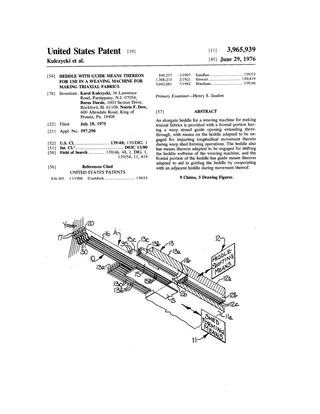
Heddle with Guide Means Thereon for Use in a Weaving Machine for Making Triaxial Fabrics, US Patent No. 3965939
Patent · 12 pages
US Patent 3,965,939 (29 June 1976) to Karol Kulczycki, Burns Darsie and Norris F. Dow describes an elongate strip heddle for machines that weave triaxial fabrics. The heddle has a warp guide opening in a reduced-width frontal portion and a small lateral guide tab that cooperates with adjacent heddles. It moves longitudinally to form sheds and is shifted weftwise to make the warps run diagonally. The document includes the claims, a description of the machine arrangement with two staggered rows of heddles, shifting and guide bars, dimensions, and patent drawings (Figs. 1-5). It is a printout from the USPTO database plus the original patent pages.
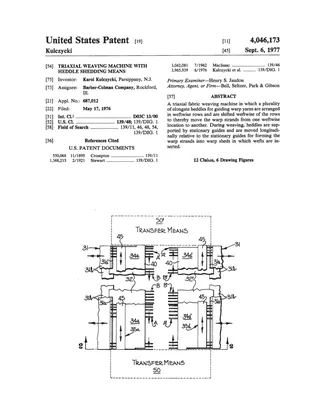
Triaxial Weaving Machine with Heddle Shedding Means, US Patent No. 4046173
Patent · 16 pages
US Patent 4,046,173 (6 September 1977), granted to Karol Kulczycki and assigned to Barber-Colman Company, describes a triaxial weaving machine in which elongate strip heddles are arranged in weftwise rows and shifted weftwise to move warp strands from one weftwise location to another. Stationary guide plates support the heddles while shedding bars engage cutouts in them and move them longitudinally to form warp sheds for weft insertion. The document includes the abstract, 12 claims, a description of the drawings and mechanisms (cams, cranks, drive links, heddle shifting bars), and three sheets of patent drawings. It appears twice: as a USPTO web printout and as the original patent layout.
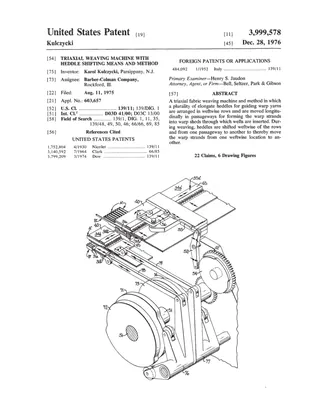
Triaxial Weaving Machine with Heddle Shifting Means and Method, US Patent No. 3999578
Patent · 17 pages
US Patent 3,999,578 (granted 28 December 1976 to Karol Kulczycki, assigned to Barber-Colman Company) describes a triaxial fabric weaving machine. Elongate heddles guide the warp strands and move longitudinally in passageways to form sheds. Between sheds, movable heddle-shifting bars move the heddles weftwise from one passageway to another, so the warp strands run obliquely to the wefts. The document has the USPTO web database printout (abstract, claims, description) and the original patent print with three sheets of drawings showing racks, cams, linkages and drive shafts.
Triaxial Weaving Machine with Heddle Transfer and Method, US Patent No. 4013013
Patent · 32 pages
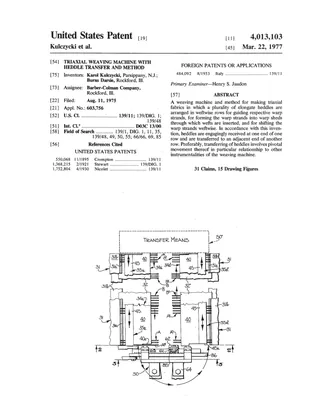
US Patent 4,013,103 (granted March 22, 1977) to Karol Kulczycki and Burns Darsie, assigned to Barber-Colman Company, describes a weaving machine and method for making triaxial fabrics. Elongate heddles arranged in weftwise rows guide the warp strands and form sheds. A transfer mechanism receives a heddle at the end of one row and moves it pivotally to the adjacent end of another row, so the warp strands can be shifted weftwise without undue stress. The scan includes a web printout with abstract and claims, the printed patent with five sheets of mechanical drawings (Figs. 1-15), the full specification and claims, and a certificate of correction.
5 documents found