Textile Documents › Topic: Hemp, jute, ramie, and other plant fibers
374 documents found
Sort: 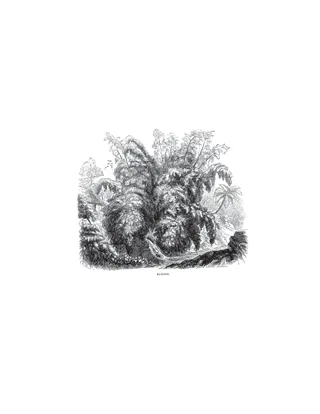
Bamboo
Illustration · 1 page
A single-page engraved illustration titled "Bamboo" showing a dense bamboo grove with tall feathery stalks and arching foliage. A palm tree stands at the right, a small thatched hut at the left, and a stream or waterfall runs through the lower center. The only text is the caption.
Bamboos in English Gardens
Article · 2 pages
A short illustrated article from Garden and Forest describing bamboos, the giant tropical grasses. It discusses the great bamboo of Penang and the Java Gigantochloa at the Peradeniya garden in Ceylon, their rapid growth, the species and genera and their distribution worldwide, and their many uses for food, building, mats, cordage and paper. It closes with remarks on hardy dwarf bamboos for European and American gardens.
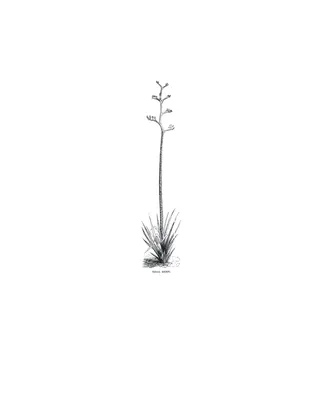
Sisal Hemp
Illustration · 1 page
A single engraved illustration of the sisal hemp plant (Agave sisalana) from Harper's New Monthly Magazine, 1871. It shows a rosette of long, pointed, sword-like leaves with a tall, branching flowering stalk. The page carries only the caption "Sisal Hemp" and no accompanying article text.
Tree That Grows Silk
Technical World, 1911
Article · 1 page
A short 1911 magazine article describing the kapok, or silk cotton tree, found in tropical Asia, Africa and the West Indies. It explains that the silky fiber surrounding the seeds is sold as kapok for upholstery, pillow and cushion stuffing, and life-preservers, and notes Ceylon as a major exporter. It also mentions the tree's shelf-like folds of bark and its role in certain African religious rites. A photograph of the tree accompanies the text.
Abaca
Article · 1 page
A one-sentence encyclopedia entry from the 11th edition of the Encyclopedia Britannica. It defines abaca (abaka) as the native name for the plant Musa textilis, source of the fibre called Manila hemp, and refers readers to the separate Manila Hemp article.
Agave
Article · 1 page
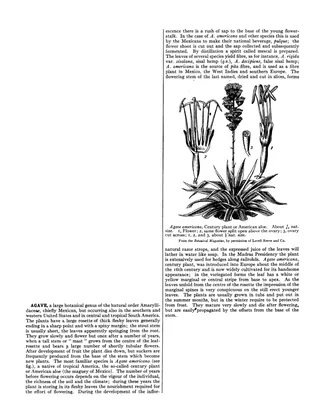
Encyclopedia article on the agave genus, a largely Mexican group of rosette-forming succulents. It describes the plant's growth and flowering habit, the uses of Agave americana (century plant, maguey) for pulque, mescal and pita fibre, and sisal hemp from related species. It includes a botanical illustration of Agave americana with flower details.
[Ambary Hemp]
China Pictorial, 1976
Illustration · 1 page
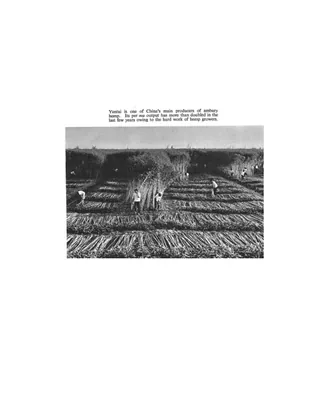
A single-page illustration from China Pictorial (1976, No. 3) showing a black-and-white photograph of a field of harvested ambary hemp. Stalks lie in rows in the foreground and bundled stalks are stacked in tall piles behind, with workers in the field. The caption says Yentai is one of China's main producers of ambary hemp and that per mu output has more than doubled in recent years.
Bamboo
Manufacturer and Builder, 1869
Article · 1 page
A very short note from The Manufacturer and Builder on the many uses of the bamboo, especially in China. It lists uses including shelter, food, boats, furniture, writing materials, clothing and punishment. It has no technical detail on processing or textile use.
Coir
Article · 1 page
A very short encyclopedia entry from the 11th edition of the Encyclopedia Britannica defining coir as a rough, strong fibre obtained from the outer husk of the coconut. It gives the word's Malay origin and refers readers to the article on the coco-nut palm for further detail.
Crotalaria
Article · 1 page
A short encyclopedia entry on Crotalaria, a genus of about 250 leguminous plants with inflated rattling pods. It describes the species that yield commercial fibers, especially Sunn hemp (Crotalaria juncea) and Jubbulpore hemp (C. tenuifolia) of India, and notes C. burhia grown in Sinde. It also mentions U.S. species thought to poison horses.
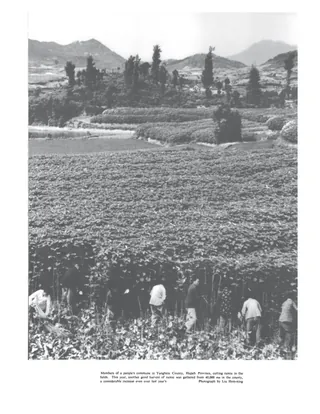
[Cutting Ramie]
China Pictorial, 1965
Article · 1 page
A single-page photo feature from China Pictorial showing members of a people's commune in Yanghsin County, Hupeh Province, cutting ramie in the fields. The caption reports a good harvest from 40,000 mu in the county, an increase over the previous year. The photograph shows workers bent over the plants in a large field with hills and terraced land behind.
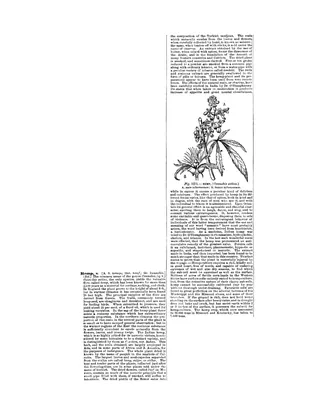
Hemp
Zell's Encyclopedia, 1876
Article · 1 page
A one-page encyclopedia entry on hemp (Cannabis sativa) with a botanical illustration showing male and female inflorescences. It covers the plant's use as a fibre for cordage, sacking and cloth, its seed and oil, and its narcotic resin and preparations (hashish, ganjah, churrus) with their medical use. It ends with notes on soil requirements for hemp culture in the United States and the decline of the Missouri and Kentucky crop.
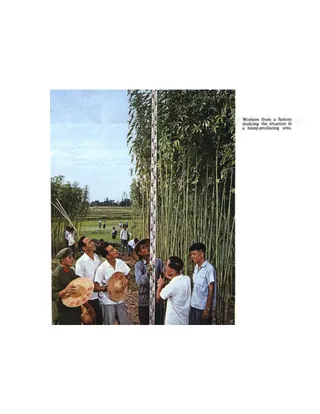
[Hemp-Producing Area]
China Pictorial, 1975
Illustration · 1 page
A single photograph from China Pictorial, 1975, No. 11, showing factory workers studying conditions in a hemp-producing area. Men stand in a field of tall hemp plants, one holding a measuring rod against the stalks while another points. The only text is a one-line caption.
Jute
Manufacturer and Builder, c. 1881
Article · 1 page
A short 1881 magazine article on jute, covering U.S. import values, the botany of the plant, and how the fiber is harvested and steeped. It lists uses such as gunny cloth, burlap, bagging, matting and cheap carpets, and notes that jute is poor for ropes. It argues that jute could be grown profitably in the Southern States and California to supply American demand, citing cotton baling needs.
Manilla Hemp in Plaster
Manufacturer and Builder, 1888
Article · 1 page
A short 1888 trade-journal article reporting architects' tests of fibers used as binders in plaster. Plates containing Manilla hemp, Sisal hemp, jute and goat's hair were loaded with weights, and the Manilla plate carried the most (195 pounds) and cracked without separating. A second test stored lime-and-sand mortar with Manilla hemp or goat's hair for nine months; the hair was largely consumed by the lime, while the hemp mortar stayed cohesive.
Nettle
Article · 1 page
A short encyclopedia entry on the nettle (genus Urtica, family Urticaceae), covering its botany, stinging hairs, flowers and distribution. It names the three British species and notes that nettle stem fibre is used for cordage and papermaking. Textile use gets only a brief mention.
Ramie
Article · 2 pages
A short editorial introduction from the Hawaiian Forester and Agriculturalist (1904) to the potential of ramie fibre cultivation in Hawaii. It points readers to L. G. Blackman's comparison of fibre plants in the Bishop Museum Occasional Papers and says ramie is regaining a place in European markets now that machinery can handle it. It advises that planting suit small companies with some capital, notes that degumming is done after the fibre is marketed, and announces later articles on sisal, Manila hemp and coir.
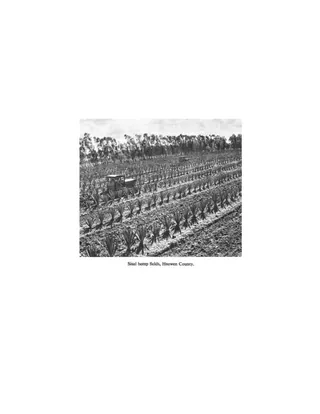
Sisal Hemp Fields, Hsuwen County
China Pictorial, 1976
Illustration · 1 page
A single black-and-white photograph from China Pictorial showing sisal hemp fields in Hsuwen County, on the Leichow Peninsula. Rows of agave-like sisal plants cover sloping ground, with trees along the horizon and two small carts or wagons on the field track. The only text is a one-line caption.
Value of Bamboo as a Fiber
Article · 1 page
A short note from Harper's New Monthly Magazine on the growing commercial importance of West Indian bamboo as a fibre. It reports large exports from Jamaica to the United States and describes crushing the bamboo between mill rollers and baling it with a screw press to reduce bulk and freight costs. It also refers back to an earlier item on palmetto leaves as a textile material.
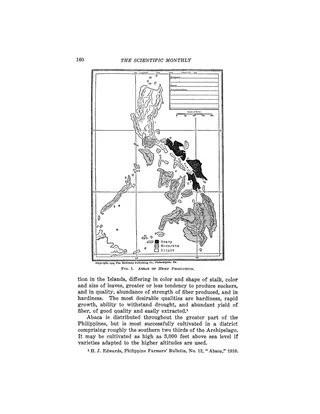
Abaca (Manila Hemp): The Fiber Monopoly of the Philippine Islands
Article · 12 pages
A 1920 Scientific Monthly article on abaca (Manila hemp), the leaf-sheath fiber of Musa textilis, and its role as a Philippine monopoly. It covers the plant's cultivation, soil and climate needs, harvesting, hand stripping of the fiber, the 1914 fiber grading law, uses (rope, paper, hat braid, local goods), and export statistics for 1899-1917. Shorter sections treat maguey, sisal, and minor fiber plants such as kapok, ramie, pina and buri raffia. It includes a map of hemp-producing areas and a table of hemp exports.
Agave
Rees's Cyclopedia, 1819
Article · 2 pages
An encyclopedia article on the botanical genus Agave (American aloe) from Rees's Cyclopaedia. It gives the botanical characters, describes seven species, and notes the history of their introduction to Europe and England. It also covers uses of the leaf juice as soap and the leaf fibres for thread, rope and cloth, including a process for extracting thread at Loule, Portugal, and ends with cultivation advice and a comparison with Aloe.
Asbestos
Article · 1 page
A short encyclopedia entry describing asbestos as a native stone that splits into fine, silky threads one to ten inches long and survives fire, which only whitens it. It notes that cloth and paper have been made from it, reports Royal Society trials in which asbestos cloth lost a dram of weight in the fire, and repeats Pliny's account of napkins cleaned by burning. It names localities in Asia and Europe, including Anglesey in Wales and Aberdeenshire in Scotland.
Bamboo
Chambers's Encyclopedia, 1881
Article · 1 page
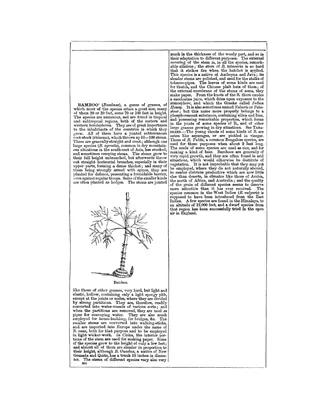
A one-page encyclopedia entry on bamboo (Bambusa), a genus of tropical and subtropical grasses. It describes the plant's growth habit, rhizome and jointed stems, and the many species and their sizes. It also lists uses: building, water pipes, walking sticks, wickerwork, paper, plaited hats, thatch, food and the exudate tabasheer. A line drawing of a bamboo plant accompanies the text.
Bamboo
Article · 2 pages
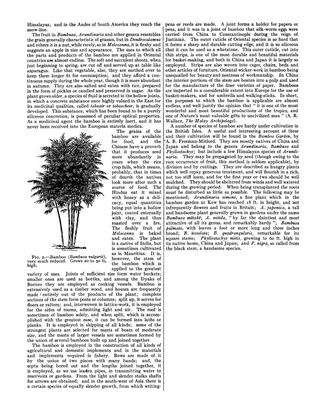
A two-page encyclopedia article on bamboo from the 11th edition of the Encyclopedia Britannica. It describes the botany of the Bambuseae grasses, their flowering habits and geographic distribution, and their many uses in Asia, including food, building, implements, basketry, wickerwork, and paper. It closes with notes on hardy species cultivated in the British Isles. Two botanical illustrations accompany the text.
Coir
Article · 1 page
A short dictionary entry on coir, the fiber prepared from the husk of the coconut. It describes how the nut's husk is stripped, soaked, beaten and rubbed, then twisted into yarn much like hemp. It also gives the strength of coir rope compared with hemp and its suitability for hawsers and rigging, and notes a second source of coir fiber.
Hemp
Chambers's Encyclopedia, 1881
Article · 2 pages
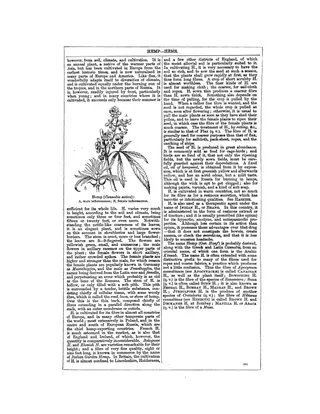
An encyclopedia article on hemp (Cannabis sativa) from Chambers's Encyclopedia. It describes the plant's botany, its cultivation for fibre in Europe and elsewhere, and the effect of sowing and pulling time on fibre quality. It also covers uses of the fibre for cloth, sailcloth and rope, the seed and its oil, the narcotic and medicinal uses (hashish, bhang), and the many other fibres called 'hemp' (Manilla, Sunn, Bowstring, Canadian). It includes a botanical illustration of male and female flowers.
Hemp
Article · 1 page
A short dictionary entry on the early history of hemp as a fiber plant. It cites Herodotus on hemp in Scythia and Thrace, Hesychius on Thracian hemp sheets, and Moschion on hempen ropes aboard the Syracusia. It also covers the Greek and Roman use of tow for calking, hemp among the Anglo-Saxons, and the spread of hempen cloth in Europe by the thirteenth century. It ends with a cross-reference to appliances for treating hemp and other fibers.
Hemp
Manufacturer and Builder, 1869
Article · 1 page
A very short 1869 magazine item on hemp as a fiber plant, noting its use for thread, cloth, and cordage and comparing it to flax in form, culture, and use. It says the bark of the stalk is the useful part and that the fiber is coarser and stronger than flax. It begins a remark on the limited cultivation of hemp in Great Britain, and the text ends partway through that remark.
Hemp Cultivation in the Philippine Islands
Article · 2 pages
A two-page article from Science (June 5, 1891) on Manila hemp cultivation in the Philippine Islands, based on a report by the British consul at Manila. It covers soil and climate, planting and crop timing, harvesting and hand-cleaning of the fibre with knife and board, drying, costs, labor arrangements, land ownership rules for foreigners, and 1890 export figures. It does not deal with African basketry or weaving.
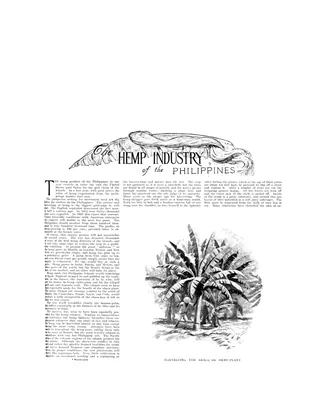
Hemp Industry of the Philippines
Article · 2 pages
A 1900 Harper's Weekly article promoting the abaca (Manila hemp) industry of the Philippines as an investment for American capital. It describes how the plant is grown, harvested and hand-stripped with a bolo on a bamboo bench, then baled, graded, and shipped through Manila, Cebu and Hong Kong. It also covers prices, the Chinese and English role in the trade, and the failure of stripping machines and of transplanting abaca abroad. Brief mention is made of woven abaca and piña cloth, and three illustrations show drying, unloading and baling hemp.
Improvement in Preparing Jute-Yarns, US Patent No. 77073
Patent · 1 page
US Patent No. 77,073, granted April 21, 1868 to James Monach of Philadelphia, describes treating jute yarn by boiling it in caustic alkali, then washing it in a weak sulphuric acid solution and drying it. The treatment makes the brittle yarn tougher and more elastic, so it can substitute for or be combined with wool yarns in knitted or woven fabrics. The patent notes an earlier patent of February 4, 1868 covering jute fibres boiled in alkali of about sixty degrees Twaddell.
Improvement in Treating Jute-Fibre, US Patent No. 74113
Patent · 1 page
US patent specification by James Monach of Philadelphia, assignor to himself, Jeffery Hart and Robert Thorp of Conshohocken, Pennsylvania, for treating jute fibre so it can substitute for or be mixed with wool. The process boils jute for about two hours in caustic alkali of roughly 60° Twaddell, then washes it, neutralizes it in weak sulphuric acid, washes and dries it. The treated fibre can be carded, bleached, dyed and spun like wool. The claim is for jute fibres treated with caustic alkali of that strength.
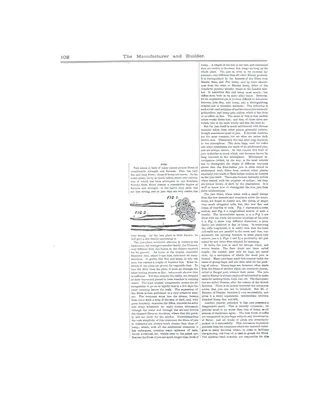
Jute
Article · 2 pages
A two-page magazine article describing jute fibre: the plant (Corchorus olitorius), its tropical Asian origin, retting and fibre separation, and how it compares with flax, hemp, ramie and other bast fibres. It gives a chemical test (acid sulphate of aniline) and microscopic features for telling jute from hemp and flax and for detecting adulteration with malva fibres. It also covers uses (bags, gunny cloth, ropes), bleaching, the smell prejudice, growth of European consumption after the Crimean War, and its use for ladies' false hair pieces.
Manila Hemp
Hawaiian Forester and Agriculturalist, July 1904
Article · 1 page
A short editorial note from the July 1904 Hawaiian Forester and Agriculturist introducing the second in a series of articles by Leopold Blackman on developing a fibre industry in Hawaii. It discusses abaca (Manila hemp, Musa textilis), its strength as a cordage fibre, its displacement of true hemp, and its earlier introduction to the Islands. The editor urges investigation of Hawaiian banana fibre and other native plants, and suggests an Hawaiian Agricultural College might undertake such work.
Nettle
Article · 1 page
A one-page encyclopedia entry on the nettle (genus Urtica and related stinging-haired plants). It covers botany, stinging species, dyes from roots and juice, and uses as fodder and food. It also describes the bast fibre used for yarn, cloth, lace and rope, with the species and regions where it is used.
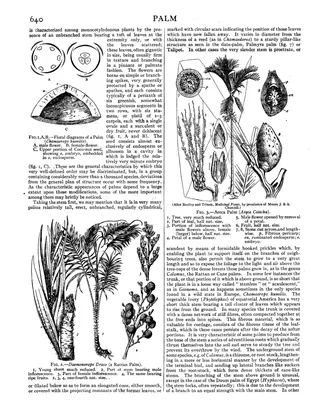
Palm
Article · 4 pages
Encyclopedia article on the palm family (Palmaceae) from the 11th edition of the Encyclopaedia Britannica. It describes the botany of palms, including stems, leaves, inflorescence, flowers, fruit and seeds, with seven botanical figures (rattan, areca, date, sago and Palmyra palms among them). It also covers geographic distribution and the economic uses of palms, including fibres for cordage, sugar, starch, oil, wax, vegetable ivory and food.
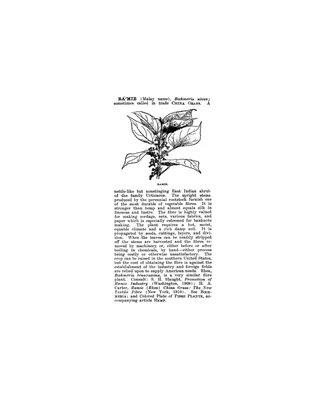
Ramie
Article · 1 page
A short encyclopedia entry on ramie (Boehmeria nivea), also called China grass, a nettle-family fibre plant of East Asia. It describes the plant, the strength and fineness of its fibre, its uses for cordage, nets, fabrics and banknote paper, growing conditions, and the costly extraction of the fibre. It notes the related rhea plant and gives two references from 1908 and 1910. A line drawing of a ramie sprig is included.
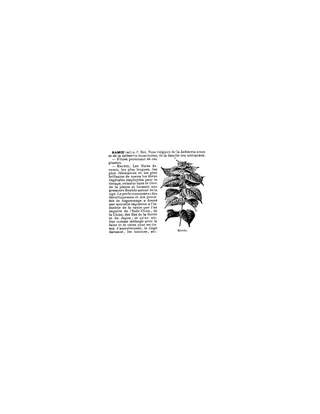
Ramie
Article · 1 page · French
A one-page encyclopedia entry on ramie from the Nouveau Larousse Illustré, with a botanical illustration of the plant. It identifies ramie as Boehmeria nivea and Boehmeria tenacissima of the nettle family. It describes the fibers as the longest, strongest and most lustrous of the vegetable weaving fibers, found in the bast. It also notes improvements in decorticating and degumming, imports from Indochina, China, the Sunda Islands and Japan, and use blended with wool and cotton for furnishing fabrics, damask linen and batiste.
Ramie Culture in Pennsylvania
Manufacturer and Builder, 1889
Article · 2 pages
A short 1889 notice from The Manufacturer and Builder reporting that a company has been formed in Pennsylvania to cultivate ramie and manufacture its fiber. It says 2,000 plants were brought from Louisiana, that the Landreth seedsmen will devote several acres near Philadelphia to the crop, and that a new decorticating machine is being built.
Silk-Cotton
Chambers's Encyclopedia, 1881
Article · 1 page
Encyclopedia article on silk-cotton, the silky seed fibre from Bombax and related tropical trees of Asia, Africa and America. It explains that the fibre is too short, smooth and elastic for cotton machinery, though it has been spun and woven on a small scale in India and New Spain, and is mainly used as stuffing for pillows and mattresses. It also describes the main silk-cotton trees (Bombax ceiba, Bombax malabaricum) and mentions Brazilian vegetable silk from Chorisia species.
Sisal Hemp
Article · 1 page
A one-page encyclopedia entry on sisal hemp (henequen), the fibre from Agave rigida var. sisalana, native to Yucatan and cultivated in Florida, the Bahamas and the West Indies. It describes the plant's growth and propagation, machine extraction of the fibre from the leaves, fibre yields, and uses in cordage, binder twine, bags and hammocks. It also mentions false sisal (Agave decipiens) as an inferior fibre.
The Structure of Bast Fibers
Article · 3 pages
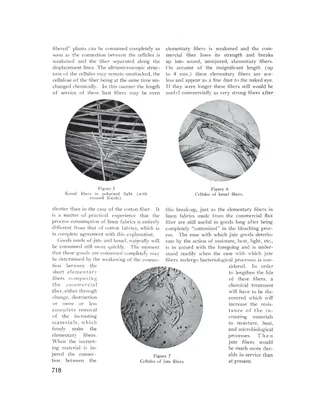
A 1929 article from The Melliand in which A. P. Sakostschikoff reports microscopic studies of the cellular structure of bast fibers. Flax, hemp, kendyr, ramie, jute and kenaf were examined in ordinary and polarized light after treatment with chromic acid, NaOH and HCl, and all show cellules enclosed in an outer epidermis with 'displacements'. The author compares elementary fiber lengths and links the short fibers and incrusting materials of jute and kenaf to their poor durability. Seven micrographs illustrate the fibers and cellules.
Abaca
Rees's Cyclopedia, 1819
Article · 1 page
A very short encyclopedia entry on abaca, described as a flax- or hemp-like fiber gathered in the Manila (Philippine) Islands. It says the plant is sown yearly, then steeped in water and beaten like hemp. Two kinds are named: white abaca for fine linen and grey abaca for cordage only.
Amianthus
Rees's Cyclopedia, 1819
Article · 2 pages
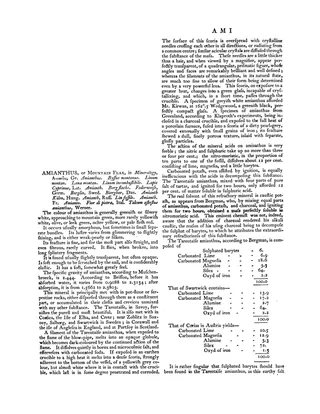
Encyclopedia article on amianthus (mountain flax), a fibrous, incombustible mineral related to asbestos. It covers physical characteristics, localities, behavior under heat and acids, and chemical analyses by Bergman. It also gives the history of spinning and weaving the fibers into fireproof cloth, used for Roman funeral shrouds, along with Mahudel's method for preparing the cloth, incombustible paper, and lamp wicks.
Asbestos
Article · 2 pages
Encyclopedia article on asbestos from the 11th edition of the Encyclopaedia Britannica. It covers the etymology and ancient use of the mineral, the amphibole and serpentine (chrysotile) varieties, and the main sources in Canada, the United States, Italy, South Africa and elsewhere. It also describes how it was spun and woven into fabrics as a curiosity, its modern industrial uses, and a short list of references.
Asbestos
Article · 2 pages
Two pages from the asbestos entry in Knight's New Mechanical Dictionary (the later part of the article). They list industrial uses of asbestos, such as packing, insulation, lamp wicks, fireproof clothing, paper and roofing, with British and U.S. patents, and a long bibliography of period journal references on its uses and history.
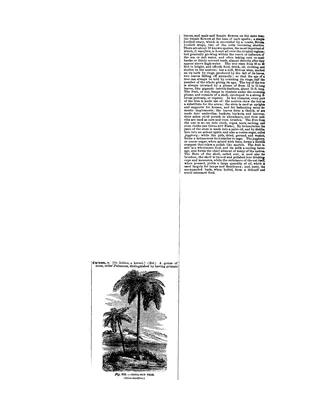
Cocoa
Zell's Encyclopedia, 1876
Article · 1 page
A one-page encyclopedia entry on the cocoa-nut palm (Cocos nucifera) from Zell's Encyclopedia. It describes the tree's botany, range and height, and lists the uses of its parts, including the fibre (coir) woven into cloth, ropes, mats and sacking, and leaves made into thatch and baskets. It includes an engraving of the tree and refers readers to a separate entry on cocoa-nut fibre.
Coconut
Article · 2 pages
Encyclopedia article on the coconut palm (Cocos nucifera), covering its origin, distribution, botany, and yield. It describes the uses of the fruit, oil, copra, sap, leaves, wood, and especially coir fibre from the husk, along with related species. Of interest to textile researchers for the passages on coir, cordage, and leaf plaiting for mats and baskets.
Coir
Article · 1 page
A short encyclopedia entry on coir, the coconut husk fibre, covering its etymology, the two grades of fibre (ordinary and brush fibre), and its spinning into yarn for doormats and matting. It gives 1913 US import figures and mentions uses of the refuse for mattress stuffing and horticulture.
Coir
Rees's Cyclopedia, 1819
Article · 1 page
A short encyclopedia entry defining coir, the strong fibre prepared from coconut husks and widely used in the East Indies for cables and cordage. It summarizes the experiments Dr. William Roxburgh of Calcutta sent to the Society of Arts, London, in 1801 and 1806, comparing the strength of hemp and about twenty other vegetable fibres when white, tanned and tarred, fresh and after maceration in water.
374 documents found