Textile Documents › Publications › Publication: Harper's Weekly
19 documents found
Sort: 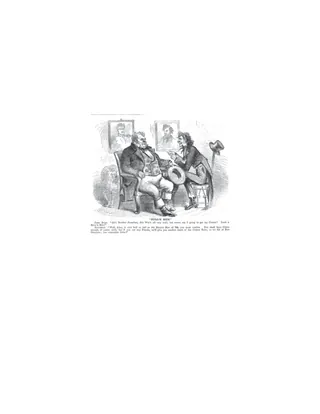
"Bull's Run"
Harper's Weekly, August 21, 1861
Other · 1 page
A single-page caricature engraving from Harper's Weekly, 1861, set during the American Civil War. John Bull complains to Brother Jonathan that the war is cutting off his cotton supply, a pun on the Battle of Bull Run. Jonathan answers that Britain will get cotton if it behaves, and recalls the cotton bales used against the British at New Orleans.
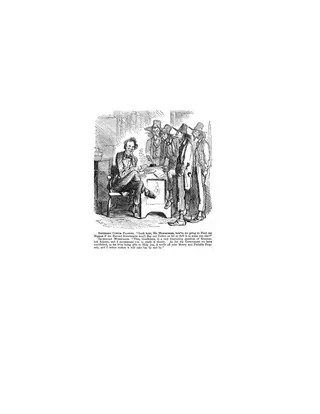
[Cartoon: Southern cotton planter and Secretary Memminger, Harper's Weekly, 1861]
Other · 1 page
A single-page satirical engraving from Harper's Weekly, 1861, with a caption. A Southern cotton planter and other shabbily dressed men confront Confederate Treasury Secretary Memminger in his office, asking how they will feed their slaves if the government will neither buy their cotton nor let them sell it elsewhere. Memminger answers evasively that the new government needs their money and portable property. It is a political cartoon on the Confederate cotton embargo early in the American Civil War, not a weaving or textile-technique document.
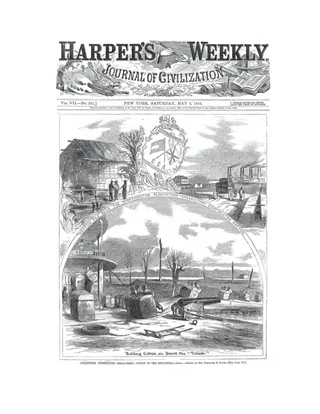
Collecting Confiscated Anglo-Rebel Cotton in the Southwest
Harper's Weekly, May 2, 1863
Illustration · 1 page
A single-page wood engraving from Harper's Weekly, May 2, 1863, showing the collection of confiscated cotton on plantations in the Southwest during the American Civil War. The scenes include a cotton pile near the Worthington plantation, bales marked 'C S A 1861' stacked in a barn, and bales being rolled aboard the steamboat 'Tatum' at a landing. The engraving is based on a sketch by Theodore R. Davis.
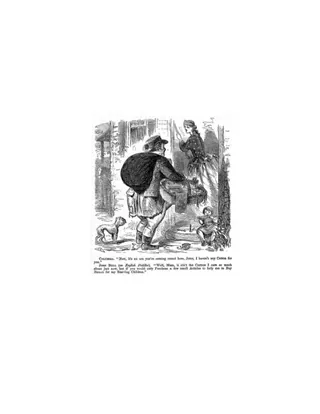
[Columbia and an English Peddler: Cartoon on the Cotton Shortage]
Other · 1 page
A single-page wood engraving from Harper's Weekly, 1861, a political cartoon about cotton and the American Civil War. Columbia, the female personification of the United States, tells an English peddler named Jons Bras that she has no cotton for him. He answers that he is more concerned about selling small articles to feed his starving children. The image alludes to British dependence on American cotton during the Union blockade of Southern ports.
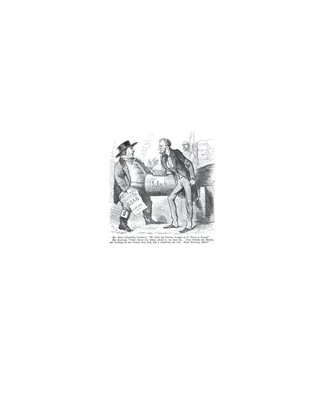
[Cotton Loan]
Harper's Weekly, May 16, 1863
Other · 1 page
A single-page political cartoon from Harper's Weekly, May 1863, concerning the Confederate cotton loan raised in Britain. John Bull holds a placard reading 'Cotton Loan $5,000,000' and asks Abraham Lincoln for cotton bought at fivepence a pound. Lincoln replies that the Rebels are burning the cotton and that he confiscates the rest.
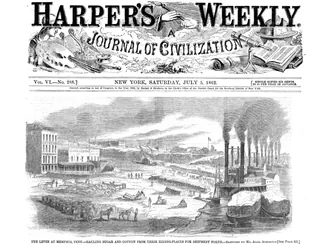
[Hauling Sugar and Cotton from their Hiding Places]
Harper's Weekly, July 5, 1862
Illustration · 1 page
A single wood-engraved illustration from Harper's Weekly, July 5, 1862, showing the levee at Memphis, Tennessee. Workers and carts haul sugar and cotton bales from their hiding places for shipment north during the Civil War. The caption credits a sketch by Mr. Alex. Simplot and refers readers to page 423 for the accompanying text.
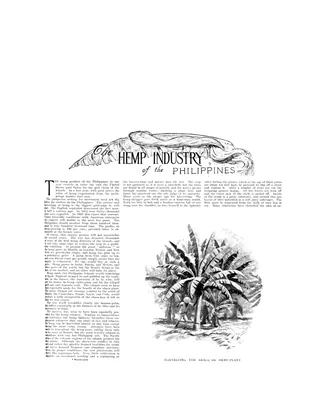
Hemp Industry of the Philippines
Article · 2 pages
A 1900 Harper's Weekly article promoting the abaca (Manila hemp) industry of the Philippines as an investment for American capital. It describes how the plant is grown, harvested and hand-stripped with a bolo on a bamboo bench, then baled, graded, and shipped through Manila, Cebu and Hong Kong. It also covers prices, the Chinese and English role in the trade, and the failure of stripping machines and of transplanting abaca abroad. Brief mention is made of woven abaca and piña cloth, and three illustrations show drying, unloading and baling hemp.
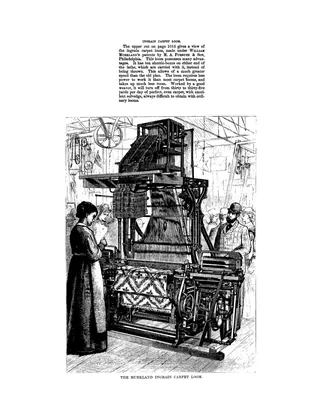
Ingrain Carpet Loom
Harper's Weekly, December 16, 1876
Article · 1 page
A short illustrated notice from Harper's Weekly describing the Murkland ingrain carpet loom, built under William Murkland's patents by M. A. Furbush & Son of Philadelphia and shown at the Centennial Exposition. It notes the loom's ten shuttle-boxes at each end of the lathe, which move with it rather than being thrown, allowing higher speed, lower power and less floor space. It claims output of thirty to thirty-five yards of carpet per day with good selvedges. An engraving shows the loom in a workshop with a partly woven patterned carpet and onlookers.
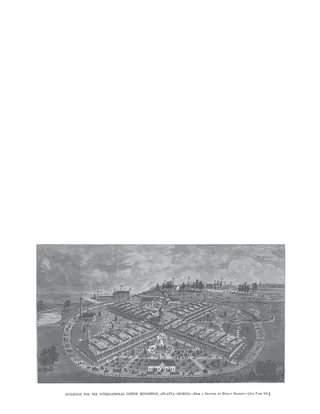
International Cotton Exposition
Harper's Weekly, May 7, 1881
Article · 2 pages
A Harper's Weekly article from May 1881 announcing the International Cotton Exposition to be held in Atlanta, Georgia, opening October 5 of that year. It explains that the show will feature cotton and other textiles, plus Southern food products, manufactures and minerals, and Northern manufacturers' exhibits. It also covers the hoped-for benefits (better agricultural machinery, closer ties between producer and manufacturer), Atlanta's rail accessibility, and the estimated $200,000 cost and fundraising by director-general H. J. Kimball. A bird's-eye engraving after Horace Bradley shows the exposition buildings.
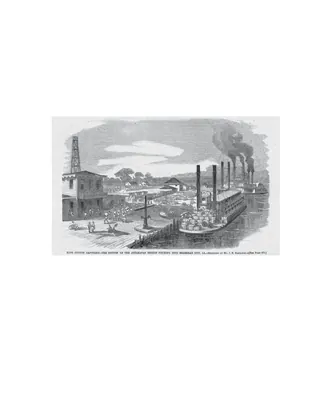
King Cotton Captured
Harper's Weekly, June 13, 1863
Illustration · 1 page
A single wood-engraved illustration from Harper's Weekly showing cotton from the Attakapas region of Louisiana arriving at Brashear City during the Civil War. It shows a steamboat loaded with cotton bales and workers carrying bales along a wooden wharf. The caption credits the sketch to Mr. J. R. Hamilton and refers readers to page 875 for the accompanying text.
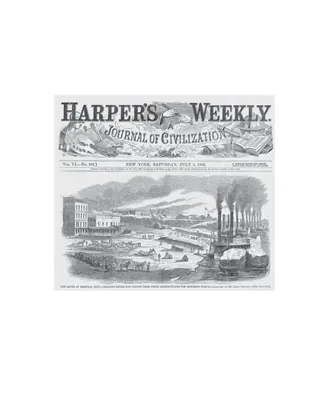
Levee at Memphis, Tenn. -- Hauling Sugar and Cotton from their Hiding Places for Shipment North
Harper's Weekly, July 5, 1862
Illustration · 1 page
A single-page wood engraving from Harper's Weekly showing the levee at Memphis, Tennessee, during the Civil War. Horse-drawn wagons haul cotton bales and hogsheads of sugar along the riverfront, which is lined with brick commercial buildings and signs, as the goods are brought out of hiding for shipment north. The caption credits the sketch to Mr. Alex. Simplot and refers readers to page 423 for the accompanying text.
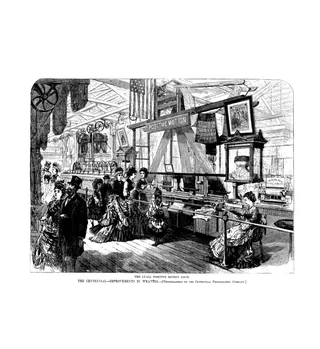
Lyall Positive Motion Loom
Harper's Weekly, December 16, 1876
Article · 2 pages
A Harper's Weekly article on James Lyall's positive motion loom, shown at the 1876 Centennial Exposition in Philadelphia. It explains how the shuttle is carried through the warp by mechanism below the threads instead of being thrown, which allows very wide looms and gentle handling of fine or weak fibres. It describes the 24-foot-wide loom in Machinery Hall and applications such as a Jacquard corset loom and a fast double-thread lock-stitch sewing machine. A second page has an engraving of crowds at the Lyall loom exhibit.
Manufactures of the State (Connecticut)
Harper's Weekly, April 5, 1902
Article · 3 pages
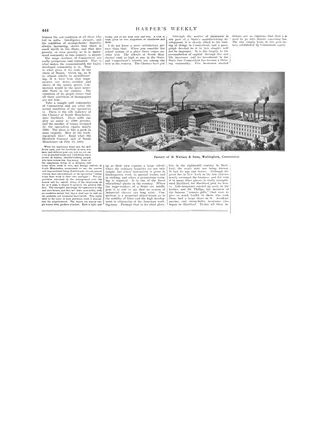
A 1902 Harper's Weekly article surveying Connecticut's manufacturing industries using 1900 census figures. It covers the number of establishments, capital, wages, the state's leading industries and their growth from 1890 to 1900, and the specialties of its main cities. It also argues that mill workers prosper, using the Cheney silk mills at South Manchester as an example, and closes with a note on Hartford's insurance business. Textiles (silk, cotton, carpets, hosiery, thread) appear as one industry among many.
Methods of Conveying Cotton in India to the Ports of Shipment
Harper's Weekly, May 18, 1861
Illustration · 1 page
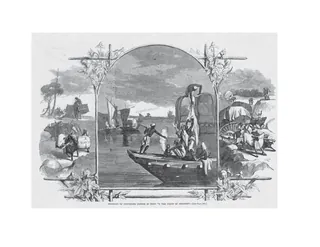
A single engraved illustration from Harper's Weekly, May 18, 1861, showing how raw cotton was carried overland in India to the ports of shipment. The scene is framed by an arch of cotton plants and posts, with bullock carts loaded with bales and pack oxen carrying bales. The caption refers readers to an accompanying article on page 316 of the issue, which is not part of this scan.
New Clothes from Old
Harper's Weekly, April 5, 1902
Article · 1 page
A short magazine article from 1902 explaining how most manufactured wool cloth contains reclaimed fiber called shoddy, made by shredding old rags in a machine called the "devil" and respinning them with new yarn. It traces the development of the industry from mid-nineteenth-century Yorkshire, notes Dewsbury as the center of the rag trade, and mentions byproducts such as oil, prussiate of potash, flock, and the higher-grade "mungo."
One Man Sows and Another Reaps
Harper's Weekly, July 6, 1861
Other · 1 page
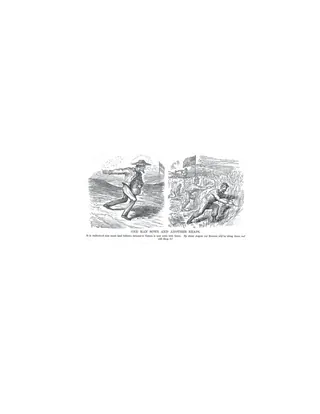
A single-page cartoon from Harper's Weekly, July 6, 1861, early in the American Civil War. The left panel shows a Southern planter sowing grain on land formerly used for cotton, and the right panel shows Union Zouave soldiers reaping the crop. The caption says the Zouaves will arrive about August to harvest it. It is political satire on the Southern shift from cotton to grain crops and has no weaving content.
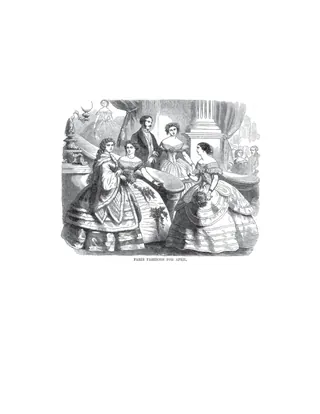
Paris Fashions for April
Harper's Weekly, April 16, 1859
Illustration · 1 page
A single engraved fashion plate from Harper's Weekly, April 16, 1859, titled "Paris Fashions for April." It shows several women in crinoline gowns with fringed or ruffled skirts, floral bouquets, and a fur-trimmed wrap, with a man in a dark coat standing among them. The only text is the caption, so the item is useful mainly as a visual record of mid-19th-century women's dress.
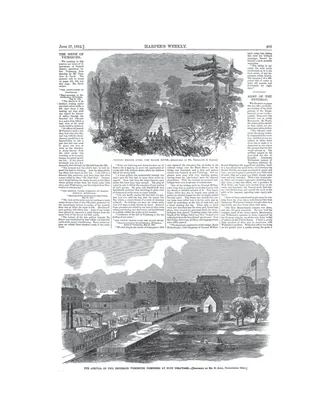
Siege of Vicksburg
Harper's Weekly, June 27, 1863
Article · 1 page
A single page from Harper's Weekly reporting on General Grant's Vicksburg campaign, with letters from artist Theodore R. Davis describing the trenches, sharpshooting, and the army's approaches. It includes an account of a bridge built of cotton bales over the Black River by Major Hickenlooper's engineers. A shorter section on the Army of the Potomac describes the shelling of rifle-pits at the Rappahannock crossing. Engravings show the cotton bridge and the arrival of Vicksburg prisoners at Fort Delaware.
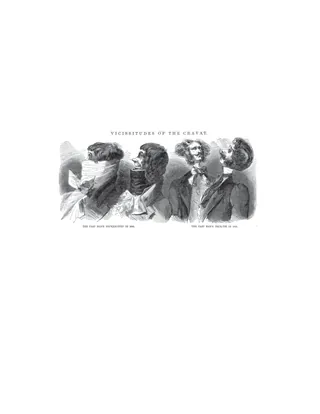
Vicissitudes of the Cravat
Harper's Weekly, April 16, 1859
Illustration · 1 page
A single-page satirical wood engraving from Harper's Weekly, 16 April 1859, tracing changes in men's neckwear. Four caricatured male profiles in two pairs contrast the 'fast man's' large neckerchief of 1800, which wraps around the face and neck, with his much smaller neck-tie of 1859. It is of interest for the history of men's costume and for satirical commentary on fashion.
19 documents found