Textile Documents › Topic: Fiber preparation: carding, combing, ginning
628 documents found
Sort: 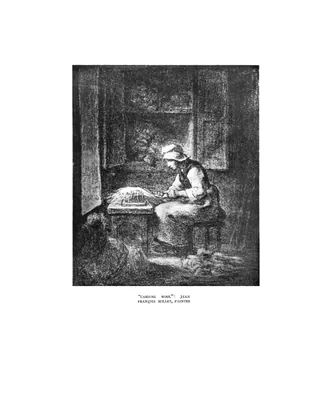
Carding Wool
Illustration · 1 page
A single-page halftone reproduction of Jean-François Millet's painting 'Carding Wool', printed in The Craftsman. It shows a seated woman in a white cap and dark bodice working wool with a hand card at a table, with a heap of wool and a basket nearby. The only text is a caption naming the painting and the painter.
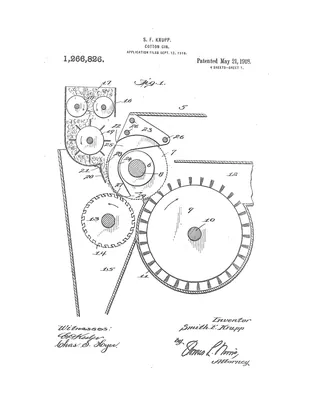
Cotton Gin, US Patent No. 1266826
Patent · 9 pages
US Patent No. 1,266,826, granted May 21, 1918 to Smith F. Krupp of Atlanta, Georgia, for a saw-type cotton gin designed to gin long staple (sea island) cotton without damaging the fibers. The invention uses ribs with free ends and raised guards between the saws, working with a doffer and brush cylinder. Four sheets of drawings show the main form and variants with a roll box and with a hulling chamber, followed by the specification and eleven claims.
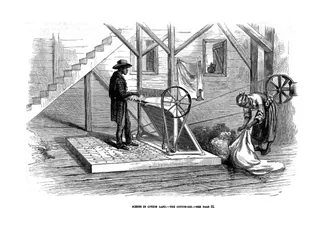
[Scenes in Cotton Land. The Cotton Gin]
Frank Leslie's Illustrated Newspaper, October 7, 1871
Illustration · 1 page
A single-page engraved illustration from Frank Leslie's Illustrated Newspaper, 1871, showing a cotton gin in operation inside a barn-like building. A man in a wide-brimmed hat feeds raw cotton to the gin's roller while a large hand-cranked flywheel drives the machinery, and a woman is also shown at work. The only text is the caption referring readers to page 55 for the accompanying article.
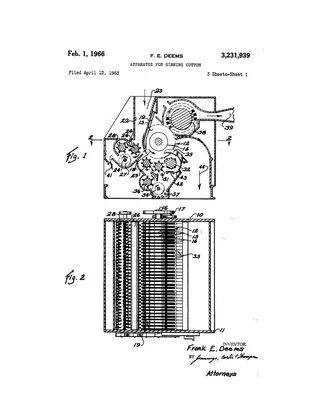
Apparatus for Ginning Cotton, US Patent No. 3231939
Patent · 6 pages
US Patent 3,231,939, granted to Frank E. Deems of Birmingham, Alabama, for a saw-type cotton gin that removes the roll box. Seed cotton passes in a thin stream over a bed of rotating pinned drums or saw cylinders, between the huller ribs and the ginning ribs. This is meant to cut fiber damage, saw wear, and power use. The document has three sheets of drawings (Figs. 1-10), the specification describing three variants, two claims, and a list of earlier patents cited.
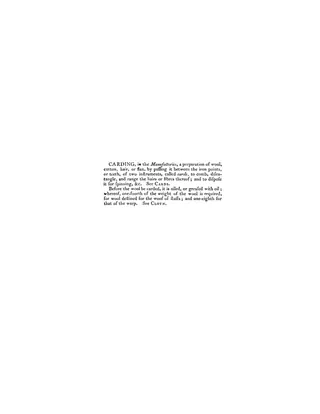
Carding
Rees's Cyclopedia, 1819
Article · 1 page
A very short encyclopedia entry defining carding as the preparation of wool, cotton, hair, or flax by passing it between the iron teeth of two cards to comb, disentangle, and align the fibres for spinning. It also notes that wool is oiled before carding, giving proportions of oil by weight for weft wool versus warp wool, and cross-references the entries on Cards and Cloth.
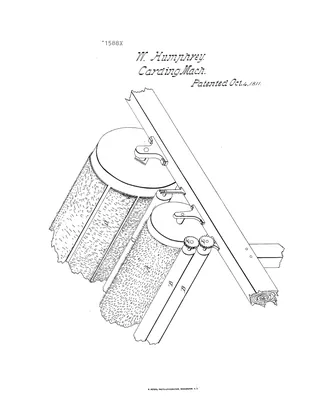
Carding Machine, US Patent No. X0001588
Patent · 1 page
A single-page drawing from an early US patent for a carding machine, issued to W. Humphrey on October 4, 1811. It shows a perspective view of two large cylindrical card drums covered with wire teeth, mounted on a wooden frame with diagonal side members and lettered reference parts. No descriptive specification text is included in the scan, only the sheet heading.
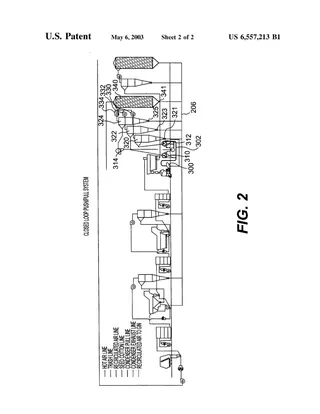
Closed Loop Push/Pull System for a Cotton Gin, US Patent No. 6557213
Patent · 16 pages
US Patent 6,557,213 B1, granted May 6, 2003 to William E. Winn of Levelland, Texas, for a closed loop push/pull air system for cotton gins. It uses a hot shelf tower dryer and strategically placed push and pull fans to recirculate conveying air through dryers, cleaners, extractors, collectors and lint cleaners, reducing pollutant emissions. The document has the patent front page, two sheets of schematic drawings (Figs. 1 and 2), the full specification and 12 claims, and a second printed copy from the USPTO web database.
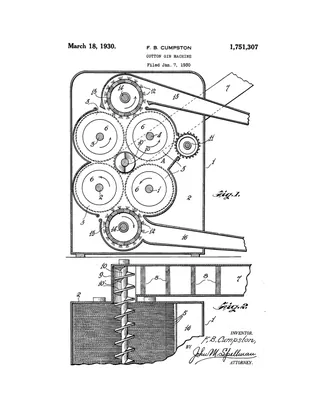
Cotton Gin Machine, US Patent No. 1751307
Patent · 4 pages
US Patent No. 1,751,307, granted March 18, 1930 to Frederick B. Cumpston of Blooming Grove, Texas, assignor to Associated Factories Corporation, for a cotton-gin machine. It describes a ribless gin in which a central screw conveyor carries cotton past surrounding carding saws rotating in the same direction at progressively increasing speeds. The saws remove lint from the seed, and brushes doff the lint into flues. A slightly wider gap lets wadded cotton pass to a stripper. The text includes the description, thirteen claims and a sheet of drawings (Figs. 1 and 2). The machine can also relint cotton seed.
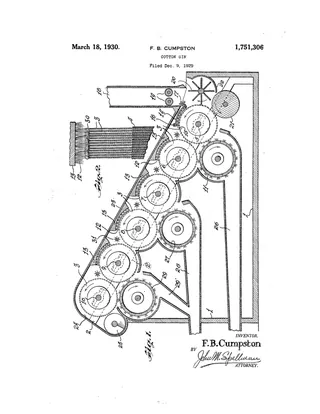
Cotton Gin, US Patent No. 1751306
Patent · 4 pages
US Patent No. 1,751,306, granted March 18, 1930 to Frederick B. Cumpston of Blooming Grove, Texas, assignor to Associated Factories Corporation, for a ribless cotton gin. The design uses a series of gin saws on inclined shafts, each turning faster than the one below, with curved brushes that clean lint from the seed. Seed is thrown off by centrifugal force into a conveyor, and lint of different fiber lengths is withdrawn separately. The patent includes a drawing of two figures, a specification, and nine claims.
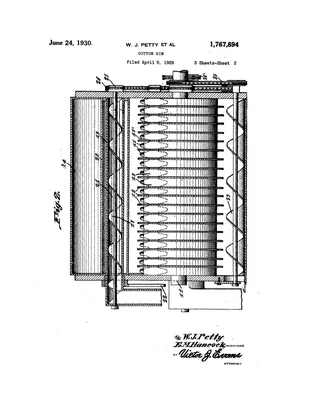
Cotton Gin, US Patent No. 1767894
Patent · 6 pages
US Patent No. 1,767,894, granted June 24, 1930 to William J. Petty and Eugene M. Hancock of Hollis, Oklahoma, for a saw-type cotton gin. The gin has a box over the saws, a grooved huller roll at the front that keeps hulls and burrs out, and a grooved roll at the rear that holds seeds back while lint passes. It also has a feeding reel, auger conveyors for seeds, hulls and trash, and a doffer brush. The scan has three sheets of drawings (Figs. 1-3) followed by the specification and four claims.
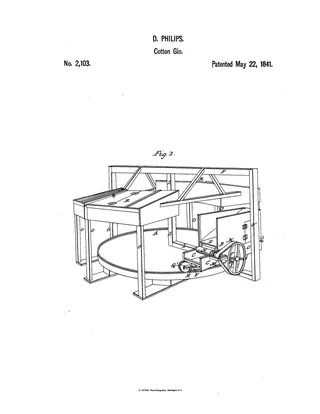
Cotton Gin, US Patent No. 2103
Patent · 3 pages
US Patent No. 2,103, granted May 22, 1841 to David Philips of Georgetown, Mercer County, Pennsylvania, for a "Railroad Cotton-Gin." The specification describes a cotton gin mounted on a car that travels around a circular raised track about fifty feet in diameter, driven by horse or steam power. A belt from the car's drum wheel turns the saw cylinder. It also describes the covered building, with a roof used for drying cotton and trap doors for moving it. One page carries the perspective drawing, and two pages carry the text and claim.
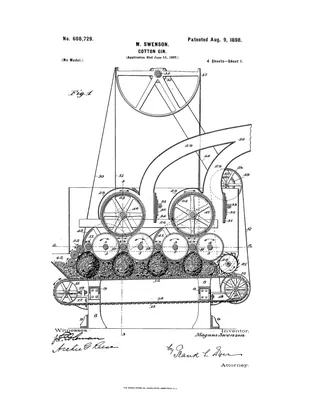
Cotton Gin, US Patent No. 608729
Patent · 9 pages
US Patent No. 608,729, granted August 9, 1898 to Magnus Swenson of Chicago, assignor to the American Cotton Company, for a multiple cotton gin. The design uses several gangs of saws in one horizontal plane, grooved rollers between the gangs, a slatted feed belt that carries off seeds and foreign matter, a spiked roller that keeps cotton off the belt, and interlinked brushes for moting. The document has four sheets of patent drawings (Figs. 1-4) followed by the specification, which describes the belt-and-pulley drive and ends with 16 claims.
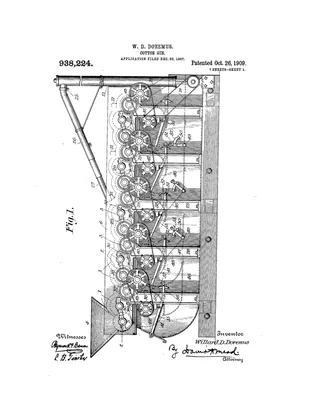
Cotton Gin, US Patent No. 938224
Patent · 15 pages
US Patent No. 938,224, granted 26 October 1909 to Willard D. Doremus of Washington, D.C. (assignor to the National Cotton Improvement Company), for a cotton gin. It describes a horizontal series of overlapping saw cylinders, all turning the same way at increasing speeds, that comb seed from the fiber without shortening it. The patent also covers brushes that clear the saws, fiber conduits with mote boards, hinged cylinder covers, a seed-return system, and a sectional frame. It has seven sheets of drawings (Figs. 1-11), a specification, and 48 claims.
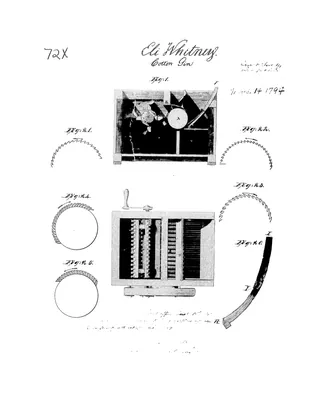
Cotton Gin, US Patent No. X0000072
Patent · 12 pages
Copy of Eli Whitney's 1794 US patent for the cotton gin, a machine that separates cotton fibre from seeds. It includes two sheets of patent drawings, a certification signed by James Madison as Secretary of State in 1803, and Whitney's written description of the frame, toothed cylinder, breastwork, brush cleaner and hopper. It also gives construction details such as wire tooth making, wood choice, and the belt and whirl drive. It ends with a notary's oath of inventorship dated October 1793.
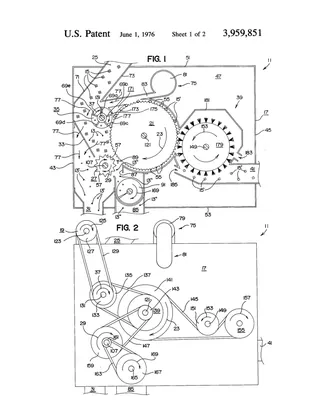
Cotton Ginning Apparatus, US Patent No. 3959851
Patent · 20 pages
US Patent 3,959,851, granted June 1, 1976 to Woodrow W. Bledsoe of Memphis, Tennessee, for a cotton ginning apparatus that removes seeds from seed cotton. It uses a ginning saw cylinder, a serrated kicker cylinder, and a spiral gin roller with left- and right-hand vanes. A brush doffs the lint, and an air-wash system cleans the fibers. The scan includes an online text version of the patent (abstract, claims, description) and the printed patent with two sheets of drawings (Figs. 1-4).
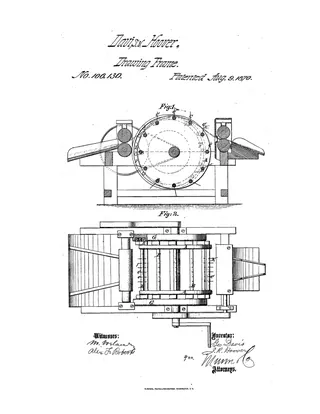
Drawing Frame, US Patent No. 106130
Patent · 2 pages
US Patent No. 106,130, granted August 9, 1870, to George Davis and John R. Hoover of Elizabeth Port, New Jersey, for an improved hemp drawing frame. The machine uses rotary disks carrying oscillating comb-bars whose teeth are tilted by cranks and pins running in eccentric grooved disks, so the teeth enter and leave the fiber endwise. The first page is the patent drawing (Figs. 1 and 2) and the second page is the specification and claim.
Fleece prep
Article · 1 page
A one-page column from the spinning series "As the Wheel Turns" in Minnesota Weaver, on realistic expectations when preparing and buying fleece. Kate Foreman reports advice from St. Peter Woolen Mill on sending wool for custom carding: be explicit in instructions, keep lots separate, remove chaff and burrs beforehand, and scour on the dry side. It also covers buying skirted versus unskirted fleeces and how price affects the choice.
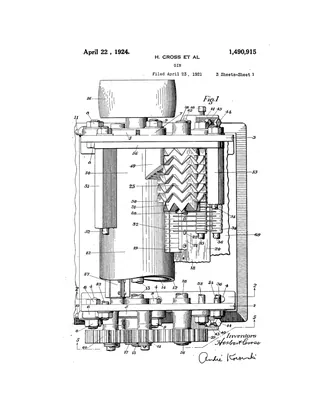
Gin, US Patent No. 1490915
Patent · 7 pages
US Patent No. 1,490,915, granted April 22, 1924 to Herbert Cross of Cynwyd and André Koronski of Narberth, Pennsylvania, for a cotton gin. The machine removes fibre from short staple cotton seed without saws, using a friction ginning roll, a knife made of narrow side-by-side blade sections, a zigzag-flanged feed roll, a brush and grids. The patent argues this method avoids cutting or hooking the fibre and removes the fire risk of saw gins. It has three sheets of drawings (top, side and gear views, blade and grid details), a specification describing the parts and operation, and 22 claims.
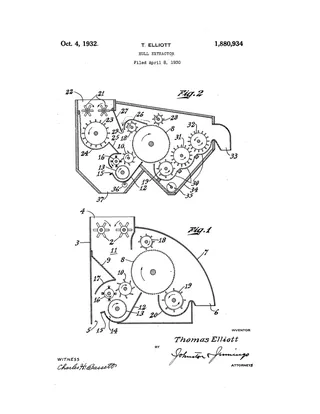
Hull Extractor, US Patent No. 1880934
Patent · 5 pages
US Patent No. 1,880,934, granted 4 October 1932 to Thomas Elliott of Birmingham, Alabama, and assigned to Continental Gin Company, for a hull extractor used to remove hulls and trash from seed cotton before ginning. It describes a main saw cylinder with a picker roller, stripper rollers and doffers, plus a reclaiming saw cylinder that recovers cotton escaping with the hulls. Two embodiments are shown: a single stripper roller version (Fig. 1) and a double stripper roller version with added cleaning rollers and screen concaves (Fig. 2). The patent ends with 11 claims. It concerns cotton processing machinery and has no weaving content.
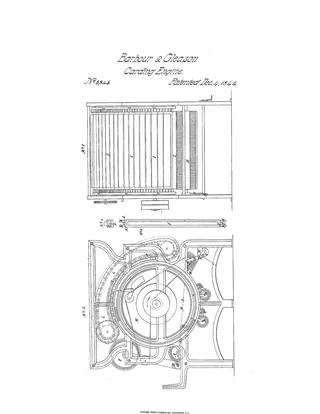
Improvement in Self-Stripping Cards for Carding Fibrous Substances, US Patent No. 3843
Patent · 3 pages
US Patent No. 3,843, granted December 4, 1844 to Horace Barbour and John Gleason of Lowell, Massachusetts, for a self-stripping card for carding engines. A revolving wire brush is brought by a cam into contact with the main cylinder, or with the revolving top cards, to strip and clean them while in motion, without stopping the machine or hand labor. The patent includes a drawing sheet of the carding engine (Figs. 1-5), the specification and claims, including a claim for use with Crane's self-stripping carding machine.
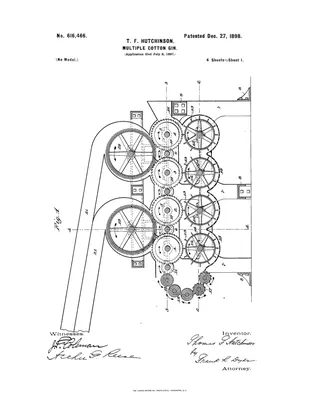
Multiple Cotton Gin, US Patent No. 616466
Patent · 7 pages
US Patent No. 616,466, granted December 27, 1898 to Thomas F. Hutchinson of Chicago, assignor to the American Cotton Company, for a multiple cotton gin. The machine uses several gangs of saws in one horizontal plane, with grooved rollers between them, spiked feed-rollers beneath each gang, and perforated aprons that let seed and trash fall out. The document has four sheets of drawings (Figs. 1-4) followed by the specification and eight claims. It covers the construction and operation of the gin, including the brushes and lint-flues that remove cotton from the saws.
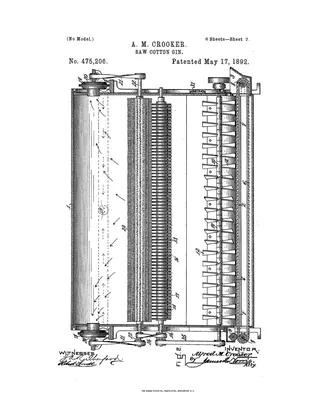
Saw Cotton Gin, US Patent No. 475206
Patent · 9 pages
US Patent No. 475,206, granted May 17, 1892 to Alfred M. Crooker of Boston, for a saw cotton gin that separates lint from seed, pods and immature bolls. The design uses an air current from suction fans to carry material up to the gin saws, with beater cylinders and a conveyor apron at the base. Breast-bars with guard flanges protect the saw teeth from refuse. The document has six sheets of patent drawings followed by the specification and thirteen claims.
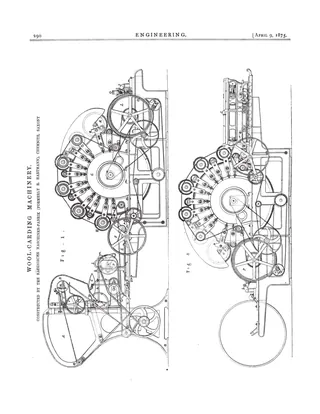
Wool-Carding Machinery
Engineering Weekly, April 9, 1875
Article · 2 pages
A two-page illustrated article from Engineering (9 April 1875) describing wool-carding machinery built by the Sächsische Maschinen-Fabrik (formerly R. Hartmann) of Chemnitz, Saxony. It explains a set of three machines: a scribbler with a cup-feed apparatus, a second carder with a diagonal feeding apparatus, and a continuous carding engine that divides the fleece into thirty cardings. Four engraved figures show side elevations and a diagonal view with lettered parts.
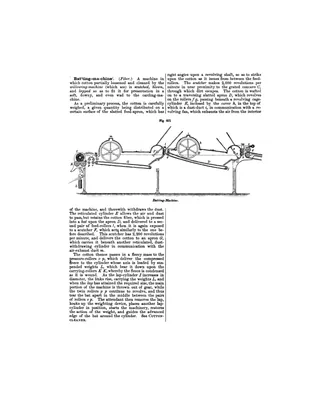
Batting-Machine
Article · 1 page
A dictionary entry from Knight's American Mechanical Dictionary describing the batting-machine used in cotton processing. The machine scutches, blows, and laps cotton already loosened by the willowing machine, forming a soft, even wad for the carding machine. The text walks through the feed apron, scutchers, cage cylinders, fans, and pressure and lap rollers, and is illustrated with an engraving (Fig. 601).
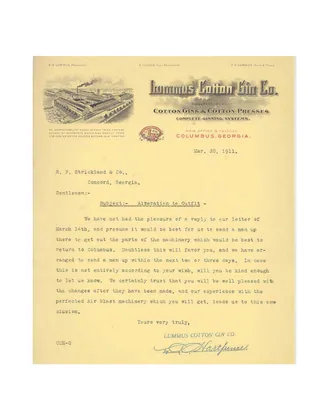
Billhead
Lummus Cotton Gin Co., March 28, 1911
Ephemera · 1 page
A one-page business letter on Lummus Cotton Gin Co. letterhead, dated March 28, 1911, from the company's Columbus, Georgia office to R. F. Strickland & Co. of Concord, Georgia. It concerns an alteration to a ginning outfit: the company plans to send a man to remove machinery parts to be returned to Columbus and mentions replacement with Air Blast machinery. The letterhead has an engraved view of the factory complex and lists company officers.
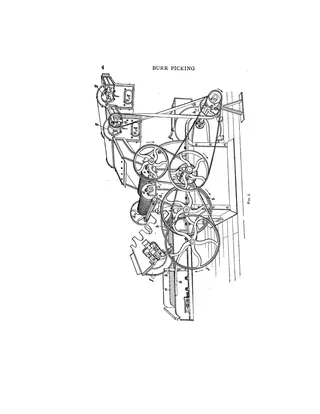
Burr Picking
Monograph · 25 pages
An International Correspondence Schools instruction paper (Serial 472) on burr picking, the first mechanical operation applied to scoured and dried wool to remove burrs, twigs and other vegetable matter before carding. It describes the Parkhurst, Sargent multiplex, single burr-cylinder and Goddard (Curtis and Marble) burr pickers, covering feed-rolls, picking and burr cylinders, burr guards, brushes, beaters, blowers, drives, speeds and capacities. It also gives burr wire types and advice on setting, cleaning, oiling, safety and the gauze room.
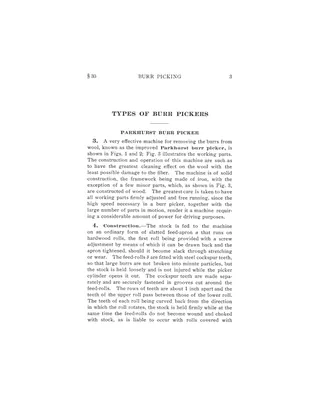
Burr Picking
Monograph · 27 pages
An instructional section (§30) from an International Textbook Co. correspondence course on burr picking, the first operation wool undergoes after scouring and drying. It explains why burrs and shives must be removed before carding, then describes the Parkhurst, single burr-cylinder, and Goddard (Curtis and Marble) burr pickers: their construction, drives, speeds, capacities and operation. It closes with sections on management, setting, the gauze room, and examination questions. Illustrated with line drawings of the machines, a burr wire table, and drive diagrams.
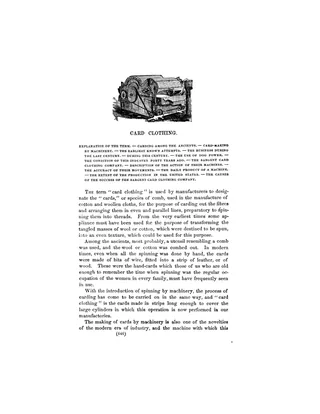
Card Clothing
Article · 5 pages
A 1872 article on card clothing, the wire-toothed leather strips used to cover carding cylinders in cotton and wool mills. It traces card-making from hand-cards to machine production in the United States, with early inventors such as Nathaniel Niles, Oliver Evans, Crittenden and Amos Whittemore, and the early use of dog power in Worcester County, Massachusetts. The second half describes the Sargent Card Clothing Company of Worcester, how its tooth-setting machines work, and its daily output compared with the national total.
Carding
Article · 1 page
A short encyclopedia entry defining carding as the mechanical process of disentangling and aligning cotton, wool, or flax fibres with wire-toothed cylinders before spinning. It describes card clothing, the carding engine attributed to Lewis Paul (1738), the doffer and doffing knife, and how slivers are formed. It also notes the machine arrangements used for wool, cotton, and worsted, and refers readers to Murphy's The Textile Industries and the article on Spinning.

Carding of Cotton
Chambers's Encyclopedia, 1881
Article · 1 page
A short encyclopedia entry describing the carding of cotton, in which the fibres are disentangled and laid parallel. It explains the wire-toothed card mounted on cylinders, the transfer of the cotton between cylinders, and its removal as a fleece by the doffer and doffing-knife. The fleece is then condensed through a funnel into a sliver ready for drawing or doubling, with a cross-reference to Spinning.
Carding Wool for Worsted Yarns
Article · 4 pages
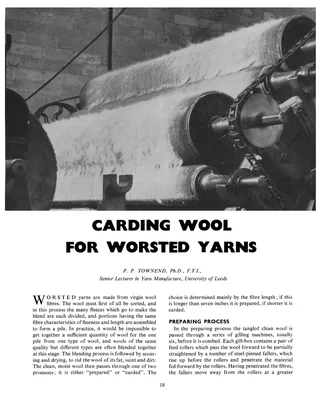
An article by P. P. Townend explaining how wool is carded for worsted yarns, and how this differs from the preparing (gilling) process used for longer fibres. It covers the aims of carding, the removal of burrs and other vegetable matter, the structure and action of the worsted card (working, stripping and lifting), roller sizes, speeds and tooth densities, output rates, and fibre breakage. Illustrated with photographs of carding engines, a card diagram, a diagram of wire teeth and a table of roller specifications.
Century of Cotton Ginning and Baling
Engineering Weekly, August 12, 1898
Article · 3 pages
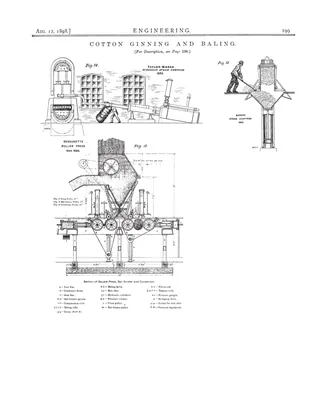
Three pages from the British journal Engineering (Aug. 12, 1898) reporting on George A. Lowry's paper "One Hundred Years of Ginning and Baling Cotton," read before the American Society of Mechanical Engineers. It describes the Whitney saw gin and its improvements (mote board, lint room, condenser), compares saw and roller gins, and traces cotton baling presses from early screw presses to steam, hydraulic and cylindrical-bale presses. Engraved plates show the Churka gin, Whitney and Carver gins, the Bessonette roller press, the Taylor-Birage hydraulic compress and the Lowry cotton compress. The pages begin with the end of an unrelated item on French marine engines.
Combing
Article · 1 page
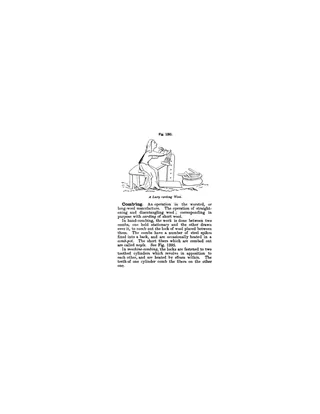
A short dictionary entry defining combing as the operation of straightening and disentangling long wool for worsted manufacture, comparable to carding of short wool. It describes hand-combing with two heated steel-spiked combs and a comb-pot, and machine-combing with steam-heated toothed cylinders. An engraving of a woman carding wool accompanies the entry.
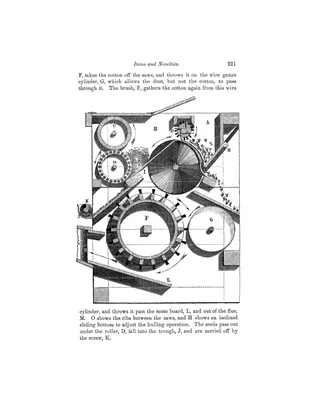
Cotton Gin, by Richard R. Gwathmey
Journal of the Franklin Institute, April 1869
Article · 3 pages
A short 1869 notice from the Journal of the Franklin Institute describing the Champion Gin and Huller, a cotton gin exhibited by Richard R. Gwathmey. It explains the machine's parts with a labeled cross-section diagram (saws, hulling roller, carrying rollers, brush, wire gauze cylinder, mote board, seed screw). It claims the reverse-running saws let the machine gin cotton in the boll with hulls included, and gives a calculation of the planter's financial gain over hand-picking.
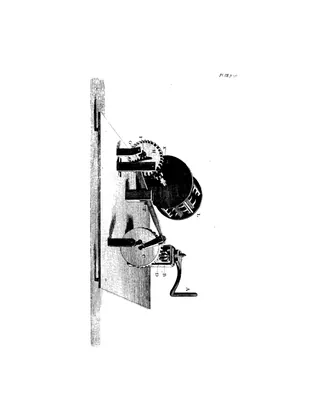
Description of a Machine for Twitching Wool
Article · 5 pages
A 1794 article from The Repertory of Arts and Manufactures describing Hugh Hughes's machine for twitching (opening and loosening) wool, a task formerly done by hand with rods or in gigging mills. It includes extracts from two letters by Hughes, mention of certificates from users, and a lettered description of the crank, gear and flier mechanism, which can be driven by hand, horse, water or wind. An engraved plate shows the machine.
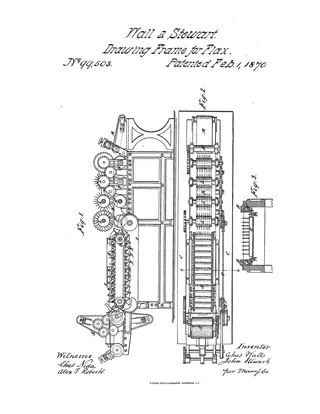
Drawing Frame for Flax, US Patent No. 99503
Patent · 2 pages
US patent No. 99,503, granted February 1, 1870, to Charles Wall of New York and John Stewart of Brooklyn for an improved drawing-frame for dressing flax, hemp and manilla fibre. The invention adds a series of revolving comb-cylinders working over an endless carrying-apron to the existing endless chain and condensing apparatus, so combing and drawing into slivers happen in one machine and the separate lap-machines are no longer needed. The document has a sheet of patent drawings (side elevation, plan and transverse section) and the printed specification with a single claim.
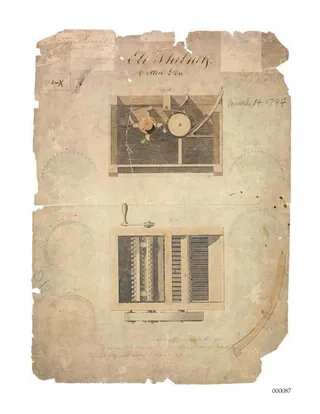
Drawing from patent application for the cotton gin
Whitney, Eli, 1794
Ephemera · 1 page
A single-sheet reproduction of the patent drawing for Eli Whitney's cotton gin, dated March 14, 1794. It shows two figures of the machine, including a side view with a large toothed cylinder, a smaller cylinder and a brush or comb mechanism used to separate cotton fiber from seed. The sheet carries almost no text beyond the inventor's name, title and date.
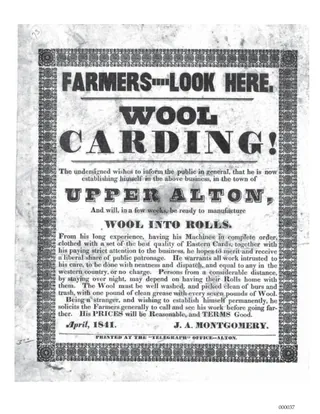
Farmers ---- look here. Wool carding
Telegraph Office, Alton, April 1841
Ephemera · 1 page
A one-page broadside dated April 1841 in which J. A. Montgomery advertises a wool carding business starting up in Upper Alton, Illinois. He offers to process wool into rolls on machines clothed with Eastern cards, guarantees his work, and states preparation requirements: the wool must be washed and picked clean, with one pound of grease for every seven pounds of wool. It was printed at the Telegraph office in Alton.
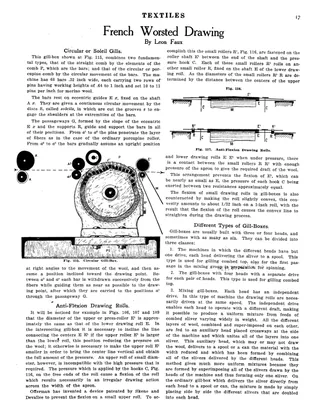
French Worsted Drawing
Article · 1 page
A one-page 1915 article from the periodical Textiles by Leon Faux on French worsted drawing machinery. It describes the circular (soleil) gill-box with its rotating bars and eccentric guides, anti-flexion drawing rolls that keep small upper rolls from bending under pressure, and the three classes of gill-boxes, including mixing gill-boxes. Illustrated with machine diagrams (Figs. 115-117).

Hackle, Heckle, or Hatchell
Article · 1 page
A very short encyclopedia entry defining the hackle, also called heckle or hatchell, as a tool for cleaning, sorting, and straightening raw flax, hemp, and jute fibres before spinning. It gives the Dutch etymology and refers readers to the article on flax.
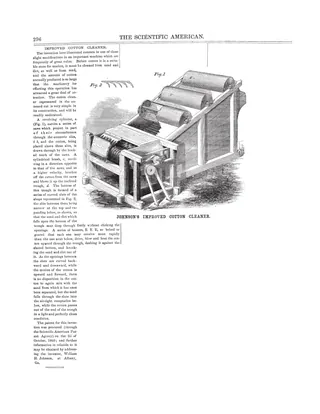
Improved Cotton Cleaner
Scientific American, October 27, 1860
Article · 1 page
A short 1860 Scientific American article describing William H. Johnson's patented cotton cleaner, which removes sand and dirt from raw cotton. It explains how a saw cylinder, a counter-rotating brush, and a series of beaters drive the cotton up an inclined trough with a slatted bottom, so that dirt falls through the slats into receptacles below. Two figures illustrate the machine and the slat shape. It also gives the patent date and the inventor's address.
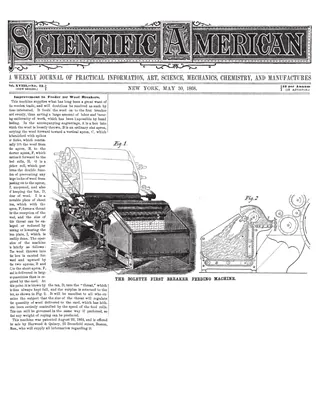
Improvement in Feeder for Wool Breakers
Scientific American, May 30, 1868
Article · 1 page
A short 1868 Scientific American article describing a patented automatic feeder for the first breaker card in woolen manufacture. It explains how aprons, a picker roll, a fan and an adjustable throat plate deliver wool evenly to the card in place of hand feeding. Two engravings show a perspective view and a cross-section of the Bolette First Breaker Feeding Machine, which was sold by Harwood & Quincy of Boston.
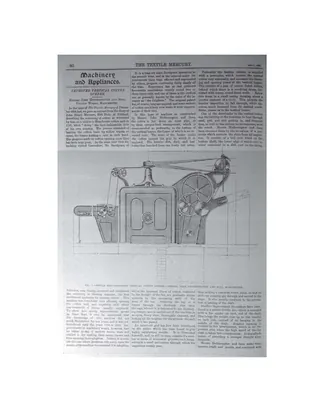
Machinery and Appliances
Textile Mercury, 1890
Article · 2 pages
Two-page article from The Textile Mercury (Feb. 1, 1890) describing an improved vertical cotton opener of the Crighton type made by John Hetherington and Sons, Vulcan Works, Manchester. It covers the creeper feed with porcupine, the new grooved grid, a water-sealed step protector, the patent double fan, working speeds and output, and a double machine for Surat cottons, with three line drawings. A short note on the Bailey-Friedrich steam motor for electric lighting follows, along with brief trade news items.
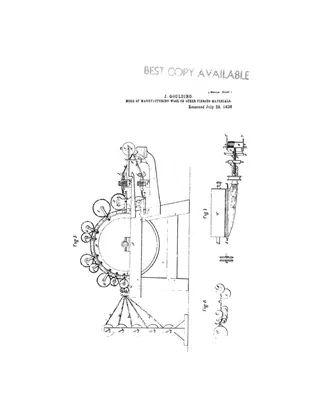
Mode of Manufacturing Wool or Other Fibrous Materials, US Patent No. 2
Patent · 6 pages
Reissued US patent specification (Patent No. 2) by John Goulding of Dedham, Massachusetts, describing a continuous carding and roving process for wool, cotton, hemp and other fibers. The text details a series of three carding machines that deliver slivers through rotating tubes, wind them on bobbins via drums, and unwind them for mule spinning. It includes two sheets of patent drawings of carding cylinders, rollers, bobbins and a spinning frame, and ends with the claim and witness signatures.
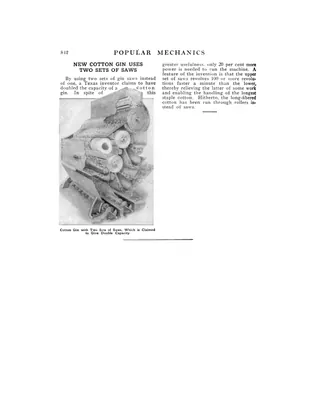
New Cotton Gin Uses Two Sets of Saws
Popular Mechanics, 1923
Article · 1 page
A short Popular Mechanics item describing a Texas inventor's cotton gin with two sets of saws, claimed to double capacity while needing only about 20 percent more power. The upper saws turn faster than the lower set, which lets the machine handle long-staple cotton that had previously been ginned with rollers. Includes one photograph of the machine.
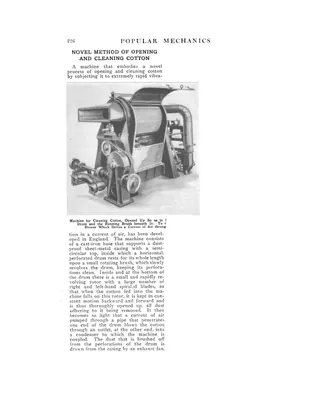
Novel Method of Opening and Cleaning Cotton
Popular Mechanics, 1923
Article · 1 page
A short Popular Mechanics item describing an English machine that opens and cleans raw cotton by subjecting it to rapid vibration in an air current. It explains the perforated drum, the small rotating brush that turns the drum and keeps its holes clear, and the rotor with spiraled blades that agitates the cotton. Air blown through the drum carries the opened cotton to a condenser, and an exhaust fan removes the dust. One illustration shows the machine opened up.
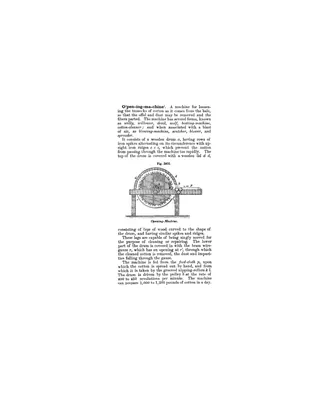
Opening Machine
Article · 1 page
A dictionary entry from Knight's American Mechanical Dictionary describing the opening machine used to loosen tussocks of baled cotton and remove dust and offal before further processing. It lists alternate names (willy, devil, scutcher, blower, spreader) and explains the spiked wooden drum, wire-gauze lower section, feed-cloth and nipping rollers, with operating speed and output. An engraved cross-section diagram (Fig. 3401) accompanies the text.
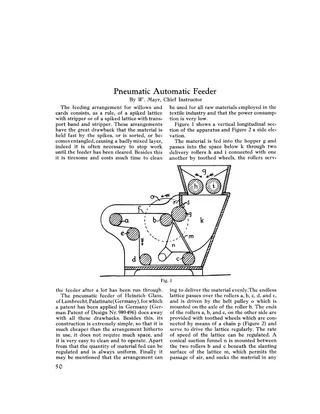
Pneumatic Automatic Feeder
Article · 2 pages
A short 1929 article by W. Mayr describing a pneumatic automatic feeder for willows and cards (opening and carding machinery) in textile preparation, patented by Heinrich Glass of Lambrecht, Germany. It explains how a fan and suction funnel draw raw material onto a moving lattice, with delivery rollers and a fluted roller giving an even, adjustable feed, and notes advantages over spiked-lattice feeders. Two figures show the apparatus in section and elevation, and a closing note covers oiling wool with an automatic spraying device.
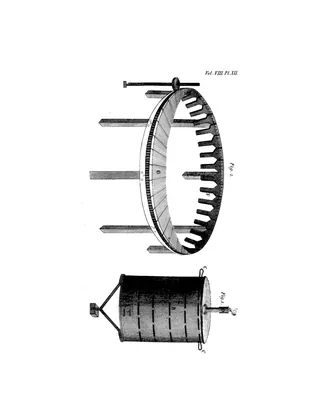
Specification of the Patent Granted to Mr. John Hawksley for Certain Improvements and Additions to Machinery for Combing Wool, Cotton, Silk, Flax, Hemp, and Mohair
Article · 6 pages
Specification of John Hawksley's 1797 English patent for improvements to wool and fibre combing machinery, as printed in the Repertory of Arts and Manufactures. It describes a circular revolving comb-pot (stove) for heating combs, a lapper or layer-on for feeding wool onto the combs, and holsters for holding the combs while the wool is drawn off. It builds on his earlier 1793 combing machine patent. Two plates of engraved machinery diagrams accompany the text.
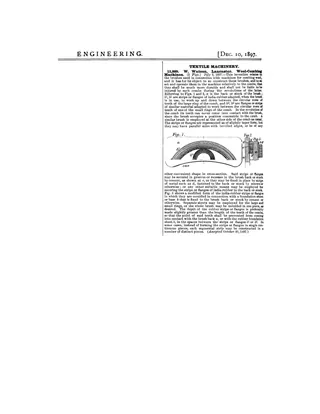
Textile Machinery
Engineering Weekly, December 10, 1897
Article · 1 page
A one-page patent abstract from the December 10, 1897 issue of Engineering describing W. Watson's patent no. 15,809 (Lancaster) for wool-combing machines. The invention is an improved brush with india-rubber strips that work between the circular rows of comb teeth, making the brushes more durable and keeping the teeth from damaging them. Three line drawings show the brush back, the rubber strips, and a modified molded form.
628 documents found