Textile Documents › Topic: Braiding, plaiting, and sprang
101 documents found
Sort: 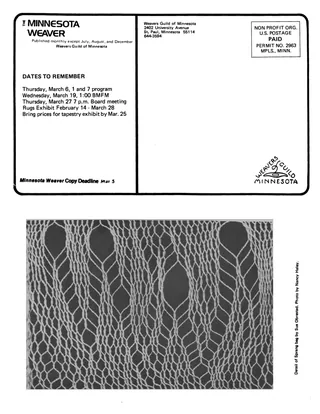
Sprang (photo)
Minnesota Weaver, March 1980
Article · 1 page
A single page from the Minnesota Weaver (Weavers Guild of Minnesota newsletter), March 1980, showing a photograph of a detail of a sprang bag by Sue Obrestad, photographed by Nancy Haley. The image shows twisted, interlaced warp structure with diamond-shaped openwork patterns. The page also carries the newsletter's mailing panel and a list of upcoming guild dates.
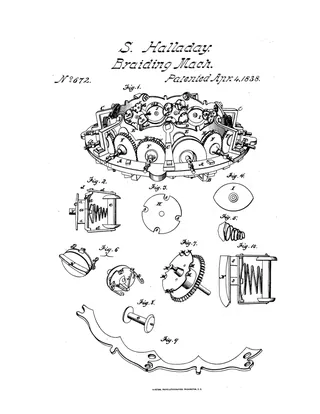
Braiding Machine, US Patent No. 672
Patent · 2 pages
US Patent No. 672, granted April 4, 1838 to Seymour Halladay of Westfield, Massachusetts, for an improvement on John Thorp's braiding machine, described as a plaiting machine for covering whips. The specification describes oval guide plates (forms) that replace Thorp's cant wire, a carrier wheel with single cavities, and a racer with one outside stud and an inner shoe. It includes one drawing sheet with Figures 1-10 and the written specification with three claims.
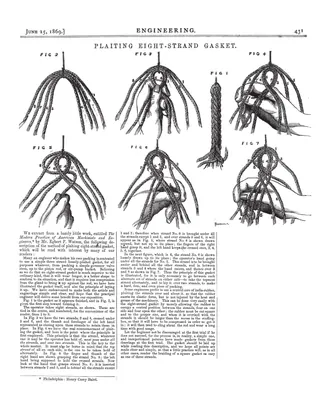
Plaited Eight-Strand Gasket
Engineering Weekly, June 25, 1869
Article · 1 page
A one-page 1869 article from the journal Engineering that reproduces Egbert P. Watson's instructions for plaiting an eight-strand square gasket, used as packing for engine stuffing-boxes. Seven engraved figures show the hands and numbered strands at each stage. The text states the rule that each strand passes under all the others and over two, and it suggests an optional india-rubber core.
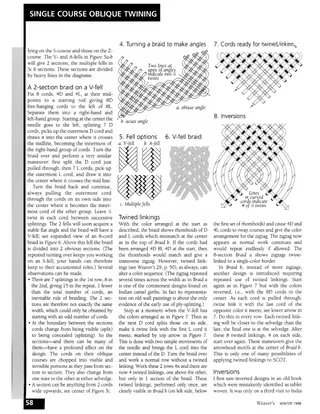
Single Course Oblique Twining
Article · 4 pages
Third article in Peter Collingwood's series on ply-split braiding, covering single course oblique twining (SCOT). It explains how cords are split on an oblique fell, then covers curves and angles, multiple fells (V- and A-fells), twined linkings for color changes, and inversions that curve the cords into ovals. It closes with ideas for further exploration and is illustrated with photographs of sample braids and diagrams of the cord movements.
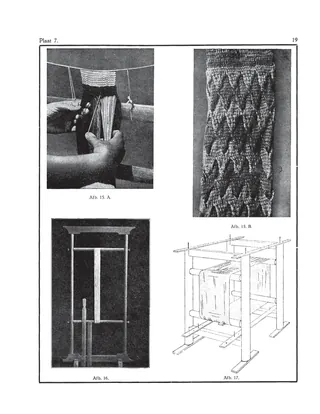
Egyptisch Vlechtwerk [Sprang]
Book · 36 pages · Dutch
A Dutch-language instruction manual on sprang, called "Egyptisch vlechtwerk" (Egyptian plaiting), by E. Siewertsz van Reesema, with a foreword by Elis. M. Rogge. It covers the history of the technique, the frame and its set-up, the hand movements, and methods for joining and finishing work, including fringes, tassels and cord fringe. It also covers increasing, holes, sticks, left-hand plaiting, and double-field work in two colors. Twenty plates of photographs and drawings show the process and finished pieces such as caps, bags, bottles, sashes and scarf ends.
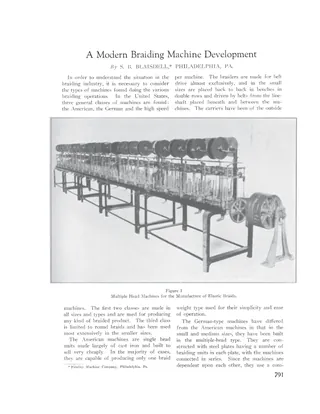
Modern Braiding Machine Development
Article · 3 pages
A 1930 trade article by S. B. Blaisdell of the Fidelity Machine Company, Philadelphia, on developments in industrial braiding machinery. It compares American single-head, German multiple-head and high speed braiders, then describes a new multiple-head machine that combines their features, with a built-in lineshaft, flexible couplings and chain-and-motor drive. Four photographs show installations making elastic braids, tying tape, gas tubing and small braided cords.
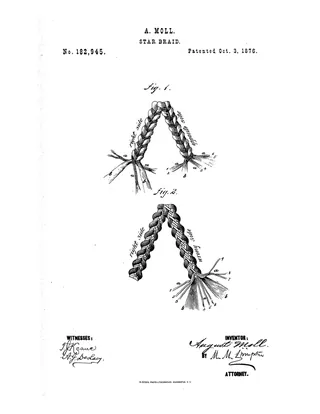
Star Braid, US Patent No. 182945
Patent · 2 pages
US Patent No. 182,945, granted October 3, 1876 to August Moll of Brooklyn, New York, for an improved "star braid" trimming braid. The braid is made with six binding-threads instead of nine, so both sides are alike. The specification explains that it is made on an imported braiding machine with every third spindle omitted, and the drawing sheet compares the new braid with the older nine-thread version.
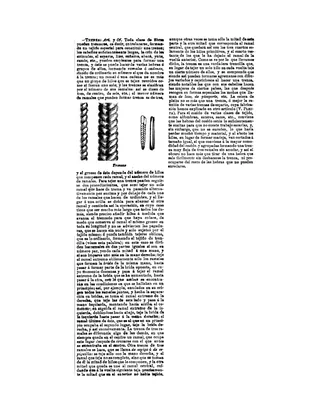
Trenza [Braid]
Article · 1 page · Spanish
A Spanish encyclopedia entry on the braid (trenza), explaining how fibers such as hair, horsehair, esparto, flax, hemp, abaca, jute and ramie are interlaced in groups of strands (ramales). It classifies braids by number of strands, with three as the minimum, and describes two methods of braiding: a single weft strand woven through warp strands, or the usual oblique plaiting. It also covers the three-strand 'espiga' braid, braided hairstyles, esparto mats made of braids, and loose braids used to hold sewing threads. One page of illustrations shows braided cords.
Braiding and Covering Machines
Article · 3 pages
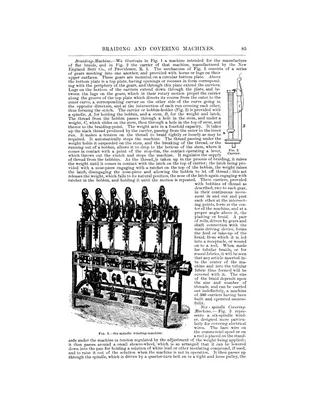
An article from Appletons' Cyclopaedia of Applied Mechanics describing braiding machinery for flat and round plaited fabrics such as trimmings, wicks, laces and cords, and for covering electrical wire. It explains the gear-driven carrier mechanism of a flat braiding machine made by the New England Butt Co., including the weighted bobbin carrier. It also describes a six-spindle wire-covering (winding) machine with flier, stop-motion and feed-wheel. Illustrated with three engravings and line drawings.
Braiding-Machine
Article · 1 page
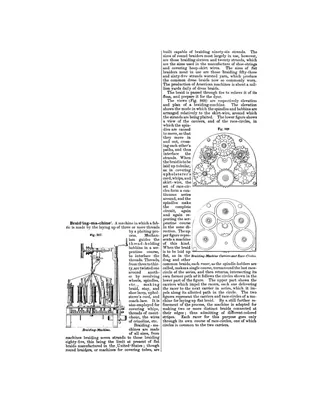
Dictionary entry on the braiding machine from Knight's American Mechanical Dictionary. It describes how the machine plaits three or more threads by guiding bobbin-carrying spindles along serpentine race-circles, and covers machine sizes, round (tubular) and flat braiding, and products such as shoe laces, dress braids, upholsterer's cord and covered skirt wires. Two figures show the machine in elevation and its carriers and race-circles.
A Few Simple Braids
Article · 6 pages
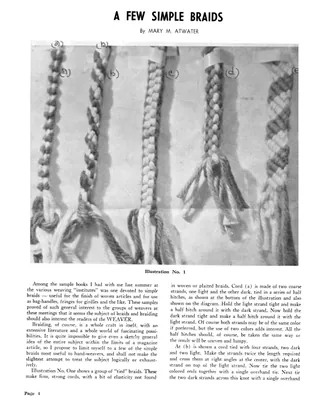
Mary Atwater introduces a selection of simple braids and knotted cords that handweavers can use for finishing woven pieces, bag handles, drawcords and girdle fringes. She gives step-by-step directions for tied braids (half-hitch and crowning knot), Solomon knot cords, looped or bight braids (twin-bight, Antique Sennit), multi-strand Indian, combing and Girdle of Rameses braids, and sailors' sennits. Photographs of sample cords and hand-drawn diagrams accompany the text, and she recommends a further reference on knots and rope work.
The Osage Braid
Article · 5 pages
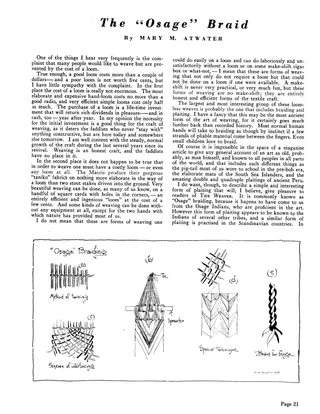
Mary M. Atwater describes the loomless Osage braid (also called "Swedish weaving"), a finger-plaiting technique used for belts and girdles with chevron and diamond patterns. She gives instructions for a three-inch girdle in five colors of Bernat's Peasant yarn: warping, the twining tie, the spreader, picking up the shed and drawing threads through, and finishing with braided fringes, including a four-strand Indian braid. She also covers variations such as arrowhead and lightning figures made by looping the weft threads. Diagrams and photographs of finished girdles, including pieces made at Bacone Indian College, illustrate the article.
Plain Braids, Braiders and Braiding
Article · 2 pages
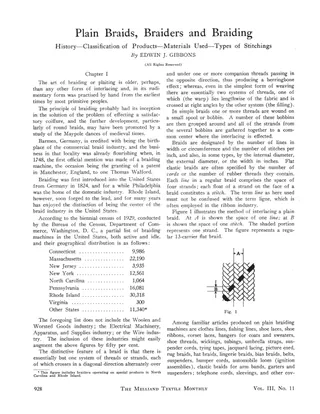
First chapter of a series on commercial braiding by Edwin J. Gibbons, published in The Melliand Textile Monthly. It covers the history of braiding and braiding machines, the braid industry in Germany, England and the United States (with 1929 census figures on machines by state), and how braids differ from woven fabric. It also classifies braids as round or flat, lists the materials and products made on braiding machines, and describes the plain, diamond (basket) and Hercules stitches, illustrated with diagrams and photographs of braids.
Plaited Soutache
Article · 5 pages
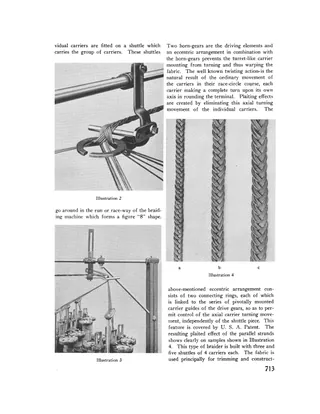
A 1929 Melliand article on soutache (flat plaited braid) and the specialized braiding machines built in the United States to produce it. It explains how a soutache braider works, using two horn-gears, an odd number of carriers (3 to 13) and a figure-8 race-way. It describes a heavy 'battleship carrier' machine for paper cord braid used in rag-style Colonial rugs and reed or fiber furniture, with details of tension weights, wire-cored paper cord, machine size and output. Illustrated with a rug photograph, schematic diagrams and photographs of the machines.
Ply-Split Braiding
Article · 6 pages
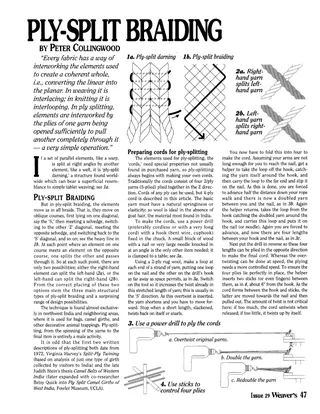
Peter Collingwood introduces ply-split braiding, a technique in which one cord is split through its plies to let another pass through, used in northwest India for camel girths and bags. The article explains how to make four-ply cords with a power drill, how to mount them on a starting rod, and how to work plain oblique twining (short and long rows with a quarter twist between splittings). It also covers color patterning with twined linkings, slits, cylindrical and 3-D forms, and turning a braid through a right angle, and mentions two further structures to be covered in later articles.
Ply-Split Braiding II
Article · 4 pages · weaving drafts
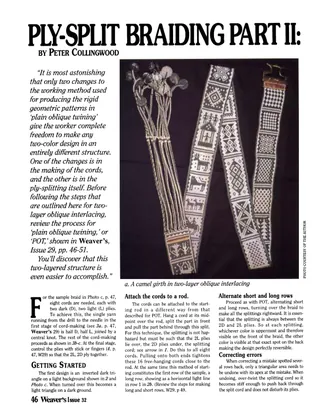
Second part of Peter Collingwood's series on ply-split braiding, explaining two-layer oblique interlacing, a structure that allows free two-color designs that look identical on both sides. It gives step-by-step directions for a sample braid with eight 4-ply cords (2 dark, 2 light plies each), including attaching cords to a rod, alternating long and short rows, and leaving no twist or a half twist between splittings to change color. It also covers correcting errors, ways of joining the two layers at the selvedges, pocket formation, designing on a 45° diamond grid, and use of more than two colors. Illustrated with photos of an Indian camel girth and sample braids, and with design grids and a splittings diagram.
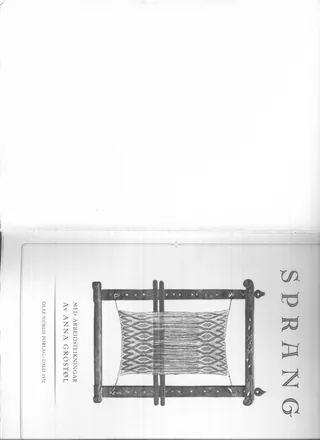
Sprang
Book · 25 pages · weaving drafts
A 1932 Norwegian-language handbook on sprang (a plaited, twined warp technique) by Anna Grostøl, with instructions and working charts. It covers the history of sprang in Norway, the frame and spindles, warping, the stitch sequence for a sample, making holes, and finishing. Photographs show historic pieces from Hallingdal, Gudbrandsdalen, Nordmøre and other regions, plus bands, mittens, bags, a shawl and a cloth. The last pages hold gridded working charts for the patterns shown in the figures.
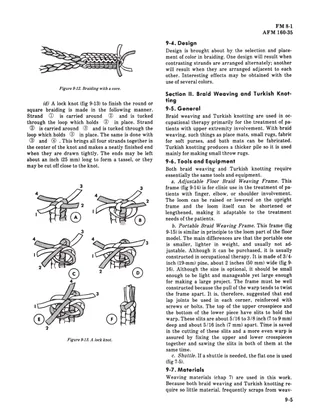
Braiding and Hooked Rugs
U.S. Army, 1980
Monograph · 13 pages
Chapter 9 of U.S. Army/Air Force manual FM 8-1 (AFM 160-35), written for occupational therapy, covering braiding, braid weaving with Turkish knotting, and rug hooking. It gives step-by-step instructions for flat braids (3 to 16 strands), round and square braids, and the lock knot. It also describes floor and portable braid weaving frames, warping and weaving methods, Turkish knot rugs, and hooked rug tools, materials, design, hooking, finishing and safety. Illustrated with numbered line figures.
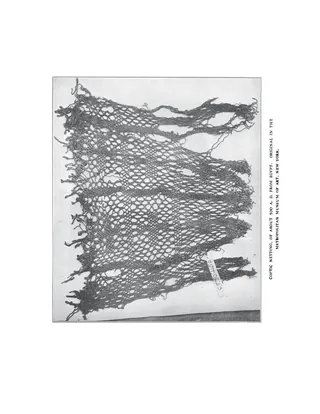
Old Egyptian Lace
Article · 7 pages
Article by a Dutch researcher on the open-work 'lace' found in Egyptian graves, such as Coptic caps, which she argues is not bobbin lace or needle lace but a form of sprang (twisted-thread netting worked on a frame). She describes how Louise Schinnerer matched it to Ruthenian peasant work in Galicia, and explains the frame setup, crossing of front and back threads, and use of a wooden sword. She also covers its survival in Scandinavia and the Netherlands (silk sashes, 1700-1840), the Spanish faja, and her own method for making horizontal patterns. Illustrated with a photograph of Coptic netting, two process photographs, and a cap and bag she made.
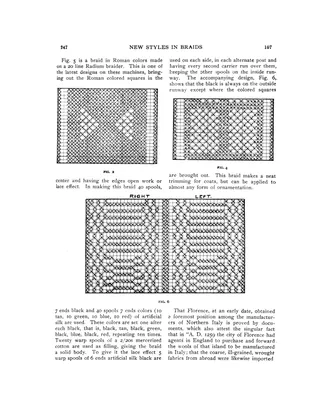
New Styles in Braids
Article · 2 pages
A 1913 trade article by Montcalm on new styles of machine-made braid trimmings, especially those in Bulgarian, Balkan and Roman color combinations. It describes the spool counts, colors and materials (artificial silk, mercerized cotton, gimp) used on lace braiding machines, including a 24 line lace braider and a 20 line Radium braider. Photographs show braid samples, and grid charts show the jacquard-controlled spool and color placement for each braid. The braids were used as trimmings for hats and coats.
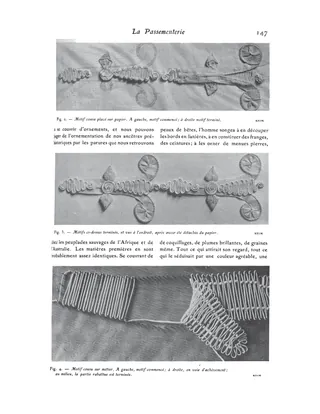
Passementerie
Article · 14 pages · French
A French-language illustrated article on passementerie (trimmings made of braid, cord, soutache, tassels and knots), published in the journal Art et Décoration in 1908. It tries to define passementerie and set it apart from embroidery and lace. It then gives a historical survey from prehistoric and ancient peoples through the Orient, Greece and Rome to medieval and 17th-century France, followed by materials (silk, cotton, wool, raphia, metal threads, beads, spangles). It also describes techniques (sewing on paper, working on a nailed board, bench work for knots and lacs, hand-woven galons) and the four main product categories. Many plates show soutache and princesse work by designers such as P. Doizey, Keim and Bonnon-Dumoutier, with a figure of the common knots.
Weaver, Vol. 7, No. 1 (January-February 1942)
Weaver, January-February 1942
Periodical · 31 pages · weaving drafts
Issue of The Weaver (Jan.-Feb. 1942), published by Emile Bernat & Sons, with Mary Atwater's illustrated guide to simple braids and tied cords for finishing woven pieces, and Marguerite Davison's article on treadle variations that gives drafts for Weaver's Fancy, Finnish Diamond and Swiss Twill with sample plates. It also includes Helen Starbuck's account of a Golden Gate Weavers exhibit in modern and colonial room settings, Edith Myers on the Fallbrook Weaving Institute led by Atwater, and Berta Frey on Greek Lace, a leno technique with twisted warp threads. The issue closes with Atwater's Questions and Answers (rusted heddles and reeds), directions for woven bags using strips cut from old stockings, and an advertisement for Bernat Superior Looms.
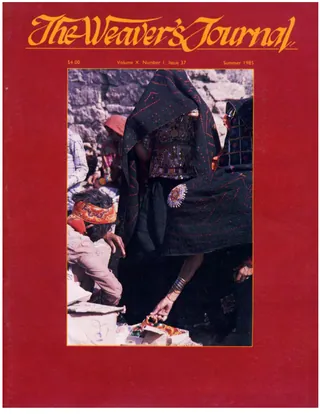
Weaver's Journal, Vol. X, No. 1 Issue 37 (Summer 1985)
Weaver's Journal, Summer 1985
Periodical · 92 pages · weaving drafts
Summer 1985 issue of The Weaver's Journal (Vol. X, No. 1, Issue 37), focused largely on ethnographic textiles and garment construction. Features include the final installment of a textile conservation series on preservation and storage, and Adele Cahlander's and Noémi Speiser's articles on loop-manipulated braids, with an annotated bibliography. Other articles cover Southwestern weaver Ramona Sakiestewa, Rabari lodi shawls of Kutch, Qotny and Alaga striped satin fabrics for Middle Eastern kaftans, Greek chemises and a summer shirt for narrow looms, a satin weave evening bag, contest results, Bolivian fullus ikat blankets, Kumejima kasuri, weft ikat, and Bergman weave. It also includes color trends, letters, book reviews, an index to Volume IX, calendar, products, classifieds and many advertisements.

Braid
Zell's Encyclopedia, 1876
Article · 1 page
A short dictionary-style entry for the word 'braid' from Zell's Encyclopedia. It gives the Anglo-Saxon etymology, defines the verb as to weave, knit, intertwine or wreath, and the noun as a texture formed by weaving strands together. Quotations from Dryden and Milton illustrate the usage.
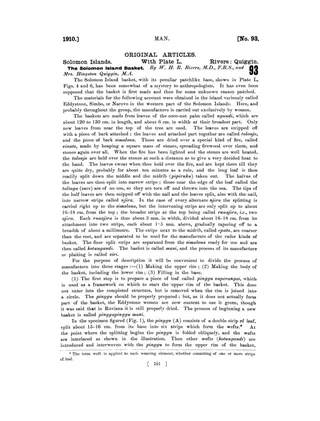
The Solomon Island Basket
Article · 4 pages
Article from the journal Man (1910) by W. H. R. Rivers and Mrs. Hingston Quiggin describing how women on Simbo (Eddystone Island) in the Solomon Islands make plaited baskets from split coconut-palm leaf. It explains the preparation of the leaf, making the upper rim, the body and contraction, and the turning of the basket inside out, then the filling in of the base that produces the patch-like bottom. The authors argue the patch results from the fineness of the strands rather than a need for strength. One plate with line diagrams and photographs illustrates the stages, and native technical terms are given. The scan also ends with the start of an unrelated short piece by Sir Herbert Risley on India and anthropology.
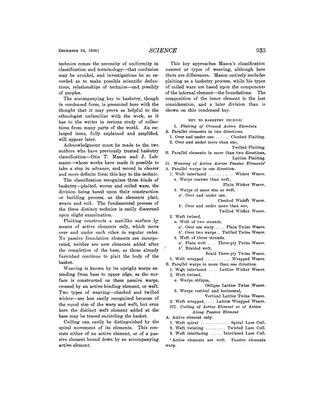
System of Basketry Technic
Article · 3 pages
A short 1909 article in Science proposing a uniform classification and terminology for basketry techniques. Kissell divides basketry into plaited, woven (wicker and twine) and coiled ware according to construction process, and compares her scheme with those of Otis T. Mason and J. Lehmann. It ends with a condensed outline key listing types such as checked and twilled plaiting, wicker and twine weaves, and the various lace and plain coils.
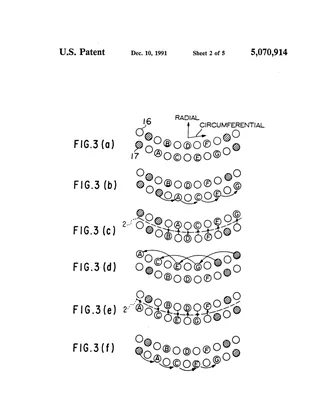
Triaxial Fabric of Interlaced Oblique Yarns, US Patent No. 5070914
Patent · 25 pages
US Patent 5,070,914 (granted 10 December 1991) describes a triaxial textile fabric for reinforcing composite materials. Oblique yarns radiate from the center and a circumferential yarn is woven spirally between them, with adjacent oblique yarns interlaced in a braiding-like action. The fabric gives isotropic elasticity and can be shaped into domes and other shells of revolution. The patent gives claims, a description of the weaving apparatus with spindle chucks, shuttles and a die, a test weaving, graphs of thermal expansion and modulus against latitude, and drawings. Certificates of correction are included.
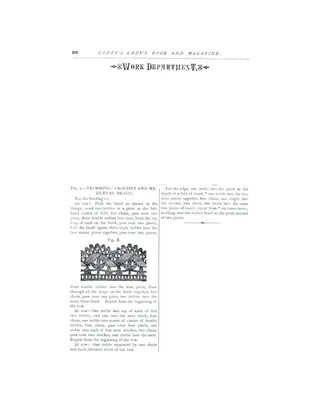
Trimming: Crochet and Mediaeval Braid
Godey's Lady's Book and Magazine, April 1890
Article · 1 page
A one-page needlework instruction from the Work Department of Godey's Lady's Book (April 1890) for a trimming made from crochet and mediaeval braid. It gives row-by-row directions for the heading, which is worked into folded braid picots, and for a scalloped edge. A small illustration shows the folded braid with a picot edging.
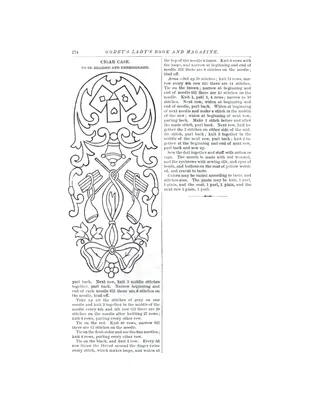
Cigar Case to be Braided and Embroidered
Godey's Lady's Book and Magazine, September 1873
Article · 1 page
A single magazine page from Godey's Lady's Book (September 1873) with a line-drawn pattern for a cigar case to be braided and embroidered. The design is an arch with playing-card suit motifs, scrollwork, a bow with tassels, ivy leaves and a flower. The page also carries the middle of unrelated knitting instructions for a knitted doll, with details on arms, colors and finishing.
Cord Knotting
Monograph · 15 pages
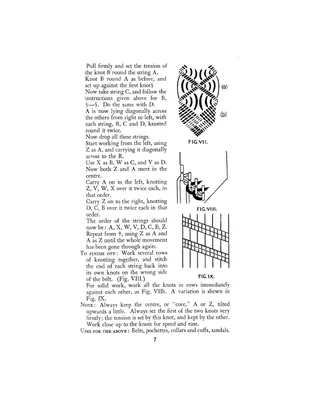
Dryad Leaflet No. 127 is a short instruction booklet on decorative cord knotting and macramé-style string work by E. Mary Macdonald of Dorset House School of Occupational Therapy. It gives step-by-step directions, with diagrams, for eight knots and plaits: buttonhole, finger knitting, four in hand, half hitch, nine or seven plait, round plait, Solomon's knot and square sennate. It ends with instructions for four knotted belts (A to D) attached to buckles, with notes on string lengths, colour arrangements and uses such as bag handles, dog leads and belts.
Embroidering and Braid-Making Machine
Manufacturer and Builder, 1877
Article · 1 page
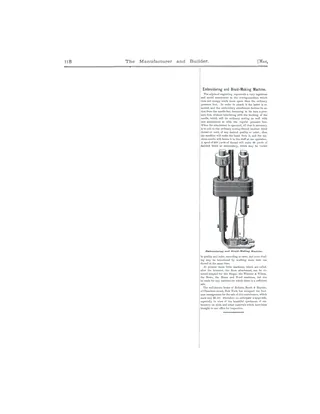
A short 1877 notice from The Manufacturer and Builder describing the Rose attachment, a sewing-machine accessory that replaces the pressure foot and makes braid or embroidery from an added thick thread or cord while the needle stitches it to the fabric. It gives yield (200 yards of thread makes 86 yards of braid), the machines it fits (Singer, Wheeler & Wilson, Howe, Home, Weed), the price of $1.50, and the New York sales agents. An engraving shows the attachment.
Machine Braided Torchon Lace Insertion and Method of Making the Same, US Patent No. 1637716
Patent · 6 pages
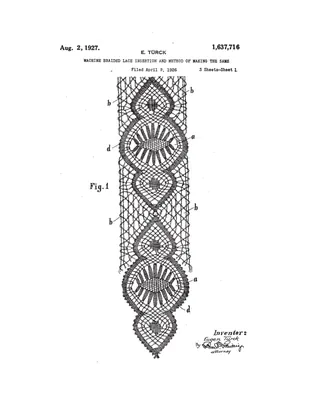
US Patent 1,637,716, granted 2 August 1927 to Eugen Türck of Barmen-Langerfeld, Germany, for machine-braided lace insertions (motifs) and the method of making them. The lace is braided as a continuous strip in which unused threads are led out into a simple net groundwork, and returned threads form firm selvaged edges so the motifs do not fray when the groundwork is cut away. This allows convex, wavy or zig-zag edges rather than only straight ones. Three sheets of drawings show the lace strip, an enlarged detail and a half-insertion variant, followed by the specification and five claims.
Plait
Article · 1 page
A short dictionary entry defining 'plait' as a braid, a flat fold in a garment, and a straw braid used for hats. It describes how straw plait is named by place (Leghorn, Tuscan, Dunstable), strand count, or character, and outlines preparing the straw by cutting, bleaching with sulphur, splitting and plaiting. It explains the over-and-under movement of the 13-strand Leghorn plait and the flattening of finished plait between rollers.
Straw Braid
Article · 1 page
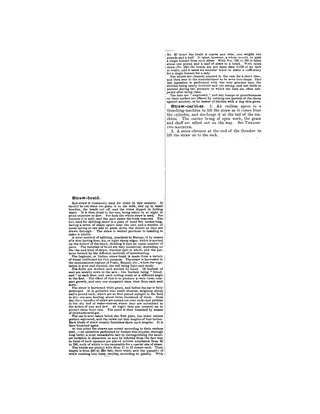
A one-page dictionary entry on straw braid used for hats and bonnets. It describes how rye straw is harvested, scalded, dried, split and plaited in the United States, and the European method of splitting with a multi-edged wire. It also covers Leghorn (Italian) braid in detail: growing the wheat, harvesting, bleaching, sorting by size, plaiting with 11 to 13 straws, and sewing into hats.
Finger Weaving
Monograph · 21 pages
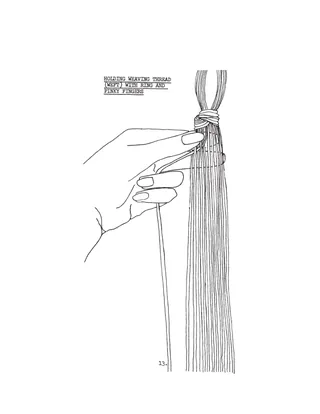
A short instructional pamphlet from the Tucson Public Schools Art Department on finger weaving, a tool-free braiding or plaiting method for making bands, belts and straps. It covers choosing yarns, preparing and attaching the warp (knots on a dowel or ring, overhand loops), and four weaving methods: from one side, with one warp thread, with an added weft thread, and from the center. It closes with ways of ending (overhand knots, Guatemalan braid, beads, fringes), helpful hints and a short reference list. Line drawings illustrate the knots and techniques.
Canadian Folk Handicrafts Society
Article · 9 pages
An article by Mary M. Phillips, first president of the Canadian Handicrafts Guild, tracing how a Montreal women's art society's exhibitions of 1900 and 1902 led to "Our Handicrafts Shop" (1902) and the Canadian Handicrafts Guild (1905). It surveys the Guild's activities and the crafts it supported: Quebec spinning, weaving and dyeing, homespuns, rag weaving, rug making and home dyeing in Prince Edward Island, Doukhobor embroidery, and Indian basketry, beadwork and quillwork. It also describes the "ceinture flechée" (L'Assomption sash), which is braided rather than woven, and the woven tufted decoration of the Lower St. Lawrence.
Weaver's Journal, Vol. XI, No. 4 Issue 44 (Spring 1987)
Weaver's Journal, Spring 1987
Periodical · 80 pages · weaving drafts
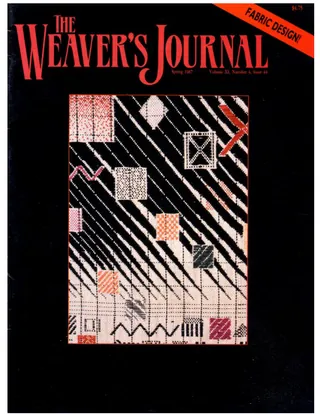
Spring 1987 issue of The Weaver's Journal (Vol. XI, No. 4, Issue 44), a general-interest issue on fabric design. It includes articles on computer-aided fabric analysis, an excerpt from Else Regensteiner's Geometric Design in Weaving, sprang on the loom, Finnweave (double-weave patterning on 4 and 8 shafts) with drafts, marketing handwoven fabric, velvet ikat, and a profile of brocade weaver Morgan Clifford. Also included are the name draft contest winners (huck and double-weave runners), the Moebius vest, plaited twill projects, articles on weaving by blind and visually impaired weavers, loom maintenance, product reviews, calendar, book reviews, classifieds and ads.
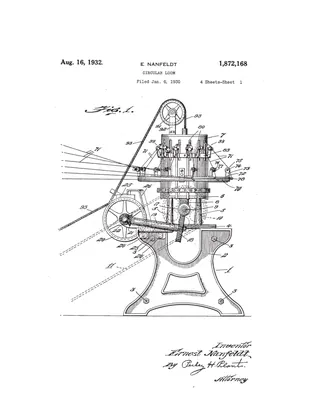
Circular Loom, US Patent No. 1872168
Patent · 11 pages
US Patent No. 1,872,168, granted August 16, 1932 to Ernest Nanfeldt of New Haven, Connecticut, assignor to Respro, Inc., for a circular loom that weaves tubular fabric. Weft thread carriers travel around a circular path while cam-driven pivoting guide arms place warp threads above or below each carrier in a set pattern. The loom can weave the tube around a central pin or as a covering on a wire or tube drawn through the hollow shaft. The document has four sheets of patent drawings (side elevation, top plan, vertical section, cam-groove diagram, gear detail, guide-arm detail), then the specification and 14 claims.
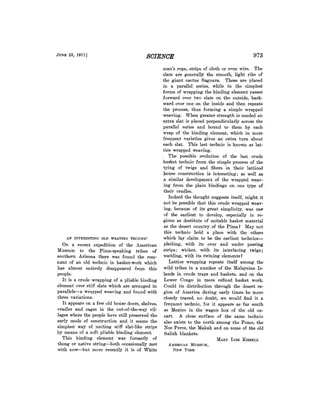
An Interesting Old Weaving Technic
Article · 1 page
A one-page note from Science (1911) by Mary Lois Kissell of the American Museum, New York, describing a nearly vanished wrapped-weaving technique found on an expedition to the Pima of southern Arizona. Stiff slats, often saguaro cactus ribs, are bound with a pliable element such as thong, string, rope, cloth strips or wire. Variations include a simple wrapped weaving and a lattice-wrapped form with a perpendicular slat. The author speculates that it is an early technique and notes similar work in Malaysia, the Lower Congo, Mexico and among Pacific Northwest and Plateau peoples.
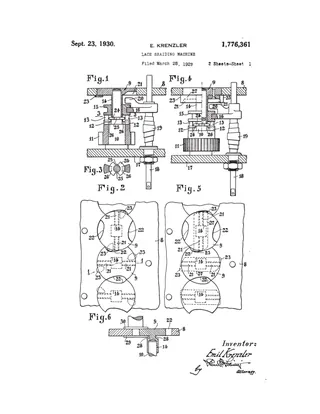
Lace Braiding Machine, US Patent No. 1776361
Patent · 2 pages
Two sheets of drawings for US Patent No. 1,776,361, a lace braiding machine invented by Emil Krenzler, filed March 28, 1929 and dated September 23, 1930. Sheet 1 shows sectional elevations and plan views (Figs. 1-6) of the machine, including a bobbin carrier head. Sheet 2 shows Figs. 7-9 with end and sectional views of the spool-like bobbin carriers. Only the drawings and reference numerals are present; the patent specification text is not included.
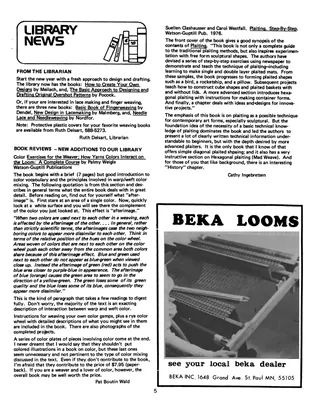
Library News - Color Exercises, Plaiting
Minnesota Weaver, February 1977
Article · 1 page
A one-page library column from the Minnesota Weaver with the librarian's list of new acquisitions on design, overshot drafting, fingerweaving and lace. It also carries two book reviews: Color Exercises for the Weaver (Watson-Guptill) on how warp and weft colors interact, and Plaiting, Step-By-Step by Clashausser and Westfall, on plaiting techniques and sculptural forms.
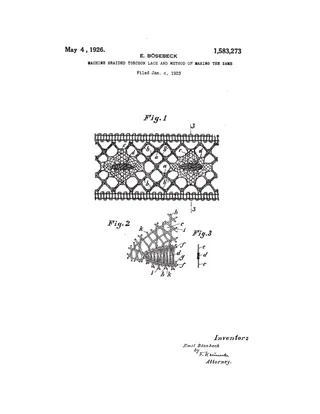
Machine Braided Torchon Lace and Method of Making the Same, US Patent No. 1583273
Patent · 3 pages
US Patent 1,583,273, granted 4 May 1926 to Emil Bösebeck of Barmen, Germany, and assigned to Max Henkels of New York. It describes a method for making leaflet motifs in machine-braided torchon lace on a single-thread lace braiding machine. Three sets of small-meshed ground threads are interbraided (lengthwise skeleton threads, transverse threads, and a meandering filling thread) so the leaflet stands out in relief on both sides and is firmly joined to the ground all around. The patent consists of a drawing sheet (Figs. 1-3) and the specification with two claims.
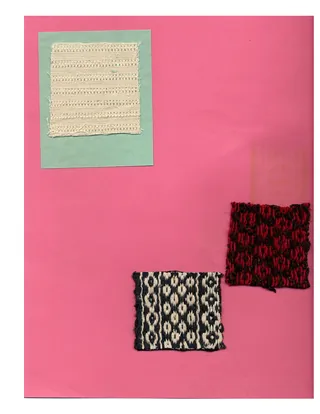
Mexican Motifs Portfolio
Other · 5 pages
A five-page portfolio of mounted textile sample photographs accompanying Harriet Tidball's Shuttle Craft Monograph Six, "Mexican Motifs" (1962). It consists of a cover with the title and pages of photographed woven samples, including striped, black-and-white geometric, openwork and plaited examples. There are no weaving drafts and almost no printed text.
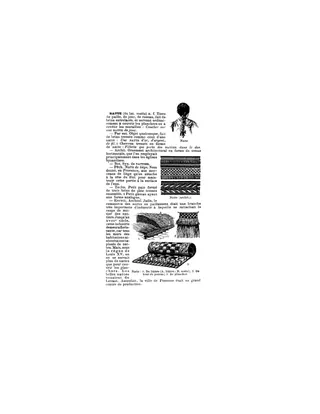
Natte [Mat]
Article · 1 page · French
A single-page French dictionary entry on the 'natte' (mat) from the Nouveau Larousse Illustré. It defines the word as a woven or plaited fabric of straw, rush or reed used to cover floors or walls, and gives extended senses including braided hair, the architectural plait ornament of Byzantine churches, and a braided loaf. The encyclopedic note covers the historical trade of mat-makers (natiers), the use of mats on walls until the 18th century, and Pontoise as a production centre. Illustrations show a braided-hair bust, an architectural plait band, and three kinds of mat.
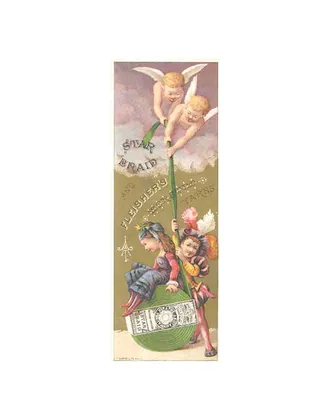
Trade card
Ephemera · 1 page
A single chromolithographed trade card advertising Star Braid, associated with Fleming's yarns. The tall vertical card shows two winged cherubs at the top holding a green pole, with a young woman in a blue headdress and a young man in a feathered cap below. The printed text is minimal and partly illegible.
Braid Sizing and Polishing
Article · 1 page
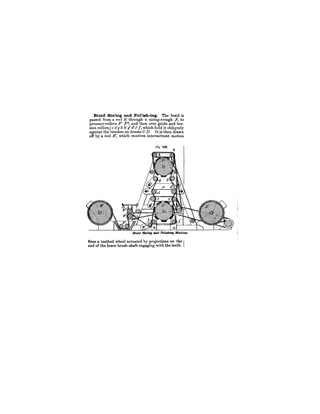
A short dictionary entry from Knight's American Mechanical Dictionary describing a machine for sizing and polishing braid. The braid runs from a reel through a sizing trough and pressure rollers, then over guide and tension rollers that hold it against brushes on rotating drums, and is taken up on a second reel with intermittent motion. Includes one cross-sectional diagram (Fig. 869) of the machine.
Triaxial Weaving Templates
Ralph E. Griswold · December 14, 2001
Web Doc · 9 pages
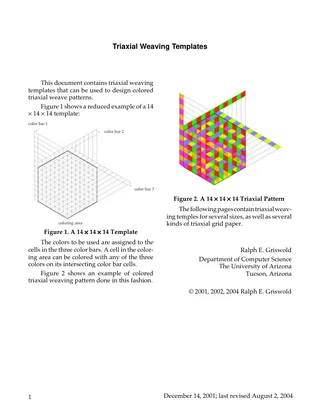
A short web document by Ralph E. Griswold offering printable templates for designing colored triaxial weave patterns. The first page explains how to use a template: colors are assigned to three color bars, and each cell in the coloring area takes one of the three colors on its intersecting bar cells. It includes an example 14 × 14 × 14 template and a colored pattern. Blank 10 × 10 × 10, 12 × 12 × 12 and 14 × 14 × 14 templates follow, then several pages of triaxial grid paper.
Cord-Covering Machine
Article · 1 page
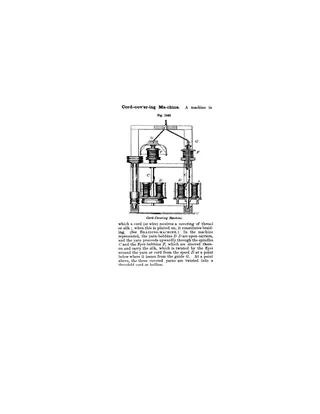
A short dictionary entry from Knight's American Mechanical Dictionary describing a cord-covering machine, which wraps a cord or wire with thread or silk. The accompanying figure (Fig. 1449) shows a cross-section with spindles, yarn bobbins, flyer bobbins and guides. The text explains how the flyers twist silk around the yarn and how three covered yarns are then twisted into a threefold cord or bullion.
The Finish of Edges
Article · 4 pages
Mary Atwater's article on finishing the edges of woven pieces, mostly with fringes. It covers deciding whether to fringe, finishing in the loom with Spanish open-work weaving, and weaving separate applied fringes on an inkle or harness loom. It also describes knotted macramé (Solomon knot) fringes, seizing, braided fringes and tops, a braided rug-fringe tie from the Philippines, and three Maori twined finishes. Diagrams and five photographs illustrate the methods.
Straw and Straw Manufacture
Article · 1 page
A single page from the 11th edition of the Encyclopedia Britannica on straw and its manufactures. It covers straw as the stalk residue of grain plants and its uses in thatching, papermaking, mats, baskets and especially plaited hats and bonnets. It describes the selection, harvesting and bleaching of Tuscan wheat straw for plaiting and the domestic plaiting industry of Tuscany, and begins to introduce the Luton straw-plait industry in Britain.
101 documents found