Textile Documents › Topic: Biography
223 documents found
Sort: 
Autograph of author of late 1800s textile books
Ephemera · 1 page
A single page bearing a handwritten autograph signature with a flourished underline, captioned as that of Thomas R. Ashenhurst, author of textile books in the late 1800s. The rest of the page is blank. It contains no technical or instructional content.
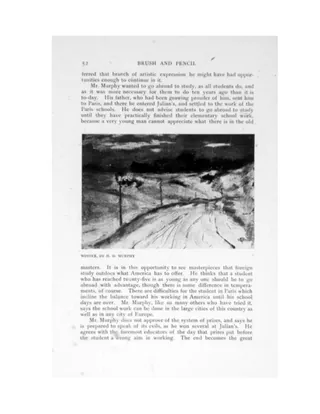
Hermann Dudley Murphy
Article · 8 pages
An article from Brush and Pencil (November 1899) profiling the American painter and illustrator Hermann Dudley Murphy. It covers his youth in Massachusetts, study in Boston and at Julian's in Paris, work as an illustrator on the Nicaragua Canal expedition, his views on prizes and foreign study, and his low-key, decorative portraits and landscapes. Illustrated with halftone reproductions of his portraits, landscapes and a profile head study.
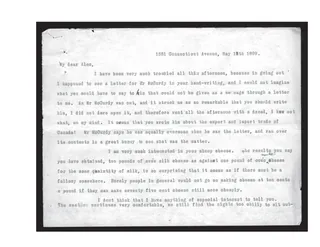
[Letter from Mabel Bell to Alexander Graham Bell, May 1899]
Letter to Alexander Graham Bell from His Sister, May 17, 1899
Ephemera · 3 pages
A typed family letter dated May 1899 from Mabel (Mrs. Alexander Graham Bell) in Washington, D.C., to her husband Alec. It discusses his experiments with sheep's milk cheese, a message from Miss Tarbell about Mr. McClure publishing a series of papers from his notebooks, and family and household news. It mentions a piece of silk bought from a weaver's loom in Kioto, Japan, which had just arrived.
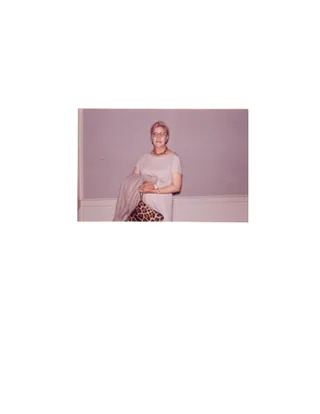
Photograph
Ephemera · 1 page
A single photograph of an older woman with short light hair and glasses, wearing a light short-sleeved top and a necklace, standing against a plain wall with white wainscoting. The catalog record associates the image with Harriet D. Tidball, a handweaving author. There is no readable text and no weaving content.
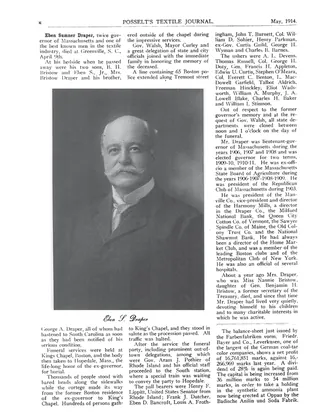
Eben Sumner Draper
Article · 1 page
A one-page obituary of Eben Sumner Draper, twice governor of Massachusetts and a prominent figure in the textile industry, who died at Greenville, S.C., on April 9th. It describes the funeral in Boston and burial at Hopedale, and lists his political offices and his directorships in textile and banking companies, including the Manville Co., Harmony Mills and the Draper Co. A short unrelated note on the Bayer dye company's profits follows.
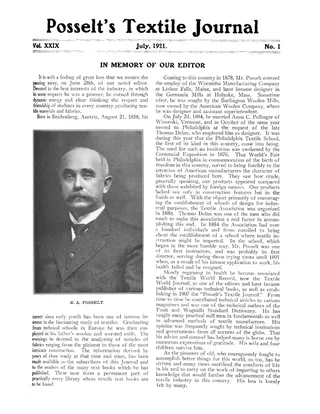
In Memory of our Editor [E. A. Posselt]
Posselt's Textile Journal, July 1921
Article · 1 page
A one-page obituary of E. A. Posselt, editor and founder of Posselt's Textile Journal, who died June 28, 1921. It traces his life from his birth in Reichenberg, Austria, in 1858 through his work in American woolen mills, his early teaching and directorship at the Philadelphia Textile School, and his career as a textbook author and publisher. It includes a portrait photograph.
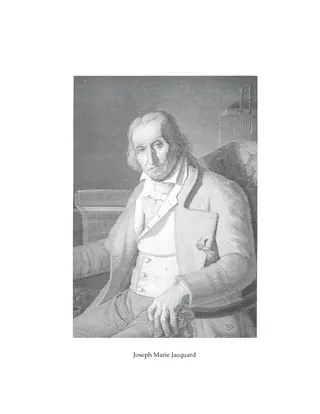
[Likenesses of Joseph Marie Jacquard]
Illustration · 4 pages
A four-page set of illustrations depicting Joseph Marie Jacquard, inventor of the Jacquard loom attachment. It includes two engraved portraits, a photographic plate of his statue in a public square in Lyons, and a grid of nine portraits and likenesses in various media (engravings, lithograph, bust, medallion). Captions give his birth at Lyons on 7 July 1752 and, on the last page, his death at Oullins on 7 August 1834.
Early Minnesota Weavers - Florence Titus
Article · 2 pages
A biographical profile by Kate Foreman of Florence Titus, a Minnesota rug weaver who began weaving rag rugs in 1916 at age 15 on a $32 two-harness Montgomery Ward loom. It covers her materials, pricing, trademark inlaid end borders, weft choices, knotting, wide carpets and stair runners, and her later years. The second page carries the article's end plus unrelated guild newsletter items: a report on the Midwest Weavers Conference and the end of a studio tour notice.
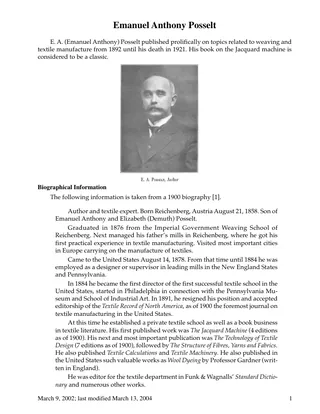
Emanuel Anthony Posselt
Ralph E. Griswold · 2002-2004
Web Doc · 15 pages
A short biographical and bibliographic study by Ralph Griswold of E. A. Posselt (1858-1921), the Austrian-born textile designer, teacher, publisher and editor active in Philadelphia. It reproduces a 1900 biography, lists his two book series and other titles, and discusses projected books that were never published, his Textile Journal, publishers, and where copies can be found. Appendices give short and long titles for 14 books, sample illustrations and advertisements from the books, and a 1890 business letter.
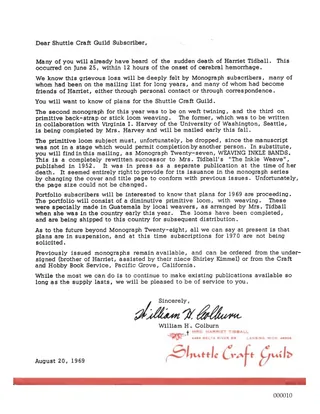
Form letter notifying membership of Harriet Tidball's death
Shuttle Craft Guild, August 20, 1969
Ephemera · 1 page
A form letter dated August 20, 1969, from William H. Colburn, brother of Harriet Tidball, informing Shuttle Craft Guild subscribers that she died suddenly on June 25 of a cerebral hemorrhage. It describes the fate of the planned monographs: the weft twining monograph will be completed by Virginia I. Harvey, the primitive loom monograph is dropped, and Monograph Twenty-seven, Weaving Inkle Bands, is issued as a rewrite of The Inkle Weave (1952). It also covers the 1969 portfolio of a small Guatemalan primitive loom, the suspension of 1970 subscriptions, and how to order back monographs.
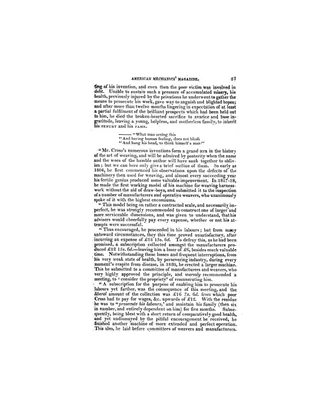
Some Account of the Late James Cross, a Journeyman Weaver, of Paisley, in Scotland
Journal of the Franklin Institute, January 1827
Article · 5 pages
A short biographical article on James Cross (died March 1824, aged 45), a journeyman weaver of Paisley, Scotland, who invented improvements to harness looms for figured fabrics that made draw-boys unnecessary. It reprints an account from the London Journal of Arts and Sciences (May 1825) describing his machines, the repeated and inadequate subscriptions raised by Paisley manufacturers, his debts and death, and the plight of his orphaned children. Footnotes list his inventions and quote weavers' testimonials praising the machine.
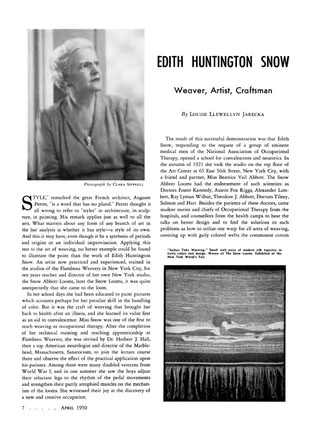
Edith Huntington Snow: Weaver, Artist, Craftsman
Article · 5 pages
A profile of New York weaver and teacher Edith Huntington Snow, written for the first issue of Handweaver & Craftsman. It traces her path from weaving as convalescent therapy to founding the Snow Abbott Looms, later the Snow Looms, and describes her teaching, her materials and her design philosophy. Most of the text describes her fine linen table sets, runners, lunch cloths and silk and wool fabrics, with notes on yarns, thread counts, colors and looms. The illustrations are photographs of her work and a line drawing of an Alaskan Eskimo boot design; there are no weaving drafts.
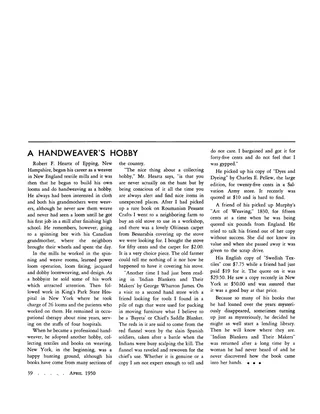
A Handweaver's Hobby
Handweaver and Craftsman, April 1950
Article · 1 page
A short profile of Robert F. Heartz of Epping, New Hampshire, a weaver who began in New England textile mills and later became a professional handweaver and collector of textiles and weaving books. It recounts his mill and occupational therapy background and anecdotes of bargain finds, including an Oltinean carpet, a possible Bayeta saddle blanket, and rare books on dyeing, weaving, and Swedish textiles. It ends with his decision to start a lending library.
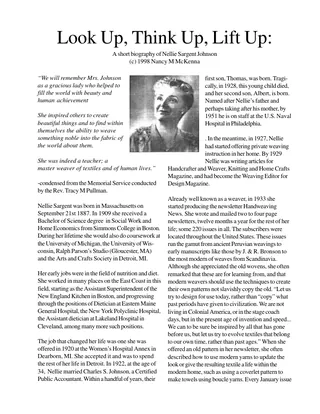
Look Up, Think Up, Lift Up: A Short Biography of Nellie Sargent Johnson
Nancy M. McKenna · 1998
Web Doc · 4 pages
A short biography of Nellie Sargent Johnson (1887-c.1950s), a Detroit weaver, teacher and editor of the newsletter Handweaving News. It covers her education, early dietetics career, weaving instruction at Wayne State, her 1939 Peru trip and collection of ancient and modern Peruvian textiles, and her death after a hip fracture. A closing section describes the Sears Hearthside looms she designed (rigid heddle and six-shaft folding floor loom), their catalog history from 1940 to 1953, and evidence that the Pope Machine Company of Kankakee manufactured them.
Luther Hooper [Bibliography]
Other · 6 pages · weaving drafts
A short biographical and bibliographic piece on Luther Hooper (1849-1932), English weaver, designer and author of seven handweaving books. It reprints his brief autobiography covering his early work in illumination, wallpaper design and engraving, and his later silk weaving, tapestry and teaching. It then lists his books with publishers and page counts, notes his 1912 Royal Society of Arts lectures, his illustrations and monogram, his loom designs, and the availability of his works. The last pages show sample illustrations from his books, including a 16-shaft table loom draft, a loom-entering diagram, and a plate of tablet-woven bands.
Lydia Brown, Spinster
Article · 6 pages
An article from the Bulletin of the Needle and Bobbin Club on Lydia Brown, a missionary sent to Wailuku, Maui, to teach Hawaiian women carding, spinning, knitting and weaving cotton cloth in the 1830s. It quotes her letters, mission committee reports and appropriations, and notes the later decline of hand-weaving as imported cloth arrived. It closes with a history of cotton growing in Hawaii from the 1860s to the early 1900s.
Sir Isaac Holden, Bart.
Engineering Weekly, August 20, 1897
Article · 1 page
An obituary of Sir Isaac Holden, Bart., who died in August 1897 at age 90, published in the journal Engineering. It traces his rise from a Renfrewshire miner's son and teacher to bookkeeper, manager and partner in a woollen firm, and describes his work on mechanical wool-combing. It explains hand combing, the competing inventions of Heilmann, Lister, Donisthorpe and Holden, Holden's square-motion comb patented in 1848, and the mills at Bradford, St. Denis, Rheims and Croix, closing with brief notes on his business and later life.
Handweaving News (2000): Biography of Nellie Sargent Johnson and Contents Listing
Periodical · 11 pages
A compiled set of writings by Nancy M. McKenna on Nellie Sargent Johnson (1887-1951), Detroit weaver, teacher and editor of the newsletter Handweaving News (1933-1951). It includes a short biography covering her education, teaching at Wayne University, her 1939 Peruvian textile collecting, and her design of the Sears Hearthside loom. A history of the Sears Hearthside looms (2-, 4- and 6-shaft models, 1940s-1950s catalogs, and the question of who manufactured them) follows, with a reproduced Sears Hearthside loom and accessories catalog section. The document ends with an index of Handweaving News issues by month from 1933 to 1951, listing topics, and of Johnson's self-published monographs.
Luther Hooper
Ralph E. Griswold · May 8, 2002
Web Doc · 8 pages · weaving drafts
A short biographical essay by Ralph Griswold on the English weaver, designer and author Luther Hooper (1849-1932). It reprints Hooper's brief autobiography, covering his early work as an illuminator, wallpaper designer and silk-weaving designer, and his later teaching and writing, along with Dorothy Wilkinson's 1960 appreciation of him as a teacher. It also lists his seven books with publication details, his 1912 Royal Society of Arts lectures, his illustrations and monogram, his Hooper looms, and where his works can be found. An appendix reproduces sample illustrations from his books, including a table loom draft, a loom prepared for entering, and a tablet-weaving plate.
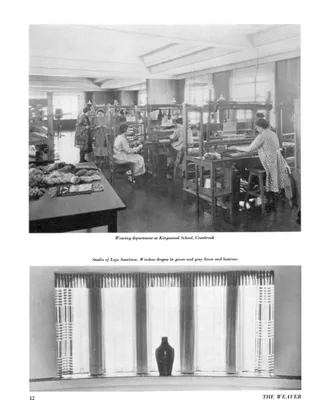
The Weavings of Loja Saarinen
Article · 7 pages
An article by Florence Davies on the weaving work of Loja Saarinen at the Cranbrook Foundation in Bloomfield Hills, Michigan. It describes how she began weaving rugs, wall hangings, drapery and upholstery fabrics for the Saarinen-designed Cranbrook buildings and for commissions such as Hudnut and Yardley shops in New York. It discusses her design philosophy, her color choices, her growth to about thirty-five looms, and a large tapestry for the Kingswood School dining room. Photographs show studio work, rugs, a tapestry and pieces by Cranbrook students. The scan also includes the ends of two other articles, with a Rosengang harness sequence and a basket-weave baby blanket draft, and a list of Scandinavian weaving references.
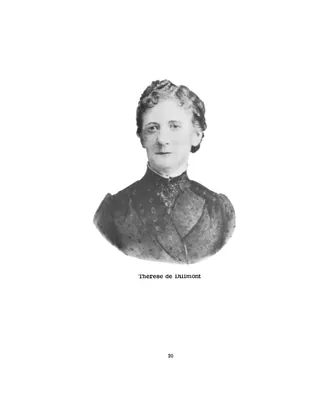
Thérèse de Dillmont and her Encyclopedia of Needlework
Article · 10 pages
A biographical article on Thérèse de Dillmont (1846-1890), the Austrian-born needlewoman who wrote the Encyclopedia of Needlework for the Alsatian thread firm DMC. It covers her family background, her move to Dornach near Mulhouse, her business arrangement with DMC, her earlier albums, and her death. It also traces the Encyclopedia's publication, editors, translations, and features. Endnotes give sources, and two appendices list the chapters of the 1886 and 1913 French editions.
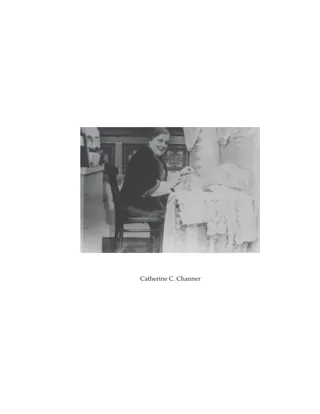
Catherine C. Channer, Lacemaker
Illustration · 1 page
A single black-and-white photograph of Catherine C. Channer, a lacemaker, shown seated at a table draped with lace while working on lace with her hands. The only printed text is her name. It serves as a portrait record of a lace maker at work.
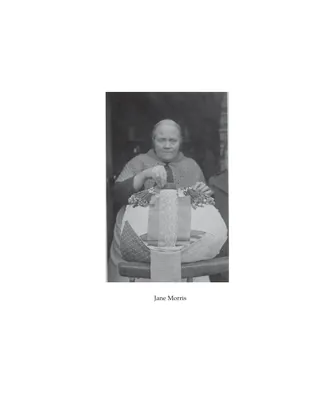
Jane Morris, Lacemaker
Illustration · 1 page
A single black-and-white photograph of an elderly woman, identified by the caption as Jane Morris, seated at a lace pillow. She wears a knitted shawl and is working bobbins, with a strip of lace and checked fabric draped across the pillow. The only printed text is her name.
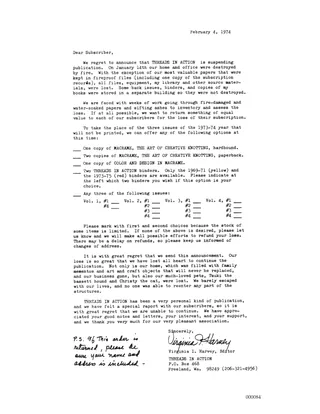
Letter to subscribers to Threads in Action announcing suspension of publication
Threads in Action, February 4, 1974
Ephemera · 1 page
A form letter dated February 4, 1974, from editor Virginia I. Harvey to subscribers of Threads in Action, announcing that the magazine is suspending publication after a fire on January 14 destroyed the Harveys' home and office. The letter lists replacement options for the three unprinted issues of the 1973-74 year: copies of her macrame books, binders, or back issues. It includes a checklist order form and a handwritten postscript about a returned order.
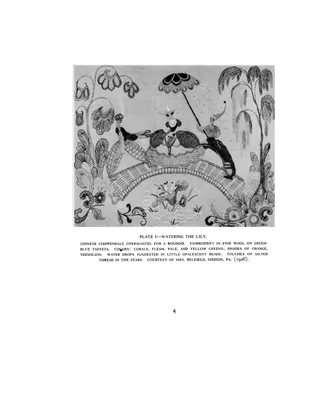
Georgiana Brown Harbeson, a Painter in Needlework
Article · 11 pages
An introductory biographical article by Frances Morris on Georgiana Brown Harbeson, an American embroiderer and trained painter regarded as a leading exponent of modern embroidery in the 1920s-30s. It covers her background, her design process (pictorial cartoon, choice of ground, a 'palette of wools') and her use of stitches like brush strokes. Seven plates show her embroidered panels, portraits, an overmantel and a zodiac wall hanging, with captions giving materials, colors and stitches, plus a panel by Mrs. Theodore Roosevelt, Jr. and a needlepoint monkey screen.
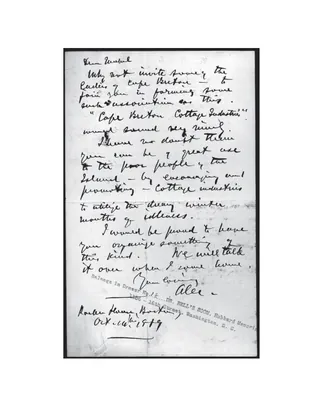
Letter From Alexander Graham Bell To His Sister
Letter from Alexander Graham Bell to his wife Mabel Bell, October 1899
Ephemera · 2 pages
Letter from Alexander Graham Bell suggesting the founding of an association called "Cape Breton Cottage Industries" to give the poor people of the island work during the idle winter months. The scan has a handwritten draft or version and a typed transcript. The letter is addressed to Mabel, his wife, and the two pages differ slightly in wording, salutation and date.
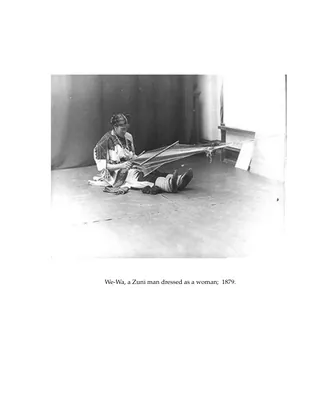
We-Wa, a Zuni Man Dressed as a Woman, Weaving
1879
Illustration · 1 page
A single black-and-white photograph of We-Wa, a Zuni man who lived and worked in the role of a woman, seated at a loom or warp frame stretched across the floor. The setting is a studio with a draped curtain. The only text is a caption giving the subject and the date, 1879.
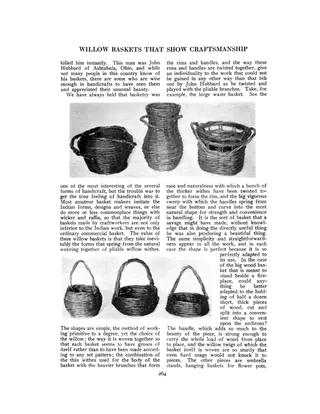
Willow Baskets that Show the True Spirit of Handicraft
Craftsman, 1910
Article · 3 pages
An article from The Craftsman describing the willow baskets of John Hubbard of Ashtabula, Ohio, a deaf self-taught basket maker who developed his own method of weaving willow withes and was killed by a train while working for a manufacturer. It discusses the forms, twisted rims and handles, stains, and household uses of his baskets, and argues that willow basketry suits furniture and village industry. Illustrated with photographs of waste baskets, vase-shaped baskets, and handled baskets.
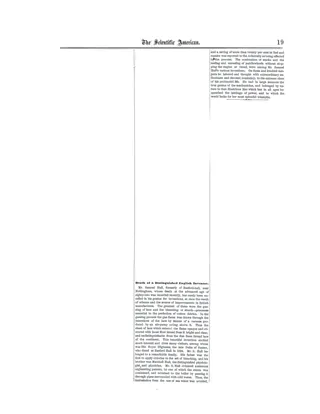
Death of a Distinguished English Inventor [Samuel Hall]
Scientific American, 1854
Article · 1 page
A short obituary notice in Scientific American for Samuel Hall of Basford Hall, near Nottingham, who died aged 82. It credits him with the gassing of lace, in which a gas flame was drawn through the lace by a vacuum to burn off loose fibers, and with the bleaching of starch. It also mentions his marine engineering patents, including a surface condenser for steam, smoke combustion and a paddlewheel reefing device, and his family connections.
Eli Whitney, the Inventor of the Cotton Gin
Cassier's Magazine, 1899
Article · 6 pages
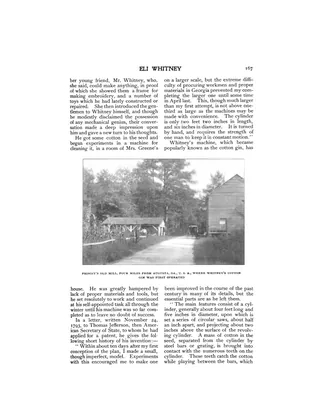
A biographical sketch of Eli Whitney (1765-1825) from Cassier's Magazine, covering his youth in Massachusetts, his years at Yale, and his invention of the cotton gin in Georgia in 1793. It describes the gin's saw cylinder, brushes and fan, the patent disputes and lawsuits that kept him from profiting, and the state payments for patent rights. It also covers his musket contract with the US government and his system of interchangeable parts, and closes with notes on his character and household inventions. Illustrated with a portrait and a photograph of Phinizy's Old Mill near Augusta, Georgia, where the gin was first operated.
Emanuel Anthony Posselt [Bibliography]
Ralph E. Griswold · 2002
Other · 13 pages · weaving drafts
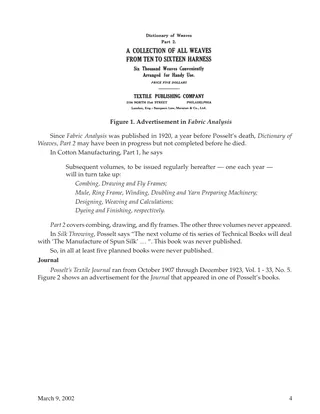
A 2002 work-in-progress bibliographic and biographical essay by Ralph Griswold on E. A. Posselt (1858-1921), Austrian-born textile author, teacher and publisher in Philadelphia. It summarizes his career and lists his two book series (Posselt's Textile Library and Hand Books of the Textile Industry) plus other titles, with editions, projected but unpublished volumes, his Textile Journal, and notes on availability. Appendices give full short and long citations, sample illustrations from the books (including a weave and Jacquard figures), and sample advertisements from Posselt's books.
Embroideries of Mrs. Theodore Roosevelt, Jr.
Article · 5 pages
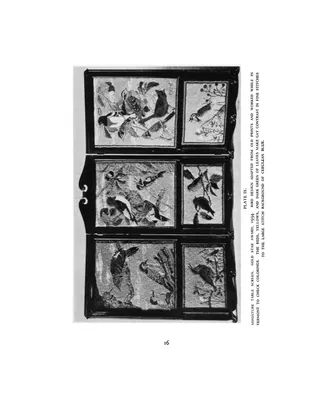
Article profiling the needlework of Mrs. Theodore Roosevelt, Jr., whose embroidery won the award for best piece at the Vernay Galleries exhibition in New York. It discusses her petit point and gros point panels, including a sampler of animals hunted on her husband's expeditions, a market scene, a threefold monkey screen, and a miniature bird table screen that won a 1934 gold star award. The author comments on her mixing of stitches, her modern designs, and practical problems such as matching imported wool colors. Two plates illustrate the sampler and the table screen.
Arkwright, Sir Richard
Article · 2 pages
Encyclopedia article on Sir Richard Arkwright (1732-1792), English inventor of the spinning frame. It covers his early life as a barber in Bolton, the development and 1769 patent of the water-powered spinning frame, and his mills at Nottingham and Cromford with Jedediah Strutt and Samuel Need. It also covers the patent lawsuits of 1781-1785, in which his patents were cancelled, the destruction of his mill near Chorley in 1779, and his knighthood in 1786 and death in 1792.
"Eli Whitney" in Leading American Inventors
Monograph · 31 pages
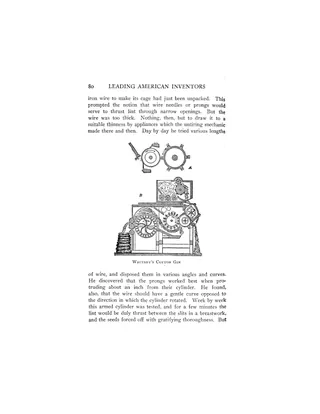
A biographical chapter on Eli Whitney (1765-1825) from George Iles's Leading American Inventors. It follows his Massachusetts boyhood, Yale education, and invention of the cotton gin at Mulberry Park, Georgia, then the patent battles with Georgia and South Carolina and the Hodgen Holmes saw-gin infringement. It ends with his move to musket manufacture at New Haven and his early use of interchangeable parts. Illustrations include a portrait, an engraving of the gin and a photograph of a gin.
Minnesota Weaver, Vol. 5, No. 2 (November 1979)
Minnesota Weaver, November 1979
Periodical · 12 pages
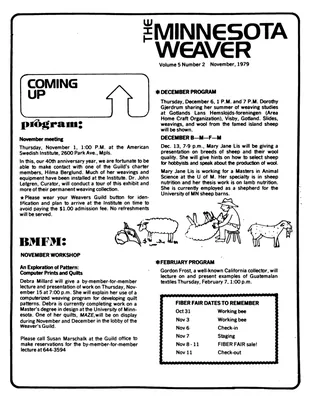
November 1979 issue of the Weavers Guild of Minnesota newsletter, covering upcoming programs, board and committee news, the Fiber Fair sale (Nov. 8-11), school and exhibit notices, and a president's column announcing a state arts grant. Features include a tribute to charter member Hilma Berglund, whose weavings are now at the American Swedish Institute, and a spinner's humorous essay on fear of new equipment, followed by a Q&A on woods for spinning wheels. It also carries a new members list, shows and exhibits listings, classifieds, and advertisements for yarn shops, looms and Fiberarts magazine.
Nellie Sargent Johnson - Bibliographic Notes
Ralph E. Griswold · September 23, 2001
Web Doc · 6 pages
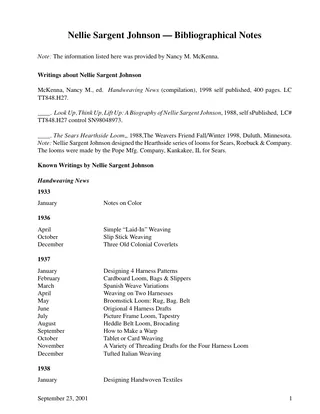
A bibliography of Nellie Sargent Johnson, a handweaving author and designer of the Sears Hearthside looms. It lists writings about her, her monthly Handweaving News articles from 1933 to 1951, self-published monographs and loom booklets, Handweaving News compilation volumes, and articles in The Weaver and The Shuttle. Information was provided by Nancy M. McKenna.
Rhymes and Recollections of a Hand-Loom Weaver
Living Age, 1844
Article · 6 pages
Two reprinted reviews in The Living Age of William Thom's book 'Rhymes and Recollections of a Hand-loom Weaver'. The first, from the Examiner, retells his account of destitution after Dundee's looms fell silent, the death of his daughter Jeanie, his wandering with his family, and his work as a country weaver in Inverury, with several of his Scots poems. The second, from Punch, argues that Scotland should support the living weaver-poet rather than only honor Burns. The pieces concern weaving as a livelihood and its hardships, not weaving technique.
Whitney, Eli
Chambers's Encyclopedia, 1881
Article · 1 page
A short encyclopedia biography of Eli Whitney (1765-1825), the American inventor of the cotton gin. It covers his Yale education, his time in Georgia, the invention of the gin to separate cotton from seed, the patent lawsuits that consumed his profits, and his later success manufacturing firearms with interchangeable parts at Whitneyville, Connecticut.
Whitney, Eli
Article · 1 page
Encyclopedia Britannica (11th ed.) biographical article on Eli Whitney (1765-1825), American inventor of the cotton gin. It covers his Yale education, his time on Mrs Greene's Georgia plantation, the design of the gin, the patent and partnership with Phineas Miller, the patent litigation, and his later firearms manufacture using standardized parts. It ends with a short list of references.
Whitney, Eli
Zell's Encyclopedia, 1876
Article · 1 page
A short biographical encyclopedia entry on Eli Whitney, born in Westborough, Massachusetts, in 1765, inventor of the cotton gin. It describes his partnership with Miller, the lawsuits that consumed his profits, and his later success manufacturing firearms at Whitneyville, Connecticut, using division of labor and interchangeable parts. He died in 1825.
Arkwright, Sir Richard
Encyclopaedia Perthensis, 1803
Article · 1 page
A short biographical encyclopedia entry on Sir Richard Arkwright, inventor of machinery for spinning and carding cotton. It traces his path from barber at Wirksworth to cotton-spinning entrepreneur, mentioning John Kay the clockmaker, his patent, his partnership and mills at Nottingham and Cromford, his knighthood in 1786, and his death in 1793.
The Constellation Orion in Summer and Winter Weave
Article · 2 pages · weaving drafts
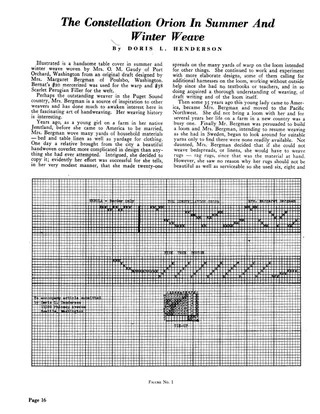
Article profiling Mrs. Margaret Bergman of Poulsbo, Washington, a Swedish-born weaver and teacher in the Puget Sound region, and presenting her summer and winter draft "The Constellation Orion." It recounts her weaving history from Jemtland, Sweden, her rag rugs, her discovery of summer and winter through Mrs. Atwater's book, her folding loom, and her teaching. A table cover woven by her pupil Mrs. Gaudy illustrates the pattern, and the draft includes a Nebula border and a Tree border with tie-up.
Sketches from the History of the Textile Industry: Jacquard
Article · 5 pages
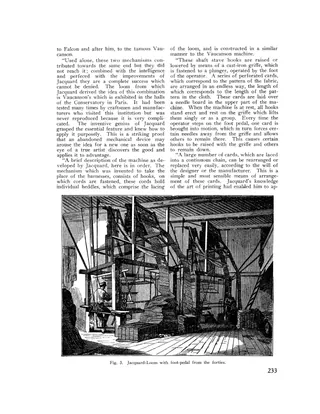
A biographical article on Joseph Marie Jacquard (1752-1834) and the invention of the Jacquard loom. It covers his life in Lyons, his early drawboy machine and prizes, the hostility of the weavers, and his later honors. It also discusses his forerunners Falcon and Vaucanson, quotes an 1808 description of the card-controlled hook and griffe mechanism, and ends with the loom's worldwide spread. Illustrations include a portrait plate, a mechanism diagram, and a foot-pedal Jacquard loom from the 1840s.
Biography of an Inventor [E. B. Bigelow]
Scientific American, 1854
Article · 1 page
A Scientific American editorial from February 1854 reviewing a biography of power-loom inventor Erastus B. Bigelow, published in Hunt's Merchant's Magazine and written by N. Cleveland. The editors argue the biography exaggerates Bigelow's feat of inventing a coach-lace power loom in six weeks, noting Jacquard's earlier work on figured-fabric looms. They still credit Bigelow with carpet power-loom improvements, many patents, his Lancaster, Mass. carpet factory, and power-woven silk brocatelles shown at the Crystal Palace.
Expressions in Fiber: The Art of Eleanor Merrill
Other · 38 pages
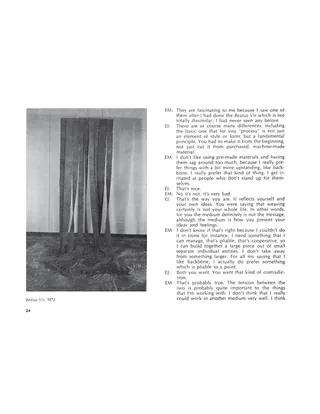
Catalogue of a 1975 exhibition of fiber art by Eleanor Merrill at the Allen Memorial Art Museum, Oberlin College. It includes a foreword on the art versus craft debate, a long interview between curator Ellen H. Johnson and the artist, a biographical chronology, and a catalogue of seven illustrated works. The interview covers her choice of wool breeds, rope, jute, sisal and manila, scavenged materials, large looms, twining, and the landscape, biblical, and family themes in her weavings. Black-and-white photographs show the works, sketchbook pages, and the artist.
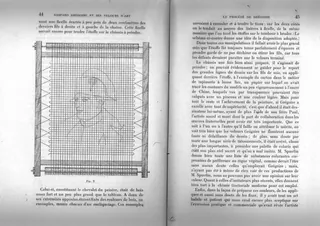
Gaspard Grégoire et ses Velours d'Art [Gaspard Grégoire and His Art Velvets]
Book · 45 pages · French
A 1908 French monograph on Gaspard Grégoire (1751-1846), an inventor from Aix-en-Provence who made small painted silk velvets ("velours Grégoire") resembling miniature paintings. It gives his biography, his dealings with the royal administration under d'Angiviller, and his privilege of 1788. It also explains his process of painting the pile warp threads before weaving, catalogues surviving pieces in museums and collections, discusses imitators, and reproduces archival documents.
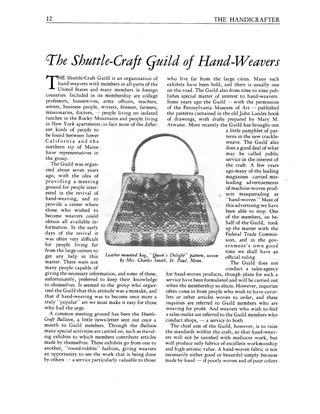
The Shuttle-Craft Guild of Hand-Weavers
Handicrafter, November-December 1931
Article · 4 pages
A 1931 Handicrafter article describing the Shuttle-Craft Guild of Hand-Weavers, founded about seven years earlier by Mary Meigs Atwater. It covers the Guild's membership, its monthly Shuttle-Craft Bulletin, traveling exhibits, publications, and its aim of raising standards of hand-weaving. It also gives a biographical sketch of Atwater and her weaving course, and her revival of Summer and Winter, Bronson and crackle weaves. Illustrated with photographs of members' work, including a bag, rugs, coverlets, a wall hanging and a weaving studio.
WeaveTech Archives, December 2000
WeaveTech, December 2000
Web Doc · 141 pages
A compilation of WeaveTech mailing list digests (Topica issues 528 to 564) covering December 2000. The messages are informal discussions among hand weavers, including handloom weaving in an industrial context, books such as the Goerner draft books and Keasbey's Designing with Blocks, and looms and equipment (Louet Megado, AVL, Jim Ahrens looms, linen testers, a tiny powerloom). Long threads cover marketing and advertising handwoven goods, postcards, craft shows and digital cameras, along with announcements of Andean textile tours and workshops with Ed Franquemont, an exhibition on women textile designers, and an obituary for loom builder Jim Ahrens.
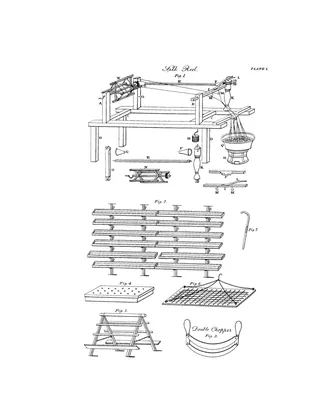
Memoir of Samuel Slater Connected with a History of the Rise and Progress of the Cotton Manufacture in England and America
George S. White · 1836
Book · 469 pages
A biography of Samuel Slater, who brought Arkwright's cotton spinning machinery from England to Rhode Island in 1790, set within a broad history of the cotton manufacture in England and America. It covers Slater's apprenticeship with Jedediah Strutt, early American manufactures, the founding of mills at Pawtucket and other New England towns, and testimony on the moral influence of factories. Later chapters give technical material from the Spinning Master's Assistant (gearing and speed calculations, carding, roving, throstle and mule spinning, power looms), cotton growing and the cotton gin, bleaching, calico printing, silk machinery, and dyeing. The appendix includes pieces on Oliver Evans, John Fitch and the woollen and worsted trades. Illustrated with engravings of mills and machinery, plus statistical tables.
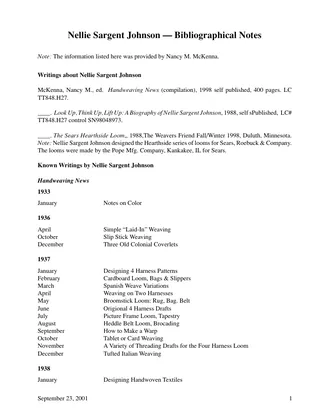
Nellie Sargent Johnson [Bibliography]
Other · 6 pages
A six-page bibliography of the weaving writings of Nellie Sargent Johnson, compiled from information supplied by Nancy M. McKenna. It lists works about her, a month-by-month index of her Handweaving News articles from 1933 to 1951, her self-published monographs, booklets for the Sears Hearthside looms, compilations, and articles in The Weaver and The Shuttle. Topics include Spanish weave, crackle, summer and winter, Bronson weaves, Peruvian textiles, brocading, and simple looms.
223 documents found