Textile Documents › Publications › Publication: Cassier's Magazine
16 documents found
Sort: 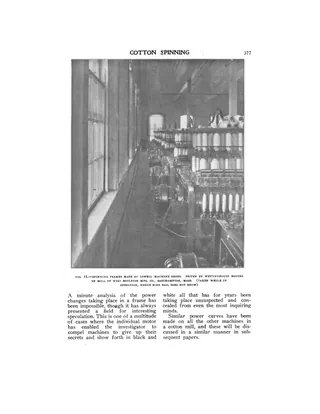
Analysis of Power Distribution in Cotton-Spinning Frame
Article · 11 pages
A 1909 engineering article reporting measurements of the power drawn by a single motor-driven ring spinning frame in a cotton mill, taken with a Westinghouse graphic recording wattmeter over a full working day. It explains how a ring frame works (cylinder, bands, spindles, rolls, ring rail, traveler) and interprets the power chart. The author attributes the roughly 20 percent higher load with full bobbins to air fanning at the bobbin surface rather than to bobbin weight. He attributes the small recurring peaks to yarn ballooning during the ring-rail traverse. Illustrated with photographs of the testing set and mill frames, diagrams, and power curves.
Cotton Industry in India
Article · 8 pages
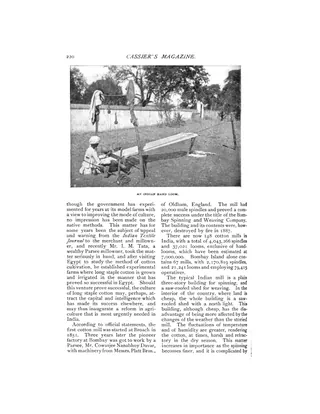
A 1897 Cassier's Magazine article surveying the cotton industry in India, from early legends of the cotton plant and ancient hand-spun Dacca muslin to the mechanized Bombay mills of the 1890s. It covers hand-loom weaving and warp preparation, the native churka gin, baling, mill construction and humidity problems, labour conditions and wages, and the prospects for improved cotton cultivation. Illustrations show Bombay mills, mill operatives, warping for hand looms, an Indian hand loom, a native cotton gin, and hand calico printing.
Current Topics (Spinning Machinery)
Cassier's Magazine, 1908
Article · 2 pages
A short 1908 magazine piece praising Richard Roberts's self-acting mule spinning frame as the culmination of early cotton machinery invention. It explains how the mule draws, twists, backs off and winds yarn onto the cop as the carriage moves out and in, and describes the complex headstock mechanism. It also compares Roberts's machine with the earlier mules of Crompton and the spinning frame of Arkwright, and notes Roberts's 1832 patent and the machine's rapid adoption.
Electric Driving for Mule Spinning
Article · 9 pages
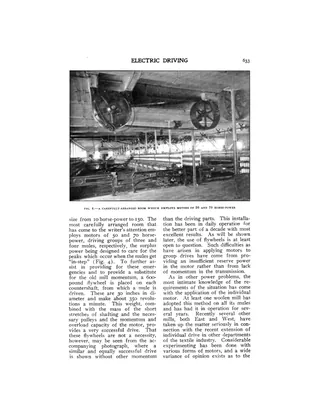
Article by Albert Walton in Cassier's Magazine (1911) on driving self-acting spinning mules with electric motors. It explains the mule's cycle (run-out, twisting, back-turns, run-in) and the sharp power peak when the spindles accelerate. It then compares group drive, individual motors with a 250-pound flywheel, and flywheel-free motors with looser speed regulation, including a side-by-side demonstration on worsted mules and power curves. Walton favors a constant-speed standard motor driving the existing countershaft.
Electric Driving for Weaving Machinery
Article · 7 pages
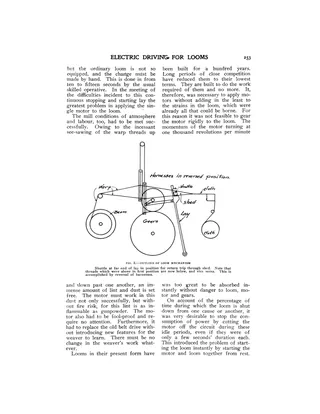
A 1909 Cassier's Magazine article by Albert Walton on applying individual electric motors to directly drive power looms in textile mills. It explains basic loom operation (warp, harnesses, reed, shuttle, shed) and the problems of starting and stopping a loom instantly, lint and dust, and the drawbacks of overhead and under-floor belt shafting. It compares a German belt-suspended motor, a friction-disc quill motor, and the friction-gear drive with a switch that cuts power when the loom stops. Illustrated with line diagrams of loom mechanism and drive arrangements.
Electric Driving of Cotton-Picking Machinery
Article · 16 pages
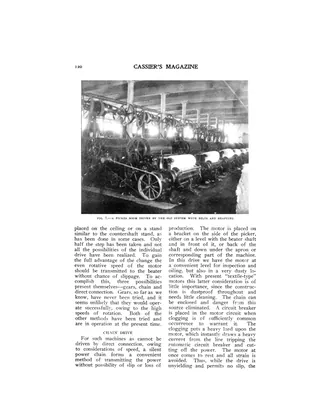
A 1910 article from Cassier's Magazine by Albert Walton on replacing belt and line-shaft drives with individual electric motors on cotton-mill picking machinery (opener, breaker, intermediate, finisher). It describes the picking process, the drawbacks of the traditional belt drive, and three motor arrangements: ceiling-mounted belt drive, silent chain drive, and direct connection to the beater shaft. It includes diagrams, photographs of picker rooms before and after conversion, and Westinghouse graphic wattmeter charts showing daily power use of a breaker, intermediate and finisher picker.
Electric Power in American Cotton Mills
Article · 8 pages
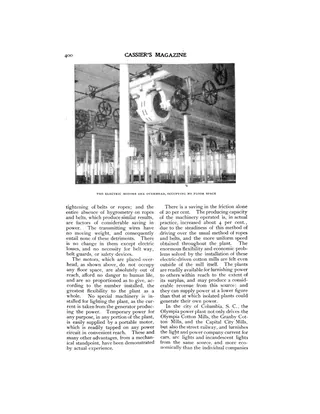
An article from Cassier's Magazine by W. B. Smith Whaley on the adoption of electric drive in American, mainly Southern, cotton mills. It sketches the history of Southern cotton spinning from water and steam power to electricity, then describes steam-electric mills such as Olympia, Buffalo, De Kalb, Inman and Seneca. It lists the advantages claimed for electric drive over rope and belt transmission: lower building cost, flexibility, less friction and power saved, and surplus power sold to other users. Illustrated with photographs of mills, engine rooms and overhead motors, and with floor-plan diagrams of mill layouts.
Electricity in Textile Manufacturing
Article · 10 pages
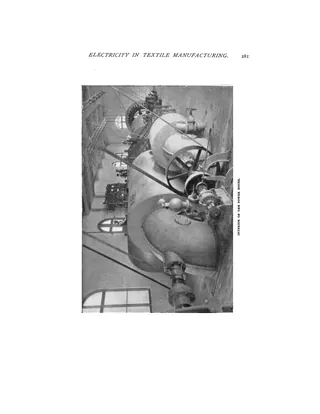
A February 1895 Cassier's Magazine article describing the Columbia Cotton Company mill at Columbia, South Carolina, the first cotton mill powered entirely by electric motors. It covers the water-powered generating station on the Congaree River, two 500-kilowatt three-phase generators, the underground cable line to the mill, and twenty 65-horsepower three-phase induction motors suspended from ceilings. It gives engineering details on speed regulation, efficiency (about 82 percent) and operating results, with photographs, plans and cross sections.
Eli Whitney, the Inventor of the Cotton Gin
Cassier's Magazine, 1899
Article · 6 pages
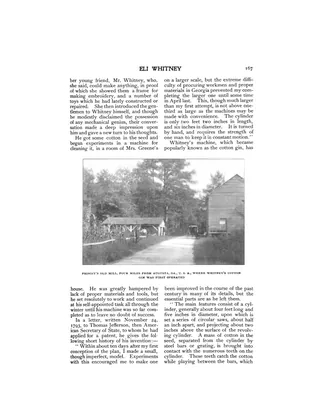
A biographical sketch of Eli Whitney (1765-1825) from Cassier's Magazine, covering his youth in Massachusetts, his years at Yale, and his invention of the cotton gin in Georgia in 1793. It describes the gin's saw cylinder, brushes and fan, the patent disputes and lawsuits that kept him from profiting, and the state payments for patent rights. It also covers his musket contract with the US government and his system of interchangeable parts, and closes with notes on his character and household inventions. Illustrated with a portrait and a photograph of Phinizy's Old Mill near Augusta, Georgia, where the gin was first operated.
Influence of Motive Power on the Design of Cotton Mills
Article · 4 pages
A 1899 article from Cassier's Magazine by Stephen Greene on how the source of motive power shaped the design and siting of cotton mills. It divides mill history into three periods: water power up to about 1860, steam engines (Corliss cut-off) from 1860 to about 1893, and the beginning of electric transmission. It discusses wooden breast and overshot wheels, turbines, engine placement, and shafting. It closes with the Pelzer Manufacturing Company mill in South Carolina, which was driven by electric power from a site 2.5 miles away.
Lubrication of Textile Mills
Article · 8 pages
A 1902 article from Cassier's Magazine, originally presented to the New England Cotton Manufacturers' Association, arguing that lubricants for textile mills should be chosen by practical trial rather than by friction-testing machines or chemists' reports. It classifies oils (fixed, volatile, residual, distillate) and gives recommendations for each class of mill machinery: steam cylinders, engines, dynamos, shafting, openers, pickers and cards, drawing frames, looms, spindles (bath, Sawyer open, mule, twister) and top rolls. It closes with the argument that savings in power from good lubrication outweigh oil cost.
Modern Cotton Spinning Factory, Part I
Article · 21 pages
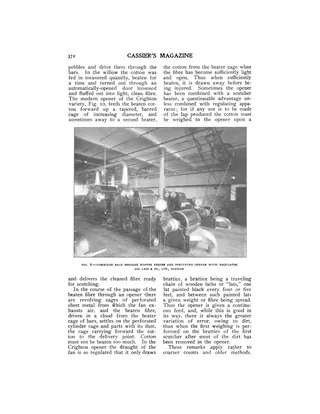
Part I of an illustrated 1909 Cassier's Magazine article on the layout and machinery of a modern Lancashire cotton spinning mill. It covers the history of spinning, cotton staple types (Sea Island, Egyptian, American, Indian), and the case for Lancashire and Oldham as the centre of the industry. Most of the article describes the blowing room: bale breakers, hopper feeders, openers, scutchers and lap machines, and feed regulators, with illustrations from Asa Lees, Dobson & Barlow, and Howard & Bullough. It ends with mill dimensions, spindle counts for fine and coarse mills, and the card room arrangement.
Modern Cotton Spinning Factory, Part II
Article · 18 pages
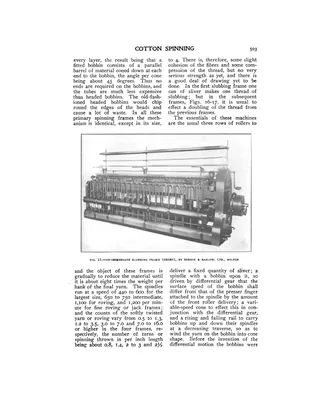
Second instalment of W. H. Booth's series on the modern cotton spinning factory, covering the preparatory machinery after scutching: carding, combing, drawing, and slubbing and roving. It explains how roller and revolving flat carding engines work, card clothing manufacture, the sliver lap, ribbon lap and Heilmann combing machines, drawing frames with their stop motions, and the speed frames with flyers and differential bobbin drive. It is illustrated with photographs of machines from Platt Bros., Dobson & Barlow and Howard & Bullough, and of mills in England, Brazil, Canada and Italy. The article is continued in a later part on the final spinning processes.
Modern Cotton Spinning Factory, Part III
Article · 21 pages
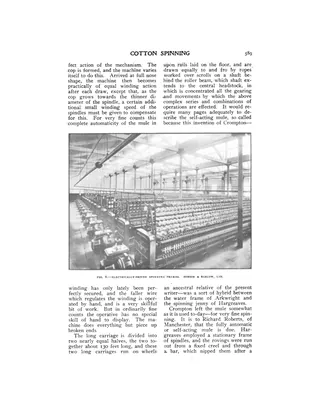
Third and final article in W. H. Booth's series on the cotton spinning factory, published in Cassier's Magazine. It describes the spinning operation on throstle, ring frame and self-acting mule, with notes on their history (Arkwright, Crompton, Roberts), twist calculations and mule action. It then gives machinery lists for standard mills (Tables I and II), floor plans and descriptions of several Lancashire mills (Stanhill, Cairo, Curzon, Broadstone, Kearsley, Imperial), and notes on construction, engines, shafting and fire protection. Illustrated with photographs of machines by Howard & Bullough, Platt Bros., Asa Lees and Dobson & Barlow.
Protection of Employees in Cotton Mills
Article · 15 pages
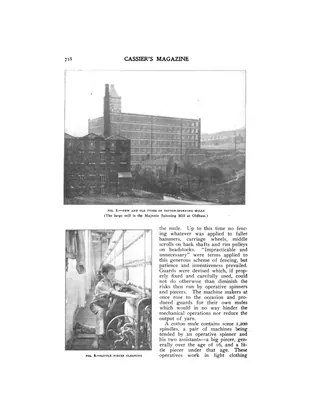
An article from Cassier's Magazine by H. M. Crawford on safety guards for self-acting spinning mules in cotton mills, mainly in Britain. It describes the parts that caused most accidents (headstocks, quadrant pinions, tightening pulleys, starting rods, back-shaft scrolls, drawbands and pulleys, carriage wheels, faller hammers) and the guards developed for each, with approximate costs, accident statistics and British regulations. It is illustrated with about 30 photographs of mules and guards.
Some Aspects of the Power Problem for the Textile Industries
Article · 10 pages
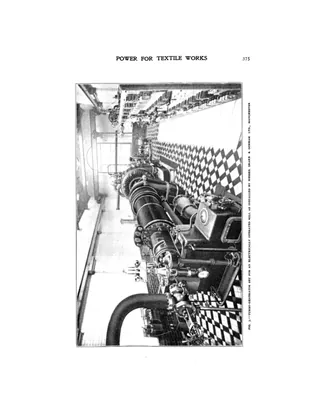
A 1908 article from Cassier's Magazine reviewing the competing sources of motive power for textile mills, chiefly in Britain. It compares steam engines, steam turbines, gas engines with producer plants, and electric drive by three-phase and direct-current motors, with rope and belt transmission as the alternative. Topics include flexibility, steadiness of running, reliability, power economy, maintenance, and group versus individual driving of spinning frames, mules and looms. Photographs show a Hick Hargreaves cross-compound engine, a rope race, a turbo-generator, motor-driven ring frames, a gas engine and individually driven looms.
16 documents found