Textile Documents › Topic: Damask
154 documents found
Sort: 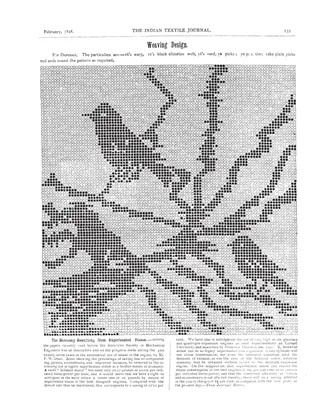
Weave Design
Indian Textile Journal, February 1898
Article · 1 page · weaving drafts
A single page from the Indian Textile Journal (February 1898) presenting a damask weaving design as a large dot-matrix drawdown, with particulars of 16's warp, 16's black alizarine weft, 56's reed and 56 picks, 50 percent size, and plain picks and ends around the pattern. The page also carries a short unrelated item on the economy of superheated steam in engines.
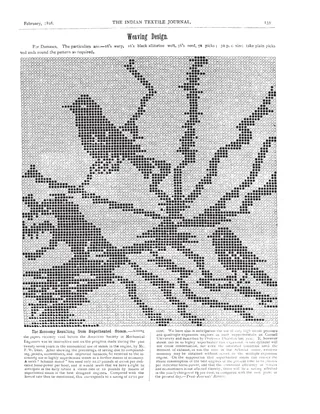
Weaving Design
Indian Textile Journal, February 1898
Article · 1 page · weaving drafts
A single page from the Indian Textile Journal (February 1898) with a damask weaving design shown as a drawdown grid of dark and light cells. A short note gives the cloth particulars: 16's warp, 16's black alizarine weft, 56's reed, 56 picks, and 50 percent size, with plain picks and ends around the pattern. The page also carries an unrelated item on the economy of superheated steam in engines.
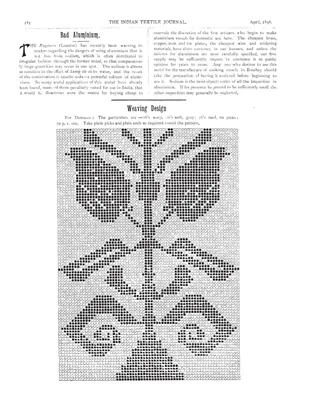
Weaving Design
Indian Textile Journal, April 1898
Article · 1 page · weaving drafts
A single page from the Indian Textile Journal (April 1898) with a short note on aluminium impurities and a damask weaving design. The design is a large point-paper drawdown grid with brief cloth particulars: 16s warp, 16s weft, 56-reed, 60 picks, 50 percent size, with plain ends and picks around the pattern.
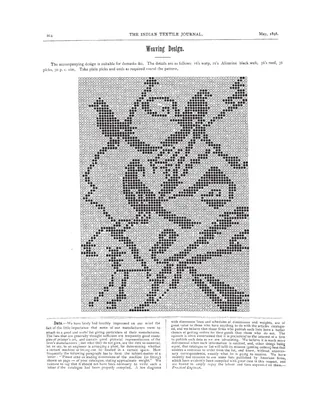
Weaving Design
Indian Textile Journal, May 1898
Article · 1 page · weaving drafts
A one-page item from the Indian Textile Journal (May 1898) presenting a large weaving draft for a damask-style pattern. The brief text gives cloth particulars: 16's warp, 16's Alizarine black weft, 56's reed, 56 picks and 50 percent size, with plain picks and ends to be added around the pattern. The page also carries an unrelated short piece, reprinted from Practical Engineer, urging manufacturers to include dimensions and weights in their catalogues.
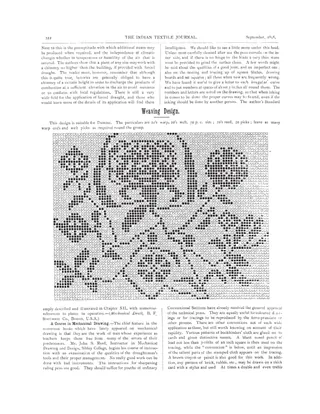
Weaving Design
Indian Textile Journal, September 1898
Article · 1 page · weaving drafts
A single journal page from The Indian Textile Journal, September 1898, presenting a damask weaving design as a large square-grid drawdown. The caption gives particulars: 20's warp, 20's weft, 50 per cent size, 50's reed and 50 picks, with a note to leave extra warp ends and weft picks around the group. The page also carries unrelated columns on forced draught for steam plants and a book review of a course in mechanical drawing.
Weaving Design
Indian Textile Journal, April 1898
Article · 1 page · weaving drafts
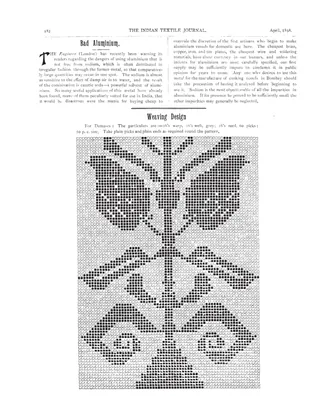
A single journal page from The Indian Textile Journal, April 1898, with a short "Weaving Design" item for damask cloth. It gives the cloth particulars (16's warp and weft, grey, 56's reed, 60 picks, 50 percent size) and a large point-paper drawdown grid of the damask pattern, with plain picks and ends to be taken around the pattern. The page also carries an unrelated note, "Bad Aluminium," on impurities such as sodium in aluminium cooking vessels in India.
D is for Damask
Article · 2 pages
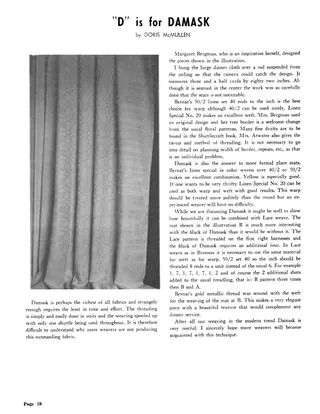
A short 1941 magazine article encouraging handweavers to try damask, which the author describes as rich yet quick to weave because threading is done in units and only one shuttle is used. It describes a tree-bordered linen dinner cloth designed by Margaret Bergman, recommends linen warps and wefts and sett, and suggests place mats. It also explains how to combine damask with Lace weave on eight ends per unit, with gold metallic thread in the weft. No drafts are given, but the author refers readers to the Atwater Shuttle-Craft book for drafts and tie-ups.
Damask
Zell's Encyclopedia, 1876
Article · 1 page
A short encyclopedia dictionary entry defining damask as a wrought linen chiefly made in Flanders, named for the silk fabrics with raised floral figures first made at Damascus. It notes the use of damask linen for tables, the term 'damask service' for a tablecloth and a dozen napkins, and the adjective and verb senses of the word.
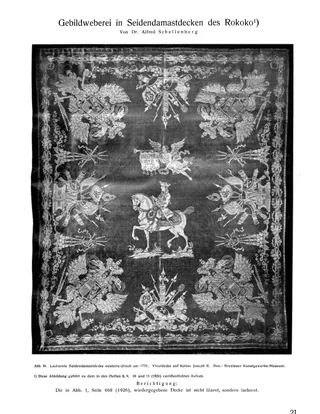
Gebildweberei in Seidendamastdecken des Rokoko [Pictorial Weaving in Silk Damask Covers of the Rococo]
Article · 1 page · German
A single page from Melliand's Textilberichte with Alfred Schellenberg's illustration (Abb. 10) of a salmon-red Austrian silk damask cover (Vivatdecke) of about 1779 made for Emperor Joseph II, held by the Breslau Kunstgewerbe-Museum. The figure shows a central equestrian figure surrounded by floral and foliate motifs. A footnote says the figure belongs to Schellenberg's article on pictorial weaving in Rococo silk damask covers, published in issues 8-11 of 1926. A correction states that the cover shown in Abb. 1 on page 668 (1926) is salmon-red, not lilac-red.
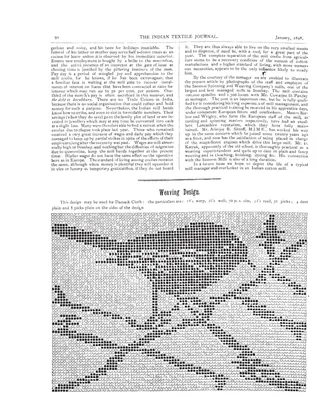
Weave Design
Indian Textile Journal, January 1898
Article · 1 page · weaving drafts
A single page from the Indian Textile Journal, January 1898, with a short weaving design note and a large drawdown grid for a damask cloth. The note gives cloth particulars: 18's warp, 26's weft, 50 per cent size, 32's reed, 56 picks, with 4 dent plain and 8 picks plain at the sides. The top of the page carries the end of an unrelated article on Indian mill labour (wages, debt, strikes) and photographs of the staff of the Sassoon Spinning and Weaving Company's mills in Bombay.
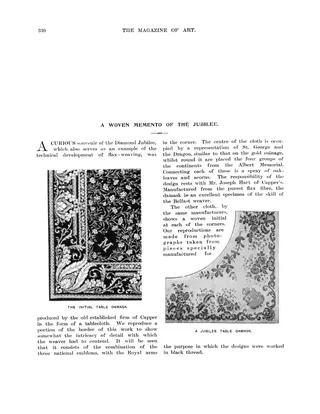
Woven Memento of the Jubilee
Magazine of Art, 1899
Article · 1 page
A short magazine article describing a damask tablecloth woven by the firm of Capper as a souvenir of Queen Victoria's Diamond Jubilee (1897). The border combines the three national emblems with the Royal arms, and the centre shows St. George and the Dragon with groups from the Albert Memorial. A second Capper cloth with woven corner initials is also noted, and both are illustrated from photographs of specially made pieces.
Damask
Article · 1 page
A one-page dictionary entry on damask from Knight's American Mechanical Dictionary. It defines damask as a rich figured silk originally from Damascus, then as a linen fabric made in Scotland and Ireland for table linen, and also as a watered stuff or moire. It includes historical and biblical anecdotes about Damascus and its trade, and notes that the figures are produced by a particular arrangement of the loom and warp threads.
Damask
Oxford Encyclopedia, 1828
Article · 1 page
A short encyclopedia entry defining damask as a tweeled (twilled) fabric of silk, linen, or cotton, with its supposed origin in Damascus. It notes the spread of silk damask manufacture from the continent to England through Dutch and Flemish weavers in Elizabeth's reign, and its later restriction to linen and cotton table linen. It also describes the loom setup, with five leaves of front mounting plus a draw loom harness for common damasks and eight leaves for the finest patterns drawn on squared paper.
Damask Weaving
Article · 2 pages
An article from Posselt's Textile Journal (February 1922) explaining how damask fabrics are woven on a jacquard loom. It describes tying several mails to each jacquard cord so that threads move in groups, how point-paper designs correspond to groups of threads, and the supplementary front harnesses that tie the figure. It also covers the cross-shed problem and relief devices such as the half-harness. The second page has the journal's subscription notice and an unrelated economic article on postwar price levels, with tables of money, production, wages and prices.
Entwürfe für Damast-Tischzeug (Gebild-Gewebe) [Designs for Damask Table Linen (Figured Fabric)]
Article · 3 pages · German · weaving drafts
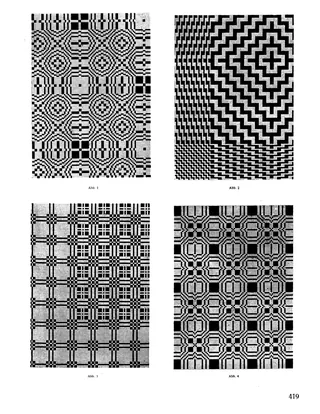
A short German-language technical article by Artur Hamann giving four designs for damask table linen (Gebild-Gewebe). For each design (Abb. 1-4) it states thread counts per cm, the binding (5-end satin, 4-end twill), the number of shaft groups and shafts needed, pattern repeat size in threads and cm, and materials (cotton warp with linen weft, or all linen). A page of drawdown figures illustrates the four patterns.
Weaving Designs
Indian Textile Journal, July 1898
Article · 1 page · weaving drafts
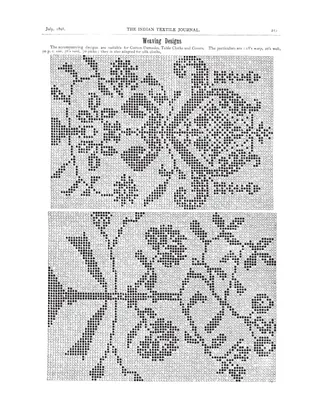
A one-page item from the Indian Textile Journal (July 1898) presenting two large drawdown designs for cotton damasks, table cloths and covers. The brief text gives cloth particulars: 18's warp, 20's weft, 50 percent size, 56's reed and 70 picks, and notes the designs also suit silk cloths. The rest of the page is taken up by the two pattern grids.
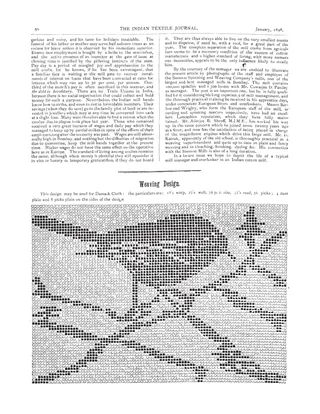
Weaving Designs
Indian Textile Journal, January 1898
Article · 1 page · weaving drafts
A single page from the Indian Textile Journal (January 1898) with a damask weaving design shown as a large square drawdown grid. The printed particulars give 18's warp, 26's weft, 50 per cent size, a 52's reed, 56 picks, and 4 dent plain with 8 picks plain at the sides. The page also carries the end of an article on Indian cotton mill labour in Bombay, covering wages, debt, strikes and the staff of the Sassoon Spinning and Weaving Company's mills.
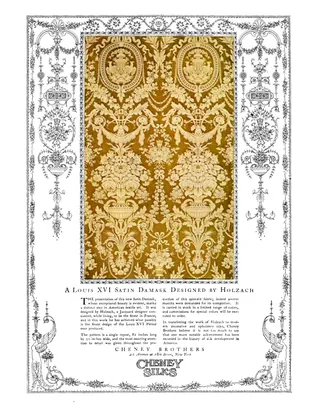
Advertisement in Arts and Decoration, 1921
Cheney Silks, c. 1921
Ephemera · 1 page
A one-page 1921 advertisement from Cheney Brothers for a Louis XVI style satin damask silk designed by Holzach, a French Jacquard designer. The text says the pattern is a single repeat 82 by 50 inches, was produced over several months, and is stocked in a limited range of colors with special colors made to order. The page shows an ornamental Louis XVI border and a black-and-white image of the damask pattern.
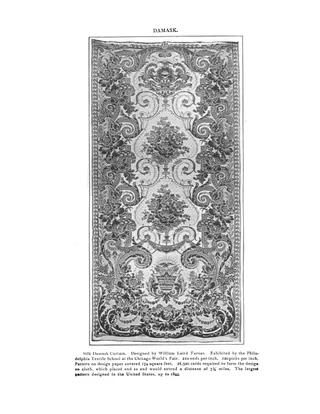
Damask
Article · 10 pages
An encyclopedia-style article on damask and its manufacture by William Laird Turner. It traces weaving from antiquity and the draw loom to Damascus damask and the Jacquard machine, then describes Jacquard parts, warp preparation, designing, design paper, and card stamping. It closes with notes on fine damask fabrics and brocatelle, including their shaft arrangements. A full-page plate shows a silk damask curtain designed by the author for the Philadelphia Textile School.
Damask
Chambers's Encyclopedia, 1881
Article · 2 pages
A two-page encyclopedia article defining damask as figured fabric woven with non-geometric patterns, and tracing its name to Damascus. It describes the Jacquard machine's role and the main centers of manufacture in Europe and Britain, especially Dunfermline. It distinguishes full harness, single (common) and double damask by the number of threads lifted per needle and the shaft ground (five-shaft, eight-leaf twill), then gives cost and industry statistics for Dunfermline from 1836 to 1877.
Damask
Article · 1 page
A short encyclopedia entry on damask from an 1859 commercial cyclopedia. It defines damask as a figured silk, wool, linen or cotton fabric, traces the name to Damascus, and notes production centers in Flanders, Dunfermline, Lisburn and Ardoyne. It also discusses the Irish linen damask industry, hand-loom versus power-loom and Jacquard weaving, and the design of table linens, and ends with a note on damask steel.
Damask
Article · 2 pages
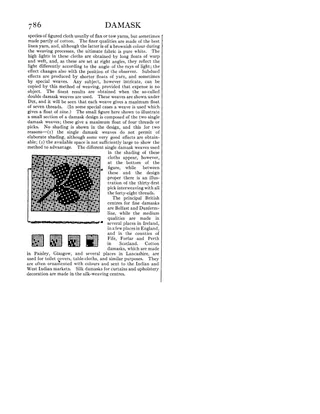
Encyclopedia Britannica (11th ed.) article on damask, covering the origin of the term in the figured silks of Damascus and its present meaning as richly patterned linen. It explains how damask figures are produced with long warp and weft floats, single and double damask weaves, and the maximum float lengths. It closes with the main British centres of manufacture (Belfast, Dunfermline, Scotland, Paisley, Lancashire) and uses of cotton and silk damasks. A small figure shows a damask design section and single damask weaves.
Damask
English Encyclopedia, 1867
Article · 1 page
A short encyclopedia entry on damask, a figured woven cloth of flax and silk thought to originate in Damascus. It covers linen damask for table linen, the shift of manufacture from Germany to Scotland and Ireland, the draw-loom and the many pattern changes it required, and the introduction of silk damask weaving to England by Flemish refugees in 1567. It also notes the later use of mixed-fiber damask for furnishing fabrics.
Damask
Article · 1 page
A short 1922 encyclopedia entry defining damask as a textile with satin, twill, or taffeta figures on a satin ground. It contrasts damask, a warp-manipulated weave made with a harness, with tapestry, a weft weave. It also covers materials (silk, wool, linen, cotton), upholstery silk damasks, linen table damasks, and the loose historical use of the term.
Damask
Rees's Cyclopedia, 1819
Article · 2 pages
A short encyclopedia entry on damask from Rees's Cyclopedia, defining it as a twill-based figured fabric with large patterns. It covers the possible Damascus origin of the name, the early silk damask of France and Italy, its probable introduction to Britain by Dutch and Flemish weavers, and its later decline in silk. It notes that British production had shifted to linen and cotton table linen centered on Dunfermline, and that the weaving uses five or eight leaves of front mounting plus a draw loom harness. It refers readers to the entries Design and Draw-book for the process.
Entwürfe für Damast-Tischzeug (Gebild-Gewebe) [Designs for Damask Table Linen (Figured Fabrics)]
Article · 3 pages · German · weaving drafts
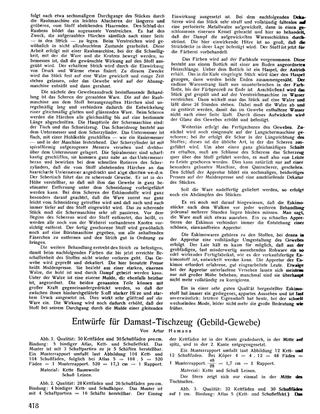
A short German-language piece from Melliand's Textilberichte by Artur Hamann presenting four designs for damask table linen (Gebild-Gewebe). For each design (Abb. 1-4) it gives thread counts per cm, the binding (5-end satin or 4-end twill), the number of shaft groups and shafts needed, pattern repeat calculations and materials (cotton warp with linen weft, or all linen). The scan also includes the end of G. Lehmann's article on the technique of figured weaving, covering a Schleicher damask jacquard attachment and a half-damask machine.
Shuttle-Craft Bulletin, Vol. XXXIII, No. 3 (March 1956)
Periodical · 23 pages · weaving drafts
March 1956 issue of the Shuttle Craft Guild Handweaver's Bulletin (Portfolio edition), devoted entirely to damask weaving on the handloom. It explains damask as a satin weave with opposed weft-face and warp-face blocks, using circle diagrams to derive satin sequences. It gives drafts and tie-ups for five-shaft satin, ten-shaft two-block damask, four-shaft broken twill, and eight-shaft false-damask, with notes on extending to three blocks. It also covers linen sizes and warp settings, weft variations (colors, heavier wefts, metallics), and a project for table mats and napkins, with a photograph of two woven damask samples.
Design in Linen Damask
Article · 4 pages
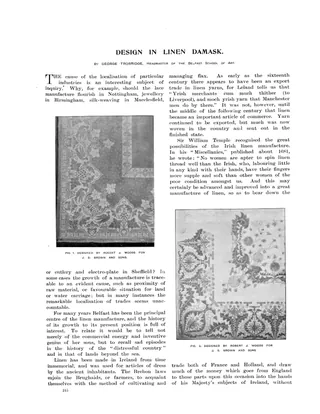
Article by George Trobridge, headmaster of the Belfast School of Art, on design for Irish linen damask. It sketches the history of the Irish linen industry and explains how damask is woven on the Jacquard loom, with pattern repeats controlled by punched cards. It then discusses the quality of commercial damask design and the efforts of the Belfast School of Art to improve it. Six black-and-white illustrations show damask designs by Robert J. Woods, Lewis F. Day, James Ward, Edwin A. Morrow and David Gould.
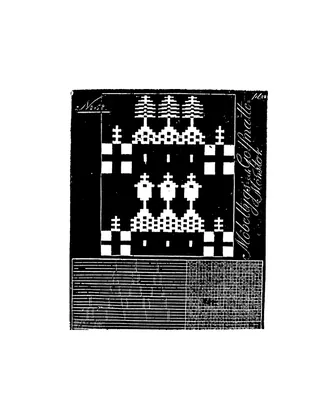
Mönster-Bok for Unga Fruntimmer [Pattern Book for Young Ladies]
Book · 95 pages · Swedish · weaving drafts
Facsimile reprint (Gidlunds, 1984) of Maria Christina Ekenmark's Swedish weaving pattern book, second edition, originally published in Linköping in 1827. It gives instructions and treadling orders for damask ("Dräll") and for figured and double fabrics, such as dress goods, waistcoat fabrics, shawls, borders and sleeping mats, with numbered patterns on plates (Planchen). It also gives practical advice on yarn starching, paste, warp and reed calculations, and the setup of looms with 20 to 30 shafts. The second half consists mainly of plates with damask drafts and pattern motifs. A preface by Jan von Gerber describes the Ekenmark family of weaving teachers.
Shuttle-Craft Bulletin, Vol. XXIX, No. 1 (January 1952)
Periodical · 19 pages · weaving drafts
January 1952 issue of the Shuttle Craft Guild's Handweaver's Bulletin (Portfolio Edition), the first issue of the revamped format. The main article covers damask woven in linen on 10 or more harnesses: block profiles, satin tie-ups, warp setting, mat and napkin dimensions, plus double damask, eight-harness false damask and a reverse twill alternative for four harnesses. Other items include a Goose Eye linen draft from Martha Colburn's Weaver's Guide series, an article on dressing the loom with an economical tie-in method, an announcement of the Portfolio Edition with fabric samples, a guild price list, a list of back issues, and a list of supply sources.
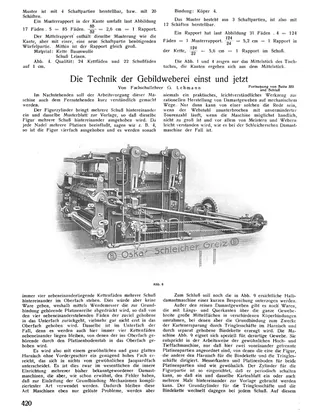
Die Technik der Gebildweberei einst und jetzt [The Technique of Figured Weaving Then and Now]
Article · 2 pages · German · weaving drafts
Concluding part of G. Lehmann's article on the technique of figured (damask) weaving, past and present. It describes how the Oskar Schleicher Greiz damask machine works, using a figure cylinder, turning knives and a plain harness to form the ground weave, and then a half-damask machine for fabrics with twill-bound borders and central fields. It opens with the end of a preceding passage on twill-bound tablecloth patterns, with repeat and shaft calculations. A second, unrelated article by M. Loescher on patterning pullover fabrics follows, covering ice, cock's-tread (houndstooth), windmill and waffle weaves, with small drawdown sketches.
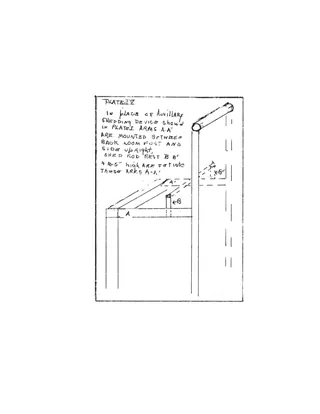
Damask on Four Harnesses
Monograph · 47 pages · weaving drafts
A 1958 monograph by Robert Fredric Heartz explaining how to weave damask-type figured cloth on a four-harness loom using split (long-eye) heddles and a shed-rod pick-up technique. It opens with a history of damask, the draw loom, the Jacquard and the Paisley shawl, then gives loom preparation, tie-up, pick-up methods, designing on squared paper, yarns and color. Numbered hand-drawn plates show loom modifications, tie-ups, and design motifs, including a Whig Rose adaptation, Summer and Winter, and cat tracks. It ends with notes on Paisley shawl production and an ad for a correspondence course in advanced handweaving.
Swatch Page - Satin Weave and Damask
Article · 2 pages · weaving drafts
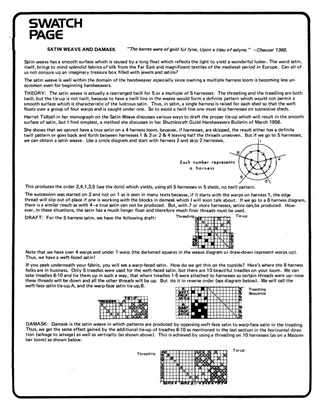
A swatch-page article from Minnesota Weaver explaining the satin weave and its extension to damask. It covers the theory of satin as a rearranged twill on 5 or more shafts, using a circle diagram to derive the 2,4,1,3,5 order, and gives drafts for weft-faced and warp-faced satin on 5 shafts. It then extends these to a 10-shaft block damask threading and tie-up. It also gives sett recommendations for linen, silk, cotton and wool, design variations, a glossary and references.
August, 1913
Article · 2 pages · weaving drafts
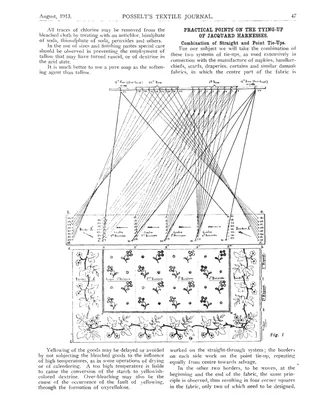
Two pages from the August 1913 issue of Posselt's Textile Journal (pp. 47-48) on tying up Jacquard harnesses. The article covers combining straight-through and point tie-ups for damask fabrics such as napkins, handkerchiefs and draperies, with worked needle and warp-end counts for 200 and 600 machines and diagrams of the tie-ups and fabric ground plans. A short note on waterproofing tulle with collodion, amyl acetate and gum-lac, and a few lines on removing chlorine and avoiding yellowing in bleached cloth, also appear.
Damask
Article · 1 page
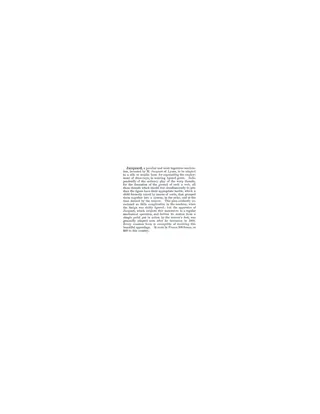
A short encyclopedia passage describing the Jacquard mechanism, invented by Jacquart of Lyons for silk or muslin looms to replace draw-boys in weaving figured goods. It explains how the device groups the warp threads that rise together to form the figure and is operated by a pedal. It also notes that it came into general use soon after its invention in 1800 and gives its cost in France and the United States.
Draw Loom 4
Master Weaver, November 1963
Article · 1 page · weaving drafts
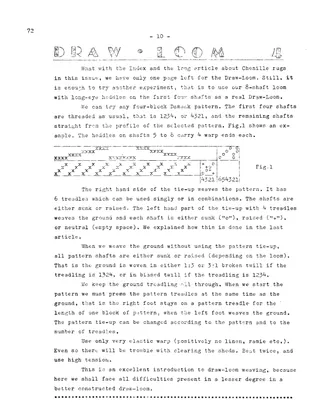
A one-page installment in the Master Weaver series on the draw loom, describing how to use an 8-shaft loom with long-eye heddles on the first four shafts as a simple draw loom for four-block damask patterns. It explains the threading, a split tie-up with 6 pattern treadles and 4 ground treadles, and the ground treadling in broken or biased twill. It ends with practical advice on warp elasticity, beating, and tension. A threading and tie-up diagram is included.
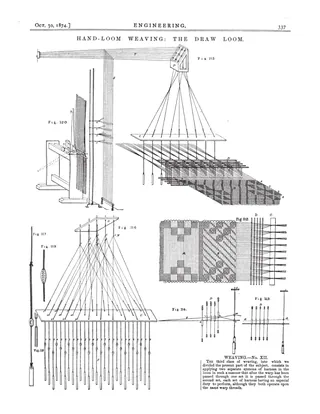
Weaving. -- No. XII: Hand Loom Weaving; The Draw Loom
Article · 2 pages · weaving drafts
Part XII of Alfred Barlow's series "Weaving" in Engineering, covering hand-loom damask weaving on the draw loom. It explains the two-harness system, in which a pattern harness forms the large outline and a ground harness works the detail intersections, here a five-leaf twill. It describes the leashes, comber board, pulley box, tail cords, simple cords, lingoes and mails, with a page of engineering diagrams (Figs. 112-120). It also gives a brief account of the origin of damask weaving and its supposed introduction to England in 1567.
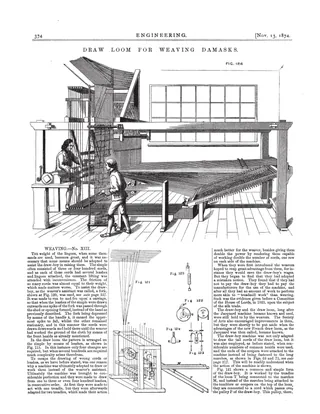
Weaving. -- No. XIII: Draw Loom for Damask Weaving
Article · 2 pages
Installment XIII of Alfred Barlow's 'Weaving' series, as printed in Engineering, covers the draw-boy and the draw loom used for damask weaving. It explains how the draw-boy's work of lifting the simple cords was assisted by a fork and later by a draw-boy machine with a pecker, ratchet wheel, and knotted cords worked from the treadles. It also describes a French eighteenth-century draw loom for figured velvet damasks with 400 pulleys and a bobbin frame, and compares it to the Jacquard. The text refers to Figs. 120-126, with an engraved view of the draw loom and mechanical diagrams.
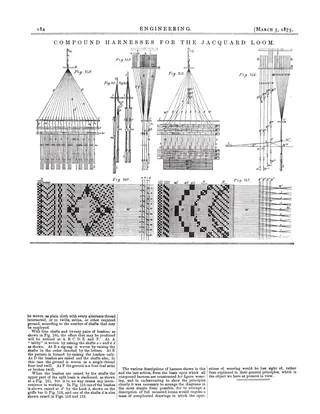
Weaving. -- No. XVIII: The Jacquard Loom -- Compound Harnesses
Article · 2 pages · weaving drafts
Installment XVIII of Alfred Barlow's 'Weaving' series in Engineering (5 March 1875), explaining compound harnesses for the Jacquard loom. It describes the damask harness, which uses headles combined with Jacquard hooks, and the Rooke 'shaft monture' and Gough split harness used for fine silks. Diagrams (Figs. 155-162) show harness cords, leashes, griffe bars and shafts, with small drawdown-style figures of tabby, zig-zag, twill and satin grounds.
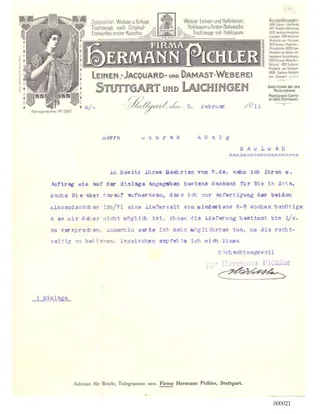
Billhead
Ephemera · 2 pages · German
A 1911 business letter on the printed letterhead of Hermann Pichler, a linen, jacquard and damask weaving firm in Stuttgart and Laichingen, sent to Conrad König in Saulgau. Pichler confirms an order and warns that two cushion covers (120/71) will need 6-8 weeks to make, so he cannot promise delivery by 1 April. The letterhead lists the firm's specialties (white and colored table linens made from designs by leading artists, linen and half-linen goods, hemstitched bedding) and its exhibition medals from 1866 to 1896.
Design in the Weaving Manufactures
Rees's Cyclopedia, 1819
Article · 3 pages · weaving drafts
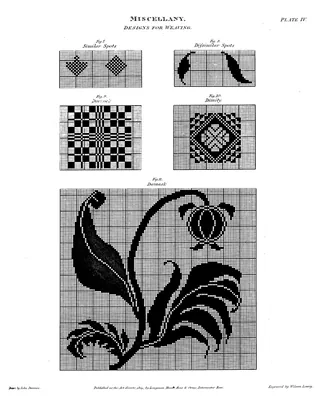
An encyclopedia article on 'design' in woven manufactures, explaining how ornamental patterns are drawn on ruled design paper and translated to the loom. It covers how squares represent warp and weft threads, how oblique and curved lines are approximated, and includes a table of angles of obliquity for 1 to 9 squares of warp and weft. A worked example calculates the size of a damask flower on cloth versus on paper. The last page is Plate IV, 'Designs for Weaving', showing grid designs for similar spots, dissimilar spots, dornock, dimity and damask.
Draw Loom 14
Master Weaver, September 1965
Article · 2 pages · weaving drafts
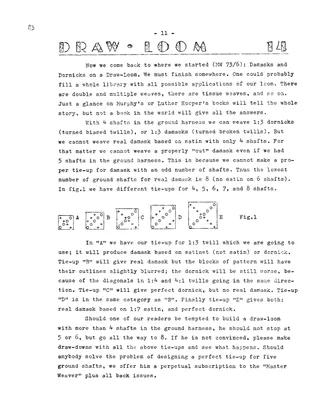
A two-page installment in the Master Weaver series on draw looms, concluding the discussion of damasks and dornicks. It explains why real satin-based damask needs eight ground shafts and compares tie-ups for 4 to 8 shafts (Fig. 1). It also gives draw-downs for dornick and damask on four ground shafts (Fig. 2). The closing remarks say a converted standard loom is only suitable for study and demonstration, and advise on the depth and harness spacing of a purpose-built draw loom.
Ornamental Design
Book · 171 pages
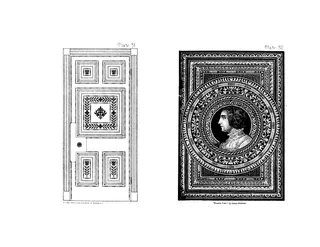
Three of Lewis F. Day's Text Books of Ornamental Design bound together: The Anatomy of Pattern, The Planning of Ornament, and The Application of Ornament. The books explain how repeating patterns are built on square, diamond, triangle, hexagon, circle and ogee plans, how drop repeats work for weavers and printers, how borders and panels are laid out, and how material, tool and process shape ornament. Roughly 130 full-page plates show diapers, damasks, Sicilian silk, tapestry, velvet, wall-paper, tile, stencil and carved examples. The text is general design theory and has no weaving drafts, though it often refers to the loom and to textile repeat.
Warp & Weft, Vol. 22, No. 8 (October 1969)
Warp & Weft, October 1969
Periodical · 8 pages · weaving drafts
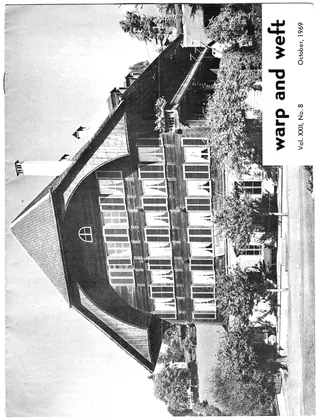
October 1969 issue of Warp & Weft, a monthly published by Robin & Russ Handweavers of McMinnville, Oregon. It includes an editor's column on a Pacific Northwest Handweavers Conference and a planned 1970 weaving tour of Switzerland and Ireland. A feature describes Sanger and Company, a Swiss hand-weaving shop making aprons, damask linen tablecloths, ticking and drapes, with some weaving done by families at home. The issue also gives a four-harness baby blanket project, "Bye Bye Baby Bunting", with threading, two tie-ups, a sleying plan, treadling, and a cost breakdown for wool worsted and pompadour yarns, followed by classified ads and marketplace ads for yarns, looms, and books.
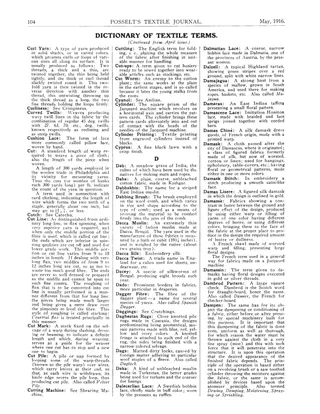
Dictionary of Textile Terms
Article · 2 pages
Two pages from the May 1916 installment of E. A. Posselt's serialized dictionary of textile terms in Posselt's Textile Journal, covering entries from Curl Yarn through Denim. Entries define fibers, yarns, fabrics, laces, tartans, rugs, finishing processes, loom and machine parts, and trade terms, with some on the denier system for silk and on cotton and wool grades.
Master Weaver, No. 83 (September-October 1965)
Periodical · 14 pages · weaving drafts
Issue No. 83 (September-October 1965) of Master Weaver, a bi-monthly bulletin for handweavers published by Z-Handicrafts in Fulford, Quebec. It contains a skeptical essay on textile sculpture, a short piece on when double beating is justified, a tutorial on weaving leno over a tabby ground in double weave on four shafts (with tie-ups and threading drafts), an article arguing for stronger-warped rag rugs, and a second installment on damask and dornick on a draw-loom with tie-ups for 4 to 8 ground shafts. The last page is an advertisement for Handweaver & Craftsman magazine.
Looming Arts, Vol. 6, No. 4 (July-August 1971)
Looming Arts, July-August 1971
Periodical · 9 pages · weaving drafts
July/August 1971 issue of The Looming Arts, a bimonthly handweaving newsletter edited by Mary Pendleton of Sedona, Arizona. It gives drafts and directions for a four-harness chenille warp-float stripe/plaid drapery fabric, a two-harness weft-float honeycomb, and an eight-harness 'Un-Damask' damask-threaded sample in heavy textured yarns. It also has a tip for improvising a second warp beam with a weighted beaming stick, a report on the 1971 Pendleton Fabric Craft School (Navajo and Hopi weaving classes), the 1972 school schedule and application form, conference dates, and advertisements for looms, yarns and supplies.
Shuttle-Craft Bulletin, Vol. XXXIII, No. 4 (April 1956)
Periodical · 19 pages · weaving drafts
April 1956 issue of the Shuttle Craft Guild Handweaver's Bulletin (Portfolio edition), written by Harriet Tidball, completing a three-month series on the Double Twill technique of the Unit Weave Class. It presents a Technique Variation Chart and index of double twill variations, four-harness double twills woven as weft stripes, Mary Atwater's four-harness false-damask pick-up method, double jeans twill, eight-harness double twill and false damask, an upholstery fabric in double twill, double twill on opposites, and double damask. Practical sections cover warping and beaming linen damask warps, selvages, and washing linens, followed by Threadbender notes on publications and courses.
Weaving on a Draw-Loom
Monograph · 40 pages · weaving drafts
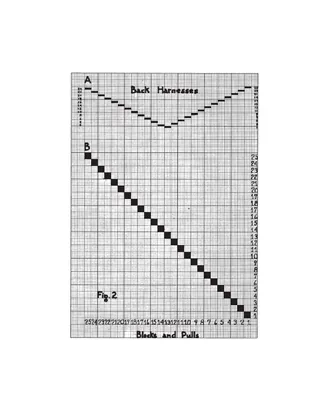
Instruction manual for weaving on the Purrington draw-loom, an eight-harness front loom combined with 25 back pattern (draw) harnesses, based on the Swedish "dragrustning" principle. Part I gives the text and explanation of diagrams, covering designing for the draw-loom, warping, threading, tie-up and weaving of four weaves: damask, spot weaves (Swedish lace, spot-bronson), summer and winter, and double weave. Part II contains the illustrative diagrams: harness and pull arrangements, threading drafts, tie-ups, shed diagrams, cross-sections and flat views of the cloth. It includes a foreword by the loom's maker, a preface, and a bibliography of English, Swedish and Finnish weaving books.
Allt för Fosterlandet [All for the Native Land]
Book · 47 pages · Swedish · weaving drafts
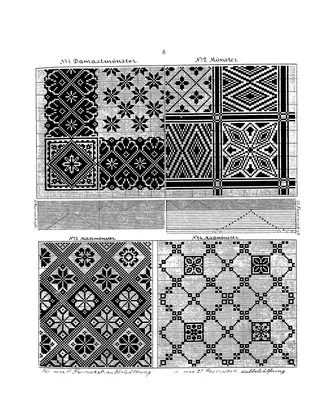
A Swedish-language manual on drawloom and damask-type pattern weaving, built around Lovisa Nylander's patented loom. It describes the loom and its parts (pattern shafts, draw board, treadles, beater with jerk mechanism), yarn, sizing and reeds, warping, threading, tie-ups and the draw sequence for figures. A large part is plates of damask and drawloom patterns with borders, rosettes and a Swedish coat of arms, plus drafts for twill, satin and double weave. Later sections cover shawls, felts, quilting, double cloth and rules for beginners.
154 documents found