Textile Documents › Topic: Brocade, inlay, and supplementary weft
317 documents found
Sort: 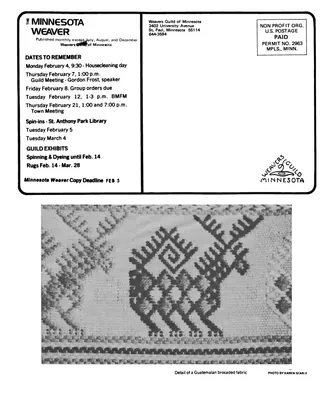
Detail of Guatemalan Brocaded (photo)
Minnesota Weaver, February 1980
Article · 1 page
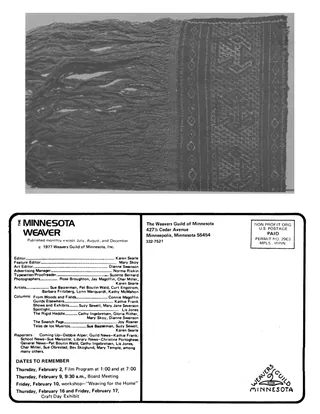
A single black-and-white photograph of a Guatemalan brocaded fabric, credited to Karen Searle, printed on the back cover of an issue of The Minnesota Weaver. The detail shows geometric brocade motifs in a diamond or stepped pattern. The page also carries the Weavers Guild of Minnesota's February calendar of meetings, exhibits and deadlines, along with mailing information.
Adaptation of Dukagang to a Modern Work Bag
Article · 2 pages
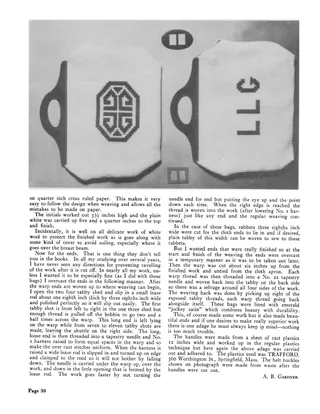
A.B. Gardner describes adapting the Scandinavian Dukagang technique, as presented by Elmer Wallace Hickman in an earlier issue of The Weaver, to make a white wool work bag with an octagonal green medallion and initials. She explains her departures from Hickman's method: weaving right side up with a bobbin bin clamped to the cloth beam, weaving in pattern ends instead of knotting them, and carrying the pattern to the selvedges. She also covers warp and yarn choices, a twill threading, overcast and woven-back finishing of the ends, and plastic handles. A photograph shows the finished handles and belt buckles.
Afghans in Dukagang Effect
Article · 2 pages · weaving drafts
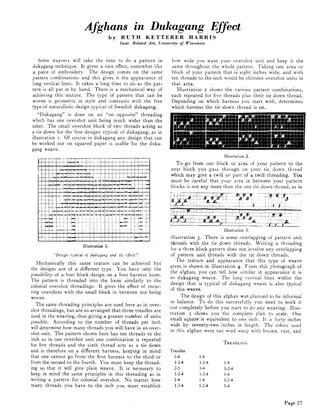
A 1938 Weaver article by Ruth Ketterer Harris explaining how to weave afghans with a texture resembling dukagang, using an overshot-type threading on four harnesses with a tie-down thread after each overshot unit. It covers the threading principles, pattern combinations, treadling with three treadles at once, and the plain-weave tabby system. It also describes a 40 by 72 inch afghan in tan wool with brown, rust and green pattern wefts, with threading drafts, treadling and layout diagrams.
Handweaving News (April 1936): Simple "Laid-In" Weaving
Periodical · 3 pages
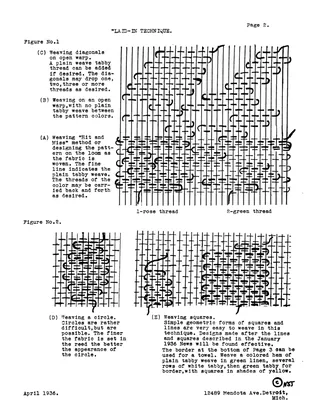
A short 1936 instructional piece by Nellie S. Johnson on simple laid-in (supplementary weft) decoration woven on a plain weave ground. It explains the hit-and-miss method step by step, with suggested yarns and sett for towels, luncheon sets, rugs and a table runner. Diagrams show hit-and-miss, open-warp, diagonal, circle and square inlay, and a sheet of simple border designs (trees, diagonals, squares) for towels.
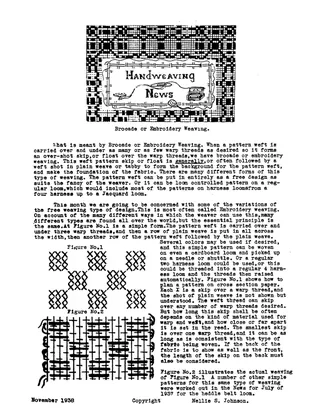
Handweaving News (November 1938): Brocade or Embroidery Weaving
Periodical · 3 pages · weaving drafts
A three-page article from the November 1938 Handweaving News by Nellie S. Johnson on brocade or embroidery weaving, in which a pattern weft floats over the warp between plain-weave tabby shots. It covers free-design techniques including a simple over-three skip, Swedish (Dukagang), Russian and Coptic embroidery weaves. It gives 4-harness twill threading and tie-up drafts, cross-section paper plans, and suggestions for warp and weft materials and sett.
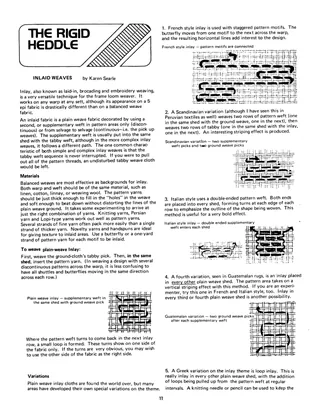
The Rigid Heddle - Inlaid Weaves
Article · 2 pages
A two-page article from Minnesota Weaver on inlay (laid-in, brocading) techniques for the rigid heddle loom and other frame looms. It explains inlay as a supplementary weft worked on a plain weave ground, recommends materials and yarns, and describes plain weave inlay plus French, Scandinavian, Italian, Guatemalan and Greek loop variations, each illustrated with small diagrams. It also covers charting designs on graph paper, making cartoons, and ends with a short reference list.
Brocade
Article · 1 page
A brief encyclopedia entry defining brocade as a silk fabric with figures formed by raised warp or filling threads. It notes the long history of brocade manufacture in Oriental countries and in Europe since the thirteenth century, and mentions the early use of gold and silver threads.

Brocade
Zell's Encyclopedia, 1876
Article · 1 page
A short encyclopedia entry defining brocade as a stout silk fabric variegated with gold and silver and enriched with foliage, flowers and other ornaments. It notes use in dress during the 17th and 18th centuries, quotes prices from an inventory of Charles II's wardrobe, and says brocade reached England only after the 13th century. It includes a brief etymology.
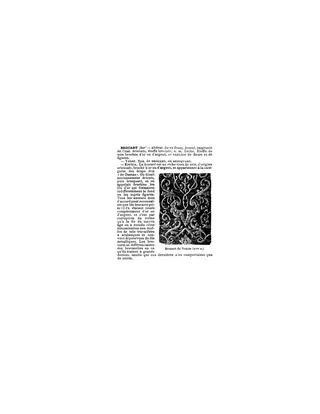
Brocart [Brocade]
Article · 1 page · French
A one-page French dictionary entry on brocade (brocart) from the Nouveau Larousse Illustré. It gives the word's etymology and defines brocade as a silk fabric brocaded with gold or silver, and it also notes the hunting-term sense. The encyclopedic note covers the Oriental origin, the early all-gold and silver weaving, and how the term later broadened to figured silks. It also distinguishes brocade (large patterns) from brocatelle (small patterns). An illustration shows a 16th-century Venetian brocade.
Broché or Brocade
Klara Cherepov · 1970s
Monograph · 30 pages · weaving drafts
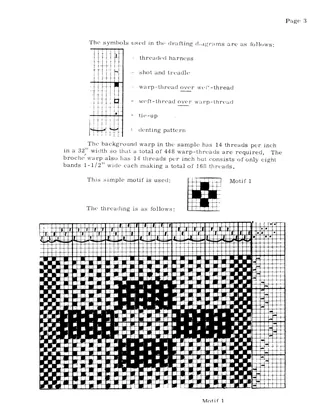
A study of broché (brocade) weaving by Klara Cherepov of the Handweaving Studio, Greenwich, Connecticut. It defines broché as a loom-controlled technique in which warp or weft threads are brought to the surface in spots over a tabby ground, then explains planning and treadling for warp broché on 4, 6 and 8 harnesses and for weft broché on 4, 6 and 8 harnesses. It ends with combined warp and weft broché on 16 harnesses. Thirty numbered motifs are given as drafts with threading, tie-up and treadling.
Clasped Wefts (or Skyscrapers)
Master Weaver, June 1952
Article · 3 pages
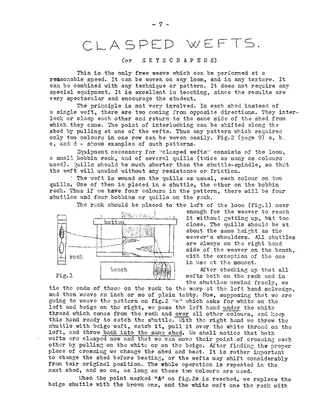
A short instructional article describing the clasped weft technique (also called skyscrapers), a free weaving method in which two wefts enter each shed from opposite sides and interlock, with the meeting point shifted by pulling either weft. It covers the equipment (a bobbin rack and extra quills), how to set up and weave, color changes, vertical lines and ground areas, yarn choice, and methods for using three colors in a shed. A page of six diagrams (a-f) shows sample patterns.
Handweaving News (August 1947): Weaving on the "Hearthside" Loom; Some Laid-In Technique
Periodical · 2 pages · weaving drafts
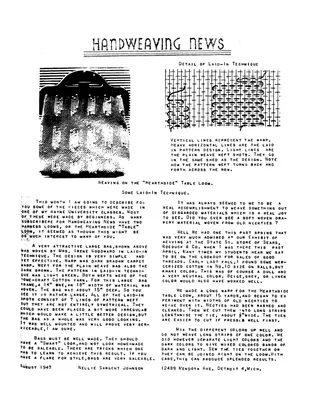
A two-page August 1947 issue of Handweaving News in which Nellie Sargent Johnson describes laid-in pieces woven by her Wayne University students on the Hearthside table loom and other two-harness looms. It covers a large laid-in bag, a drapery fabric woven from strips of old neckties, and a runner with blue-green laid-in areas and red accent lines, with a diagram of the laid-in technique and a draft of the runner. It also carries news on a lesson with loaned samples, the six-harness folding floor loom, and guild exhibits in Victoria and Detroit.
Handweaving News (February 1945): Peruvian Brocades from My Own Collection
Periodical · 3 pages · weaving drafts
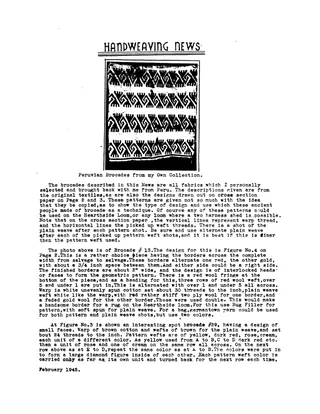
A three-page issue of Handweaving News in which Nellie S. Johnson describes Peruvian brocades she collected in Peru. She gives details of warp and weft fibers, thread counts, colors and motifs (interlocked heads, small faces, birds, fish), with pattern-weft drafts on cross-section paper for several pieces. She suggests adapting the designs as borders on a two-harness loom such as the Hearthside loom, with plain weave shots between pattern shots.
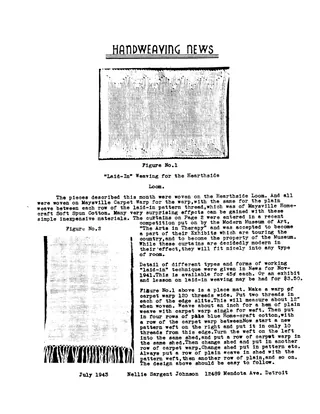
Handweaving News (July 1943): "Laid-In" Weaving for the Hearthside
Periodical · 2 pages · weaving drafts
A two-page article from Handweaving News by Nellie Sargent Johnson giving instructions for laid-in weaving on the Hearthside Loom, a slit-and-hole heddle loom. It describes a place mat, a runner with lengthwise stripes and small laid-in figures, and a curtain, with warp counts, materials (Maysville carpet warp and Homecraft Soft Spun cotton) and threading notes. A cross-section-paper pattern chart for the curtain is included.
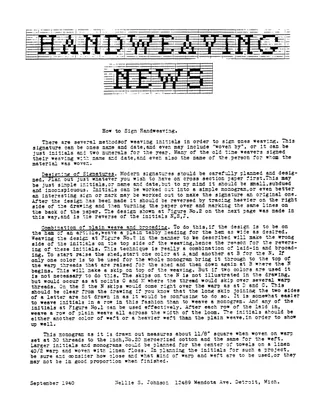
Handweaving News (September 1940): How to Sign Handweaving
Periodical · 3 pages · weaving drafts
A short 1940 article by Nellie S. Johnson on how to weave a signature, such as initials, a monogram, or a name and date, into handwoven cloth. It explains planning and reversing a design on cross-section paper, then gives instructions for combining plain weave with laid-in brocading, simple brocading, embroidery weave (dukagang), and Spanish weave. Figures include an alphabet chart and grid plans for initials.
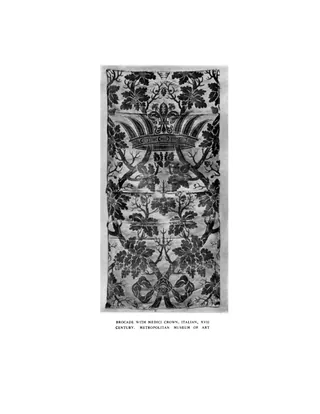
Interesting Brocade
Article · 3 pages
A short article from the Bulletin of the Needle and Bobbin Club about a 17th-century Italian silk brocade in the Metropolitan Museum of Art. The pattern is an ogival framework of green silk oak leaves and metal-thread acorns on a white satin ground, with a crown and a bow knot alternating at the finials. The author identifies the crown as the Medici grand-ducal crown and reads the oak leaves as the badge of the della Rovere family. This points to the 1634 marriage of Ferdinand II de' Medici and Vittoria della Rovere, or to the later enlargement of the Pitti Palace, as the occasion for the fabric.
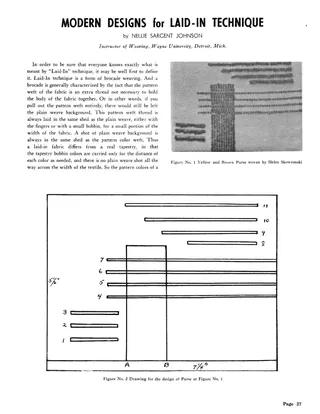
Modern Designs for Laid-In Technique
Article · 3 pages
Article by Nellie Sargent Johnson, a weaving instructor at Wayne University, defining laid-in technique as a form of brocade weaving. The pattern weft lies in the same shed as a plain weave ground shot. She distinguishes it from tapestry and from the loosely used term "finger-weaving." It gives working instructions for a yellow and brown envelope purse woven on an 8-inch Structo loom with a twill threading, including warp, weft, dimensions and making up. It also describes two linen runner borders designed by students, with charts of the border designs.
Moorman Inlay Technique for Rigid Heddle Frame Looms
Monograph · 7 pages
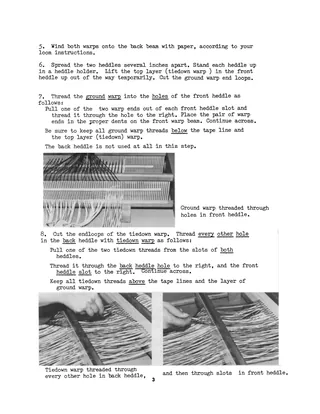
A short instruction booklet by Karen Searle adapting Theo Moorman's inlay technique to rigid heddle frame looms, published by Dos Tejedoras in St. Paul, Minnesota. It explains how to dress the loom with separate ground and tiedown warps using two heddles and masking-tape guides, and sets out the sheds for the ground tabby and the two inlay sheds. A sampler section covers sparse and dense inlay, overlapping motifs, a solid tapestry effect, and variations such as changing the tiedown ratio or spacing the warp. It is illustrated with photographs of the threading steps and woven samples.
Pick-up or Brocade Weaving on a Simple Heddle Loom
Article · 3 pages · weaving drafts
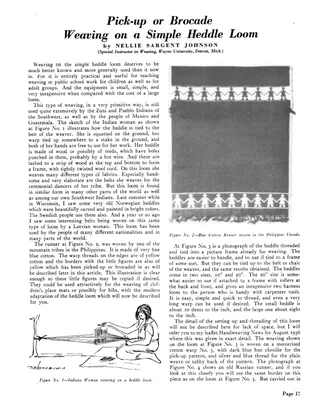
Article by Nellie Sargent Johnson on pick-up (brocade) weaving using a simple heddle loom, a small portable loom similar to those used by Southwest Indians, Mexicans and Guatemalans. It describes the heddle sizes, a runner from the Philippines, and an old Russian runner whose border pattern is charted. It gives step-by-step pick-up directions for a small white silk evening bag, plus a chart of further border patterns and a second, larger blue bag. Photographs, a sketch and charts illustrate the loom, the runners and the finished bags.
Something Different in Two Harness Weaving
Article · 2 pages · weaving drafts
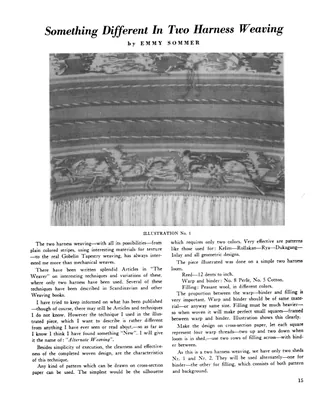
Emmy Sommer describes "Alternate Weaving," a two-harness technique she believes is new, in which one shed carries a binder weft and the other carries heavier pattern and background filling, producing small framed squares. She gives loom setup, materials (No. 8 Perle and No. 5 cotton warp and binder, peasant wool filling, 12-dent reed), and step-by-step instructions for a border and the start of a pattern worked from cross-section paper charts. Illustrations show the finished piece and a charted border with color key.
Woven Fabric, US Patent No. 522555
Patent · 5 pages · weaving drafts
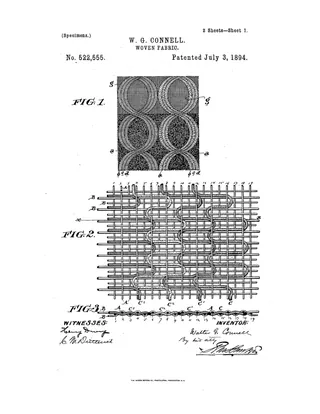
US Patent No. 522,555, granted July 3, 1894 to Walter Glen Connell of Philadelphia, for a woven fabric. Pattern and color are made by additional sectional filling threads that travel laterally within the sheds and are bound in by the warp, over a body of ordinary warp and weft. The patent has two sheets of drawings (a fabric swatch, an enlarged weave diagram, a cross-section and a diagram of thread manipulation), a specification and seven claims. A companion loom patent (Serial No. 452,264) is mentioned.
Brocade
Rees's Cyclopedia, 1819
Article · 2 pages
An encyclopedia entry on brocade from Rees's Cyclopedia (1819). It defines brocade as cloth of gold, silver or silk enriched with flowers and figures, and describes how gilt wire is spun onto silk thread, including Milanese, Nuremberg and Chinese gilt-paper variants. It also covers the Venetian damasquete and Vaucanson's heated-roll machine at Lyons for extending the gilding, then gives advice on cleaning rich brocades with spirit of wine. A short note on the brocade-shell in conchology closes the entry.
Christmas Card Weaving
Article · 4 pages · weaving drafts
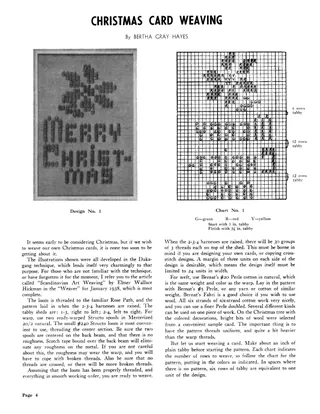
An article from The Weaver explaining how to weave small Christmas and birthday cards in the Dukagang technique on a Rose Path threading, using a small Structo loom with fine cotton warp. It gives warp and weft materials, shed sequences, step-by-step instructions for laying in the pattern, and tips on beating, finishing and hemstitching. Six designs with color charts are included, plus advice on designing your own cards and mounting the finished weaving in photo folders.
Garden Studio Quarterly, Vol. 2, No. 2 (April 1934)
Garden Studio Quarterly, April 1934
Periodical · 9 pages · weaving drafts
An April 1934 issue of a small weaving-service quarterly from the Garden Studio in Brookline, Massachusetts, giving project instructions with drafts. It includes curtain tie-backs woven in Swedish embroidery weave from six charted border designs, a woven hand bag with a change purse and fastening strap (with threading, materials, and making-up directions), and a tweed coat or suit fabric adapted from Caroline Halvorsen's Haandbog i Vaevning, with an 8-treadle tie-up.
Handweaving News (May 1945): Modern Peruvian Weft Brocaded Belts
Periodical · 2 pages · weaving drafts
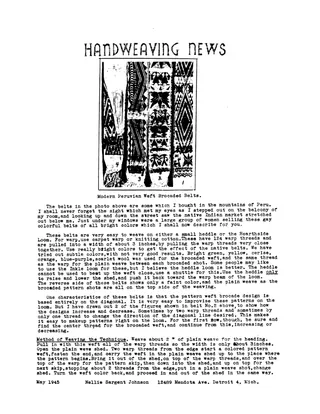
A two-page article from Handweaving News in which Nellie Sargent Johnson describes modern weft-brocaded belts bought in the Peruvian mountains. She gives instructions for weaving them on a heddle (rigid heddle) loom or Hearthside Loom with carpet warp or knitting cotton and bright wool brocade wefts, based on diagonal patterns. The second page covers warp pattern belts, the difference between this skip brocade and regular brocade, and a drawdown grid of the skip pattern from belt No. 2.
Handweaving News (November 1944): Some Variations of Laid-In Technique
Periodical · 3 pages · weaving drafts
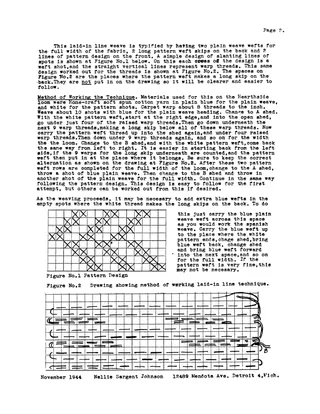
A November 1944 Handweaving News article by Nellie Sargent Johnson on variations of laid-in technique. It distinguishes laid-in from tapestry, then gives instructions for "laid-in lines" (derived from Peruvian textiles) worked on a Hearthside loom in blue and white cotton with carpet warp. It also describes wrapped laid-in using cut rag strips for rugs and place mats, and a method of laying short strips in the shed to make raised outlines. Four figures illustrate the pattern design, the structure, the wrapped weft and the strip layout.
Handweaving News (September 1943): Double Brocaded Ancient Peruvian Textile
Periodical · 3 pages · weaving drafts
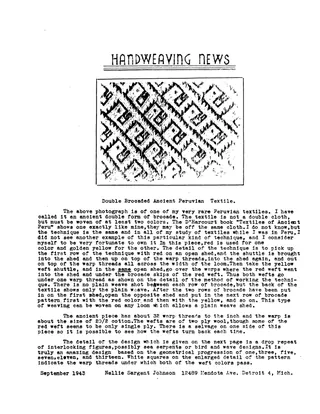
Nellie Sargent Johnson describes an ancient Peruvian textile from her own collection, woven in a double form of brocade with two weft colors (red and golden yellow) on a plain weave ground. She explains how to work the technique with a pick-up stick, how to chart the pattern on cross-section paper, and gives the thread counts and materials of the ancient piece. The article includes an enlarged technique diagram, a pattern chart taken from the textile, and a modern upholstery fabric woven by one of her Wayne University students using the technique.
Interesting Ways to Use Laid-in Technique
Article · 5 pages · weaving drafts
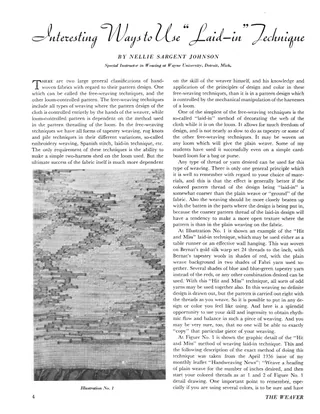
Article by Nellie Sargent Johnson on the free-weaving laid-in technique, in which colored pattern threads are laid into a plain weave ground on any loom that makes a two-harness shed. It describes the 'Hit and Miss' method and a method for weaving definite squares, with step-by-step instructions, and gives materials, warp settings and examples such as table runners, a luncheon set, a wall panel with a tulip design, a bag and a towel border. It also presents designs built from the square as a unit and urges weavers to create their own designs. The scan also includes a Questions and Answers column by Mary M. Atwater on weft-faced and warp-faced weaving.
Practical Weaving Suggestions, Vol. XXVII (1954): Two Dresses with Danish Suggestions
Periodical · 4 pages · weaving drafts
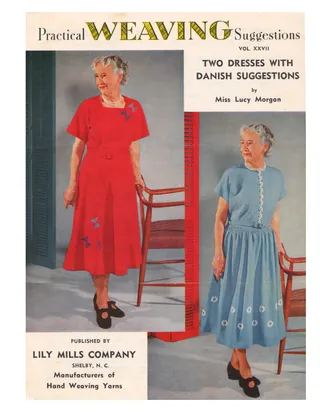
An issue of Lily Mills' Practical Weaving Suggestions in which Lucy Morgan, director of Penland School of Handicrafts, describes weaving two plain-weave cotton dresses inspired by Danish designer Cis Fink's costumes. She gives yarn specifications, reed and treadle setup, and step-by-step directions for laying in butterfly and wreath motifs with floss and novelty yarn. Two charts show the unit-by-unit laying-in of each motif, and a back-page note lists the Lily yarns used.
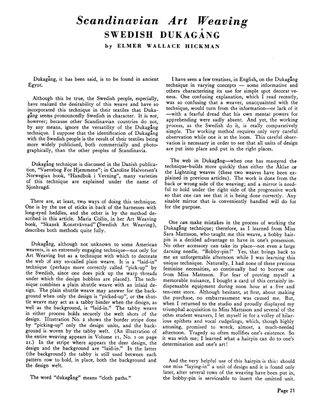
Scandinavian Art Weaving, Swedish Dukagång
Article · 9 pages · weaving drafts
Instructional article by Elmer Wallace Hickman on Swedish dukagång, a laid-in (pick-up) technique worked from the back of a plain-weave web with design bobbins and tabby binder shots. It covers materials, reed and warp setup, bobbin winding and handling, the shed sequence on a four-harness table or floor loom, and 18 numbered troubleshooting tips. A worked example gives a color-by-color row sequence, and the article includes working-side sketches, photographs of experimental pieces, and charted Scandinavian border, pillow-top and spot motifs, with rosepath and twill threading drafts.
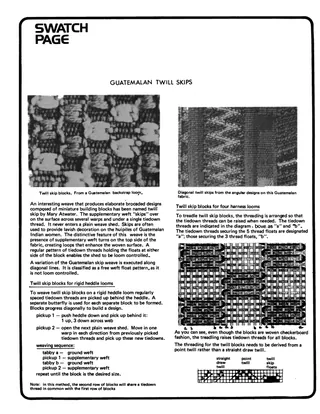
Swatch Page - Guatemalan Twill Skips
Article · 2 pages · weaving drafts
A two-page Swatch Page from Minnesota Weaver explaining twill skip, a supplementary-weft brocade technique used on Guatemalan huipiles and named by Mary Atwater. It gives instructions for weaving twill skip blocks on rigid heddle, four-harness and six-harness looms, with threading, tie-up and weaving sequences. It also covers diagonal skip weave motifs, which are picked up by hand and not loom controlled.
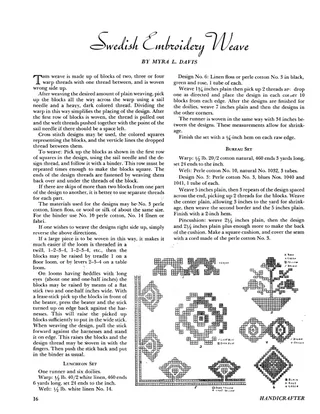
Swedish Embroidery Weave
Article · 1 page · weaving drafts
A one-page instruction sheet on Swedish embroidery weave, a plain-weave technique in which blocks of two to four warp threads are picked up with a sail needle and a design thread, then followed by a binder. It explains how to place cross-stitch-style designs, which materials to use, and how to raise blocks on a twill-threaded loom or with a wide flat stick. Project directions are given for a luncheon set and a bureau set with pincushion, along with six block design charts.
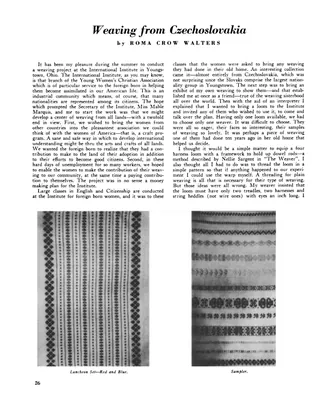
Weaving from Czechoslovakia
Article · 3 pages · weaving drafts
First-person account by Roma Crow Walters of a summer 1938 weaving project at the International Institute (YWCA) in Youngstown, Ohio, where Slovak immigrant women wove traditional Czechoslovak patterns. She describes setting up a two-harness, two-treadle loom with long string heddles to the weaver's specifications, the white cotton ground with red and blue pattern thread, and the four-thread unit of the overshot-type patterns. The article explains the pattern-stick and pattern-board method used to pick up the patterns, and illustrates a luncheon set, sampler, shirt front and table cover.
Brocade
Article · 3 pages
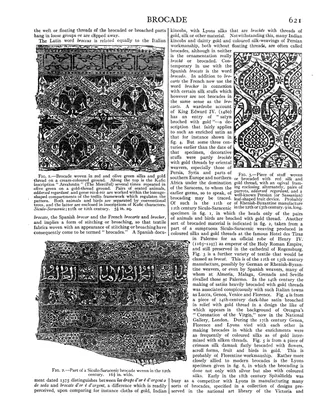
Encyclopedia Britannica (11th ed.) entry defining brocade as a decorative shuttle-woven fabric with ornament added in supplementary weft, often in coloured silks and gold or silver thread. It covers the etymology of the word, the Saracen and Siculo-Saracenic origins, Italian, French and English (Spitalfields) production from the 14th to 18th centuries, and early Chinese brocading. Six photographs of fragments illustrate the types discussed, and no weaving drafts are given.
Brocade
Encyclopaedia Perthensis, 1803
Article · 3 pages
A three-page encyclopedia entry on brocade, covering the definition of the word and how its meaning broadened from cloth woven wholly of gold or silver to any figured silk. It describes how gilt wire is spun onto silk thread, the Chinese use of gilt paper, and the Venetian domusquete brocade. It also gives Vaucanson's rolling machine for flattening the gilding at Lyons, and a method of cleaning tarnished brocades with spirit of wine.
Brocade
Oxford Encyclopedia, 1828
Article · 2 pages
Two-page encyclopedia entry on brocade as a commercial fabric of gold, silver, or silk enriched with flowers and ornaments. It explains how the meaning of the word broadened over time and how gilt wire is spun onto yellow silk thread. It also describes Vaucanson's rolling machinery for flattening the gilding, made for the Lyons manufacture, and ends with advice on cleaning brocades with spirits of wine.
Brocades or Embroideries? Seventeen Textiles from Pachacamac, Peru
Article · 26 pages
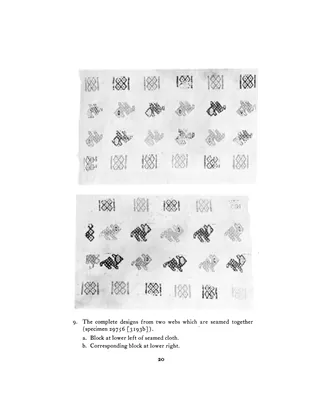
Study of seventeen wool-on-cotton patterned textiles from the temple site of Pachacamac, Peru, collected by Max Uhle and held by the University Museum, University of Pennsylvania. The author examines whether each piece is brocade (woven supplementary yarns) or embroidery (sewn), finding two clear brocades, three clear embroideries, and the rest a mixture or indeterminate. It describes the design types (reversed diagonal bands, diapered repeats, simple repeats, rectangular block figures), colors, yarn spin and diameters, and construction details. A table of yarn data and many photographs and motif drawings are included, and the author argues for finding looms with unfinished cloth to resolve the classification.
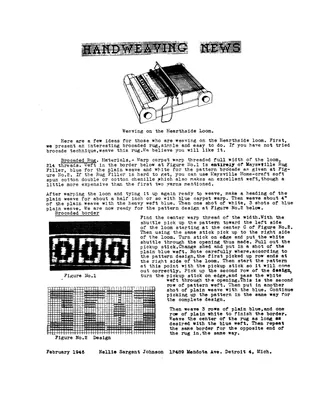
Handweaving News (February 1946): Weaving on the Hearthside Loom
Periodical · 2 pages · weaving drafts
A two-page issue of Handweaving News (February 1946) by Nellie Sargent Johnson of Detroit, with project ideas for the Hearthside loom. It gives instructions for a brocaded rug with a pick-up border in blue and white, a belt woven with black leather lacing, and place mats woven with wheat straw or raffia. It closes with an announcement of the formation of the Detroit Handweaver's Guild and its membership terms.
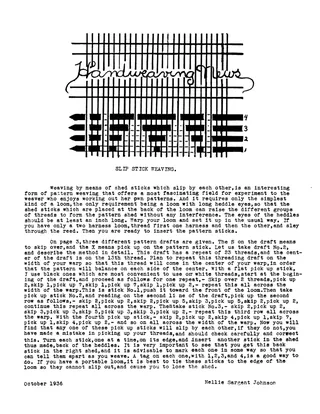
Handweaving News (October 1936): Slip Stick Weaving
Periodical · 3 pages · weaving drafts
A three-page instruction sheet by Nellie Sargent Johnson on slip stick weaving, a pick-up method of pattern weaving that uses shed sticks which slip past one another behind the heddles. It explains how to read her S/X draft notation, how to pick up and tag the sticks, and how to weave borders with pattern and plain weft shots in overshot fashion. It also gives suggestions for color, fine linen settings, and substitute heddle rods for looms with short heddle eyes. Page 3 has three threading drafts with drawings of the woven effects.
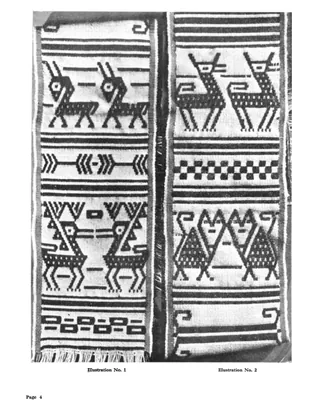
A Primitive Weave
Article · 7 pages · weaving drafts
Mary Atwater describes a warp-face pick-up technique inspired by ancient Peruvian girdles with stylized animal figures, adapted for modern four-harness looms using three harnesses. She gives warp plans, yarns, sleying, treadling and pick-up stick instructions for a Peruvian piece and a Mexican piece, with figure charts and photographs of finished work. She suggests uses such as bags, runners, pillow tops and wall panels, and notes the fabric is decorative rather than hard-wearing.
Shuttle-Craft Bulletin, Vol. XXXII, No. 12 (December 1955)
Periodical · 14 pages · weaving drafts
December 1955 issue of the Shuttle Craft Guild Handweaver's Bulletin (Portfolio Edition), edited by Harriet Tidball. It gives directions for weaving narrow Christmas tapestry panels in 5-block bound weaving on a 83-thread cotton warp, with five- and four-harness drafts (the latter using a heddle-stick), tie-ups, and charts for motifs such as Santa Claus, dolls, bells, angels, sheep, reindeer, trees and wreaths. Other articles cover weaving metallic lame fabric with 1/64 metallic weft on 24/2 cotton and making woven snack napkin sets in book-style cases, followed by the editor's Threadbender letter.
Spotting with Extra filling or Warp for Harness and Jacquard
Article · 5 pages · weaving drafts
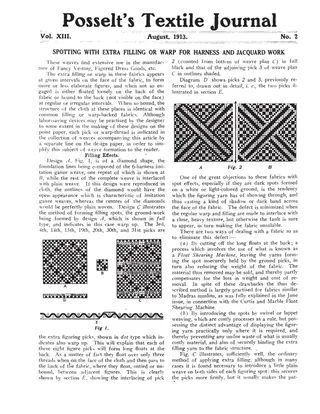
An article from Posselt's Textile Journal on spotting with extra filling or warp for harness and Jacquard fabrics such as fancy vestings and figured dress goods. It explains how extra figuring picks form spots on the face and float or are stitched at the back, and covers the shadowing defect, float shearing, swivel and lappet alternatives, and modified ground weaves. Weave plans, sections and photographs of woven cloth are included, along with a Jacquard card-stamping and yarn layout for a worsted, spun silk and mercerized cotton vesting. The scan also ends with the start of a separate article on fancy honeycomb weaves (check, checkerboard, diamond effects).
Suggestions for Design
Article · 4 pages
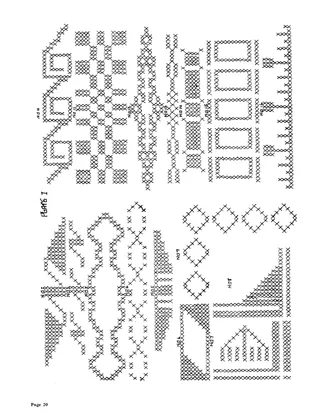
A 1940 Weaver article by Clara M. Youse offering ready-made counted-grid motifs for hand-manipulated weft techniques on the loom. The text explains how to use the motifs from Plates 1 and 2 for luncheon sets, towels, curtains, bath mats and monograms, and gives formulas for the Woven Sheaf Stitch, Spanish stitch, French embroidery weave and Dukagang. Three plates of X-marked grid motifs and an alphabet follow, and the Dukagang formula includes a Rosengang threading.
Telas de los Muertos - Supplementary Weft Techniques
Article · 4 pages
An article in the Telas de los Muertos series on supplementary weft patterning in ancient Peruvian textiles from the Science Museum of Minnesota collection. It explains how supplementary wefts differ from embroidery and describes the main structures with diagrams: brick alignments with short and long floats, paired floats, rib, free weft float patterning, and columns (Dukagang). It also covers the materials (cotton ground, cameloid wool supplementary wefts), thread counts, and design motifs, with photographs of five museum fragments.
Tissue Weaves - Broché
Master Weaver, September 1961
Article · 4 pages · weaving drafts
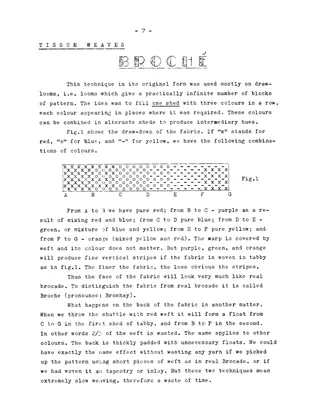
An article from the Master Weaver series on tissue weaves, explaining Broché, a technique for imitating brocade on multi-shaft looms by laying several colours of weft in a single shed. It covers colour mixing from adjacent pure colours, the wasted floats on the back, tabby and twill grounds (1:2, 1:3, 3:1), and tie-ups and treadlings for 8-shaft drafts with profile drafts. It also discusses locked wefts as in Full Swivel to increase the number of blocks, and ends with a practical upholstery project with warp, sett and colour details.
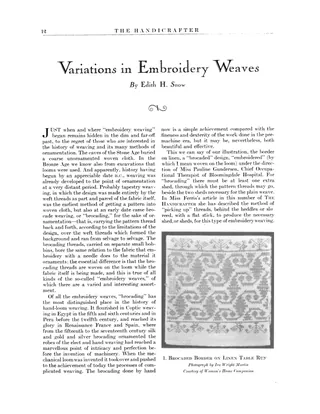
Variations in Embroidery Weaves
Article · 4 pages
Article by Edith H. Snow surveying hand-loom embroidery weaves, which add pattern threads during weaving. It covers brocading, Scandinavian stick weaving (with a Peruvian bird motif in blue wool on linen), and the Greek method used on silk robes shown by Eva Palmer Sikelianos. Instructions describe threading and tie-up on a four-harness loom (1-2-3-4 threading, four pedals), how pattern threads are carried over and under warp threads, and how to chart designs on squared paper. It closes by introducing the laid-in pattern, to be treated in a later article.
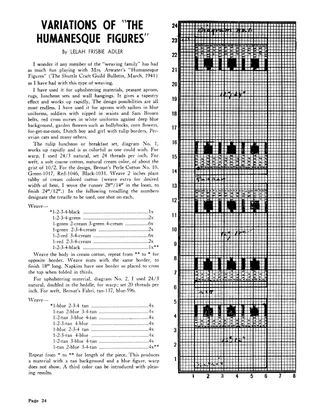
Variations of the Humanesque Figures
Article · 2 pages · weaving drafts
Lelah Frisbie Adler describes her variations on Mary Atwater's "Humanesque Figures" weaving technique, a tapestry-effect weave worked on four treadles with pattern wefts. She gives warp setts, yarns, colors and treadling sequences for a tulip luncheon set, a tan and blue upholstery fabric, and a Flame Bargello simulation. The pages include draft and diagram grids. The scan also includes a Questions and Answers column by Mary M. Atwater on weaving and finishing a plain tabby suit fabric from hard-twisted "fabri" yarn.
Weaver's Quarterly, Vol. 1, No. 1 (January 1935)
Weaver's Quarterly, January 1935
Periodical · 9 pages · weaving drafts
First issue (January 1935) of The Weaver's Quarterly, edited by Kate Van Cleve and Myra L. Davis. It includes charts of six cross-stitch style designs for embroidery weaving and an article on the laid-in weave, with diagrams and suggestions for using the designs on luncheon sets, runners and curtains. It also gives drafts and instructions for a linen luncheon set (40/2 linen, 12-dent reed) and a narrow runner adapted from a John Landes coverlet design in the Pennsylvania Art Museum, with threading, sleying and treadling notes.
Weaver's Quarterly, Vol. 2, No. 2 (April 1936)
Weaver's Quarterly, April 1936
Periodical · 10 pages · weaving drafts
April 1936 issue of The Weaver's Quarterly (Vol. 2, No. 2) by Kate Van Cleve and Myra L. Davis, giving project instructions with drafts. It includes a chair back with Swedish Embroidery weave and a deer and tree motif, plus charts of related designs for French Tapestry and laid-in weave. It also gives a wall hanging adapted from the Rebecca Hewitt coverlet (Pomfret, Vermont, c. 1800), with warp color plan, treadling and drafts, and a cushion cover with a couch cover variation, drafted from an 1847 coverlet. Materials, sett and yarn amounts are specified for each project.
Weaver's Quarterly, Vol. 2, No. 4 (October 1936)
Weaver's Quarterly, October 1936
Periodical · 9 pages · weaving drafts
October 1936 issue of The Weaver's Quarterly by Kate Van Cleve and Myra L. Davis, with instructions for small woven projects. It includes a laid-in neck scarf with charted motifs, a zipper purse, and notes on cigarette cases, an under arm purse with gusset, and utility cases that reuse the same threading. Two drafts are taken from early Pennsylvania patterns (John Landis book and the Speck Collection, 1723, Pennsylvania Art Museum). Yarn, warp and sett recommendations are given, mostly Bernat's yarns, along with upholstery and luncheon set suggestions.
317 documents found