Textile Documents › Topic: Rayon and synthetic fibers
217 documents found
Sort: 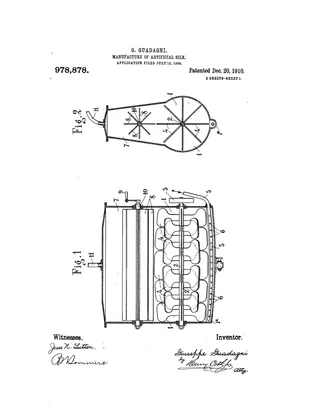
Manufacture of Artificial Silk, US Patent No. 978878
Patent · 5 pages
US Patent No. 978,878, granted Dec. 20, 1910 to Giuseppe Guadagni of Pavia, Italy, for a process of making artificial silk from cellulose. Cellulose is dissolved in a cupro-ammonium solution with excess copper hydrate, aided by compressed air. The solution is forced through capillary tubes into an acid coagulant bath of sulfuric and hydrochloric acids, and the filament is wound on bobbins and washed. It includes two sheets of drawings of the dissolving vessel, filament-forming device and winding apparatus, plus the specification and two claims.
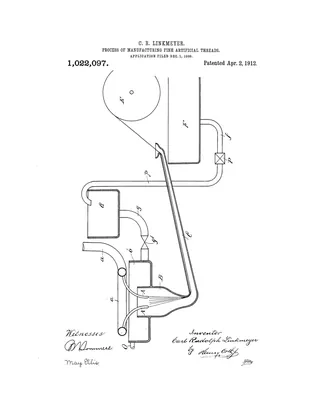
Process of Manufacturing Fine Artificial Threads, US Patent No. 1022097
Patent · 3 pages
US Patent No. 1,022,097, granted April 2, 1912 to Carl Rudolph Linkmeyer of Bremen, Germany, for a process of making fine artificial threads (rayon) from cupro-ammonium cellulose solutions. The process draws a very viscous solution into fine filaments and coagulates them fully in a single precipitating bath, so the threads can be spooled at once. The patent describes the apparatus (glass tube spinnerets, funnel-shaped vessel, inclined tube, pump and tanks), gives example solution and bath compositions, and lists three claims. It includes one drawing sheet.
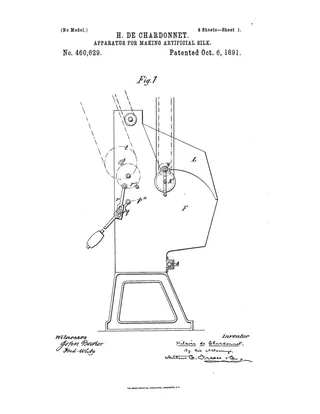
Apparatus for Making Artificial Silk, US Patent No. 460629
Patent · 11 pages
US Patent No. 460,629, granted October 6, 1891 to Hilaire de Chardonnet of Besançon, France, for improvements in a machine that spins collodion (nitrated cellulose) into artificial silk filaments. Six sheets of drawings (Figs. 1-14) show the frame, spinning dies, nippers, bobbins and reeling mechanism, followed by a specification and 13 claims. The text describes the collodion solution, die and valve design, water-cooled coagulation, bobbin winding, and recovery of ether and alcohol solvents with potash and sulphuric acid. It builds on his earlier US patents on artificial silk.
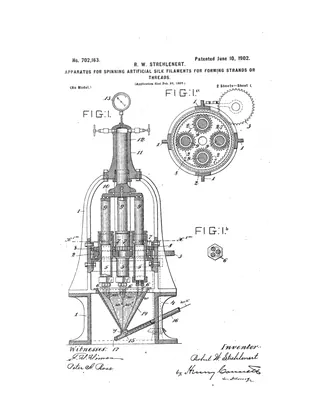
Apparatus for Spinning Artificial Silk Filaments for Forming Strands or Threads, US Patent No. 702163
Patent · 5 pages
US Patent No. 702,163, granted June 10, 1902 to Robert Wilhelm Strehlenert of Stockholm, for an apparatus that spins artificial silk filaments into strands or threads. Revolving and rotating mouthpieces dip into a liquid reservoir so the filaments twist together as they form, and a broken filament is caught and twisted in without stopping the machine. The patent describes batch and continuous versions plus a horizontal variant, and ends with six claims. It includes two sheets of drawings (Figs. 1, 1a, 1b, 2 and 3).
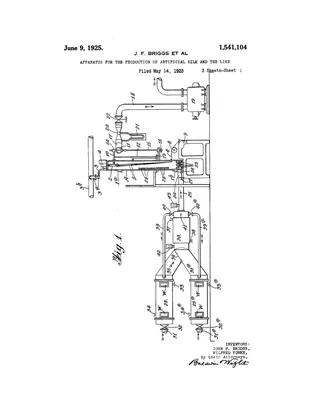
Apparatus for the Production of Artificial Silk and the Like, US Patent No. 1541104
Patent · 10 pages
US Patent 1,541,104, granted June 9, 1925 to John Frederick Briggs and Wilfred Yorke of Spondon, near Derby, England, assignors to the American Cellulose and Chemical Manufacturing Company. It describes dry (evaporative) spinning apparatus for artificial silk made from cellulose acetate and other cellulose derivatives. The apparatus is divided into spinning cells, each with its own outlet pipe, flow meter (water gauge) and regulating valve for the vapour-laden air, plus independent temperature control and air dehumidifying and preheating equipment. The patent has three sheets of drawings (Figs. 1-5), a specification and 13 claims.
Cotton, Artificial
Article · 1 page
A very short encyclopedia entry defining artificial cotton as filaments made by chemically treating wood pulp or other cellulose so they can be woven into textiles. It notes that these filaments are also called artificial silk or wood-pulp yarns and refers readers to the entry on wood-pulp yarns.
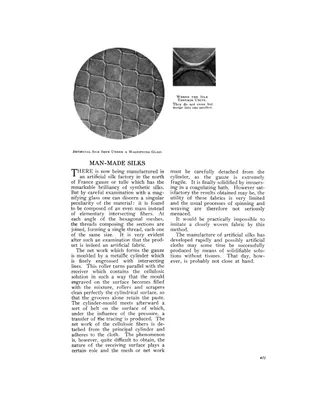
Man-Made Silks
Technical World, April 1911
Article · 1 page
A short 1911 magazine article describing an artificial silk gauze or tulle made in a factory in northern France. It explains how a cellulose solution is moulded in an engraved metal cylinder, transferred to a belt or cloth, and set in a coagulating bath to form a hexagonal net. The author notes that the product is fragile and of limited use, so conventional spinning and weaving are not threatened. Two micrographs show the mesh and the thread junctions.
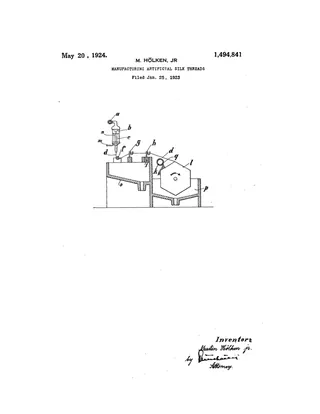
Manufacturing Artificial Silk Threads, US Patent No. 1494841
Patent · 5 pages
US patent 1,494,841, granted May 20, 1924 to Martin Hölken Jr. of Barmen, Germany, for an improved stretch-spinning process for making artificial silk (rayon) threads from copper oxide-ammonia cellulose solutions. The invention lengthens the air path between the precipitating bath and the hardening liquid, so most stretching happens in open air, and applies the hardening liquid to thread wound on a large reel. The specification explains the prior method, describes the apparatus shown in the drawing, and ends with three claims.
Method of and Means for Manufacturing Artificial Silk, US Patent No. 01641588.pdf
Patent · 8 pages
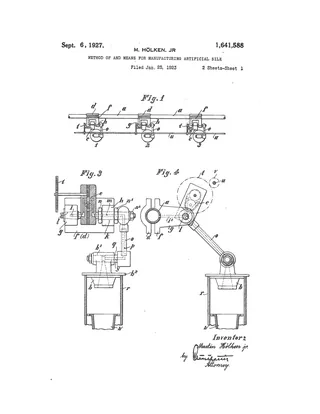
US Patent No. 1,641,588, granted Sept. 6, 1927 to Martin Hölken Jr. of Barmen, Germany, for a method and apparatus for stretch-spinning artificial silk (cuprammonium rayon). Each spinneret is fed by its own rotary gear pump instead of directly from a common pressurized supply pipe, so that thread fineness stays uniform across all spinning heads. The text describes the apparatus, with two sheets of drawings, the operation, and seven claims covering the method and the pump, pivot and articulated-arm assemblies.
Process and Apparatus for Spinning Artificial Silk, US Patent No. 1596086
Patent · 3 pages
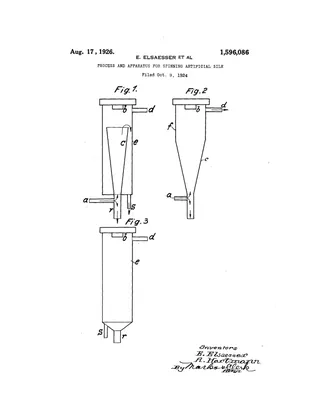
US Patent 1,596,086, granted 17 August 1926 to Emil Elsaesser and August Hartmann of Barmen-Langerfeld, Germany, and assigned to American Bemberg Corporation. It describes a stretch-spinning process and apparatus for artificial silk (rayon). The precipitating liquid flows against the fibre while it is partly hardened, then flows in the same direction as the fibre. Three apparatus designs are shown in drawings: a cylindrical jacket with an internal cone, a conical vessel without a jacket, and a cylinder with a short conical base. The text includes five claims.
Synthetic Yarns
Master Weaver, July 1957
Article · 3 pages
An article from Master Weaver (No. 34, July 1957) that sorts weaving yarns into natural, processed, synthetic and mixed fibers. It explains why synthetic yarns exist and then reviews the properties of rayon types, nylon, Vinyon, Saran, Orlon, Terylene, Perlon, polythene and glass fiber from a handweaver's viewpoint. The scan opens with the end of a piece on texture effects in pattern weaving and closes with the start of an article on velvet rugs.
Apparatus for Making Threads, US Patent No. 1202766
Patent · 3 pages
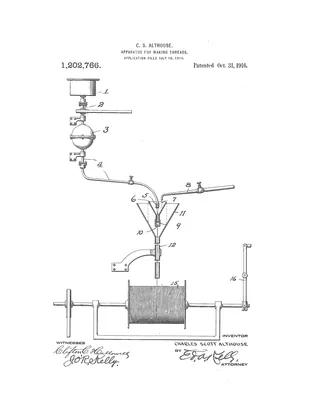
US Patent No. 1,202,766, granted 31 October 1916 to Charles Scott Althouse of Reading, Pennsylvania, for an apparatus that makes threads from cellulose solution (artificial silk or rayon type filaments). It describes a centrifugal separator that cleans the solution without changing the pressure at the spinning nozzle. It also describes a two-funnel system in which a setting liquid draws the thread to the desired fineness before it reaches the winding reel. The patent has a drawing sheet, a specification and four claims.
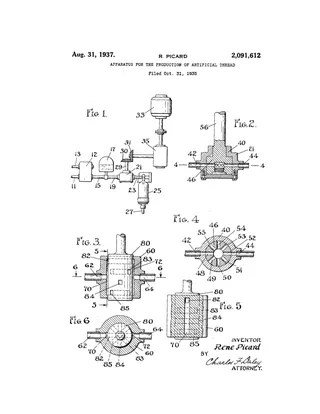
Apparatus for the Production of Artificial Thread, US Patent No. 2091612
Patent · 3 pages
US Patent 2,091,612, granted 31 August 1937 to René Picard of Vaulx en Velin, France, and assigned to E. I. du Pont de Nemours & Company. It describes a rotating-plug regulating valve placed in the pipeline between the pump and spinning nozzle of a viscose or similar artificial-thread spinning machine. The valve intermittently interrupts the flow of spinning solution, producing filaments of uneven denier with nubs or sharp thick-thin variations that imitate materials such as pongee silk. The document includes a drawing sheet (Figs. 1-6), the specification and a single claim.
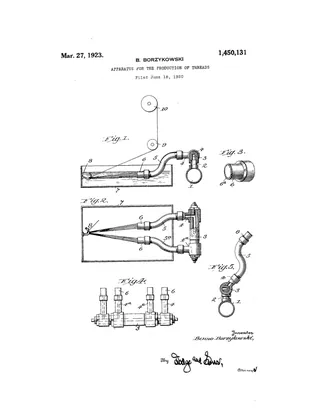
Apparatus for the Production of Threads, US Patent No. 1450131
Patent · 3 pages
US Patent 1,450,131, granted 27 March 1923 to Benno Borzykowski of Paris, for an apparatus that spins artificial (viscose) threads. Several fine nozzles are submerged in a setting bath and their filaments are united into one bundle, which is drawn off by a driven cylinder and stretched onto a take-up spool. The patent claims finer threads (5 deniers and below) and replaces a separate doubling frame. It includes five drawing figures, a specification and four claims.
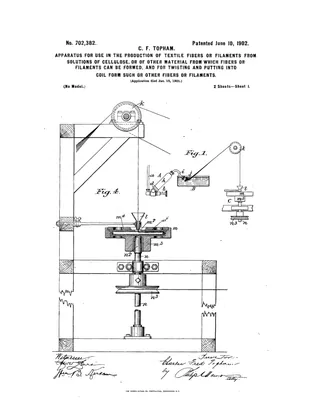
Apparatus for Use in the Production of Textile Fibers or Filaments from Solutions of Cellulose, or of Other Material from which Fibers or Filaments Can Be Formed, and for Twisting and Putting into Coil Form Such or Other Fibers or Filaments, US Patent No. 702382
Patent · 4 pages
US Patent No. 702,382, granted June 10, 1902 to Charles Fred Topham of Kew, England (assignor to James Yate Johnson), for an apparatus that forms artificial fibers or filaments by forcing cellulose solution through fine nozzles into a setting bath. It also covers a device that twists the filaments and coils them by centrifugal force in a rapidly rotating box. The patent has two sheets of drawings and a specification with seven claims describing the filter plug, air-space nozzle tube, and coiling box.
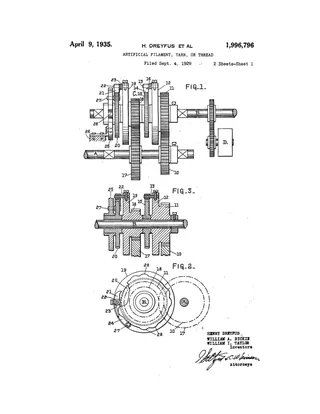
Artificial Filament, Yarn, or Thread, US Patent No. 1996796
Patent · 5 pages
US Patent 1,996,796, granted 9 April 1935 to Henry Dreyfus, William A. Dickie and William I. Taylor, assignors to Celanese Corporation of America. It describes making artificial filaments, yarns or threads with a regular, systematic variation in denier by varying the output of the spinning pump, using a pawl-and-ratchet drive with cam control or a multi-cylinder cam-driven pump. The text notes use of the resulting yarns in weaving, knitting, braiding and lace-making, and the effects when dyed. It includes two sheets of apparatus drawings and two claims.
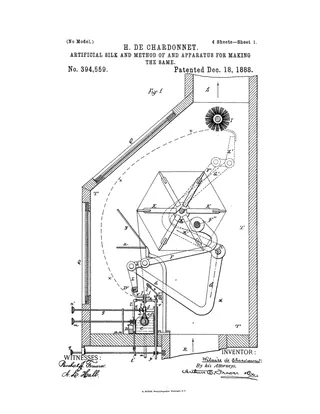
Artificial Silk and Method of and Apparatus for Making the Same, US Patent No. 394559
Patent · 9 pages
United States Patent No. 394,559, granted December 18, 1888 to Hilaire de Chardonnet of Besançon, France, for artificial silk and a method and apparatus for making it. The specification describes making filaments from a collodion (pyroxyline) solution in ether and alcohol. The solution is forced through fine nozzles into cold water, and the filaments are drawn onto a reel and dried with warm air in an enclosed casing. Four sheets of drawings show the spinning apparatus, and the document ends with 25 claims covering the textile material, the method, the composition and the machine parts.
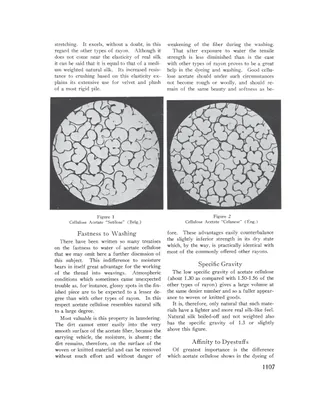
Comparative Studies on Cellulose Acetate, Part 1
Article · 8 pages
First part of a two-part article by consulting chemist H. Stadlinger comparing cellulose acetate rayon ('acetate silk') from several European makers. It first defends acetate against common criticisms (ironing, alkalies, strength) and lists its advantages: smoothness, luster, elasticity, water resistance, low specific gravity, dye affinity and sanitary properties. It then reports laboratory tests on samples from Belgian, British, French, German and Dutch producers, with tables of denier, twist, breaking strength, elasticity, gloss, fluorescence, dyeing, boiling behavior, acetic acid content, viscosity and oil coating, plus micrographs of fiber cross-sections.
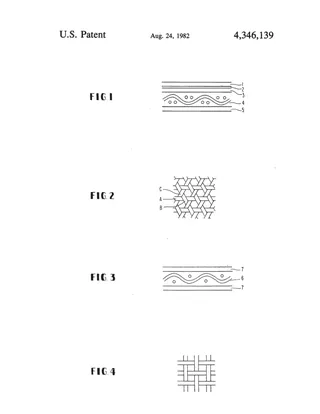
Highly Weather-Proof High Strength Tri-Axial Woven Membrane Materials, US Patent No. 4346139
Patent · 9 pages
US Patent 4,346,139, granted 24 August 1982 to Osawa, Nishimura and Toyooka of Sumitomo Electric Industries, for a weather-proof, high-strength membrane material for radomes. The membrane is a layered laminate: polyvinyl fluoride film, adhesive, sprayed urethane, a triaxially woven polyaramide (Kevlar-type) fabric with axes at 60 degrees, and a second sprayed urethane layer. The triaxial weave is claimed to resist creasing on triangular frames and to keep radio-wave permeability. The scan includes a web-database printout and the original patent pages with four figures, 13 claims and a description.
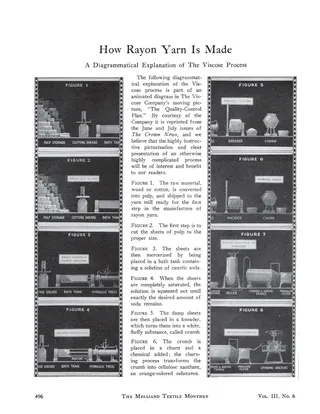
How Rayon is Made
The Melliand, September 1931
Article · 2 pages
A two-page illustrated explanation of the viscose process for making rayon yarn, reprinted from The Crown News and drawn from The Viscose Company's film "The Quality-Control Plan." Sixteen numbered diagram frames with captions follow the process from wood or cotton pulp through caustic soda steeping, kneading into crumb, xanthation, ageing and filtering of the viscose solution, spinning through a spinnerette into an acid bath, then reeling, washing, bleaching, centrifugal extraction, drying, inspection and packing.
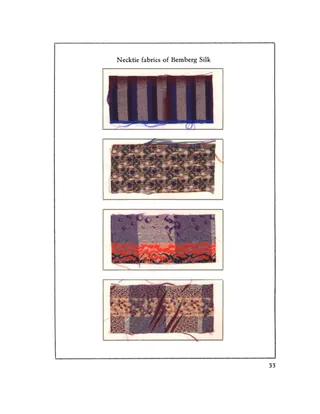
Necktie Fabrics of Bemberg Silk
The Melliand (specimen), 1929
Article · 1 page
A single-page specimen from The Melliand showing four mounted swatches of woven necktie fabric made with Bemberg silk (cuprammonium rayon). The swatches include vertical stripes and small-scale geometric patterns. The page carries only a heading and the samples, with no explanatory text or weaving drafts.
Silk, Artificial
Article · 1 page
Encyclopedia article on artificial silk (rayon) as understood around 1922. It describes the three main manufacturing processes: Chardonnet nitrocellulose, cuprammonium (Glanzstoff), and viscose. It also covers the fibre's properties and uses, early inventors, and 1912 world production figures, and ends with a short list of references.
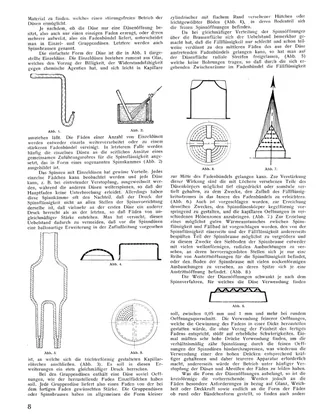
Spinndüsen für die Kunstseidenspinnerei [Spinnerets for Rayon Spinning]
Article · 3 pages · German
A 1927 German-language technical article by Robert Glafey on spinnerets (Spinndüsen) used in rayon (artificial silk) spinning. It distinguishes single nozzles from group nozzles (spinning showers), describes designs meant to improve coagulation and heat exchange, orifice sizes and shapes, and the materials used (glass, platinum, nickel, porcelain, gemstones). It also covers how orifices are made and how nozzle plates are mounted in nozzle heads, with twelve figures; the text ends with "to be continued".
Artificial Silk
Science, 1889
Article · 2 pages
A 1889 article in Science, reporting from the Paris Exposition, on Comte de Chardonnet's process for making artificial silk from cellulose. It explains how natural silk is formed, then describes nitrating paper pulp, dissolving it as collodion, forcing it through capillary tubes, and denitrating the filament. It describes the three demonstration machines, compares cost and strength with natural silk, and mentions fabrics and a chasuble made from the product.
Artificial Silk in the Form of Loose Fibers
Article · 3 pages
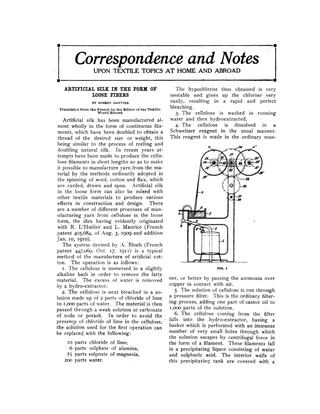
A 1913 article, translated from the French, on making artificial silk (rayon) as short loose fibers rather than continuous filaments, so it can be carded and spun like wool, cotton or flax or blended with other fibers. It describes several patented processes: Bloch's cuprammonium (Schweitzer reagent) method, Girard's winding of viscose filaments on bobbins and cutting them into staple, Girard and Buffard's metal-plate spinnerets, and Cahen's collodion-based filaments formed without pressure. Line drawings show the machinery and spinneret details. The scan ends with a short unrelated note on depression in the Scotch tweed industry.
China Builds Her Own Chemical Fibre Industry
Article · 2 pages
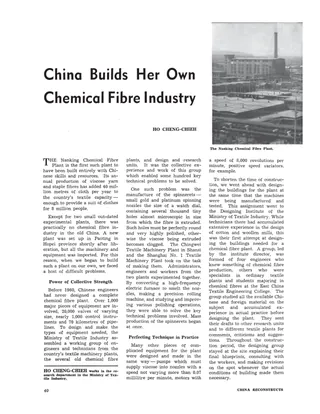
A 1965 article describing how China built the Nanking Chemical Fibre Plant, the first chemical fibre plant designed and built entirely with Chinese skills and resources. It covers the design and manufacture of equipment such as spinnerets and pumps, construction of acid-resistant buildings, staff training, and the plant's output of viscose yarn and staple fibre. It presents the project as an example of industrialization through self-reliance.
China's New Chemical Fibre Industry
China Pictorial, 1965
Article · 2 pages
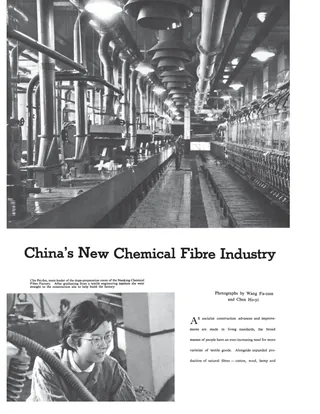
A two-page photo article from China Pictorial (1965) on China's new chemical fibre industry, centered on the Nanking Chemical Fibre Factory. Photographs show the dope-preparation room, a staple fibre spinning room, installation of a filament spinning machine, and a drying machine for wool-type viscose fibre. The short text says viscose fibre factories began production that year using domestic materials, supplying the textile industry with raw material for rayons and viscose staple blends.
Comparative Studies on Cellulose Acetate
Article · 7 pages
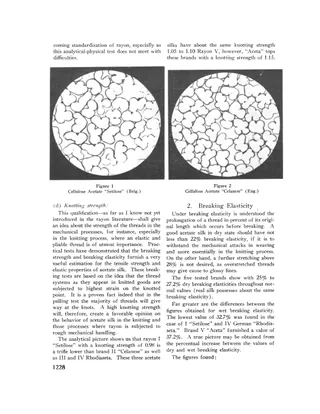
Concluding part of H. Stadlinger's laboratory comparison of five commercial cellulose acetate rayons (Setilose, Celanese, French and German Rhodiaseta, and Aceta). It reports tests of dry, wet, boiled and knotting tensile strength, breaking elasticity, titer, sorting defects, gloss, color, ultraviolet fluorescence, dyeing with Cellit fast dyes, acetic acid content, viscosity and oil content. Micrographs of fiber cross-sections illustrate how ribbon-shaped filaments gave way to multi-lobed round forms and how this affects gloss. The article ends with eleven numbered conclusions on suitability for knitting, weaving and dyeing.
Gewebe und Effekte mit Acetatseide [Fabrics and Effects with Acetate Rayon]
Article · 3 pages · German
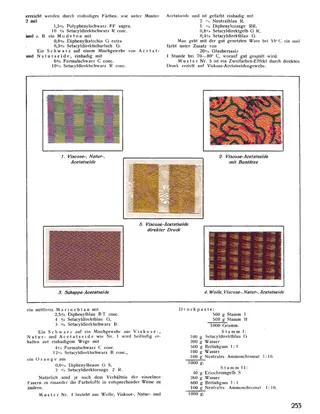
A 1927 German-language trade article on dyeing and printing acetate rayon (Acetatseide, e.g. Celanese) and its use for effect threads in mixed fabrics. It explains why acetate resists traditional dyes, describes direct acetate dyes, and gives dye recipes and print pastes for five sample fabrics combining viscose, natural silk, schappe and wool. The scan also includes two short pieces on vat (Indanthren) dyeing of schappe effect threads and on dyeing acetate rayon, the latter breaking off after its introduction.
Machinery and Appliances
Textile Mercury, 1890
Article · 2 pages
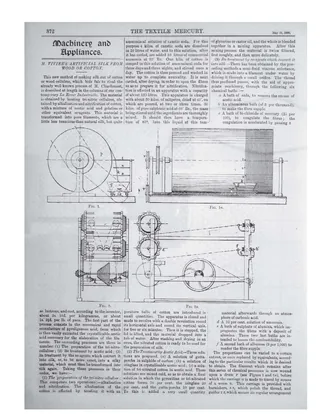
Two pages from The Textile Mercury, 31 May 1890, mainly describing M. Vivier's process for making artificial silk from cotton or wood cellulose, with machinery drawings of the drum and carriage that winds the filament. The process covers nitrating cotton, treating it with acetic acid, gelatine and gutta-percha, and passing the filament through six chemical baths. Page 2 adds short notes on finishing cotton cloths (mangles, beetling, calender finishes), re-hardening of softened waters, and free acid in alumina sulphate.
Rayon Necktie Fabrics
Article · 2 pages
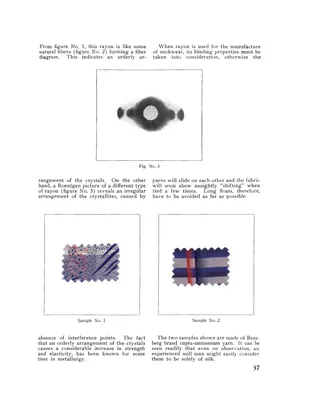
A short 1929 trade article on the use of rayon in necktie fabrics. It explains that cuprammonium rayon has improved enough in strength, elasticity and fineness to be used as warp as well as filling, and compares its filament diameter and denier with weighted silk. It discusses the molecular structure shown by X-ray diffraction patterns, the need to avoid long floats so yarns do not shift, and two sample fabrics woven from Bemberg cupra-ammonium yarn.
Rayon Staple Fiber and Manufacture of Spun Rayon Yarns
Article · 4 pages
Introductory article by D. L. Pellatt, the first in a planned series of five, on rayon staple fiber, which is rayon cut or made in cotton- or wool-like lengths and then spun into yarn. It compares rayon with cotton and wool for clothing and furnishing fabrics, covering luster, warmth and cleanliness. It briefly surveys the nitrocellulose, acetate, cuprammonium and viscose processes, explaining why viscose dominates staple production, and discusses cellulose raw materials such as wood pulp and cotton linters. It concludes that cotton spinning machinery, with minor changes, suits spun rayon yarns.
Rayon Staple Fiber and Manufacture of Spun Rayon Yarns; Article II. Producing Staple Fiber
Article · 7 pages
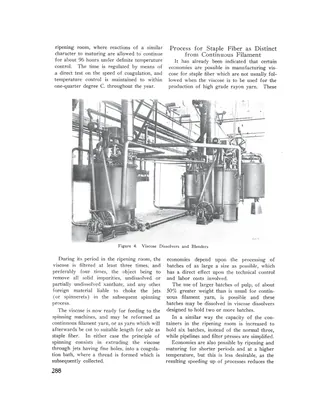
Second article in D. L. Pellatt's series on rayon staple fiber, from The Melliand, May 1930. It reviews the position of spun rayon in Lancashire and Yorkshire, where it is mixed with cotton or wool, and explains why staple fiber can be made more cheaply than continuous filament yarn. It then describes the viscose process step by step: wood cellulose, alkali cellulose, xanthation in churns, dissolving, blending and ripening. Five photographs of factory equipment illustrate the stages.
Recent Developments in the Textile Industries
Engineering Weekly, October 26, 1900
Article · 1 page
A one-page report in Engineering (26 Oct 1900) summarizing a paper by Dr. A. Liebmann on recent developments in textile industries, chiefly silk imitations. It covers chlorinated wool yarns with silk-like lustre, early artificial silks from cotton and cellulose (Chardonnet, Lehner, Vivier, Millar, Pauly), and mercerisation of cotton, followed by brief discussion remarks. It appears to be a report of a British Association meeting.
Shuttle-Craft Bulletin, Vol. XXX, No. 12 (December 1953)
Periodical · 2 pages
A two-page portfolio item from the December 1953 Shuttle-Craft Bulletin, with a cover and one page of text carrying two pasted fabric swatches. The author reports on handweaving with new synthetic and blend yarns (Nylkara, nylon, orlon), giving sources, warp settings, sleying and observations on weaving behavior. She notes that the orlon is fuzzy and springy and sheds poorly at close settings, while the nylon warps and weaves easily and develops diagonal water-mark texture patterns when washed. Neither fiber shrank.
Silk Substitutes
Article · 4 pages
A 1907 article in Posselt's Textile Journal summarizing a paper by Edward Lodge on silk substitutes. It covers early attempts to give cotton a silk-like lustre by coating or treating it (Hoseman, Brodbeck, Knecht, mercerising) and the development of artificial silks from cellulose, including Chardonnet, Lehner, Du Vivier, Pauly's Glanzstoff, viscose, cellulose acetate and gelatine silks. Process chemistry, patent dates, and comparisons of strength, lustre and cost are given.
Sizing of Artificial Silk
Article · 2 pages
A two-page 1929 article on sizing artificial silk (nitro, acetate, viscose and cuprammonium rayon) warps before weaving. It covers hank and beam sizing, sizing machines, the equipment for a size kitchen, and size preparation using farina, wheat starch, dextrin, oil and the diastase Diastafor, with temperatures and mixing procedure. It also discusses problems such as uneven sizing, fuzzing and desizing, and why gelatine sizes are unsatisfactory.
Soie Artificielle [Artificial Silk]
Article · 1 page · French
A one-page French encyclopedia entry on artificial silk, as shown at the 1889 Exposition. It describes Count de Chardonnet's process: nitrating cotton or soft-wood pulp, spinning the collodion through capillary glass tubes, then denitrating the threads with dilute nitric acid to remove their explosive properties. It also gives the density, breaking load, elasticity, diameter range and dyeing of the resulting fiber.
Textile Fabrics from Glasss
Manufacturer and Builder, 1869
Article · 2 pages
A short 1869 magazine item reprinted from an exchange on articles made of spun glass shown at a Vienna exhibition. It describes head-dresses, ribbons, cuffs, collars and ostrich feathers made by M. Jules de Brunfaut of Paris, and says the fibre is fine enough to knit or sew. It also reports a comparison of the heat retained by glass-wool and cotton, with a suggested medical use.
American Fabrics, Number 44 (Fall 1958)
American Fabrics, Fall 1958
Periodical · 10 pages
A feature from American Fabrics no. 44 (Fall 1958) telling the story of Zefran, a new acrylic alloy fiber introduced by Dow Chemical Co. It covers Dow's history and research philosophy, the nine-year development of the fiber, its production at the Williamsburg, Virginia plant, pilot-plant testing at Pittsburg, California, and its claimed advantages in dyeability, pilling resistance and hand. Photographs show laboratory work, fiber processing, and fabrics blending Zefran with wool and cotton from several mills.
Faults in Crêpe Fabrics Containing Rayon
Article · 4 pages
A 1932 technical article on the causes of faults in crêpe fabrics made wholly or partly of rayon. It covers weft faults (weft bars, tram lines, lashing-in, box marking), warp faults (slack ends, streaky acetate warps), scouring faults (oil spots, residual silk gum, creasing) and finishing faults (over-tensioning, rain-spotting, slipping, blistering, shrinkage). It concludes that most faults can be avoided with proper care in manufacture. Two photographs illustrate weft bars and a crease effect after dyeing.
Die Kunstseide [Artificial Silk]
Article · 2 pages · German
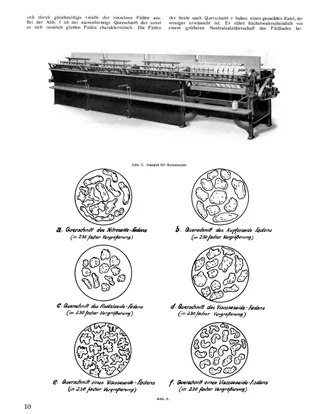
Concluding installment of a German article on artificial silk (rayon) manufacture. It describes reeling machines (Haspel) used to wind silk from spinning cakes into skeins, including a Carl Zangs A.-G. (Crefeld) reel with a patented counter, followed by washing, drying, chlorine bleaching, softening with paraffin or glycerin, and skein dyeing. It also compares magnified cross-sections of nitro, copper, acetate and viscose silk filaments at 230x, and notes how the shapes reflect the process used.
Method of Preventing Spotty Effects in Rayon Fabrics
Article · 2 pages
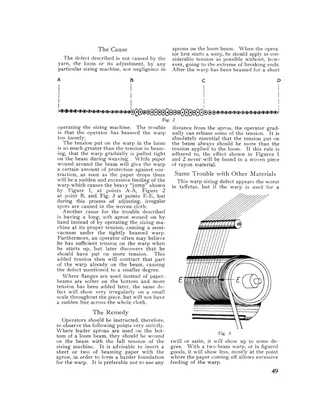
A 1929 article from the first issue of The Melliand explaining a defect in rayon fabrics, a periodic loose-warp effect that shows as spotty bands across taffeta. The author attributes it to warp beamed too loosely on the sizing machine, so the warp tightens on the beam during weaving and then feeds excessively when the paper drops. He gives remedies: wind leader aprons with full sizing-machine tension, add beaming paper, and keep beaming tension above loom tension. Three figures show a taffeta swatch, a warp cross-section and a loom beam.
Rayon Fabric Designing
Article · 2 pages
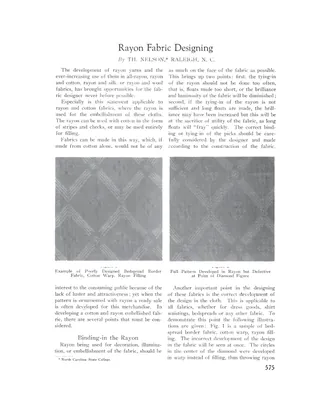
A short trade-journal article on designing fabrics that combine cotton with rayon as an embellishing yarn. It covers how often to bind the rayon filling into the cloth, balancing luster against durability, and developing the pattern correctly on the face of the fabric. Three photographed bedspread border samples illustrate defects: figures developed in the warp instead of the filling, diamond points that fail to join, and floats that are too long or too short.
Rayon Fabrics Made of Cupra-Ammonium Yarns
Article · 2 pages
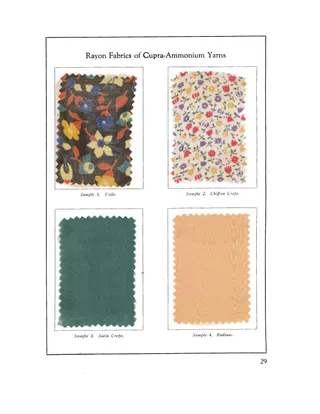
A short 1929 article from The Melliand by Otto Niemann on fine-filament cupra-ammonium rayon yarns that give fabrics with the look, drape and handle of silk. It gives construction details for four piece-dyed sample fabrics (voile, chiffon crepe, satin crepe, and a radium underwear/shirting fabric), including ends and picks per inch, yarn denier and twist. It also advises using clip rather than pin tenter frames in finishing and notes that the rayon fabrics cost less than silk. The second page shows the four swatches as magnified images.
Machinery and Appliances
Textile Mercury, 1891
Article · 3 pages
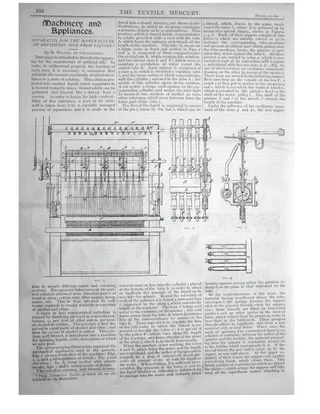
Two items from The Textile Mercury, February 1891. The first is Hilaire de Chardonnet's description of his machine for spinning artificial silk from nitrated cellulose (collodion), covering the spinners, the water bath that coagulates the thread, the nippers and bobbins, solvent recovery (ether and alcohol) and the denitrating and dyeing of the finished silk. The second is part V of "Papers on Bleaching," on the lime sour (grey sour) and the ley boil for cotton goods, with a method for testing the strength of the acid. Two pages carry engineering figures of the spinning machine.
New Rayon Products
Article · 6 pages
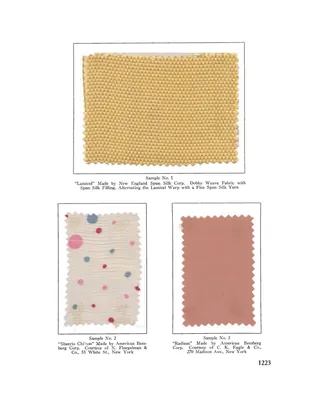
A December 1930 trade-journal article surveying new rayon yarns and fabrics then reaching the market. It covers yarn developments (Lamicel, Sase, Bemberg, Celanese, Acele), and uses in sheets, bedspreads, velvets, crepes, knits, lingerie, sportwear, lace, neckties, draperies and upholstery. Six fabric samples are pictured, with one construction given in detail (Enka warp, 4-shaft plain weave, spun silk nub filling). It also discusses consumer prejudice, trade names and shrinkage problems.
The Use of Weave and Material for Effects in Artificial Silk Fabrics
Article · 5 pages
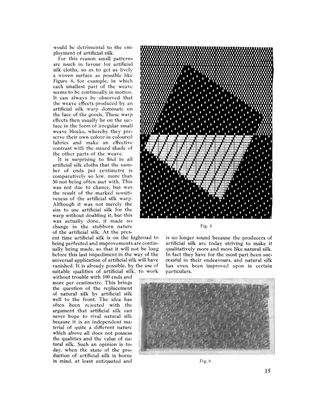
A 1929 trade article by F. Müller on how weave and material interact in artificial silk (rayon) fabrics, especially Jacquard cloths for items such as cravats. It discusses the difficulties of using artificial silk as warp (sizing, close sets, sagging threads), the use of satin, taffeta, twill and plain weaves, draughts-board and block patterns, shot effects from warp and weft stripes, and appliqué-style figuring by changing weave. It closes with comments on artificial silk replacing natural silk and organzine/tram. Six figures show weave plans and Jacquard patterns, but there are no standard weaving drafts.
Bindungs- und Materialeffekte in kunstseidenen Stoffen [Weave and Material Effects in Rayon Fabrics]
Article · 3 pages · German
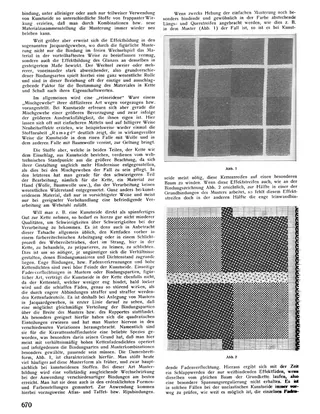
A 1927 article from Melliand's Textilberichte by Franz Müller on how weave structure and material interact in rayon (Kunstseide) fabrics. It covers rayon warp preparation and sizing, the problems of tight weaves and high warp density, and the use of checkerboard (Damenbrett) Jacquard patterns, especially for neckties, with satin, taffeta and rib weaves. It also discusses warp- and weft-direction effect stripes and their crossing points, illustrated by a pattern figure and a weave drawdown. The scan also includes the end of an article on Jacquard card care and the start of Josef Funke's article on plain weave, which covers shedding on hand and power looms.
Bindungs- und Materialeffekte in kunstseidenen Stoffen [Weave and Material Effects in Rayon Fabrics]
Article · 2 pages · German · weaving drafts
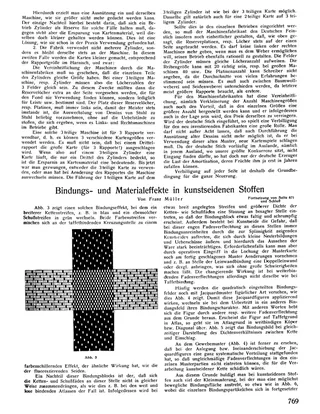
The concluding part of Franz Müller's article on weave-structure and material effects in rayon (Kunstseide) fabrics. It discusses block-type binding effects where warp and weft color stripes cross in plain weave, and how jacquard figures change binding (e.g., satin figure on plain ground, twill on satin ground). It also covers the fragility of rayon warps, low warp densities, the use of unplied rayon, and rayon's prospects for replacing natural silk. Figures show binding diagrams and fabric samples. The scan begins with the end of an unrelated piece on standardizing jacquard machines, cylinders and punched cards.
217 documents found