Textile Documents › Topic: Mohair, alpaca, and other animal fibers
185 documents found
Sort: 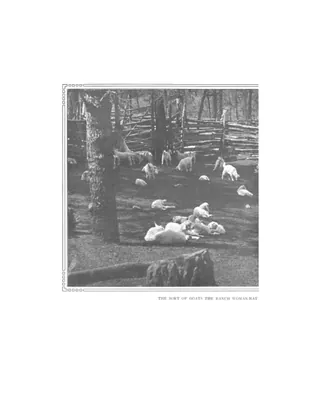
[Goats raised by ranch women in the mountains of New Mexico]
Technical World, 1911
Illustration · 2 pages
Two black-and-white photographs from a 1911 issue of Technical World Magazine showing flocks of goats in rustic fenced corrals, with pine trees in the background of one. The caption reads 'The sort of goats the ranch woman may raise in the mountains of New Mexico.' There is no weaving content, though the images relate to fiber-animal husbandry.
Mohair
Manufacturer and Builder, 1876
Article · 1 page
A short 1876 news item from The Manufacturer and Builder reporting that John S. Harris of California brought twelve Angora goats from Asia Minor to Baltimore after a year-long journey. It gives the cost per goat and in total, and notes his California flock and the prospects for producing mohair there.
Picture postcard
Ephemera · 1 page
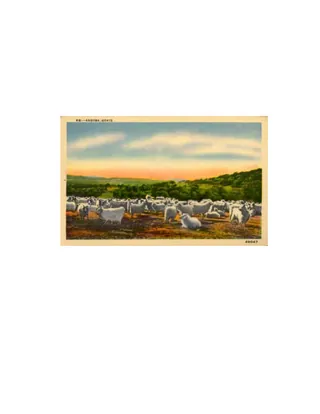
A single color picture postcard showing a flock of white Angora goats grazing on a hillside at sunset, with trees and rolling hills behind. The only text is a caption identifying the animals as Angora goats and a number. It is useful as pictorial evidence of mohair-producing goats and their keeping.
Picture Postcards
Ephemera · 1 page
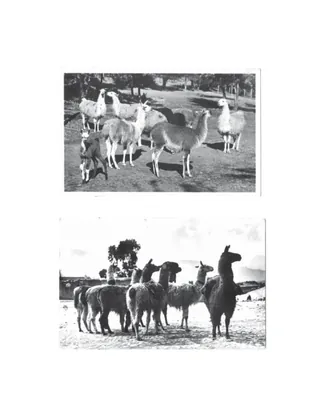
A single page reproducing two black-and-white photographs of llamas and alpacas, apparently picture postcards. The upper photo shows a group of the animals standing on bare ground in front of trees. The page has no printed or handwritten text.
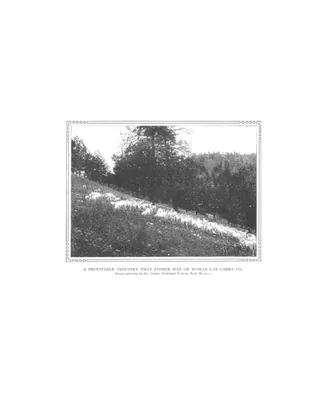
[Profitable Industry]
Technical World, 1911
Illustration · 1 page
A single-page illustration from Technical World Magazine, 1911, showing a photograph of a flock of goats grazing on a hillside beside conifer trees in the Alamo National Forest, New Mexico. The caption presents goat keeping as a profitable industry that either a man or a woman can carry on. It has no weaving content and is of interest mainly for the history of goat raising and mohair or fiber sources.
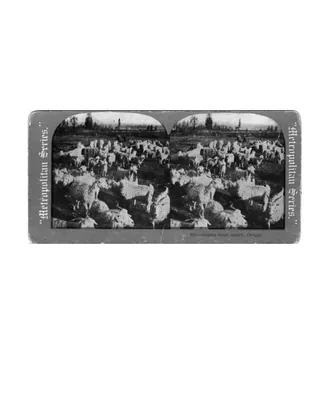
Stereo view
Ephemera · 1 page
A single stereoscopic view card from the "Metropolitan Series," numbered 953 and captioned "Angora Goat Ranch, Oregon." The two side-by-side photographs show a flock of white Angora goats on open ground with trees behind and a figure, possibly a herder, in the distance. It documents Angora goat raising, a source of mohair fiber, in Oregon.
Camel
Article · 2 pages
Encyclopedia Britannica (11th ed.) article on the camel, covering the Arabian (dromedary) and Bactrian species. It describes the wild Bactrian camel, the animal's domestication, its use as a beast of burden, its temperament and diet, and the products obtained from it, including hair, hide, milk, meat and dung. It also notes the Biblical references to camels and the 'needle's eye' saying.
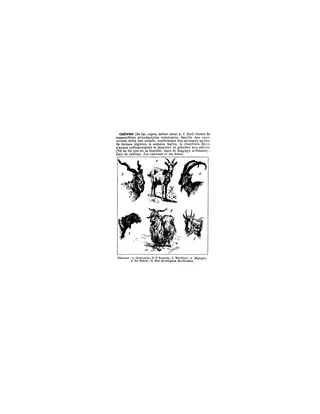
Chèvre [Goat]
Article · 1 page · French
A single-page French encyclopedia entry on the goat (chèvre) from the Nouveau Larousse Illustré. It gives a short zoological definition of the genus and a plate of six engravings showing the ordinary goat, Angora, Markhor, Ægagre (wild goat), Nubian goat, and Rocky Mountain goat. The page has no textile or weaving content beyond the illustration of the Angora goat, a mohair source.
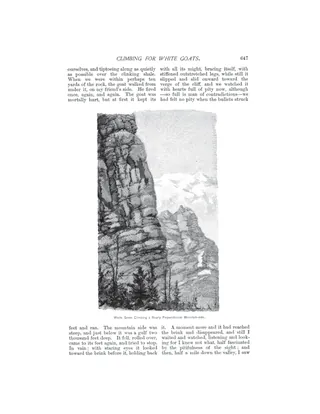
Climbing for White Goats
Article · 5 pages
A May 1894 Scribner's Magazine article by George Bird Grinnell on the mountain goat of the western American and Canadian ranges. It describes the animal's habitat, range, coat, and climbing ability, and narrates hunting trips in the Rocky Mountains. It includes engraved illustrations. Textile content is limited to a short passage noting that the goat's fine white underwool is woven into blankets by British Columbia Indians, with the yarn hand-twisted on the knee and woven on a simple loom.
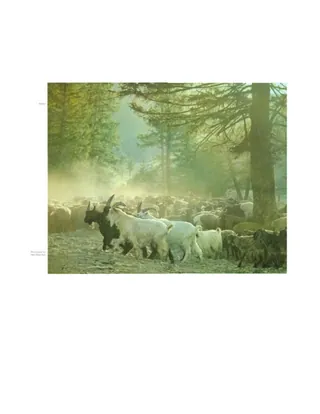
Flocks
Illustration · 1 page
A single-page photograph from China Pictorial, 1966 No. 2, titled "Flocks". It shows a large flock of goats moving through a misty conifer forest in soft morning light, with dust rising from the ground. The page carries only the title and a photographer credit, with no text on weaving or textiles.
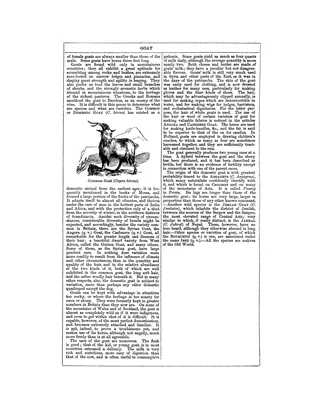
Goat
Chambers's Encyclopedia, 1881
Article · 2 pages
Encyclopedia article on the goat (genus Capra) from Chambers's Encyclopedia. It describes how goats differ from sheep, their wild habitats, domestic breeds (including the Angora, Cashmere and Syrian goats noted for long fine hair), and their uses for milk, meat, leather, horn and hair. It also covers the wild species thought to be the ancestor of the domestic goat. It includes an engraving of the common goat.
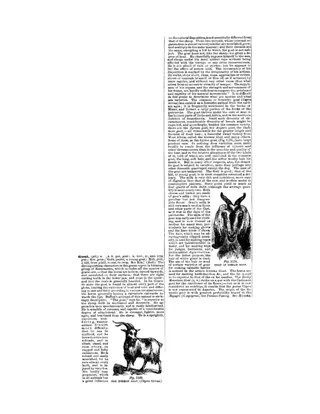
Goat
Zell's Encyclopedia, 1876
Article · 1 page
A one-page encyclopedia entry on the goat (genus Capra), covering its zoological characters, domestic varieties, and temperament as described by Buffon. It lists uses of goat milk, meat, skin, hair, horns and fat, and notes the long-haired Syrian, Angora and Cashmere breeds valued for fibre. Two engravings show the common goat and the Syrian goat.
Goat Raising
Article · 1 page
A one-page encyclopedia entry from 1906 on the American Angora goat industry. It covers the origin of the breed from Angora, Turkey, the main producing states, uses of the goats for brush clearing, mohair for cloth and plush upholstery, and meat, and cautions on husbandry. It also mentions goat shows, breeding prices, and a 1901 importation from Turkey.
The Grunting Ox of Thibet
The American Penny Magazine, January 30, 1847
Article · 2 pages
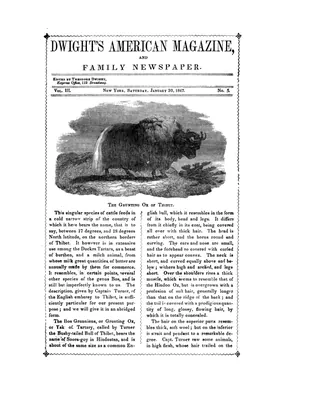
A short 1847 magazine article describing the grunting ox, or yak, of Tibet, with an engraving. It covers the animal's range, appearance, long hair, temperament, and its use by Tartar nomads for carrying loads, butter, and tents and ropes made from its hide. A second section describes the musk ox of North America as a comparable long-haired animal.
Guanaco
Article · 1 page · French
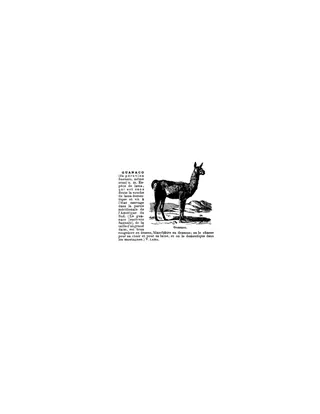
A short French dictionary entry on the guanaco, a wild South American camelid regarded as the likely ancestor of the domestic llama. It gives the etymology (Peruvian huanaco), the Latin name Auchenia huanaco, a description of size and coloring, and notes that it is hunted for meat and wool. A line drawing of a guanaco accompanies the entry, which cross-refers to the entry for Lama.
Handbook of South American Indians, The Andean Highlands
Illustration · 4 pages
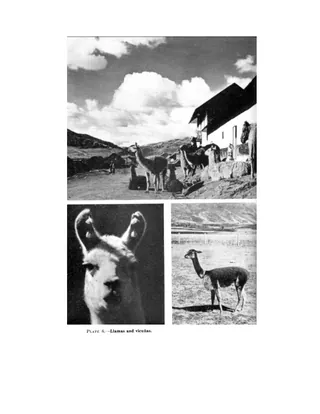
Four-page excerpt from Bureau of American Ethnology Bulletin 143, Handbook of South American Indians, Volume 2 (The Andean Civilizations), edited by Julian H. Steward. It includes the title page, the opening page of Wendell C. Bennett's introduction to the Andean Highlands, and two plates of photographs showing alpacas on the Bolivian puna and llamas and vicuñas. The excerpt is limited to the illustrations relevant to camelid fiber animals.
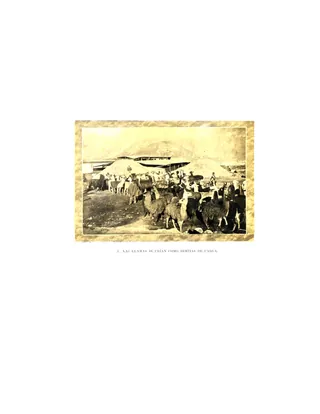
Las llamas se crían como bestias de carga [Llamas Are Raised as Beasts of Burden]
Enciclopedia Comercial, 1922
Illustration · 1 page · Spanish
A single-page sepia photograph from the Enciclopedia Comercial (1922) showing a large herd of llamas gathered with several people in an open yard in Peru. Piles of material, possibly grain or wool, lie nearby, with a long low building and a hillside behind. The printed caption says llamas are raised as beasts of burden.

Mohair
Domestic Encyclopedia, 1821
Article · 1 page
A one-sentence encyclopedia entry defining mohair as the hair of a goat found near Angora in Turkey. It notes that the inhabitants of Angora were all employed in making camblets (camlets) from this hair.
Musk Ox
Article · 1 page
A one-page encyclopedia article on the musk ox (Ovibos moschatus), covering its classification, former and present range, physical features, habits, diet and use as food by Eskimos. It notes that the animal's long woolly hair has been spun into extremely soft fabrics. It ends with a short bibliography of works on musk oxen.
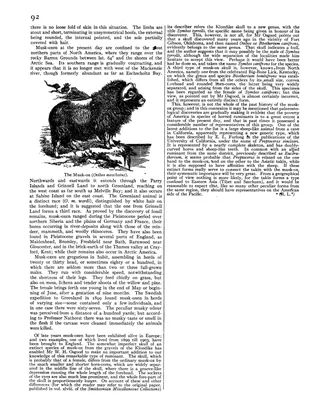
Musk-Ox
Article · 2 pages
Encyclopedia Britannica (11th ed., 1911) article on the musk-ox (Ovibos moschatus), an Arctic American ruminant. It describes the animal's size, horns, long hair and woolly under-fur, its present range in northern North America and Greenland, and its habits, then covers fossil musk-oxen and related extinct forms such as Symbos, Bootherium and Preptoceras. It includes an engraved illustration of a musk-ox. There is no weaving content, though the animal is a source of qiviut wool.
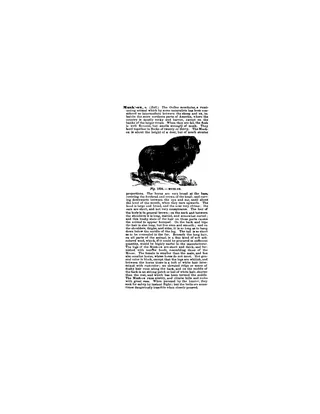
Musk-Ox
Zell's Encyclopedia, 1876
Article · 1 page
A one-page encyclopedia entry on the musk-ox (Ovibos moschatus), with an engraved illustration. It describes the animal's northern American range, herding habits, horns, coat colors and build, and notes that the fine ash-colored wool under the long hair could be useful to manufacturers if obtained in quantity.
Alpaca
Living Age, October 19, 1844
Article · 3 pages
A review reprinted from the Polytechnic Review in the Living Age of William Walton's book on naturalizing the alpaca in the British Isles. It summarizes the book's contents, including the alpaca's wool and meat, its suitability to British soil and climate, and the benefits for farmers and manufacturers. It quotes passages on the animal's hardiness in snow and storms, and mentions breeders such as Prince Albert and the Earl of Derby. It ends with a letter from G. Stirling about showing an alpaca at the Glasgow Highland show in 1844.
Angorawolle [Angora Wool]
Article · 1 page · German
A short German encyclopedia entry on Angora wool (mohair), the hair of the Angora goat. It describes the fibre's fineness, silky luster and curly structure, colors and grades, and its microscopic appearance. It also gives fibre diameter, length, fleece weight, and annual export volume.
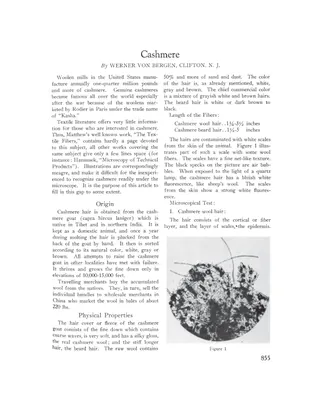
Cashmere
Article · 5 pages
A 1929 article from The Melliand on the microscopic identification of cashmere fiber. It covers the origin of the cashmere goat and how the hair is harvested and traded, then the physical properties of the fleece, including down and beard hair. The author describes scale counts, which separate cashmere from sheep's wool, along with fiber diameter measurements, cross-sections and pigment in brown hairs. Illustrated with photomicrographs, cross-section drawings and charts of scale counts and diameter variation.
Cashmere Goat and Shawls
Article · 1 page
A short 19th-century magazine item on the Thibet (Cashmere) goat and the shawls made from its wool. It reports the introduction of the goat into the United States by Dr. J. B. Davis of South Carolina, and its spread to Tennessee. It also covers shawl prices, the debate over whether genuine Indian shawls are woven in pieces and sewn together, French and Paisley imitations, and wool yields per animal.
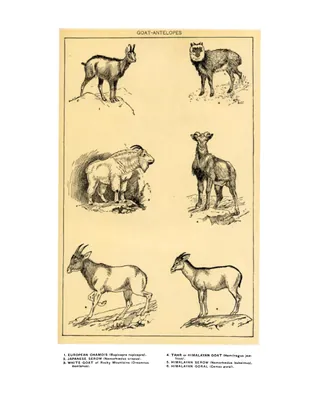
Goat
Article · 4 pages
Encyclopedia article on the goat (genus Capra), covering wild species such as the bezoar goat, Caucasian turs, Spanish goat, ibex and markhor, then domestic breeds. The domestic section describes the Angora (mohair) goat and the Cashmere (shawl) goat, whose underwool (pashm) is used for Kashmir shawls. It includes a plate of goat-antelopes and bibliographies. It is of limited use for textile research, mainly for the fibre-producing goats.
Goat, Rocky Mountain
Chambers's Encyclopedia, 1881
Article · 1 page
A short encyclopedia entry on the Rocky Mountain goat (Antilope lanigera), describing its range in the Rocky Mountains of North America, its sheep-like size and white fleece, and its musky flesh. It notes the suggestion that the fleece might be used for finer manufactures and that the animal might be introduced into the Scottish Highlands.
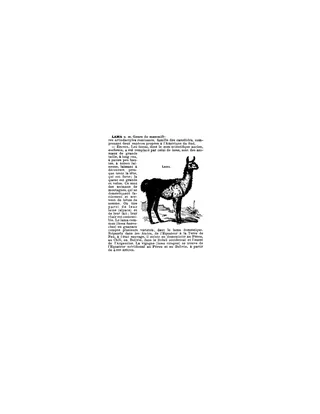
Lama [Llama]
Article · 1 page · French
A one-page French encyclopedia entry on the llama from the Nouveau Larousse Illustré, with an engraving of a llama in a rocky landscape. It describes the genus as South American camelids, notes their use as pack animals and for wool (alpaca), milk and meat, and mentions the guanaco (common llama) and the vicuña with their ranges in the Andes.
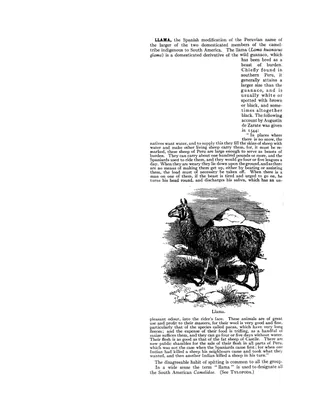
Llama
Article · 1 page
Encyclopedia Britannica (11th ed.) entry on the llama, the larger domesticated South American camelid, descended from the wild guanaco and bred as a beast of burden. It describes the animal's range, size and colouring, and quotes Augustin de Zarate's 1544 account of its use for carrying loads, its wool (especially the long-fleeced pacas) and its meat. An engraving of a llama accompanies the text.
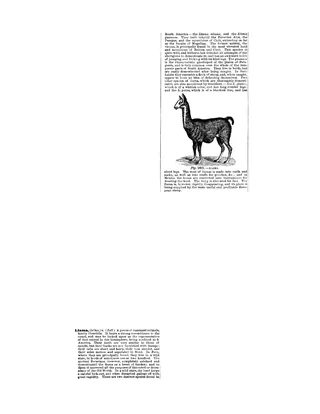
Llama
Zell's Encyclopedia, 1876
Article · 1 page
A one-page encyclopedia entry on the llama, a South American camelid, from Zell's Encyclopedia. It describes the llama genus and its species (vicuna, guanaco, and the domesticated L. glauca and L. pacos), their range in Peru, Bolivia, Chile and Patagonia, and their habits. It notes that llama wool is made into cords, sacks and stuffs for ponchos, and that in Mexico the bones were made into weaving implements. Includes an engraving of a llama (Fig. 1603).
Microscopic Study of Alpaca Fibers
Article · 3 pages
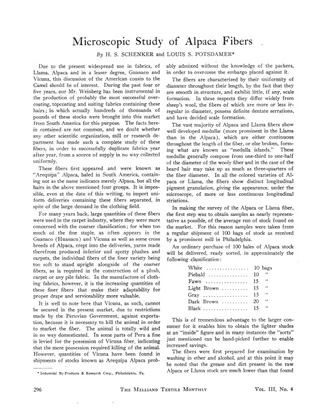
A 1931 article from The Melliand Textile Monthly reporting a microscopic survey of alpaca and llama fibers taken from a 100-bag shipment received by a Philadelphia mill. It describes fiber structure (smooth surface, little scale, medullae, pigment granulation) and compares it with sheep's wool. It also gives ether-extractable grease and dirt content and fiber diameter distributions for seven color sorts in two tables. Average diameters are compared with Government Standard Wool Tops grades, concluding that alpaca/llama averages 26 to 36 microns, roughly equal to 58's down to 46's wool.
Mohair
Manufacturer and Builder, 1876
Article · 1 page
A short 1870s magazine article on mohair, the fiber from the Angora goat. It describes the fiber's qualities (strength, luster, dye uptake), its use in place of silk in Irish poplins, and the trade in fleeces from Asia Minor and England. It then traces the introduction and breeding of Angora goats in the United States (South Carolina, Georgia, California and the Pacific states) and at the Cape of Good Hope.
Mohair
Article · 1 page
A short encyclopedia entry defining mohair as the fleece of the Angora goat of Asia Minor and South Africa. It describes the fibre's qualities, typical yield per animal, and the fabric's light weight and lustre. It also mentions uses in pile fabrics such as plushes and astrakhans, in so-called camel's hair fabric, and in wigs and switches, and cites a USDA Farmers' Bulletin.
Mohair
Zell's Encyclopedia, 1876
Article · 1 page
A short encyclopedia entry defining mohair as the hair of the Angora goat. It covers the annual clipping, fleece yields, the relative value of male and female hair, and the places where it is spun and manufactured (France, England, Scotland). It lists products made from it, including camlets, plush, laces, buttons, trimmings and cloth for paletots, and notes that mohair dresses were replaced by alpaca cloths.

Mohair
Article · 1 page
A one-sentence encyclopedia entry defining mohair as the hair of a goat found around Angora in Turkey. It notes that the inhabitants of the city were all employed in making camblets from this hair. Useful as an example of eighteenth-century commercial description of the fiber.
Musk-Ox Wool and its Possibilities as a New Textile Fiber, Part 2
Article · 4 pages
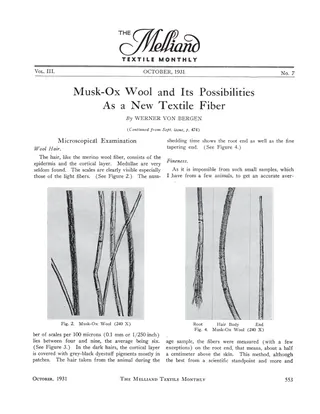
Second installment of a serial article on musk-ox wool as a possible textile fiber, covering its microscopical examination. It describes the structure, scale counts and fineness of the fine underwool and the coarse beard hairs (kemp), with micron measurements for root end and middle of the staple. It compares samples from Alaska and New York animals and against cashmere and Australian merino. Illustrated with micrographs and width-variation graphs.
Musk-Ox Wool and its Possibilities as a New Textile Fiber, Part 3
Article · 3 pages
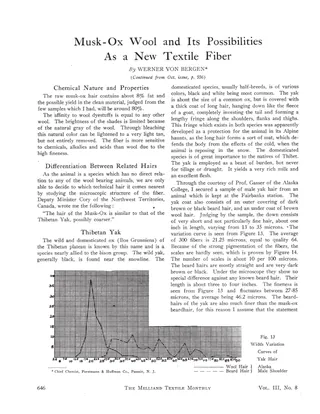
Third installment of Werner von Bergen's serial article on musk-ox wool as a possible commercial textile fiber. It covers the chemical properties of the raw hair (fat content, yield, dye affinity, sensitivity to chemicals) and compares it microscopically with yak, vicuna, cashmere and camel hair. Includes width-variation charts, 240x microphotographs, and a comparison table of color, length, fineness, scales, quality and medullation. The author concludes that musk-ox shoulder wool is closest to cashmere and may be the finest known wool hair.
Musk-Ox Wool and its Possibilities as a New Textile Fiber, Part 4
Article · 3 pages
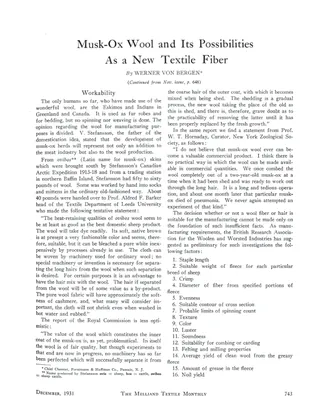
Part of a serial article by Werner von Bergen, chief chemist at Forstmann & Huffman, on the textile potential of musk-ox (ovibos) wool. It reviews opinions on workability from Stefansson, Prof. A. F. Barker of Leeds, the Royal Commission and W. T. Hornaday. It lists the criteria the British Research Association for the Woolen and Worsted Industries proposed for judging a fiber. The author argues that musk-ox wool can be separated from its coarse beard hair as cashmere is, and he describes the 1920s Leeds experiments and the unpublished Atkinson thesis. One figure shows a cashmere goat.
Spinning and Weaving Glass
Manufacturer and Builder, 1881
Article · 1 page
A short 1881 magazine article reporting on Atterbury & Co. of Pittsburgh, who drew colored glass rods into fine threads on a large spinning wheel and wove them into fabrics. It describes the process, including the gas burners, the 8½-foot wheel, and the reeling speed, and mentions a tablecloth and ornamental plumes made from glass. The editors conclude that glass cloth is impractical for clothing because the fibers are brittle, though it could serve for ornamental objects.
Alpaca
Chambers's Encyclopedia, 1881
Article · 1 page
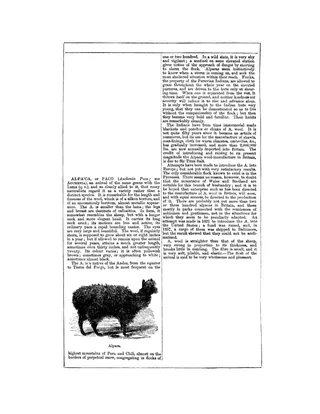
A one-page encyclopedia entry on the alpaca (Auchenia paco), a South American camelid related to the llama. It describes the animal's appearance, habitat in the Andes, and behavior, and the length, color and silky quality of its wool. It also covers the use of the wool by Peruvian Indians, its commercial importation into Britain and manufacture there (credited to Sir Titus Salt), and attempts to introduce the animal to Europe and the United States.
Alpaca
Article · 1 page
A one-page review, reprinted from the Spectator in the Living Age, of William Walton's book urging the naturalization of the Alpaca in the British Isles. The reviewer summarizes Walton's case for the Alpaca over the Llama (better wool, meat and constitution) and the earlier attempts at introduction in Britain. He cautions that the author overrates the meat and underrates the difficulties, but considers the fleece valuable to manufacturers and the experiment worth a larger trial, with pure breeding and careful management.
Goat
Article · 3 pages
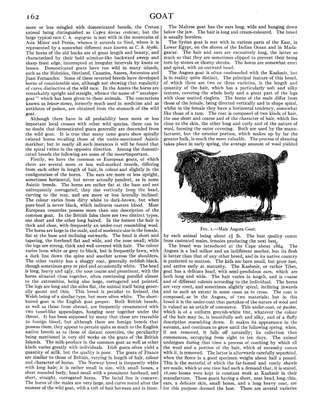
Encyclopedia article on the goat (Capra hircus) from the 11th edition of the Encyclopedia Britannica. It covers goat etymology, wild and feral populations, and the main domesticated breeds (European, Maltese, Syrian, Angora, Kashmir/Tibet, Nubian, Nepal, Guinea). The Angora and Kashmir sections describe mohair and pushm fleece, shearing and combing, and Kashmir shawl production. The article closes with wild relatives such as ibex, markhor and tur, and includes two engraved illustrations.
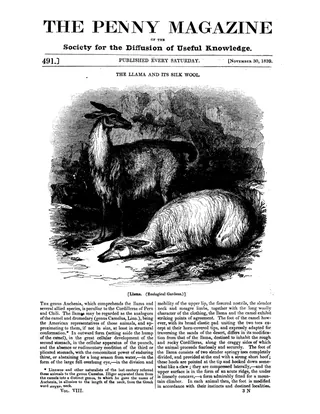
Llama and its Silk Wool
Article · 2 pages
A short natural-history article from The Penny Magazine on the llama (genus Auchenia) of the Peruvian and Chilean Cordilleras. It compares the llama with the camel in anatomy and foot structure, then argues for naturalizing the animals, especially the alpaca-vicugna cross, in Wales or Scotland for their wool. It stresses the commercial value that llama fleece could have, comparing it to sheep wool and silk. An engraving of llamas at the Zoological Gardens accompanies it.
Mohair
Article · 1 page
A short dictionary entry on mohair, the fleece of the Angora goat, quoted from Hayes' Centennial Reports. It describes the fiber's silk-like luster, its lack of felting, and its stiffness, which means it is rarely woven alone and is usually paired with cotton, silk, or wool warps. It notes the main use in Utrecht velvet (furniture plush), where the pile is formed of cut mohair warps, and refers readers to Hayes' work on the Angora goat.
Mohair
Oxford Encyclopedia, 1828
Article · 1 page
A short encyclopedia entry defining mohair as the hair of a goat found around Angora in Turkey, and as the camblet fabrics made from it. It distinguishes smooth plain mohair from watered mohair, which is calendered, and notes versions with wool, cotton, or thread wefts.
Mohair
Article · 1 page
Encyclopedia Britannica (11th ed.) article on mohair, the hair of the Angora goat. It covers the word's etymology, the fibre's characteristics, and the spread of Angora goats from Asia Minor to South Africa, the United States, and Australia. It also covers the Yorkshire mohair spinning and weaving industry, with statistics on goat numbers, hair yield, and prices.
Musk-Ox Wool and its Possibilities as a New Textile Fiber, Part 1
Article · 3 pages
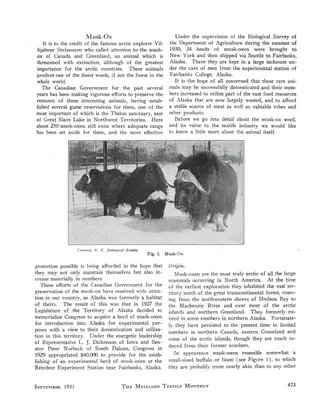
First installment of an article on musk-ox wool as a potential new textile fiber. It opens with the search for new fibers and gives production statistics for mohair and alpaca, then discusses the impracticality of breeding foreign fiber animals in the U.S. It then covers the musk-ox itself: conservation efforts in Canada, the 1930 Alaska experimental herd, the animal's range, appearance, herd behavior and population, and begins measurements of the hair coat (wool and beard hair lengths and percentages) from New York and Alaska samples.
Silk-Producing Fish
The Penny Magazine of the Society for the Diffusion of Useful Knowledge, February 1, 1840
Article · 2 pages
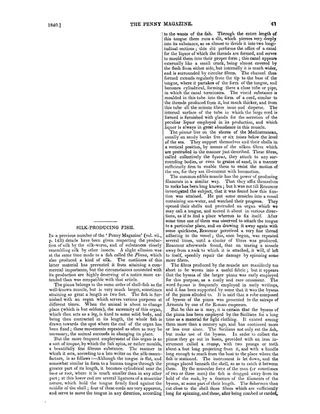
A two-page article from The Penny Magazine (1840) on the pinna, a large Mediterranean bivalve that produces a silky fibre called byssus. It describes how the animal forms and uses the fibres, how Sicilians gather the byssus, spin it, and weave or knit it into light, warm gloves, stockings and caps, and compares it to the threads of the common mussel. It also recounts ancient and later naturalists' accounts of the pinna's crab companion and quotes proposals to farm pinnae in ponds to increase byssus production.
Alpaca
Article · 2 pages
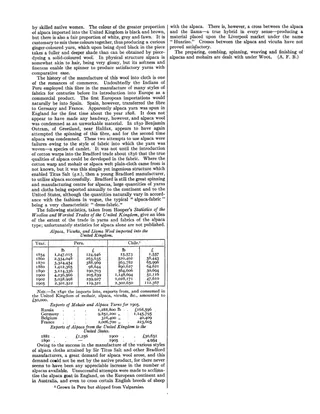
Encyclopedia article on the alpaca, both the South American domesticated animal and the fibre and fabric made from it. It covers the animal's habitat and wool colours, the history of alpaca cloth manufacture in Europe (Benjamin Outram, Titus Salt, Bradford cotton-warp fabrics), and trade statistics for imports and exports of alpaca, mohair and yarns up to 1905. It ends with notes on failed acclimatization attempts and the llama hybrid 'Huarizo'.
Alpaca
Article · 1 page
A short encyclopedia entry on the alpaca, a domesticated Andean cameloid related to the llama, guanaco and vicuña. It describes the animal, its semi-domesticated flocks in Peru, and the annual shearing. It also covers the qualities of the fleece, its use in Andean ponchos and blankets, and the start of the European alpaca cloth industry under Sir Titus Salt at Saltaire from 1836.
185 documents found