Textile Documents › Topic: Knitting
244 documents found
Sort: 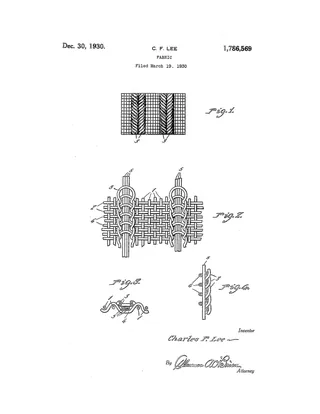
Fabric, US Patent No. 1786569
Patent · 3 pages
US Patent No. 1,786,569, granted to Charles F. Lee of Philadelphia on December 30, 1930, for a combined woven and knitted fabric. Certain weft threads are interlooped to form knitted sections between woven sections, with no extra yarns added. The unlooped weft threads and bunched warp threads resist stretching in both directions. The patent has drawings of the fabric in plan and section, a short specification, and six claims.
Knitted or Netted Fabric, US Patent No. D0058860
Patent · 2 pages
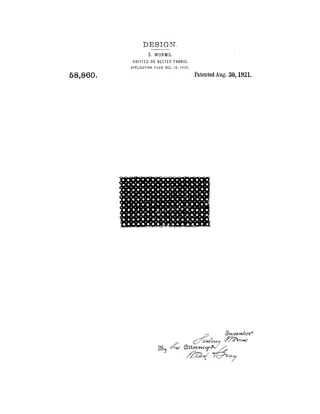
US design patent D58,860, granted 30 August 1921 to Sidney Worms of New Rochelle, New York, and assigned to Franklin Knitting Mills. It claims an ornamental design for a knitted or netted fabric. The single drawing shows a plan view of a fabric with small open holes in a staggered diagonal grid and a looped border. The text is a short specification with a one-line claim.
Knitting: -- Processes and Machinery, Part 2
Article · 3 pages
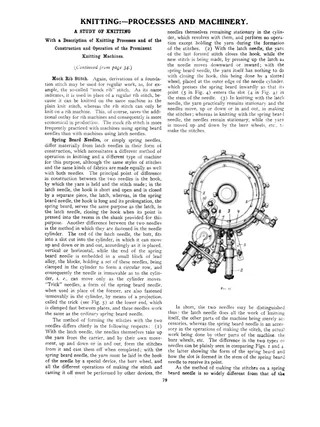
Part of a serial study of knitting in Posselt's Textile Journal (November 1907). It explains the mock rib stitch, then compares spring beard (and trick) needles with latch needles in construction, fastening in the cylinder, and stitch formation. It describes the parts of a spring beard circular knitting machine (feed burr, dividing burr, landing burr, presser wheel, sinker burr, cloth wheel) and walks through plain stitch formation using Figs. 17-21.
Lace Sweater in Glow Crinkle
Handicrafter, 1932
Article · 2 pages
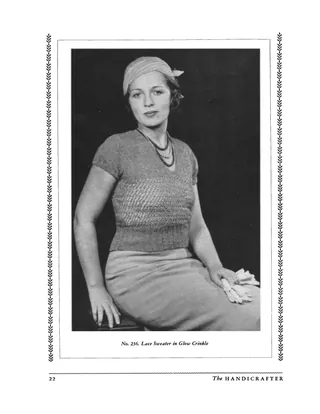
A two-page knitting pattern from The Handicrafter for a slip-on lace sweater (No. 236, size 34-36) in Bernat Glow Crinkle yarn. It gives materials, stitch counts, an eyelet lace pattern, and directions for the back, front, puff sleeves and finishing, with a photograph of the finished sweater. The second page also carries the end of the pattern for a Three-Piece Boucle Suit (belt, coat, sleeves).
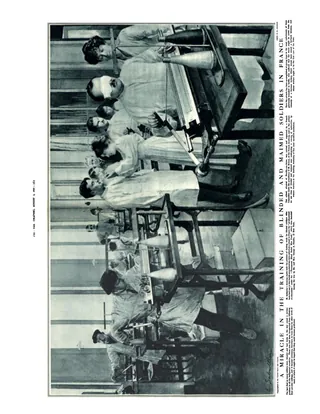
A Miracle in the Training of Blinded and Maimed Soldiers in France
The Graphic, August 2, 1919
Illustration · 1 page
A double-page illustrated feature from The Graphic (2 August 1919) showing a knitting workshop in France where blinded and maimed soldiers are taught by women instructors. The accompanying text describes the institute at Neuilly-sur-Seine, organized by a French committee and funded by the French Permanent Blind Relief War Fund, founded by Mr. and Mrs. George A. Kessler of New York. It concerns vocational rehabilitation of disabled World War I veterans through knitting.
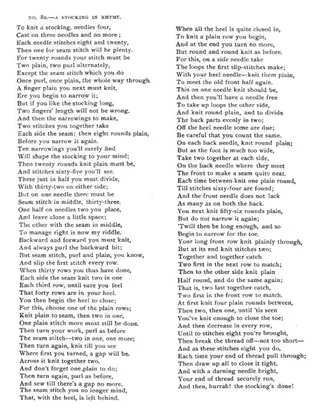
A Stocking in Rhyme
Other · 1 page
A single-page set of rhymed instructions for knitting a stocking on four needles, numbered as pattern No. 80. The verses cover casting on, ribbing with a seam stitch, narrowing for the leg, working and closing the heel, picking up gusset stitches, and shaping and closing the toe, with specific stitch and row counts.
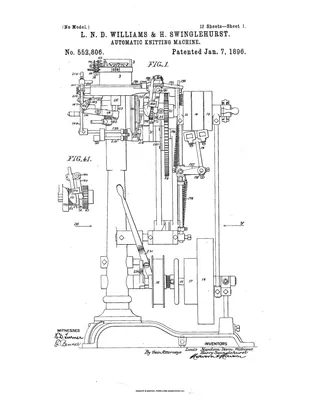
Automatic Knitting Machine, US Patent No. 552806
Patent · 25 pages
US Patent No. 552,806, granted January 7, 1896 to Louis N. D. Williams of Ashbourne and Harry Swinglehurst of Philadelphia, for an automatic circular knitting machine that makes socks and stockings. Twelve sheets of drawings show the needle cylinder, cam box, needle lifters, thread-feeding mechanism, pattern chain and clutch and belt-shifting gear. The specification explains how the machine switches between rotary and reciprocating motion to form the heel and toe pocket, shapes the leg by varying needle draft, and adds a reinforcing thread at intervals. It ends with numbered claims.
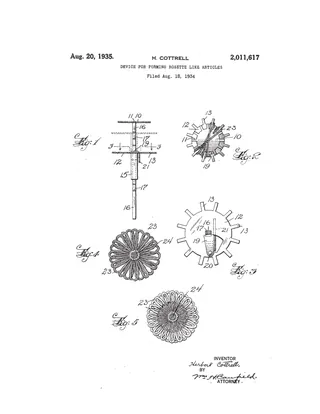
Device for Forming Rosette Like Articles, US Patent No. 2011617
Patent · 3 pages
US Patent No. 2,011,617 issued to Herbert Cottrell of Point Pleasant, N.J., for an adjustable device for making rosette-like, daisy-shaped articles from yarn or wool. Two star-shaped discs with radial lips are mounted on a telescoping tube and rod, so the spacing can be changed to make rosettes of different sizes, including a small rosette superimposed on a large one. The rosettes are sewn together to make sweaters, coats, pillows and bed covers. The scan has a drawing sheet (Figs. 1-5), the specification and five claims.
Electronic Control Apparatus for a Textile Machine, US Patent No. 6269282
Patent · 27 pages
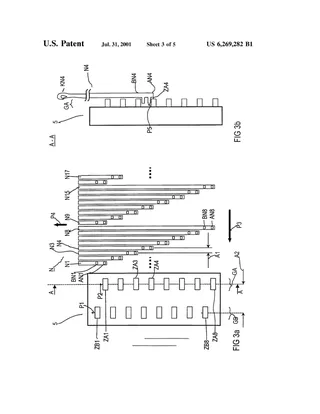
US Patent 6,269,282 (granted July 31, 2001, assigned to Siemens AG) describes an electronic control apparatus that sends textile pattern data to groups of mechanical actuation elements on a textile machine. It uses a serial data bus, sequentially connected serial-parallel converters (shift registers), and a central release signal. The main example is a circular knitting machine with piezoelectric actuators acting on needles, and the text also mentions warp knitting, meshing, weaving and Jacquard machines. The scan contains an online USPTO full-text printout, the patent's front page, five sheets of drawings, and the two-column printed patent text with claims, background and detailed description.
Fabric, US Patent No. D0036209
Patent · 2 pages
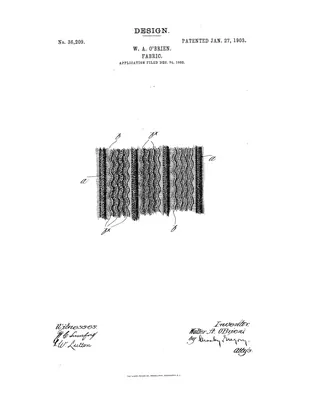
US design patent No. 36,209, granted January 27, 1903 to Walter A. O'Brien of Boston, assignor to Sterling Knit Goods Company, for an ornamental fabric design. The design has parallel large rope-like wales separated by broad bands, each band carrying small serpentine ribs that run in the same direction as the wales. The scan has a drawing sheet and a one-page specification with a single claim for the design as shown.
Höchstleistung durch Schnelläufermaschinen in der Wirkerei und Strickerei [Maximum Output through High-Speed Machines in Knitting and Hosiery Manufacture]
Article · 2 pages · German
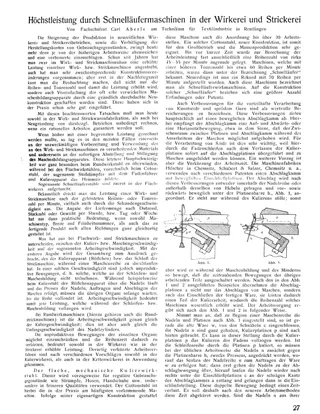
A 1927 German-language article by Carl Aberle of the Reutlingen textile technical school on raising output in knitting and hosiery manufacture with high-speed machines. It explains the difference between knitting speed and working speed, then describes improvements to flat Cotton frames, notably a movable knock-over comb with enclosing sinkers. It also covers high-speed circular knitting machines, including the Terrot system and the Haaga loop-wheel frame. Three cross-section diagrams of needle and sinker mechanisms illustrate the text, and the article ends with "Fortsetzung folgt" (to be continued).
Knitted Laces
Article · 2 pages
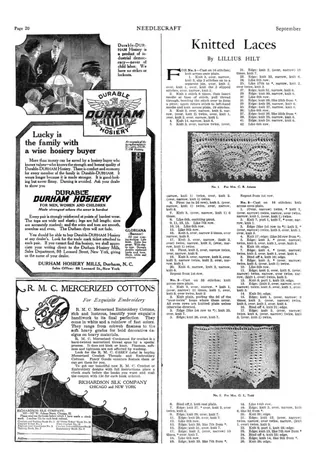
Two-page article from Needlecraft, September 1919, by Lillius Hilt, giving row-by-row written instructions for three knitted lace edgings (Nos. 1, 2 and 3), each named for a dedicatee. Photographs show the finished edgings. The scan also includes the end of a filet crochet pillow-cover pattern and several advertisements.
Knitted Suit of Glow Crinkle Yarn
Handicrafter, 1932
Article · 2 pages
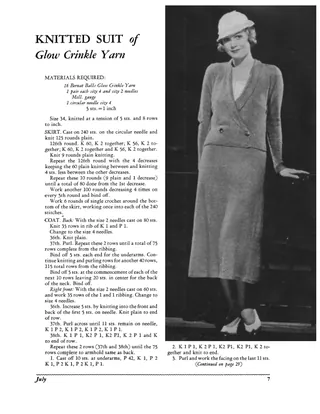
Knitting instructions for a woman's three-piece suit (skirt and coat) in Bernat Glow Crinkle Yarn, size 34, at 5 stitches and 8 rows to the inch. It gives materials, a circular-needle skirt with regular decreases, and a coat with back, fronts with ribbed facings, and sleeves, finished with single crochet seams and edging. The second page holds only the continuations of other articles from the same Handicrafter issue, on a two-harness Bronson lace weave, bedspreads, women potters, Indian bracelets, and bags.
Knitting Department
Article · 2 pages
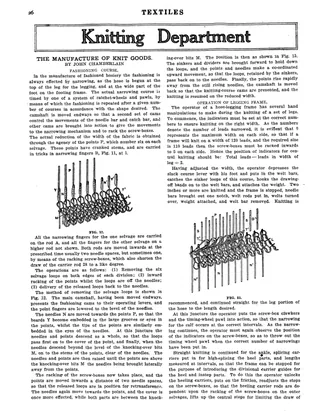
A two-page installment of the Knitting Department in Textiles by John Chamberlain, on the manufacture of fashioned hosiery on flat knitting frames. It explains the fashioning (narrowing) course, in which points remove and retransfer selvage loops, and the operator's tasks on the legging frame and footing frame. It ends with a short note on a wire take-up attachment for yarn slack on a knitting machine. Two figures (Figs. 12 and 13) show needles and points during loop transfer.
[Knitting Machines]
The Book of the Fair, 1893
Illustration · 1 page
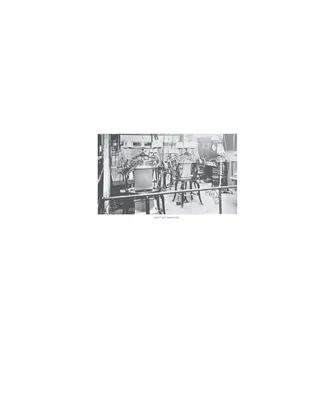
A single-page illustration titled "Knitting Machines" from The Book of the Fair, the account of the 1893 World's Columbian Exposition. It shows a photograph of an interior with several circular knitting machines, with cylindrical needle cylinders, cast-iron frames and hand cranks, behind a decorative scrolled iron railing. The only text is the caption.
Knitting: -- Processes and Machinery
Article · 3 pages
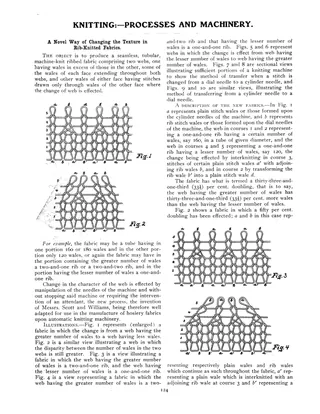
Two short technical pieces on knitting machinery from Posselt's Textile Journal, December 1907. The first describes a process by Scott and Williams for changing the number of wales in seamless tubular rib-knitted fabric, for example from one-and-one to two-and-one or two-and-two rib. It does this by transferring stitches between dial and cylinder needles without stopping the machine. The second describes H. A. Klemm's needle-bed with alternating long and short grooves and filling pieces, which allows a higher gauge in straight-frame and circular machines. Both are illustrated with fabric diagrams and machine sections.
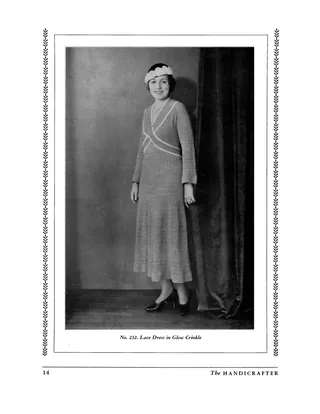
Lace Dress with Hat in Glow Crinkle
Handicrafter, December/January 1932-1933
Article · 2 pages
Two-page magazine article from The Handicrafter giving knitting instructions for a one-piece red lace dress (No. 232, size 16-18) with a matching brimmed hat, worked in Glow Crinkle yarn. It lists materials (Glow Crinkle in red, white brush wool, bone and steel needles) and gives row-by-row lace and yarn-over patterns, plus directions for the neck, sleeves, and skirt. Photographs show the dress and the hat with brim; the instructions continue on a later page not included here.
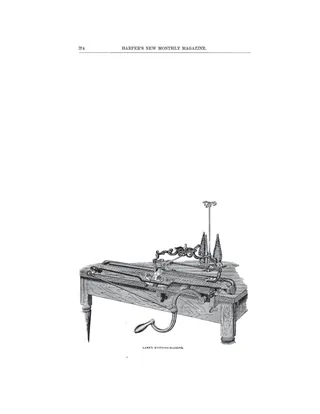
Lamb's Knitting Machine
Illustration · 1 page
A single magazine page with an engraving of Lamb's knitting machine, printed in Harper's New Monthly Magazine. The illustration shows a table or stand with turned legs supporting a cast-iron knitting frame with a row of needles, ornamental scrollwork, and yarn cones or spools on upright supports. Only a caption is given on the page, with no descriptive article text.
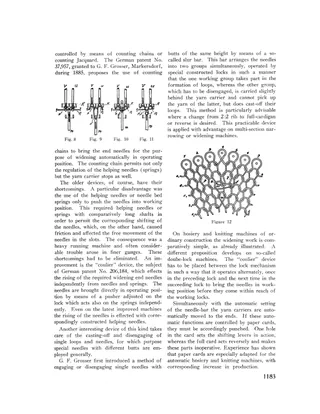
Manufacture of Fashioned Knit Goods
Article · 3 pages
Concluding installment of Karl Aberle's article on making fashioned (shaped) knit goods on flat and tubular knitting machines. It covers widening of double-sided rib and cardigan fabrics, the special difficulty of widening tubular work, and Grosser's patented method of widening tubular fabric without holes. It also describes automatic widening devices (counting chains, counting Jacquard, the "coulier" device, slur bar, punched paper cards), illustrated with needle-bed, lock, and loop diagrams in Figures 6-12.
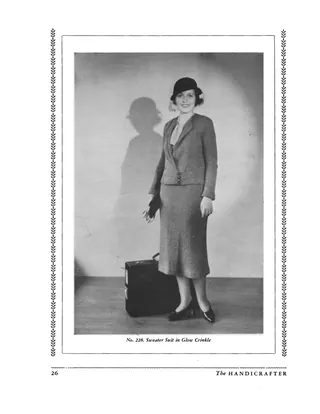
Sweater Suit in Glow Crinkle
Handicrafter, April 1933
Article · 4 pages
Knitting instructions from The Handicrafter (April 1933) for a three-piece sweater suit, pattern No. 228, size 16, worked in Glow Crinkle yarn. It gives materials, needle sizes and gauge, and row-by-row directions for a light green sweater blouse with a garter-stitch jabot, a dark green jacket, and a circular-knit skirt with elastic beading. Photographs and a silhouette illustration show the finished suit.
Three-Piece Boucle Suit
Handicrafter, 1932
Article · 3 pages
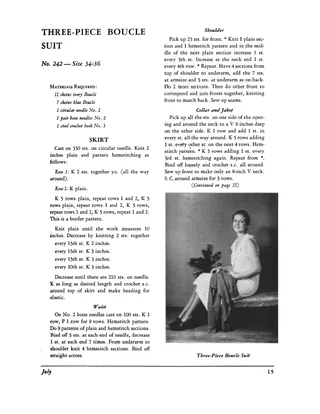
Knitting instructions from a 1932 issue of The Handicrafter for a three-piece boucle suit (No. 242, size 34-36) made up of a skirt, waist (top), and coat, with a belt, collar and jabot. The pattern gives materials, stitch counts, hemstitch border patterns, and crochet finishing. The scan also includes a photograph of the suit and instructions for a separate lace sweater in Glow Crinkle yarn (No. 236).
Tricot [Knitting]
Article · 1 page · French
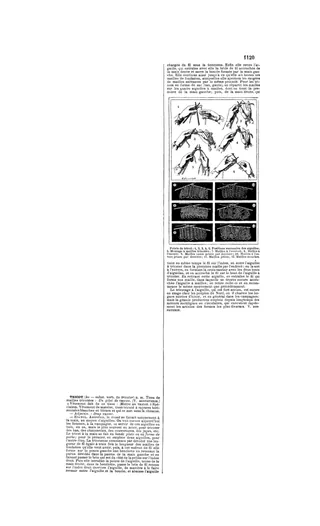
A one-page French encyclopedia entry on 'tricot' (knitting) from the Nouveau Larousse Illustré. It defines the word and explains hand knitting with two needles for flat pieces and four or five for seamless items such as stockings and gloves, covering casting on and forming stitches. An illustrated plate shows successive needle positions, cast-on and basic stitches (knit, purl, twisted, yarn-over, speckled). It notes that hand knitting persists in northern countries and rural areas while industry uses straight or circular knitting machines, and refers readers to the entry on bonneterie.
Tweed Sweater in Glow Yarn
Handicrafter, December/January 1932-1933
Article · 2 pages
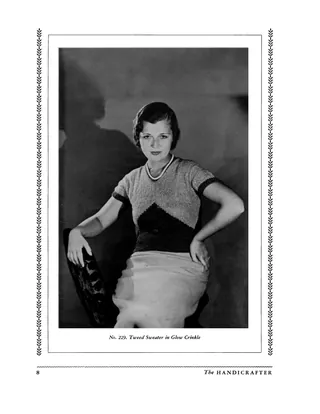
Knitting pattern for a woman's size 16 tweed-effect sweater (No. 229) worked in Glow Crinkle yarn in dark brown and tan. It gives materials (bone needles and crochet hook No. 4) and instructions for the back, front, and sleeve, which combine a knit-purl ribbed section in dark yarn with stockinette in light yarn. The neckline is finished with single crochet. The scan has a very dark photograph of the finished sweater.
Warp-Knitted Fabric, US Patent No. 4074543
Patent · 12 pages
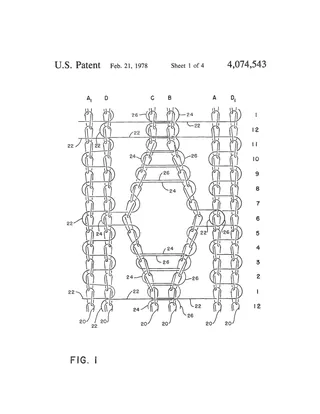
US Patent 4,074,543 (Frederick O. G. Schmidt, Allura Corporation, granted 21 February 1978) describes a lace or net fabric and its manufacture on a raschel warp-knitting machine. The net has a repeating pattern of squares enclosing small six-sided figures, imitating bobbin-net (Leevers) lace while staying dimensionally stable in both warp and weft directions. The patent explains the chain-stitched wales and laid-in unlooped threads, gives guide-bar chain notation for two variants, and notes the preferred 36-gauge machine with a 12-course repeat. Patent drawings show the thread arrangement, pattern chain, guide-bar threading and fabric repeats.
Cardigan-Jacket Machine
Article · 1 page
A short dictionary entry defining the cardigan-jacket machine, a circular rib knitting machine that makes the polka (one-and-one) stitch for knit jackets. It describes the Gimson & Coltman machine of Leicester shown at the Centennial, which could form a welt and had a dial counting courses, producing about 6 dozen bodies a day. It also mentions Lamb's machine and refers to G. W. Gregory's report in the Centennial Reports.
Combined Knitting and Weaving Loom
Article · 2 pages
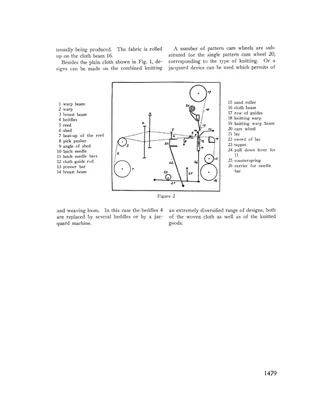
Article describing a combined warp knitting and weaving loom invented by Dr. Edwin Wildt of Leicester (German Patent No. 454,161). The machine alternates weaving and knitting operations to produce a fabric that is less prone to lengthening and excessive stretch than ordinary knitted goods. The text walks through the sequence of weaving a pick, pushing it into the latch needles, and knitting it into a row of loops, with a numbered parts key and a side-section diagram. It also notes that pattern cam wheels, multiple heddles or a jacquard device can be used for patterned fabrics.
Hand Knit Sweaters
Handicrafter, May-June 1932
Article · 5 pages
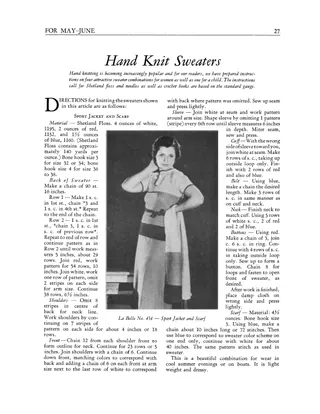
A magazine article giving written instructions for five hand-knit and crocheted outfits in Shetland Floss yarn: a crocheted sport jacket and scarf, a blouse and beret, a lace blouse and turban, a child's sweater and beret, and a cardigan outfit with scarf and hat. Each pattern lists materials, needle or hook sizes, stitch counts, shaping and finishing, and suggests color combinations. Each outfit is illustrated with a photograph and a pattern name and number.
Improvement in Knitting Looms
Scientific American, 1849
Article · 1 page
A short 1849 Scientific American item on John Pepper of Portsmouth, New Hampshire, and his improved power knitting looms (machines), as seen in operation at H. and J. Crane's establishment. It compares weekly output of English hand stocking looms with Pepper's earlier rotary looms and his newest plain and ribbed looms. It also notes that the new looms can handle stronger yarns and run in independent sections of any width. A small woodcut of a knitting machine accompanies the text.
Knitting
Zell's Encyclopedia, 1876
Article · 1 page
A short encyclopedia entry defining knitting as an art allied to weaving, formed from a single thread making a continuous series of interlocking loops. It notes that machines have made hand knitting uneconomical for staple goods such as stockings and gloves. It describes the improved Lamb knitting machine, with two parallel rows of needles worked by cams, adjustable loop length, hand-crank operation, and a speed of four to five thousand loops a minute.
Knitting Department
Article · 3 pages
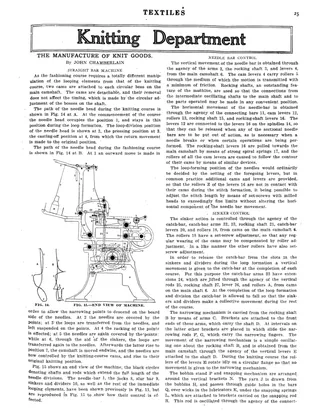
Three pages from the Knitting Department of the trade journal Textiles (pp. 25-27). John Chamberlain's installment on the manufacture of knit goods covers the straight bar (fashioning) knitting machine: needle-head paths for knitting and fashioning courses, needle bar, sinker and narrowing mechanism control, and care, adjustment and fault-finding for good selvages. Shorter items follow on grades of silk hosiery (pure dye, dipped, ingrain) and a patented thread-cutting attachment for looping machines.
[Knitting machine terms from Knight's American Mechanical Dictionary]
Article · 1 page
A single page of short glossary entries on knitting-machine and hand-knitting terms, taken from Knight's American Mechanical Dictionary (1876). Entries define parts such as jacks, jack-sinkers, slurs, shifters, fashioning-needles, sinker-bars and work-rollers, along with the terms narrowing and knitting-needle. The text describes the mechanical action of the stocking-frame.
Knitting-Machine Needle
Article · 2 pages
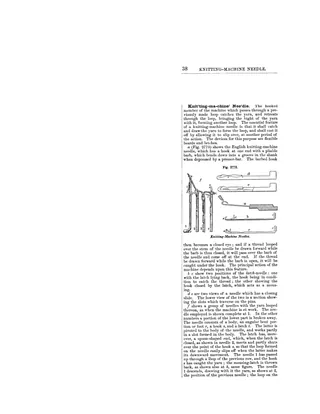
A two-page dictionary entry on knitting-machine needles from Knight's American Mechanical Dictionary. It describes how the needle forms and casts off loops, and distinguishes the bearded (barbed) needle, the latch needle, and a needle with a closing slide, with a figure of needles a through f. It ends with brief notes on machines for manufacturing the needles, including Aiken's machine and one for making needle tongues.
Knitting: -- Processes and Machinery, Part 1
Article · 5 pages
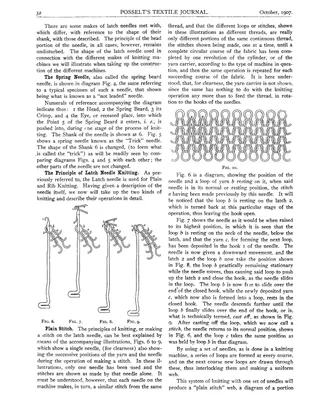
First installment of E. A. Posselt's study of knitting processes and machinery, from Posselt's Textile Journal, October 1907. It opens with the history of the stocking frame and the competing stories about William Lee's invention, then names later improvers of knitting machinery. It describes the latch needle and the spring beard needle, with numbered part diagrams. It explains how plain stitch, 1:1 and other rib stitches, and tuck stitch are formed and how the resulting fabrics differ. Knitted fabrics are classed as hosiery, ribbed goods and flat goods.
Manufacture of Fashioned Knit Goods, Part 1
Article · 6 pages
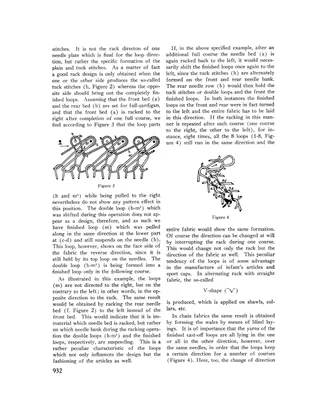
First part of an article on how fashioned (shaped-on-the-machine) knitted goods are manufactured, by Karl Aberle of Reutlingen. It compares fashioned articles with garments cut from piece goods and lists the main shaping methods: changing loop form, loose and tight loops, changing loop direction by racking, widening, narrowing and gussets. It covers stitch changes for connected sleeve parts, needle selection on flat and circular machines, rib dial adjustment on hosiery machines, rack stitch and tuck stitches, and widening by adding needles. Five diagrams illustrate sleeve sections, loop structures, racking and carrier-limited widening. The article ends with "To be continued".
The Origins of Knitted Fabrics
Article · 15 pages
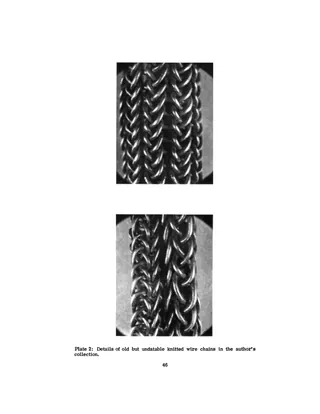
An article by Braham Norwick arguing that knitting in the British Isles and Europe is much older than textile scholars have admitted. He reviews disputed literary evidence (Chatterton's Rowley poem, translations of Pliny, Ovid, Marco Polo and Odoric) and then turns to archaeological silver wire knitted chains and bands, including those in the Ardagh Chalice, and the Cuerdale, Croy, Ballinaby, Trewhiddle and Dura-Europos finds. It also discusses defining knitting by structure rather than technique. It ends with a 32-item bibliography and six plates of knitted wire chains.
Proposed Standardization of Terms Used in the Warp Knitting Industry
Article · 5 pages
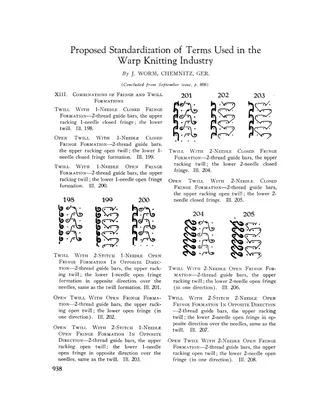
Concluding installment of J. Worm's proposal for standardized terminology in the warp knitting industry. It defines and numbers (Ills. 198-245) combinations of two guide bars: fringe formations (1- and 2-needle, open and closed) combined with twill, open twill, and atlas (plain, interlaced, back-racked) lappings. It ends with notes on suspending or shifting guide bars and a ruling on which bar is called the upper one.
Twisted Net Fabric, US Patent No. 1139344
Patent · 2 pages
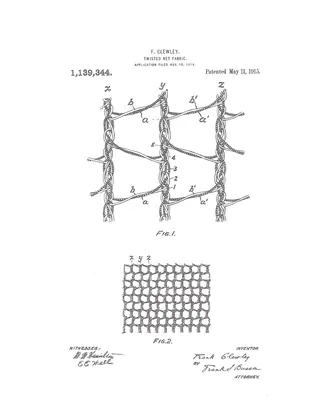
US Patent No. 1,139,344 granted to Frank Clewley of Philadelphia in 1915 for a twisted-net fabric. It describes an open-work knitted fabric made on a rib-lace machine with two guide bars, in which paired threads interloop in alternating chains so that torn or cut fabric cannot ravel far. The fabric is intended for laundry bags and dyers' bags. Two line drawings show the loop and chain construction.
Variety and Quantity of Knitwear Have Increased
China Pictorial, 1975
Illustration · 1 page
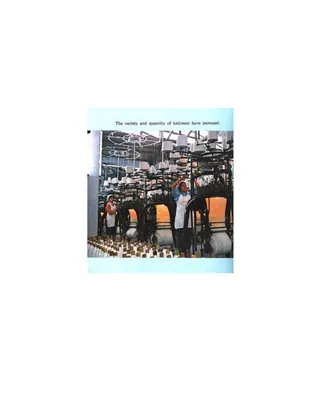
A single illustrated page from China Pictorial, 1975, with a photograph of a knitting mill. Rows of large circular knitting machines stand under overhead racks of yarn cones, with two female workers in white aprons at the machines. The only text is a caption saying the variety and quantity of knitwear have increased. The catalog notes place the mill in the Kwangsi Chuang Autonomous Region.
Warp Fabric, US Patent No. 519101
Patent · 3 pages
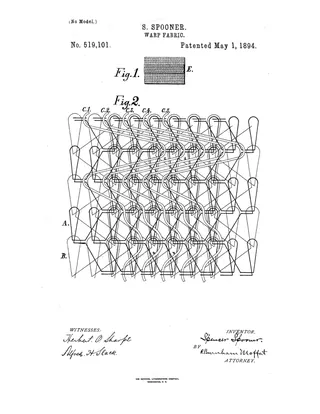
US Patent No. 519,101, granted May 1, 1894 to Spencer Spooner of Brooklyn, assignor to the Jennings Lace Works, for a warp-knitted (jersey-type) fabric of varying thickness. Extra inlaid threads are laid on the back surface only by a middle guide-bar on a warp machine, which thickens the fabric at the finger-tips of gloves, in parasols and similar articles. The text explains the guide-bar movements and needle traverses, with a patent drawing showing the thread paths, and ends with a single claim.
Warp-Knitted Fabric, US Patent No. 2691286
Patent · 3 pages
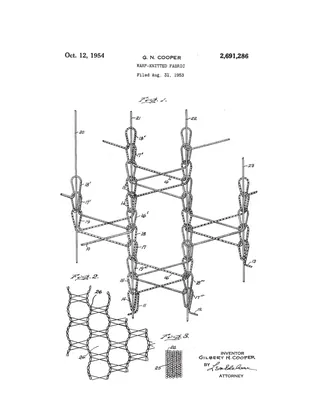
US Patent 2,691,286, granted 12 October 1954 to Gilbert N. Cooper of Elkins Park, Pa., for a warp-knitted mesh fabric. The fabric has knitted warp chains of paired principal loops and single auxiliary loops, locked by unknitted warp threads, producing twelve-sided meshes that look circular. It is made on a knitting machine, keeps its shape without stretching or sizing, has a perfect selvage and suits overlay decoration. It was intended for millinery and shoe mesh in nylon or other yarns, and it simulates lace-machine products. The scan includes the drawing sheet, specification, five claims and cited references.
Knitting
Article · 1 page
A short encyclopedia article defining knitting as forming a single yarn into a looped fabric with needles or wires. It distinguishes hand knitting from frame-work knitting, and describes needle types and materials, the main yarn fibers, and stitch variations such as purling and slipping. It also notes hand knitting as a domestic art and as a cottage industry in parts of Scotland, Ireland and the Shetland Islands.
Knitting and Crocheting for Children
Article · 1 page
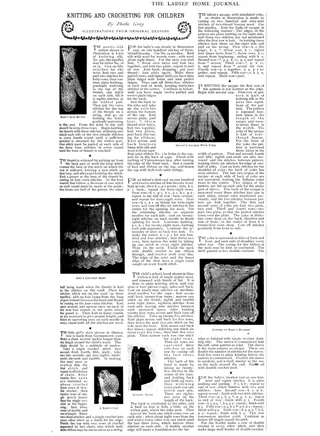
A single-page 1898 Ladies' Home Journal article by Phoebe Gray giving written instructions for knitted and crocheted children's items. Patterns cover a baby's silk mitten, a girl's crochet skirt, a baby's cap, an infant's shirt, a child's school hood, an infant's sacque with yoke, and a baby's blanket. Yarns named include knitting silk, Germantown yarn, Saxony wool and zephyr wool. Illustrated with photos of the finished pieces.
Knitting Department
Textiles, c. 1919-1920
Article · 3 pages
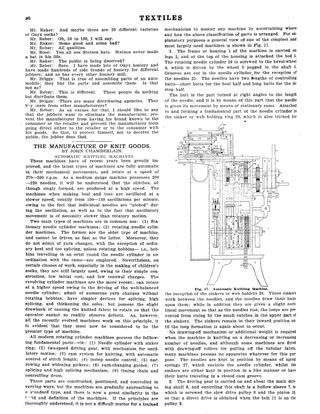
Three pages from the "Knitting Department" of the trade journal Textiles. The first part covers a warning to American manufacturers about currency exchange rates and imports, citing the closure of Hongkong knitting mills, and a congressional hearing on trademarks and jobber branding in the hosiery trade. The main part is the start of John Chamberlain's "The Manufacture of Knit Goods," which describes automatic hosiery knitting machines in detail, with a line drawing (Fig. 17) and numbered parts. It covers the needle cylinder, sinkers, driving gear, cams, narrowing and widening pickers, yarn changing, splicing, and the timing chain.
Knitting Machinery
Article · 5 pages
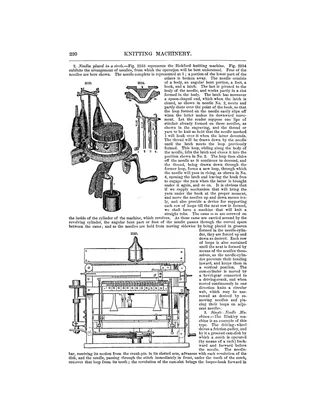
A five-page encyclopedia article from Appletons' Cyclopaedia of Applied Mechanics on knitting machinery as of the 1880s. It covers the manufacture and gauging of spring-beard knitting needles, hosiery yarn designation, and hand knitting machines (straight-bed, circular, and single-needle types such as the Lamb, Bickford and Hinkley machines). It then describes power machines, both straight and circular, the Tompkins upright rotary machine with its output figures, and the Tompkins cone-winder. Illustrated with engravings and diagrams of needle action.
Knitting-Machine
Article · 5 pages
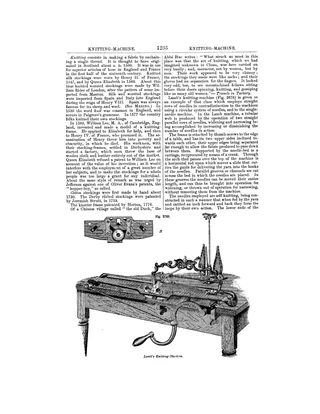
Encyclopedia entry on the knitting machine from Knight's American Mechanical Dictionary. It opens with the origins of knitting and distinguishes it from braiding, netting and weaving, then gives a brief history from Scotland c. 1500 through William Lee's 1589 stocking frame and later English patents. The main part describes how several machine types work, illustrated with engravings: Lamb's straight two-bed machine, the Bickford circular machine, Hinckley's single-needle machine, an ordinary circular tube machine, and a flat-web machine. It ends with a glossary of technical names for knitting-machine parts.
Pretty Designs in Knitted Lace
Article · 2 pages
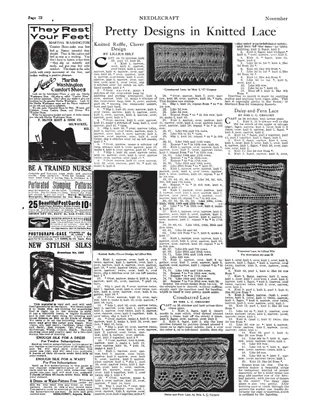
Two scanned pages from Needlecraft Magazine presenting row-by-row instructions for several lace patterns. Knitted patterns are a clover-design ruffle, crossbarred lace, daisy-and-fern lace and Francesca lace. A coronation-braid and crochet medallion and insertion pattern is also included. Photographs illustrate each piece, and the pages also carry a short mending hint and period advertisements.
Priscilla Cotton Knitting Book
Priscilla Publishing Co., 1918
Monograph · 51 pages
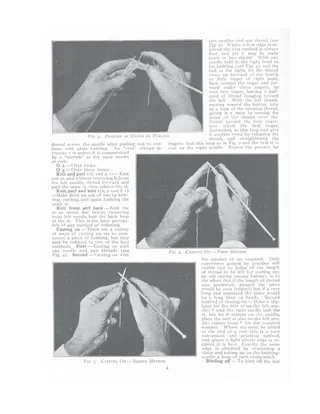
A 1918 Priscilla Publishing Co. pattern book of knitted cotton, linen and silk articles, edited by Belle Robinson. It opens with an introduction and basic instruction in knitting (holding needles, casting on, plain, purl, ribbing, moss stitch, fagoting), then gives row-by-row directions for cameo (two-colour) knitting, lace insertions and edgings, filet knitting with charts, Torchon-pattern collars, baby bonnets, bags, doilies, counterpane blocks and large centrepieces. Most pages carry photographs of the finished pieces, with some charts for cameo and filet designs. Advertisements for the Priscilla Initial Outfit and Modern Priscilla magazine appear at the front and back.
Stocking Frame
Article · 1 page
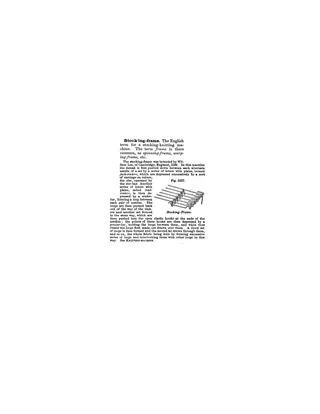
A short dictionary entry on the stocking-frame, the English term for a stocking-knitting machine, invented by William Lee of Cambridge in 1589. It explains how jack-sinkers, lead-sinkers, the slur-bar and the presser-bar form and interlock loops on a row of hooked needles. An engraving (Fig. 5837) shows the machine.
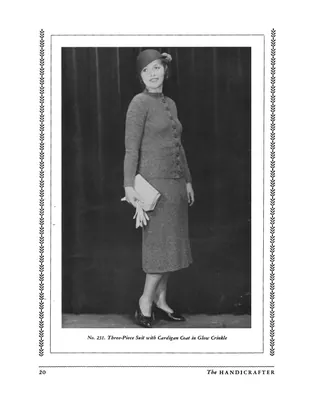
Three-Piece Suit with Cardigan Coat in Glow Crinkle
Handicrafter, December/January 1932-1933
Article · 4 pages
Knitting instructions from The Handicrafter for a three-piece outfit (No. 231) in size 16: a circular-needle skirt and a cardigan coat in Glow Crinkle yarn (Wine), plus a Popcorn Stitch pullover sweater in Lady Helen yarn (Tan). Gives materials, needle sizes, stitch counts and shaping for backs, fronts, sleeves, cuffs, neck bands and buttoned front bands. The last page also carries the end of a crochet lace dress pattern, including a collar, a wire-brimmed hat and a bow, in Glow Crinkle.
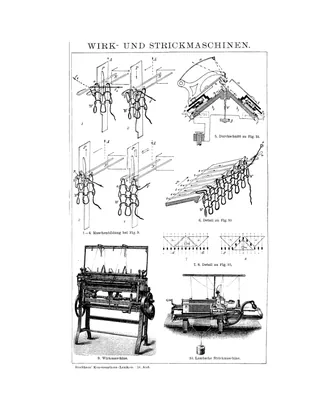
Wirkmaschine [Hosiery Machine]
Article · 6 pages · German
A German encyclopedia article on the knitting or hosiery machine (Wirkmaschine) from Brockhaus' Konversations-Lexikon, 14th edition. It explains the difference between weft-knitting (Kulierstuhl) and warp-knitting (Kettenstuhl) frames, flat and circular machines, and the hook and latch needles, sinkers and presser used in loop formation. It covers William Lee's 1589 hand frame, the Paget and Cotton frames, and the Lamb flat knitting machine of 1866, and lists literature on the subject. A plate of numbered illustrations shows stitch formation, machine sections and details.
244 documents found