Textile Documents › Topic: Inventors and inventions
648 documents found
Sort: 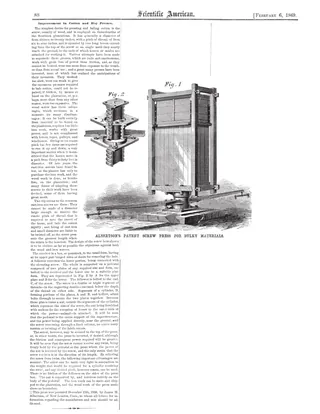
Improvement in Cotton and Hay Presses
Scientific American, February 6, 1869
Article · 1 page
A Scientific American article describing James M. Albertson's patented screw press for baling cotton and hay, patented December 15, 1868. It reviews the traditional wooden screw presses used on Southern plantations and the drawbacks of cast-iron screws. It then explains the new design, in which a fixed pedestal and a rotating nut keep the screw from twisting. One engraving shows the press.
Death of a Distinguished English Inventor [Samuel Hall]
Scientific American, 1854
Article · 1 page
A short obituary notice in Scientific American for Samuel Hall of Basford Hall, near Nottingham, who died aged 82. It credits him with the gassing of lace, in which a gas flame was drawn through the lace by a vacuum to burn off loose fibers, and with the bleaching of starch. It also mentions his marine engineering patents, including a surface condenser for steam, smoke combustion and a paddlewheel reefing device, and his family connections.
Eli Whitney, the Inventor of the Cotton Gin
Cassier's Magazine, 1899
Article · 6 pages
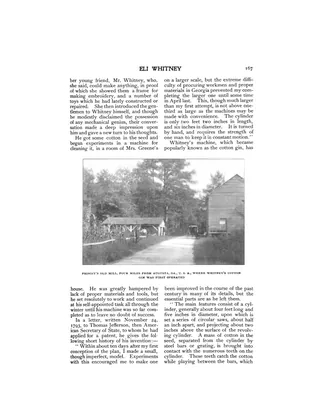
A biographical sketch of Eli Whitney (1765-1825) from Cassier's Magazine, covering his youth in Massachusetts, his years at Yale, and his invention of the cotton gin in Georgia in 1793. It describes the gin's saw cylinder, brushes and fan, the patent disputes and lawsuits that kept him from profiting, and the state payments for patent rights. It also covers his musket contract with the US government and his system of interchangeable parts, and closes with notes on his character and household inventions. Illustrated with a portrait and a photograph of Phinizy's Old Mill near Augusta, Georgia, where the gin was first operated.
Sewing Machine
Zell's Encyclopedia, 1876
Article · 1 page
A short encyclopedia entry on the sewing machine, describing it as a major invention of the 19th century. It recounts Elias Howe's patent, his difficulties selling it in England and the U.S., and his later success in court. It briefly classifies machines by single-thread and double-thread stitching and mentions special-purpose machines for shoes, gloves and embroidery.
Arkwright, Sir Richard
Article · 2 pages
Encyclopedia article on Sir Richard Arkwright (1732-1792), English inventor of the spinning frame. It covers his early life as a barber in Bolton, the development and 1769 patent of the water-powered spinning frame, and his mills at Nottingham and Cromford with Jedediah Strutt and Samuel Need. It also covers the patent lawsuits of 1781-1785, in which his patents were cancelled, the destruction of his mill near Chorley in 1779, and his knighthood in 1786 and death in 1792.
Chronological Events in the Textile Industry
Article · 2 pages
Two pages from the March 1911 issue of Posselt's Textile Journal. They carry the end of an article on sizing, covering antiseptics for size such as zinc chloride, formaldehyde and carbolic acid, followed by an installment of a chronology of textile industry events from 1606 to 1740. The chronology covers inventions like the stocking frame, fly shuttle and roller spinning, plus the start of carpet, lace, silk and calico industries. The pages end with a directory of textile trade marks registered in February 1911.
Cloth Shearing Machine of Leonardo Da Vinci
Article · 4 pages
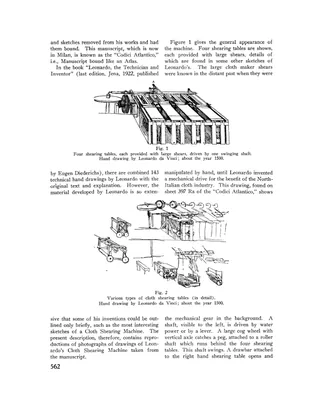
Article by Franz M. Feldhaus describing Leonardo da Vinci's designs, from about 1500, for a mechanically driven cloth shearing machine. It opens with a short biography of Leonardo and the fate of his manuscripts, then goes through six drawings from the Codex Atlanticus. These show four shearing tables driven by a swinging shaft, tension rolls, gearing, spring and springless shear mechanisms, and Leonardo's own notes. It ends by noting that Everett of Wiltshire invented a similar machine in 1758.
"Eli Whitney" in Leading American Inventors
Monograph · 31 pages
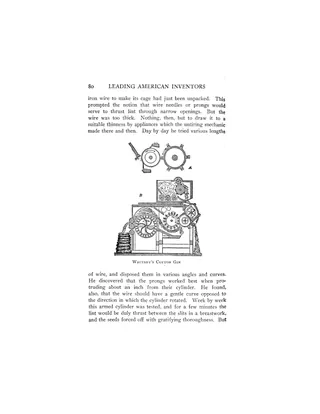
A biographical chapter on Eli Whitney (1765-1825) from George Iles's Leading American Inventors. It follows his Massachusetts boyhood, Yale education, and invention of the cotton gin at Mulberry Park, Georgia, then the patent battles with Georgia and South Carolina and the Hodgen Holmes saw-gin infringement. It ends with his move to musket manufacture at New Haven and his early use of interchangeable parts. Illustrations include a portrait, an engraving of the gin and a photograph of a gin.
The Power Loom
Article · 6 pages
A biographical essay in Household Words on Edmund Cartwright (1743-1823), the clergyman and poet who invented the power loom. It covers his early life and friendship with the poet George Crabbe, the 1784 conversation at Matlock that set him on the idea, his patents of 1785 onward, his Doncaster mills, and the opposition and losses he suffered. It also follows his later inventions, his agricultural work at Woburn and the Parliamentary grant of £10,000. It includes figures on the growth in the number of power looms in England and Manchester.
The Silk Stocking an Inventor's Fate
Article · 2 pages
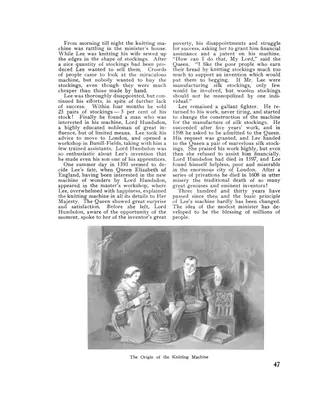
A short, popular and somewhat romanticized account of William Lee, the English clergyman who invented the stocking frame (mechanical knitting machine) in 1589-1593. It tells how he was moved by watching his sweetheart Mary hand-knit, built the machine, moved to London under Lord Hunsdon's patronage, and was refused a patent by Queen Elizabeth I, even after producing silk stockings in 1598. Lee died in poverty in 1608. A halftone illustration titled "The Origin of the Knitting Machine" accompanies the text.
"Whitney and the Cotton-Gin: 1765-1825" in Historic Inventions
Monograph · 15 pages
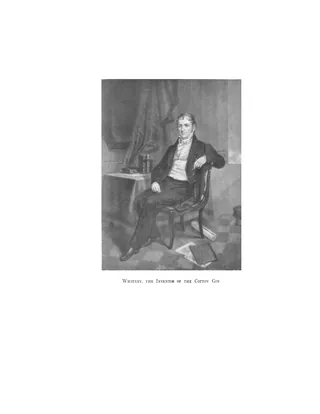
A chapter on Eli Whitney (1765-1825) and his invention of the cotton-gin in 1793, drawn from a book on historic inventions. It follows his Georgia years, his partnership with Phineas Miller, the crowds and pirated copies that undermined his patent, and the lawsuits and state patent-right sales that brought little profit. It closes with the 1807 court decision in his favor, his turn to firearms manufacture, and his failed 1812 patent renewal. Includes letters from Whitney and Miller and a plate portrait.
Whitney, Eli
American Cyclopedia, 1883
Article · 1 page
A one-page encyclopedia entry on Eli Whitney (1765-1825), American inventor of the cotton gin. It covers his Yale education, his work in Georgia, the theft of his machine, patent infringement, and legislative payments from southern states. It also describes his turn to manufacturing firearms with interchangeable parts at Whitneyville, Connecticut.
Whitney, Eli
Chambers's Encyclopedia, 1881
Article · 1 page
A short encyclopedia biography of Eli Whitney (1765-1825), the American inventor of the cotton gin. It covers his Yale education, his time in Georgia, the invention of the gin to separate cotton from seed, the patent lawsuits that consumed his profits, and his later success manufacturing firearms with interchangeable parts at Whitneyville, Connecticut.
Whitney, Eli
Article · 1 page
Encyclopedia Britannica (11th ed.) biographical article on Eli Whitney (1765-1825), American inventor of the cotton gin. It covers his Yale education, his time on Mrs Greene's Georgia plantation, the design of the gin, the patent and partnership with Phineas Miller, the patent litigation, and his later firearms manufacture using standardized parts. It ends with a short list of references.
Whitney, Eli
Article · 3 pages
Encyclopedia entry on Eli Whitney (1765-1825), inventor of the cotton gin. It covers his Yale education, his time in Georgia with Mrs. Greene, the invention of the saw-gin, his partnership with Phineas Miller, and the patent disputes. It also discusses the gin's effect on cotton production and slavery, and his later firearms manufacture. Includes an engraved portrait.
Whitney, Eli
Article · 1 page
A one-page encyclopedia entry on Eli Whitney (1765-1825), the American inventor of the cotton gin. It covers his education at Yale, his work in Georgia on a machine to separate cotton seed from fibre, the patent litigation that consumed his profits, and his later firearms manufacture at Whitneyville, Connecticut, using interchangeable parts.

Whitney, Eli
Zell's Encyclopedia, 1876
Article · 1 page
A short biographical encyclopedia entry on Eli Whitney, born in Westborough, Massachusetts, in 1765, inventor of the cotton gin. It describes his partnership with Miller, the lawsuits that consumed his profits, and his later success manufacturing firearms at Whitneyville, Connecticut, using division of labor and interchangeable parts. He died in 1825.
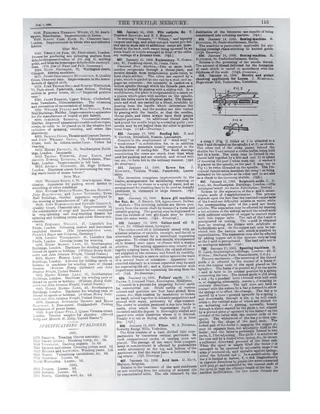
Application for Patents
Textile Mercury, 1889
Article · 3 pages
Three pages from The Textile Mercury of June 1, 1889 (pp. 114-116), mainly listing British patent applications filed 20-24 May 1889 and abridged specifications published, with two line diagrams of a loom shuttle-checking strap and drawings of a bobbin-winding stop-motion and a spinning mule delivery mechanism. The pages also include a closing passage on the US tariff classification of worsted versus woollen cloths, joint stock and financial news for Oldham cotton spinning companies and new companies, Gazette bankruptcy notices, and an index to advertisers.
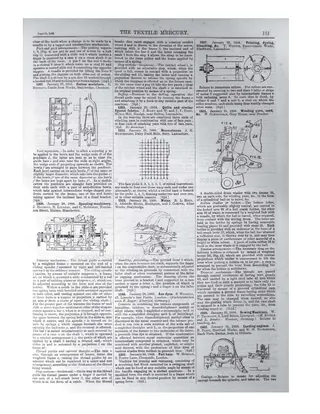
Application for Patents
Textile Mercury, 1889
Article · 3 pages
Three pages from the Textile Mercury of 15 June 1889 (pp. 150-152) covering the patents section of the trade journal. They list British patent applications filed 29 May to 1 June 1889 and notices of applications to amend dye patents held by Farbenfabriken vormals Bayer. They also list published specifications and abstracts of 1888 patents on looms, drop-box motions, spooling, carding, mules, beaverteens, quilts, woven trade marks, dyes and wool washing, with line diagrams. The pages open with bankruptcy and dissolved-partnership notices and close with an index of advertisers.
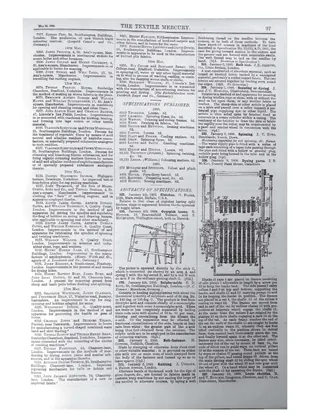
Application for Patents
Textile Mercury, 1889
Article · 3 pages
Three pages from The Textile Mercury of 25 May 1889 centered on British patent news. They list patent applications filed 13-18 May 1889 (looms, reeds, shuttle guards, jacquard card punching, carding, spinning, dyeing and finishing), specifications published, and abstracts of 1888 specifications, some with drawings of an overpick loom picker, a yarn dyeing frame, a loom shuttle, a rotary dipping wheel and a wet twisting frame. The pages also carry a French duty table for textiles, company and share news for Lancashire cotton mills, Gazette bankruptcy notices, and an advertisers' index.
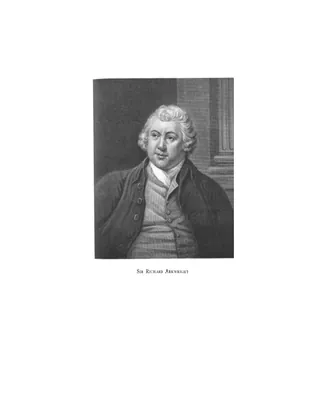
"Arkwright and the Spinning-Jenny: 1732-1792" in Historic Inventions
Monograph · 13 pages
A short biographical chapter on Sir Richard Arkwright (1732-1792), taken from the book Historic Inventions. It follows his move from barber and wig dealer to inventor of the roller-drawing spinning frame and founder of the Cromford and Manchester cotton mills. It covers Hargreaves' spinning-jenny, the hostility of hand spinners, his patents of 1769 and 1775, the patent lawsuits, the duties on calicoes, and his knighthood. A portrait of Arkwright is included.
Arkwright, Sir Richard
Chambers's Encyclopedia, 1881
Article · 2 pages
Two pages from Chambers's Encyclopedia (1881) covering the later career of Sir Richard Arkwright, inventor of the cotton spinning-frame. It describes the roller spinning machine, his partnership with Jedidiah Strutt, his mills at Nottingham and Cromford, and his patent disputes and lawsuits. It also covers hostility from rival manufacturers and workers, his knighthood and high-sheriff appointment, and his death in 1792.
Arkwright, Sir Richard
Encyclopaedia Perthensis, 1803
Article · 1 page
A short biographical encyclopedia entry on Sir Richard Arkwright, inventor of machinery for spinning and carding cotton. It traces his path from barber at Wirksworth to cotton-spinning entrepreneur, mentioning John Kay the clockmaker, his patent, his partnership and mills at Nottingham and Cromford, his knighthood in 1786, and his death in 1793.
Arkwright, Sir Richard
English Encyclopedia, 1867
Article · 3 pages
Encyclopedia biography of Sir Richard Arkwright (1732-1792), inventor of the water-frame for roller spinning of cotton. It covers his early career as a barber and wig-dealer, his patents of 1769 and 1775 and the legal disputes over them, the roller-drawing mechanism, and the mills at Cromford and with Jedediah Strutt. It also describes how his strong cotton warp yarn enabled all-cotton calicoes, the growth of cotton imports, and his family and character.
Arkwright, Sir Richard
Ottův slovník naučný, 1897
Article · 1 page · Czech
A short Czech encyclopedia entry on Sir Richard Arkwright (1732-1792), the English mechanic and industrialist. It covers his origins as a barber and wig dealer, his cotton spinning machine of 1767, the horse-driven mill in Nottingham and the water-powered mill at Cromford, and the lawsuits that overturned his patent. It also notes the public hostility toward him, his knighthood and his wealth.
Chronological Events in the Textile Industry
Article · 2 pages
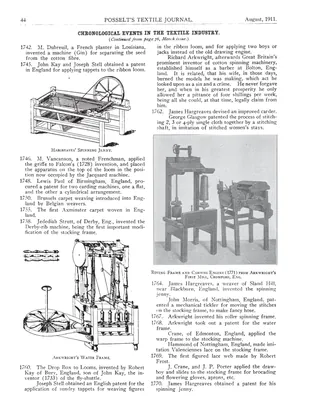
Installment of a chronological list of textile industry inventions and events from 1742 to 1783, published in Posselt's Textile Journal, August 1911, and continued from the March issue. Entries cover cotton gins, ribbon looms, carding machines, the spinning jenny, Arkwright's water frame, Crompton's mule, Almond's hand loom, power loom attempts, stocking frames, lace machines, and early American mills. Illustrations show Hargreaves' jenny, Arkwright's water frame, a roving frame and carding engine, Almond's loom, and Crompton's mule. A short unrelated note on removing nap from cotton yarns with konnyaku before mercerising ends the second page.
Chronological Textile Events
Article · 3 pages
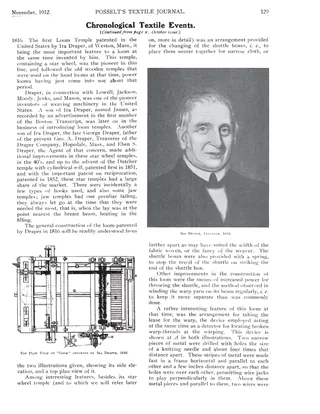
Installment of Posselt's "Chronological Textile Events" from the November 1912 issue, covering 1816. It describes in detail Ira Draper's 1816 loom and his patented star wheel temple, including the warp lease and broken-thread detector, the sizing rollers, the brush and the shuttle box arrangements. It then lists other 1816 textile events, such as power loom and loom reed patents, British lace and knitting inventions, and Jefferson's statement on domestic manufactures. Illustrated with a portrait of Draper and engravings of the loom and temple.
Correspondence Relating to the Invention of the Jacquard Brussels Carpet Power Loom
Alfred Mudge & Son, 1868
Monograph · 10 pages
A printed 1868 exchange of letters between English inventor William Wood and American inventor Erastus B. Bigelow over who first invented the power loom for weaving Jacquard Brussels carpets. Wood claims priority for changes to tension weights, the lifting of the mounture in place of the poll shaft, and the placement of the ground-warp heddles. Bigelow replies with his own invention dates (1836 terry-fabric loom, 1845 carpet loom), patent details, the 1842 US Patent Office rejection of Wood's application, and the jury report from the 1851 Great Exhibition in London.
The Mule-Maker
Article · 4 pages
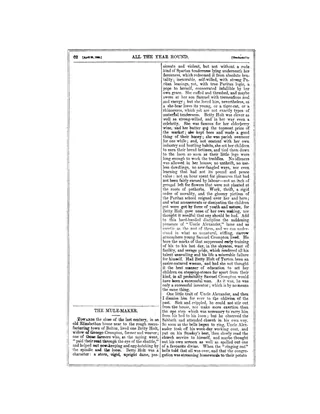
A magazine article from All The Year Round presenting a biography of Samuel Crompton, inventor of the spinning mule, set in Bolton, Lancashire. It describes his stern upbringing, the mechanical inventions that unbalanced spinning and weaving (Kay's fly-shuttle and drop-box, Hargreaves's jenny, Arkwright's frame), and Crompton's years of experiments on a muslin wheel. It follows his loss of control over the invention, the meagre parliamentary grant, the rise and fall of muslin weavers' wages, and his death in obscurity.
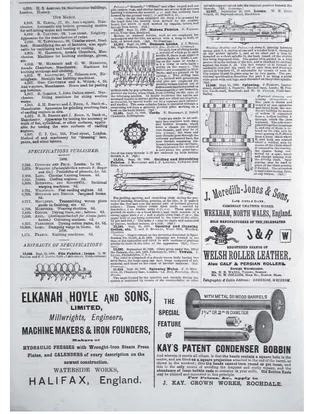
Patents
Textile Mercury, 1890
Article · 2 pages
Two pages from The Textile Mercury of March 22, 1890, combining a table of wool-goods tariff rates (France, Belgium, Russia, Norway), British trade gazette notices, and the patents column. The patents section lists applications filed 10-15 March 1890 and published specifications, then abstracts of 1888 patents for pile carpet looms, damask loom knives, lace-machine cords, cloth-stretching rollers, towels, shuttle checking and spinning. The page also carries advertisements for leather rollers, hydraulic presses and condenser bobbins.
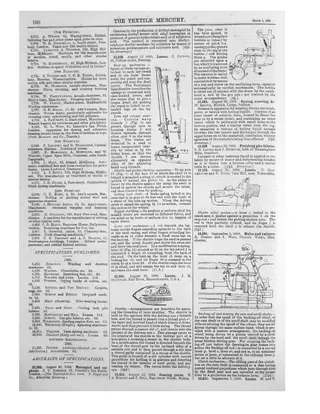
Patents
Textile Mercury, 1890
Article · 3 pages
Three pages from The Textile Mercury of 1 March 1890 (pp. 159-161), mainly the patents column: lists of British patent applications filed 17-22 February 1890, published specifications, and abstracts of 1888 specifications, most of them for looms, shuttles, spinning and doubling frames, and knitting machines. The abstracts have line drawings of loom beat-up, picker-checking, shuttle-threading, shedding and ribbon take-up mechanisms. The pages also carry trade news on the Kidderminster carpet trade, new company registrations, Gazette bankruptcy notices, and a directory of textile machinery makers.
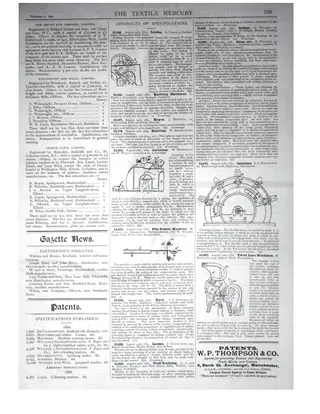
Patents
Textile Mercury, 1891
Article · 1 page
A single page from The Textile Mercury of 7 February 1891 with British textile trade news. It lists newly registered companies (Arctic Fur Company, Wainwright and Riley, George Lumb), partnerships dissolved, and patent specifications published in 1890. It also gives abstracts of patents filed in August 1889 for looms, picking motions, knitting machines, rope making, card clothing grinding, pile fabric machines, wool washing, indigo and azo dyes, carding engines and twist lace machines.
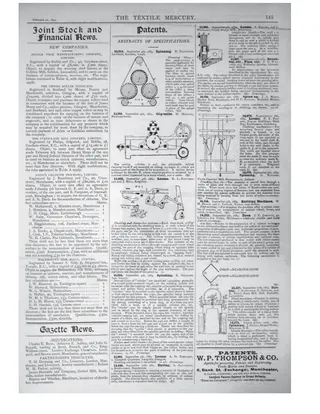
Patents
Textile Mercury, 1891
Article · 1 page
A single page from The Textile Mercury of 21 February 1891 combining company and financial news with abstracts of British textile patent specifications. It lists new companies (cotton mills, silk mills, a copper roller syndicate, a chlorine process company), Gazette notices, and patent abstracts from September 1889 on spinning, looms and shedding mechanisms, shuttle-box swells, gig-mills, knitting machines, flax breaking and dyeing. Machinery diagrams accompany several of the patents.
Patents
Textile Mercury, 1891
Article · 1 page
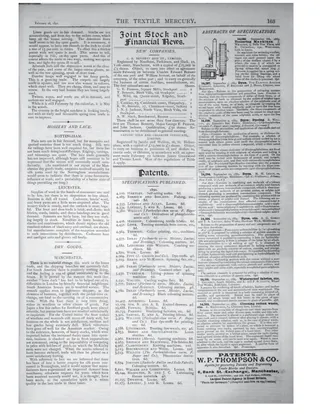
A single page from The Textile Mercury of 28 February 1891 headed Patents. It lists British patent specifications published in 1890 (looms, spinning, knitting, dyes, and similar subjects), followed by abstracts of several 1889 specifications covering a tentering machine, azo dyes, waterproofing fabrics and cleaning cotton waste. The page also carries trade reports for linen, hosiery, lace and dry goods, and new company registrations.
Patents
Textile Mercury, 1891
Article · 2 pages
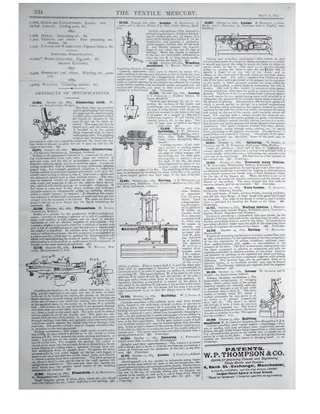
Two pages from The Textile Mercury, 28 March 1891 (pp. 233-234), combining regional textile trade reports, company and bankruptcy news, and British patent lists. The patent section lists specifications published in 1890-91 and gives abstracts of patents filed in October 1889. The abstracts cover looms (shedding, picking, shuttle stop-motions, shuttle guards, pattern pegs), knitting machines, carding, spinning, dyeing, bleaching, winding and stentering.
Patents
Textile Mercury, 1891
Article · 1 page
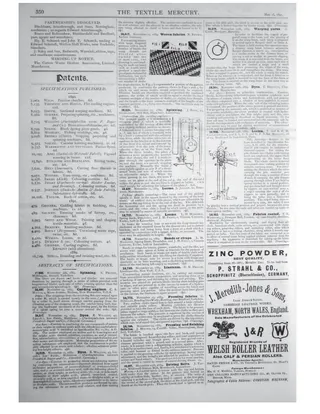
A single page of the Textile Mercury (16 May 1891, p. 350) with the patents column: lists of dissolved partnerships, specifications published in 1890 and 1891, and abstracts of specifications filed in November 1889. Abstracts cover spinning, carding engines, azo dyes, looms (leno, picking spindle, pile carpet), woven bands and driving belts, warping, and fabric pressing and finishing. One abstract (Reiser, No. 18,617) describes combining two small diagonal twill drafts on six and seven shafts to produce a large diagonal pattern on thirteen shafts.
Patents
Textile Mercury, 1891
Article · 1 page
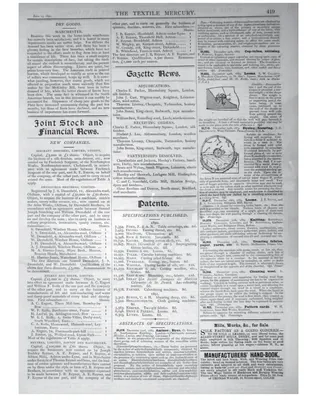
A single page from The Textile Mercury of 13 June 1891 (p. 419) combining trade news with a patents section. It includes a Manchester dry goods market report, notices of new textile companies, bankruptcy and partnership gazette lists, and a list of published patent specifications for 1890-91. Abstracts describe patents for shuttles with tension weights and weft clearers, a dyeing and scouring drum, knitting, fabric treatment, wool cleaning and pattern-card apparatus, with two small illustrations.
Patents
Textile Mercury, 1891
Article · 1 page
A single page from The Textile Mercury, 23 May 1891, with British trade news and a list of published patent specifications. The market reports cover Glasgow wool and sheep skins, the Dundee flax and jute trade, and Manchester dry goods, followed by Gazette notices of partnerships dissolved, adjudications and receiving orders. The patents section lists specifications filed in November 1889 for spinning, dyeing, knitting, looms, lace-making, scutching and related machinery, with drawings of a hank-dyeing machine, a rotary dash-wheel dyer and a loom picking motion.
Patents
Textile Mercury, 1891
Article · 1 page
A single page from The Textile Mercury of 27 June 1891 (p. 455) covering British textile trade news and patents. It lists new company registrations (including Brinton's Limited, a carpet and worsted yarn firm in Kidderminster), Gazette notices of adjudications, dissolved partnerships and winding-up, and patent specifications published in 1890 and 1891. It also gives abstracts of patents for a dobby, carding, spinning, doffing, a figured Mitcheline cloth, a dyeing drum apparatus and a winding machine, with mechanical diagrams.
Recent Textile Patents
Textile World Record, January 1906
Article · 2 pages
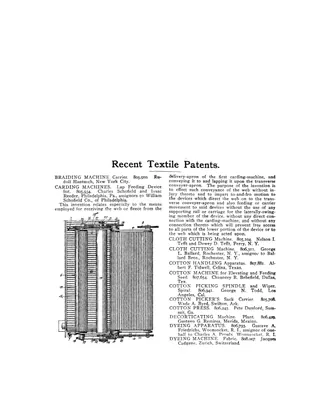
A two-page list of U.S. textile-related patents issued around late 1905 and early 1906, arranged alphabetically by subject with patent numbers, inventors, locations, and assignees. Only the carding machine lap-feeding device (805,934) is described in any detail. Most entries cover looms and loom attachments (warp stop motions, let-off, take-up, lappet, narrow ware, pile fabric), spinning machinery, cotton handling, and dyeing apparatus. One entry is for a weaving diagram and method of making it (805,244, Jan Szczepanik).
Biography of an Inventor [E. B. Bigelow]
Scientific American, 1854
Article · 1 page
A Scientific American editorial from February 1854 reviewing a biography of power-loom inventor Erastus B. Bigelow, published in Hunt's Merchant's Magazine and written by N. Cleveland. The editors argue the biography exaggerates Bigelow's feat of inventing a coach-lace power loom in six weeks, noting Jacquard's earlier work on figured-fabric looms. They still credit Bigelow with carpet power-loom improvements, many patents, his Lancaster, Mass. carpet factory, and power-woven silk brocatelles shown at the Crystal Palace.
Patents
Textile Mercury, 1890
Article · 2 pages
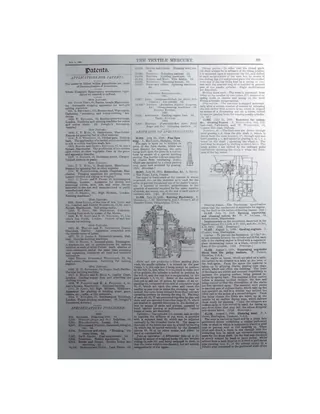
Two pages from The Textile Mercury, 1 February 1890 (pp. 89-90), listing British textile patents. They cover applications filed 20-25 January 1890, published, amended and later-edition specifications, and abstracts of 1888 specifications. The abstracts include flax spinning pirns, knitting machinery for heels and toes, straight bar knitting, wool cleaning, fibre separation, elastic and fireproof fabrics, and pile-fabric apparatus for rugs. A directory of textile machinery makers follows.
Patents
Textile Mercury, 1890
Article · 1 page
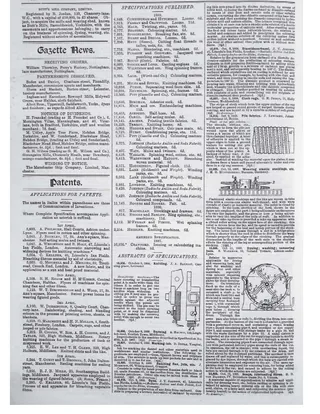
A single page from the Textile Mercury (1890) with textile trade news and British patent listings. It covers company registrations, Gazette notices (receiving orders, dissolved partnerships, dividends), patent applications for April, published specifications, and abstracts of 1888 patents. The abstracts deal with knitting machines, pile fabrics, cloth rugs, woven elastic stockings, dyes from carbazol, hat dyeing apparatus and fibre lubricants.
Patents
Textile Mercury, 1890
Article · 2 pages
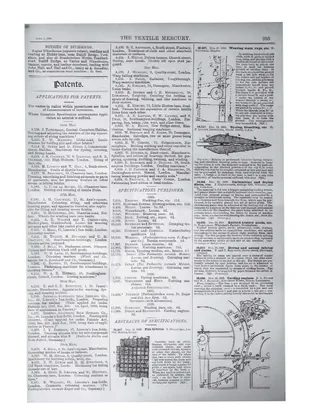
Two pages of patent notices from The Textile Mercury, issue of June 7, 1890. They list British patent applications filed 24-31 May 1890, published specifications, and abstracts of specifications from December 1888 with some mechanical illustrations. The abstracts cover looms (jacquards, dobbies, temples, let-off and reed motions), pile fabrics and velvets, mat and rug weaving, dyeing machinery and processes, carding engines, knitting, and related machinery.
Patents
Textile Mercury, 1890
Article · 2 pages
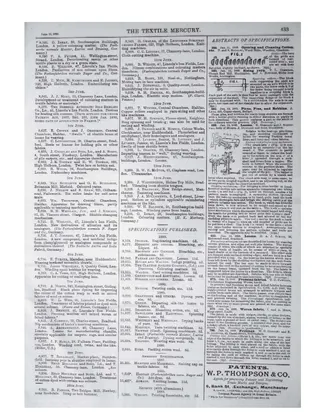
Two pages from The Textile Mercury, 21 June 1890 (pp. 432-433), covering British textile patents. They list patent applications filed 2-14 June 1890, specifications published, amended specifications and abstracts of specifications from early 1889. Subjects include looms, shuttles, spinning, dyeing, lace, embroidery and knitting machines. The first page also carries market reports (silk, dry goods, Nottingham lace, Kidderminster carpets), new company registrations and Gazette notices.
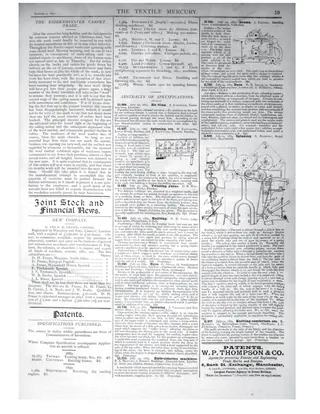
Patents
Textile Mercury, 1891
Article · 1 page
A single page from The Textile Mercury of January 3, 1891, mainly listing British textile patents: specifications published and abstracts of 1889 applications covering knitting, spinning, doffing, twisting, looms and dobbies, embroidering machines, reeling, and dyes. It also carries a short report on the Kidderminster carpet trade and a new-company notice for D. and D. H. Fraser, Limited. Line drawings of a doffing clip, a dobby mechanism and a reeling machine accompany the abstracts.
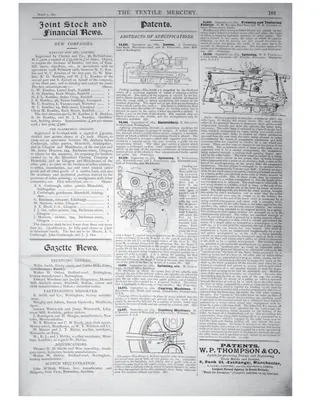
Patents
Textile Mercury, 1891
Article · 1 page
A single page from The Textile Mercury (7 March 1891, p. 181) with company registration news, bankruptcy and partnership notices from the London Gazette, and abstracts of British patent specifications filed in September 1889. The patents cover a frictional loom picking motion, an embroidery machine thread carrier, carding engine flat grinding, spindle drives, combing machines, a pressing and tentering machine, and a long entry on a mule spinning machine. Three patent drawings are included, and the page ends with an advertisement for a patent agent.
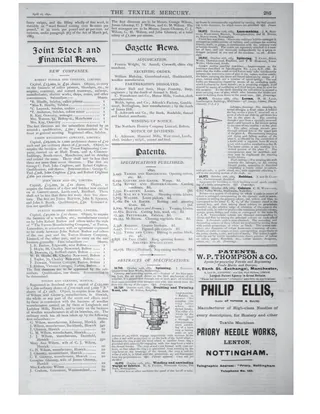
Patents
Textile Mercury, 1891
Article · 1 page
A single page from The Textile Mercury of April 18, 1891, covering British textile trade news. It lists new joint-stock companies (calico printers, engineers, dyers, hosiery and woollen manufacturers), Gazette notices of bankruptcies and dissolved partnerships, and published patent specifications with abstracts. The abstracts cover spinning, combing, stop-motions, twist-lace machines, loom selvage forming and weft cutting, and a patent for a colour system based on the musical scale.
Sir Richard Arkwright
Rees's Cyclopedia, 1819
Article · 1 page
A biographical encyclopedia entry on Sir Richard Arkwright, who rose from country barber to wealthy manufacturer through machinery for carding and spinning cotton. It explains the principle of his drawing rollers and rotary carding engines, and the role of John Kay, Peter Atherton, Mr. Smalley and others in developing the first engine. It also covers the Nottingham cotton mill, the patent dispute, his knighthood in 1786 and his death at Cromford in 1792.
Chronological Events in the Textile Industry
Article · 2 pages
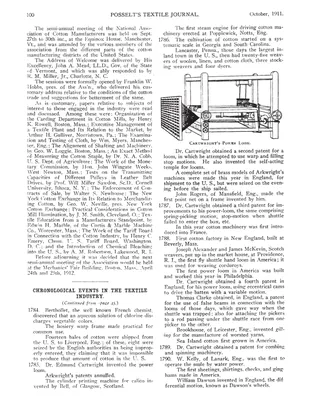
Two pages from Posselt's Textile Journal, October 1911. The main item is an installment of a chronology of textile industry events for 1784-1792, covering inventions such as Cartwright's power loom patents, Arkwright's patents, early cotton mills and looms in America, and cylinder printing. The pages also contain a description of the Globe Machine & Foundry Co. spindle-driven beam warper for silk, and a short note on a German patent for printing a pattern on both sides of a fabric. The page opens with a report on the National Association of Cotton Manufacturers meeting.
648 documents found