Textile Documents › Topic: Hand looms
603 documents found
Sort: 
Adjustments
Article · 1 page
A short 1930 article by C. J. Burchard on the correct adjustment of the tie-up on a handloom, covering the lamms, treadles and the cords joining them. He recommends placing a rigid support under the treadles and a clamp or rod on the lamms, then tying each cord from the back forward with even tension. He says this gives a clean shed, treadles in alignment and good clearance above the floor.
Double Tie-Up Loom - 1
Master Weaver, September 1953
Article · 2 pages
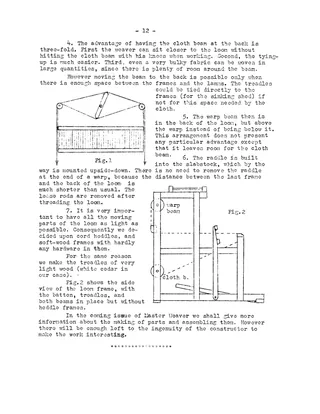
A 1953 Master Weaver article proposing the design of a loom for advanced amateur weavers, built at home from hardware-store parts. It lists seven features: double tie-up with side-by-side floating lamms, friction brakes on both beams, a cloth beam at the back, a warp beam on top, a built-in raddle, and very light cord-heddle frames. Each feature is explained, and two figures show the lever and pulley arrangement and a side view of the frame. Construction details are promised for a later issue.
Double Tie-Up Loom - 3
Master Weaver, November 1953
Article · 2 pages
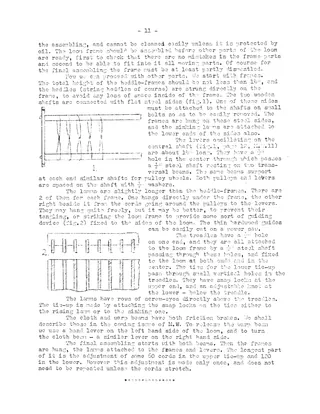
Third installment of a series on building a double tie-up loom, covering the materials list and construction steps. It gives approximate quantities of lumber, hardware, pulleys and cord, and explains how to scale up the plans from the previous issue's drawing. It then describes making the loom frame, heddle frames, levers, lamms, treadles and tie-up, and the final assembly. Brakes for the beams are deferred to the next issue.
Fish Hooks On A Loom
Article · 1 page
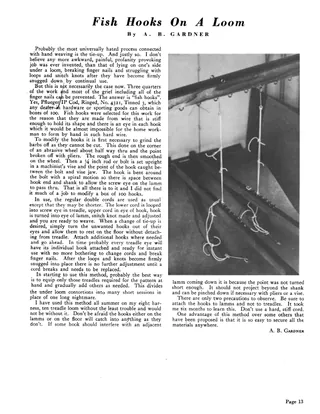
A short 1939 article in which A. B. Gardner describes using modified fish hooks to simplify the treadle tie-up on a hand loom. He explains how to grind off the barbs, bend the hooks, and attach them between lamms and treadles with cords and snitch knots so tie-ups can be changed without lying under the loom. He reports using the method on an eight-harness, ten-treadle loom and lists two precautions. A photograph shows the under-side of a loom fitted with the hooks.
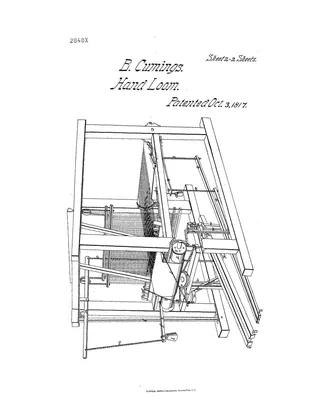
Hand Loom, US Patent No. X0002848
Patent · 2 pages
Two sheets of patent drawings for a hand loom patented October 3, 1817 by B. Cummings (spelled Cumings on sheet 1). The drawings show a side elevation and a perspective view of a wooden-framed loom with warp and cloth beams, a batten with reed, heddle mechanisms, treadles and levers, and a ratchet and pawl take-up. The scan contains only drawings with numbered callouts and no descriptive text.
Handwebstuhl [Handloom]
P. B. van Haver · July 13, 1928
Patent · 3 pages · German
German Reich patent specification no. 461982 for a hand loom by Etablissements P. B. Van Haver of Hamme-sur-Durme, Belgium. The loom derives the harness (shaft) movement from the swinging motion of the beater, using a rocker arm on the beater, notched rods attached to the shafts, and a pivoting switch and bracket that alternately engage the rods to form the shed. The document gives the description, one patent claim, and a sheet of five drawings (Abb. 1-5) showing the mechanism.
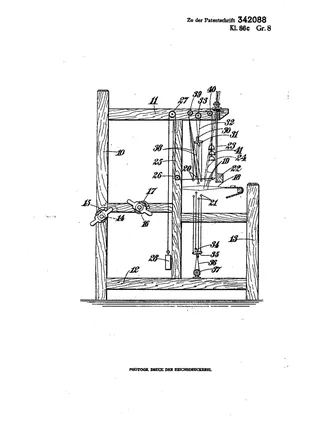
Handwebstuhl [Handweaving Loom]
William Lane · October 13, 1921
Patent · 4 pages · German
German Reich patent no. 342088 for a hand loom by William Lane of Eastbourne, England, issued in 1921 on an application of 25 August 1920 with English priority from 1919. The loom is designed so that war-disabled people, including those with only one hand or no use of the feet, can weave. The beater is pulled back to its rear position by weights or springs, and the shafts are paired on rocker levers and moved by hand-operated cords with handles instead of treadles. The text describes the design and states one claim, and a line drawing of the loom appears on the last page.
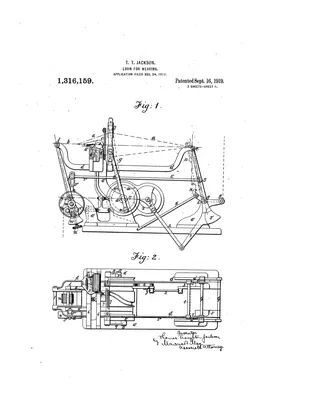
Loom for Weaving, US Patent No. 1316159
Patent · 2 pages
Two sheets of patent drawings for a loom for weaving, US Patent 1,316,159, granted 16 September 1919 to T. T. Jackson on an application filed 24 December 1917. Figures 1 and 2 show a side elevation and plan view of the harness, lever, cam and treadle linkage. Figure 3 shows a side elevation with a vertical frame, cloth roller and shedding mechanism. Only the drawings are present, with no specification text.
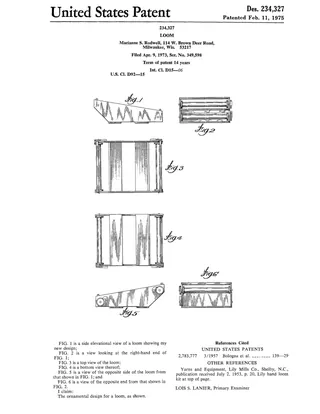
Loom, US Patent No. D0234327
Patent · 1 page
US design patent D234,327 for the ornamental design of a hand loom, granted to Marianne S. Rodwell of Milwaukee, Wisconsin. The single page has six drawings (side, end, top, bottom, opposite side and opposite end views) of a loom with a trapezoidal frame and two stacked beam rollers. It includes the one-line design claim and cited references, including a Lily Mills hand loom kit.
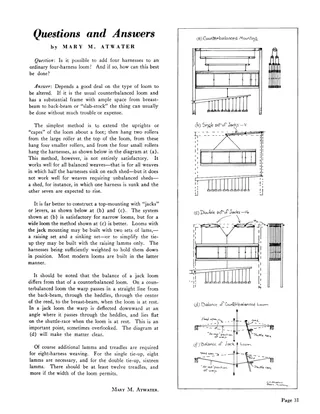
Questions and Answers
Article · 1 page
A one-page question-and-answer column by Mary M. Atwater on converting a four-harness loom to eight harnesses. She describes extending the uprights and hanging extra harnesses from rollers, which suits only balanced weaves, and the better option of a top mounting with jacks or levers (single or double sets). She also explains how the warp balance of a jack loom differs from that of a counterbalanced loom, and the lamms and treadles needed for eight-harness weaving. Five diagrams illustrate the mountings and warp balance.
Questions and Answers
Article · 1 page
A one-page question-and-answer column by Mary M. Atwater of the Shuttle Craft Guild. She answers a reader who wants working drawings for building a loom, recommending those in Victor Beriau's "Home Weaving" for a four-harness counterbalanced loom. She also advises on heddles, frame alignment, hardwood construction, and whether building a loom saves money.
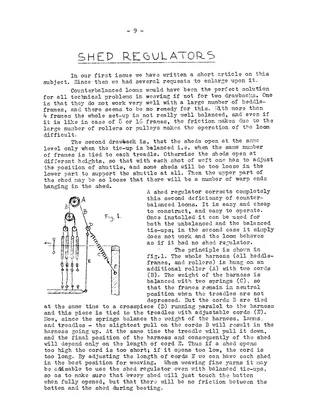
Shed Regulators
Master Weaver, July 1953
Article · 2 pages
A two-page article explaining how to add a shed regulator to a counterbalanced loom so that unbalanced tie-ups open sheds at an even height. It describes the drawbacks of counterbalanced looms, the principle of the spring-balanced harness hung from an extra roller and tied to the treadles with adjustable cords, and gives a materials list and mounting instructions. Two diagrams show the mechanism and the wooden extension pieces.
Shed Regulators for Counter-Balanced Looms
Master Weaver, March 1961
Article · 2 pages
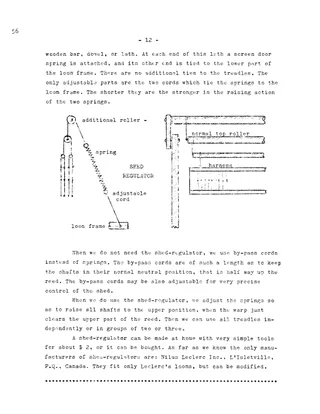
A short article from Master Weaver (No. 56, March 1961) on using shed regulators with four-shaft counterbalanced looms. It explains how the regulator lets such a loom handle balanced tie-ups, six-treadle tie-ups, and skeleton tie-ups by converting it into a reversed jack-type loom with spring-raised shafts. It describes the setup with an added top roller, a lath, and screen door springs with adjustable cords, notes by-pass cords for when the regulator is not used, and mentions cost and a commercial maker, Nilus Leclerc Inc. A line diagram illustrates the mechanism.
Shed Regulators on Counter-Balanced Looms
Master Weaver, December 1951
Article · 1 page
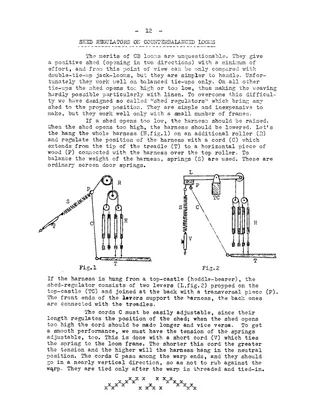
A one-page article describing "shed regulators" for counterbalanced looms, which correct sheds that open too high or too low on unbalanced tie-ups. It explains two arrangements: harness hung from an additional top roller, and harness hung from a top-castle using levers. Cords from the treadles adjust shed position, and adjustable springs balance the harness weight. Two figures illustrate the arrangements.
Shortcuts - Looms
Master Weaver, July 1958
Article · 4 pages
An opinionated article from the Master Weaver bulletin (No. 40, July 1958) giving advice on choosing a loom. It argues for a heavy, rigid four-shaft counterbalanced loom with a shed regulator, which can be converted to a reversed jack-type, over jack-type, folding or portable looms. It covers noise, space, treadle number and placement, and a 60-picks-per-minute tabby test before buying. The issue opens with a short editor's note about reader response to earlier articles on shortcuts and exhibitions.
[Two Women Weaving; Chicago]
Illustration · 1 page
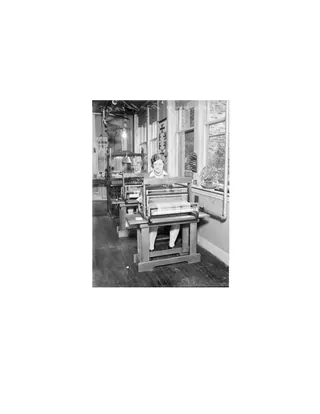
A single black-and-white photograph showing the interior of a weaving workshop in which two women sit at floor looms and weave. The room is bright, with tall windows on the right, a woven textile hanging on the wall and a light bulb hanging from the ceiling. The page carries no readable text, so the date, photographer and exact location cannot be determined from the image.
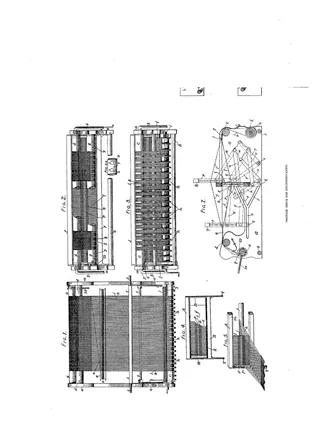
Vorrichtung für Handwebstühle zum Fachbilden undAnschlagen des Schussfadens mittels eines Fachbildungsblattes [Handloom Device for Opening the Shed and Beating the Weft by Means of a Shedding Reed]
The Linen Thread Co., Ltd. in Glasgow · July 6, 1906
Patent · 8 pages · German
German imperial patent No. 191713 issued to The Linen Thread Co. Ltd. of Glasgow, patented from 6 July 1906, for a handloom in which a shedding reed (Fachbildungsblatt) both forms the shed and beats up the weft. The invention concerns the mechanism that moves the reed: pins on the reed frame run in Y-shaped guide slots in the side frames, with parallel-motion levers keeping the reed upright, plus a variant using a spring-loaded swing lever. The text describes the loom frame, the reed construction with eyes for alternate warp threads, and three patent claims, followed by sheets of drawings.

Weaver
Vincent van Gogh · 1884
Illustration · 2 pages
Two-page reproduction of a painting by Vincent van Gogh showing a weaver seated at a wooden hand loom in a dim interior. The weaver works the shuttle and treadles, and a window on one side shows a field with a church tower and a small figure outside. There is no printed text or caption, so the item serves as a visual reference for a handloom and its setting.
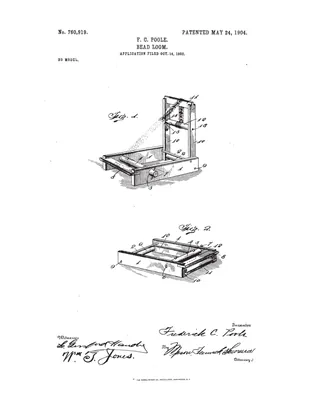
Bead Loom, US Patent No. 760919
Patent · 3 pages
US Patent No. 760,919, granted May 24, 1904 to Frederick C. Poole of Gloucester, Massachusetts, for an upright folding hand loom for beadwork. The specification describes a base frame with a pivoted upright section, warp combs, and two rollers for tension and take-up, and explains how the loom is threaded and folded for storage. It closes with seven claims; the drawings show the loom in open and folded positions.
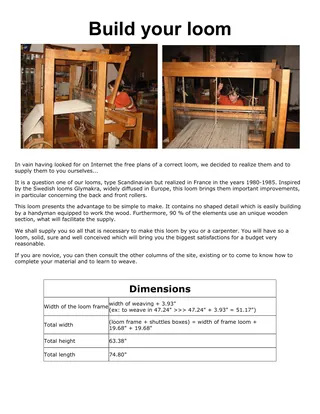
Build Your Loom
Web Doc · 11 pages
Free construction plans for a Scandinavian-style wooden floor loom, based on Swedish Glimåkra looms and built in France in the 1980s. The document gives overall dimensions, side-frame plans, cut lists with section sizes, crossbars, pedals, the batten, shuttle boxes, and the front and back rollers. Photographs show joinery, brakes, the shuttle launch system, the raised-shaft system and roller blocking. The plans are supplied by CVMT.
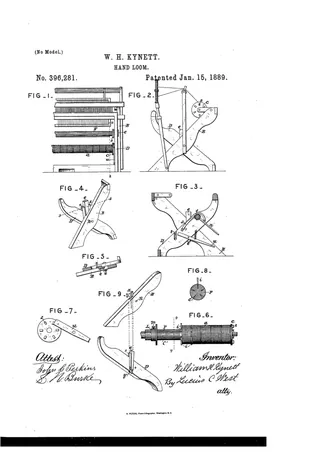
Hand Loom
Kynett W. H. · January 15, 1889
Patent · 3 pages
US Patent No. 396,281 issued to William H. Kynett of Battle Creek, Michigan, for a hand loom intended for weaving carpet. The specification describes a loom frame of crossed pivoted legs with wedge-shaped keys for adjusting height, and a warp roller with radial grooves, pins and an adjustable head. It also covers a foot-treadle lever and pawl for letting off warp, and a ratchet carpet roller. One sheet of patent drawings (Figs. 1-9) is included, followed by the text and two claims.
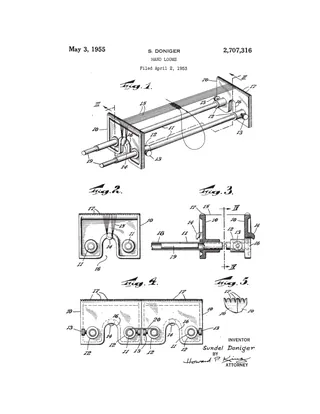
Hand Looms, US Patent No. 2707316
Patent · 3 pages
US Patent No. 2,707,316, granted May 3, 1955 to Sundel Doniger of New York, for a modular hand loom designed for weaving beaded belts, bags and other ornamental beaded articles. The loom has two notched end headers mounted on parallel tubular bars, with extension bars for added length and side-by-side units joined by couplings for added width. The text gives the specification, five figures of drawings, two claims and the references cited.
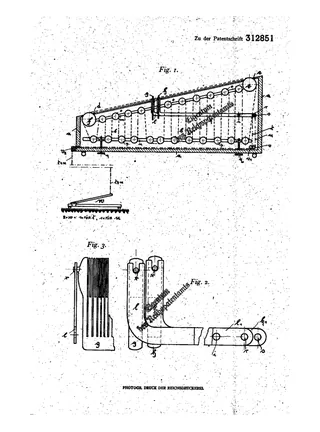
Handwebvorrichtung [Handweaving Device]
Ellen Struve · June 17, 1919
Patent · 3 pages · German
German Reich patent no. 312851 (class 86c, group 8) issued 17 June 1919 to Ellen Struve, née Gleiche, of Berlin-Friedenau, for a hand-weaving device, patented from 8 May 1917. The warp is a single continuous thread run in a zigzag over two rows of rollers inside a small housing, so a long warp and a long piece of cloth fit in a compact device. Sheds are formed by two combs with alternately long and short slots, carried on pivoting double-lever pairs worked by cords and pedals, and warp tension is adjusted by raising or lowering one roller row. The scan includes the description, the single patent claim, and a sheet of drawings (Figs. 1-3).
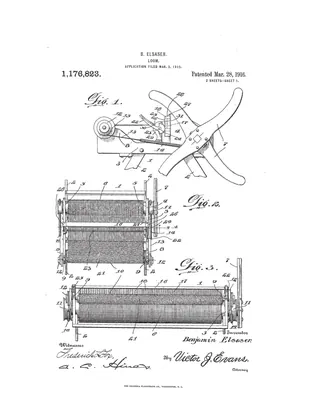
Loom
B. Elsaser · March 28, 1916
Patent · 5 pages
US Patent No. 1,176,823, granted March 28, 1916 to Benjamin Elsaser of Boonville, New York, for a hand loom for household rug and rag carpet weaving. It describes a combination reed and harness with a vertically adjustable reed frame that holds two sets of warp threads, so the shed is formed without a separate harness mechanism. The warp and cloth beams are linked by spring-tensioned flexible connections on stepped pulleys. The text gives the specification and three claims; two sheets of drawings show the loom in side, plan, front and section views, with diagrams of the three reed positions.
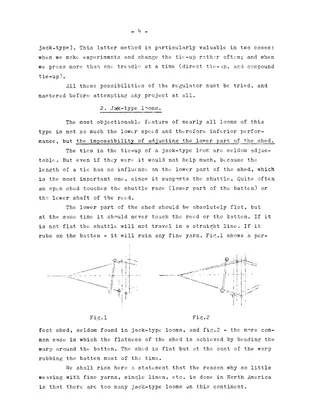
Shortcuts - How To Maintain & Improve a Weaving Loom
Master Weaver, November 1958
Article · 5 pages
A short 'Shortcuts' article from the Master Weaver on maintaining and improving a handloom. It covers adding a shed regulator to counterbalanced looms, fixing the uneven lower shed of jack-type looms with a stationary dowel or 'shed stop', and adding a second warp beam and take-up. It closes with practical advice on small workshop conveniences, tightening screws, replacing cords, lubrication, rust prevention and wood care. Two diagrams illustrate shed geometry.
Shortcuts 3 - Looms Multishaft
Master Weaver, September 1958
Article · 6 pages
An installment of the 'Shortcuts' series from Master Weaver (1958) on multishaft looms and on setting up a new loom. It advises against buying more than four shafts unless needed, and compares single tie-up (jack-type) and double tie-up (countermarche, Swedish) looms. It then covers siting and anchoring the loom, lighting, heating, bench height and distance, and troubleshooting faults such as slipping brakes, an uneven batten, sticky varnish and cramped batten clearance.
Hand Loom Weaving
Scientific American, 1847
Article · 1 page
A short 1847 editorial note from Scientific American on the fortunes of hand loom weavers after the introduction of the power loom. It reports on a hand loom invented by a Frenchman named Clausenne, operated by a simple crank, said to weave about five times as much as the old loom and produce better cloth. The writer suggests it would suit rural villages in America and help weavers in Ireland, and promises a more detailed account later.
Hand-Loom
Article · 1 page
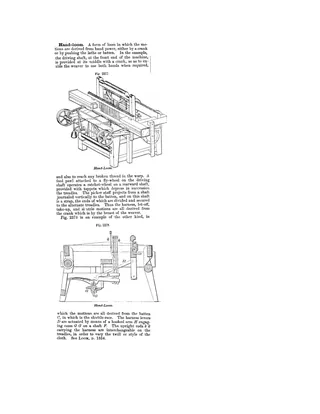
A short dictionary entry defining the hand-loom as a loom powered by hand, either by a crank or by pushing the batten. It describes two engraved examples: one with a crank on the front driving shaft that operates the treadles, picker staff, let-off and take-up through a ratchet and tappets, and one in which all motions derive from the batten, with harness levers actuated by cams. It cross-references the Loom entry.
Handweaving News (August 1941): Choice of Loom
Periodical · 3 pages
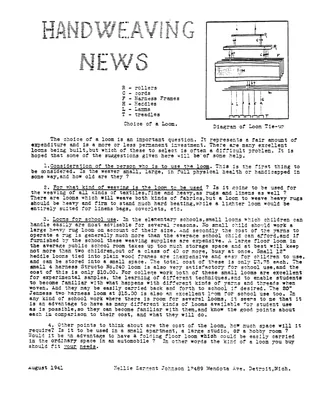
A three-page article from Handweaving News, August 1941, in which Nellie Sargent Johnson gives practical advice on choosing a handloom. She covers the weaver's needs, school use, cost, space, buying from reputable makers, and construction points such as heddles, warp beams, ratchets, and treadles. She also compares two-harness and four-harness looms, including table, floor, and folding types, and names specific makers and prices of the period.
Home-Made Hand-Loom
Article · 1 page
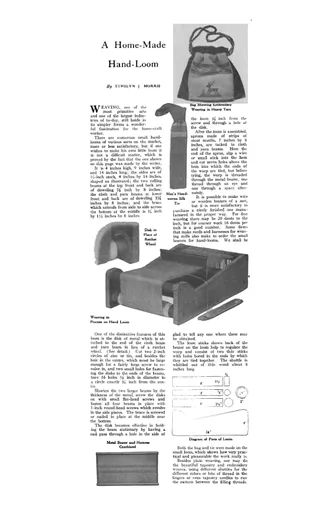
A one-page magazine article describing how to build a small hand-loom at home, with dimensions for the frame, rolling beams, cloth and yarn beams, and brace. It explains the metal disk with 16 holes and a nail that replaces a ratchet wheel, how to attach muslin aprons and warp through a metal beater (16 to 20 dents per inch), and how to make lease sticks and a shuttle. Photos show a bag woven with embroidery weaving, a man's hand-woven silk tie, the loom in use, and a diagram of its parts.
How to Build a Loom
Monograph · 19 pages
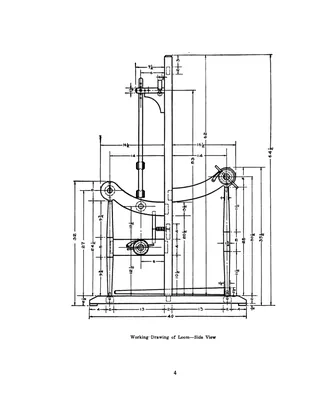
A booklet of working drawings and brief instructions for building two counterbalance floor looms, a lighter Danish loom and a larger Swedish loom, both with swinging beaters. It includes dimensioned drawings of loom parts and of accessories: warping reel, spool rack, shuttles, floor swift, warp spreader (raddle), temple and fly shuttle beater. The 1973 printing adds pages on a contramarche (countermarch) tie-up with two sets of lams and on converting the loom to a jack type. The booklet is almost entirely drawings with short explanatory text.
Instructions on Building a 36" Wide Hand Loom
The Oriental Rug Company, 1938
Other · 9 pages
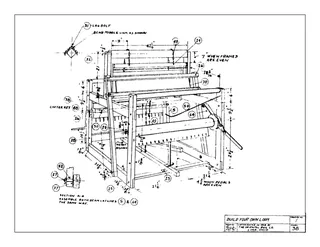
Builder's instructions and drawing set from The Oriental Rug Company of Lima, Ohio, for making a 36-inch wide hand loom (Model 38) from standard lumber, pipe and hardware. An introductory page explains the build sequence and which parts must be bought (ratchet, reed, heddles). Dimensioned drawings follow for the frame, beams, pedals, heddle frames, lathe/beater, apron, ratchet, and accessories such as warping comb, spool rack, shuttle rack, threading hook and beam counter. The set ends with parts lists giving sizes, materials and quantities.
Introduction to Weaving
Article · 5 pages
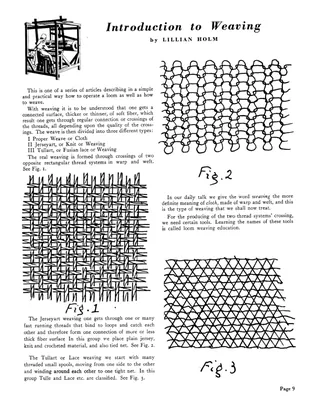
An introductory article by Lillian Holm, the first in a series on how to operate a loom and weave. It defines weaving and its three types (cloth, jersey/knit, and tulle/lace), then describes the shed, primitive warp-stretched frames, and the parts of the floor loom: beams, heddles and harnesses, heddle horses, pulleys, lams, pedals, beater, reed, shuttle, bobbin winder, and flying shuttle. Illustrated with numbered figures; no weaving drafts. The article ends with "Continued in the next number."
Striking up the Weft
Article · 1 page
A one-page excerpt from Master Weaver (No. 5, August 1952). It opens with the end of a discussion of colour-and-weave draw-downs, in which a 3:3 twill with wide colour bands gives arrow-head checks and fine colour distribution gives broken zig-zag lines. The rest is a reprinted 1844 passage by Clinton G. Gilroy, "Striking Up the Weft," in the "From the Classics" section. It covers beating with the lay, mounting the loom so the lay's range suits the cloth, the pendulum-like swing of the batten, the fell, and keeping treadling, throwing the shuttle and beating regular.
Weaving
Oxford Encyclopedia, 1828
Article · 2 pages
An encyclopedia entry defining weaving and describing the construction and operation of the common treadle loom, including lams (headles), treadles, lay or batten, breast bar, knee roll and yarn beam. It also explains the flying shuttle, its boxes and drivers, and how it lets one weaver work wide cloth. It ends with cross-references to the articles Cloth and Loom.
Weaving Terminology - Counter Marche, Sinking and Rising Sheds
Master Weaver, March 1954
Article · 1 page
A short piece from Master Weaver (No. 14, 1954) on loom terminology. It questions the use of the word 'counter-marche' for long lamms in double-tie-up looms and the name 'Swedish' for such looms. It also argues that 'sinking shed' and 'rising shed' are misapplied: jack and table looms are rising-shed, while counterbalanced looms open the shed in both directions. The page opens with the end of a preceding article on cutting blocks in dornick twill, discussing biased versus broken twill treadling and tie-ups.
Weaving. -- No. V: Hand-Loom Weaving
Article · 2 pages
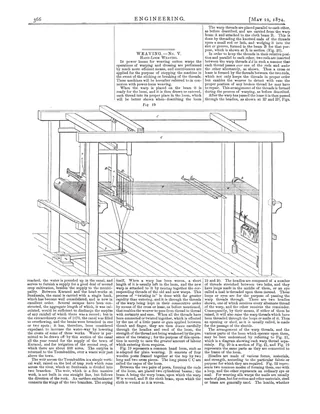
A two-page installment (No. V) of a serial on weaving from the journal Engineering, describing hand-loom weaving for plain cloth. It covers placing the warp beam in the loom, the lease rods and cross, twisting in a new warp to an old one, and the parts of a common four-post hand loom. It also explains healds (heddles) with loops or mails, treadles, pulleys, and the reed, including the old method of cleaving reed strips. Illustrated with engravings of the loom and its components (Figs. 19-26).
Weaving. -- No. VI: Hand-Loom Weaving (continued)
Article · 3 pages
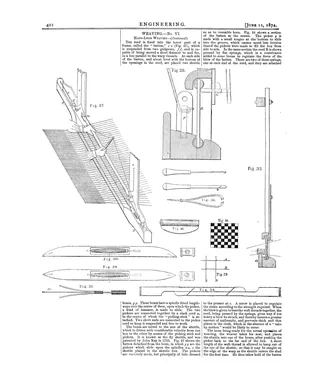
Part VI of a serial in the British journal Engineering (June 12, 1874) on the mechanics of weaving, continuing the description of the hand loom. It covers the batten, reed, fly shuttle (John Kay, 1733) with its pickers and shuttle boxes, shuttle construction and quills, the hand-thrown shuttle, warp tension weights, take-up, temples, winding tools, and small weaver's implements. It closes with plain (tabby) weave shown as a designer's draft and as a headle-and-treadle tie-up, and a note on shedding in plain weaving.
The Best Loom
Master Weaver, August 1952
Article · 4 pages
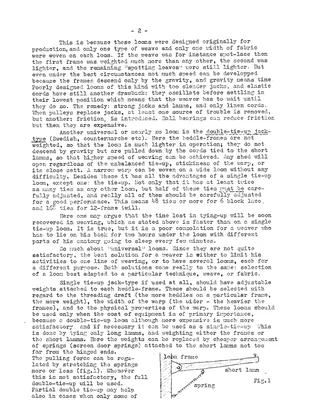
An essay from the Master Weaver newsletter (Fulford, Quebec) arguing that no single loom is best for every purpose. It compares single tie-up jack looms, double tie-up (countermarche) jack looms, counterbalanced looms, draw-looms, two-harness looms, fly-shuttle and automatic looms, frame looms, and table looms, covering the strengths and drawbacks of each. It concludes that a weaver should specialise or own several looms, and suggests a basic set of four. Two figures show a spring-weighted short lamm and counterbalanced harness arrangements. A short errata notice for issue 4 follows.
Hair-Cloth Loom
Article · 1 page
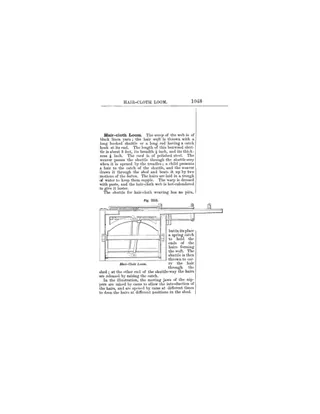
A one-page dictionary entry describing the loom used to weave hair-cloth, with a black linen warp and a weft of single horse hairs. It explains the long hooked shuttle or rod, the spring catch that holds the hair, and how the weaver and an assistant child insert each hair through the shed. It also notes dressing the warp with paste and hot-calendering the finished cloth, and includes a line drawing (Fig. 225) of the loom showing the batten, nippers, treadles and cams.
The Indian Hand Loom
Indian Textile Journal, August 1897
Article · 1 page
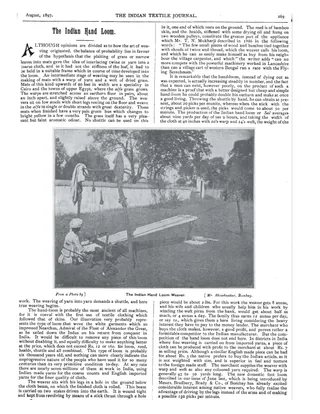
A single-page 1897 article from the Indian Textile Journal on the primitive Indian pit hand loom. It speculates on the origins of weaving from mat plaiting, describes the loom's construction (bamboo reed, healds, cloth beam on stakes, weaver seated with legs in a pit), and gives production figures of about nine yards per day. It covers weaver and family earnings, competition between hand-woven and imported English cloth, and the introduction of a new domestic foot loom by Bradbury, Brady & Co. of Bombay. Includes a photograph of an Indian hand loom weaver.
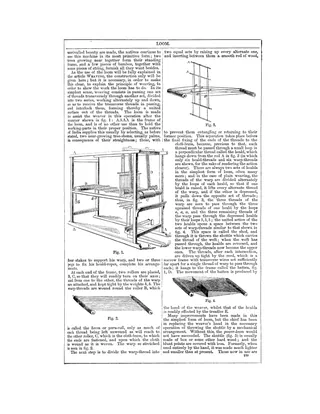
Loom
Chambers's Encyclopedia, 1881
Article · 3 pages
An encyclopedia article describing the loom as the machine for weaving, with a short note on its history from ancient hand looms to Cartwright's power loom of 1787. It explains the principle of plain weaving and the parts of a simple hand loom: frame, warp beam and cloth beam, healds, shed, reed and batten, treadles. It also covers the shuttle and shuttle races and shows a power loom. Six figures illustrate the frame, warp, healds, shed, shuttle and power loom.
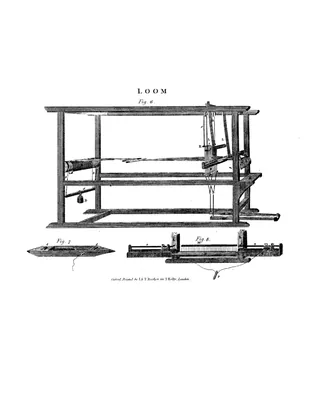
Loom
Oxford Encyclopedia, 1828
Article · 3 pages
An encyclopedia entry on the loom, defining it as the weaver's frame and describing a plain-weave silk loom illustrated on an engraved plate. It explains the cloth beam and yarn beam, the two heddles (called lambs) worked by treadles, the swinging reed frame, and the shuttle race with pickers driven by a hand-held stick. It also describes the weaver's sequence of operations and the speed of an expert weaver.
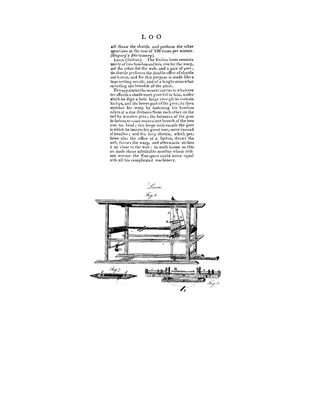
Loom
Pantalogia, 1819
Article · 2 pages
A two-page encyclopedia entry on the loom from Pantalogia (1819), drawing on Gregory's Dictionary. It defines the loom and describes a silk or plain-weaving loom with cloth beam, yarn beam, lambs (heddles), treadles, reed frame, and shuttle driven by pickers, and explains the weaving operations step by step. It also describes the simple Indian loom set up under a tree, and includes an engraved figure of the loom.
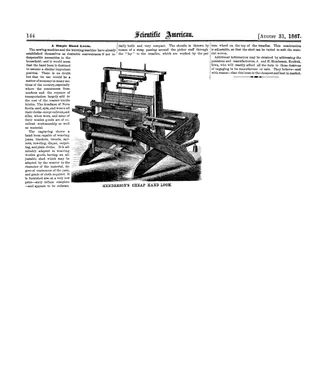
A Simple Hand Loom
Scientific American, August 31, 1867
Article · 1 page
A short 1867 Scientific American notice describing Henderson's Cheap Hand Loom, a treadle loom sold for sixty dollars. The article argues for the household and rural economy of hand looms and says the loom can weave jeans, blankets, tweeds, satinets, toweling, diaper, carpeting, and plain cloths. It describes the adjustable shed, the strap-driven shuttle with picker staff, and the pattern wheel on top of the treadles, and gives the makers' address. An engraving of the loom accompanies the text.
Tissage pour Debutants [Weaving for Beginners]
Luther Hooper · 2002
Book · 71 pages · French
A French translation (2002, by Philippe Demoule) of Luther Hooper's 1919 beginner's handbook on hand-loom weaving. It covers building a simple four-shaft treadle loom from wood and metal, making heddles, warping, beaming, threading and sleying, tying up the harness, tools such as shuttles, and starting to weave, ending with common faults and how to correct them. It is heavily illustrated with dimensioned line drawings of loom parts, warping boards, and warp handling. The final 15 pages on weave structures were not translated.
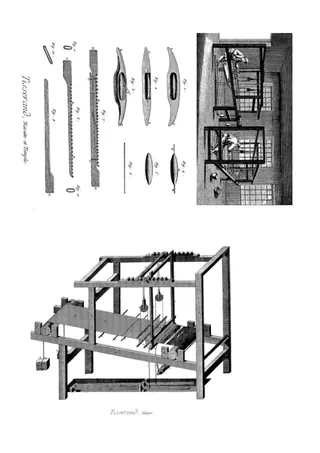
Tisserand [Weaver]
Illustration · 5 pages · French
A set of engraved plates on the weaver (Tisserand) from Diderot and d'Alembert's Encyclopédie, prepared as Part III of a series of weaving plates. The plates show a French plain-cloth (linen) loom in perspective, plan, front and side elevation, with numbered figures of the frame, beams, heddles, reed, treadles, shuttles, temples and joints. The pages carry only plate titles and figure numbers, with no explanatory text.
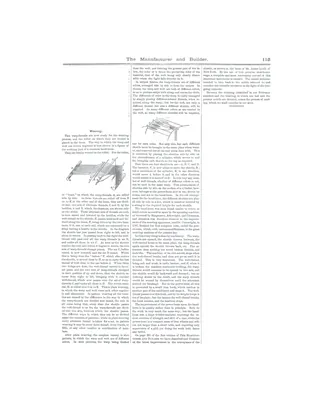
Weaving
Manufacturer and Builder, 1870
Article · 1 page
A one-page 1870 article from The Manufacturer and Builder explaining how weaving works, using diagrams of a common hand-loom and of a cylinder carrying several shuttles. It describes plain weave, shot patterns, stripes and checks, and how multiple weft colors are handled. It then contrasts the hand-loom with Cartwright's power-loom (1787) and its automatic weft-break stop, and refers readers to an earlier article on James Lyall's shuttle carriage.
Weaving Terminology - The Two Harness Method
Master Weaver, August 1952
Article · 1 page
A short piece from Master Weaver (No. 5, August 1952) on the term "two-harness method." It contrasts the traditional meaning, a loom with two sets of heddle frames (one with long-eye heddles and one with plain heddles, about a foot apart), with the newer American usage for weaving on two frames. The author argues the newer usage is misleading and the method suited only to tabby or pick-up work. The page opens with the end of an article on weaving blocks with binder wefts, covering the sett of the warp, binder grist and use of three shuttles.
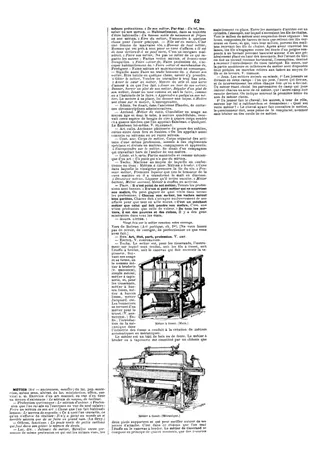
Métier [Loom]
Article · 1 page · French
A single-page dictionary entry on the word "métier" from the Nouveau Larousse Illustré. It covers general meanings (trade, profession), idioms, proverbs and historical senses. The encyclopedic section describes the loom: embroidery and tapestry frames, the weaver's loom with warp beam, heddles (lames), reed, beater, cloth beam and treadles, and the low-warp, high-warp and Jacquard types. Two engravings show a hand-operated frame loom with a seated weaver and a mechanical loom.
603 documents found