Textile Documents › Topic: Clothing fabrics and dress goods
921 documents found
Sort: 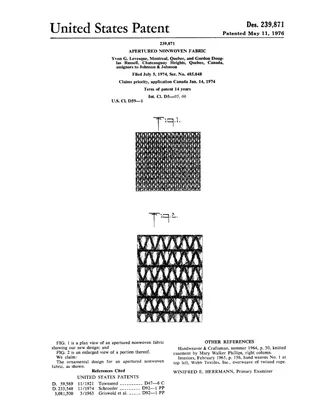
Apertured Nonwoven Fabric, US Patent No. D0239871
Patent · 1 page
US design patent D239,871 (granted May 11, 1976) for the ornamental design of an apertured nonwoven fabric, assigned to Johnson & Johnson. It consists of a single page with two figures: a plan view of a dense, repeating open-mesh pattern and an enlarged detail showing teardrop-shaped apertures. The references cited include earlier patents and two magazine citations on handwoven and knitted open fabrics.
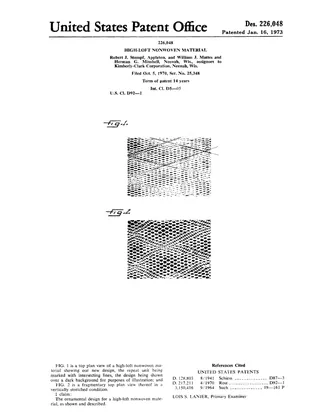
High-Loft Nonwoven Fabric, US Patent No. D0226048
Patent · 1 page
A one-page US design patent (Des. 226,048) for the ornamental design of a high-loft nonwoven material, granted January 16, 1973 to Kimberly-Clark Corporation. The figures show a diamond-like repeat pattern in plan view, and Fig. 2 shows it vertically stretched. It includes the single design claim and references cited.
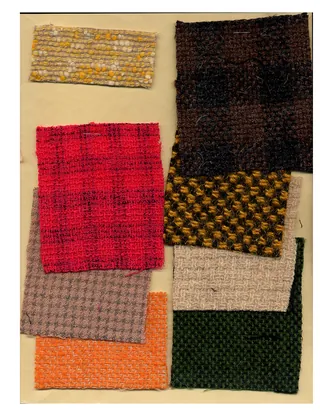
Surface Textiles of Today Portfolio
Other · 3 pages
Portfolio edition accompanying Harriet Tidball's Shuttle Craft Monograph Two, 'Surface Interest: Textiles of Today' (1961). The three pages consist of a cover and two sheets of pinned woven fabric swatches, with a key of numerals that appears to refer to sections and sample numbers in the monograph. The swatches include tweeds, textured wools and plain grey and cream fabrics.
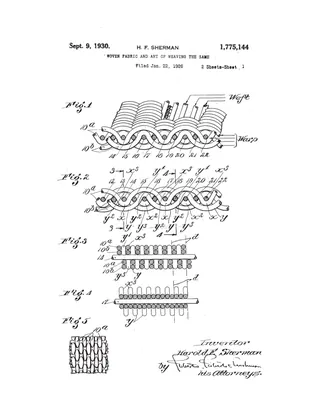
Woven Fabric and Art of Weaving the Same, US Patent No. 1775144
Patent · 6 pages · weaving drafts
US Patent 1,775,144, granted 9 September 1930 to Harold F. Sherman of Northboro, Massachusetts, for a dense single-ply woven fabric and the method of weaving it. Warps are woven in pairs, one lying over the other, with straight wefts in a median plane. Alternate 'key' wefts are bound by warp bights and intervening wefts hold the bights tight. The fabric repeats on four ends and four picks and is intended as a broadcloth-like material for collars and cuffs. The patent has two sheets of drawings (Figs. 1-7, including a weave diagram and drawing-in draft), a description, and 15 claims.
Designing
Textile Mercury, 1890
Article · 2 pages · weaving drafts
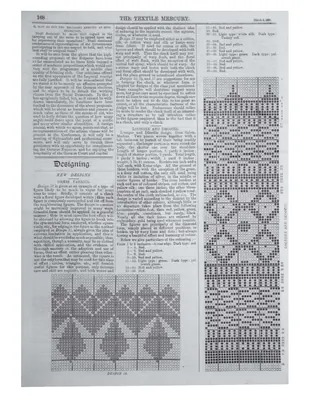
A short article from The Textile Mercury presenting new dress fabric designs on point-paper grids. It discusses Design 52, a check with floral figures developed within it, and suggests how to build it in cotton, silk, or cotton warp with lustre weft. Designs 53, 54 and 55 are offered as check suggestions. It also describes a Loongee and Dhootie from Salem, Madras, a paired Indian garment cloth, with dimensions, weight, border details and a colour sequence for the border.
Garments - Bog Jackets Part 2
Article · 1 page
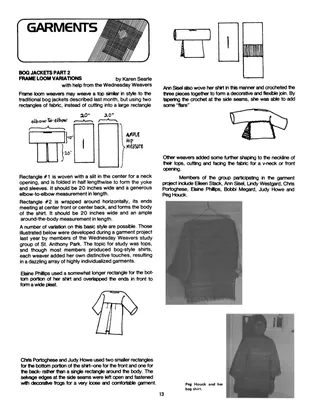
A one-page article from Minnesota Weaver, the second part of a series on bog jackets, covering frame loom variations. It explains how to make a top from two woven rectangles: one with a neck slit folded to form yoke and sleeves, and one wrapped around the body. It illustrates variations by members of the Wednesday Weavers study group of St. Anthony Park, including a front pleat, separate front and back panels joined with frogs, and panels crocheted together with flare. Line drawings and a photograph accompany the text; there are no weaving drafts.
Novelties in Dressgoods from Abroad
Article · 1 page · weaving drafts
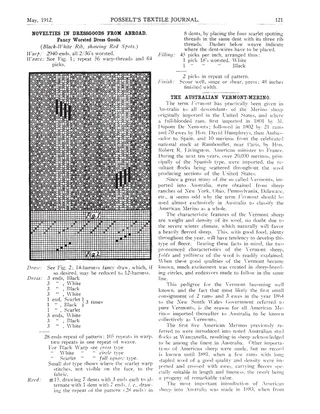
A single page from Posselt's Textile Journal, May 1912, giving full manufacturing details for a fancy worsted dress fabric, a black-white rib with red spots. It lists warp, weave repeat, a 14-harness fancy draw (reducible to 12), color dressing, reed, filling and finish, with two weaving draft grids. The lower part of the page begins a separate article on the Australian Vermont-Merino sheep and the history of American Merino imports into Australia.

Tweed
Article · 1 page
A very short encyclopedia entry defining tweed as a soft, durable twilled fabric, usually wool or a cotton and wool blend, often woven in two colors from yarn dyed before weaving. It gives the name's origin in the villages along the Tweed river in Scotland and cross-references the encyclopedia's article on weaving.
Coating and Suiting Materials
Monograph · 5 pages · weaving drafts
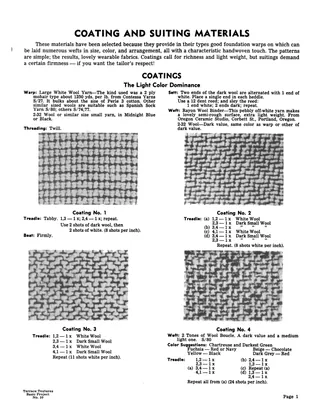
Basic Project No. 10 from Terrace Textures gives treadling and materials instructions for seven coating fabrics and twelve suiting fabrics woven on a four-shaft twill threading. Each sample lists warp yarns, sett, weft yarns, color suggestions, treadle sequences and shots per inch, using wool, mohair, tweed, boucle, rayon and spun silk. The pages are grouped by light-color, dark-blend, white, black and two-color warps, with drawdowns and swatch illustrations.
Creation of Smart Fabrics, Part One
Article · 7 pages
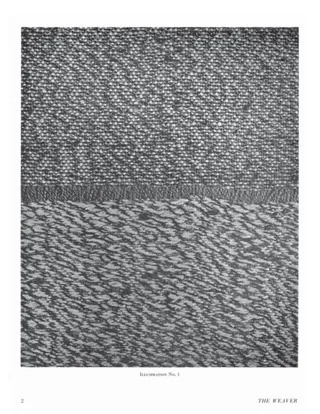
Part one of a two-part article by Maria Steinhoff arguing for the practical and economic value of hand-weaving fashion fabrics. She compares the cost of handwoven yardage with expensive designer and imported cloth, the speed of weaving versus knitting, and the mixing of different fibers. She then describes five illustrated sample fabrics for suits, dresses and coats, naming the Bernat yarns used for warp and filler and the colors. No threading drafts are given.
Designing - Scotch Tweeds
Textile Mercury, 1889
Article · 2 pages
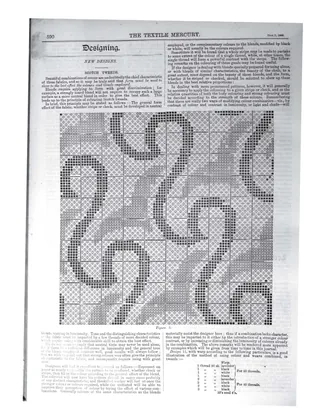
Two pages from The Textile Mercury, 7 December 1889, opening with a 'Designing' column on Scotch tweeds. It explains the principle of colouring tweeds (neutral blends for the general stripe or check form, with a few threads of stronger colour for character) and gives warp and weft colour sequences, reed and pick counts for Design II and a design for lustre goods. The remaining text covers dyeing recipes (fawn, olive, green, red, ponceau), a note on detecting quebracho extract, short notes on sapan wood, flax and gallamine blue, and a review of a German garment-dyeing book.
Designing and Coloring of Scotch Tweeds
Article · 2 pages · weaving drafts
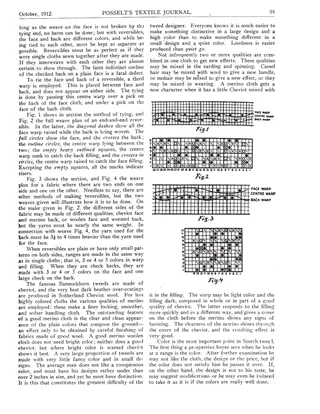
An article from Posselt's Textile Journal (October 1912) on the history, designing and coloring of Scotch tweeds. It covers the origin of the name and early checks, how designers build ranges of patterns in color and stripe size, and the importance of color to buyers. A section on reversible cloths explains how face and back cloths are tied with a third centre warp, with sectional views and weave plans (Figs. 1-4) for end-and-end and two-and-one constructions.
Did Your Wife Really Weave It?
Article · 1 page
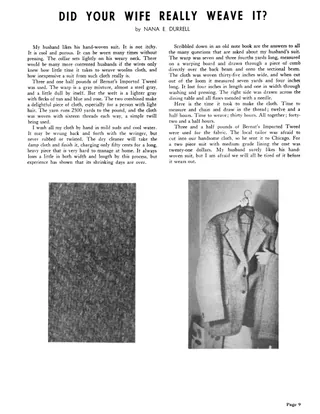
A short first-person article in which Nana Durrell describes weaving wool tweed cloth for her husband's suit. She gives the yarn (Bernat's Imported Tweed, 3.5 pounds), a simple twill at sixteen threads per inch, warp length, finished width, and shrinkage after hand washing. She also reports the time spent (about 42.5 hours) and the tailoring cost.
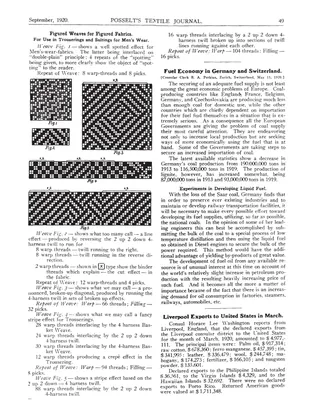
Figured Weaves for Figured Fabrics, for Use in Trouserings and Suitings for Men's Wear
Article · 1 page · weaving drafts
A one-page article from Posselt's Textile Journal (September 1920) presenting five weave designs for figured trouserings and suitings for men's wear. Each weave (Figs. 1-5) is described with its repeat size and thread arrangement: a spotted effect on a double-plain base, a reversed 2-up 2-down 4-harness twill line effect, a broken diagonal, a fancy stripe combining basket weave and twill with a crepe section, and a twill stripe with broken twill sections. The scan also includes unrelated news items on fuel economy in Germany and Switzerland and Liverpool exports.
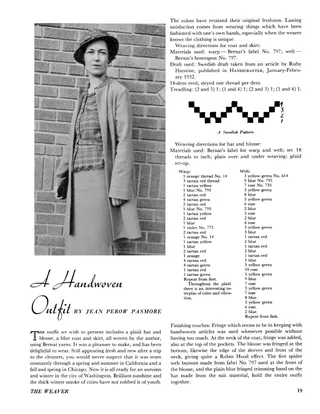
A Handwoven Outfit
Article · 1 page · weaving drafts
A one-page article in which Jean Perow Pasmore describes a handwoven outfit made with Bernat yarns: a plaid hat and blouse and a blue coat and skirt. It gives weaving directions for each part, including materials, reed and sley, treadling, a plaid warp color sequence, a weft color sequence, and finishing details such as fringe and spider web buttons. A Swedish draft taken from a 1932 Handicrafter article by Ruby Harstine is used for the coat and skirt fabric.
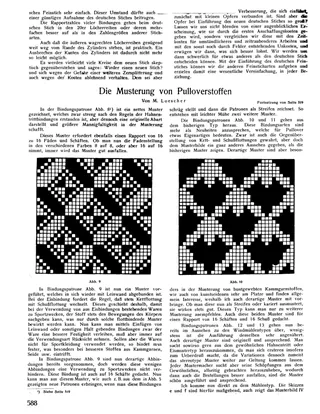
Die Musterung von Pulloverstoffen [The Patterning of Pullover Fabrics]
Article · 2 pages · German · weaving drafts
A two-page continuation of M. Loescher's article on designing patterns for pullover fabrics, published in Melliand's Textilberichte in 1927. It discusses weave diagrams (Bindungspatronen, Abb. 8-15) on 16 shafts, including houndstooth variants, ice weaves that alternate warp and weft floats, and the windmill (Mühlen) pattern achieved with 8 or 16 thread colour arrangements and plain-weave tie-downs. The page also opens with the end of a separate piece advocating a German fine gauge (deutscher Feinstich) for knitting cylinders.
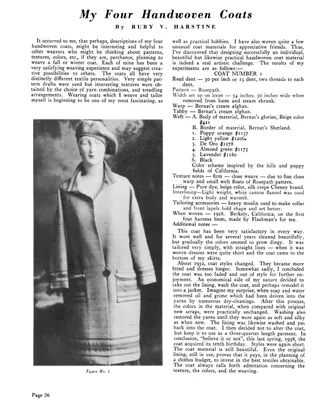
My Four Handwoven Coats
Article · 3 pages
Ruby V. Harstine describes four coats she wove and tailored between 1928 and 1938, giving for each the reed, pattern, warp and weft yarns (mostly Bernat's), color notes, lining, interlining, tailoring details and how the coat wore. A short section gives the threading and treadling drafts used for the coats: rosepath, plain weave, a Flashman original draft, and broken diamond twill. Photographs of the coats are included, and a notice for a July 1939 weaving course at Kate Van Cleve's Brookline studio appears at the end of the draft section.
Novelty from Abroad
Article · 1 page · weaving drafts
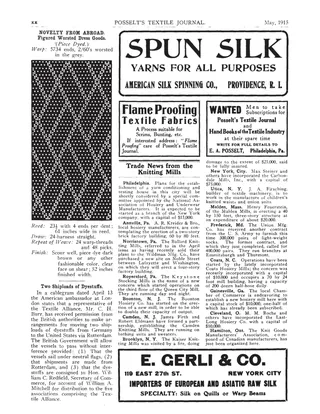
A single page from the May 1915 issue of Posselt's Textile Journal. It gives specifications for a piece-dyed figured worsted dress goods fabric from abroad, with a drawdown of the weave and the warp, reed, draw, repeat and finish details. The page also carries a news item on two shiploads of German dyestuffs allowed through to the United States, knitting mill trade news, and advertisements.
Novelty in Worsted Trousering
Article · 1 page · weaving drafts
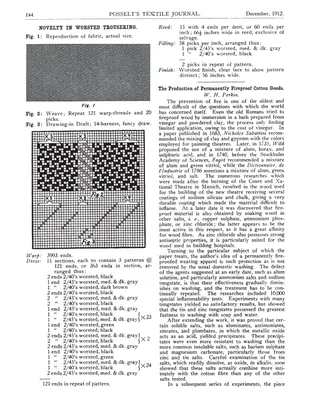
A single journal page from Posselt's Textile Journal (December 1912) giving full specifications for a novelty worsted trouser fabric. It includes a reproduction of the fabric, the weave (121 threads by 20 picks), a 14-harness fancy drawing-in draft, and details of warp, color and yarn arrangement, reed, filling and finish. The page also begins an unrelated article by W. H. Perkin on permanently fireproofing cotton goods.
Ostrich Feathers as Effects for Dress Goods
Article · 2 pages
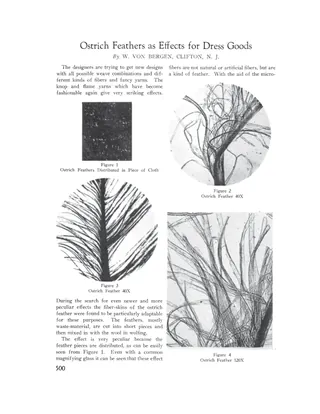
A short article describing the use of cut ostrich feather waste mixed with wool as a novelty effect in dress goods. It explains how the feather pieces appear scattered through the cloth and how to identify them under a magnifying glass or microscope. Six micrograph figures at 40X and 120X show feather barbs and their branching structure.
Practical Weaving Suggestions, Vol. XIII: We'd Suggest Evening Bags ...
Periodical · 4 pages
A four-page issue of Lily Mills' Practical Weaving Suggestions for handweavers, in which Toni Ford recommends weaving evening bags for sale. It advises on materials (pearl cotton and metallic guimpe), weave choice (plain weave, goose-eye twill, overshot, Dukagang), color, and bag styles and tops. It describes three sample bags by Harry Burkett and Eulalia Burns with Lily yarn article numbers, and lists books, weavers' bulletins and directories of craft suppliers. The last page carries a Lily yarns advertisement.
Questions and Answers
Article · 1 page · weaving drafts
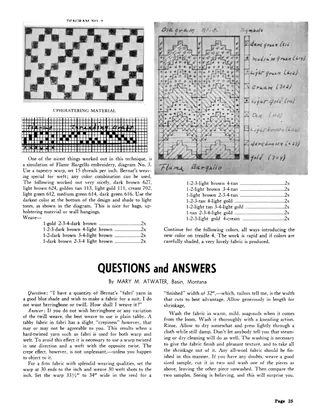
A single page from Mary M. Atwater's Questions and Answers column in The Weaver (July 1942). It opens with the end of a preceding item about a Flame Bargello-style upholstery/bag fabric woven on four treadles, with a tapestry warp at 15 ends per inch, Bernat's weaving special weft in a shaded color sequence, and a treadling table. The column then answers a reader's question on weaving a suit fabric from hard-twisted Bernat "fabri" yarn: use plain tabby, set 30 ends per inch, and wash the fabric to finish it.
Shuttle-Craft Bulletin, Vol. XXX, No. 3 (March 1953)
Periodical · 3 pages
A three-page portfolio item from the March 1953 Shuttle-Craft Bulletin, credited to Harriet D. Tidball. It has a handwritten cover, a page of printed notes describing two woven samples, and a page with mounted swatches. The notes cover a wool fabric woven with metallic weft on a tabby shed, with a matching stole woven using only tie-down and tabby sheds, and a 24/2 cotton sample using novelty weft materials on the tie-down shed with a weft-pattern border.
Skirts
Monograph · 5 pages · weaving drafts
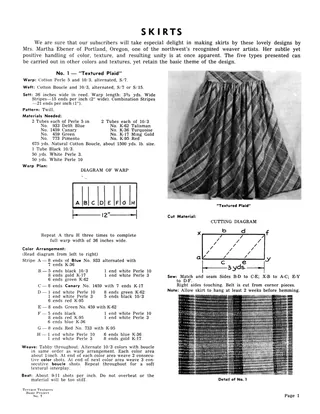
Instructions for five handwoven skirt designs by Martha Ebener of Portland, Oregon, published as Basic Project No. 7 of Terrace Textures. Each design (Textured Plaid, Stripe Tone, Texture Blend, Topaz Beauty, Fiesta) gives warp and weft yarns, colors, sett, and weaving sequence, with photographs and fabric detail swatches. The first includes a warp stripe diagram and cutting and sewing layout; the last gives a small four-shaft draft and an alternative border.
Summer Adventures in Weaving
Article · 2 pages
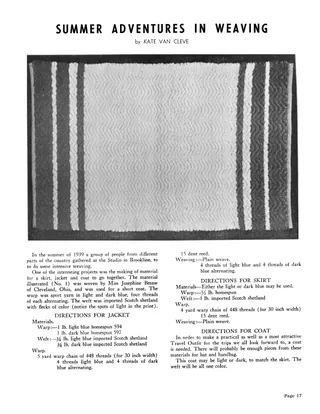
A short article from The Weaver describing projects woven at a summer 1939 weaving studio in Brookline. It gives warp and weft materials, sleying and threading details for a matching blue plain-weave jacket, skirt and coat, plus a twill skirt and jacket in white, grey and black. It ends with a note on a chenille rug in a shell pattern woven on a small-pattern threading such as honeysuckle.
Webwarenkunde [Knowledge of Woven Fabrics]
Article · 4 pages · German
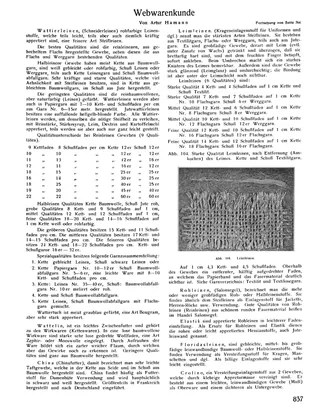
A 1927 installment of Artur Hamann's serial 'Webwarenkunde' (textile fabric knowledge) in Melliand's Textilberichte, covering interlining, stiffening and lining fabrics. It describes Wattierleinen, Leimleinen, Rohleinen, Futtergaze, Einlagenfutter, and in particular horsehair fabrics (Roßhaargewebe), with yarn types, thread counts per cm, finishing, and weave bindings. Numbered quality tables and photographic samples (Abb. 104-111) are included, along with a drawing of a twisted (Dreher) cord; there are no weaving drafts.
What Shall I Weave
Article · 2 pages
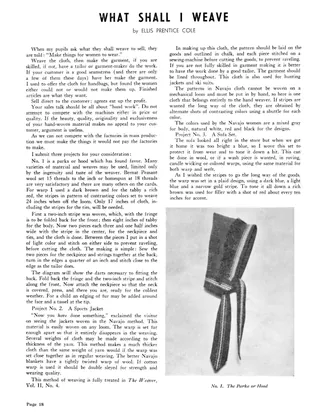
A short article by Ellis Prentice Cole advising handweavers to make finished garments and household items to sell, rather than compete with factories. She presents three projects: a striped wool parka or hood with a diagram for weaving and making up, a sports jacket in Navajo-method weaving, and a set of woven protective covers for a sofa. It gives practical details on yarns, setts, widths and finishing, with photographs and a layout diagram.
Aprons
Monograph · 3 pages · weaving drafts
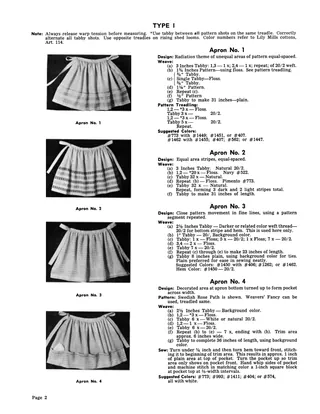
Basic Project No. 4 from Terrace Textures gives instructions for handwoven cotton aprons in two types: Type I is woven across a wider warp, and Type II uses the warp width as the apron length. It includes tables of yarn amounts, warp lengths and sett, a four-shaft threading adapted from Weavers' Fancy, and weaving and treadling directions for six aprons with suggested colors. The last page gives general directions for washing, sewing belts, gathering and hemming the finished aprons.
Car Coats
Article · 5 pages · weaving drafts
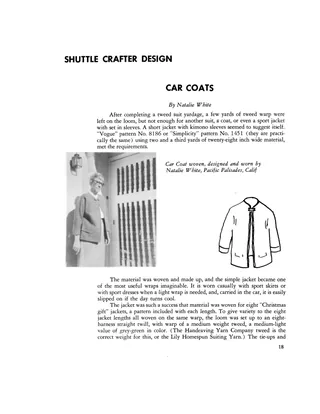
An article from the Shuttle-Craft Bulletin, 1957, in two parts. Natalie White describes a short kimono-sleeved car coat woven from leftover tweed warp on an eight-harness straight twill, with pattern numbers, a cutting layout and warp and weft specifications for a single jacket length. Harriet Tidball then adds a commentary on rescuing failed or "bargain" tweed yarn. She describes a soft Glen Plaid fabric woven as a 3-1 twill, re-sleyed to 30 ends per inch, and suggests using it for a car robe or afghan.
December, 1913
Article · 2 pages · weaving drafts
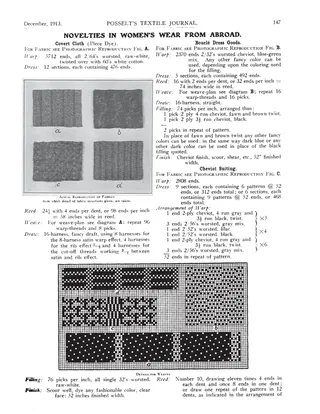
Two pages from the December 1913 issue of Posselt's Textile Journal. The first gives specifications for women's dress fabrics from abroad (covert cloth, boucle dress goods, cheviot suiting, mouliné dress goods), covering warp and filling yarns, reed, draw, weave repeats, and finishing, with fabric photographs and weave plans. The second continues with a short note on a patented process for artificial silk from viscose, and an installment of "Manufacture of Narrow Wares" on two-system filling weaves with face and back picks, illustrated by diagrams (Figs. 46-48) using 5-harness satin, 4-harness twill, and 8-harness satin.
Designing
Textile Mercury, 1890
Article · 2 pages · weaving drafts
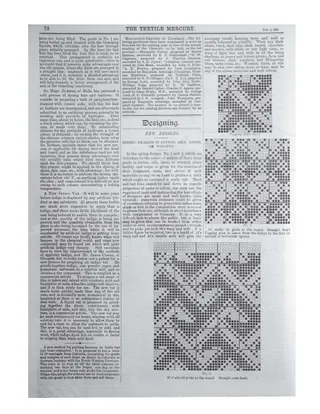
Two pages from the Textile Mercury of 1 February 1890 with a 'Designing' column for power-loom cloth makers. It gives pegging plans for spring dress goods in cotton, silk, linen or worsted, a design for woollen mantle cloth combining ribbed and twill sections with setts and colourings, and a figured dress fabric with semicircle motifs. Drawdown and pegging-plan grids are included. The first page also carries unrelated trade news items.
Designing
Textile Mercury, April 19, 1890
Article · 2 pages · weaving drafts
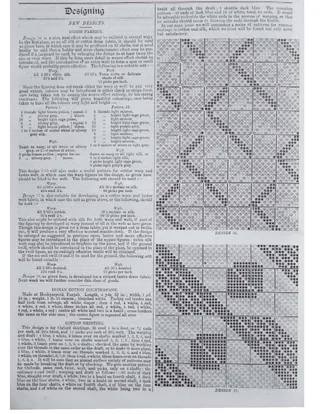
Two pages from The Textile Mercury, April 19, 1890, in a series on textile designing. They give weave designs 76, 77 and 78 for silk, cotton and worsted dress fabrics, with setts, yarn counts and colourings, and cotton shirting drafts and pegging plans for Oxford shirtings. They also cover an Indian cotton counterpane from Hoshyarpur, Punjab, with border and centre layout. Page 2 also carries a notice of a loan exhibition of British-made silks in London and a news item on the Rating of Machinery Bill.
Designing
Textile Mercury, 1891
Article · 2 pages · weaving drafts
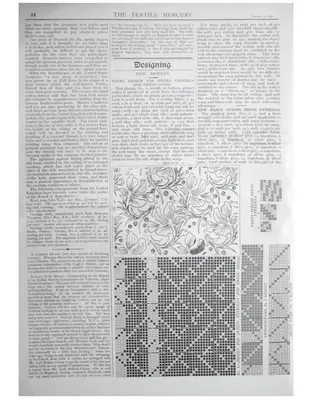
A short article from The Textile Mercury (January 17, 1891) offering suggested designs for spring vestings, dress goods, fancy dress patterns and figured mantle cloth. It gives yarn counts, reeds, picks per inch and warp and weft colour sequences, with pegging plans and draft plans for Designs 1 to 4, a floral Sketch A, and a graph-paper figure for Design 7 meant for a 384 jacquard machine. Page 1 begins with unrelated trade news.
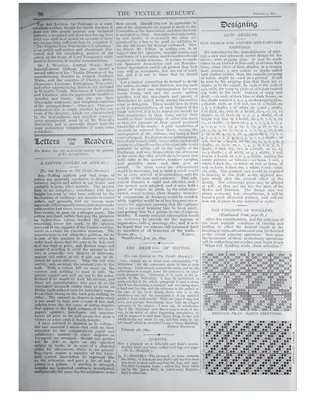
Designing
Textile Mercury, 1891
Article · 2 pages · weaving drafts
Two pages from The Textile Mercury of 7 February 1891 (pp. 98-99) containing the 'Designing' column. It gives a new 21-shaft design for fancy Oxford and Harvard shirtings, with pegging plans and a detailed warp colour and draft sequence (80 ends per inch of 24's twist, 64 picks of 16's weft). It continues a series on the finishing of woollens, covering weaving, scouring and milling, and ends with a note on novelty double cloths (Designs 11 and 12) combining a 2/2 twill worsted with a plain woollen stripe or check. Short trade notices and letters to the editor about cotton disputes, cotton drawing and loom queries are also on the pages.
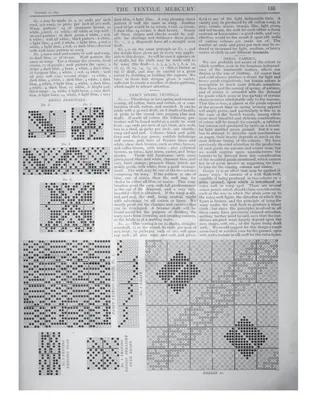
Designing
Textile Mercury, 1891
Article · 2 pages · weaving drafts
Two pages from the Textile Mercury of 21 February 1891 with a 'Designing' section on new designs for the spring season. It gives fancy diagonal dress fabrics (Nos. 1-4) and fancy spring vestings, with warp and weft counts, ends and picks per inch, colour schemes, stripe and check sequences, and shaft drafts. Drawdowns, a pegging plan and a draft are shown for the vestings and for Design 17, a weft-flush twill with an extra weft figure. The first page also carries unrelated trade news and a paper on machine stoking of boiler furnaces.
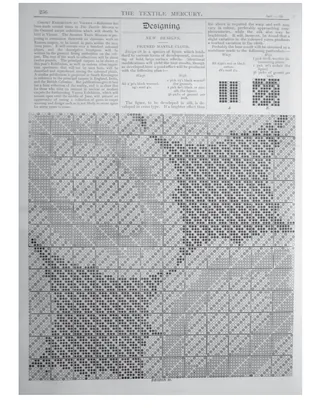
Designing
Textile Mercury, 1891
Article · 2 pages · weaving drafts
Two pages from the Textile Mercury of 11 April 1891 with the weekly 'Designing' column of new fabric designs for the trade. It gives yarn counts, reeds and picks per inch for a figured mantle cloth (Design 28), a 20-shaft dress goods draft, coloured fancies, zephyr lawns, stripes and plain muslins, with warp colour schemes and pegging plans. A short note on the Oriental carpet exhibition at Vienna precedes the column.
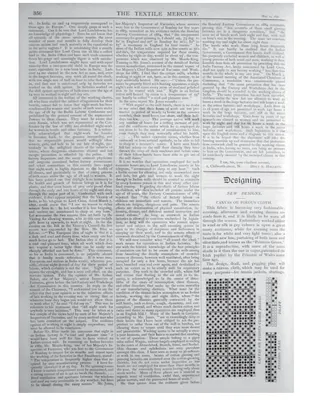
Designing
Textile Mercury, 1891
Article · 2 pages · weaving drafts
A two-page extract from The Textile Mercury of 23 May 1891 with a trade column on new fabric designs. It gives a draft and pegging plan for a canvas or porous cloth, with warp and weft particulars (20's twist warp, 25's linen weft, reed and pick counts) and finishing advice. It also lists dress lining patterns with warp stripe sequences, 5-shaft and 7-shaft satins and a 5-shaft twill, then discusses colour-and-weave effects in woollens and worsteds and gives Design 44, a twenty-shaft weave with draft and example yarn set-ups.
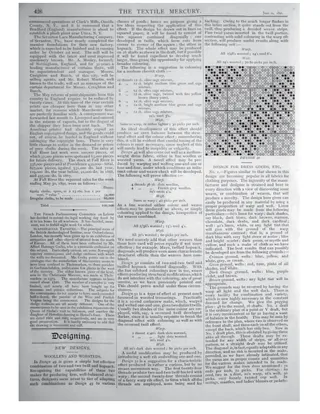
Designing
Textile Mercury, 1891
Article · 2 pages · weaving drafts
A two-page 'Designing' column from The Textile Mercury (20 June 1891) offering new woollen and worsted weave designs (Designs 49-52) with suggested warp and weft colourings, yarn counts, reed sizes and picks per inch. It also gives a figured design for dress goods with pegging plan and two alternative drafts (16 shafts, 48 to the round), with advice on yarns and setts for linen dress goods, shirtings and vestings. Page 1 opens with unrelated trade news, including a note on Norwegian tapestry counterpanes.
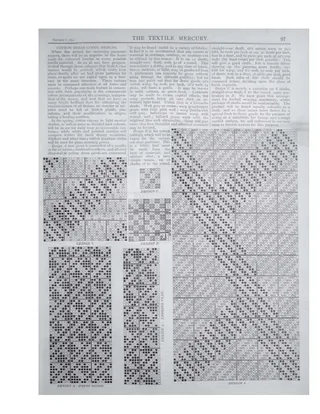
Designing
Textile Mercury, 1892
Article · 2 pages · weaving drafts
Two pages from The Textile Mercury of 6 February 1892 giving new fabric designs with weave drafts. The first page has twill designs (Designs 8 and 9) for waistcoatings and dress fabrics, combining two-and-two twill with an eight-end sateen, with warp and weft counts and setts. The second page covers cotton dress goods designs A, B and C, on 13, 16 and 8 shafts with straight-over drafts for dobby looms, with yarn counts, ends and picks per inch, colour combinations, and a pegging plan. The scan also includes unrelated dyeing articles at the top of page 1.
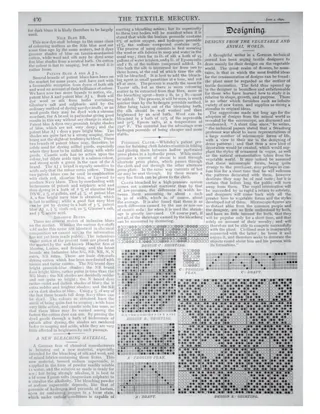
Designing
Textile Mercury, 1892
Article · 2 pages · weaving drafts
A two-page extract from The Textile Mercury of 4 June 1892. It opens with trade notes on new blue dyestuffs, a sodium superoxide bleaching agent, and cloth finishing and bleaching. A short Designing section follows, arguing for plant forms over microscopic forms as sources of textile ornament. It then gives new shirting designs A, B and C with pegging plans and drafts, and Design D, an extra weft spot figure, with warp, weft and sett details.
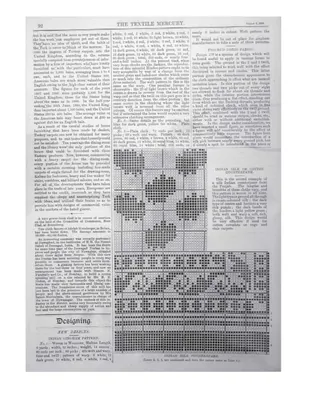
Designing
Textile Mercury, 1890
Article · 2 pages · weaving drafts
Two pages from the Textile Mercury of August 9, 1890, in the "Designing" column. They give new designs with setting details: three Indian gingham patterns (Woozzoor, Madras) with warp color sequences, an Indian silk counterpane from the Punjab, and a figured dress fabric (Design 172) on a 2 and 2 twill ground with flushing threads imitating leno. A section on tweeds gives delicate neutral colorings, yarn counts, reed setting and finishing advice. The top of page 1 carries trade news on Turkey carpet imports and mill news from Germany, Austria and India.
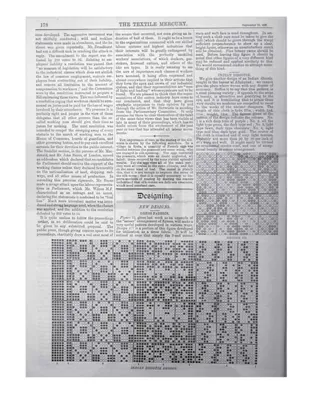
Designing
Textile Mercury, 1890
Article · 2 pages · weaving drafts
Two pages from the Designing column of The Textile Mercury giving new textile designs with drawdowns. Covers a 5-end sateen figured dress fabric (Design 177), an Indian dhootie bought in Allahabad with its colour key (Design 178 grid), a 32-shaft woollen suiting with a weft figure twilling over a warp twill ground, and settings for gingham and zephyr check cloths. Includes sett, yarn counts and warp colour patterns. The first page also carries unrelated editorial text on a trades union congress and silkworm rearing.
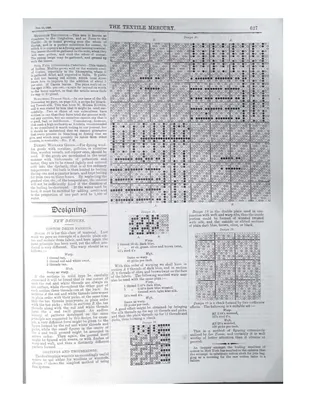
Designing - Cotton Dress Fabrics
Textile Mercury, 1889
Article · 1 page · weaving drafts
A single page from The Textile Mercury, 21 December 1889, in the Designing column. It presents Designs 16 to 19, with drawdown grids, for cotton dress fabrics and for woollen and worsted coatings and trouserings. The designs are double plain weaves in tan, red and white, and in blues, olive and brown, with 4-end twill grounds, warp and weft ribs, and corkscrew checks. Warp and weft colour orders, reed counts and picks per inch are given. The page also carries short notes on dyeing and tanning materials, bleaching Tussah silk, and dyeing woollens.
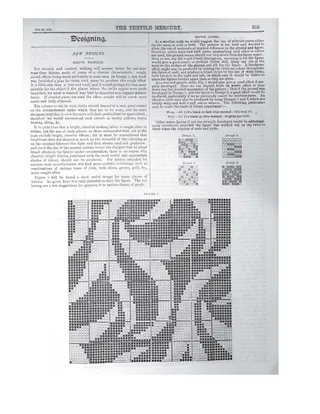
Designing - Dress Fabrics
Textile Mercury, 1889
Article · 1 page · weaving drafts
A single page from the Designing column of The Textile Mercury (28 Nov. 1889) on new designs for dress fabrics. It recommends cheviot-type and mixture yarns and muted colours for outdoor winter wear, and suggests ways to use a large figured pattern (Figure 1) in woollen and worsted mantle cloths. Four small drawdowns (Designs 5-8) show twill and four-end sateen weaves for ground and figure, with warp and weft particulars for a worsted cloth.
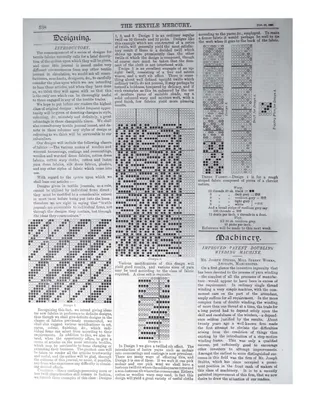
Designing - Introductory
Textile Mercury, 1889
Article · 1 page · weaving drafts
A page from The Textile Mercury of 16 November 1889 that opens the journal's series on textile designing. It explains the editors' plan to offer ideas and modifications for fabrics (set, yarns, colour, finishing) rather than only fixed designs. It then gives three coating designs (a regular twill, an upright twill built on a five-end sateen with a weft rib, and a twilled rib using mohair and wool weft) and a striped cheviot dress fabric (Design 4) with a draft, pegging plan, and warp/weft colour and sett details. The page ends with the start of a machinery notice on Joseph Stubbs's patent doubling winding machine.
Designing and Colouring of Scotch Tweeds
Article · 15 pages · weaving drafts
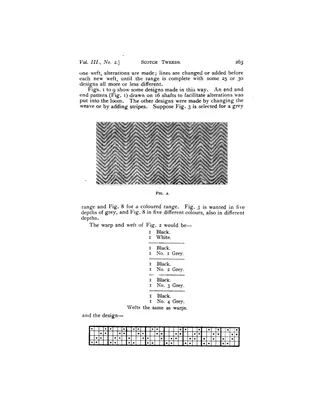
A paper by Thomas Welsh of Hawick, read at a Textile Institute congress in 1912, on how Scotch tweeds are designed, colored and sold. It covers the history of the tweed trade, the making of trial ranges of 25 to 30 designs in graded colors, end-and-end patterns, and the construction of reversible double cloths with a centre tying warp (with sections and an 8-shaft weaving draft). It also discusses wool types such as Cheviot and Saxony, the cost of pattern ranges, and design trends, and it ends with a recorded discussion among manufacturers and teachers.
Designs in Cotton Shirting Fabrics
Textile World Journal, January 17, 1920
Article · 2 pages · weaving drafts
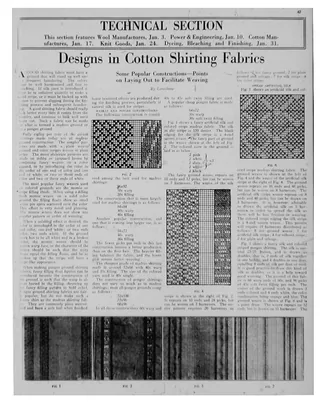
Two-page issue excerpt from Textile World Journal's cotton manufactures technical section. The main article, by Lanceham, covers cotton shirting fabric design, comparing madras and pongee grounds, typical thread counts and yarn sizes, and harness requirements for dobby-woven patterns with artificial silk, colored stripes, momie and Bedford cord weaves. It includes fabric swatches and weave drafts (Figs. 1-8). A second article, on the setting of drawing rolls on roving and spinning frames, follows on page 2.
Hand Woven Materials for Clothing
Article · 4 pages · weaving drafts
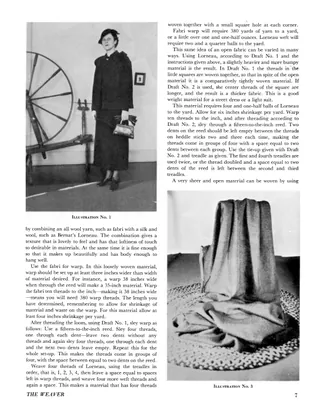
A 1936 article by Ruth Bolinger on planning, weaving, finishing and making up hand-woven fabrics for clothing. It covers yardage, warp waste, shrinkage allowances, flaxseed dressing for warps, washing and pressing woolens, and preventing raveling. It then describes several dress and coat fabrics woven from Bernat's fabri, Afghan, Lorneau and Glorine yarns, with sett, sleying, treadling and yardage given. Five four-shaft drafts appear on the last page, along with photographs of finished garments and fabrics.
Miscellaneous Weaves
Baldwin's Textile Designer, March 1889
Article · 2 pages · weaving drafts
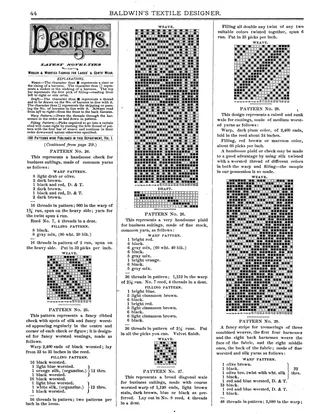
Two pages from Baldwin's Textile Designer (pp. 44-45) continuing the department "Latest Novelties in Woolen & Worsted Fabrics for Ladies' & Gents' Wear," presenting Patterns No. 24 through 35. Each pattern has a short description of the intended fabric (suitings, vestings, coatings, trouserings, dress goods), warp and filling color sequences, thread counts, yarn run sizes, reed numbers, and picks per inch, accompanied by weave and draft diagrams. An explanation of the weave and draft notation is given at the top of the first page.
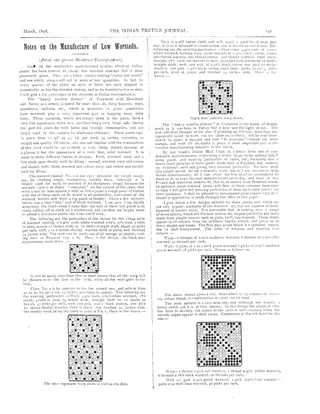
Notes on the Manufacture of Low Worsteds
Indian Textile Journal, March 1898
Article · 1 page · weaving drafts
A March 1898 article from a Bradford correspondent of the Indian Textile Journal on making cheap low worsted coatings in Yorkshire's heavy woollen district. It gives layouts for three classes of cloth (worsted warp with shoddy weft, with cotton and shoddy weft, and with worsted and cotton warp), including ends, reed, picks, yarn counts and 10- and 12-shaft weave drafts. It closes with 12-shaft honey-comb and related designs for ladies' dress goods, with warp and weft colour orders.
921 documents found