Textile Documents › Publications › Publication: Textile World Journal
17 documents found
Sort: 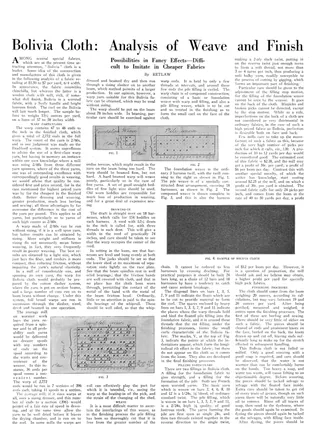
Bolivia Cloth: Analysis of Weave and Finish
Article · 2 pages · weaving drafts
A 1916 Textile World Journal article by 'Retlaw' analyzing Bolivia cloth, a lustrous worsted fabric resembling chinchilla with a small curled pile. It covers warp and filling yarns, sizing and beaming, an 18-harness straight draft, the compound weave (3-harness twill foundation plus a cut-float pile filling), and the finishing sequence of scouring, dyeing, gigging, whipping, curling and shearing. It also gives a cost breakdown and suggestions for colored or cotton-warp variations.
Designs in Cotton Shirting Fabrics
Textile World Journal, January 17, 1920
Article · 2 pages · weaving drafts
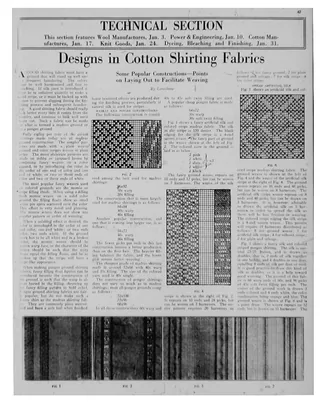
Two-page issue excerpt from Textile World Journal's cotton manufactures technical section. The main article, by Lanceham, covers cotton shirting fabric design, comparing madras and pongee grounds, typical thread counts and yarn sizes, and harness requirements for dobby-woven patterns with artificial silk, colored stripes, momie and Bedford cord weaves. It includes fabric swatches and weave drafts (Figs. 1-8). A second article, on the setting of drawing rolls on roving and spinning frames, follows on page 2.
Details of Manufacture of Spun Silk Yarns
Article · 2 pages
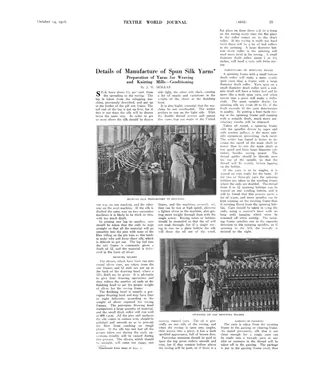
A two-page installment from Textile World Journal (continued from the Sept. 2 issue) describing the later stages of spun silk yarn manufacture. It covers drawing frames, roving, spinning frame settings and drafts, winding, twisting, gassing to burn off nibs, reeling into 840-yard skeins, washing, shaking out, and conditioning to about 11 percent moisture. Practical advice is given on yarn counts, loss in gassing, and bundling for weaving and knitting mills. Photographs show drawing, cap spinning, doubling/twisting/reeling, and gassing machinery.
Hand-Weaving Industry
Textile World Journal, June 2, 1917
Article · 1 page
A short 1917 trade-journal note on the Biltmore Industries of Asheville, North Carolina, which grew out of an industrial school begun in 1901 at Biltmore Village under Mrs. George W. Vanderbilt. It reports the sale of the enterprise to F. L. Seely of the Grove Park Inn, the building of new shops on the Inn grounds, and the reputation of Biltmore Homespun, an all-wool, unshrinkable, colorfast cloth. The management also asks for information on carding and spinning machinery.
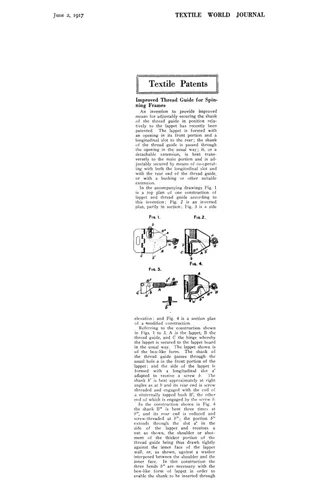
Improved Thread Guide for Spinning Frames
Textile World Journal, June 2, 1917
Article · 2 pages
A two-page column of textile patent notes from Textile World Journal, June 2, 1917. It describes a patented adjustable thread guide and lappet for spinning frames, a hosiery holder frame with clamping bars for embroidering machines, and an Austrian process for combined napping and carbonizing of mixed vegetable and animal fiber cloth to make raised designs. Line drawings illustrate the spinning-frame and embroidery-holder devices.
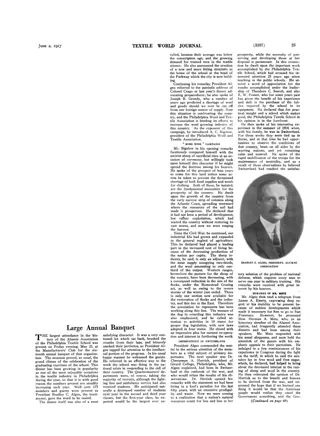
Large Annual Banquet
Textile World Journal, June 2, 1917
Article · 2 pages
A 1917 trade-journal report on the sixteenth annual banquet of the Alumni Association of the Philadelphia Textile School, held May 25 at the Manufacturers' Club with over 175 attendees. It summarizes speeches by association president Bradley C. Algeo, A. C. Bigelow on the "More Wool" campaign and the wool shortage, Dr. Cheesman A. Herrick on Switzerland and national defense, Herman A. Metz, E. W. Fairchild, and John Fisler. Topics include the school's response to World War I, enrollment, a planned new school building, and domestic wool production.
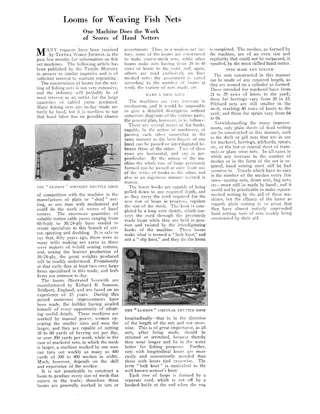
Looms for Weaving Fish Nets
Textile World Journal, May 26, 1917
Article · 1 page
A 1917 trade article, reprinted from the Textile Mercury, describing Richard R. Samson's hand-powered net-making machines (straight and circular shuttle looms) built in Bridport, England. It explains how the machines form lock knots with interdigitating hooks and a wire shuttle, the output per day for herring and mackerel nets, and the mesh sizes for different fish. It also notes that only plain flat netting can be machine-made, while trawls and shaped nets still require hand netting.
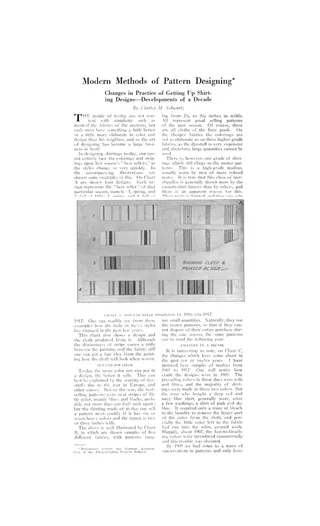
Modern Methods of Pattern Designing
Textile World Journal, June 16, 1917
Article · 2 pages
A 1917 trade article by Charles M. Schwartz on how shirting fabric patterns are designed in American mills. It traces changing fashions in stripes, plaids and colors from 1905 to 1917, including the effect of wartime dye scarcity and the introduction of bleach-fast colors. It also contrasts the old method of weaving sample "blankets" with tie-ins against designers painting patterns on paper using a reed-card and percentage chart. Illustrated with charts of cloth and painted design samples.
Modern Mill Villages
Article · 1 page
A 1917 trade-journal article describing the cotton mill villages built around Marion, North Carolina, by D. D. Little and his son Hugh F. Little. It covers the Marion Manufacturing Co. and Clinchfield mills, their landscaped village plans, housing, churches, schools, company stores, gardens, wage increases and worker health. It is an account of welfare and community planning in a Southern cotton mill town, not of textile production techniques.
New Bedford School Graduation
Textile World Journal, June 23, 1917
Article · 2 pages
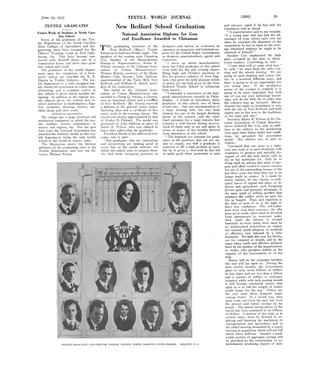
A June 1917 Textile World Journal report on the graduation exercises of the New Bedford (Mass.) Textile School, including the speakers, the award of the National Association of Cotton Manufacturers medal to Cheng Q. Amona, and extracts from addresses by President William E. Hatch, Speaker Channing Cox and Rufus R. Wilson on graduates' careers and wartime duty. The scan also begins with a short item on textile graduates of North Carolina State College, with a group portrait of the thirteen-member class and Director Thomas Nelson.
New Textile School Building
Textile World Journal, June 2, 1917
Article · 1 page
A short 1917 trade-journal news item announcing that the Philadelphia Textile School will move from its quarters at Broad and Pine Streets to larger buildings on the new Parkway at Twenty-fifth and Spring Garden Streets, next to the future Art Museum site. It reports the plans for building the school section first and the expected sale of the old property. It also gives the resolution of appreciation adopted by the school's Alumni Association.
Philadelphia Textile School Commencement
Textile World Journal, 1917
Article · 1 page
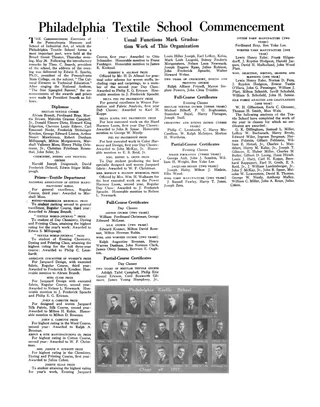
A report from Textile World Journal on the 1917 commencement of the Philadelphia Textile School, part of the Pennsylvania Museum and School of Industrial Art, held at the Broad Street Theater on May 24. It records the addresses given and lists the diplomas, prizes, and full- and partial-course certificates awarded in day and evening classes. The prizes cover Jacquard design, weave formation, hand and power loom work, color design, and chemistry, dyeing and printing. A group photograph of the Class of 1917 accompanies the article.
Raw Cotton Efficiency
Article · 1 page
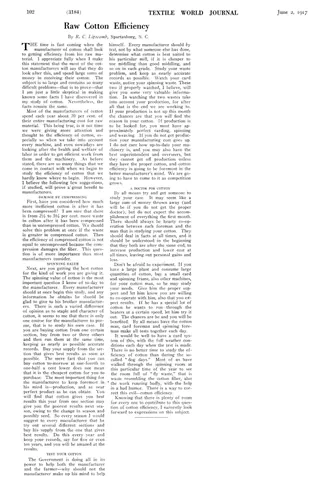
A one-page 1917 trade journal article by R. C. Lipscomb of Spartanburg, S.C., urging cotton mill manufacturers to get more efficiency from raw cotton, which makes up about 70 percent of manufacturing cost. It covers extra waste and fiber damage from compressed cotton, choosing cotton by testing it against the mill's own work, and tracking card and spinning waste. It also recommends hiring a cotton specialist and running small-scale mill tests with daily records.
Successful Land Cruise
Textile World Journal, June 2, 1917
Article · 1 page
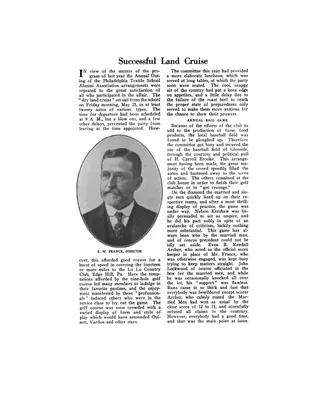
A brief 1917 news report on the annual outing of the Philadelphia Textile School Alumni Association, held as an automobile 'dry land cruise' on May 25. It describes the trip to the Lu Lu Country Club in Edge Hill, Pa., golf, a luncheon, and the traditional baseball game between married and single men, won by the married men 12 to 11. Includes a portrait of E. W. France, Director.
The Textile Reconstruction of France: Conditions in the Department Du Nord Before the War
Article · 1 page
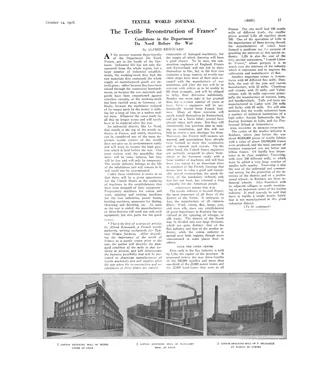
First article in a series by French textile authority Alfred Renouard, published during World War I, on rebuilding the textile industry of northern France (Department du Nord), most of which was then German-occupied. It argues that American makers of textile machinery will find opportunities replacing equipment destroyed or stripped, then surveys pre-war industry: Lille and flax/linen, Armentieres, Dunkirk jute and canvas, lawn and handkerchiefs at Chambray and Valenciennes, lace and tulle, and wool at Roubaix-Tourcoing. Includes three photographs of cotton spinning mills.
Textile School Alumni Meeting
Textile World Journal, June 2, 1917
Article · 2 pages
A 1917 trade journal report on the sixteenth annual meeting of the Alumni Association of the Philadelphia Textile School, held with the school's graduating exercises on May 24. It covers the treasurer's and loan fund reports, membership figures, technical papers read by title, wartime service by students and alumni, and the election of officers.
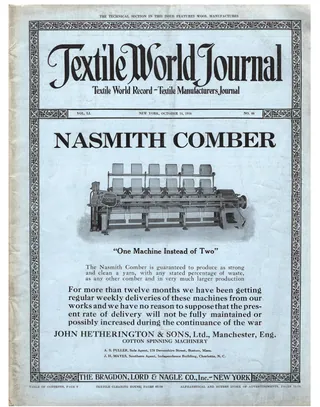
Textile World Journal, Vol. 51, No. 46 (October 14, 1916)
Textile World Journal, October 14, 1916
Periodical · 80 pages · weaving drafts
Issue of Textile World Journal, a weekly American trade paper, dated October 14, 1916, with its technical section devoted to wool manufactures. It combines industry news (the British embargo on knit goods, cotton in explosives, the wool census, tariff and wage items, mill news) with market reports for cotton goods, yarns, wool, dyestuffs and knit goods. Technical articles cover Bolivia cloth (weave and finish analysis), spun silk yarn preparation and conditioning, wool combing and pin setting, steamer rugs, carpet terms, spinning worsted around a cotton thread, and a cop winding mechanism. Much of the issue is advertising for textile machinery, yarns, chemicals and dyes, plus a buyers' index and the Textile Clearing House classified section.
17 documents found