Textile Documents › Topic: Basketry, straw, and matting
208 documents found
Sort: 
The Art of Basket Making
Book · 122 pages
An instructional handbook on English willow and cane basket-making from Pitman's Handwork Series. It covers materials and their preparation, tools, and terminology, then walks through slewed, fitched, and randed work, with chapters on round, oval, and square baskets, borders, handles, covers, skein handles, and plaited hasps and nooses. It is illustrated with numerous figures and photographs of finished baskets and construction steps, and ends with a conclusion and glossary.
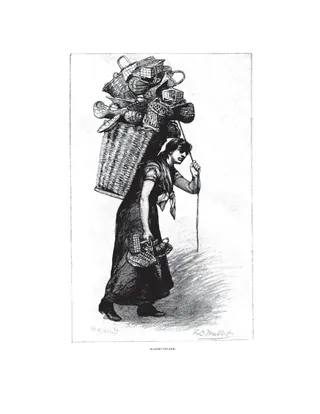
Basket Seller
Illustration · 1 page
A single engraved illustration titled "Basket-Seller" from Harper's New Monthly Magazine, 1885. It shows a woman walking with a staff, carrying a large load of woven baskets on her back and head and holding smaller baskets in her hand. The page has only the caption and no accompanying article text.
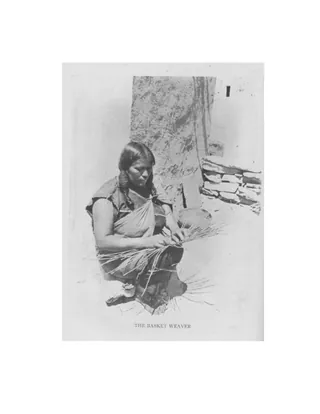
Basket Weaver
Craftsman, 1905
Illustration · 1 page
A single-page illustration titled "The Basket Weaver" from The Craftsman. It is a black-and-white photograph of a seated young woman with long hair in side braids, wearing a draped garment, who works plant fibers such as grass or rush stems on her lap with a basket beside her. The page carries only the caption and no accompanying article text.
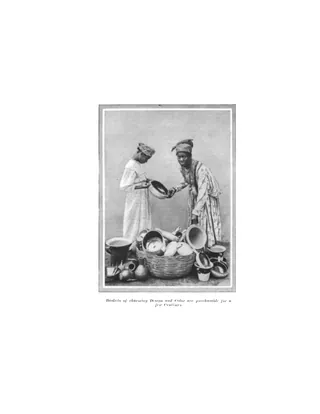
[Caribbean Basketry]
Illustration · 2 pages
Two halftone photographs with captions, apparently from Harper's New Monthly Magazine, showing Caribbean basketry. One shows a seated woman among round and rectangular baskets and bundles, captioned as baskets of charming design and color purchasable for a few centimes. The other, captioned "A Martinique Basket-maker," shows a standing man beside a seated figure surrounded by baskets and a large basket-work piece. No weaving drafts or technical descriptions are included.
Modern Basket Maker -- II
Article · 2 pages
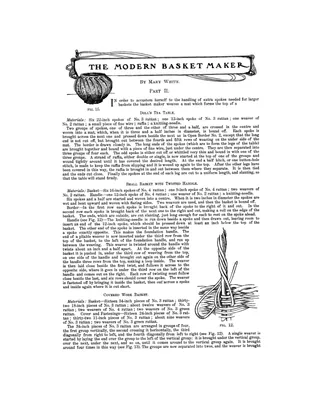
Part II of Mary White's series on rattan basketry in Everybody's Magazine gives materials lists and step-by-step directions for five projects: a doll's tea table with a woven mat top and raffia-wrapped legs, a small basket with a twisted handle, a covered work basket with hinge and ring fastening, a candy basket with a colored band, and a large scrap basket in green and natural rattan. The text covers spoke layouts, weavers, borders, and finishing. Figures show a finished basket, handle construction, a radiating-spoke base, and the interlinked ring fastening.
A Nice Way of Taking Their Medicine
The Graphic, January 12, 1918
Illustration · 1 page
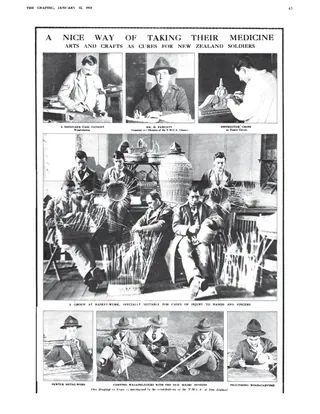
A single illustrated page from The Graphic, 12 January 1918, showing New Zealand soldiers in occupational therapy at a hospital in Essex run by the New Zealand Y.M.C.A. The photo collage shows wood-planing, wood-carving, pewter metal-work, carving walking-sticks with Maori designs, and a group doing basket-work, described as suited to hand and finger injuries. Captions name the Y.M.C.A. class organiser Mr. H. Fawcett and the carving instructor Cross.
Notes on Solomon Island Baskets and on Lord Howe's Group
Article · 4 pages
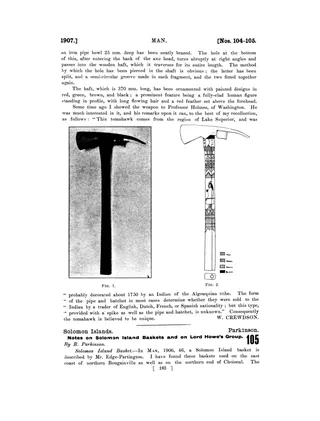
A short 1907 note from the journal Man by R. Parkinson. It describes plaited trays and baskets (dara, doado, koko) from the east coast of Bougainville and northern Choiseul in the Solomon Islands, made from the dried stem of a fern, and notes similar work in New Britain and the Admiralty Islands. A second part on Lord Howe's Group (Ongtong Java) gives bibliographic pointers, brief notes on the islanders' origins and contacts, and two photographs of graveyards. The scan also includes the end of a preceding note on a tomahawk and the start of a book review.
Of Baskets
Article · 1 page
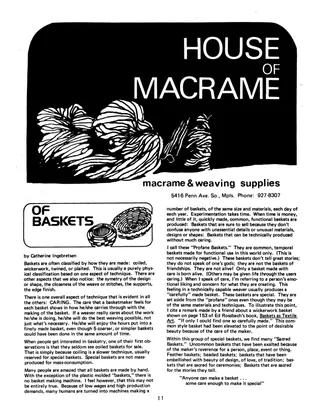
A one-page essay on basketmaking by Catherine Ingebretsen, published in the Minnesota Weaver. She argues that beyond technique (coiled, wickerwork, twined, plaited), the defining quality of a basket is the care the maker puts into it. She contrasts mass-produced, functional "profane" baskets with specially made and "sacred" baskets, citing a wickerwork basket in Ed Rossbach's Baskets as Textile Art.
Of Baskets
Article · 1 page
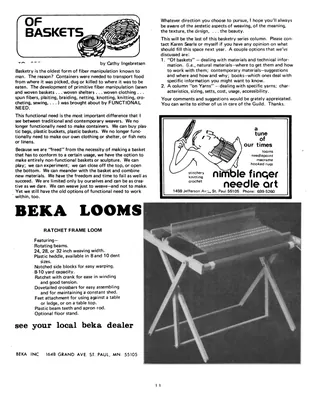
A short column from the Minnesota Weaver, the last in a basketry series by Cathy Ingebretsen. She argues that basketry is the oldest fiber craft, born of functional need, and that modern makers are free to make non-functional baskets and sculpture. She closes by asking readers for ideas for next year's column, such as one on basketry materials and books or one on yarns. The page also carries advertisements for Nimble Finger needle art shop and Beka looms.
On an Unusual Form of Rush Baskets from the Northern Territory of South Australia
R. Etheridge Jr. · Journal of The Royal Anthropological Institute of Great Britain and Ireland, 1894
Article · 3 pages
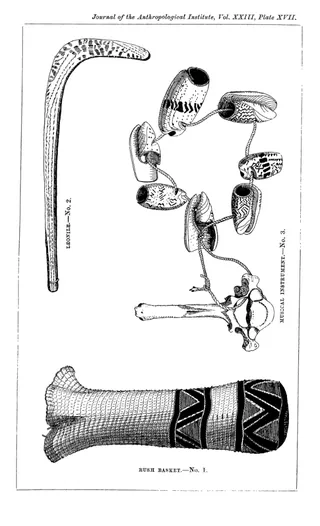
A short 1894 article by R. Etheridge Jr. describing an unusual cylindrical rush basket with a bell-shaped mouth, collected from the Alligator Rivers Tribe in the Northern Territory of South Australia. It gives dimensions, the stake-and-siding plaiting structure, the twisted-fibre rim, and the decoration in black bands, white pipe-clay and Indian red triangles. It compares the form with other Australian aboriginal baskets, and Plate XVII illustrates the basket together with a leonile and a musical instrument.
Pine Needle Basketry: A Complete Book of Instructions for Making Pine Needle Baskets
Book · 37 pages
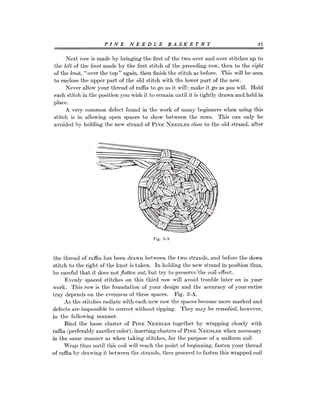
An instruction book for making coiled baskets, trays, and other articles from long-leaf pine needles and wire grass, sewn with raffia. It covers selecting and preparing materials, starting round and oval pieces, splicing, shaping, and the main stitches (chain, wheat, spiral wheat, fern, and Ti or knot stitch). Later sections cover handles, glass bottoms, and detailed directions for a sandwich tray, work basket, hanging basket, oval tray, and jardiniere, illustrated with line drawings and photographs.
Re-Caning a Stool or Chair Seat
Monograph · 11 pages
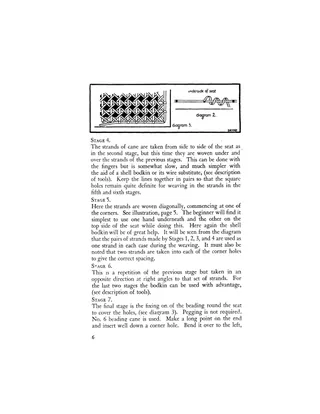
Dryad Leaflet No. 16 gives instructions for re-caning a stool or chair seat with seating cane. It lists the tools (knife, clearer, doubler, shell bodkin, cane seating weaver) and gives home-made substitutes. It then describes the seven-stage standard pattern, three alternative four-stage patterns, and a closely woven reversible loose-seated stool with a twill side and a diamond side. Diagrams and photographs of the stages and patterns accompany the text.
Wire Grass Basketry
Article · 3 pages
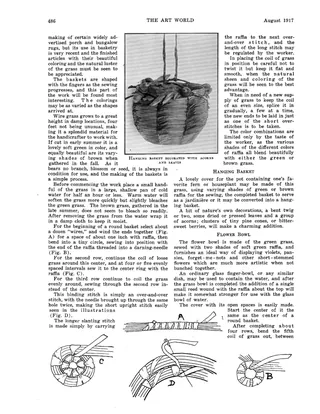
A 1917 magazine article from The Art World describing how to make coiled baskets from wire grass sewn with raffia. It covers gathering and dampening the grass, starting a round coil, the over-and-over binding stitch, and splicing in new grass. Instructions are given for a hanging basket, a flower bowl with an open cover, a three-cornered basket with a color scheme, and a tall centerpiece basket. Photographs and a lettered construction diagram (A-D) illustrate the work.

Basket
Article · 1 page
A very short dictionary-style entry on 'basket' from the first edition of the Encyclopedia Britannica. It defines a basket as a machine made of interwoven twigs for holding fruit, earth and similar goods, and notes that the word also denotes an uncertain quantity, giving examples such as a basket of medlars (two bushels) and of asafoetida (20 to 50 pounds).
Basket Drum
Article · 7 pages
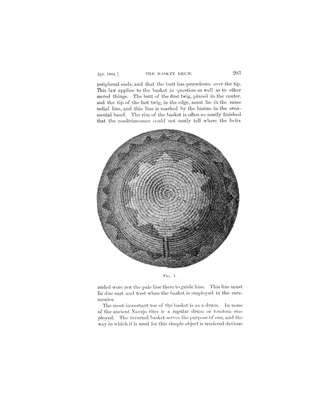
Article by Washington Matthews on the Navajo ceremonial basket drum, a coiled sumac-twig basket used inverted as a drum in the nine-night night-chant ceremony. It covers the basket's construction, butt-and-tip rules, decorative band with a gap, plaited rim finish and its legend, and the ritual handling of the basket. A second part describes the yucca-leaf drumstick, how its leaves are gathered, its ritual use and ceremonial unraveling. Two figures show the basket and the drumstick.
Basket Weaver on Attu
Illustration · 1 page
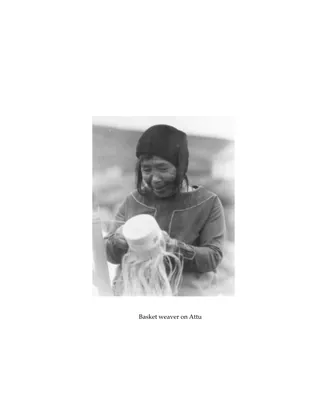
A single black-and-white photograph of an older woman working with a bundle of pale grass or fibers, captioned as a basket weaver on Attu. She wears a dark hood and a jacket with light piping, and a blurred landscape is visible behind her. The image documents Native basketry practice in the Aleutian Islands.
Basket Weaver, Howkan, Alaska
1897
Illustration · 1 page
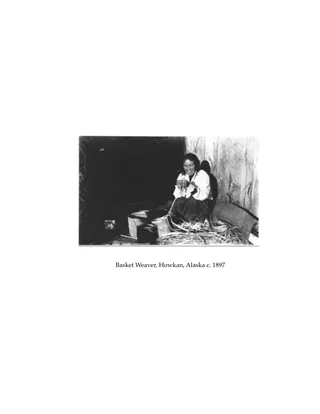
A single black-and-white photograph, captioned as a basket weaver at Howkan, Alaska, around 1897. It shows a seated woman holding a partially finished woven basket, with other finished baskets and a large woven mat or basket around her. The only text is the caption.
The Basket-Maker
Other · 1 page
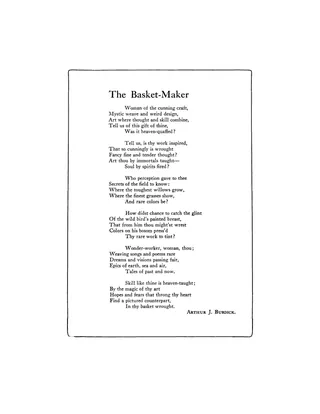
A single-page poem by Arthur J. Burdick addressed to a woman basket-maker. It praises her skill, her knowledge of where to find willows and grasses, and her use of natural colors, and likens her baskets to woven songs and visions. It is literary rather than technical and gives no instructions.
Basketry and Weaving
The Studio, 1906
Illustration · 1 page
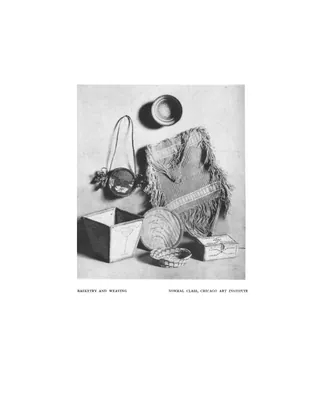
A single page illustration from a 1906 volume of The Studio showing a photograph of handcrafted basketry and woven objects, including a small round bag with a long shoulder strap and tassels, a small woven cap or bowl, and a large rectangular piece. The caption credits the Normal Class of the Chicago Art Institute. There is no accompanying article text or weaving draft.
The Basketry Book
Book · 149 pages
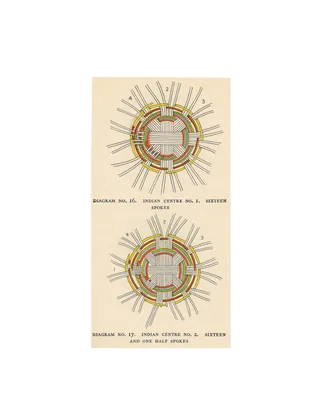
A twelve-lesson instruction manual in reed basketry by Mary Miles Blanchard. It begins with materials, tools and the eight fundamental weaves (over-and-under, Japanese, pairing, triple, coil and arrow). It then moves through round and oval bases, work-baskets, handled baskets, flower, candy, scrap and gathering baskets, Indian centres, borders and handle winding. Each lesson gives model dimensions and reed sizes, numbered paragraphs, review questions, and a chapter of answers. The book has many photographs of finished models, colored diagrams of weaving and handle-winding sequences, a table of weaves, coils, measurements and borders, and an index.
Decorative Value of Woven Cane Chairs
Article · 2 pages
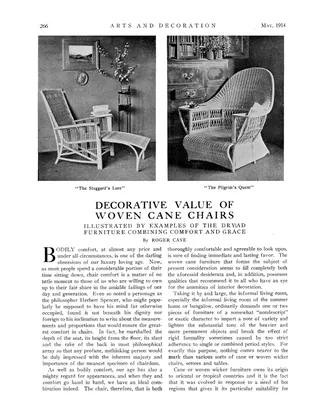
A two-page magazine article from Arts and Decoration (May 1914) promoting woven cane chairs as comfortable, decorative furniture for informal living rooms and summer homes. It discusses the oriental and tropical origins of cane furniture and its adaptation by English craftsmen, and illustrates Dryad furniture models such as "The Sluggard's Lure," "The Pilgrim's Quest," "John Peel" and "Sesame." It is about furniture design and decoration rather than weaving technique.
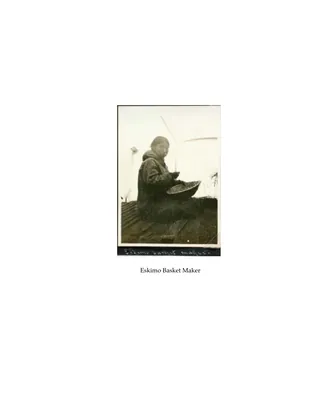
Eskimo Basket Maker
Illustration · 1 page
A single page with a black-and-white photograph of a seated woman in a hooded garment, working on a woven basket held in her lap. The only text is the caption "Eskimo Basket Maker." It is useful as a visual reference for Arctic basketry and its makers.
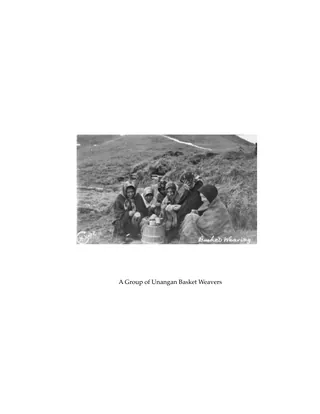
Group of Unangan Basket Weavers
Illustration · 1 page
A single black-and-white photograph showing a group of Unangan (Aleut) women seated outdoors on a grassy hillside in front of a grass-roofed structure. They wear headscarves and shawls and are working with baskets or basketry materials. The only text is the caption identifying them as basket weavers.
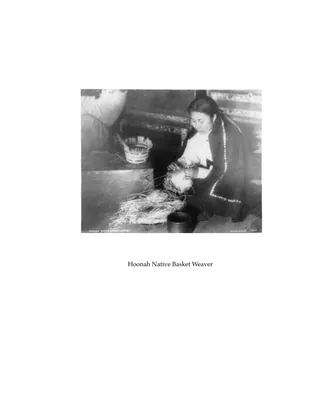
Hoonah Native Basket Weaver
Illustration · 1 page
A single black-and-white photograph captioned "Hoonah Native Basket Weaver." It shows a seated Native woman with long dark hair, wearing a dark dress with beaded trim, holding a partly woven basket with loose fiber strands. The only text is the caption; no date or photographer is given.
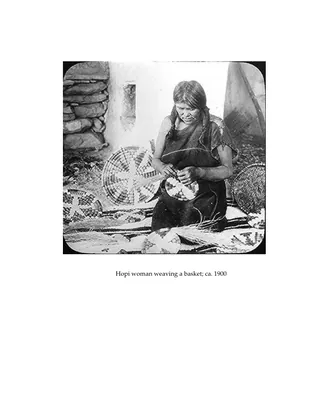
Hopi Woman Weaving Basket
1900
Illustration · 1 page
A single black-and-white photograph, dated about 1900, showing a seated Hopi woman making a coiled basket in her lap. Several partly finished baskets with geometric patterns and bundles of material lie around her. The only text is a caption identifying the scene.
Hugest of Baskets
Technical World, September 1912
Article · 1 page
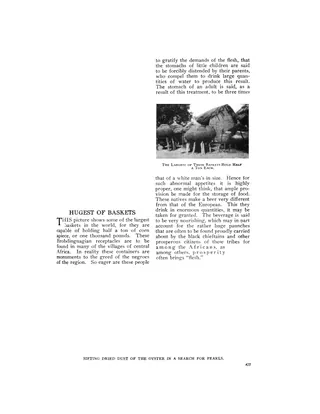
A one-page 1912 magazine item with a photograph of very large storage baskets in villages of central Africa, said to hold about half a ton (1,000 pounds) of corn each. The text is mostly racially prejudiced commentary of the period about the eating and drinking habits of the people, with little on basket construction or materials. It is of interest mainly as a historical example of how African basketry was presented in early twentieth-century popular press.
Kuskokwim Baskets from Alaska
Illustration · 1 page
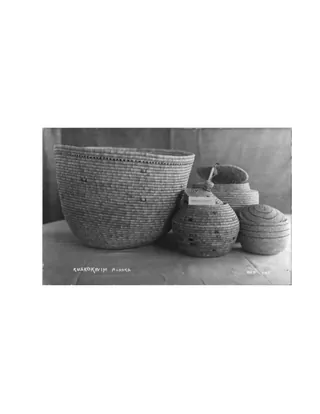
A single-page photograph of four coiled grass baskets from the Kuskokwim region of Alaska, arranged on a draped cloth. The baskets include a large open bowl-shaped basket with a dark decorative band near the rim and small dark tabs on the body. The only text is a brief caption naming Kuskokwim, Alaska.
Of Baskets - Story of Cane
Article · 1 page
A one-page article on the origin and processing of cane and reed for basketry and chair seating, reprinted with permission from the Comcraft Cane Seating Handbook of Peerless Reed and Rattan Mfg. Co. It explains that cane is the outer skin stripped from rattan vines and reed is the inner core. It describes how rattan is harvested in the South Pacific jungles, transported, sulphured, sorted, soaked, split and shaved into cane and reed.
Panier [Basket]
Article · 1 page · French
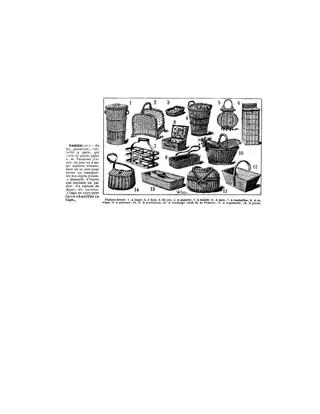
A one-page dictionary entry on the panier (basket) from the Nouveau Larousse Illustré. It gives the word's Latin origin and defines it as a vessel of wicker, rush or other plaited material for carrying or storing things. An engraved plate shows fourteen numbered basket types, including baskets for linen, wood, salad, bread, bottles, needlework, provisions, grape harvest, silverware and fishing.
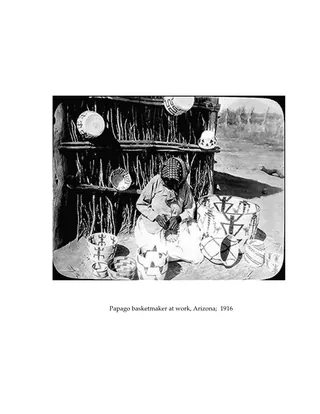
Papago Basketmaker
1916
Illustration · 1 page
A single black-and-white photograph of a Papago (Tohono O'odham) basketmaker seated at work on a basket, Arizona, 1916. She wears a patterned head covering and sits before a wall of upright stalks, with shelves holding finished baskets decorated with geometric designs. The caption is the only text.
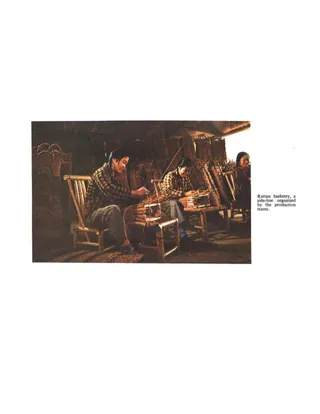
Rattan Basketry
China Pictorial, 1976
Illustration · 1 page
A single-page illustration from China Pictorial, 1976, No. 11, showing a photograph of workers seated on wooden chairs weaving rattan baskets in a dim workshop, with finished baskets stacked nearby. The caption describes rattan basketry as a side-line organized by the production teams. The catalog notes link it to the Miao Mountains.
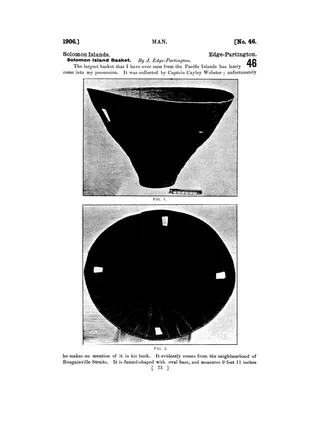
Solomon Island Basket
Article · 2 pages
A short note from the journal Man describing a very large funnel-shaped coiled basket from the Solomon Islands, probably the Bougainville Straits area. It gives the basket's dimensions and construction: single-rod coiling of reeds bound with split rattan, herring-bone ornament in vertical bands, and four handholes below the rim. The author compares it with smaller baskets in the British Museum. Two photographs illustrate the basket.
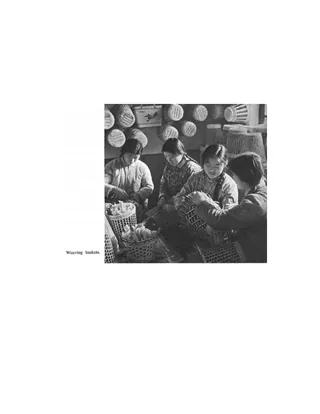
Weaving Baskets
China Pictorial, 1975
Illustration · 1 page
A single illustrated page from China Pictorial showing a black-and-white photograph of four young women seated together weaving baskets. Finished round and cylindrical baskets hang on the wall behind them, with bundles of cane or splints nearby. The only text is a brief caption, "Weaving baskets."
African Basketry Weaves
Article · 1 page
A short note from Science describing a collection of Barotse and Bechuana baskets recently received by the American Museum of Natural History. The author lists the woven and coiled basketry techniques present, including wicker, checker, twill, wrapped, twine variants, the California 'ti' weave, and several coil types, and compares them with Californian and Aleutian basketry. She notes the emphasis on sturdy storage chests and the black-only coil decoration.
Alaskan Basket Sellers
Article · 1 page
A short 1909 travel magazine article describing Native Alaskan women selling baskets and other goods to tourists on the wharves of Alaskan towns, with emphasis on Yakutat. It covers the old and new Yakutat baskets, prices from $2 to $50, bargaining customs when ships are in port, and sealskin items with beadwork and flannel. It opens with a comparison to the flower sellers of Honolulu. One photograph shows a display of baskets and other objects.
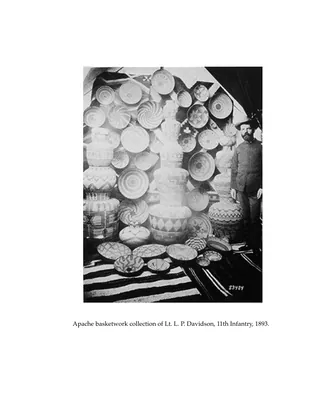
Apache Basketwork
1893
Illustration · 1 page
A single photograph of a large display of Apache coiled baskets, hung on a wall and arranged on the floor over a striped blanket, with a bearded man in a uniform-style jacket standing at the right. The caption identifies it as the Apache basketwork collection of Lt. L. P. Davidson, 11th Infantry, 1893.
Basket
Chambers's Encyclopedia, 1881
Article · 1 page
A short encyclopedia entry on baskets from Chambers's Encyclopedia. It covers the word's Welsh origin, early use of baskets (Israelites, ancient Britons), materials, willow cultivation and profits in Britain, the trade in handmade baskets, basket-making in blind asylums, and imports from the continent. It gives no technical instruction on construction.
Basket
Article · 2 pages
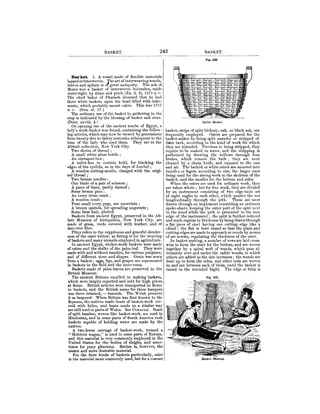
A two-page dictionary entry on baskets from Knight's American Mechanical Dictionary (1876). It surveys the history of basketry from biblical and ancient Egyptian examples, ancient Britons, and basket-work boats and carriages, then describes preparing osiers and splints and the method of weaving a basket from the bottom, sides, brim and handles. It closes with remarks on fruit baskets and veneer baskets, and includes illustrations of a splint basket and basket-making.
Basket
The Americana, 1903
Article · 2 pages
Encyclopedia entry on baskets from The Americana (1903). It traces the origin of the word from Britanno-Celtic roots and Roman references, treats basketry as a forerunner of weaving and pottery, and surveys materials such as willow, bamboo, rattan, palm and New Zealand flax. It describes the basic process of making an osier basket (slath, ribs, rim and handle) and closes with the decline of Native American basketry and efforts to revive it in Indian schools.
Basket Designs of the Pomo Indians
Article · 8 pages
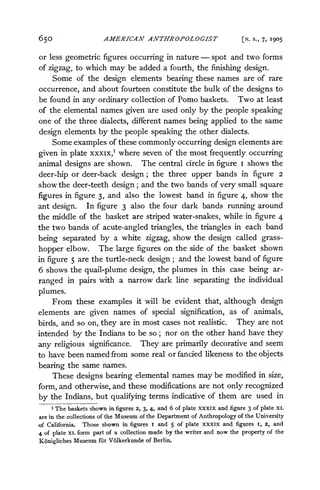
A preliminary account by S. A. Barrett of the design vocabulary in Pomo basketry from central California, based on 1904 fieldwork. It outlines the coiled and twined techniques and basket forms, then describes the 29 named design elements (animal, plant, and geometric), the qualifying terms that modify them, and how complex pattern names are built. Two plates show Pomo baskets with animal designs and arrowhead variations. Comparisons are made with design naming among the Hupa, Karok, Yurok, and Maidu.
Basket Shield from a Cliff Dwelling
Illustration · 1 page
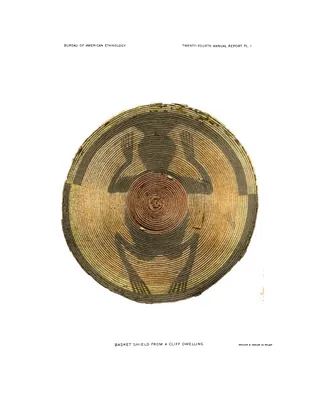
A single plate from the Bureau of American Ethnology's Twenty-fourth Annual Report showing a basket shield from a cliff dwelling. The circular coiled basketry disc has concentric rings and a dark stylized central figure, possibly a face or humanoid motif with outstretched arms or horns. The plate has only a caption and a printer's credit, with no discussion of construction.
Basket-Making
Article · 3 pages
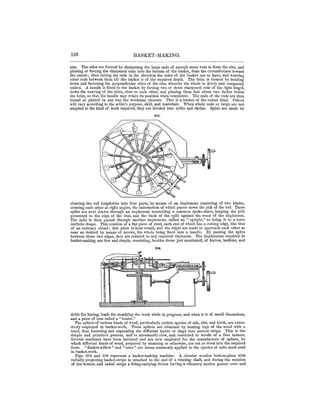
A short encyclopedia entry describing how baskets are made from split hickory, oak, black ash, osier and similar rods. It covers weaving the slat base, raising the sides on sharpened rib rods, forming the brim and fitting a handle. It also describes preparing splits and splints, the hand tools used (spoke-shave, upright, knives, bodkins, drills, beater), and a basket-making machine shown in Figures 305 and 306.
Basketry Bolo Case from Basilan Island
Article · 4 pages
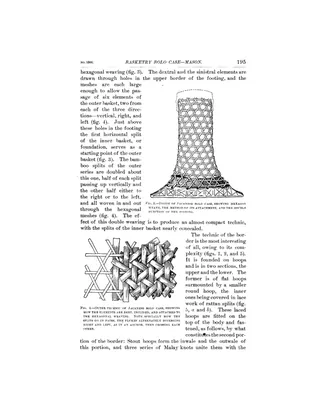
Otis T. Mason describes a basketry bolo (toilet or knife) case of the Jacanes (Yacanes) of Basilan Island in the Philippines, held in the U.S. National Museum. He covers its structural parts: a carved wooden footing and bottom, a body of bamboo splits woven in four directions over a hexagonal foundation, a complex hooped border with rattan lace work and Malay knots, and rattan carrying strips. He also describes the Malay knot and the decoration by carving, staining and smoking. Illustrated with photographs and line drawings of the case, its weave and its border.
Basketry: Everybody's Craft
Article · 2 pages
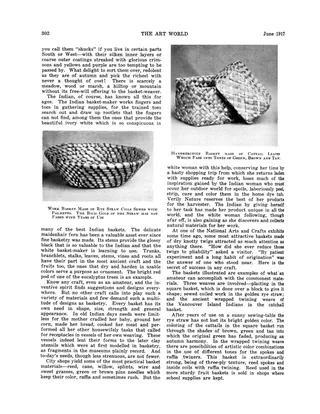
A 1917 magazine article promoting basketry as an accessible craft for amateurs. It surveys natural materials such as cattail leaves, rye straw, willow, poplar splints, pine needles, corn husks and maidenhair fern stems, and compares Native American gathering practice with shop-bought supplies. It describes three illustrated baskets: a plaited cattail handkerchief basket, a rye straw coiled work basket sewed with palmetto, and a wrapped twining catchall basket in the style of Vancouver Island Indians.
Beginnings of the Carrying Industry
Article · 26 pages
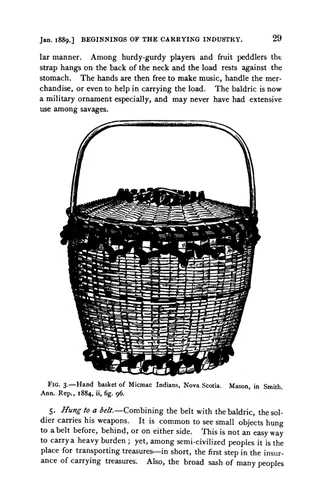
Otis T. Mason's 1889 essay in American Anthropologist surveys the origins of human burden-carrying as the starting point of transport and commerce, using the railway as a modern analogy. It catalogs the methods of bearing loads on the human body (hand, arm, shoulder, back, head, forehead, pockets) and goes on to combined effort, hauling, tossing, caravans, trails, couriers and professional carriers, drawing on ethnographic examples. Basketry and carrying devices appear in the illustrations (Hupa cradle, Ute seed basket, Micmac hand basket, Aleutian twined wallet, Zuni head pad, Gallinomero burden basket). The scan ends with two short unrelated notes.
[Cane]
Article · 2 pages
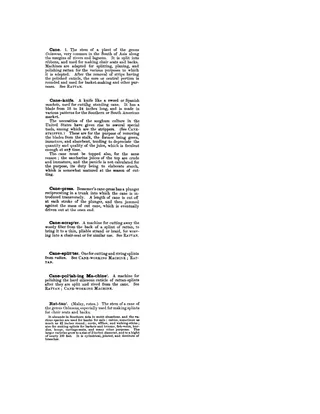
A group of short dictionary entries from Knight's American Mechanical Dictionary (1876) on cane and rattan. It defines cane (Calamus stem) and its use in chair seats and basketry, and covers machines for splitting, scraping and polishing rattan splints. It also covers cane-knives, sorghum cane tools and cane presses, and gives a brief entry on rattan.
Curing Basket Grass
Illustration · 1 page
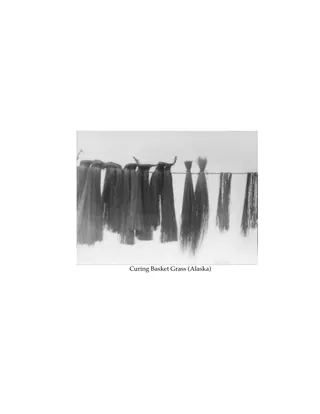
A single-page black-and-white photograph showing bundles of dried basket grass tied at the top and hung from a horizontal line to cure. The caption identifies the scene as Alaska. It documents a preparation step for basketry fiber, likely associated with Native Alaskan basket making.
How Indian Baskets are Made
Article · 3 pages
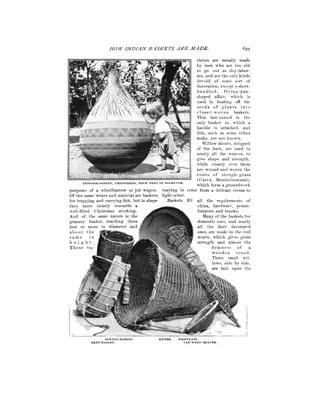
A 1900 magazine article describing how Pomo Indian women of northwestern California make baskets. It covers the three classes of baskets (burden, domestic and decorated 'family jewels'), the willow, slough-grass root, redbud, fern and tule materials, the coil weave, decorative designs and feather and bead embellishment. Illustrated with photographs of storage baskets, burden and baby baskets, sifters, fish traps and domestic baskets.
How to Make Baskets
Book · 207 pages
An instructional handbook on basketry by Mary White, first published in 1901 and reprinted through 1902. It covers materials (rattan, raffia, rush), tools, and basic weaving methods such as under-and-over weaving, pairing, triple twist and double weaving. Chapters then give step-by-step projects: mats, simple baskets, covers, handles, work baskets, candy baskets, scrap baskets, bird's nests, oval and melon baskets. Later chapters cover finishing, staining and polishing, chair caning, and Native American twined and coiled basketry techniques. It ends with Neltje Blanchan's chapter on what the basket means to the Indian, and a publisher's advertisement for dyes and materials. Line drawings and plates illustrate the techniques and finished baskets.
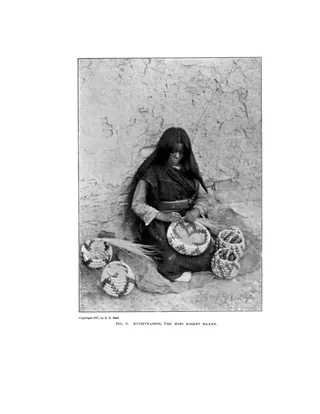
Indian Basketry
Article · 10 pages
A 1901 magazine article by George Wharton James surveying Native American basketry of Nevada, the Southwest, California, and the Pacific coast. It describes the cultural and ceremonial roles of baskets and the materials, coiling and twining techniques, border stitches, colors, and symbolic designs of the Paiute, Washoe, Hopi, Apache, Pima, Pomo, Yokut, Aleut and other peoples. It is illustrated with halftone photographs of baskets and weavers, including Dat-so-la-lee, Kuchyeampsi and Ramona.
208 documents found