Textile Documents › Publications › Publication: Everybody's Magazine
7 documents found
Sort: 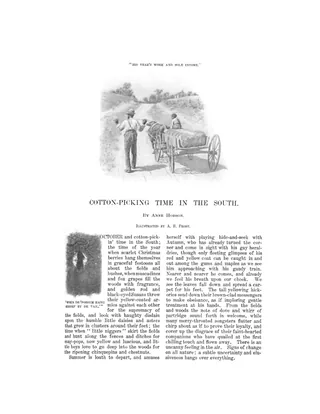
Cotton-Picking Time in the South
Article · 7 pages
A 1902 magazine article by Anne Hobson, illustrated by A. B. Frost, describing the autumn cotton-picking season in the American South. It combines scenic description of the fall countryside with a long monologue in imitated Black dialect by a cotton picker, then describes wagons of cotton bales going to the depot and Saturday town visits by pickers. The piece is a romanticized, condescending period portrait that uses racial slurs and caricatured dialect, and it offers little technical information about cotton or textiles.
Making of a Navajo Blanket
Article · 11 pages
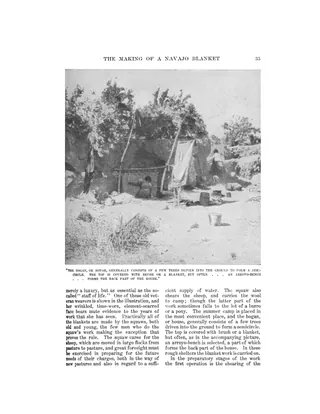
A 1902 magazine article by George H. Pepper describing how Navajo women make blankets, based on observation in Chaco Canyon, New Mexico. It follows the process from shearing, washing, dyeing (native black and yellow-green dyes versus aniline), carding and spinning with the distaff, to setting up the upright loom with stone weights, healds, batten and comb, and weaving the designs. It closes with criticism of traders' influence (store cord, aniline dyes, Germantown yarn) and the Hyde Exploring Expedition's efforts to revive native wool and dye work. Illustrated with photographs of weavers, camp, loom and finished blankets.
Modern Basket Maker -- I
Article · 3 pages
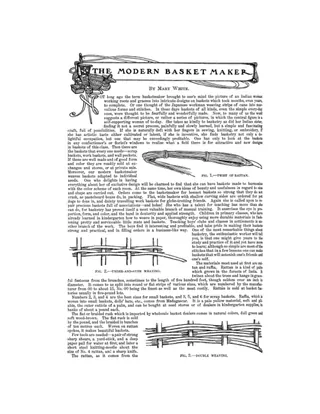
An introductory 1902 magazine article on basketry as a modern craft for women, covering its uses, income possibilities, and value in manual training. It describes the main materials (rattan, raffia, flat and braided rush), basic tools, and basic weaves: under-and-over, double, pairing, and triple twist. Step-by-step instructions are given for a knotted raffia work bag, a round mat with open border No. 1, and a small candy basket with rounding sides and open border No. 2, illustrated with line drawings. The article is the first part of a series and ends with "To be continued."
Modern Basket Maker -- II
Article · 2 pages
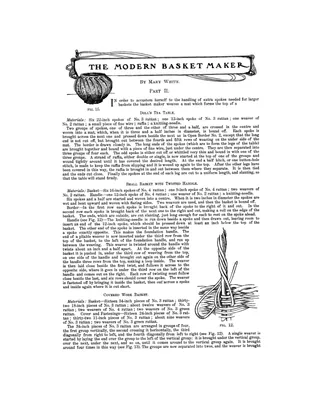
Part II of Mary White's series on rattan basketry in Everybody's Magazine gives materials lists and step-by-step directions for five projects: a doll's tea table with a woven mat top and raffia-wrapped legs, a small basket with a twisted handle, a covered work basket with hinge and ring fastening, a candy basket with a colored band, and a large scrap basket in green and natural rattan. The text covers spoke layouts, weavers, borders, and finishing. Figures show a finished basket, handle construction, a radiating-spoke base, and the interlinked ring fastening.
Modern Basket Maker -- III
Article · 3 pages
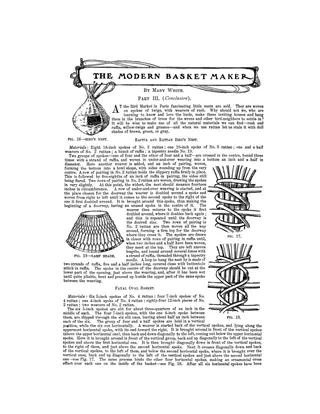
The concluding part of Mary White's three-part series on basketry for amateurs, published in Everybody's Magazine in 1902. It gives materials lists and step-by-step directions for a raffia-and-rattan bird's nest, an oval Fayal basket, a raffia lamp shade and a raffia rattle. It also includes recipes for dyeing rattan with vegetable dyes (fustic, logwood, indigo) and a terra-cotta stain, and explains the Indian twining stitch and spoke arrangement, with figures courtesy of Prof. Otis T. Mason.
A Revival of Feminine Handicrafts
Article · 5 pages
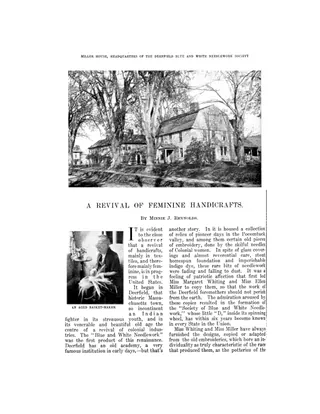
A 1902 magazine article surveying the American revival of handicrafts, especially textiles, led by women. It describes the Deerfield, Massachusetts Blue and White Needlework society and its cooperative payment scheme, Deerfield basket-making and hand-woven rag rugs, the Cranberry Islands hooked rugs, and the Abnakee pulled rug. It also covers the Sabatos yarn rugs and hand-woven fabrics of Centre Lovell, Maine, and a planned tapestry settlement in Ohio or West Virginia. It closes with a defense of handwork against machine production. Illustrated with photographs of the Miller House, basket-makers, rug warping and weaving, and Sabatos rug designs.
The Woman That Toils
Article · 13 pages
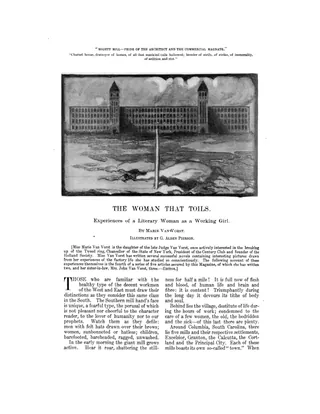
First-person journalistic account by Marie Van Vorst of working undercover in cotton mills near Columbia, South Carolina (Excelsior and Granton) in 1902. She describes spooling, drawing-in and speeding work, wages, hours, company coupons and stores, boarding-house conditions, sanitation, child labor, health hazards such as lung disease and snuff use, and the workers' outlook. The article is illustrated with halftone photographs and engravings of mill hands and mill village housing. It is the fourth in a series of five articles on women factory workers.
7 documents found