Textile Documents › Topic: Textile education and schools
599 documents found
Sort: 
Efficiency, its Use and Abuse
Article · 4 pages
An address by Melville W. Mix, president of the Dodge Manufacturing Company, delivered before the Chicago Executive Club and printed in Textile World Record in 1913. It argues that industrial efficiency and operative standardization must take account of workers' goodwill and morale rather than treating people as machines. Mix uses golf handicaps as an analogy for standards and describes a departmental accident-prevention score board at his company, along with the National Association of Corporation Schools. It is a general management essay with no weaving or textile technical content.
New Textile School Building
Textile World Journal, June 2, 1917
Article · 1 page
A short 1917 trade-journal news item announcing that the Philadelphia Textile School will move from its quarters at Broad and Pine Streets to larger buildings on the new Parkway at Twenty-fifth and Spring Garden Streets, next to the future Art Museum site. It reports the plans for building the school section first and the expected sale of the old property. It also gives the resolution of appreciation adopted by the school's Alumni Association.
Philadelphia Textile School Commencement
Textile World Journal, 1917
Article · 1 page
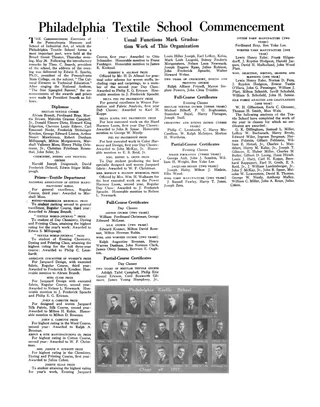
A report from Textile World Journal on the 1917 commencement of the Philadelphia Textile School, part of the Pennsylvania Museum and School of Industrial Art, held at the Broad Street Theater on May 24. It records the addresses given and lists the diplomas, prizes, and full- and partial-course certificates awarded in day and evening classes. The prizes cover Jacquard design, weave formation, hand and power loom work, color design, and chemistry, dyeing and printing. A group photograph of the Class of 1917 accompanies the article.
photographs
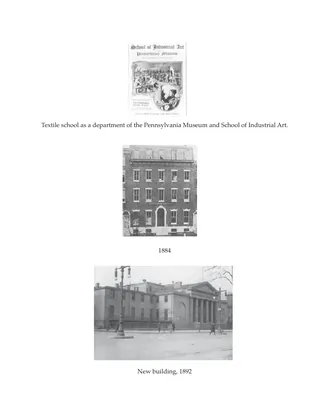
Philadelphia Textile School, c. 1884-1892
Ephemera · 1 page
A single sheet of photographs and captions documenting the early history of the Philadelphia Textile School. It includes an engraved illustration of the School of Industrial Art of the Pennsylvania Museum showing students at looms, with captions noting the textile school as a department of the Museum and School of Industrial Art in 1884 and a new building in 1892.
photographs
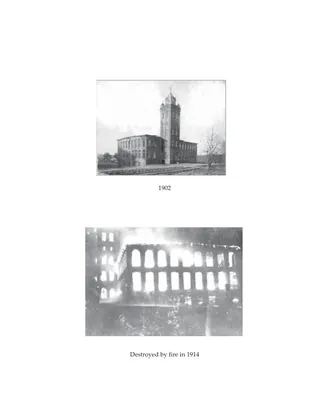
Tompkins Hall, textile school building, North Carolina College of Agriculture and Mechanic Arts, 1902-1914
Ephemera · 1 page
A single page with two black-and-white photographs of a multi-story brick mill-style building with a clock tower and arched windows, shown with railway tracks in front. The upper photograph is dated 1902, and a caption notes the building was destroyed by fire in 1914. The catalog record identifies it as Tompkins Hall, a textile school building.
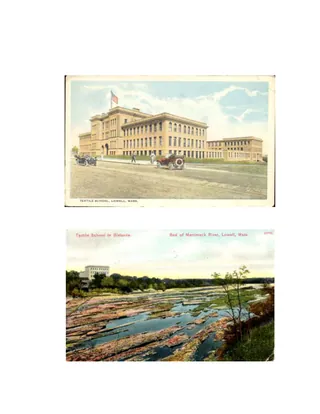
Picture postcards
Ephemera · 1 page
A single page showing two hand-colored picture postcards of the Textile School in Lowell, Massachusetts. The top card shows the large stone school building with a flag on the roof and early automobiles and pedestrians in front. The bottom card is captioned as a view of the school in the distance, with the bed of the Merrimack River in the foreground.

Register of International Correspondence Schools
Monograph · 57 pages
Third edition of a register published by the International Correspondence Schools (Scranton, Pa.), listing names and addresses of 107,239 students who completed or made considerable progress in their mail-instruction courses. It opens with a preface, an explanation of the I. C. S. system, instructions for reading the entries, a course index, and lists of subjects in each course, including abolished courses. The sampled directory pages cover Arizona Territory, with entries giving name, year, address, class letters and number, and record. The textile content is limited to course subject lists (textile designing, woolen, worsted and cotton manufacture, carpet design, silk designing, loom fixing, weaves).
Successful Land Cruise
Textile World Journal, June 2, 1917
Article · 1 page
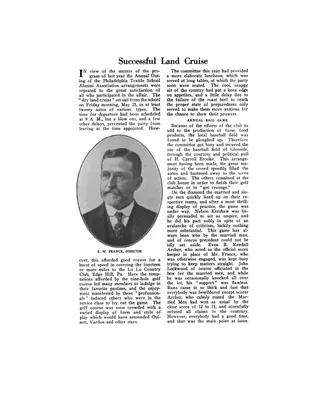
A brief 1917 news report on the annual outing of the Philadelphia Textile School Alumni Association, held as an automobile 'dry land cruise' on May 25. It describes the trip to the Lu Lu Country Club in Edge Hill, Pa., golf, a luncheon, and the traditional baseball game between married and single men, won by the married men 12 to 11. Includes a portrait of E. W. France, Director.
Textile School Alumni Meeting
Textile World Journal, June 2, 1917
Article · 2 pages
A 1917 trade journal report on the sixteenth annual meeting of the Alumni Association of the Philadelphia Textile School, held with the school's graduating exercises on May 24. It covers the treasurer's and loan fund reports, membership figures, technical papers read by title, wartime service by students and alumni, and the election of officers.
American Handicrafts in Vocational Education
Article · 3 pages
Extracts from the December 1918 report of the Federal Board for Vocational Education arguing for the value of handicrafts in vocational training, the reeducation of disabled soldiers, and postwar industry. It discusses the educational and social worth of craft work, leisure and the machine-age worker, and the limits of the arts and crafts movement as an economic enterprise. The last page carries a photograph of an overshot coverlet from the Shuttle-Craft looms in Basin, Montana.
Certificates
Master Weaver, May 1957
Article · 2 pages
A short editorial from the Master Weaver newsletter proposing a way to issue weaving skill certificates for Apprentice, Journeyman and Master Weaver levels without any national or international authority. A candidate would complete the published list of requirements and have a guild, studio, school or teacher review the work. The certificate would state that the work meets generally accepted requirements, would list those requirements, and would be free of charge. The article suggests making criteria measurable, such as edge straightness in fractions of an inch and pick-per-inch variation within 5%, and invites readers' suggestions.
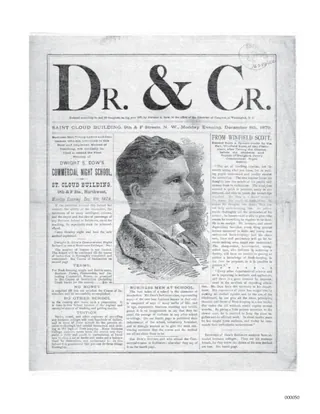
Dr. & Cr ...[circular for Dwight S. Dow's commercial night school]
1879
Ephemera · 4 pages
A four-page promotional circular, printed as a newspaper-style broadside titled 'Dr. & Cr.', for Dwight S. Dow's Commercial Night School, announcing an opening meeting in the St. Cloud Building, Washington, D.C., on 8 December 1879. It describes the course (double- and single-entry book-keeping, penmanship, business forms, detecting counterfeit money), terms ($20, payable only on satisfaction), testimonials from Baltimore and Louisville businessmen, and criticism of business colleges. It includes an illustration of Dow's patent head-line indicator on a multiple-column journal-day book. It is not about weaving; the only textile reference is a passing comparison to the spinning-jenny and power-loom.
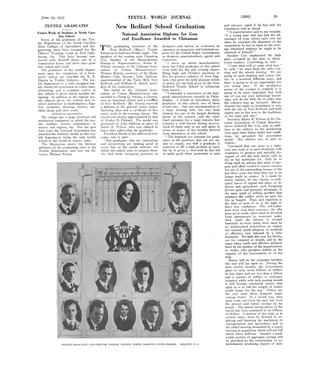
New Bedford School Graduation
Textile World Journal, June 23, 1917
Article · 2 pages
A June 1917 Textile World Journal report on the graduation exercises of the New Bedford (Mass.) Textile School, including the speakers, the award of the National Association of Cotton Manufacturers medal to Cheng Q. Amona, and extracts from addresses by President William E. Hatch, Speaker Channing Cox and Rufus R. Wilson on graduates' careers and wartime duty. The scan also begins with a short item on textile graduates of North Carolina State College, with a group portrait of the thirteen-member class and Director Thomas Nelson.
One Day's Weaving -- Montgomery, Alabama
Article · 2 pages
A first-person missionary account of one day (Thursday, Jan. 18) in Montgomery, Alabama, by a teacher at the Teachers' Home near the Swayne School for Black children. It describes home visits to sick and needy neighbors, church and missionary society matters, and afternoon and evening lessons in music, drawing and making worsted hoods. Despite the title, the piece is about missionary work and has no textile weaving content.
Large Annual Banquet
Textile World Journal, June 2, 1917
Article · 2 pages
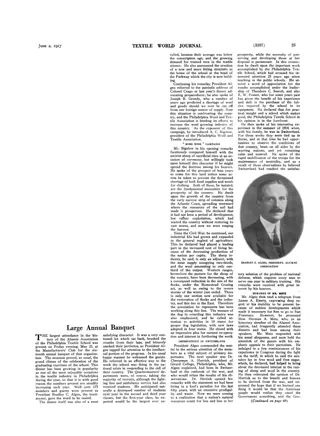
A 1917 trade-journal report on the sixteenth annual banquet of the Alumni Association of the Philadelphia Textile School, held May 25 at the Manufacturers' Club with over 175 attendees. It summarizes speeches by association president Bradley C. Algeo, A. C. Bigelow on the "More Wool" campaign and the wool shortage, Dr. Cheesman A. Herrick on Switzerland and national defense, Herman A. Metz, E. W. Fairchild, and John Fisler. Topics include the school's response to World War I, enrollment, a planned new school building, and domestic wool production.
Letter
Posselt, E. A., August 26, 1890
Ephemera · 2 pages
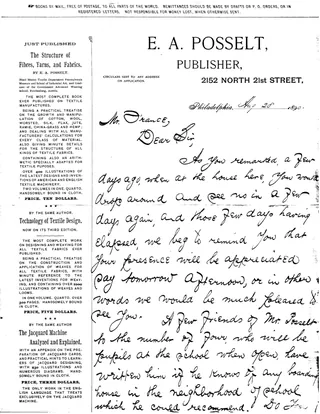
A two-page letter from the office of E. A. Posselt, Philadelphia textile author and publisher, written on his printed book-advertising letterhead. The letterhead advertises his books The Structure of Fibres, Yarns, and Fabrics, Technology of Textile Design, and The Jacquard Machine Analyzed and Explained, with prices. The handwritten body asks a Mr. Drance to call and asks whether he knows of a boarding house near the school for four prospective pupils.
Threadbender Newsletter (1955)
Periodical · 2 pages
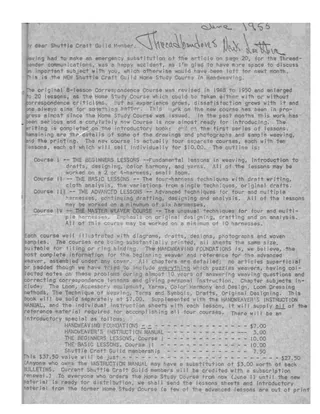
A two-page June issue of the Threadbender Newsletter, a desk letter from Harriet Tidball to Shuttle Craft Guild members. It announces the new Shuttle Craft Guild Home Study Course in Handweaving, a four-course series of ten lessons each (beginners, basic, advanced, master weaver), with prices, an introductory package offer, and the companion books Handweaving Foundations and Handweaver's Instruction Manual. It also reports on the delayed rewriting of the Twill and Tartan material, the return of assistant Wilma Widener, a Mexico City weaving studio invitation, a weavers' tour of Mexico, and summer weaving courses.
Training Youth for the Textile Industry of Today
Article · 3 pages
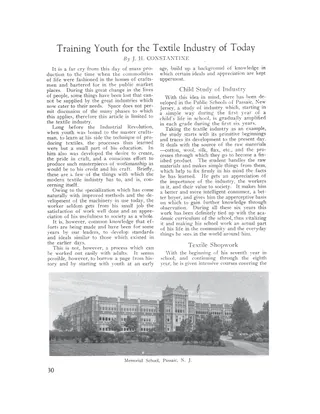
A 1929 article by J. H. Constantine describing how the Passaic, New Jersey public schools prepare youth for the textile industry. Industry study begins in the first six grades, followed by textile shopwork in grades seven and eight and a two-year Vocational School course in textile manufacturing under the Smith-Hughes Act. The article argues for building pride in craft and an understanding of the industry in young workers. Photographs show the Memorial School building, the school textile workshop with hand and power looms, and an exhibit of fabric samples.
Weavers' Workshops and Summer Classes
Handweaver and Craftsman, April 1950
Article · 5 pages
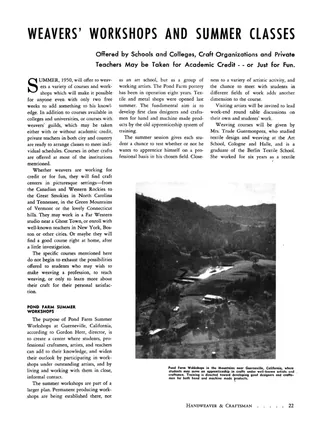
An article from the first issue of Handweaver and Craftsman surveying weaving workshops and summer courses available in 1950 at schools, colleges, craft centers and with private teachers. It describes programs at Pond Farm, Penland, New York University, Fletcher Farm, Teachers College, Utah State and the University of British Columbia (Mary Atwater), Taxco, Gatlinburg, Berea, Banff, Black Mountain and others. Entries give dates, instructors, course content and addresses for enrollment. Two photographs show Pond Farm Workshops and the Lily Loom House and Lucy Morgan at Penland.
[Weaving Departments at the Belfast Municipal Technical Institute]
The Graphic, 1907
Illustration · 1 page
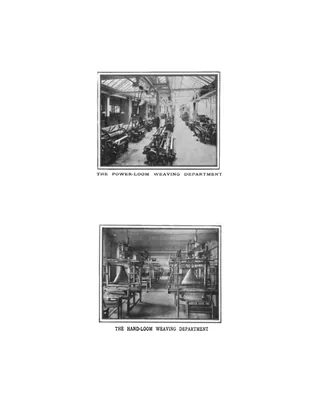
A single page from The Graphic (1907) with two black-and-white photographs of weaving rooms at the Belfast Municipal Technical Institute. The upper photograph shows the power-loom weaving department with rows of machines, and the lower one shows the hand-loom weaving department. The captions are the only text.
Handweaving Made Easy
Master Weaver, September 1954
Article · 2 pages · weaving drafts
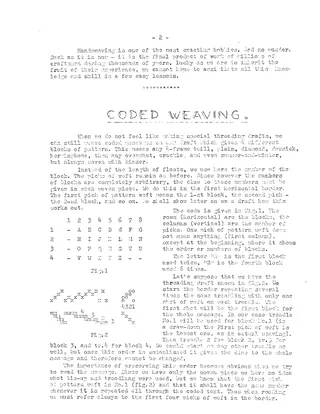
A 1954 issue of Master Weaver (Fulford, Quebec) carries an editorial arguing that handweaving is not easy and that advertising claims of 'easy' looms, yarns and lessons are misleading and discourage beginners. The second page begins a section on 'Coded Weaving', explaining how to weave coded messages into four-block drafts by using the number of picks per block to stand for letters, with a code table (Fig. 1) and a small draft (Fig. 2).
The Philadelphia School of Industrial Arts
Manufacturer and Builder, June 1894
Article · 1 page
The concluding portion of a June 1894 article on the Philadelphia School of Industrial Arts. It reports growth in enrollment under Prof. L. W. Miller, from 30 pupils and one teacher to 536 pupils and 27 teachers, and praise for the school's World's Fair display. It quotes a local newspaper account of the closing exhibition, covering the art department and the Textile School, where students designed, dyed yarn, cut loom cards and wove silks, dress goods, vestings and woolens.
Problems in Teaching - Workshops
Master Weaver, September 1953
Article · 2 pages
An article from the Master Weaver newsletter (Z-Handicrafts, Fulford, Quebec) on planning and running short weaving workshops. It covers choosing a limited set of subjects, structuring daily sessions into lecture, demonstration and supervised work, grouping students by level, and preparing students beforehand. It also gives advice on looms, warping equipment and blackboards, with recommended loom types for demonstrations.
Warp & Weft, Vol. 14, No. 3 (March 1961)
March 1961
Periodical · 9 pages · weaving drafts
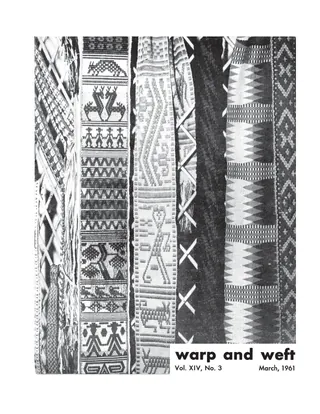
March 1961 issue of Warp and Weft, a monthly handweaving newsletter from Robin & Russ Handweavers in Santa Barbara. It includes the editor's report on a Pacific Northwest lecture trip, a profile of the Penland School of Handicrafts in North Carolina, and a 4-harness Swedish Rib project (raised warp stripe borders for skirts) with threading, tie-up, treadling, color key, reed, yarn costs and a sample. The issue ends with classified ads for yarns and supplies and advertisements for looms and books.
Handweaving Today, Textile Work at Black Mountain College
Article · 5 pages
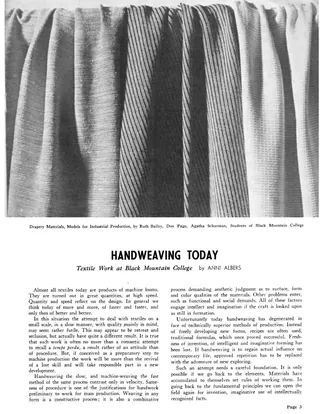
An essay by Anni Albers on the approach to teaching and practicing handweaving at Black Mountain College. She argues that handweaving and machine weaving share the same constructive process, that handweaving should return to fundamentals and experimentation rather than traditional recipes, and that it can serve as preparation for industrial production. The article is illustrated with photographs of student work from the college, including drapery materials, a double-weave wall hanging and a tapestry, plus display material by Albers.
International Correspondence Schools; Publications on Weaving and Textile Manufacture
Ralph E. Griswold · January 20, 2005
Web Doc · 27 pages
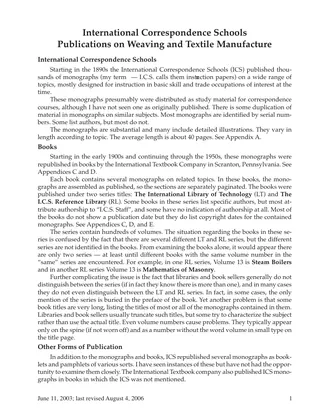
Ralph Griswold's bibliographic guide to the textile and weaving publications of the International Correspondence Schools (ICS) of Scranton, Pa. It explains how ICS instruction papers (monographs) were republished in the International Library of Technology and I.C.S. Reference Library book series, and tabulates the textile volumes by series, author and date. It also lists individual monographs with serial numbers, copyright dates and the volumes they appear in, and notes which are available online. Appendices reproduce a typical monograph cover, binder, book spines, ICS logos and buildings, a preface, advice to students, advertisements and a 1903 encyclopedia article on the schools.
Problems
Master Weaver, January 1954
Article · 4 pages
An editorial essay from the Master Weaver newsletter (Z-Handicrafts, Fulford, Quebec) criticizing hand weavers' lack of knowledge and their rigidity. It argues that "texture weaving" with odd materials repeats the earliest weavers' experiments, and that vegetable-dye enthusiasm and poorly designed looms show the same pattern. It closes with a recommended course of learning for the average weaver: loom mechanics, yarns, weave theory, art and design, then a narrow specialty, with guilds helping members find experts.
Textiles and Clothing
Article · 1 page
A one-page encyclopedia article defining textiles and clothing as a branch of home economics. It covers the scientific study of fibres, the share of family budgets spent on clothing, the effect of fashion on standards, and the shift from household training in spinning, weaving and sewing to scientific and economic instruction in schools and colleges. It ends with a short bibliography of early twentieth-century textile texts.
Weaving has Part in New York University's Annual Spring Conference on Industrial Arts
Article · 2 pages
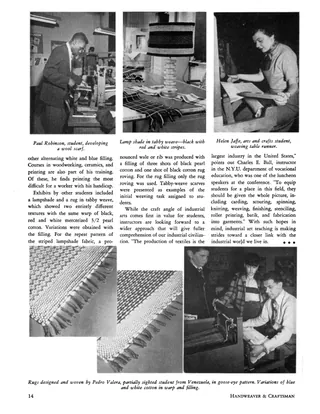
Report on the Annual Industrial-Arts Spring Conference held April 28-29, 1950 at New York University School of Education, with emphasis on handweaving in occupational therapy. It describes the exhibits: silk-screened textiles, a hospital-style wall hanging, and student work including goose-eye rugs by a partially sighted Venezuelan student, a tabby-weave lampshade and rug in pearl cotton and rug roving, and tabby scarves as beginner projects. It closes with remarks on broadening industrial arts teaching to cover the whole textile industry.
The Business of Weaving
Article · 2 pages
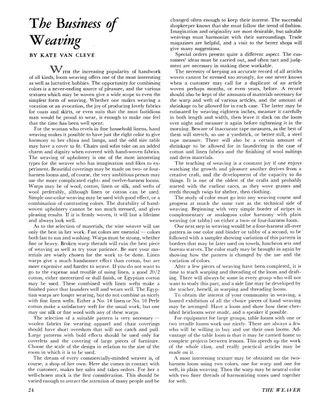
A two-page article from The Weaver by Kate Van Cleve on weaving as a business and hobby. It covers choice of warp and weft materials, pattern selection, running a shop, special orders, record keeping and shrinkage allowances, and teaching weaving classes. The page also carries a Questions and Answers column by Mary M. Atwater on hand-woven versus hand-loomed fabric and on weft-face and warp-face fabrics, plus the end of an article on the overshot weave on six harnesses.
Certificates
Master Weaver, November 1960
Article · 2 pages
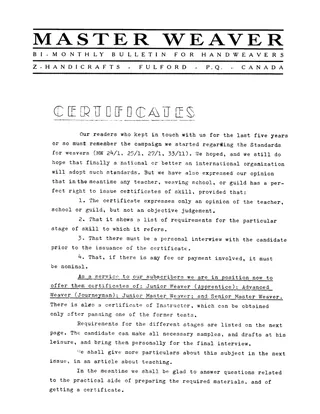
Article from the Master Weaver bulletin (Fulford, Quebec) announcing certificates of skill for handweavers at four levels: Junior Weaver (Apprentice), Advanced Weaver (Journeyman), Junior Master Weaver and Senior Master Weaver, plus an Instructor certificate. It sets out conditions for issuing such certificates, then lists the samples, projects and written descriptions required at each level, from tabby and twill samplers to double weave, damask, drawloom and rug work.
Cotton Trade Schools in the South
Article · 2 pages
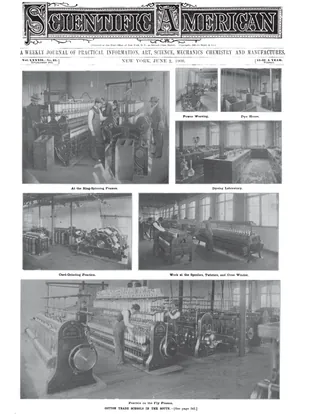
A June 2, 1900 Scientific American piece on the new cotton textile schools in the South, chiefly the Georgia school (Georgia Tech) and Clemson College in South Carolina. It describes the mill equipment donated by machine makers, the range of looms and machines students learn on, the four-year and two-year curricula, and the argument for manufacturing cotton goods in the South rather than shipping raw cotton abroad. The cover page carries photographs of the schools' spinning, weaving, dyeing, carding, and winding rooms.
Designing in General
Monograph · 18 pages · weaving drafts
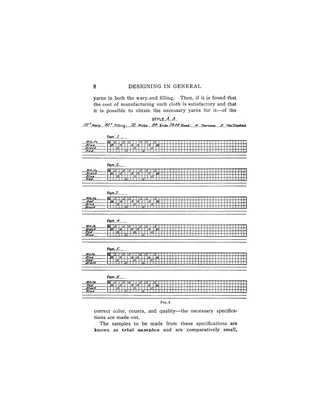
An International Correspondence Schools instruction paper on the work of a textile mill designer and the mill's sample-making department. It covers the designer's duties, the equipment of the designer's room and sample weave room (yarn and cloth testing machines, reels, sample books), how new styles originate, and how trial and selling samples are made. Procedures described include blanket warps, warping on pegs from a creel, beaming, drawing in, weaving, and tying over warp ends to get more samples from one warp. The one page marked as a draft is a set of color-order specifications for six warp patterns, not a weave draft.
Make the Most of Weaving at Camp
Article · 2 pages
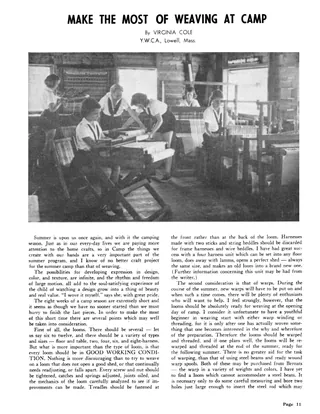
Virginia Cole of the Lowell, Mass. Y.W.C.A. gives practical advice for running a weaving program at a summer camp. She covers keeping looms in good working order, having looms warped and threaded before camp opens, using steel beams and ready-wound warp spools, beaming warps well, and winding bobbins for boat shuttles. She suggests projects (plaid scarves, towels and luncheon sets, rugs, bathmats) with yarn types and sett, and proposes a progress checklist chart for campers.
The Pennsylvania Museum and School of Industrial Art
Manufacturer and Builder, September 1891
Article · 2 pages
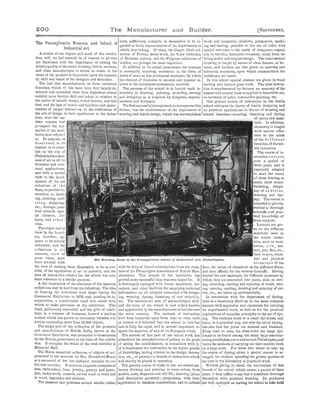
A 1891 magazine article reviewing the Pennsylvania Museum and School of Industrial Art in Philadelphia. It covers the institution's founding after the 1876 Centennial Exhibition, its museum collections (British India, Moore memorial lace and embroidery, Fulgence textiles), and its art school courses. Most attention goes to the three-year textile school covering design, weaving, dyeing, fibers and chemistry. Illustrated with a photograph of the school's weaving room and a prize design for a Brussels carpet ground.
The Peripatetic Weaver
Article · 4 pages
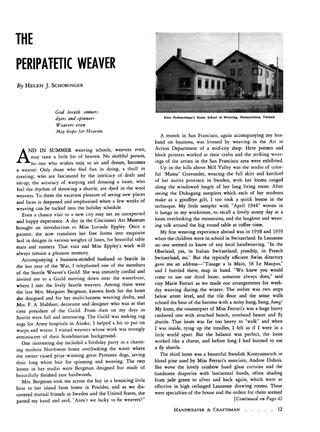
A first-person travel essay by Helen J. Schobinger recounting weaving schools, studios and guilds she visited in the United States and Europe between about 1938 and 1950. Stops include Seattle, San Francisco, Lausanne, Säterglantan in Sweden, Hämeenlinna and Helsinki in Finland, and the Cranbrook summer school in Michigan. It describes teachers, looms, techniques taught and the daily routine of the schools, and closes by encouraging weavers to take summer weaving courses.
The Purpose of Textile Education. An Address at the Opening of the Lowell Textile School Year, Commencing October 4, 1897
Monograph · 19 pages
Printed address delivered by C. J. H. Woodbury, Secretary of the New England Cotton Manufacturers' Association, at the opening of the Lowell Textile School year on October 4, 1897. It traces textile instruction in colonial Massachusetts, including the 1642 and 1655 laws on spinning and weaving and the Boston spinning schools of the 1700s. It then argues for technical education, note-keeping, and good design, and ends with remarks on Francis C. Lowell, the power loom, and the social effects of cotton manufacturing.
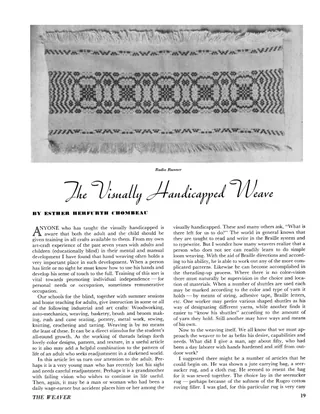
The Visually Handicapped Weave
Article · 4 pages · weaving drafts
An article from The Weaver (1937) on teaching hand weaving to blind and visually impaired adults, drawn from the author's seven years of experience. It describes how students use Braille directions and mark shuttles by touch, and gives case examples with projects: a seersucker rug, a Panama weave cloth rug, linen tray cloths and napkins, and a modernistic crackle-weave rug. Threading and weaving instructions are included, along with a reproduced Shuttle-Craft recipe by M. M. Atwater for a three-strip rug in crackle weave.
Cotton Manufacture: How We Train People for First-Class Positions in Cotton Manufacture and Fabric Designing
International Textbook Co., c. 1901-1903
Monograph · 29 pages
Promotional booklet from the International Correspondence Schools (Scranton, PA) describing its textile correspondence courses after it acquired the American Correspondence School of Textiles of New Bedford, Massachusetts. It covers the school's history, faculty, teaching method and student aid, then lists the cotton manufacture and textile designing courses with subject lists and detailed synopses (carding, spinning, warp preparation, plain and fancy weaving, fabric design, color, and mill engineering). It is a period advertising and curriculum document rather than a weaving instruction text.
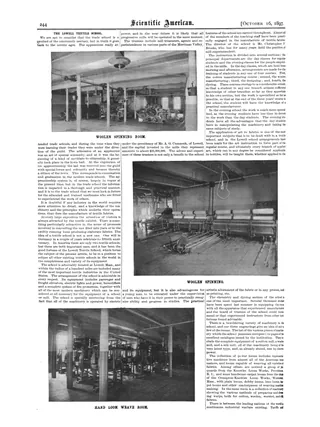
Lowell Textile School
Scientific American, October 16, 1897
Article · 2 pages
A Scientific American article from 1897 describing the newly established Lowell Textile School in Lowell, Massachusetts. It covers the school's equipment, trustees, director, and its four courses (cotton manufacturing, woolen manufacturing, designing, dyeing), with day and evening classes. It also surveys the machinery, including power looms, jacquards, dobby and carpet looms, and argues for trade schools in industrial competition. Three photographs show the woolen spinning rooms and a hand loom weave room.
Teaching
Master Weaver, January 1961
Article · 4 pages
An article from the Master Weaver bulletin on how to teach handweaving. It sorts teachers into four classes, advises assessing a new student's knowledge first, and stresses teaching basic drafting, equipment and loom coordination. It gives a 100-hour course plan (20 hours theory, 80 hours practice) covering tabby, twills, overshot, crackle and summer and winter, with an alternative sequence for students who want yardage. It ends with requirements for an Instructor Weaver certificate.
The Bulletin of the Needle and Bobbin Club, Vol. 10, No. 2 (1926)
Periodical · 37 pages
Issue of the Bulletin of the Needle and Bobbin Club (Vol. 10, No. 2, 1926) with a Hawaiian theme. Gertrude Whiting's article on Lydia Brown reports on the introduction of spinning, weaving and knitting to Hawaiian women in the 1830s, quoting missionary letters and mission minutes and adding notes on cotton growing. Further pieces cover silkworm culture in Hawaii and a photographic series of Hawaiian and South Pacific handicrafts from the Bishop Museum: bamboo printing stamps, tapa beaters, tapa and kapa bark cloth, a feather gorget and a feather cape. The issue also has club notes, an erratum, a field note on Tönder lace in Denmark, club officer lists and period advertisements for lace and silk dealers.
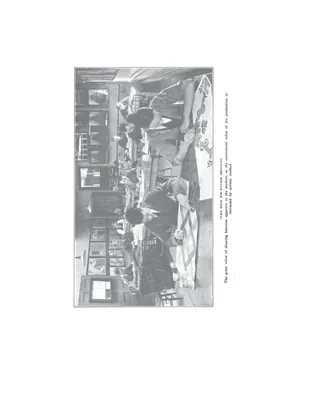
Circular of the Textile Department (Philadelphia Textile School)
Other · 201 pages
Annual circular (43rd year, 1926-1927) of the Textile Department of the Pennsylvania Museum and School of Industrial Art in Philadelphia, known as the Philadelphia Textile School. It gives the school's history, administration, advisers, admission rules, fees and the day and evening courses of study: weave formation, fabric analysis, figured and Jacquard design, card cutting, warp preparation and weaving, cotton, wool, worsted and silk yarn manufacture, chemistry, dyeing and finishing. It also describes the laboratories and equipment, with photographs of weaving, dyeing and finishing rooms, and lists alumni with their positions. Many pages of advertisements from textile machinery makers, yarn spinners, dyers and finishers, and mills are bound in.
Education Catalog Winter/Spring 1984
Ephemera · 18 pages
Education catalog of the Weavers Guild of Minnesota for winter and spring 1984, listing classes with schedules, instructors, and tuition. Class descriptions cover frame loom, floor loom, spinning, dyeing, and related crafts such as tatting and basketry. The catalog also includes registration forms, teacher biographies, guild membership information, and local advertisements from suppliers and shops.
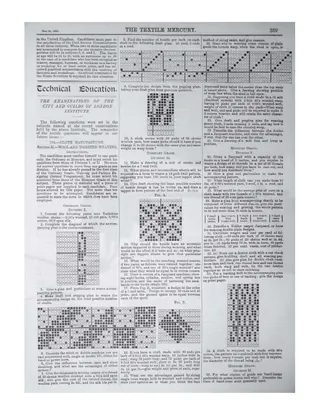
Designing
Textile Mercury, 1890
Article · 2 pages · weaving drafts
Two pages from The Textile Mercury, 24 May 1890, reproducing examination questions set by the City and Guilds of London Institute. The first group covers Cloth Manufacture (wool and worsted weaving), Ordinary and Honours grades. It asks about drafts, pegging plans, tappets, dobbies and Jacquards, satins and twills, double cloth, gauze, yarn counts and cost calculations. The second group covers Linen Manufacture (flax spinning): flax cultivation, retting, scutching, hackling, carding and spinning. Some figures and point-paper design grids accompany the weaving questions.
Education Catalog Spring-Summer 1985
Ephemera · 14 pages
Spring-summer 1985 class catalog of the Weavers Guild of Minnesota, listing course schedules, instructors, tuition and materials fees. Classes cover frame loom, floor loom, spinning, natural dyeing, and related crafts such as cardweaving, backstrap weaving, tatting, basketry, ikat, drafting and table linens. It also has a registration form and policies, class descriptions, instructor biographies, guild membership information, and local advertisements from suppliers and printers.
Hand-Loom Weaving
Book · 80 pages · weaving drafts
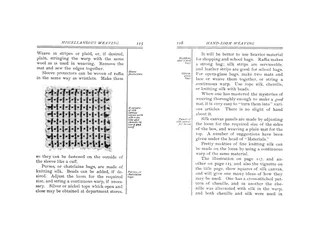
A manual for teachers and parents on teaching hand-loom weaving to children, written by a Minneapolis school teacher and first published in 1902 (revised 1914). It covers primitive and modern looms, the Todd small frame looms, paper and slat mat weaving for kindergarten, stringing warp, materials, dyeing formulas, splicing, and making rugs, mats, hammocks, raffia mats, doll towels, bed shoes and other small articles. Later chapters cover Oriental rugs, Navajo blankets, pile-weaving stitches, songs, games and stories about weaving, and a bibliography and index.
Helps and Hints
Monograph · 66 pages · weaving drafts
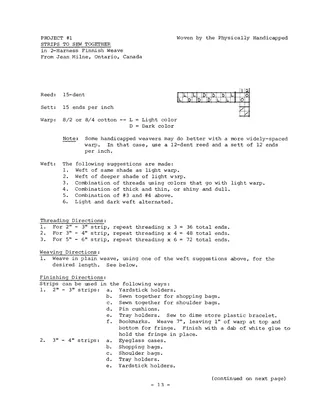
A 1976 handbook compiled by the Handweavers Guild of America Service Committee for weavers, spinners, therapists and teachers running weaving programs in nursing homes, hospitals, rehabilitation centers and schools. It gives hints for teaching weaving to the blind, aging, mentally retarded, emotionally disturbed and physically handicapped, then thirty loom projects with drafts, setts, threading and finishing directions. Projects include place mats, table runners, pot holders, pillows, rugs, towels, a poncho, an inkle belt, a bag and a duster mitt. Later sections give a yarn sett chart by yardage, school spinning and weaving demonstrations, simple cardboard looms, braids and straps, and a blank weaving record sheet.
The Book of School Weaving
Book · 66 pages · weaving drafts
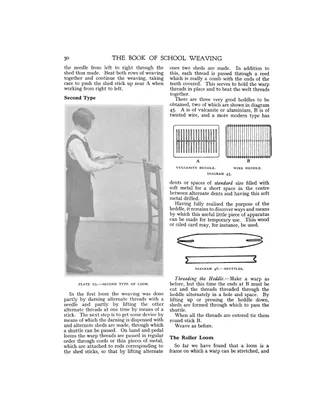
A 1933 teaching manual on weaving for schools by N. A. Reed, a lecturer for the Board of Education and London County Council, with a foreword by R. R. Tomlinson. It progresses from cardboard looms, simple pattern work and small articles through board, frame, braid and roller looms, tapestry, rug making, spinning, dyeing and small table looms, ending with the pedal loom and pattern weaving. Numbered diagrams and plates illustrate loom construction, warping and projects. Drafts are given for Monksbelt, Rose Path, Honeysuckle, twill and bird-eye patterns, and the book includes advice on materials and on teaching children.
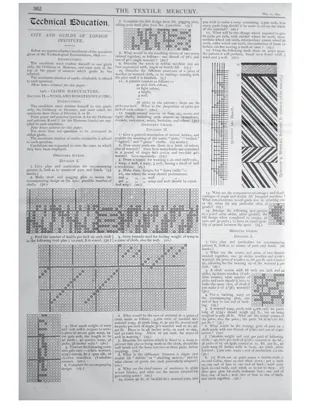
Technical Education
Textile Mercury, 1891
Article · 4 pages · weaving drafts
A four-page instalment from The Textile Mercury (23 May 1891) reprinting question papers from the 1891 City and Guilds of London Institute Technological Examinations. It covers wool and worsted weaving (Ordinary and Honours grades, with point-paper design, draft and pegging-plan problems, yarn counts, costing, Jacquard, dobby, tappet and gauze questions), lace manufacture, jute weaving, hosiery, wool and worsted spinning and jute spinning. The remaining page carries miscellaneous items on the decline of Spitalfields silk weaving, Chinese velvet, an Indian cotton mill and textile symbolism, followed by the start of a cotton market report.
599 documents found