Textile Documents › Topic: Sewing, quilting, and needlework
244 documents found
Sort: 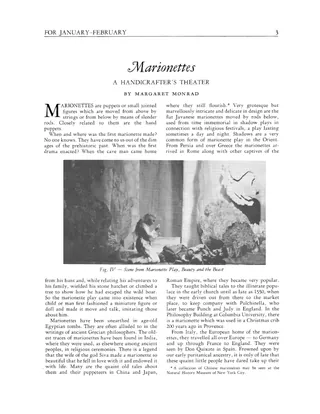
Marionettes, A Handicrafter's Theater
Article · 8 pages
An article from The Handicrafter giving a short history of marionettes, from ancient Egypt, India, and Java through Europe to modern American puppeteers, followed by practical instructions for making them. It covers a simple rag-doll marionette for children, and a more elaborate marionette with a papier-mâché head, wire and wood body, wire-and-yarn hands, and wigs. It also covers joints, costuming, and stringing with a controller. Illustrated with photographs of scenes from a Beauty and the Beast production and line drawings of leg joints, arm joints and controllers.
[Modern Priscilla Cover, April 1912]
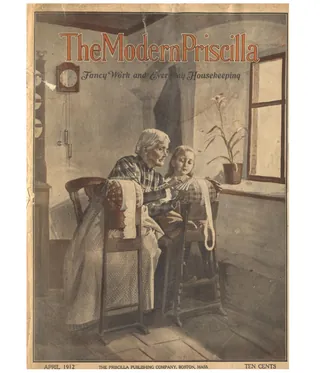
Modern Priscilla, April 1912
Illustration · 1 page
Cover of the April 1912 issue of The Modern Priscilla, a Boston magazine on fancy work and everyday housekeeping. The illustration shows an elderly woman in spectacles and a plaid dress seated beside a young girl, working on white lace or needlework draped over a chair back. The cover carries only the masthead, date, publisher and ten-cent price.
Bag Making
Article · 1 page
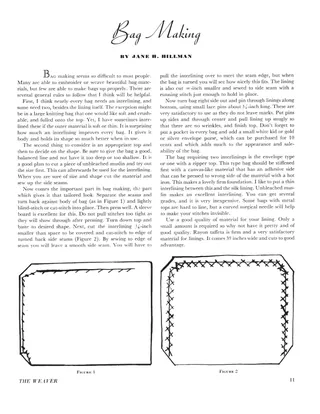
A short 1937 how-to article on making up handwoven or embroidered fabric into handbags. It gives general rules on interlinings, choosing shape and top, turning back and cat-stitching side seams, fitting the lining, and using pins and a pocket. It also covers stiffening envelope and zipper-top bags and choosing lining fabrics such as rayon taffeta. Two line drawings illustrate the seam finishing.
Cleaning Sewing Machines
People's Friend, 1872
Article · 1 page
A short 1872 household-hints item on cleaning a sewing machine with trotter oil, the fat rendered from sheep's feet. It gives the method for preparing the oil by boiling trotters and separating the fat. It then describes working the oil through the bearings by running the machine and wiping away the dirt until the fat comes out clean.
Comfort Magazine
Comfort Magazine, 1925
Ephemera · 1 page
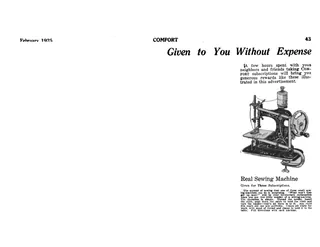
A single magazine page from the February 1925 issue of Comfort (page 43), carrying an advertisement for a subscription premium. Readers who took three subscriptions to Comfort would receive a small sewing machine that clamps to a table and is turned by a hand handle. The page has an illustration of the machine and a short promotional description.
Novel Ripping Attachment for Sewing Machines
Scientific American, June 4, 1898
Article · 1 page
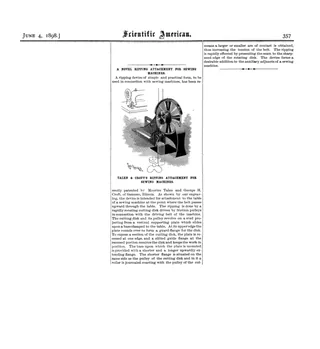
A short Scientific American article describing a ripping attachment for sewing machines, patented by Maurice Talen and George H. Croft of Geneseo, Illinois. A rotating cutting disk, driven by friction pulleys from the machine's driving belt, is mounted on a sliding plate clamped to the machine table, and seams are ripped by presenting them to the disk's sharpened edge. An engraving shows the attachment and a detail view.
Box for Tatting
Godey's Lady's Book and Magazine, September 1875
Article · 1 page
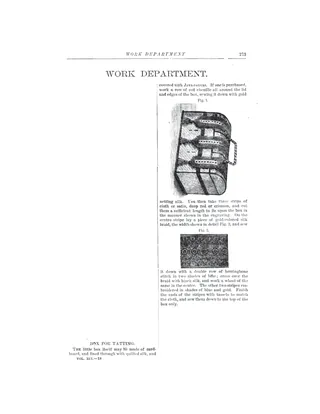
A short Work Department item from Godey's Lady's Book describing how to make a box for holding tatting. The box is made of cardboard, lined with quilted silk and covered with Java canvas, then decorated with three strips of red cloth or satin. The strips carry gold silk braid, herringbone stitch in blue, and embroidery, and are finished with tassels. Two engravings show the finished box and a detail of the braid.
Cloth Creaser
Article · 1 page
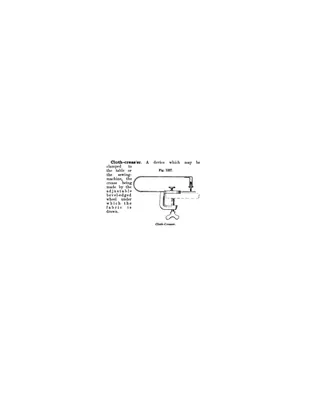
A short dictionary entry on the cloth-creaser, a device clamped to a table or sewing machine that makes creases in fabric as it is drawn under an adjustable bevel-edged wheel. It includes a line drawing (Fig. 1337) showing the bent metal arm, clamp, wheel and thumbscrew handle.
Hand Sewing Machine
Article · 1 page
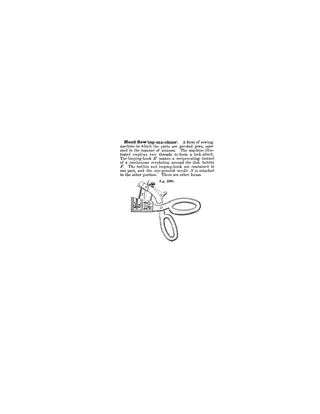
A short dictionary entry from Knight's American Mechanical Dictionary describing a hand-operated sewing machine whose pivoted jaws work like scissors. It explains that the machine makes a two-thread lock-stitch, with a looping hook moving back and forth around a disk bobbin and an eye-pointed needle on the opposite jaw. A line drawing (Fig. 2386) illustrates the device.
Plaiting Attachment for Sewing Machines
Article · 1 page
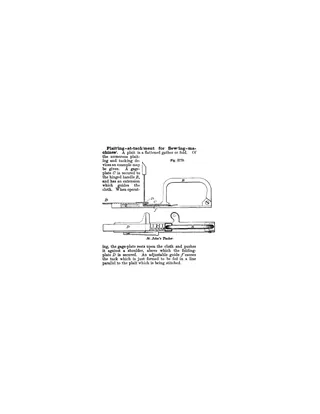
A short dictionary entry describing a plaiting (tucking) attachment for sewing machines, with a line drawing (Fig. 8779) of St. John's Tucker. The text defines a plait as a flattened gather or fold and explains how the gage-plate, folding-plate and adjustable guide form tucks and feed them parallel to the plait being stitched.
Ruffler
Article · 1 page
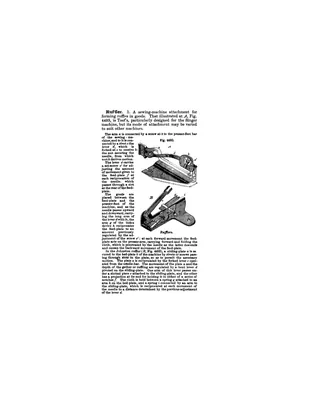
A dictionary entry describing the ruffler, a sewing-machine attachment that gathers cloth into ruffles. It explains the mechanism of Toof's ruffler, designed for the Singer machine, and of the Johnston ruffler, both driven from the needle and adjustable for the depth of gather. Two line engravings (Fig. 4493 A and B) illustrate the attachments.
Sewing Machine Gage
Article · 1 page
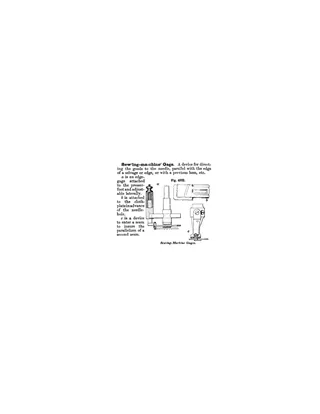
A short dictionary entry on the sewing-machine gage, a device that guides fabric to the needle parallel to a selvage, edge, or earlier hem. A single figure shows three types: an edge-gage attached to the presser-foot and adjustable sideways, a gage attached to the cloth-plate ahead of the needle-hole, and a seam-entering device that keeps a second seam parallel to the first.
Sewing Machine Motor
Article · 1 page
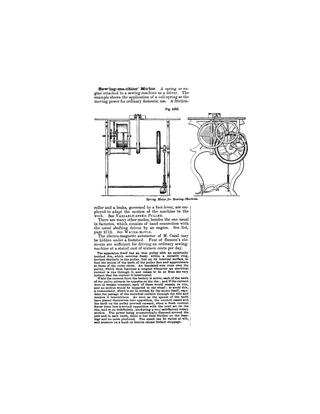
A short dictionary entry on sewing-machine motors, describing a coil-spring motor for domestic machines with a friction roller and foot-lever brake to control speed. It also describes M. Cazal's electro-magnetic motor, powered by Bunsen cells, which uses a toothed pulley, a ring and a commutator to produce rotary motion. A figure shows front and side views of the spring motor.
Stay Gage
Article · 1 page
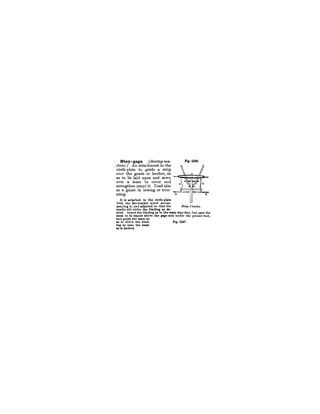
A short dictionary entry on the stay-gage, a sewing-machine attachment fixed to the cloth-plate that guides a strip of binding over a seam to cover and strengthen it. It explains how to attach and adjust the gage and how to feed the seam and binding under the presser-foot. Two line drawings (Figs. 5596 and 5597, the latter captioned Stay-Chains) illustrate the attachment.
Textile Fabric, US Patent No. 5335613
Patent · 12 pages
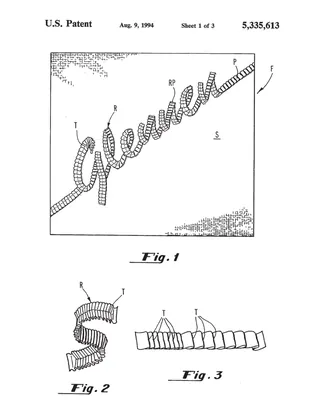
US Patent 5,335,613 (granted Aug. 9, 1994) to Douglas J. Glenn describes decorative fabrics made by stitching narrow fabrics such as lace, ribbon, braid or tape onto a substrate in a longitudinally compressed, convoluted or pleated condition. It also covers a sewing-machine guide (feed folder) that feeds the narrow fabric into the path of a reciprocating needle without a presser foot or feed dog. The document includes the abstract, claims, description, and three sheets of patent drawings. It is present in two forms: a 2002 USPTO web database printout and the scanned patent itself.
A Utility Bag
Article · 2 pages
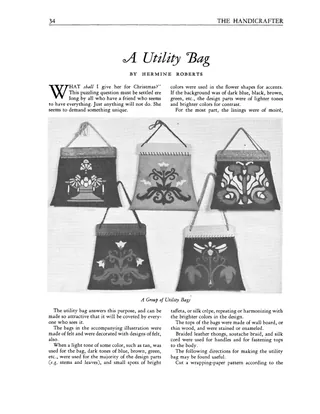
A 1931 magazine article giving instructions for making a decorative utility bag from felt, trimmed with applied felt cut-out designs. It covers color choices, linings, wood or wall board tops, and handles of braided leather, soutache braid or silk cord. Step-by-step directions refer to diagrams with pattern dimensions, a symmetric design panel, and a drilled wooden top strip. A supplier's advertisement for bag frames and linings follows.
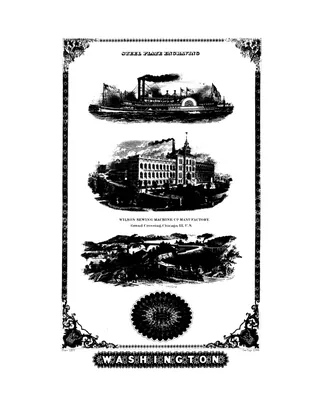
Wilson Sewing -Machine Co. Manufactory
Illustration · 1 page
A single steel plate engraving (Plate LXIV) showing the Wilson Sewing Machine Co. manufactory at Grand Crossing, Chicago, Illinois. The plate pairs views of the factory building, with signage and a smokestack, with a steamboat scene. It is cross-referenced to page 2368 of the dictionary text.
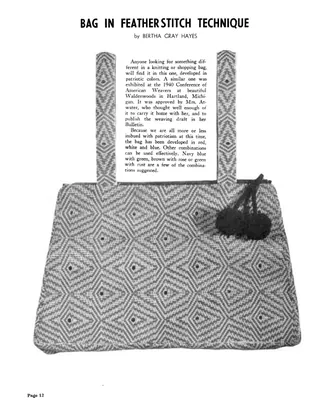
Bag in Featherstitch Technique
Article · 3 pages · weaving drafts
Instructions for weaving and assembling a knitting or shopping bag in red, white and blue using a "featherstitch" technique on a four-shaft loom. The article lists materials (carpet warp, Perle cotton tabby, Saxony wool pattern weft, canvas interlining, silk lining, zipper), the threading, and treadling tables for the front and back, connecting band and handles. It explains how to introduce the red "eye" accent, how to cut the canvas pieces, and how to sew and line the bag, with alternate directions for Structo looms.
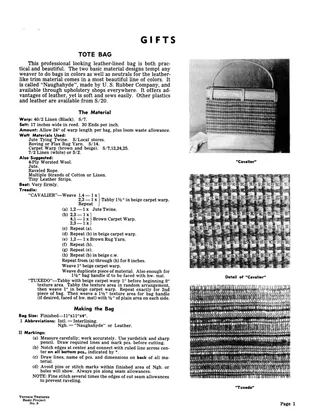
Gifts
Monograph · 6 pages · weaving drafts
Basic Project No. 9 from Terrace Textures, a set of handwoven gift projects with materials lists, sett, weft and treadling notes, and sewing instructions. It covers a leather-lined tote bag (woven in 'Cavalier' and 'Tuxedo' variations), an evening bag woven with chenille, rayon and metallic yarns, men's neckties woven several at once, and two belts ('Venetian Stripe'/'Radiant Stripe' and 'Gibson Girl'). Includes cutting diagrams, a cardboard form diagram, simple four-shaft twill and birdseye threading drafts, and source codes for yarns and supplies.
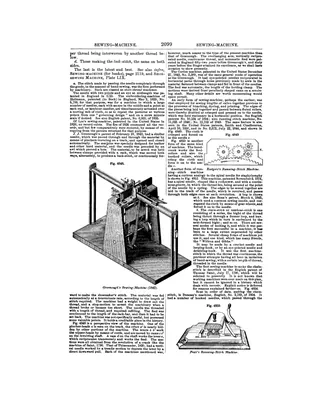
Sewing Machine
Article · 24 pages
Article on the sewing machine from Knight's American Mechanical Dictionary (1876), pages 2099-2121. It surveys the machine's history and mechanics: early needle-through machines (Saint 1790, Thimonnier 1830, Greenough 1842), the work of Hunt and Howe, and the main stitch classes (chain-stitch and lock-stitch). Much of the article is a classified list of U.S. patents by number, name and date, covering shuttles, loop-takers, feed, tension, button-hole machines, needles, tables and cabinets. It closes with descriptions and illustrations of the Wheeler and Wilson, Wilson, Grover and Baker, Florence, Domestic, Singer and St. John machines, and of attachments such as hemmers, binders, corders, quilters, tuckers and rufflers.
Sewing Machine Feed
Article · 2 pages
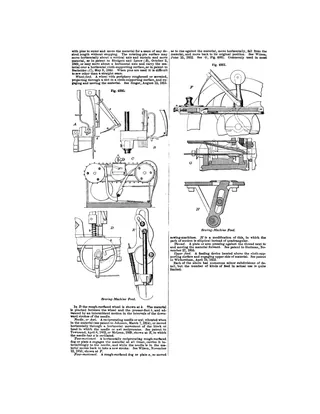
A two-page dictionary entry from Knight's American Mechanical Dictionary classifying the feed mechanisms of sewing machines, which move cloth past the needle. It describes clamp, baster or pin-plate, pin-wheel, wheel-feed, needle or awl, two-motioned, four-motioned, thread and upper feeds, citing patents from 1842 to 1869 by Greenough, Howe, Singer, Wilson and others. Two pages of line drawings (Figs. 4880 and 4881) illustrate the mechanisms.
Sewing Machines
Article · 20 pages
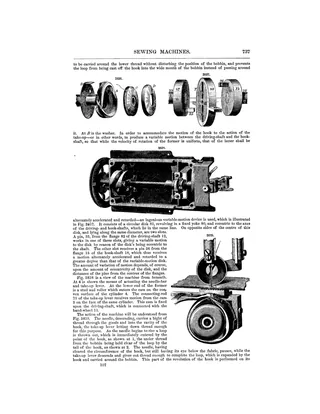
An encyclopedia article on sewing machines from Appletons' Cyclopaedia of Applied Mechanics (1889). It traces the development of stitch-forming mechanisms (running, chain, double-loop, lock stitch), needles, shuttles, rotary hooks and the four-motion feed, then describes specific machines (Wheeler & Wilson, Wilson, New Home, White, Domestic, Willcox & Gibbs, Grover & Baker, Keats shoe-sewing machines), a buttonhole machine and Smyth's book-sewing machine. It closes with a section on sewing-machine attachments such as gauges, hemmers, rufflers, binders, braiders, tuck-markers and seam-trimmers. Illustrated with numbered engravings (Figs. 3830-3889).
Sewing Machines
Article · 2 pages
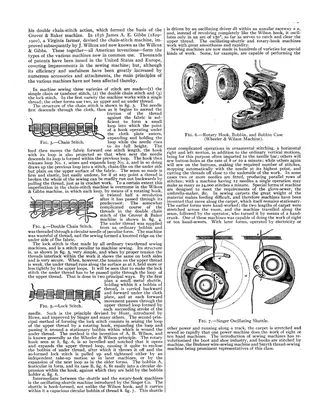
Encyclopedia article tracing the invention and development of the sewing machine, from Weisenthal's double-pointed needle (1755) and Saint's 1790 patent through Thimonnier, Hunt, Howe, Singer, Wilson, Grover and Gibbs. It explains the chain stitch, double chain stitch and lock stitch, and the shuttle, rotary-hook and oscillating-shuttle mechanisms, illustrated with engravings and stitch diagrams. It closes with specialized machines for buttonholes, carpets, gloves, boots and book sewing.
Sewing Machines
Oxford Encyclopedia, c. 1900-1910
Article · 3 pages
An encyclopedia article on the history of the sewing machine, from Thomas Saint's 1790 English patent through the inventions of Hunt, Howe, Wilson, Singer, Grover & Baker, and Willcox & Gibbs. It covers key mechanisms such as the eye-pointed needle, lock-stitch, shuttle and feed motions, the patent litigation and the 1856 combination of the major companies, and specialized industrial machines. It ends with United States production statistics for 1900.
[Sewing Machines]
Article · 1 page
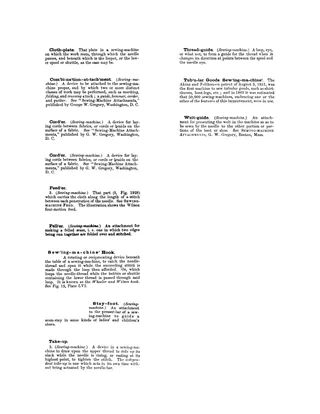
A single page of short dictionary entries on sewing-machine parts and attachments, taken from Knight's American Mechanical Dictionary. Entries cover the cloth-plate, combination attachment, corder, feeder, feller, hook, stay-foot, take-up, thread-guide, tubular goods machine and welt-guide. It also mentions the 1851 Akins and Felthouser patent for sewing tubular goods and refers readers to G. W. Gregory's publication on sewing-machine attachments.
Tailoring Machine
Article · 1 page
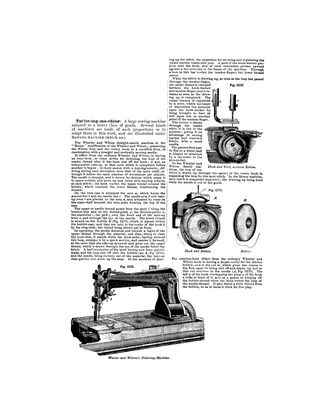
A one-page dictionary entry on the tailoring machine, a large sewing machine built for heavy goods. It describes the Wheeler and Wilson straight-needle ("House") machine: the rotary hook, independent take-up, under-thread tension finger and presser foot, and how the stitch is formed and drawn up. Engraved figures show the machine, the hook and feed, and the hook and bobbin.
Tibetan Applique Work
Article · 23 pages
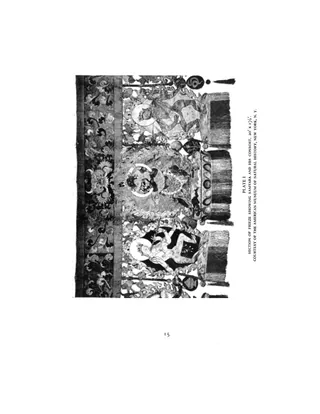
An article by Eleanor Olson of the Newark Museum on Tibetan appliqué hangings, the silk "fabric images" made by cutting and sewing satins and damasks, often over paper foundations and outlined with cord. It describes the techniques, materials and makers around Gyantse, and surveys the examples in American collections (Newark Museum, American Museum of Natural History, Metropolitan Museum, Nelson Gallery, Detroit Institute of Arts). It also covers the iconography of the pieces, the open-air ceremonies such as the Sunning of the Buddha at which large banners are displayed, and the debate over whether the craft survives. Eleven plates illustrate the pieces and the text ends with footnotes.
Work-Basket with a Sewing Cushion
Article · 43 pages
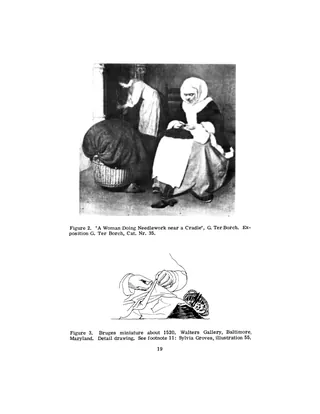
An illustrated article on the Dutch sewing-cushion and work-basket as shown in 17th-century paintings, engravings, samplers and inventories. It traces them from early depictions of the Virgin sewing and from Ter Borch, Vermeer and other Dutch painters to inventories of 1613-1637, surviving velvet cushions with fitted compartments in the Rijksmuseum, miniatures in doll's houses, and 18th-century sewing boxes with cushion lids. It also covers table-screws, weighted 'Steinkissen' and 'Plomb' cushions, and 19th-century sewing schools. It has many figure plates with captions, footnotes, acknowledgments and a post script, and no weaving drafts.
Darning Machine
Article · 1 page
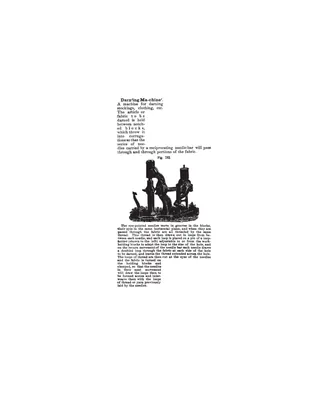
A one-page dictionary entry describing a mechanical darning machine for stockings and clothing, illustrated by Fig. 782. It explains how the fabric is held in notched blocks while a reciprocating needle-bar carries eye-pointed needles through it, and how a loop-holder places the thread loops. The fabric is then turned so a second set of threads is interwoven across the hole.
The Pouch Handbag
Monograph · 4 pages · weaving drafts
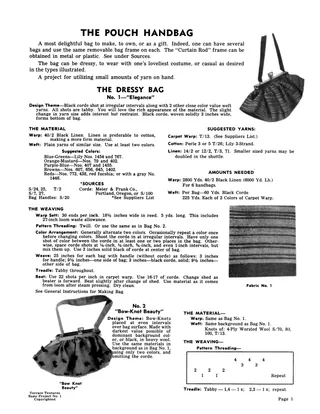
Instructions for weaving fabric and sewing a pouch-style handbag on a removable "curtain rod" frame, issued as Terrace Textures Basic Project No. 1. It gives four bag designs (the dressy "Elegance" bag with black corde, the "Bow-Knot Beauty" with inlaid wool knots, and two casual bags with multicolored warps). Each design lists yarns, colors, sett, amounts, threading and treadling, and the sewing instructions cover lining, buckram, shaping, handle and frame attachment.
Sewing Machine
Article · 2 pages
Encyclopedia article on the history and development of the sewing machine, from Thomas Saint's 1790 patent through Thimonier, Hunt, Howe, Wilson, and Singer. It describes lock stitch versus chain stitch household machines and special machines for shoes, leather, buttonholes, and carpet. It closes with U.S. export and manufacturing statistics from 1860 to 1915 and a short reading list.
Sewing Machines
Article · 9 pages
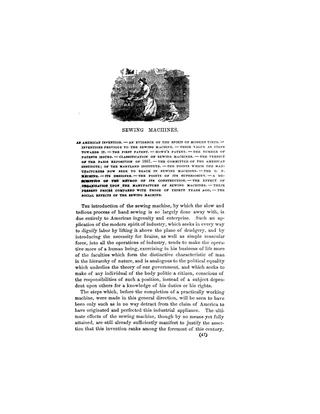
A chapter from an 1872 survey of American industry on the history and manufacture of sewing machines. It traces early patents from Weisenthal (1755) through Thimonier, Greenough and Elias Howe (1846), classifies machines by stitch type (lock-stitch, double chain-stitch, single-thread chain-stitch) and reports prize verdicts from the Paris Exposition of 1867 and American and Maryland Institute committees. Much of the text promotes the Weed Sewing Machine Company of Hartford and its G. F. "General Favorite" machine, and it closes on falling prices, factory organization and the social effects of the machine. It includes engravings, among them a view of the Weed factory.
Sewing-Machine
Chambers's Encyclopedia, 1881
Article · 2 pages
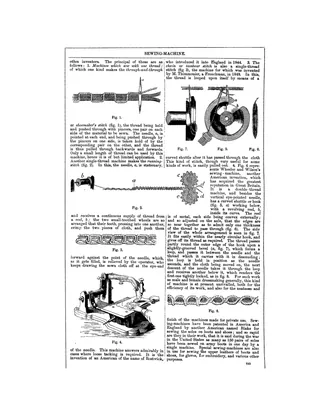
An encyclopedia article on the sewing machine from Chambers's Encyclopedia. It recounts Elias Howe's invention and patent history, then describes the main machine types: single-thread through-and-through, running-stitch and chain/tambour machines, and the double-thread Wheeler and Wilson lock-stitch machine. Eight figures illustrate the stitches and mechanisms. It closes with notes on specialized machines for boot soles, gloves and embroidery.
Ouvrages de Dames: Dessins variés [Ladies' Needlework: Assorted Designs]
Other · 5 pages · French
A short French pattern-book cover and sample charts titled Ouvrages de Dames, with assorted designs for crochet, filet, tulle, knitting, tatting, guipure and tapestry work. The four plates that follow show grid charts in dark and light squares, apparently for filet crochet or cross-stitch, with large block lettering, floral or geometric motifs and one pictorial design. The pages carry no readable text beyond the cover, and there are no weaving drafts.
Sewing Machines
Article · 8 pages
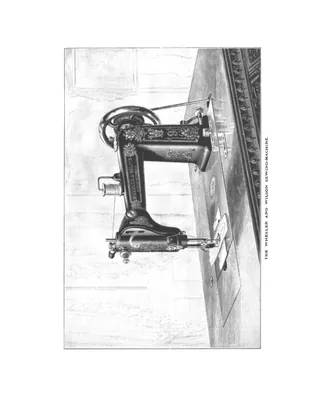
An 8-page encyclopedia article on late-19th-century sewing machines from Appletons' Cyclopaedia of Applied Mechanics. It describes domestic lock-stitch machines (Wheeler & Wilson, Domestic, Willcox & Gibbs), combined lock and chain-stitch machines, and Singer chain-stitch machines. It then covers industrial and heavy-work machines: two-needle, cylinder, over-seaming, carpet-sewing, straw-hat and canvas/belting machines. Seventeen figures show machines, bobbins, face plates and ornamental stitch patterns.
Warp & Weft, Vol. 1, No. 7 (May 1948)
May 1948
Periodical · 8 pages · weaving drafts
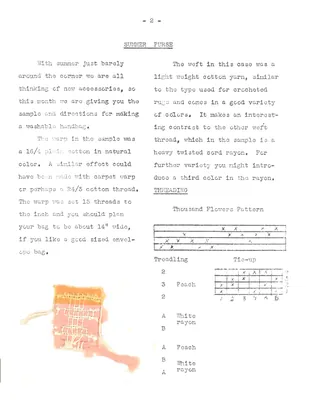
Issue 7 (May 1948) of the Chicago weaving newsletter Warp and Weft. It announces the editor's resignation, gives a draft and directions for a washable summer purse woven in the Thousand Flowers pattern, and offers instructions for making up a zipper purse from handwoven fabric. It also advises on where to place a loom in the home, collects readers' tips for dressing wool warps (lard, wax, flaxseed), and ends with a notice for an exhibition of old hand weaving at a Chicago weaving studio.
The Bulletin of the Needle and Bobbin Club, Vol. 62, Nos. 1 & 2 (1979)
Periodical · 77 pages
Double issue (Vol. 62, Nos. 1 & 2, 1979) of the Bulletin of the Needle and Bobbin Club. The main article, by M.G.A. Schipper-Van Lottum, traces the sewing-cushion and work-basket in Dutch and European art from the 14th to the 20th century, drawing on paintings by Ter Borch and others, engravings, surviving cushions, doll's house miniatures, and a patternbook title page of 1604, with a postscript on the 'Steinkissen' and 'plomb'. Eleanor B. Sachs's second article gives further notes on the figural motifs (an Alexander's Journey or ascension figure and a mermaid) on the gold brow band of a twelfth-century bishop's mitre in the Metropolitan Museum of Art, comparing Coptic, Byzantine and Romanesque parallels. The issue also has book notes on tapestry catalogues, Chinese folk embroidery and American women's needlework, plus club notes and a list of officers.
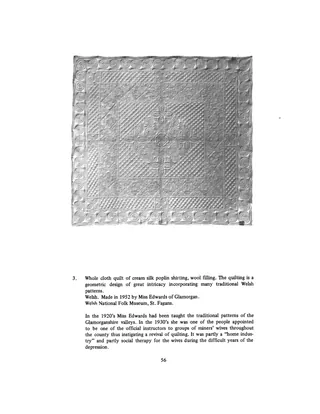
Quilting and Patchwork: World-Wide Needle Arts
Article · 23 pages
An illustrated survey of quilting and patchwork traditions around the world, written by Shiela Betterton for the Needle and Bobbin Club Bulletin. It traces the origins of both crafts in the East and their spread to Britain, Europe and North America. It then looks at regional traditions in northern England, Wales, Ireland, the Isle of Man, Holland, Sweden, Asia and Australasia, covering Log Cabin, crazy patchwork, Album quilts and strippy quilts. The article ends with acknowledgements and a bibliography, followed by twelve captioned plates of quilts from American, English, Welsh, Swedish and Dutch collections.
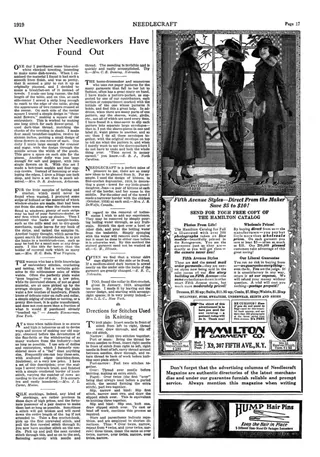
What Other Needleworkers Have Found Out
Needlecraft, September 1919
Article · 1 page
A page of reader-contributed household and needlework tips from Needlecraft magazine, September 1919. Items include a breakfast set made from checked toweling with thousand-flower embroidery, a sample book for tatting and crochet, trimming plain white waists, extending table linen with doilies, mending run stockings with a crochet hook, organizing paper patterns, and removing iodine stains. The page ends with a short list of knitting stitch abbreviations and directions, plus advertising for the Hamilton Garment Co. and hair pins.
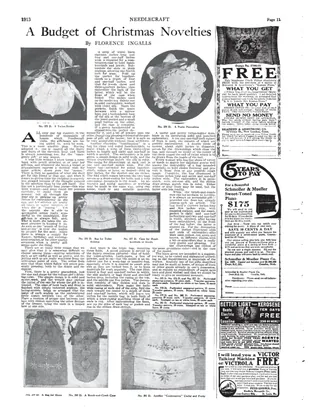
A Budget of Christmas Novelties
Article · 1 page
An article from Needlecraft Magazine offering ideas for handmade Christmas gifts in embroidered linen. It describes a twine-holder, pincushion, triple toilet-article bag, handkerchief and jewel case, double handkerchief bag, shoe bag, and brush-and-comb case, with dimensions, stitches (solid, eyelet and satin-stitch embroidery) and colors. It ends with prices for perforated stamping patterns, transfer patterns and pre-stamped linen.
Filled Lace, US Patent No. 2132603
Patent · 2 pages
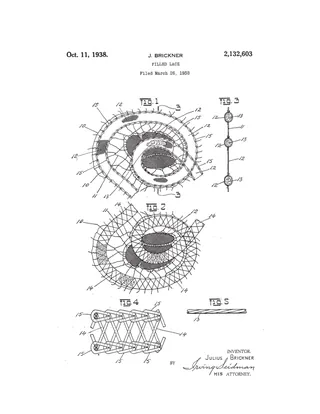
US Patent 2,132,603, granted to Julius Brickner of Brooklyn and assigned to C. H. D. Robbins Co., describes a filled lace with a raised, relief design. A heavy filling thread is laid behind the dense areas of a machine-made lace and held by cross stitches on the back and parallel chain stitches on the face. The text covers the manufacturing method, which sews the lace to a buckram backing, stitches in the filler, and then heat-disintegrates the buckram, and it gives one claim. Two pages, with a drawing sheet of five figures.
A Handsome Beaded Bag
Article · 1 page
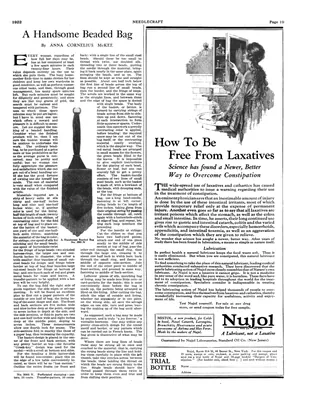
A 1922 Needlecraft Magazine article by Anna Cornelius McKee giving instructions for making a beaded handbag from satin or silk, trimmed with cut-steel beads and a beaded basket-and-flower design. It lists materials, cutting dimensions, beading methods (outlining, lattice basket, fringe, couching), and how to make the ring handles and inside pockets. Pattern numbers and prices for a perforated stamping pattern and a transfer pattern are given.
More Bags
Article · 2 pages
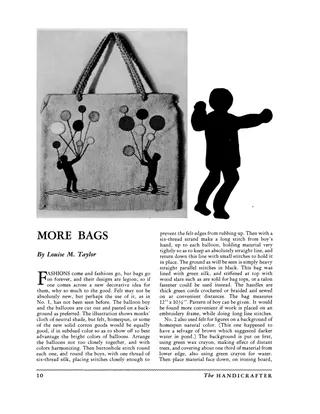
A short 1932-33 magazine article by Louise M. Taylor describing two decorative felt appliqué and embroidered bags. The first has a balloon boy with balloons cut from felt and buttonholed onto monks' cloth; the second has a pond scene with ducks and a water lily, with the water and trees colored in wax crayon set by ironing. It gives materials, stitches, lining, handle and stiffening instructions, and suggests framing the designs as samplers.
Quill
Article · 1 page
A one-page encyclopedia entry defining 'quill' as the hollow shaft of a bird's feather, especially the goose, swan or crow feathers used for pens. It also covers the word's uncertain origin, quills used as plectra in stringed instruments and keyboard actions, and the verb 'to quill', meaning to fold lace, muslin or other light fabric into narrow pleats (quilling). It ends with the French 'quillon', the cross guard of a sword hilt.
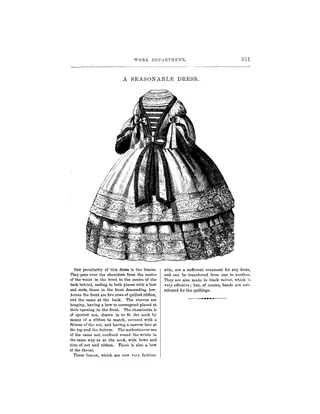
A Seasonable Dress
Article · 1 page
A short fashion-magazine item from the Work Department of Godey's Lady's Book describing a dress of 1860 with decorative braces. The braces pass over the shoulders and end in bows front and back, with five rows of quilled ribbon across the front and back. The text also describes the hanging sleeves, a spotted net chemisette and undersleeves with lace trim, and notes that the braces can be moved from one dress to another or made in black velvet. One engraved illustration shows the dress from behind.
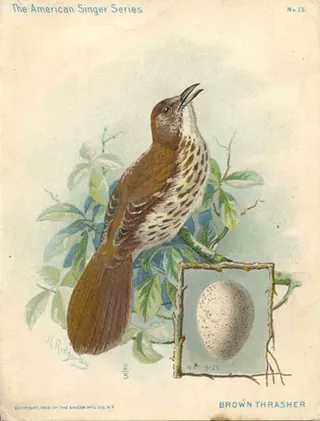
Sewing machine trade cards
1900-1937
Ephemera · 33 pages
A collection of Singer Manufacturing Co. advertising trade cards from the "American Singer Series" and "North American Song Birds" series. Each card has a chromolithographed songbird with a natural-size egg on one side, and a bird description paired with Singer advertising on the other. Birds include the brown thrasher, song sparrow, mockingbird, meadow lark, bobolink, cardinal, catbird, orchard oriole, rose-breasted grosbeak, scarlet tanager and yellow-breasted chat. The advertising covers portable and library-table electric sewing machines, the sewing motor, needles, oil, attachments (binding, hemming, tucking, shirring), the stocking darner and Singer Shop service.
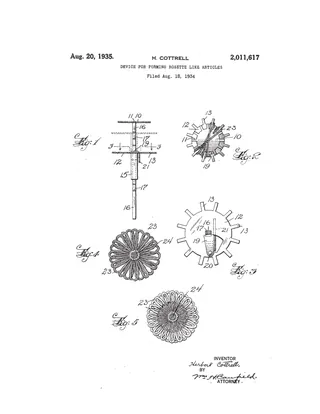
Device for Forming Rosette Like Articles, US Patent No. 2011617
Patent · 3 pages
US Patent No. 2,011,617 issued to Herbert Cottrell of Point Pleasant, N.J., for an adjustable device for making rosette-like, daisy-shaped articles from yarn or wool. Two star-shaped discs with radial lips are mounted on a telescoping tube and rod, so the spacing can be changed to make rosettes of different sizes, including a small rosette superimposed on a large one. The rosettes are sewn together to make sweaters, coats, pillows and bed covers. The scan has a drawing sheet (Figs. 1-5), the specification and five claims.
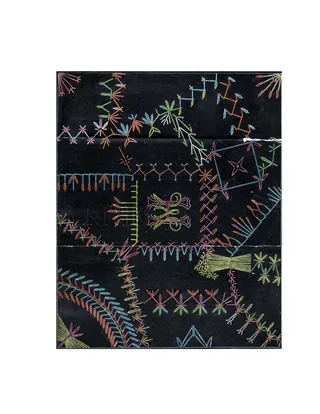
Fancy Designs - Ornamenting Oriental Work
Mary Haehnlen · 1884
Monograph · 25 pages
A small 1884 pattern book of embroidery stitch designs for decorating Oriental or "crazy" work (patchwork of silk and velvet pieces), designed and published by Mrs. M. Haehnlen of Chicago. After a short introduction on preparing the pieces, it presents twelve numbered basic stitches (straight, cat, buttonhole, feather, herringbone, coral, loops and knots). The remaining pages show white-on-black diagrams of decorative stitch borders, each with brief instructions on how to combine the basic stitches, loops and knots.
Gifts Which Men Will Like
Article · 1 page
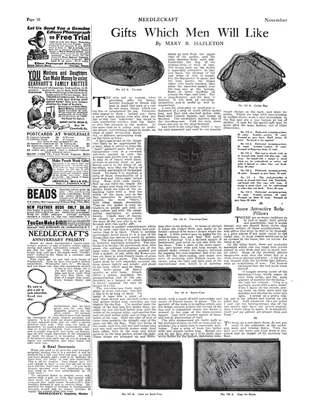
A November 1912 Needlecraft Magazine article by Mary B. Hazleton suggesting embroidered gifts for men, made on crash or linen. It gives directions for a shirt case, tie-rack, traveling-case, stick-pin case, collar-bag and razor-case, with notes on colors and stitches such as satin stitch, outline stitch, punchwork and French knots. The page also carries a short piece on washable lace sofa pillows, a household hint, and advertisements.
Madame Goubaud's Point Lace Book
Book · 61 pages
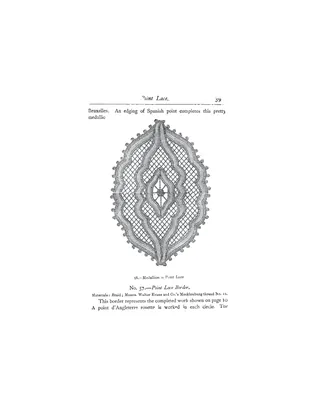
An illustrated Victorian instruction manual for making needle-made point lace, published in London as a one-shilling book (thirty-second thousand, second edition preface). It covers materials such as braids, cords, Mecklenburg linen thread and scissors, how to lay and gather the braid, and then describes dozens of lace stitches (Brussels, Venice, Spanish, Alençon, Angleterre, Mechlin and others), connecting bars, wheels and rosettes, and edgings and picots. The final section gives patterns for stars, medallions, borders, insertions, cravat ends, collars, lappets and an alphabet, each with materials and thread numbers, plus a table of thread sizes for different articles. The book ends with publisher advertisements.
244 documents found