Textile Documents › Topic: Hats and millinery
174 documents found
Sort: 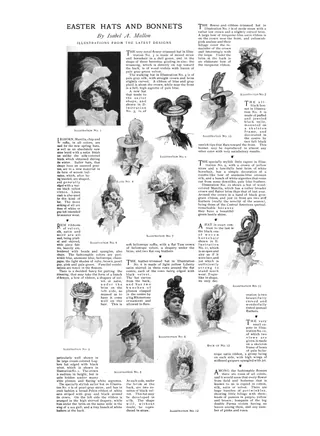
Easter Hats and Bonnets
Article · 1 page
A one-page fashion article from Ladies' Home Journal, 1898, describing the spring millinery styles for Easter. Twelve numbered illustrations of hats, bonnets and capotes accompany text on materials (Leghorn, Manilla, chip, raffia, woven bulrushes, horsehair), fashionable colors, ribbons, feathers and artificial flowers used as trimming. There is no weaving content apart from brief mentions of braided straw and woven horsehair.
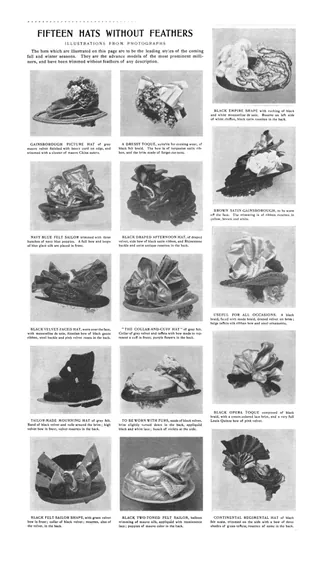
Fifteen Hats Without Feathers
Ladies' Home Journal, 1898
Article · 1 page
A single-page fashion feature from the Ladies' Home Journal showing fifteen photographed millinery designs for the coming fall and winter, all trimmed without feathers. Each hat has a short caption describing its shape, materials and trimming, including Gainsborough picture hats, toques, sailors and an Empire shape. Trimmings include velvet, felt braid, ribbon rosettes, mousseline de soie, lace and artificial flowers.
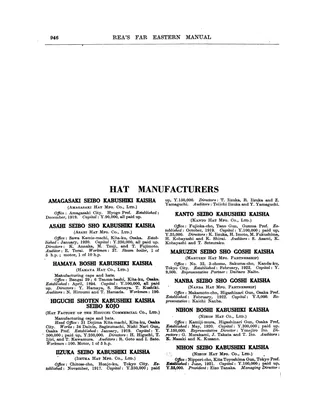
Hat Manufacturers (Japanese)
Rea's Far Eastern Manual, 1922
Article · 2 pages
A two-page directory listing from Rea's Far Eastern Manual (1922, Japan section, pp. 946-947) covering Japanese hat and cap manufacturing companies. Each entry gives the company name with its English equivalent, office and works location, date established, capital, directors and auditors, and sometimes workforce, motive power and products. Companies are based mainly in Osaka, Tokyo, Hyogo, Gunma and Shizuoka.
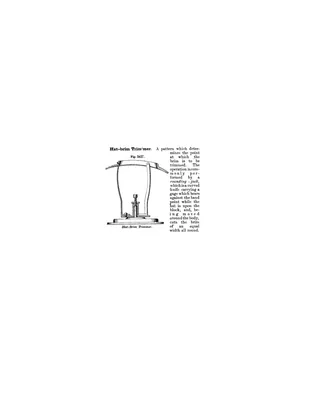
Hat-brim Trimmer
Article · 1 page
A short dictionary entry from Knight's American Mechanical Dictionary describing the hat-brim trimmer, a pattern or device that fixes where a hat brim is cut. It explains the rounding-jack, a curved knife with a gage that bears against the band point while the hat is on the block, so the brim is cut to an equal width all round. One cross-section line drawing (Fig. 2427) shows the hat on a block with the knife and gage mechanism.
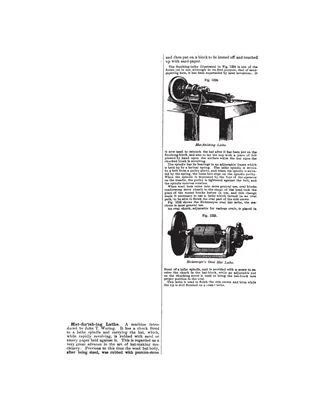
Hat-Finishing Lathe
Article · 1 page
A short dictionary entry describing the hat-finishing lathe, introduced by John T. Waring, in which a hat on a chuck is rotated while sanded or retouched. It explains the treadle-and-belt drive of the basic lathe in Fig. 1324 and the Eickemeyer oval hat lathe in Fig. 1325, which was developed for finishing oval hat blocks. It covers hat-making machinery rather than weaving.
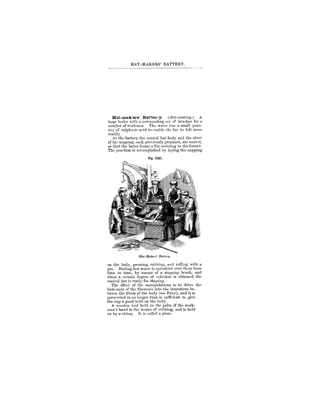
Hat-Maker's Battery
Article · 1 page
A one-page dictionary entry on the hat-makers' battery, a large boiler surrounded by workbenches where fur napping is joined to a conical felt hat body. It explains the use of slightly acidulated hot water, the pressing, rubbing and rolling that felt the fur onto the body, and the wooden 'glove' used for rubbing. An engraving (Fig. 2435) shows workmen around the boiler with a hoist.
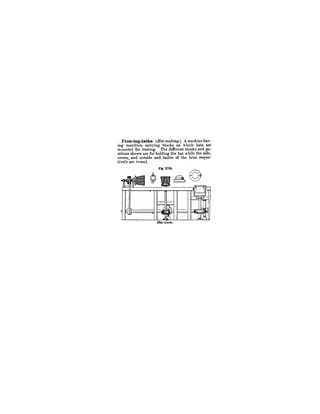
Ironing Lathe
Article · 1 page
A short dictionary entry on the ironing-lathe used in hat-making, from Knight's American Mechanical Dictionary. It describes a machine with mandrels carrying blocks on which hats are mounted for ironing the side, crown, and the outside and inside of the brim. The page includes an engraving (Fig. 2706) of a hat-lathe with frame, drive pulleys and mandrels, plus diagrams of hat blocks and positions.
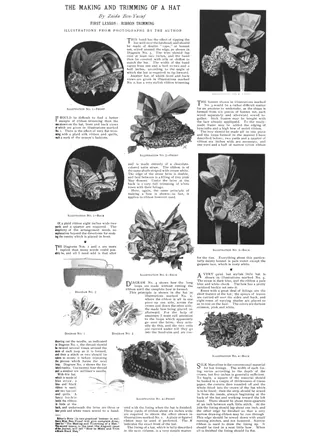
The Making and Trimming of A Hat, First Lesson
Article · 1 page
A one-page 1898 Ladies' Home Journal article, the first of two millinery lessons by Zaida Ben-Yusuf, on trimming hats with ribbon. It gives yardage and ribbon widths for four sample hats and a bonnet, and explains how to make a ribbon rosette and bow loops, a wired net band, and a silk Marceline lining. Photographs of the finished hats and line diagrams of the rosette and loops illustrate the instructions.
Bowing
Article · 1 page
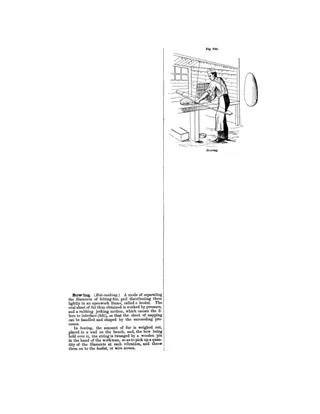
A short dictionary entry on bowing, the hat-making process of separating felting-fur fibers with a vibrating bowstring and depositing them on a basket or wire screen. The resulting sheet of fur is then worked by pressure and rubbing so the fibers felt together. An engraving (Fig. 544) shows a workman at a bench with a suspended bow over a wad of fur.
Brim Stretcher
Article · 1 page
A short dictionary entry describing the brim stretcher, a machine that stretches the brims of felt hats out from the edge of the rough cone-shaped hat body. It explains the treadle-operated spindle, the spreading ribs worked by a hand lever, the crank-driven vibrating ribs and the working sequence. It also notes that such machines had largely replaced the old hand method of blocking soft wool and fur hats.
Handweaving News (August 1944): Handwoven Hats
Periodical · 2 pages
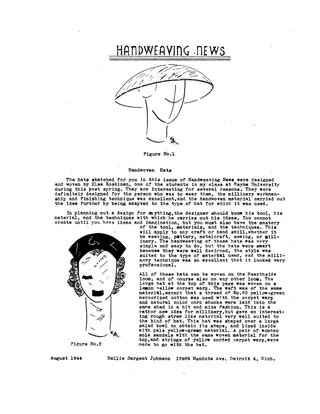
A two-page article from Handweaving News (August 1944) by Nellie Sargent Johnson describing handwoven hats designed and made by Elsa Koskinen, a student in her Wayne University class. It covers the hats' materials (carpet warp, rayon, wool, corn shucks), their construction and millinery finishing, and how to make display head forms from clay, plaster and pasted newspaper. The hats are all woven in simple tabby and can be made on a Hearthside loom.
Hardening Machine
Article · 1 page
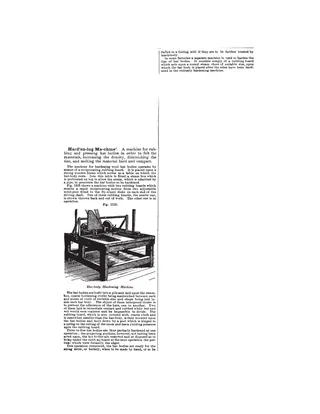
A one-page dictionary entry on the hardening machine used in hat making to felt and compact hat bodies by rubbing and pressing them with steam. It describes the wooden table with a perforated steam box, reciprocating rubbing boards driven by wrist-pins on flywheel disks, and the spring-loaded pressure post. It also explains how hat bodies are piled with separating cloths, partially hardened, and repositioned, and mentions a separate tip-hardening machine. A line drawing of the machine is included.
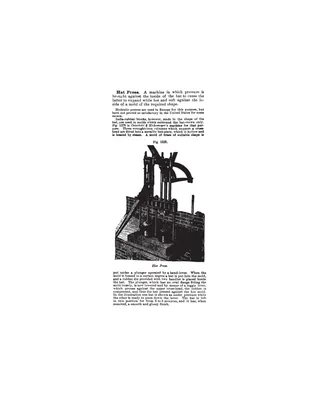
Hat Press
Article · 1 page
A short dictionary entry describing the hat press, a machine that uses pressure inside a hat to expand it against a heated mold. It describes Osterheld & Eickemeyer's press, with an india-rubber die, a steam-heated bed-plate, a brass mold and a toggle-lever plunger, and notes the 3 to 5 minute pressing time. An engraved illustration (Fig. 1828) accompanies the text.
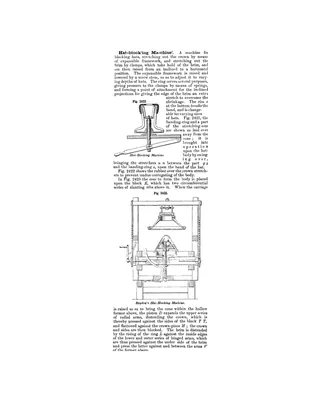
Hat-blocking Machine
Article · 1 page
A one-page dictionary entry describing machines for blocking hats, which stretch the crown with expansible framework and the brim with clamps. It explains the parts of the machines, including the banding ring, stretching arm, crown stretchers and hinged arms, and refers to three illustrations, including Boyden's hat-blocking machine.
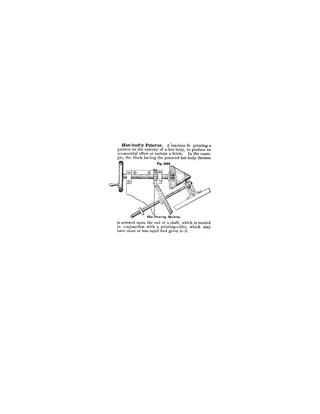
Hat-body Printer
Article · 1 page
A short dictionary entry describing a hat-body printer, a machine that prints a pattern on the outside of a hat-body to give an ornamental effect or imitate a fabric. The hat-body is mounted on a block screwed to a rotating shaft and turned in conjunction with a printing roller. A line drawing (Fig. 2424) shows the hand-wheel, shaft, gears, hat block and printing roller.
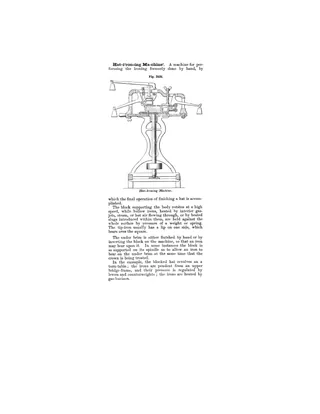
Hat-Ironing Machine
Article · 1 page
A short dictionary entry from Knight's American Mechanical Dictionary describing the hat-ironing machine, which mechanized the final hand-ironing step in finishing a hat. It explains how a rotating block holds the hat while hollow irons, heated by gas jets, steam, hot air or heated slugs, are pressed against it by weights or springs. It also covers finishing the under brim, and includes a cross-sectional drawing (Fig. 2434) of a machine with a turn-table, pendent irons, levers and counterweights.
Hat-Making Machines
Article · 3 pages
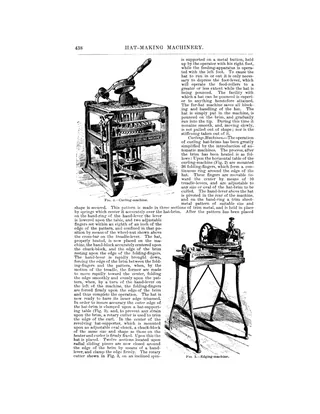
A three-page encyclopedia article on late-19th-century hat-making machinery, drawn from Appletons' Cyclopaedia of Applied Mechanics. It describes automatic tip- and brim-stretching machines, a blocking machine, pouncing machines for wool and fur hats, a curling machine and an edging machine for hat brims, and the Blanchard lathe adapted to turn hat blocks and flanges. Four engraved figures show the machines, all designed and patented by Rudolph Eickemeyer of Yonkers, N.Y.
Hat-Mold
Article · 1 page
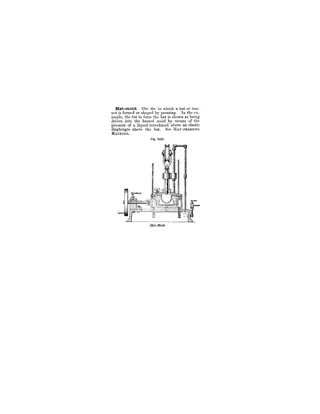
A short dictionary entry defining a hat-mold, the die in which a hat or bonnet is formed by pressing. The accompanying figure shows a press in which a hat bat is forced into a heated mold by liquid pressure acting on an elastic diaphragm. It cross-references the hat-pressing machine entry.
Hat-Stretching Machine
Article · 2 pages
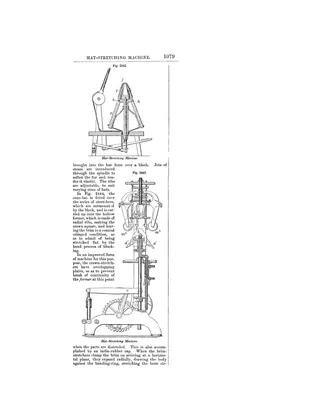
A two-page dictionary entry describing machines that stretch felt hat-cones into shape before blocking. It explains radially arranged hinged arms, stretcher levers, ribs and rollers that crimp or stretch the body, and the use of steam through the spindle to soften fur. Illustrated with figures 2441 to 2443 showing sections and elevations of the apparatus.
Hat-Tip Stretcher
Article · 1 page
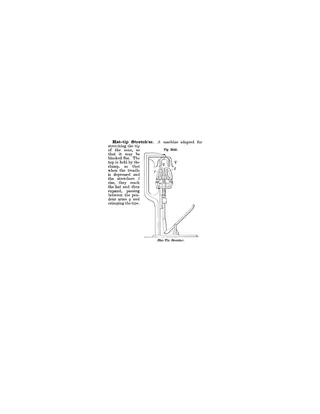
A short dictionary entry describing a hat-tip stretcher, a machine for stretching the tip of a hat cone so it can be blocked flat. The cone is held by a clamp at the top. When the treadle is pressed, the stretchers rise, reach the hat, then expand between pendent arms and crimp the tips. A line drawing (Fig. 2445) shows the frame, clamp, stretchers, spring and linkage.
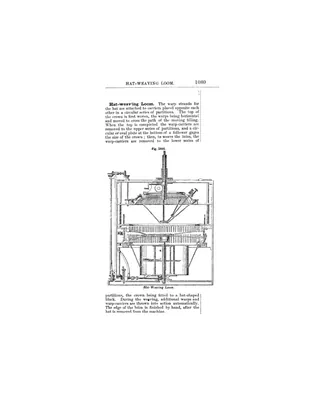
Hat-Weaving Loom
Article · 1 page
A short dictionary entry from Knight's American Mechanical Dictionary describing a loom for weaving hats. Warp strands are held in carriers set in circular partitions, the crown is woven first, and the carriers are then moved to a lower series of partitions to weave the brim over a hat-shaped block. The entry includes Fig. 2446, a cross-sectional drawing of the machine.
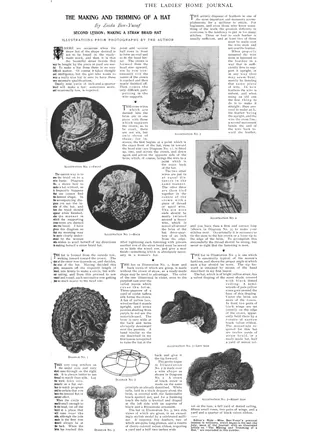
The Making and Trimming of A Hat, Second Lesson
Article · 1 page
A 1898 Ladies' Home Journal article, the second millinery lesson by Zaida Ben-Yusuf, on making a hat from straw braid. It explains sewing braid in rounds from the brim inward to the crown, fitting and darning in the cross-wire supports, and mounting feathers on wire stems. Four finished hats are described with their materials (violet taffeta, toque with tulle and net, a feathered hat, a yellow straw hat with roses), and the article is illustrated with photographs and three wire-frame diagrams.
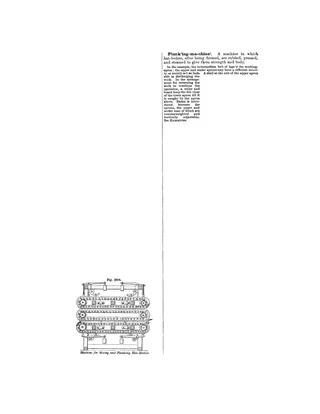
Planking Machine
Article · 1 page
A short dictionary entry from Knight's American Mechanical Dictionary describing the planking machine, used in hat making to rub, press and steam formed hat-bodies so they gain strength and body. The text explains the arrangement of stacked aprons of lags, steam introduction and the return of the work, with an illustration (Fig. 3304) of a machine for sizing and planking hat-bodies.
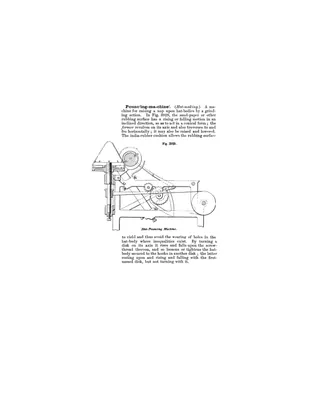
Pouncing Machine
Article · 1 page
A short dictionary entry from Knight's American Mechanical Dictionary describing the pouncing machine used in hat-making to raise a nap on hat-bodies by abrasion. It explains how a sand-paper rubbing surface acts in a conical form, with an india-rubber cushion to prevent holes, and how the hat-body is held on hooks in a disk. Includes one line drawing (Fig. 3929) of the machine.
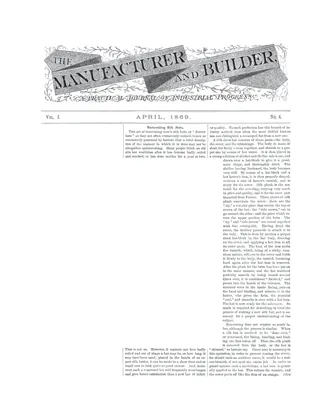
Restoring Silk Hats
Manufacturer and Builder, 1869
Article · 2 pages
A short 1869 magazine article describing how men's silk hats are made and how they are renovated by hatters. It covers the hat body, silk plush cover and trimmings, the dyeing and cleaning of old plush with logwood extract, and the reshaping with shellac and hot irons. It also warns that many hats sold as new are actually renovated ones, and advises buyers to be wary of low prices.
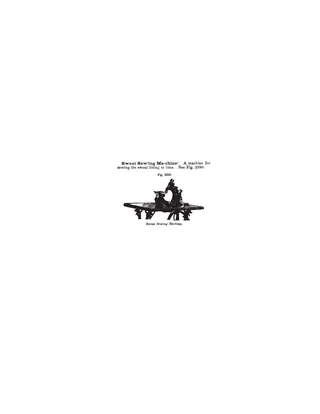
Sweat Sewing Machine
Article · 1 page
A brief dictionary entry from Knight's New Mechanical Dictionary defining the sweat sewing machine, a machine for sewing the sweat lining into hats. It includes a line drawing (Fig. 2390) showing a machine with a flat table, upright needle head, and treadle frame.
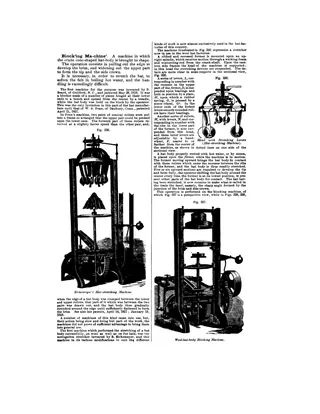
Blocking Machine
Article · 2 pages
A dictionary entry from Knight's New Mechanical Dictionary on hat blocking machines, which shape the felt hat body into brim and crown. It traces the history from D. Beard's 1816 patent through W. A. Fenn's 1857 roller machine to R. Eickemeyer's corrugation stretcher, then describes how the stretching and banding (blocking) machines work. Illustrated with figures of the stretcher, its head with levers, and three positions of the banding machine.
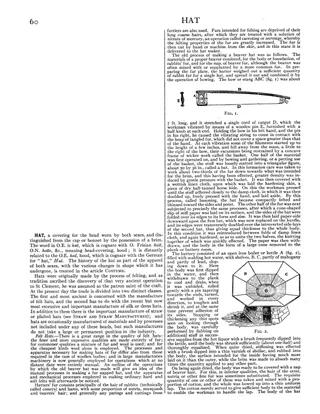
Hat
Article · 2 pages
Two-page encyclopedia article on hats from the 11th edition of the Encyclopaedia Britannica. It describes the manufacture of felt hats, covering the old hand process for beaver hats (fur preparation, bowing, basoning, battery, napping) and later machine forming of fur and wool bodies. It also briefly covers the making of silk hats. Two figures show the hatter's bow and the battery kettle.
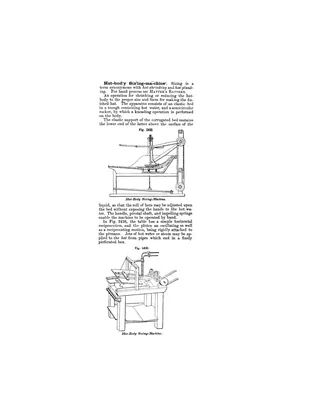
Hat-body Sizing Machine
Article · 1 page
A short dictionary entry from Knight's American Mechanical Dictionary describing machines for sizing (shrinking or planking) felt hat-bodies to the proper size and form. It explains a trough machine with a corrugated elastic bed and semicircular rocker that kneads the body in hot water, and a table-type machine with reciprocating table and oscillating platen, with jets of hot water or steam. Two line drawings (Figs. 2425 and 2426) illustrate the machines.
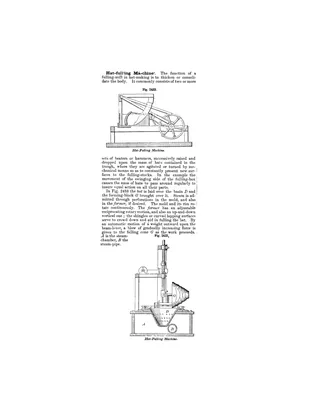
Hat-fulling Machine
Article · 1 page
A short dictionary entry describing machines used to full (thicken and consolidate) felt hat bodies. It explains how a fulling mill uses beaters or hammers on hats in a trough, and how a steam-heated machine presses the bat with a forming block. Two line drawings (Figs. 2432 and 2433) illustrate the machines.
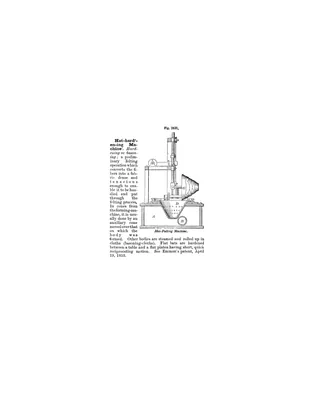
Hat-Hardening Machine
Article · 1 page
A short dictionary entry from Knight's American Mechanical Dictionary describing the hat-hardening (basoning) machine, a preliminary felting step that makes fiber bodies dense enough to handle before full felting. It explains how cone bodies are hardened with an auxiliary cone, how other bodies are steamed and rolled in basoning cloths, and how flat bats are hardened between a table and a reciprocating platen. A cross-section drawing (Fig. 2433) of a hat-fulling machine is included, and Emmon's 1853 patent is cited.
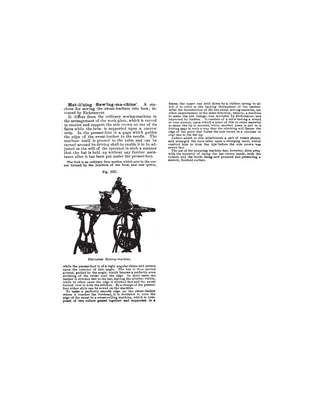
Hat-Lining Sewing Machine
Article · 1 page
A one-page dictionary entry describing a hat-lining (hat-sweat) sewing machine invented by Eickemeyer, with a line drawing (Fig. 1327). It explains the curved work-plate, presser-foot gage and feed that stitch sweat-leathers into hats, and mentions a sweat-rolling machine, a lining-making machine improved by Judson, and the pouncing machine that made lining unnecessary.
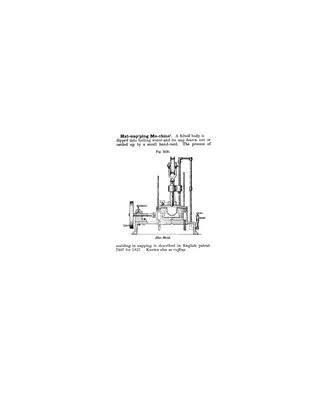
Hat-napping Machine
Article · 1 page
A short dictionary entry on the hat-napping machine, reproduced from Knight's American Mechanical Dictionary. It explains that a felted hat body is dipped in boiling water and its nap raised with a small hand-card, a process also called ruffing, and cites an 1837 English patent. A line drawing (Fig. 2436) shows a hat mold on a base with a lever press, hand crank wheel and water valve.
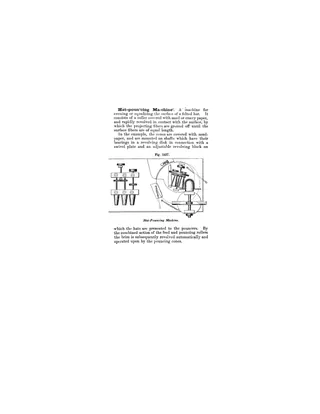
Hat-Pouncing Machine
Article · 1 page
A short dictionary entry describing the hat-pouncing machine, which evens the surface of a felted hat by grinding off projecting fibers with sand- or emery-paper-covered rollers. The illustrated example uses sandpaper-covered cones on shafts in a revolving disk, with a swivel plate and an adjustable revolving block that holds the hat. A line drawing (Fig. 2437) shows the machine.
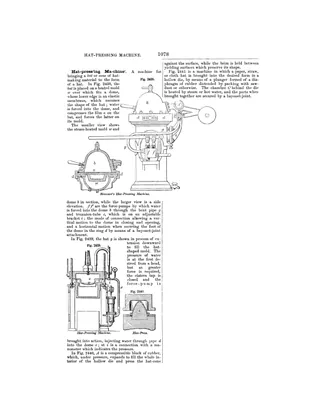
Hat-Pressing Machine
Article · 1 page
A one-page dictionary entry from Knight's American Mechanical Dictionary describing machines that press a hat bat or cone into hat form. It explains Simonet's machine, in which water pressure forces a rubber membrane dome over a steam-heated mold, and variants using a rubber block or a sawdust-packed rubber diaphragm. Engravings (Figs. 2438-2441) show sectional and side views.
Hats
Article · 1 page
An 18th-century encyclopedia entry on hats. It describes the making of felt hats from beaver fur and other animal hair: bowing, felting, fulling, blocking, singeing, dyeing, stiffening and finishing. It briefly notes the hat trade in England and the plaiting of women's hats from chip, straw or cane, and the weaving of hats from horse-hair and silk.
Hats and Caps
Article · 3 pages
A three-page encyclopedia article on the hat and cap industry in the United States around 1906. It surveys materials (rabbit and hare fur, wool, cloth, straw) and centers such as Danbury, Connecticut, then describes step by step how fur felt hats are made by machine and how silk hats are built from shellacked cambric covered with silk plush.
[Hats]
Article · 2 pages
Two pages of dictionary entries on hat-making terms and machinery, excerpted from Knight's American Mechanical Dictionary. Entries define hat blocks, hat-bodies, brushing, planking, stiffening and perforating machines, hat-measuring devices, ventilators, napping, and tools like the rounding-gage. A short entry describes preparing Tuscan straw for straw hats, and another defines sennit (plaited straw).
Hat
Rees's Cyclopedia, 1819
Article · 3 pages
Excerpt from Rees's Cyclopedia (1819) on hats. It describes how beaver felt hats were made: preparing the fur, bowing, basoning, fulling, blocking, dyeing, stiffening and finishing. It also summarizes British laws on hat retailing, duties and exports, and notes briefly that women's hats were made from various materials and that the hat was a symbol of the cardinalate.
Hat
Article · 3 pages
Encyclopedia article on the hat covering its history from ancient Greek and Roman head coverings through medieval, Tudor, Stuart and nineteenth-century styles. It also describes hat manufacture, with an account of the early American hat trade and detailed processes for fur felt, wool felt, silk and straw hats. It closes with 1909 and 1913 US production values and two references for further reading.
Hat Making
Article · 2 pages
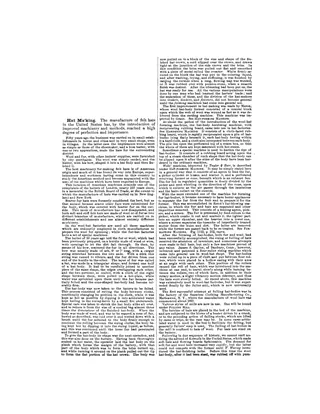
An encyclopedia entry on the manufacture of felt hats, focused on the United States. It contrasts the older hand methods (bowing fur or wool into bats, felting on the battery, blocking and finishing) with the machinery that replaced them: forming, hardening, fulling, finishing lathes, stretching, blocking, shaping and pouncing machines. It names inventors and companies, distinguishes wool-hat from fur-hat production, and ends with cross-references to other dictionary entries and to Scientific American articles.
Hat-Forming Machine
Article · 2 pages
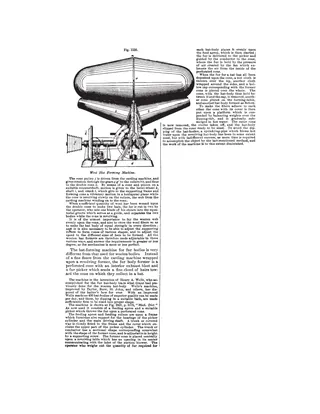
A two-page dictionary entry describing machines for forming hat-bodies from wool and fur. It explains the wool hat former, which winds a carded web onto a rotating double cone supported on conical rollers and vibrated by a crank, and the fur former, which uses a perforated cone with suction and a fur picker. It credits Mason, Grant and Henry A. Wells and describes the steps for consolidating the bodies in hot water. One engraving (Fig. 1326) shows the wool hat former.
Hat-Forming Machine
Article · 1 page
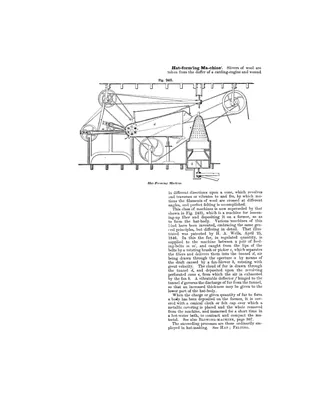
A single-page dictionary entry describing machines for forming hat bodies from wool or fur. It explains an older method of winding carded wool slivers onto a revolving cone, and the later machine patented by H. A. Wells in 1846, which uses feeding belts, a rotating picker, a fan-blower and a perforated cone to deposit fur. It then outlines how the formed body is covered and immersed in hot water to felt it. A cross-sectional diagram (Fig. 2431) is included.
Hat-Making Machinery
Article · 12 pages
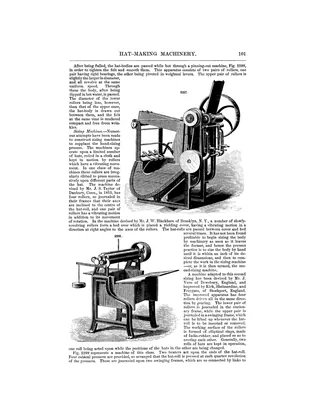
An 1889 encyclopedia article describing the machinery used in 19th-century American felt hat manufacture, covering both fur hats and wool hats. It follows the process from fur preparation and blowing, forming, hardening, sizing, fulling and stiffening through stretching, blocking, pouncing, ironing and finishing. Machines are illustrated with numbered engravings (Figs. 2295-2316), many credited to R. Eickemeyer of Yonkers, N.Y.
Hats
Article · 4 pages
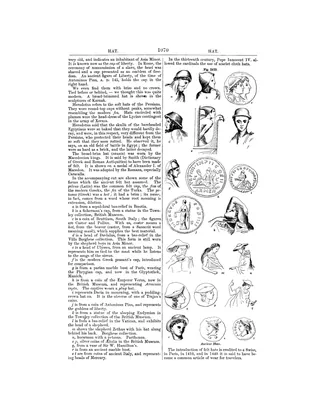
Encyclopedia entry on hats from Knight's American Mechanical Dictionary, covering the history of hats from antiquity (Greek, Persian, Roman forms, the Phrygian cap, the petasus) through the introduction of felt hats in medieval Europe. It describes hand and machine methods of making felt and fur hat bodies, including bowing, basoning, planking, the Wells perforated cone, and the finishing of silk plush hats. It also lists the parts of a hat, kinds of hats, and the preparation and plaiting of Panama straw, with illustrations of ancient hats, a hat diagram and a hat-blocking machine.
Chapeaux [Hats]
Article · 7 pages · French
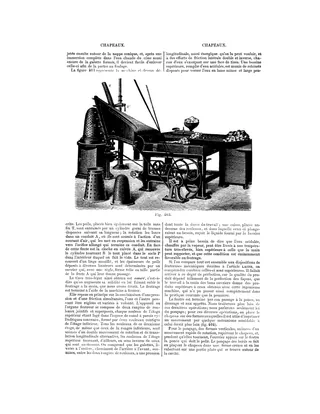
A French encyclopedia article on hat manufacture, covering felt hats in the most detail: fur and wool selection, secretage with mercury solutions, bowing with the arcon, basting, fulling, dyeing and finishing. It also describes an American machine that forms the felt body by air suction, mechanical felting machines, silk hats, collapsible (Gibus) hats, straw hats (Tuscan straw, Swiss and English production, Ludy's hydraulic finishing machine) and Panama hats. Illustrated with engravings of the fulling shop, bowing tool, felting machines and hat-finishing apparatus.
Hats and Their Manufacture
Article · 8 pages
An 1872 article on the history and manufacture of hats in the United States, from colonial protection and English restrictions on American hat exports through the post-Revolution trade. It describes hand felting (bowing) of fur and wool, silk plush hats, and straw, grass and palm-leaf hats and bonnets, including early women inventors such as Betsy Metcalf and Sophia Woodhouse. It also covers the introduction of felting machinery (Wells patent, 1846), census figures for hat production, and a closing argument that the tariff has damaged the export trade.
[Fashion plate of four women in tiered gowns, March 1844]
Godey's Lady's Book and Magazine, March 1844
Illustration · 1 page
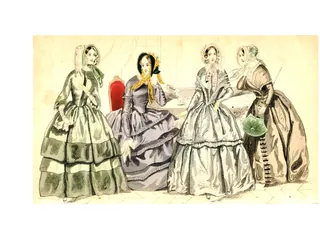
A single hand-colored fashion plate from Godey's Lady's Book and Magazine, March 1844. It shows four women in mid-19th-century dress, including a woman in a green tiered silk gown with a green bonnet and a seated woman in a lavender tiered gown with a yellow scarf. The page has no text and no weaving content; it is useful as a costume reference.
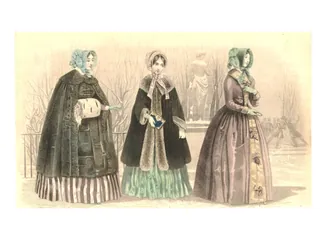
[Fashion plate of three women in winter dress, Godey's Lady's Book, December 1845]
Godey's Lady's Book and Magazine, December 1845
Illustration · 1 page
A single engraved fashion plate from Godey's Lady's Book and Magazine, December 1845, showing three women in mid-19th-century winter outerwear in a snowy outdoor scene with bare trees. Details include a dark cape with braided trim and a ribbon-trimmed bonnet. The page has no text beyond the image, so it is useful mainly as a costume reference.
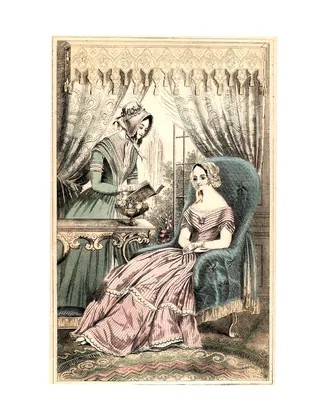
[Fashion plate of two women in an interior, June 1844]
Godey's Lady's Book and Magazine, June 1844
Illustration · 1 page
A single hand-colored engraved fashion plate from Godey's Lady's Book and Magazine, June 1844. It shows two women in an interior: a young woman in a flowered bonnet and green dress stands reading a book beside a flower-filled urn on a carved console table. The page carries no legible text, so the details of the costumes are known only from the image.
174 documents found